
Nov
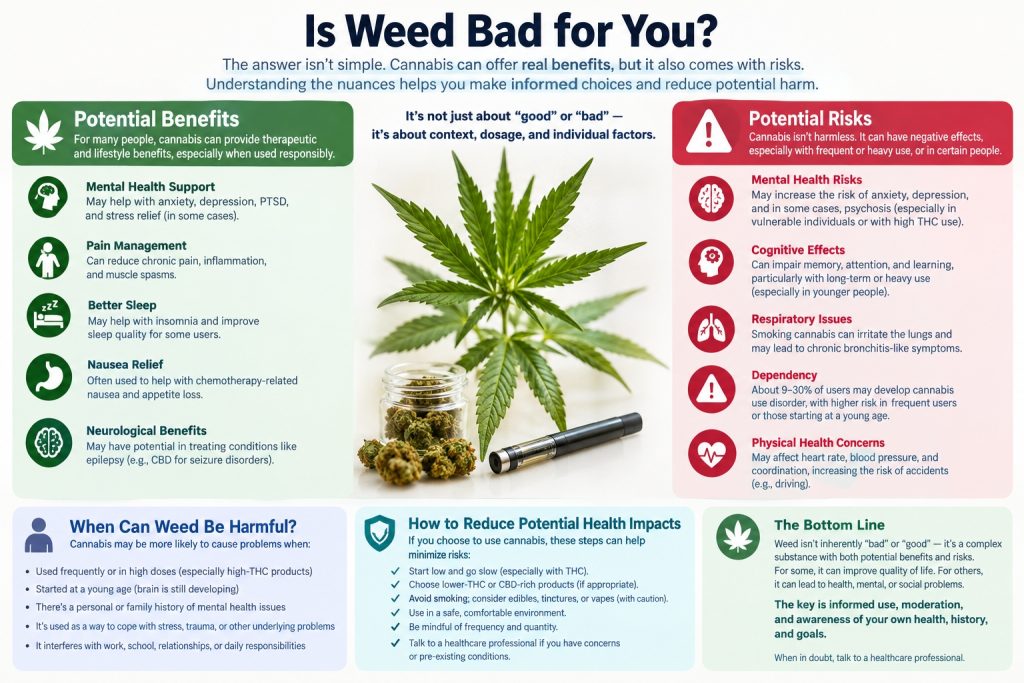
You can find two completely different versions of cannabis online. In one, it’s a harmless plant that helps people sleep, relax, and manage pain. In the other, it’s an addictive drug that damages your brain, lungs, and mental health. So, is weed bad for you, or has the argument become more dramatic than the evidence?
The honest answer sits in the uncomfortable middle. Cannabis isn’t harmless, but its risks aren’t identical for everyone. Your age, health history, frequency of use, THC dose, consumption method, and even the product’s labelling accuracy can change the equation. Using a low-dose edible once a month isn’t equivalent to inhaling a high-potency concentrate several times daily. Same plant family, very different exposure.
This review examines recreational and self-directed cannabis use, including smoking, vaping, edibles, concentrates, THC, and CBD. It doesn’t replace personalized medical care, and it isn’t an argument for prohibition or legalization. The goal is simpler: help you understand what research supports, where uncertainty remains, and how to reduce harm if you use cannabis.
A quick transparency note: Kush Station sells cannabis, so we have a stake in this topic, and this article doesn’t promote any product. Evidence comes primarily from public-health agencies and peer-reviewed medical research. Cannabis studies still face important limitations, illegal-market products vary, self-reported use can be unreliable, and associations don’t always prove causation, so confident-sounding absolutes deserve skepticism.
If you’re new to cannabis, don’t panic. If you’ve used it for years, don’t tune out. You’re not being graded here. Let’s sort through the risks without reefer-madness theatrics or wellness-influencer fog.
Key Takeaways
- Weed can be bad for you, especially with frequent high-THC use, adolescent initiation, or driving while impaired.
- Cannabis effects vary widely by dose, consumption method, product quality, and individual health factors.
- Short-term risks include impaired memory, coordination, panic, and anxiety, while long-term risks may involve addiction, psychosis, and cardiovascular issues.
- Smoking and vaping pose respiratory risks; edibles carry delayed effects and overdose potential, so caution with dosing is vital.
- Certain groups—teenagers, pregnant people, those with psychiatric or heart conditions—should avoid cannabis or seek clinical guidance.
- Harm reduction includes limiting THC dose, avoiding mixing substances, not driving impaired, choosing regulated products, and safe storage.
The short answer: is weed bad for you?
Yes, weed can be bad for you, particularly when you use high-THC products frequently, begin during adolescence, drive while impaired, smoke it regularly, or have certain psychiatric or cardiovascular risk factors. It can impair attention and coordination, trigger panic, contribute to cannabis use disorder, and cause recurrent vomiting in susceptible users.
But risk isn’t binary. Some adults use cannabis occasionally without developing obvious lasting problems, and specific cannabinoid medicines have legitimate clinical uses. That doesn’t make every dispensary product therapeutic, or safe.
A practical summary looks like this:
| Pattern or circumstance | General concern level |
|---|---|
| Infrequent, low-dose adult use | Lower, but not risk-free |
| Daily or near-daily high-THC use | Substantially higher |
| Use during adolescence or pregnancy | Best avoided |
| Driving after THC | Unsafe |
| Psychosis or serious heart history | Requires clinical guidance |
So, is weed bad for you personally? Your pattern of exposure and vulnerabilities matter more than the word “weed” alone.
What determines how cannabis affects your health?
Cannabis is a category, not a standardized substance. A 2.5-milligram THC mint, a joint, and an 80% THC vape cartridge can produce wildly different effects. Your response also depends on tolerance, metabolism, sleep, food intake, other substances, and emotional state.
Product regulation matters too. Legal-market testing may reduce, but cannot eliminate, the risk of pesticides, microbes, solvents, heavy metals, or inaccurate labels. Unregulated products offer fewer assurances.
THC versus CBD: potency, dose, and product quality
THC produces intoxication and is responsible for most acute impairment, panic, paranoia, and psychotic-like effects. Higher doses generally raise those risks. Modern concentrates such as wax, shatter, and some cartridges may contain 60% to 90% THC, far above many traditional cannabis flowers.
CBD doesn’t cause the same intoxicating high, but “non-intoxicating” isn’t synonymous with harmless. It can cause drowsiness, diarrhea, appetite changes, liver-enzyme abnormalities, and drug interactions. CBD product labels may also be inaccurate.
CBD might soften certain THC effects under particular conditions, but it isn’t a dependable emergency brake. Product ratios, timing, dose, and individual biology all matter.
Occasional versus daily use: frequency, age, and personal health history
Frequency changes cumulative exposure. Occasional use may still cause an accident or panic episode, but daily use is more strongly associated with dependence, cognitive difficulties, chronic bronchitis symptoms when smoked, and cannabinoid hyperemesis syndrome.
Age is crucial because the brain continues developing into the mid-20s. Earlier initiation, especially frequent adolescent use, correlates with worse educational, cognitive, and psychiatric outcomes, although family environment and other substance use can contribute.
Your history matters just as much. Risks rise if you have experienced psychosis, severe panic, substance addiction, heart disease, fainting, or medication interactions. “My friend handles it fine” is not medical evidence. Your friend may also eat gas-station sushi: individual tolerance proves very little.
What are the short-term effects of weed?
THC’s short-term effects can include relaxation, euphoria, altered sensory perception, increased appetite, dry mouth, red eyes, and a faster heart rate. Less pleasant possibilities include dizziness, nausea, confusion, anxiety, and loss of situational awareness.
Effects may begin within minutes after inhalation. Edibles commonly take 30 minutes to two hours, or occasionally longer, to feel noticeable and can remain impairing for many hours. That delay is where the classic “this brownie isn’t working” mistake begins.
Impaired memory, attention, coordination, and driving ability
Cannabis can temporarily impair reaction time, divided attention, short-term memory, judgment, and motor coordination. You may feel cautious while still missing hazards or responding too slowly.
According to Health Canada’s guidance on cannabis and impairment, THC can affect skills required for safe driving. Combining cannabis with alcohol generally produces greater impairment than either alone.
There’s no universally reliable waiting period because dose, tolerance, and product type differ. If you feel high, slowed, drowsy, dizzy, or mentally fuzzy, don’t drive, cycle in traffic, operate machinery, or supervise activities where delayed reactions could hurt someone.
Anxiety, panic, paranoia, and acute psychotic symptoms
High THC doses can turn “I feel relaxed” into “Why is my heart performing a drum solo?” Panic may bring racing thoughts, chest tightness, trembling, and fear of dying. Paranoia can make neutral events feel threatening.
Some users experience hallucinations, delusions, severe agitation, or disorganized thinking. These symptoms often resolve as intoxication fades, but they can require urgent care and may reveal an underlying vulnerability.
Move to a quiet setting, avoid taking more, and stay with a calm, sober person. Seek immediate help for dangerous behaviour, inability to recognize reality, severe chest pain, collapse, seizure, or thoughts of self-harm. Don’t dismiss alarming symptoms as “just weed.”
What are the long-term health risks of cannabis?
Long-term cannabis research is complicated. People use different products at different doses, and frequent users may also smoke tobacco, drink alcohol, or have preexisting health conditions. Meanwhile, potency has changed faster than many long-running studies can track.
Even so, several concerns consistently deserve attention. Risk tends to concentrate among younger users and people using high-THC cannabis frequently over months or years.
Brain health, learning, and memory: what may persist and what remains uncertain
Heavy cannabis use can interfere with learning, attention, processing speed, and memory while you’re using and during early abstinence. Teenagers may be more vulnerable because their brains are still developing.
Whether cannabis causes permanent cognitive decline in adults remains unsettled. Some studies find lingering deficits after abstinence; others find that differences shrink after days or weeks or are partly explained by earlier vulnerabilities. The Canadian Centre on Substance Use and Addiction’s review of regular use and cognitive functioning found that many measurable effects disappear after sustained periods of not using cannabis, though not all of them.
A useful self-test: take a sustained break and track sleep, attention, motivation, and recall. Improvement doesn’t prove permanent damage, but it can reveal whether your routine has been costing more than you noticed.
Psychosis, schizophrenia, depression, and anxiety: associations versus causation
Frequent cannabis use, particularly high-potency use, is associated with a higher risk of psychotic disorders. The relationship is strongest among people who start young, use often, or already have genetic or personal vulnerability. Cannabis can also worsen symptoms or complicate recovery in someone with an established psychotic disorder.
Association isn’t the same as simple causation. People with emerging psychiatric symptoms may use cannabis to self-medicate, while shared genetics and social factors can affect both use and illness. Still, dose-response patterns and evidence that THC can provoke psychotic symptoms make the concern clinically meaningful.
Links with depression, anxiety, and suicide are less straightforward. Cannabis may temporarily relieve distress while gradually worsening avoidance, sleep quality, or motivation. If you need THC to face every uncomfortable emotion, it’s worth discussing the pattern, not judging it, with a clinician.
Heart attack, stroke, and cardiovascular concerns
THC can increase heart rate, alter blood pressure, and raise the heart’s oxygen demand. Observational studies have linked cannabis use with heart attack, stroke, and other cardiovascular events, although tobacco exposure and incomplete dose data make exact risk estimates difficult.
Heart & Stroke advises people at higher risk of heart disease and stroke to speak to their healthcare provider about cannabis, and warns that vape devices of all kinds are not without harm.
Risk deserves extra attention if you have coronary artery disease, arrhythmia, uncontrolled blood pressure, prior stroke, or unexplained fainting. Sudden chest pressure, one-sided weakness, difficulty speaking, severe breathlessness, or loss of consciousness is an emergency. Don’t wait for the high to wear off.
Lung irritation, chronic bronchitis, and what research says about cancer
Burning cannabis creates fine particles, carbon monoxide, tar, and many of the same irritants found in tobacco smoke. Regular smoking is associated with cough, wheezing, phlegm, and chronic bronchitis symptoms. Those symptoms may improve after quitting.
The cannabis–lung cancer relationship is less certain than the tobacco–cancer relationship. Studies struggle with relatively low lifetime exposure, tobacco co-use, and inconsistent measurement. “Not conclusively proven” does not mean smoke is lung-friendly.
Deep inhalation and breath-holding can increase deposited irritants without being necessary for intoxication. Water pipes cool smoke but don’t make combustion clean. If your lungs are already sensitive from asthma or chronic obstructive pulmonary disease, inhaled cannabis may aggravate symptoms.
Cannabinoid hyperemesis syndrome: recurrent nausea and vomiting
Cannabinoid hyperemesis syndrome, or CHS, causes repeated bouts of severe nausea, abdominal pain, and vomiting, usually after prolonged, frequent cannabis use. Hot showers may provide temporary relief, a distinctive clue, not a cure.
CHS is often missed because cannabis is also used for nausea. That creates a miserable loop: you feel sick, use more cannabis, briefly feel different, and then become sick again. Repeated vomiting can cause dehydration, electrolyte abnormalities, kidney injury, and rare life-threatening complications.
Emergency treatment may control a flare, but sustained cannabis cessation is the most reliable prevention. Get urgent help if you can’t keep fluids down, urinate very little, faint, vomit blood, develop confusion, or have intense abdominal pain.
Can you become addicted to weed?
Yes. Cannabis addiction is clinically called cannabis use disorder (CUD). Health Canada explains that some people who use cannabis develop difficulty controlling use despite meaningful harm.
Addiction doesn’t require using “hard drugs,” hitting rock bottom, or looking visibly impaired. If cannabis has quietly become the organizer of your evenings, social life, spending, and mood, that pattern counts, even if you still meet deadlines.
Signs of cannabis use disorder and who is most at risk
Warning signs include:
- Using more or longer than intended
- Repeated unsuccessful attempts to cut back
- Craving or spending substantial time obtaining and using cannabis
- Neglecting work, school, relationships, or hobbies
- Continuing despite anxiety, memory problems, conflict, or physical symptoms
- Driving or taking other risks while impaired
- Developing tolerance or withdrawal
Risk is higher with early initiation, daily use, high-THC products, and a personal or family history of addiction or mental illness.
Try a blunt question, pun reluctantly accepted: Can you comfortably stop for a month? Difficulty doing so doesn’t diagnose CUD by itself, but it supplies useful information.
Withdrawal, recovery after quitting, and where to get support
Cannabis withdrawal can include irritability, anxiety, restlessness, reduced appetite, low mood, headaches, vivid dreams, and insomnia. Symptoms often begin within a day or two, peak during the first week, and improve over one to several weeks. Sleep changes can linger longer.
Make quitting easier by removing products and paraphernalia, planning evening activities, exercising earlier in the day, and telling someone you trust. A clinician can assess coexisting anxiety, ADHD, depression, or sleep problems that may be driving use.
Behavioural treatments such as cognitive behavioural therapy, motivational enhancement, and contingency management can help. In Canada, Health Canada’s Get help with substance use page lists free national and provincial services, including Drug Rehab Services (1-877-254-3348) for confidential referrals. If you have suicidal thoughts or an immediate crisis, call 911 or call or text 9-8-8, the Suicide Crisis Helpline.
Smoking, vaping, or edibles: how do the risks differ?
No route is risk-free: each shifts the type of risk. Smoking creates combustion toxins. Vaping can expose you to concentrated THC and contaminants. Edibles avoid smoke but make delayed overconsumption more likely.
| Method | Main advantage | Main concerns |
|---|---|---|
| Smoking | Fast onset, easier dose adjustment | Smoke, bronchitis symptoms, secondhand exposure |
| Vaping | Fast onset, less odour | High potency, device or additive contamination, lung injury |
| Edibles | No inhaled smoke | Delayed onset, long duration, accidental ingestion |
| Concentrates | Small volume | Extremely high THC, rapid tolerance, severe intoxication |
Smoking and vaping: smoke exposure, contaminants, and lung injury
Smoking cannabis exposes your airways and nearby people to combustion by-products. Vaping avoids combustion, but “no smoke” doesn’t mean “just water vapour.” Aerosols may contain metals, solvents, flavouring chemicals, pesticides, or thermal breakdown products.
The 2019 US EVALI outbreak of serious lung injuries was strongly linked to vitamin E acetate in illicit THC vaping products. Regulation has improved in some markets, but counterfeit cartridges remain a concern. Avoid informal products, modified devices, and oils not designed for inhalation.
New cough, chest pain, shortness of breath, fever, or low oxygen after vaping requires prompt medical assessment. Your lungs aren’t a product-testing laboratory, despite the packaging’s soothing mountain logo.
Edibles and concentrates: delayed effects, high THC, and overconsumption
Edibles are easy to underestimate. Someone eats 10 milligrams, feels nothing after 40 minutes, takes another 20, and discovers three hours later that time has become soup. The experience can be frightening and prolonged.
If you’re inexperienced, public-health advice commonly favours starting with 2.5 milligrams THC or less and waiting at least two hours before considering more; full effects can take up to four hours. Don’t rely on a friend’s dose because tolerance varies enormously.
Concentrates can deliver very large THC doses quickly, increasing the chances of panic, vomiting, tolerance, and dependence. Homemade edibles add another problem: uneven distribution. One corner of the brownie may not equal the next.
Who should avoid cannabis or discuss it with a clinician first?
Some people face higher-than-average risks even at doses others tolerate. Medical guidance is particularly important when cannabis might interact with brain development, pregnancy, cardiovascular disease, psychiatric vulnerability, or prescription drugs.
Honest disclosure helps. Clinicians need the product type, approximate THC or CBD dose, frequency, and reason you use it, not a rehearsed confession delivered under courtroom lighting.
Teenagers, young adults, and people with a personal or family history of psychosis
Teenagers should avoid cannabis because earlier and heavier use is associated with poorer cognitive, educational, and mental-health outcomes. Delaying initiation reduces exposure during a vulnerable developmental period. In Canada, the legal age is 19 in most provinces and territories, 18 in Alberta and 21 in Quebec.
Young adults should also be cautious, particularly with daily use and high-THC products. If you or a close relative has schizophrenia, another psychotic disorder, or unexplained episodes of paranoia and hallucinations, avoiding THC is the safest approach.
Watch for declining grades, secrecy, lost interest in activities, sleep reversal, suspiciousness, or rapid personality changes. Those signs aren’t proof of cannabis harm, but they deserve a calm conversation and professional assessment, not a dramatic bedroom raid that turns the family into a low-budget crime show.
People who are pregnant, breastfeeding, or planning pregnancy
THC crosses the placenta and can enter breast milk. Health Canada and major medical organizations, including the Society of Obstetricians and Gynaecologists of Canada, recommend avoiding cannabis during pregnancy and lactation because safety hasn’t been established and prenatal exposure may affect development.
That includes smoked, vaped, edible, and “natural” products. CBD isn’t proven safe during pregnancy either. Smoking also exposes you and the fetus to carbon monoxide and other combustion products.
If you use cannabis for morning sickness, pain, anxiety, or sleep, tell your prenatal clinician. The point is to find a better-studied option, not punish you. Don’t stop an essential prescribed treatment or replace it with cannabis without medical advice.
Older adults, people with heart disease, and anyone taking interacting medications
Older adults may be more susceptible to dizziness, confusion, low blood pressure, falls, and medication interactions. THC can also complicate memory concerns; CBD can affect liver enzymes involved in drug metabolism.
Possible interactions include sedatives, alcohol, blood thinners, anti-seizure drugs, and some heart or psychiatric medications. CBD can significantly alter levels of certain medicines, while combined sedating effects may make driving or walking unsafe.
If you have heart disease, arrhythmia, stroke history, kidney or liver disease, or take multiple prescriptions, bring the exact package to a pharmacist or clinician. “CBD gummies, blue bottle” isn’t enough. A photo of the ingredient panel and certificate of analysis is far more useful.
Does cannabis have medical benefits? Supported uses versus self-medication
Cannabinoids do have supported medical applications, but evidence varies by condition and formulation. In Canada, Health Canada has approved purified CBD (Epidiolex) for specific seizure disorders and the synthetic THC-related medicine nabilone (Cesamet) for severe nausea and vomiting associated with cancer therapy. Dronabinol is approved in the US but is no longer marketed in Canada.
Evidence also supports modest benefits from some cannabinoid products for chronic pain, multiple-sclerosis spasticity symptoms, and chemotherapy-induced nausea. The size of benefit is often smaller than advertising implies, while dizziness, sedation, and cognitive side effects remain relevant.
Self-medication is murkier. Dispensary flower isn’t equivalent to a Health Canada-approved medicine with standardized dosing. Cannabis may help you fall asleep yet reduce sleep quality or create tolerance. It may blunt anxiety tonight while reinforcing avoidance tomorrow.
Ask four questions before treating a symptom yourself:
- Has the underlying cause been evaluated?
- Is there evidence for this product and dose?
- Could it interact with your medication?
- How will you measure whether it actually helps?
Keep a two-week symptom diary. Track dose, benefit, side effects, sleep, and functioning. “I felt something” is not the same as a useful clinical result.
Is weed safer than alcohol or tobacco? Why the comparison depends on the harm
Cannabis probably causes fewer overdose deaths and less organ toxicity than alcohol, and smoked tobacco has a far clearer, larger relationship with cancer, lung disease, and premature death. But “safer overall” can conceal risks that matter in a particular moment.
| Harm being compared | Important distinction |
|---|---|
| Fatal poisoning | Cannabis alone is far less likely to cause fatal respiratory poisoning than opioids or alcohol |
| Lung damage | Any regularly inhaled smoke is harmful; tobacco’s long-term evidence is much stronger |
| Driving | Both cannabis and alcohol impair driving; combining them is worse |
| Dependence | All three can produce addiction, though patterns and severity differ |
| Psychosis | High-THC cannabis has a distinct psychiatric concern for vulnerable users |
| Violence and acute disinhibition | Alcohol generally presents the greater population-level burden |
The useful question isn’t “Which drug wins?” It’s “Which harm are you trying to prevent?” Replacing nightly heavy drinking with cannabis might reduce one set of risks while introducing dependence, impaired driving, or psychiatric symptoms. Using both usually compounds rather than cancels harm.
How to reduce harm if you choose to use cannabis
Abstinence prevents cannabis-related harm most reliably, but people deserve practical guidance even when abstinence isn’t their choice. Harm reduction isn’t approval; it’s the seat belt of health advice.
Set boundaries before you’re intoxicated. Decide the dose, location, transportation plan, and stopping time while your judgment is intact. If the plan depends on “seeing how things go,” things have already started going.
Avoid high-THC products, mixing substances, impaired driving, and unsafe storage
To lower risk:
- Choose lower-THC products and avoid concentrates.
- Use less often and schedule cannabis-free days.
- Don’t mix cannabis with alcohol, opioids, benzodiazepines, or other sedatives.
- Never drive or ride with an impaired driver.
- Avoid inhaling deeply or holding smoke.
- Use regulated, clearly labelled products.
- Don’t share vape devices during respiratory illness outbreaks.
- Store products locked, labelled, and out of sight of children and pets.
Edibles should never resemble ordinary candy in a shared kitchen. Keep them in child-resistant packaging, not a sandwich bag beside the actual brownies. If a child or pet consumes cannabis, contact a poison centre or veterinary care immediately.
Can you overdose on weed? Warning signs and when to seek emergency help
A fatal overdose from THC alone appears extremely unlikely, but you can take enough to experience severe toxicity. Symptoms may include repeated vomiting, extreme confusion, panic, hallucinations, inability to walk, dangerously abnormal heart rate, or loss of responsiveness. Children can become profoundly sedated and may need hospital monitoring.
Call 911 for:
- Chest pain, trouble breathing, seizure, or collapse
- Stroke-like symptoms
- Severe agitation, psychosis, or suicidal behaviour
- Unresponsiveness or inability to stay awake
- Persistent vomiting with dehydration
- Any significant exposure in a young child
In Canada, call your poison centre at 1-844-POISON-X (1-844-764-7669), or 1-800-463-5060 in Quebec, for immediate guidance. Don’t induce vomiting. Keep the packaging so clinicians can identify the likely dose and ingredients.
Frequently asked questions about weed and health
Simple questions about cannabis often have annoyingly conditional answers. That isn’t evasion; it reflects the difference between individual episodes and cumulative risk. Dose, product, age, and context can turn the same routine from relatively low concern into a genuine problem.
Is smoking weed once a week bad for you?
Once-weekly smoking is generally lower risk than daily smoking, but it isn’t harmless. Each session can impair driving, trigger anxiety, aggravate asthma, expose your lungs to smoke, or become dangerous when combined with alcohol. A “weekly” edible containing 5 milligrams THC also differs sharply from a weekly session involving several high-potency joints.
Ask what happens around the use. Are you driving afterward? Do you lose the next morning to brain fog? Has once weekly quietly become Friday-through-Sunday? If not, and you’re a healthy adult using a low dose in a safe setting, your overall risk is likely lower, but never zero.
Is CBD harmless, and can it counteract THC?
CBD isn’t intoxicating like THC, yet it can cause sedation, gastrointestinal symptoms, appetite changes, liver effects, and medication interactions. Product contamination and inaccurate labels add uncertainty. Health Canada’s review of cannabidiol notes that many safety questions remain unresolved.
CBD may reduce some THC-induced anxiety or psychotic-like effects at certain doses and ratios, but findings are inconsistent. Many commercial products contain too little CBD to make a predictable difference. Taking CBD after consuming too much THC shouldn’t replace observation or medical care. If symptoms are severe, get help rather than trying to chemistry-set your way out of them.
What the evidence can—and cannot—tell us: sources and research limitations
Cannabis evidence is improving, but it has blind spots. Randomized trials can evaluate short-term therapeutic effects, yet deliberately assigning people to years of heavy use would be unethical. Researchers hence rely heavily on observational studies, which can identify patterns but struggle to separate cannabis from tobacco, alcohol, poverty, trauma, genetics, and preexisting symptoms.
Other limitations include:
- Changing THC potency and product formats
- Inaccurate self-reported dose and frequency
- Differences between legal and illegal markets
- Underrepresentation of older adults and pregnant people
- Limited data on concentrates and newer cannabinoids such as delta-8 THC
- Publication bias and inconsistent definitions of “regular use”
That means headlines claiming cannabis either “destroys your brain” or “cures everything” outrun the science. Stronger conclusions exist for acute impairment, driving risk, chronic bronchitis symptoms, cannabis use disorder, CHS, and psychosis associations than for many claimed benefits or long-term outcomes.
So, is weed bad for you? It can be, sometimes seriously, but the size and type of harm depend on who you are, what you use, how much, and how often. If you’re a teenager, pregnant, vulnerable to psychosis, living with heart disease, or taking interacting medication, avoidance or clinical guidance is the smart move. If you choose to use, keep THC low, frequency limited, driving off the table, and products locked away.
Most importantly, notice what cannabis does to your actual life. If your sleep, memory, mood, money, relationships, or motivation improve when you stop, that’s valuable evidence too. You don’t need a dramatic crisis to reconsider a habit, just enough curiosity to test whether life feels clearer without it.