
Nov
You took one more edible because the first “wasn’t working.” Or the vape hit harder than expected. Now your heart seems determined to win a drum solo, time feels oddly elastic, and you’re searching for how to sober up from weed, preferably five minutes ago.
First, the reassuring part: an uncomplicated cannabis high generally improves with time and supportive care. Most adults don’t need medical treatment. But cannabis can cause intense anxiety, vomiting, confusion, poor coordination, and a rapid heart rate. High-potency concentrates, synthetic cannabinoids, accidental childhood exposures, and products containing unknown ingredients raise the stakes.
This guide covers what you can safely do while THC’s effects wear off, what popular “sobering” tricks don’t accomplish, how long different products may affect you, and when symptoms call for urgent help. It cannot diagnose your condition or guarantee that a product contained only cannabis. If something feels seriously wrong, don’t write it off as just being high.
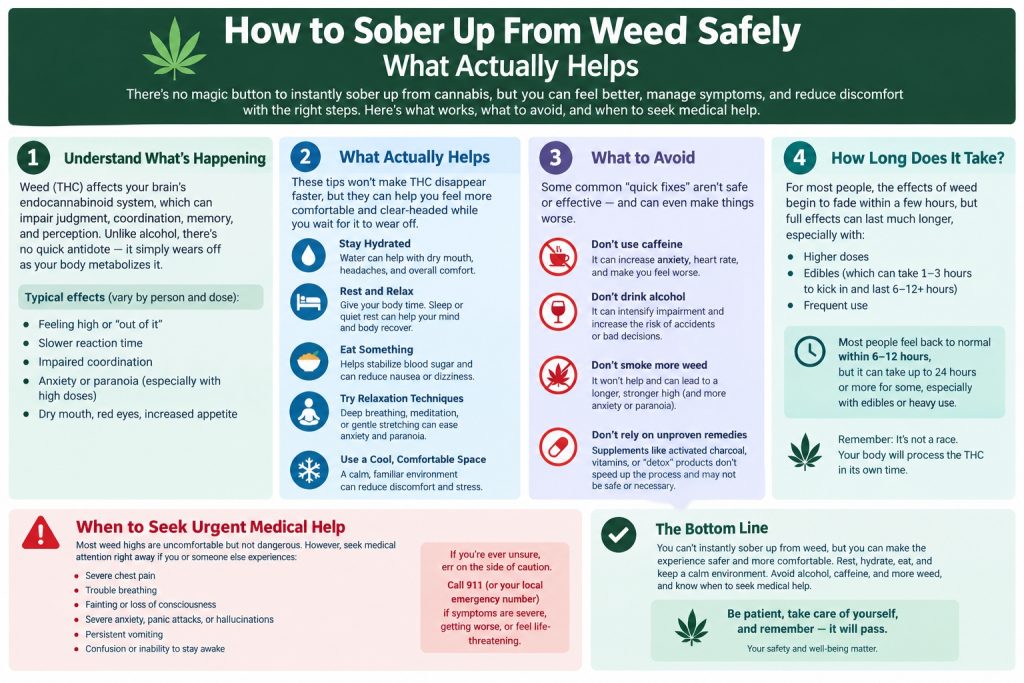
The short version? Stop consuming cannabis, move to a calm and safe place, stay with a sober person, and give your body time. Don’t drive, don’t mix in alcohol or sedatives, and don’t attempt a punishing workout or an ice-cold shower. You’re trying to reduce risk, not audition for an action movie.
If you’re currently panicking, plant both feet on the floor. Breathe out slowly. Read the emergency section first, then take the rest one small step at a time.
Key Takeaways
- To sober up from weed safely, stop consumption immediately, move to a calm and secure environment, stay hydrated with small sips, and rest while your body processes THC.
- There is no instant cure to reverse a cannabis high; popular remedies like coffee, cold showers, or exercise do not speed up sobriety and may increase risks.
- Recognize emergency symptoms such as chest pain, seizures, severe confusion, or difficulty breathing and seek immediate medical help without delay.
- Edibles have delayed and longer-lasting effects compared to smoking or vaping, so avoid redosing before initial effects fully appear to prevent overconsumption.
- Never drive or engage in safety-sensitive activities until you are certain all cannabis effects, including residual impairment, have fully subsided.
- If frequent bad reactions or dependency concerns arise, consult healthcare professionals for support instead of continuing cannabis use without guidance.
Check for an Emergency Before Trying to Manage a High
Before looking for home remedies, check whether you or the affected person needs medical help. Cannabis can produce frightening but temporary sensations: unfortunately, serious conditions can look similar. Chest pain might be anxiety, for example, but you can’t safely prove that from the couch.
Call for help sooner if the person is very young or older, pregnant, has heart or lung disease, took an unknown substance, or mixed cannabis with alcohol, opioids, benzodiazepines, stimulants, or other drugs. Synthetic cannabinoids sold under names such as Spice or K2 are especially unpredictable and are not equivalent to ordinary cannabis.
When speaking to a dispatcher or clinician, be honest about the product, estimated amount, timing, and other substances involved. That information helps treatment: it isn’t the moment to protect the reputation of somebody’s homemade brownie.
Call Emergency Services for Trouble Breathing, Chest Pain, Seizures, or Unresponsiveness
Call 911, or your local emergency number, if someone has:
- Trouble breathing, blue or grey lips, or slow/irregular breathing
- Chest pain, collapse, a seizure, or severe weakness
- Lost consciousness or cannot be awakened normally
- Extreme confusion, violent agitation, hallucinations, or unsafe behaviour
- Repeated vomiting with inability to keep fluids down
- A serious fall, head injury, or possible aspiration
- Symptoms suggesting an opioid exposure, such as pinpoint pupils and slowed breathing
Put an unresponsive but breathing person on their side if you can do so safely. Keep the airway clear and follow the dispatcher’s instructions. If they aren’t breathing normally, begin CPR if trained and use naloxone when opioid contamination or co-use is possible. Naloxone won’t reverse THC, but it can reverse an opioid overdose and generally won’t harm someone who has no opioids in their system.
Don’t leave the person alone, force them to walk, or place them in a shower. And don’t let fear of embarrassment delay the call.
Contact a Poison Centre for Accidental Ingestion, Unknown Products, or Any Child Exposure
In Canada, call your local poison centre at 1-844-POISON-X (1-844-764-7669), or 1-800-463-5060 in Quebec. The service is free and available around the clock. Call immediately for any child exposure, even if the child currently looks fine, because edible effects can be delayed and more severe in a small body.
A poison centre is also appropriate when:
- You don’t know how much was consumed
- The label is missing, unreliable, or lists unfamiliar ingredients
- A pet, older adult, or pregnant person was exposed
- Someone swallowed concentrated oil or a large edible dose
- You’re unsure whether symptoms can be monitored at home
Keep the packaging nearby. Don’t induce vomiting or give food, charcoal, medicine, or “detox” products unless a professional directs you. For pets, contact a veterinarian or animal poison service rather than a human poison centre.
How to Sober Up From Weed: What Helps While You Wait
If there are no emergency warning signs, the goal isn’t to forcibly remove THC from your body. You can’t flip an internal off-switch. Instead, reduce stimulation, prevent injury, manage discomfort, and wait for your body to metabolize the drug.
A simple plan works better than collecting twelve internet hacks:
- Stop taking cannabis and other intoxicants.
- Settle somewhere familiar, quiet, and physically safe.
- Tell a trusted sober person what you took.
- Sip, not chug, water if you’re fully alert.
- Rest and reassess symptoms periodically.
Stop Using Cannabis: There Is No Reliable Instant Reversal for a THC High
Put the vape, joint, gummy bag, or infused drink away. Don’t take another dose to “balance” the first, and don’t add alcohol, sleeping pills, anti-anxiety medication, or someone else’s prescription. Mixing substances can worsen sedation, vomiting, poor judgment, and breathing problems.
THC has already entered your bloodstream once effects begin. No food, beverage, shower, or supplement reliably neutralizes it on demand. Treatment in a medical setting is generally supportive too: clinicians monitor vital signs, address severe symptoms, and rule out more dangerous causes.
Write down what you used, how much, and when. If the package says 10 milligrams of THC per serving but contains ten servings, check whether you ate one piece or the entire package. That detail can explain why an evening took an unexpected turn, and helps a poison centre advise you accurately.
Move Somewhere Quiet and Use Slow Breathing or Grounding for Anxiety
Bright lights, loud music, crowds, and endless doom-scrolling can feed paranoia. Move to a quiet room with a comfortable temperature. Sit or lie down away from stairs, balconies, traffic, pools, stoves, and other hazards.
Try breathing gently through your nose for four seconds and out for six. The exact count isn’t magic: the longer, unforced exhale can help settle panic. If counting makes you more anxious, use the 5-4-3-2-1 grounding exercise: identify five things you see, four you feel, three you hear, two you smell, and one you taste.
Say what’s happening plainly: “I consumed THC. This feeling is uncomfortable, but it will change. I’m in a safe room with someone I trust.” Avoid arguing with paranoid thoughts. Redirect attention to a familiar show, calm playlist, or ordinary conversation instead.
Sip Water and Try a Light Snack if You Can Swallow Comfortably
Cannabis often causes dry mouth, and anxiety can make it feel dramatic. If you’re awake, oriented, and swallowing normally, take small sips of water or an electrolyte drink. You don’t need litres. Excess water can cause dangerous electrolyte disturbances and won’t clear THC faster.
A light snack, toast, crackers, banana, yogurt, or soup, may feel grounding and can help if you haven’t eaten. It does not chemically cancel the high. Skip food and drinks if you’re extremely drowsy, repeatedly vomiting, choking, or having difficulty swallowing.
If nausea is mild, sit upright and take slow sips. Persistent vomiting, severe abdominal pain, confusion, very dark urine, or inability to retain fluids warrants medical advice. Recurrent bouts of intense vomiting in frequent cannabis users may indicate cannabinoid hyperemesis syndrome, which needs clinical evaluation rather than another home remedy.
Ask a Trusted Sober Person to Stay With You and Rest Somewhere Safe
A calm sitter can do what your temporarily altered judgment may not: keep you away from the car keys, notice worsening symptoms, and remind you that ten minutes has not, in fact, lasted three years.
Tell them the product, dose, time taken, and any medications or other substances involved. Ask them to check that you remain responsive and breathe normally. Keep your phone charged and product packaging accessible.
Rest in a bed or on a couch where you can’t fall. If you’re nauseated or very sleepy, lie on your side rather than flat on your back. Don’t lock yourself in a bathroom, soak in a bathtub, cook, or wander outside alone. A sober adult should remain nearby until symptoms clearly improve. If responsiveness declines or breathing becomes abnormal, they should call emergency services immediately.
Signs You Are Too High: Common Symptoms of Greening Out
“Greening out” isn’t a medical diagnosis. It’s slang for an unpleasant cannabis reaction, often after a high dose or after cannabis and alcohol are combined. The experience varies, but common signs include:
- Intense anxiety, panic, dread, or paranoia
- Racing thoughts, confusion, or distorted time perception
- Rapid heartbeat or heightened awareness of your pulse
- Dizziness, shakiness, sweating, or pale skin
- Nausea, vomiting, or abdominal discomfort
- Dry mouth and red eyes
- Poor balance, delayed reactions, and slurred or disorganized speech
- Heavy limbs, sleepiness, or difficulty focusing
- Unusual sensory experiences or, at high doses, hallucinations
These symptoms can feel enormous from inside the high. Panic may amplify normal sensations: you notice your heartbeat, become frightened, and then adrenaline makes it beat faster. Still, don’t automatically blame every symptom on THC. New chest pain, fainting, one-sided weakness, breathing trouble, seizure activity, or inability to wake requires emergency evaluation.
Keep in mind that severe agitation, overheating, muscle rigidity, or dramatic hallucinations may point to synthetic cannabinoids, contamination, another drug, or a separate health emergency. When the reaction doesn’t match what was supposedly taken, treat the uncertainty seriously.
How Long Does It Take to Sober Up From Weed?
There’s no universal countdown because route, dose, product accuracy, tolerance, metabolism, and other substances all matter. “Feeling high” and “being fully unimpaired” aren’t identical either. You may feel calmer while reaction time, attention, or coordination remains affected.
Here’s a practical, not guaranteed, comparison:
| Product route | Effects may begin | Strongest effects often occur | Noticeable effects may last |
|---|---|---|---|
| Smoking or vaping | Seconds to minutes | Roughly 10–30 minutes | Commonly 2–4 hours: impairment may persist longer |
| Edibles | About 30 minutes–2 hours | Often 2–4 hours | Commonly 6–12 hours: sometimes longer |
| THC drinks | About 15 minutes–2 hours | Product-dependent | Several hours, potentially longer with high doses |
These ranges are broad. If symptoms are severe, don’t use the table as a reason to wait out a possible emergency.
Smoking and Vaping: Typical Onset, Peak Effects, and Recovery Time
Inhaled THC reaches the bloodstream quickly, so effects may appear within seconds or minutes. That faster feedback makes dose adjustment easier than with an edible, but potent flower, concentrates, and deep repeated inhalations can still overshoot your comfort zone quickly.
The most noticeable effects often peak within roughly half an hour and decline over the next few hours. Some people experience residual fogginess, anxiety, fatigue, or slowed reactions beyond the obvious high, particularly after concentrated products or repeated use.
Don’t calculate driving time from when you feel normal. The clock starts with the last use, and impairment differs among people. If you took repeated hits over an hour, you didn’t consume one neat, isolated dose. Give yourself a wide safety margin, avoid safety-sensitive tasks, and arrange a ride rather than trying to prove you’re fine.
Edibles and THC Drinks: Delayed Peaks and Longer-Lasting Effects
Edibles are behind many accidental overconsumption stories because their effects arrive late. Someone eats 10 milligrams, waits 35 minutes, declares the gummy defective, and eats two more. Then all three doses turn up together, fashionably late and deeply unwelcome.
Effects may take 30 minutes to two hours to begin and can continue intensifying for several hours. A full stomach, product formulation, and individual digestion alter the timing. When swallowed, THC is processed by the liver into 11-hydroxy-THC, an active metabolite that can produce strong, long-lasting effects.
THC beverages may act faster than traditional brownies or gummies, especially when formulated as emulsions, but labels and responses vary. Large edible doses can affect you for 12 hours or more, with next-day grogginess possible. Once you’ve consumed too much, stop redosing and prepare to wait safely.
Why Dose, Potency, Tolerance, Medications, and Other Substances Change the Timeline
A “small” brownie tells you nothing unless you know its THC content and serving size. Legal-market labels help, but mislabelled, homemade, illicit, or delta-8 products may be inconsistent. Concentrates can deliver far more THC than lower-potency flower.
Your response also depends on:
- Tolerance: Frequent users may feel fewer effects at a dose that overwhelms a beginner, though tolerance doesn’t guarantee safety.
- Body and metabolism: Digestion, liver metabolism, age, and health conditions influence duration.
- Food: Meals can change edible absorption and timing.
- Medications: Sedatives and some other medicines may increase adverse effects or interact unpredictably.
- Alcohol and drugs: Co-use can intensify impairment, nausea, sedation, or anxiety.
Anxiety and an unfamiliar setting can make the experience feel worse without necessarily changing THC clearance. Conversely, feeling relaxed doesn’t mean your coordination has recovered. Use symptoms as one clue, not as a precise sobriety meter.
What Does Not Reliably Sober You Up Faster?
When you’re uncomfortable, almost any confident internet remedy sounds plausible. Most tricks change how alert, distracted, or refreshed you feel: they don’t rapidly reverse THC’s effects or restore driving ability.
That distinction matters. If coffee makes you feel sharper, you may become more confident while still impaired, not an ideal upgrade. Avoid stacking unproven remedies, supplements, and medications. Simple supportive care is usually safer.
Coffee, Cold Showers, and Exercise Do Not Reverse THC Impairment
Caffeine may reduce sleepiness, but it doesn’t neutralize THC. It can also worsen a racing heart, trembling, stomach upset, or panic. If you’re already listening to your pulse like it’s a true-crime podcast, espresso probably isn’t your friend.
A cool washcloth may feel soothing. An ice-cold shower, but, can trigger dizziness, panic, falls, or abrupt cardiovascular stress. Never put a confused or heavily sedated person in a bath or shower.
Exercise doesn’t provide an immediate reset either. Running while dizzy or poorly coordinated adds risks from traffic, overheating, dehydration, and falls. THC is fat-soluble, but you cannot meaningfully “sweat it out” during one workout. Stay seated or take only gentle movement in a secure room if you’re steady. Save the heroic cardio session for a sober day.
Black Pepper, Lemon, and CBD: Limited Evidence, Uncertain Benefits, and Potential Risks
You may hear that sniffing black pepper, chewing peppercorns, drinking lemon juice, or taking CBD will end a high. These ideas are often linked to aromatic cannabis compounds called terpenes or theories about CBD modifying THC’s effects. Human evidence for using these tactics as a reliable acute antidote is limited.
Smelling ordinary black pepper or lemon may offer a familiar sensory focus, but don’t force peppercorns into the mouth of someone who is drowsy or nauseated: choking is a real risk. Concentrated essential oils can irritate tissue and shouldn’t be swallowed.
CBD is not a dependable rescue treatment. Products vary in purity and dose, can cause drowsiness, and may interact with medications. Some contain additional THC even though their branding. Adding another cannabinoid while you’re already distressed can complicate the picture. Grounding, supervision, and time remain the safer plan.
Detox Drinks and Excess Water Do Not Quickly Flush Out THC
THC and its metabolites aren’t sitting in your stomach waiting to be rinsed away. Your body must distribute and metabolize them over time. Detox teas, niacin, vinegar, cranberry juice, activated charcoal, and commercial cleansing drinks do not reliably end an active high.
Some products contain stimulants, laxatives, diuretics, or undisclosed ingredients that can create new problems. Drinking excessive water can dangerously dilute blood sodium, causing headache, confusion, vomiting, seizures, and, in severe cases, death.
Hydrate normally: small, comfortable sips when thirsty. Don’t induce vomiting, especially after an edible. By the time effects are apparent, vomiting is unlikely to remove a predictable amount, and it introduces choking and aspiration risks. If a potentially dangerous quantity was swallowed, call a poison centre (1-844-POISON-X) rather than improvising a kitchen-counter detox.
Still Feeling High the Next Day? Lingering Effects and When to Seek Advice
Next-day fogginess can occur after a large edible dose, late-night use, poor sleep, or mixing substances. You might feel tired, detached, anxious, mildly dizzy, or slower than usual. Don’t drive or operate machinery while those effects remain. Eat normally, hydrate sensibly, rest, and avoid taking more cannabis to “smooth it out.”
Contact a healthcare professional or a poison centre if effects are unexpectedly intense, aren’t steadily improving, or interfere with basic tasks. Seek urgent care for persistent vomiting, dehydration, severe panic, significant confusion, fainting, hallucinations, or a fast/irregular heartbeat that doesn’t settle. Emergency warning signs still warrant 911.
Some people experience derealization, the world feels unreal, or depersonalization, a disturbing sense of separation from themselves. These sensations often pass, but persistent symptoms deserve medical or mental health evaluation. Sleep deprivation and repeatedly checking whether you still feel strange can amplify them.
If you use cannabis frequently and wake with recurrent nausea relieved by hot showers, ask about cannabinoid hyperemesis syndrome. Hot bathing may temporarily ease symptoms but doesn’t treat dehydration or resolve the underlying pattern: stopping cannabis and obtaining medical guidance are important.
When Is It Safe to Drive or Work? Feeling Better Does Not Prove You Are Unimpaired
Don’t drive, cycle in traffic, operate machinery, cook over an open flame, work at heights, or perform safety-sensitive duties while high or experiencing residual effects. Cannabis can affect reaction time, attention, tracking, coordination, and decision-making, even after the obvious euphoria or panic fades.
There’s no home test, breathing trick, or universal hour count that proves you’re fit to drive. THC blood or saliva levels also don’t map neatly onto impairment in the way alcohol concentration is often interpreted. Even so, Canada’s Criminal Code makes it an offence to have 2 ng or more of THC per mL of blood within two hours of driving, police can use roadside oral fluid screeners, and a medical authorization for cannabis doesn’t exempt you from impaired-driving laws.
Use a sober driver, taxi, or rideshare, or stay where you are. If you consumed a high-dose edible at night and wake up foggy, call out, work remotely if permitted, or arrange transportation. That may feel inconvenient: a crash is rather more inconvenient.
For pilots, commercial drivers, healthcare workers, construction crews, and others in regulated roles, workplace policies may be stricter and testing windows much longer than the felt high. Follow your employer’s fitness-for-duty and substance policies rather than relying on subjective confidence.
How to Help Someone Who Is Too High
Your calm presence is useful. Move the person to a quiet, hazard-free setting and introduce yourself if they seem confused. Speak in short sentences: “You’re safe. I’m staying with you. You took cannabis, and we’re going to monitor you.”
Find out what they consumed, how much, and when. Check for alcohol, medications, or other drugs without lecturing. Save the container. Keep children, crowds, cameras, and teasing friends away: filming someone’s panic is cruel and can intensify paranoia.
Offer Reassurance, Monitor Responsiveness, and Do Not Induce Vomiting
Encourage slow breathing and small sips only if the person is fully awake and can swallow. Don’t restrain them unless necessary to prevent immediate harm, and don’t give coffee, sedatives, CBD, or medication unless a clinician instructs you.
Check periodically that they:
- Respond normally when spoken to
- Breathe regularly without struggling
- Aren’t developing chest pain, seizures, severe agitation, or repeated vomiting
- Can remain in a safe position without falling
If sleepy and nauseated, place them on their side and stay nearby. Never induce vomiting: choking or inhaling vomit can be more dangerous than the cannabis itself. If they become unresponsive, have abnormal breathing, or display another emergency sign, call 911. If you’re uncertain but the situation isn’t immediately life-threatening, contact a poison centre for individualized advice.
How to Avoid Getting Too High Again
A rough high doesn’t mean you “failed” at cannabis. Usually, the dose, timing, product, setting, or drug combination exceeded what your body handled comfortably. Treat the episode as useful data, not a challenge to build tolerance.
Write down what happened while details are fresh: product name, labelled potency, amount, meal timing, other substances, and when symptoms began. If the product was unregulated or behaved very differently from its label, don’t use it again.
Choose Lower-THC Products, Check Serving Sizes, and Avoid Redosing Before Effects Develop
For adults who legally choose cannabis, lower-THC products are easier to dose than concentrates or high-potency edibles. Read both THC per serving and THC per package. One chocolate bar may look like one serving while its label says otherwise.
With edibles, begin with a low dose and wait long enough for the full effect before considering more. Health Canada’s guidance emphasizes starting low and going slow, with edibles that contain 2.5 milligrams of THC or less: beginners can still find 5 milligrams of THC uncomfortable. Don’t copy a friend’s dose, their tolerance isn’t transferable.
Use measured, regulated products where legal rather than homemade treats with uneven THC distribution. Choose a familiar setting, avoid using when already panicked, and plan transportation before consuming. If your previous reaction involved severe symptoms, discuss future use with a healthcare professional, or decide that repeating the experiment simply isn’t worth it.
Avoid Mixing Cannabis With Alcohol or Other Drugs and Store Products Securely
Alcohol and cannabis can intensify dizziness, nausea, sedation, and poor judgment. Combining cannabis with opioids, benzodiazepines, sleep medicines, or other sedating drugs may further impair you. Stimulants can add cardiovascular strain or anxiety. Ask a pharmacist or prescriber about interactions with your medications.
Store cannabis locked, out of sight, and separate from ordinary food. Keep it in original, child-resistant packaging rather than a candy jar or zip-top bag. Clearly label homemade products. Children may need hospital care after eating THC gummies that look identical to familiar sweets: pets are vulnerable too.
Dispose of unwanted products according to local guidance. Don’t leave infused cookies on the counter at a gathering without warning guests. A discreet label isn’t enough when the brownie tray looks like fair game, use a separate locked location and tell responsible adults exactly what it contains.
When Repeated Bad Highs or Difficulty Cutting Back Call for Professional Support
Repeated panic, vomiting, paranoia, missed obligations, or risky behaviour deserves attention. So does wanting to reduce cannabis but repeatedly using more than planned. Other warning signs include needing increasing amounts, spending substantial time obtaining or recovering from cannabis, continuing even though relationship problems, and experiencing irritability, insomnia, appetite changes, or restlessness when stopping.
A primary care clinician, addiction-medicine specialist, or therapist can help without turning the conversation into a morality play. Treatment may include motivational interviewing, cognitive behavioural therapy, contingency management, sleep support, and care for anxiety, depression, trauma, or pain that cannabis was masking.
In Canada, Health Canada’s Get help with substance use page lists free, confidential help, including Drug Rehab Services at 1-877-254-3348 for treatment referrals. If you’re in emotional crisis or thinking about harming yourself, call or text 9-8-8, the Suicide Crisis Helpline.
Try one concrete step today: remove products from immediate reach, tell someone you trust, or schedule a medical appointment. You don’t have to wait until cannabis has dismantled your life to ask for support.
Frequently Asked Questions
Quick questions tend to appear when the room has stopped spinning but uncertainty hasn’t. These answers cover the most common concerns: individual risk still depends on the product, dose, symptoms, health history, and other substances.
Can You Sober Up From Weed in 10 Minutes?
Not reliably. You may calm down within ten minutes by moving somewhere quiet, slowing your breathing, and receiving reassurance, but that doesn’t mean THC impairment has ended. Inhaled cannabis commonly affects you for hours, while edibles may last much longer.
Be skeptical of anyone promising an instant reversal through coffee, pepper, lemon, a shower, exercise, or a detox drink. Supportive steps can make the experience more tolerable: time does the metabolic work. If symptoms worsen during those ten minutes, especially chest pain, breathing difficulty, seizure activity, or declining responsiveness, seek emergency help rather than waiting for a home remedy to kick in.
Is It Safe to Sleep When You Are Too High?
Sleep may be reasonable for an otherwise healthy adult with mild, improving symptoms who is breathing normally, can be awakened, has not mixed sedating substances, and has a sober person nearby. Use a safe bed or couch, and lie on your side if nausea is present.
It is not safe to simply “let someone sleep it off” when they’re difficult to wake, breathing abnormally, repeatedly vomiting, injured, or potentially exposed to opioids or unknown drugs. Call emergency services. Likewise, contact a poison centre for a child exposure instead of putting the child to bed and hoping for improvement.
Don’t use alcohol, benzodiazepines, opioids, antihistamines, or sleeping pills to force sleep unless a clinician specifically directs you.
Does Feeling Sober Mean THC Is Out of Your System or Undetectable on a Drug Test?
No. The noticeable high can end while THC metabolites remain detectable. Detection depends on the specimen type, test sensitivity, dose, and pattern of use. Urine tests may detect metabolites for days and, in frequent users, potentially weeks. Blood and oral-fluid windows differ: hair testing can reflect a much longer period.
A negative or positive result also isn’t a direct measure of current impairment. Don’t use how sober you feel to predict a workplace, legal, or clinical test. Commercial “cleanse” products can’t guarantee a negative result, and excessive dilution may be unsafe or flagged by testing procedures.
If testing affects employment, probation, or medical treatment, obtain guidance from the relevant qualified professional and review the actual policy. Online calculators can offer estimates, not certainty.
Medical Sources and Evidence Behind These Recommendations
These recommendations reflect harm-reduction and poisoning guidance from established public-health and medical organizations. Useful references include:
- Health Canada’s health effects of cannabis page for health effects, impairment, and higher-risk use.
- Health Canada’s cannabis poisonings in children page and the 1-844-POISON-X poison centre line for exposure response and individualized assistance in Canada.
- Health Canada’s information for health care professionals on cannabis and cannabinoids for effects, dependence, and current research.
- Health Canada’s Get help with substance use page for substance-use care and support.
- Health Canada’s cannabis impairment page and Justice Canada’s drug-impaired driving FAQ for road-safety considerations.
Evidence gaps remain. Cannabis products vary enormously, controlled studies can’t reproduce every real-world dose or combination, and blood THC levels don’t provide a simple impairment threshold. Claims that black pepper, lemon, CBD, coffee, or detox products can reliably reverse an acute high are not supported by strong clinical evidence.
So, how to sober up from weed comes down to an unglamorous but safer answer: stop consuming it, reduce stimulation, stay supervised, hydrate normally, avoid driving, and allow time to pass. Escalate quickly when symptoms suggest something more serious. If this keeps happening, changing the dose, or stepping away from cannabis altogether, isn’t overreacting. It’s listening to what your body has already told you.