
Blog 2026
Live Resin vs Distillate: Which One Should You Choose?
Oct
Open a dispensary menu and you’ll probably find two vape cartridges sitting side by side: one labelled live resin, the other distillate. The live resin cart may promise fresh, strain-specific flavour, while the distillate cart advertises 90% THC and costs $15 less. Which one belongs in your basket?
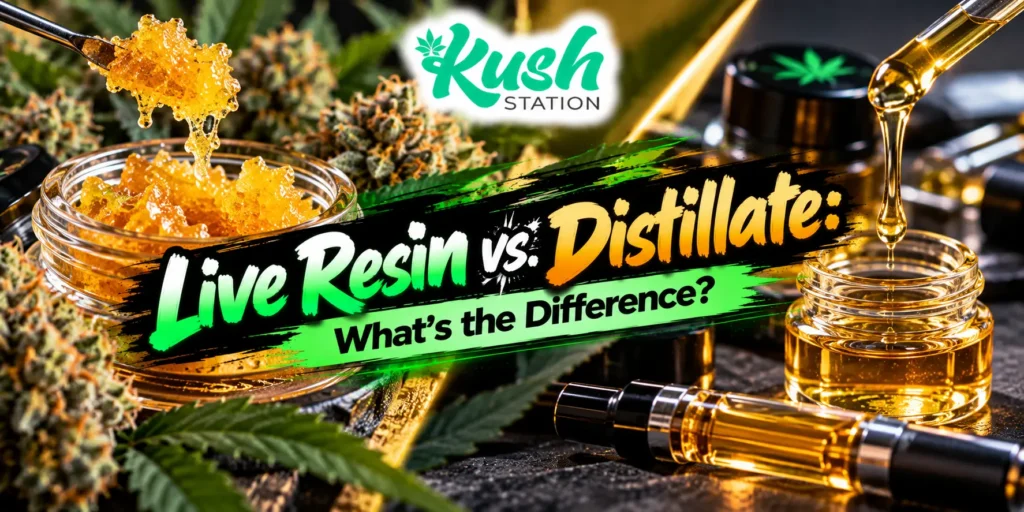
The short version of live resin vs distillate is preservation versus refinement. Live resin begins with freshly harvested cannabis frozen shortly after cutting, helping preserve volatile aromatic compounds that can disappear during drying and curing. Distillate is an extract refined to isolate and concentrate selected cannabinoids, usually THC or CBD, while removing much of the source plant’s original aroma and flavour.
That doesn’t make live resin universally better, nor does it mean distillate is cheap, flavourless, or low quality. A well-formulated distillate cartridge can have a deliberate cannabinoid ratio and an excellent terpene blend. A badly stored “live resin” cart can taste like scorched lawn clippings. Labels tell you the processing category: they don’t tell you everything about the finished product.
This review compares the extracts themselves and the cartridges commonly made from them. You’ll learn how production affects flavour, potency, perceived effects, price, hardware performance, and safety. We’ll also decode certificates of analysis (COAs), because the batch report is usually more revealing than the glamorous strain name on the box.
Cannabis affects everyone differently, and inhalation carries risks. Buy only from age-restricted sellers that share batch test results, check the legal age in your province or territory, and talk with a qualified clinician if you take medication, are pregnant or breastfeeding, or have cardiovascular, respiratory, or psychiatric concerns. Start low, avoid driving, and don’t treat THC percentage like a high score. Your lungs are not an arcade game.
Key Takeaways
- Live resin preserves fresh-frozen cannabis compounds, offering authentic, strain-specific flavour and a broader terpene and cannabinoid profile.
- Distillate is a refined concentrate featuring high cannabinoid potency, consistent formulation, discreet aroma, and generally lower cost than live resin.
- Neither live resin nor distillate is inherently stronger or safer; evaluate batch-specific certificates of analysis and ingredient transparency for safety and quality.
- Live resin is favoured by flavour chasers and experienced users seeking nuanced effects, while distillate suits value shoppers and those needing predictable, discreet consumption.
- Proper device settings and consumption habits significantly impact flavour, effects, and cartridge longevity regardless of extract type.
- Always purchase from sellers that share batch test results, verify lab testing, and dose cautiously to ensure a safe and enjoyable experience with live resin or distillate products.
Live resin vs distillate: Quick answer + side-by-side comparison
Live resin usually wins for plant-forward flavour and a broader, strain-associated chemical profile. Distillate usually wins for high cannabinoid concentration, formulation consistency, discreet aroma, and lower cost. Neither is automatically stronger, safer, or better.
If you miss the citrus peel, pine, fuel, or berry character of flower, live resin is the more natural starting point. If you want predictable THC delivery, a customized flavour, or a budget-friendly cartridge that doesn’t make the hallway smell like a dispensary, distillate may suit you better.
Comparison table (source material, extraction, cannabinoids, terpenes, flavour, effects, price, ideal users)
| Feature | Live resin | Distillate |
|---|---|---|
| Source material | Freshly harvested, rapidly frozen cannabis | Cannabis or hemp extract: input may come from dried flower, trim, or biomass |
| Processing goal | Preserve native compounds | Refine and concentrate selected cannabinoids |
| Extraction | Usually cold hydrocarbon extraction, followed by solvent removal | Initial extraction, cleanup, decarboxylation, and molecular or short-path distillation |
| Cannabinoids | THC-rich, but often retains more minor cannabinoids | Frequently very high in THC or CBD: ratios can be precisely formulated |
| Terpenes | More native, cultivar-associated terpenes | Most native terpenes are removed: terpenes may be added afterward |
| Flavour | Cannabis-forward and often “strain-true” | Neutral without flavouring: customizable when terpenes are added |
| Effects | Can feel more nuanced, though responses vary | Often described as direct or generic, depending on formulation |
| Typical retail price | Usually toward the top of the roughly $20–$50 CAD range for a 0.5–1 g cart | Usually toward the lower end of the roughly $20–$50 CAD range for a 0.5–1 g cart |
| Ideal users | Flavour chasers and experienced consumers seeking cultivar character | Value shoppers, discreet users, and people wanting consistent formulation |
Prices swing widely by province, taxes, brand, cartridge size, and promotions. Compare equal weights and check whether “live resin” describes the whole oil or merely a small ingredient blended into distillate.
What is live resin?
Live resin is a cannabis concentrate made from plant material frozen soon after harvest instead of being conventionally dried and cured first. The word live refers to the condition of the source material, not living organisms in the cartridge and not a guarantee that the product is fresher on the shelf.
Freezing slows the loss and transformation of volatile compounds. That matters because conventional post-harvest handling can change a plant’s aromatic profile before extraction even begins. The finished concentrate may be sold as sauce, badder, diamonds with sauce, or oil formulated for a vape cartridge.
You should still read the ingredient list carefully. “Live resin,” “live sauce,” and “live terpenes” aren’t always used consistently across jurisdictions. Some cartridges contain full live resin: others combine distillate with live-resin-derived terpenes.
How live resin is made (fresh-frozen input, extraction basics)
Harvested branches are typically trimmed and rapidly frozen, sometimes near -40°C (-40°F) or below, then kept cold through transport and processing. Producers commonly use chilled butane, propane, or a blend to dissolve cannabinoids and aromatic compounds. Closed-loop equipment recaptures the solvent, and controlled heat and vacuum remove residual solvent from the extract.
Cold processing helps limit terpene loss and unwanted plant components, but “cold” doesn’t mean zero heat at every stage. Cartridge oil may need further separation, decarboxylation, or formulation so it flows through small intake holes and vaporizes reliably.
This is professional laboratory work, not a kitchen experiment. Hydrocarbon solvents are highly flammable, and amateur extraction can cause explosions or leave unsafe residue. Buy lab-tested products with batch results rather than trying a social-media tutorial. Some DIY trends deserve to stay unwatched.
Typical cannabinoid/terpene profile and why it tastes more “strain-true”
Live resin commonly contains abundant THC plus measurable minor cannabinoids and a richer terpene profile than highly refined distillate. Depending on genetics and processing, dominant terpenes might include myrcene, limonene, beta-caryophyllene, pinene, or linalool.
Those compounds create recognizable notes, mango-like fruit, lemon rind, black pepper, pine needles, lavender, damp soil, or diesel. Because more of them originate in the harvested cultivar, the result can resemble the source flower more closely. Think fresh orange zest versus orange candy: both are recognizable, but one has more irregular, botanical detail.
“Strain-true” remains an approximation. Growing conditions, harvest timing, freezing speed, extraction parameters, storage, and vape temperature all alter the final profile. Strain names also aren’t chemically standardized. A terpene panel is more informative than assuming every product called Blue Dream will smell or feel identical.
What is cannabis distillate?
Cannabis distillate is a highly refined oil in which one or more cannabinoids have been concentrated and separated from much of the original extract. THC distillate is common in vape cartridges, gummies, tinctures, and capsules: CBD and other cannabinoid distillates also exist.
Distillate describes a processing method, not the plant’s original condition or one particular form of THC. It can be produced from high-THC cannabis or from hemp, and in Canada both fall under the Cannabis Act. Always check whether the formula contains delta-9 THC, delta-8 THC, CBD, THCV, or another cannabinoid instead of assuming the front label tells the whole story.
Its near-neutral base is useful to manufacturers. They can build a repeatable formula without every batch carrying the same strong botanical fingerprint as its source material.
How distillate is made (winterization, distillation, refinement)
Production starts with a crude cannabis extract. During winterization, the oil is mixed with alcohol and chilled so waxes, fats, and lipids can be filtered out. The alcohol is recovered, and the cleaned oil is commonly decarboxylated, converting acidic cannabinoids such as THCA into neutral forms such as THC.
Short-path or wiped-film distillation then uses controlled heat and vacuum to separate compounds according to volatility and boiling behaviour. Vacuum allows separation at lower temperatures than would otherwise be needed. A cannabinoid-rich fraction is collected while many pigments, odours, waxes, and other components are left behind.
Manufacturers may repeat refinement to improve purity. Yet clear, pale oil isn’t proof of safety or excellence. Process conditions, starting material, contaminant controls, formulation, storage, and testing matter more than whether the oil looks Instagram-ready.
Why distillate is often high-THC and how terpenes get added back
Distillation concentrates a target fraction, so THC distillate commonly reaches cannabinoid percentages higher than those of live resin. Exact figures vary, but licensed products frequently list roughly 80%–95% THC. That number reflects concentration, not craftsmanship, flavour, or the intensity every person will experience.
Most native aromatic compounds don’t survive the full refinement process in their original proportions. Manufacturers can hence add cannabis-derived terpenes, botanical terpenes from non-cannabis sources, or proprietary blends afterward. They may also add CBD, CBG, CBN, or other cannabinoids to create a specified ratio.
This flexibility is distillate’s quiet superpower. A quality producer can make a balanced, flavourful formula with excellent consistency. The downside is that vague labels such as “natural flavours” may hide what was added. Look for a complete ingredient list and batch-specific terpene data where available.
Potency & perceived strength: which hits harder?
On paper, distillate often wins the potency contest because it generally contains a higher concentration of THC. In practice, live resin vs distillate potency isn’t settled by one percentage.
Suppose Cart A contains 90% THC distillate and Cart B contains 75% THC live resin. A three-second puff from A doesn’t necessarily deliver exactly 20% more THC. Battery voltage, coil resistance, airflow, oil viscosity, puff duration, and the efficiency of the hardware affect aerosol output. So does your ability to stop after one puff when the flavour is suspiciously good.
Higher THC can also produce more anxiety, dizziness, rapid heart rate, or impairment, particularly for inexperienced consumers. “Hits harder” isn’t always a benefit.
THC % vs real-world effects (dose, tolerance, entourage, device settings)
Your actual dose is the amount absorbed, not the concentration printed on the package. A long pull at high voltage may deliver more aerosol than a short sip at low voltage. Frequent consumers may notice little from a dose that overwhelms someone with low tolerance.
The broader chemical profile may influence perceived effects, often discussed as the entourage effect. This is a plausible and actively researched concept, but marketing claims frequently run ahead of human evidence. Terpenes aren’t reliable prescriptions for sleep, focus, or anxiety, and a strain name can’t guarantee an outcome.
For a new cartridge, take one short puff at the lowest compatible setting, then wait at least 10–15 minutes before deciding whether to take another. Avoid stacking rapid hits because “nothing happened yet.” That sentence has launched many regrettable evenings.
What to look for on a COA beyond THC (minor cannabinoids, terpene panel)
A certificate of analysis should match the product’s batch or lot number. Beyond total THC, examine:
- Cannabinoid identity: delta-9 THC, THCA, CBD, CBG, CBN, and any intoxicating minor cannabinoids.
- Units: percentages and milligrams per gram aren’t interchangeable at a glance: 1% equals approximately 10 mg/g.
- Terpene panel: dominant compounds and total terpene concentration, if tested.
- Testing date and lab: recent, batch-specific results are more useful than a generic sample report.
- Contaminant results: not merely potency figures on a one-page marketing certificate.
Be cautious if the QR code leads only to a homepage, the batch numbers don’t match, or the report appears cropped. A legitimate COA should identify the laboratory, method, sample, dates, and pass/fail limits required by that jurisdiction.
Effects: live resin vs distillate for energy, relaxation, and functional use
Neither extract category guarantees energy, relaxation, creativity, or sleep. Your dose, tolerance, setting, expectations, cannabinoid mix, and individual biology all influence the experience. Even the same cartridge can feel different on a rested Saturday afternoon than after a stressful twelve-hour shift.
For functional use, lower dosing matters more than a “sativa” label. Too much THC can impair attention, reaction time, short-term memory, and coordination regardless of cheerful packaging. Never drive or operate machinery after using an intoxicating cannabis product.
If you’re tracking outcomes, record the product, batch, dose, time, food intake, and effects. After a few sessions, your notes will be more useful than broad strain folklore, and less likely to insist that every purple package causes sleep.
Why distillate effects can feel more “generic” (formulation-dependent)
THC-dominant distillate with few minor cannabinoids and a simple terpene blend may feel direct: rapid intoxication without much of the sensory complexity associated with flower. Consumers sometimes call that experience flat, one-note, or generic.
But this is not an inherent defect. Distillate is a blank canvas. A manufacturer can add several cannabinoids and a sophisticated terpene profile, while another can sell nearly pure THC with artificial-tasting fruit flavour. Those products shouldn’t be judged as twins merely because both use distillate.
That consistency can be helpful. If you want a predictable formula and don’t care about preserving a cultivar’s identity, distillate makes sense. Just don’t equate “indica,” “sativa,” or “sleep” on the box with clinical certainty. Read the actual formulation and dose conservatively.
Why live resin effects can feel more “strain-like” (terpene-forward profiles)
Live resin retains more of the source plant’s aromatic architecture and often more minor compounds. Alongside the familiar smell and taste, that broader profile may make the experience feel closer to vaporized flower. Many users describe clearer differences among cultivars than they notice with basic distillate carts.
Perception also plays a role. Aroma shapes expectation, and expectation can shape subjective experience. A sharp citrus-and-pine profile may feel bright or alerting, while earthy, floral aromas may suggest relaxation. That doesn’t mean the effect is imaginary: it means sensory context and pharmacology are intertwined.
Choose by measured composition and your own response rather than strain mythology alone. If one product consistently leaves you calm at a modest dose, that repeated personal result is more actionable than a budtender promising “creative cosmic focus.”
Flavour & aroma: terpenes, additives, and what to expect
Flavour is where the live resin vs distillate difference is easiest to notice. Live resin commonly smells unmistakably like cannabis, herbal, skunky, fruity, peppery, or fuel-like. Distillate itself is comparatively neutral, allowing added flavours to take centre stage.
That can make live resin less discreet. A vapour cloud may fade faster than smoke, but it can still leave a recognizable aroma in a room or car. Distillate flavoured like mint or berry may be less obvious, although it is never odourless and shouldn’t be used where vaping is prohibited.
A harsh or burnt flavour isn’t normal “extra potency.” It may signal excessive voltage, a dry coil, degraded oil, incompatible hardware, or contamination. Stop using a cartridge that tastes metallic, chemically strange, or persistently scorched.
Cannabis-derived vs botanical terpenes (taste differences and sensitivities)
Cannabis-derived terpenes are collected from cannabis and can reproduce its layered aroma more convincingly. Botanical terpenes are chemically identical compounds obtained from sources such as citrus, lavender, or pine. They’re often cheaper, scalable, and useful for profiles like watermelon candy or icy mint.
Source alone doesn’t determine quality. Purity, concentration, storage, and formulation matter. An overly concentrated blend can sting your throat or taste like perfume, even if every terpene came from cannabis. Some users also report irritation or sensitivity to particular flavour blends.
If your throat feels unusually raw, reduce temperature and stop using the product if symptoms persist. Wheezing, chest pain, or difficulty breathing warrants prompt medical attention. “Natural” is not a safety guarantee: poison ivy is natural too, and nobody’s putting that in a cart, hopefully.
Temperature/device impact on flavour (burnt taste, terpene volatility)
Terpenes are volatile, and excessive heat can flatten delicate flavour while increasing harshness and altering aerosol chemistry. Research on cannabis vaping indicates that device conditions and formulation affect emissions. Hotter is not automatically better.
For a standard 510 cartridge, begin around 2.2–2.8 volts if the manufacturer permits variable voltage. Thick oils or particular ceramic systems may need different settings, so follow product guidance rather than forcing a universal number. Take gentle two- or three-second draws and allow time between puffs so the wick can resaturate.
If flavour becomes burnt:
- Lower the voltage.
- Let the cartridge rest upright.
- Check that intake holes contain oil.
- Avoid repeated “blinkers” or chain vaping.
- Replace the cart if the burnt taste remains.
Once cotton or oil is scorched, wishful thinking won’t un-toast it.
Safety & quality: how to shop smart (especially for carts)
Neither live resin nor distillate is automatically safer. The extract name says little about pesticides, residual solvents, metals, microbes, formulation hygiene, or hardware quality. A distillate cart with complete testing is a smarter purchase than an untested “premium live resin” cart from an anonymous seller.
The 2019 vaping-associated lung illness outbreak (called EVALI in the US and VALI in Canada) made this painfully clear. US investigators linked most cases to THC vaping products from informal sources, and vitamin E acetate was strongly associated with the outbreak there. No single cause was identified in Canadian cases, and Canada’s public health guidance warns against vaping products with no control or oversight and against adding substances to vape liquids. The lesson isn’t that every tested cartridge is risk-free: it’s that provenance and ingredients matter.
Purchase sealed products from sellers that share batch COAs, verify the batch, and keep packaging in case you need to report a problem. Avoid altered or counterfeit cartridges, even when the logo looks convincing.
Ingredient red flags (cutting agents, vague “flavourings,” mystery blends)
A short ingredient list is easier to evaluate: cannabis extract, identified cannabinoids, and clearly described terpenes. Be wary of:
- Vitamin E acetate
- Medium-chain triglyceride (MCT) oil intended as a vape diluent
- Mineral oil or essential oils
- Vague “proprietary blend” language with no useful disclosure
- Cannabinoids not shown on the COA
- Packaging that mimics candy or a famous brand without licensing information
Terms such as liquid diamonds, sauce, and ultra-premium are marketing, not laboratory methods. Ask what percentage of the oil is genuinely live resin if the label says “live resin infused.”
And don’t refill a disposable or thin thick oil with random additives. Oil must be formulated for its specific delivery system. MacGyver was talented: he was not conducting inhalation toxicology.
Hardware and oil compatibility (viscosity, clogging, metals, cotton/ceramic)
Cartridge hardware must match the oil’s viscosity. Thick formulations can starve a small intake port, causing dry hits, while overly thin oils may leak through the airway. Live resin’s composition can vary more between batches: distillate formulas can be easier to standardize, although either can clog.
Ceramic heating elements are popular for viscous oils and flavour, while some cartridges use cotton wicks or metal components. No material label guarantees flawless performance. Look for reputable manufacturers that test assembled devices for metals and emissions, not only bulk oil before it enters the cartridge.
Store carts upright at moderate room temperature, away from sunlight and hot vehicles. If clogged, warm the cart gently in your hands and use the device’s preheat function briefly. Don’t attack the airway with an open flame or hair dryer. That’s how a tiny inconvenience becomes a very silly insurance claim.
Lab testing checklist (pesticides, residual solvents, heavy metals, mycotoxins)
A useful batch COA should address the contaminants required by your jurisdiction. Check for:
- Pesticides: especially failures above local action limits.
- Residual solvents: including butane, propane, ethanol, or processing solvents, where applicable.
- Heavy metals: commonly lead, cadmium, arsenic, and mercury.
- Microbials and mycotoxins: such as Aspergillus-related testing and aflatoxins where mandated.
- Potency and cannabinoid identity: including unexpected synthetic or converted cannabinoids.
Testing rules vary by jurisdiction, and a “pass” means the sample met that program’s limits, not that inhalation is harmless. Ideally, cartridge makers also conduct stability and hardware-leach testing on the finished device.
Confirm the report comes from an accredited independent lab and matches the batch. If a seller becomes defensive when you ask for test results, you’ve received useful information… just not the kind they intended.
Price, value, and longevity: which is more cost-effective?
Distillate is generally the cheaper option per gram because manufacturers can process large quantities and standardize the output. Live resin commands a premium because of cold-chain handling, cultivar-specific material, lower practical yields, and more demanding storage and processing.
Still, sticker price doesn’t equal value. Compare the amount of oil, cannabinoid content, hardware, test results, and how you actually consume it. A $25 one-gram cart that leaks halfway through is worse value than a reliable $40 cart. Likewise, paying extra for live resin makes little sense if you use it at scorching voltage and erase the flavour you bought it for.
Promotions can distort comparisons, so calculate price per gram, not merely price per package. A cheap 0.5 g cart can cost more per gram than a supposedly expensive 1 g option.
Why live resin often costs more (input material, yield, processing)
Fresh-frozen cannabis is bulky, perishable, and expensive to keep cold. Producers need freezer capacity, careful transport, specialized closed-loop extraction equipment, trained staff, and time for post-processing. They also dedicate desirable flower to extraction rather than relying solely on lower-value biomass.
Preserving a cultivar’s native profile can limit aggressive refinement and blending strategies that might otherwise improve uniformity or yield. Small batches and premium genetics push the retail price higher still.
That premium is worthwhile when you value aroma and cultivar expression. It isn’t a mandatory upgrade. Think of live resin like fresh-squeezed juice and distillate like a neutral spirit used in a carefully mixed drink: one showcases raw ingredients, while the other offers control. Either can be excellent, or regrettable by Tuesday morning.
Which lasts longer in practice (puff behaviour, clogging, potency per puff)
A high-THC distillate cart may require fewer puffs to reach your preferred effect, theoretically stretching the oil. But sweet flavour and mild aroma can encourage unconscious puffing. Live resin’s satisfying flavour can do the same. Consumption behaviour often overwhelms small differences in concentration.
Hardware reliability matters too. A clogged cart may lead you to take harder, longer pulls, while a leaking cart wastes oil outright. One-gram cartridges can be economical, but the oil spends longer exposed to heat and oxygen: occasional users may prefer 0.5 g carts for freshness and lower failure risk.
To make either last:
- Use short draws at low voltage.
- Wait before redosing.
- Store it upright and cool.
- Don’t leave it in a hot car.
- Clean battery contacts carefully.
Track how long a cart lasts for you. Personal data beats heroic puff-count claims printed by brands.
How to choose: best option by user type and use case
Choose live resin when authentic cannabis flavour and cultivar character lead your priority list. Choose distillate when you want controlled cannabinoid concentration, consistent formulation, discreet flavour, or a lower price. Then verify the actual product rather than stopping at the category.
A practical shopping order is:
- Confirm you’re of legal age in your province or territory.
- Identify every cannabinoid and ingredient.
- Match the batch to a complete COA.
- Evaluate hardware and manufacturer reputation.
- Compare price per gram.
- Finally, choose the flavour or extract style you prefer.
That order may be less exciting than shopping by names like Galactic Mango Thunder, but it’s considerably more useful.
Beginners vs experienced users (dose control, predictability, side effects)
Beginners should prioritize modest potency, clear labelling, reliable hardware, and easy dose control, not automatically distillate or live resin. A very high-THC cart can be difficult to titrate because inhaled effects arrive quickly and devices vary in output.
Start with one brief draw in a comfortable setting, ideally when you have no obligations. Wait, assess, and record the result. Don’t mix cannabis with alcohol, and keep products locked away from children and pets. If you’re prone to anxiety, a lower-THC formula with meaningful CBD may be more approachable than a 90% THC cart.
Experienced users may appreciate live resin’s complexity or distillate’s precise custom ratios. But tolerance isn’t invincibility. Take a cautious approach after a break, when changing devices, or when trying cannabinoids such as delta-8 THC or THCP that may behave differently.
Best for discreet daily use vs best for flavour chasers and connoisseurs
For discreet use, distillate usually has the edge. Neutral oil with a mild botanical terpene blend can smell less like flower, and lower-cost products may be practical for regular consumers. Discretion doesn’t override rules, though, respect smoke-free spaces, workplaces, neighbours, and local laws.
For connoisseurs, full live resin offers more to explore. You can compare batches, terpene panels, harvests, and cultivars much as coffee drinkers compare origins and roast profiles. Use low voltage and fresh hardware, or that $50 cartridge will taste like the same burnt toast as everything else.
A sensible middle ground is a distillate cart formulated with cannabis-derived terpenes or a live-resin-and-distillate blend. Just verify the ratio. If the manufacturer won’t explain what “live” means in its product, assume the front label is doing more work than the oil.
FAQ: Live resin vs distillate
These quick answers cover the questions shoppers ask most often. Remember that category-level comparisons have limits: two distillate carts, or two live resin carts, can differ dramatically in ingredients, hardware, testing, and cannabinoid composition.
Is live resin stronger than distillate?
Not necessarily. Distillate often has a higher THC percentage because refinement concentrates a selected cannabinoid. Live resin usually retains a broader mixture of terpenes and minor cannabinoids, which some people experience as fuller or more intense.
Neither observation predicts your exact response. Dose, tolerance, device output, terpene profile, and setting all matter. Compare batch COAs and use equal, modest doses if you’re evaluating products. A 75% THC live resin cart may feel stronger to you than a 90% distillate cart, or the reverse.
The safest interpretation is simple: THC concentration measures what is in the oil, not precisely how hard a particular puff will affect you.
Is live resin healthier/safer than distillate?
No extract type is automatically healthier. Live resin may retain more native compounds, but “less refined” doesn’t mean safer. Distillate may remove many unwanted materials, yet poor source material, unsafe additives, counterfeit hardware, or inadequate testing can undermine the finished product.
Judge safety using ingredient transparency, batch-specific testing, manufacturer controls, and hardware quality. Avoid unlabelled or untested carts and stop using any device associated with chest pain, breathing difficulty, or unusual illness. Canada’s public health guidance says to see a health care provider or go to an emergency department if you develop symptoms such as coughing or shortness of breath after vaping.
Vaping also isn’t risk-free simply because it avoids combustion. If inhalation concerns you, discuss non-inhaled options with a clinician, but remember that edibles have delayed, longer-lasting effects and require different dosing.
Does distillate always have added terpenes?
No. Distillate can be sold or used without added terpenes, particularly in edibles, capsules, and formulations where neutral flavour is desirable. Vape oil usually needs to meet specific viscosity and sensory goals, so manufacturers commonly add terpenes, but this isn’t universal.
Added terpenes may be cannabis-derived, botanical, or blended to mimic a cultivar or create a custom flavour. Some formulas also include minor cannabinoids rather than relying on THC alone.
Check the ingredient list instead of guessing. If a cartridge tastes strongly like peach rings, mint gum, or blue raspberry, its profile was almost certainly formulated rather than preserved intact from one cannabis plant. That can still be enjoyable: it’s simply a different product proposition.
Live resin vs live rosin vs distillate: what’s the difference?
Live resin and live rosin both begin with fresh-frozen cannabis, but their production differs. Live resin generally uses solvents, most often hydrocarbons, to extract cannabinoids and terpenes. Live rosin is solventless: producers wash fresh-frozen material into bubble hash, dry it, then use heat and pressure to press out rosin. “Solventless” describes processing, not zero risk or guaranteed purity.
Distillate is extensively refined cannabinoid oil. It may originate from various cannabis extracts and is designed to isolate and concentrate selected cannabinoids rather than preserve the plant’s original profile.
| Concentrate | Typical input | Main method | Defining strength |
|---|---|---|---|
| Live resin | Fresh-frozen cannabis | Solvent-based extraction | Native aroma and strong cultivar expression |
| Live rosin | Fresh-frozen cannabis/hash | Water separation, heat, and pressure | Solventless processing and rich flavour |
| Distillate | Refined cannabis or hemp extract | Distillation under heat and vacuum | High concentration and formulation control |
Eventually, live resin vs distillate isn’t a contest with one universal winner. Live resin is the stronger choice when you want fresh, cannabis-forward flavour and a broad, cultivar-associated profile. Distillate is often better when price, discretion, concentrated cannabinoids, or precise formulation matters most.
Before buying, perform a 60-second check: read every ingredient, identify the cannabinoids, match the batch COA, inspect contaminant results, and consider the hardware. Then start with a short puff at low voltage and wait before taking more. That tiny pause does more for a good experience than any strain name, potency race, or glossy box ever will.