
Blog 2026
Vaping Weed: A Safer, Smarter Beginner’s Guide
Nov
Vaping weed can look deceptively simple: press a button, inhale, and wait for the clouds. Then you encounter dry-herb chambers, 510-thread batteries, live-resin cartridges, ceramic coils, temperature settings, and THC percentages that seem designed for a chemistry exam. More importantly, you run into a difficult question: Is vaping cannabis actually safer than smoking it?
The honest answer is nuanced. Vaporizing cannabis generally avoids many toxic products created when plant material burns. That doesn’t make the resulting aerosol harmless, but. A well-made dry-herb vaporizer, a lab-tested THC cartridge, and a mystery disposable bought through social media may all be called “weed vapes,” but they’re profoundly different products with different risk profiles.
This review explains vaping weed from a practical, harm-reduction perspective. You’ll learn how dry herb, THC oil, and concentrates differ: what vaping may do to your lungs: how temperature and dose change the experience: and how to recognize products that belong nowhere near your airways. It isn’t medical advice or an endorsement of cannabis use. Cannabis laws also vary by province, territory, and country, so check your local rules before buying, possessing, or using it.
A quick transparency note: no cannabis or vaporizer manufacturer sponsored this guide, and no affiliate relationship influenced the products mentioned. Brand examples are included only to clarify device categories and typical price ranges. Health claims are grounded primarily in guidance from agencies such as Health Canada and the Public Health Agency of Canada, and, for the 2019 lung-injury outbreak in the United States, the U.S. Centers for Disease Control and Prevention.
If you don’t currently use cannabis, there’s no health reason to begin vaping it. If you do use it, the goal here is less glamorous but more useful: help you make fewer risky choices. That means starting with less THC than your confident friend recommends, refusing unverified cartridges, keeping hot devices away from children and pets, and knowing when chest pain or breathing trouble requires medical attention.
Ready? Let’s clear the haze, figuratively, at least.
Key Takeaways
- Vaping weed involves heating cannabis flower, oils, or concentrates without combustion, which can reduce exposure to harmful smoke toxins compared to smoking.
- Choosing lab-tested products and high-quality devices is crucial to minimize risks like contamination, excessive THC potency, and lung irritation.
- Adjusting vaping temperature controls flavour, vapour density, and harshness, with moderate temperatures (177°C–188°C / 350°F–370°F) recommended for balanced effects and less irritation.
- Start with low doses when vaping weed, wait 10–15 minutes to assess effects, and avoid unverified cartridges or products containing vitamin E acetate or unknown additives.
- Vaping produces less persistent odour than smoking but can still expose bystanders to aerosols; vape discreetly and avoid use near children, pregnant people, or those with respiratory issues.
- If vaping causes persistent cough, chest tightness, or unusual symptoms, stop use and seek medical attention, as vaping is not risk-free and device quality and product source matter greatly.
What Is Vaping Weed? (Dry Herb vs THC Oil vs Concentrates)
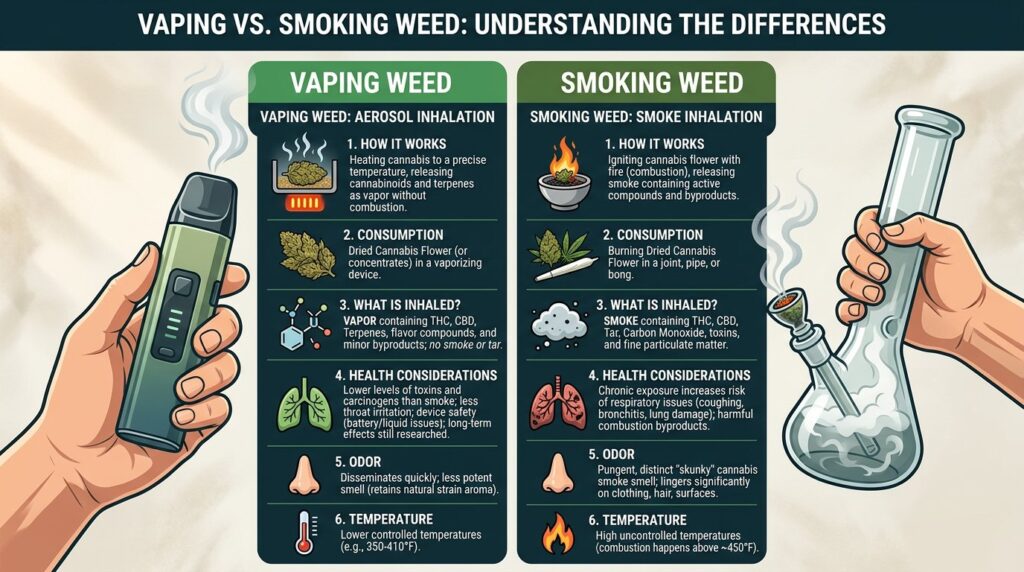
Vaping weed means using an electronic device to heat cannabis flower, extracted oil, or concentrate and inhaling the resulting aerosol. Unlike a joint, pipe, or bong, a vaporizer is intended to operate below the point where cannabis burns.
That one definition covers several very different experiences. Dry-herb devices heat ground flower in an oven. Cartridge batteries power a small heating element immersed in cannabis oil. Concentrate pens and electronic rigs vaporize sticky extracts such as wax or rosin. The device, material, temperature, and inhalation pattern all affect dose and exposure.
How vaping works: heating cannabinoids/terpenes without combustion
Burning cannabis creates smoke containing fine particles, carbon monoxide, tar-like compounds, and other potentially harmful chemicals. A vaporizer instead transfers heat through conduction, convection, or both:
- Conduction places cannabis against a hot surface. It heats quickly but may cook unevenly.
- Convection passes heated air through the material. It can produce more even extraction but usually costs more.
- Hybrid systems combine the two, as many modern portable dry-herb devices do.
Heat releases cannabinoids, including THC and CBD, and aromatic compounds called terpenes. You inhale these with ultrafine particles and other chemicals present in the aerosol. “Vapour” sounds like harmless water mist, but cannabis aerosol isn’t simply steam.
Dry herb shouldn’t ignite during normal use. If the chamber produces ash or a distinctly burnt-paper taste, the temperature may be too high, the device may be malfunctioning, or the material may have touched an overheated surface.
Product formats: flower, distillate, live resin/rosin, wax (and what each means)
Flower is dried cannabis bud. It contains the plant’s naturally occurring cannabinoids and terpenes, commonly ranging from roughly 15% to more than 30% THC in legal markets. Dry-herb vaping provides fewer unknown ingredients than an oil blend, although flower can still contain mould, pesticides, or microbes.
Distillate is highly refined cannabis oil dominated by THC or CBD. Because distillation strips away many native aromas, manufacturers often add cannabis-derived or botanically sourced terpenes. Distillate cartridges can exceed 80% THC, making them easy to overuse.
Live resin is usually made from cannabis frozen soon after harvest, preserving more volatile compounds. It often has a stronger aroma and broader chemical profile than distillate. The extraction process typically uses solvents such as butane, which reputable producers remove and test for.
Rosin is pressed using heat and pressure rather than hydrocarbon solvents. “Live rosin” starts with fresh-frozen material, commonly processed into hash before pressing. Solventless doesn’t mean risk-free: contaminants in the source material can remain, and heating still creates inhaled aerosol.
Wax, shatter, budder, and crumble describe concentrate textures rather than standardized safety grades. They’re normally consumed in dab pens or rigs and can deliver a very large dose quickly. For beginners, that’s less a feature than a trapdoor.
Vaping Weed vs Smoking: Differences in High, Smell, Cost, and Lung Impact
Vaping and smoking both deliver THC through your lungs, so their effects begin rapidly. The differences arise from temperature, cannabinoid concentration, device efficiency, and what else you inhale. Vaping may reduce exposure to combustion products, but “reduced” and “safe” are not synonyms, an annoying distinction, perhaps, but an important one.
| Factor | Dry-herb vape | THC oil cartridge | Smoking flower |
|---|---|---|---|
| Typical onset | Within minutes | Within minutes | Within minutes |
| Dose control | Moderate with small draws | Difficult with high-potency oil | Moderate, though joints keep burning |
| Odour | Noticeable but fades faster | Usually lighter: varies by extract | Strong and persistent |
| Combustion products | Lower when functioning properly | No plant combustion, but aerosol risks | Highest of the three |
| Upfront cost | About US$70–US$400+ | Battery often C$10–C$30 | Minimal |
| Main concern | Hot aerosol, contaminated flower/device | Potency, additives, metals, counterfeit oil | Smoke and respiratory irritation |
Onset time, duration, and intensity compared
With either smoking or vaping, you may feel effects in one to five minutes, with fuller effects developing over roughly 10 to 30 minutes. The noticeable high often lasts two to four hours, while impairment can persist longer depending on dose, tolerance, and the product used.
A dry-herb vape can feel clearer or less heavy than smoking to some users, but that’s subjective rather than guaranteed. Cartridge oil may feel unexpectedly intense because one small device can contain 70% to 90% THC. A long pull from a modern cart is not necessarily a “small dose.”
Smoking destroys some cannabinoids between puffs as a joint continues burning. Vaporizers can extract material more efficiently, so the same weight of flower may produce stronger effects. If you switch from smoking, don’t assume your familiar puff count transfers neatly.
Never drive after using cannabis. Waiting until you no longer feel high isn’t a reliable measure of driving fitness, and driving while impaired by cannabis is a criminal offence across Canada.
Odour, discretion, and secondhand exposure
Dry-herb vapour smells like warm, toasted cannabis: less smoky than a joint, but definitely not invisible to noses. Live-resin and rosin cartridges can be surprisingly fragrant, while distillate products often produce a sweeter, lighter smell. Aerosol generally dissipates faster than smoke and clings less stubbornly to curtains or clothing.
Still, discretion shouldn’t become permission to expose other people. Cannabis aerosol can contain THC, fine particles, volatile organic compounds, and metals. The evidence on secondhand cannabis aerosol remains limited, but limited evidence isn’t evidence of safety.
Don’t vape around children, pregnant people, pets, or anyone with asthma. Use outdoors where legal, away from doors and air intakes. A cracked car window isn’t magical ventilation, and vaping in a vehicle can still expose passengers and create legal trouble.
Respiratory irritation: smoke toxins vs aerosol concerns
Cannabis smoke contains many of the same irritants and carcinogenic compounds found in tobacco smoke, although exposure patterns differ. Regular smoking is associated with cough, phlegm, wheezing, and bronchitis symptoms. Avoiding combustion plausibly reduces exposure to carbon monoxide and several toxic byproducts.
Vaping introduces its own variables. Heated oils can generate irritant carbonyl compounds. Coils or solder may release metals, especially when hardware is poor quality, damaged, or run at excessive voltage. Flavouring ingredients considered acceptable to eat may not be safe to inhale. Dry-herb vapour can also be hot and drying.
Long-term comparisons remain incomplete because devices and formulations evolve faster than multi-year research. If vaping consistently causes cough, wheezing, chest tightness, or reduced exercise tolerance, don’t normalize it as “just part of the hit.” Stop using the product and discuss symptoms with a clinician.
Benefits of Vaping Cannabis (When It May Be Preferable)
For an adult who already uses cannabis, vaping may offer practical advantages over smoking. Those benefits are strongest when you use lab-tested material in a well-made device at a moderate temperature. They become much less convincing when the product is an untested, ultra-potent cartridge.
Lower combustion byproducts, flavour/terpene preservation, and efficiency
The clearest potential advantage is avoiding burning plant material. Controlled laboratory studies have generally found fewer combustion-related compounds in vapour than smoke, though that does not account for every real-world device or contaminant.
Vaping can also stretch flower further. Instead of watching a joint smoulder between puffs, you heat only during a session. A lightly packed chamber containing approximately 0.1 to 0.2 grams may be enough for multiple draws, depending on device design and tolerance. Premium portable models such as the Storz & Bickel Mighty+, Arizer Solo series, and PAX devices cost substantially more upfront than papers or a pipe, but efficient flower use may offset part of that expense over time.
Flavour is another draw. At moderate temperatures, you can taste citrus, pine, pepper, or earthy notes that combustion flattens into smoke. That’s enjoyable, but don’t mistake a pleasant lemon flavour for a health feature. Terpenes can irritate airways at high concentrations too.
Temperature control for tailored effects
Adjustable temperature gives you more control over flavour, vapour density, and harshness. Lower settings generally produce thinner, more aromatic vapour. Higher settings extract cannabinoids faster and create denser clouds, but they may also feel hotter and more irritating.
You’ll sometimes see charts claiming one exact temperature delivers “creativity” while another unlocks “sleep.” Biology isn’t that tidy. The effects depend on THC dose, CBD content, product chemistry, your tolerance, and your surroundings, not just a three-degree adjustment.
Temperature control is most useful for pacing. Start around 177°C to 188°C (350°F to 370°F) with dry herb, take a short draw, and increase gradually only if needed. With cartridges, low-voltage batteries, often around 2.4 to 3.0 volts, depending on coil resistance and manufacturer guidance, can reduce burnt flavours. Think simmer, not flamethrower.
Risks of Vaping Weed You Should Know
The risks of vaping weed aren’t limited to sore throats. Product contamination, extreme THC potency, acute intoxication, dependence, and underlying medical conditions all matter. The absence of tobacco doesn’t grant a health halo.
EVALI and why untested cartridges are the biggest red flag
In 2019, the United States experienced an outbreak of e-cigarette or vaping product use-associated lung injury, known as EVALI. Thousands were hospitalized, and deaths occurred. CDC investigations strongly linked the outbreak to vitamin E acetate in illicit-market THC vaping products, although other chemicals could not be excluded in every case. Canada also had cases, called vaping-associated lung illness (VALI), but no specific cause was identified here, and vitamin E acetate wasn’t found in any Canadian case.
The practical lesson remains relevant: avoid cartridges from dealers, social-media accounts, flea markets, or friends who “know a guy.” Counterfeit packaging can look polished and may copy legitimate brands or invent laboratory results. You cannot identify safe oil by colour, thickness, bubble movement, or smell.
Seek urgent medical care if vaping is followed by shortness of breath, chest pain, severe cough, fever, vomiting, confusion, bluish lips, or rapidly worsening symptoms. Tell clinicians exactly what you used. That information helps treatment: this is not the moment for mysterious cool-person energy.
Additives/contaminants: vitamin E acetate, pesticides, heavy metals, residual solvents
Cannabis oil may contain substances originating from the plant, extraction process, formulation, or hardware. Key concerns include:
- Vitamin E acetate: strongly associated with the EVALI outbreak and unsuitable for inhalation.
- Pesticides: residues can survive processing or become concentrated in extracts.
- Heavy metals: lead, nickel, chromium, or other metals may come from soil, cartridges, heating coils, or solder.
- Residual solvents: poorly processed extracts may retain butane, propane, ethanol, or other chemicals.
- Microbes and mycotoxins: mouldy source material can contaminate flower or concentrates.
- Diluents and flavourings: ingredients such as medium-chain triglyceride oil or excessive terpene blends may irritate lungs and lack adequate inhalation-safety data.
A certificate of analysis is helpful only when it matches the exact batch, comes from an accredited independent laboratory, and can be verified. Testing requirements vary by jurisdiction, and passing lab tests reduces, not eliminates, risk.
High-THC potency, tolerance, dependence, and mental health considerations
High-potency cartridges make frequent dosing almost frictionless. There’s no grinding, rolling, or lingering smoke, just a device in your pocket. That convenience can quietly turn occasional use into all-day use.
Frequent high-THC exposure may increase tolerance, meaning you need more to achieve the same effect. Some users develop cannabis use disorder, with cravings, unsuccessful attempts to cut back, impaired responsibilities, or continued use even though harm. Stopping after heavy use can cause irritability, sleep disruption, reduced appetite, anxiety, and vivid dreams.
Large THC doses can also produce panic, paranoia, vomiting, poor coordination, rapid heart rate, or temporary psychotic symptoms. Risk deserves extra attention if you have a personal or family history of psychosis, schizophrenia, bipolar disorder, or severe anxiety. Cannabis may worsen symptoms or complicate treatment.
If you’re reaching for the vape immediately after waking, hiding use, or feeling unable to enjoy anything without it, pause and take that seriously. A clinician or counsellor can help without requiring you to adopt a dramatic label on day one.
Special populations: teens, pregnancy, heart/lung conditions, medications
Adolescents and young adults face particular concerns because the brain continues developing into the mid-20s. High-potency cannabis is associated with learning, attention, dependence, and mental-health risks. Keeping vapes locked away matters: colourful devices can resemble ordinary electronics or candy-flavoured nicotine products.
Pregnant or breastfeeding people should avoid cannabis unless receiving individualized medical guidance. THC crosses the placenta and can enter breast milk. Vaping doesn’t remove those exposure concerns.
If you have asthma, COPD, cardiovascular disease, arrhythmias, or a history of stroke, inhaled cannabis may be especially risky. THC can temporarily increase heart rate and alter blood pressure: aerosols can provoke respiratory symptoms.
Cannabis can also interact with sedatives, alcohol, anticoagulants, seizure medications, and drugs metabolized through certain liver enzymes. CBD-rich products aren’t automatically interaction-free. Ask a pharmacist or clinician who can review your actual medication list rather than relying on a dispensary conversation alone.
Types of Vaporizers for Weed: Pros, Cons, and Who Each Is For
Choosing a vaporizer isn’t just a question of cloud size. The category determines what you consume, how precisely you can dose it, how much maintenance it needs, and which failure points you inherit.
Dry herb vaporizers (portable vs desktop)
Portable dry-herb vaporizers use a rechargeable battery and a small oven. Models from Arizer, PAX, Storz & Bickel, and XMAX commonly range from about US$80 to more than US$350. Look for an isolated air path, clear temperature controls, replaceable parts, a meaningful warranty, and safety certification from a recognized testing organization where available.
Desktop vaporizers plug into a wall outlet and typically offer stronger heaters, larger chambers, and either whip-style tubing or balloon bags. The Volcano line is the familiar premium example, often priced around US$400 to US$700 depending on model and sales. Desktops suit home users or medical consumers who value consistent performance over portability.
Dry herb gives you visibility into the starting material and avoids oil additives. Downsides include smell, cleaning, slower setup, and the difficulty of knowing the exact THC dose. Portable units can also produce weak vapour if packed incorrectly or used with a dying battery.
510-thread carts & batteries: what to look for
“510” refers to the common screw-thread connection between a cartridge and battery. Basic stick batteries may cost C$10 to C$20: better variable-voltage models from established vaporizer retailers often cost C$20 to C$30.
Choose a battery with low-voltage settings, short-circuit protection, overcharge protection, a timer cutoff, and USB-C charging when possible. Avoid aggressively tightening the cartridge, it can damage the centre pin or block airflow. Store it upright and away from heat.
Cartridges should come from sellers that share batch test results, list ingredients, display a batch or lot number, and provide verifiable testing. Ceramic hardware is commonly marketed as superior, but “ceramic” alone doesn’t prove that the full device is metal-free or safe. Hardware quality, oil formulation, and operating temperature matter together.
All-in-one disposables: convenience vs quality/control
Disposable cannabis vapes combine oil, coil, and battery in one sealed unit. They’re easy to use and require no compatibility decisions. They can also be difficult to troubleshoot, impossible to clean, and wasteful when the battery dies before the oil is finished.
Some disposables offer rechargeable USB-C ports, but recharging doesn’t make the heating element immortal. If the vapour tastes metallic, scorched, or unusually harsh, stop using it. Don’t crack the shell open, transfer mystery oil, or attempt DIY battery surgery, lithium-ion cells can short, vent, or ignite.
Disposables work best for infrequent adult users buying a small, lab-tested product. They’re a poor fit if you want adjustable temperature, repairable hardware, lower electronic waste, or transparent control over every component.
Concentrate pens/e-rigs: dab-like effects and added risks
Concentrate pens load wax, rosin, or similar extracts directly onto a coil or into a ceramic chamber. Electronic rigs, such as products from Puffco or Focus V, heat a removable “nail” electronically instead of using a torch.
These devices can deliver a powerful dose in seconds. That may appeal to highly tolerant users, but it increases the odds of coughing, panic, nausea, faintness, or severe impairment. Sticky reclaim also accumulates quickly, requiring regular cleaning.
A concentrate user should prioritize precise temperature control, replacement-part availability, stable construction, and a chamber made for the exact material. Avoid homemade extracts and concentrates with no batch testing. If you’re new to THC, a dab-sized cloud is an unnecessarily chaotic introduction: choose a lower-potency format and take one small inhalation instead.
How to Vape Weed: Step-by-Step for Beginners
Before using cannabis, choose a safe setting, clear your schedule, and arrange transportation that doesn’t involve driving. Keep water nearby, but don’t combine cannabis with alcohol just because both happen to be in the kitchen.
Dry herb: grind, pack, temp setting, draw technique
- Check the material. Use lab-tested flower without visible mould, moisture pockets, or a chemical smell.
- Grind it medium-fine. Aim for fluffy crumbs rather than powder. Fine dust can restrict airflow or reach the mouthpiece.
- Pack lightly. Fill the chamber according to the manual, then gently level it. Convection devices often need airflow: a brick-tight pack works against you.
- Start at a moderate temperature. Try 177°C to 188°C (350°F to 370°F). Exact performance differs by device.
- Let it reach temperature. Rushing a cold oven usually produces a disappointing first draw.
- Draw slowly for two or three seconds. Sip rather than vacuum. Hold briefly if comfortable, then exhale normally: holding vapour for a long time mainly increases irritation.
- Wait 10 to 15 minutes. Assess the full effect before taking another draw.
- Stir if the manual recommends it. Some conduction ovens heat the edges faster.
- Stop when the herb is evenly tan or brown. Black material or ash suggests overheating.
A beginner’s common mistake is chasing visible clouds. Cannabis vapour may be thin, especially at lower temperatures. Effects, not theatrical fog, are the relevant measure.
THC carts: priming, voltage/wattage basics, avoiding burnt hits
First, confirm the cartridge and battery are compatible. Screw a 510 cart in until snug, not clenched. If it has been stored cold or upside down, let it sit upright at room temperature so thick oil can settle near the intake openings.
For button-operated batteries, follow the manual’s click sequence and begin at the lowest setting. A typical starting range is roughly 2.4 to 2.8 volts, but the cartridge maker’s recommendation takes priority. Wattage depends on coil resistance, so copying someone else’s number can overheat your specific cart.
Take a gentle one- or two-second puff. Avoid repeated “blinkers”, draws held until the device’s safety cutoff flashes. They can overheat oil and hardware while delivering far more THC than expected.
If the cart clogs, warm it in your hands and take a gentle unpowered pull if the design allows. Don’t poke metal objects through the airway. Persistent leaking, darkening oil, burnt flavour, exposed wiring, or a cracked tank means retirement time. Yes, wasting oil hurts. Inhaling from damaged hardware can hurt more.
Temperature & Dosing Guide (Avoid Overdoing It)
Cannabis inhalation lacks the neat dosing precision of a labelled tablet. Puff duration, lung capacity, device power, oil concentration, chamber size, and tolerance all change how much THC reaches you. Your job is to create guardrails.
Low-and-slow dosing: puff size, wait time, and tracking effects
For a first session, take one small puff lasting one to two seconds, then wait at least 10 to 15 minutes. If you feel nothing, add one similarly sized puff, not a heroic inhale designed to make up for lost time.
Keep a simple note on your phone:
- Product name and THC/CBD percentage
- Device and temperature or voltage
- Number and length of puffs
- Effects after 15, 30, and 90 minutes
- Any cough, anxiety, dizziness, or nausea
This may feel excessively organized until you discover that “Blue Dream cart, maybe four pulls?” isn’t actionable data. Tracking is especially useful when switching products because THC percentages and device output vary widely.
If you take too much, move somewhere quiet, sit or lie safely, sip water, and remind yourself that the effects are temporary. Don’t drive. Seek help for chest pain, trouble breathing, fainting, severe confusion, psychosis, or uncontrollable vomiting. In Canada, call 1-844-POISON-X (1-844-764-7669), or 1-800-463-5060 in Quebec, for case-specific guidance, and call 911 in an emergency.
Temperature ranges and what users report (flavour vs sedation vs irritation)
These dry-herb ranges are practical starting points, not promises of specific medical effects:
| Temperature | Typical experience | Trade-off |
|---|---|---|
| 166–177°C (330–350°F) | Light, flavourful vapour | May feel weak: incomplete extraction |
| 177–193°C (350–380°F) | Balanced flavour and vapour density | Moderate throat dryness |
| 193–210°C (380–410°F) | Denser vapour and faster extraction | More coughing or harshness |
| Above 210°C (410°F) | Very dense, roasted flavour | Greater irritation: closer to combustion conditions |
Users often describe lower temperatures as more clear-headed and higher settings as heavier or more sedating. That pattern may partly reflect dose: hotter ovens extract more THC more quickly. Product chemistry and expectation also shape the experience.
For oil cartridges, use the lowest setting that produces consistent vapour. Thick oil doesn’t automatically require maximum power. If the oil spits, the mouthpiece gets painfully hot, or flavour turns burnt, stop and let the device cool.
Safer Vaping Weed Checklist (Harm Reduction)
No checklist can make vaping harmless, but it can remove avoidable risks. If a seller rushes you past basic questions, consider that an answer in itself.
Buying tips: lab tests/COAs, trusted sources, and ingredient red flags
Buy only from sellers that share batch test results, and check the legal age in your province or territory. Confirm that packaging is sealed and includes the producer, cannabinoid content, batch number, manufacture date, and testing information.
Scan the QR code or visit the laboratory’s official website through a trusted route: counterfeit packages can link to counterfeit reports. The certificate of analysis should match the batch and show results for potency, pesticides, microbial contamination, heavy metals, and residual solvents where applicable.
Avoid products containing vitamin E acetate, MCT oil, or unexplained “proprietary” diluents. Be cautious with intensely flavoured products and implausible claims such as “100% safe,” “organic equals toxin-free,” or celebrity-style packaging with no verifiable producer.
Also check freshness. Old oil may darken naturally through oxidation, but leaking, separation that doesn’t resolve, unusual crystals, or a sharp chemical odour justify returning the product rather than experimenting with your lungs.
Device safety: materials, airflow, avoiding counterfeit carts/batteries
Buy batteries and vaporizers from the manufacturer or an authorized retailer. Marketplace listings can mix genuine and counterfeit inventory. Compare serial numbers, packaging, warranty registration, and seller details.
Use the charging cable and power specifications recommended in the manual. Charge on a hard, nonflammable surface, not under a pillow, on a sofa, or overnight while everyone sleeps. Stop using a battery that swells, hisses, becomes unusually hot, smells sweet or chemical, or has damaged wrapping.
Keep airflow openings clear and avoid carrying a loose button battery where keys can activate it. Use any lock function when the device is in a bag. Never leave a vape in a hot car: heat can degrade oil, raise internal pressure, and damage lithium batteries.
For households with children, use a locked container placed out of sight and reach. Child-resistant packaging buys time, not immunity. A concentrate-filled vape can contain hundreds of milligrams of THC.
Cleaning & maintenance to reduce harshness and contaminants
Residue narrows airflow and cooks repeatedly, creating harsh flavours. For dry-herb devices, empty the chamber after it cools, brush out loose particles, and clean the mouthpiece and cooling unit on the manufacturer’s schedule. Isopropyl alcohol is commonly recommended for removable glass or metal parts, but don’t soak electronics, silicone, or plastic unless the manual explicitly permits it.
Let cleaned components dry completely before reassembly. Heating trapped alcohol is a terrible encore.
For cartridge batteries, power off the device and wipe leaked oil from the connection with a lightly dampened cotton swab. Let it dry before attaching another cart. Don’t rinse the battery or scrape contacts aggressively.
Replace cracked mouthpieces, damaged seals, degraded screens, and worn chambers. If performance suddenly changes after cleaning, inspect the assembly rather than compensating with maximum heat. Proper maintenance should make a device smoother, not turn it into a tiny hand-held furnace.
Alternatives to Vaping Weed (When to Choose Something Else)
If inhalation makes you cough, worsens asthma, or simply feels unpleasant, you don’t have to “get used to it.” Non-inhaled options avoid airway exposure, though each creates different dosing challenges.
Edibles, tinctures, capsules, topicals, inhalers: pros/cons and onset times
| Format | Approximate onset | Typical duration | Main advantage | Main drawback |
|---|---|---|---|---|
| Edible | 30 minutes–2+ hours | 6–8+ hours | No lung exposure: discreet | Delayed onset makes redosing risky |
| Sublingual tincture | 15–60 minutes | 4–6 hours | Easier incremental dosing | Some is swallowed, delaying effects |
| Capsule | 30 minutes–2+ hours | 6–8+ hours | Consistent labelled dose | Slow onset: hard to adjust once taken |
| Topical | Varies | Varies | Local application: usually little intoxication | Evidence and absorption vary by product |
| Metered inhaler | Minutes | Several hours | Potentially standardized inhaled dose | Limited availability: still inhaled |
Edibles deserve special caution. THC is processed by the liver into 11-hydroxy-THC, which can feel stronger and last longer than inhaled cannabis. Beginners should consider no more than 1 to 2.5 milligrams of THC, then wait at least two to three hours before deciding whether to take more. A standard 10-milligram gummy can be overwhelming for someone without tolerance.
Tinctures allow smaller adjustments when they include a graduated dropper and reliable labelling. Capsules are convenient when consistency matters more than rapid feedback. Topicals may suit someone seeking localized relief without a high, although transdermal patches can be formulated for systemic absorption and should not be treated like ordinary lotion.
For people using cannabis medically, discuss route and dose with a knowledgeable clinician. Sometimes the better alternative isn’t another cannabis format, it’s physical therapy, sleep treatment, migraine prevention, anxiety care, or a medication with stronger evidence. Choosing not to inhale anything is a valid upgrade, not a failure of technique.
FAQ About Vaping Weed
Is vaping weed safer than smoking?
Probably in a limited, relative sense, particularly when comparing a well-made dry-herb vaporizer with smoking the same flower. Vaping avoids combustion and can reduce exposure to carbon monoxide and several smoke toxins. It is not harmless, and long-term data remain incomplete.
Oil cartridges add risks from high THC concentrations, additives, extraction residues, and hardware contaminants. An untested cart may be more dangerous than its clean-looking aerosol suggests. The lowest-risk option for your lungs is not inhaling cannabis smoke or aerosol at all.
Does vaping weed smell?
Yes, although the smell is usually less intense and disappears faster than cannabis smoke. Dry-herb vapour smells toasted and distinctly cannabis-like. Live resin and live rosin often have a stronger aroma because they retain more volatile compounds. Distillate carts may smell fruity, sweet, or faintly herbal.
Vapour can still alert neighbours, trigger building policies, or expose people nearby. Air freshener doesn’t remove aerosol: it merely adds “lavender argument” to the room. Use only where legal and permitted, preferably outdoors and away from others.
How long does a vape high last vs smoking?
Both methods usually begin working within minutes. Noticeable effects commonly last two to four hours, with residual impairment potentially lasting longer. A vape high isn’t automatically shorter than a smoking high.
Dose matters more than the device label. A small dry-herb puff may fade relatively quickly, while several pulls from an 85% THC cartridge can remain intense for hours. Frequent users may feel subjectively normal even though lingering impairment. Don’t use the disappearance of obvious euphoria as proof that you’re ready to drive or operate equipment.
Why does vaping weed make me cough or feel tight-chested?
Hot, dry aerosol can irritate your throat and airways. High temperature, long draws, concentrated terpenes, repeated puffs, residue buildup, contaminated material, or an underlying condition such as asthma can make it worse.
Stop using the device and move to fresh air. Don’t keep testing it to see whether the fifth hit magically improves things. Persistent cough, wheezing, or recurring tightness warrants medical evaluation. Seek urgent help for severe shortness of breath, chest pain, blue or grey lips, fainting, confusion, fever, or rapidly worsening symptoms, especially after using an untested cartridge.
Can vaping weed trigger a positive drug test?
Yes. Drug tests generally detect THC metabolites, not whether THC was smoked, eaten, or vaped. Even a CBD-dominant product may contain enough THC to produce a positive result, particularly with repeated use or inaccurate labelling.
Detection windows vary with dose, frequency, body composition, metabolism, and the type of test. Urine tests may detect occasional use for several days and frequent use for weeks: hair tests can reflect a much longer period. No detox drink can reliably guarantee a negative result.
The bottom line: vaping weed may reduce exposure to combustion byproducts, but its safety depends heavily on product source, device quality, temperature, dose, and your health. If you choose to vape, use lab-tested products, start with one short puff, wait before taking more, and retire anything that tastes burnt, leaks, or lacks verifiable testing.
Most importantly, pay attention to what your body and habits are telling you. A convenient vape can become too convenient, and recurring cough or escalating tolerance isn’t background noise. You’re allowed to reduce your dose, switch to a non-inhaled option, ask a clinician for help, or stop completely. The smartest setup isn’t necessarily the newest device, it’s the one that keeps you informed, deliberate, and honest with yourself.