
Nov
The relationship between weed and blood pressure isn’t as simple as “cannabis raises it” or “CBD lowers it.” Shortly after using cannabis, especially a THC-rich product, your heart rate may increase and your blood pressure may rise. Yet the same session can leave you lightheaded when you stand because your pressure has dropped. Add edibles, concentrates, medications, alcohol, tolerance, and an anxious “Did I take too much?” moment, and the picture gets complicated fast.
This evidence-based review explains what researchers know, what remains uncertain, and what you should do if your readings change after cannabis use. It covers recreational and medical cannabis, including marijuana containing THC and products marketed as CBD. It does not assume that every product has the same effects: a low-dose CBD oil and a high-potency THC concentrate are very different exposures.
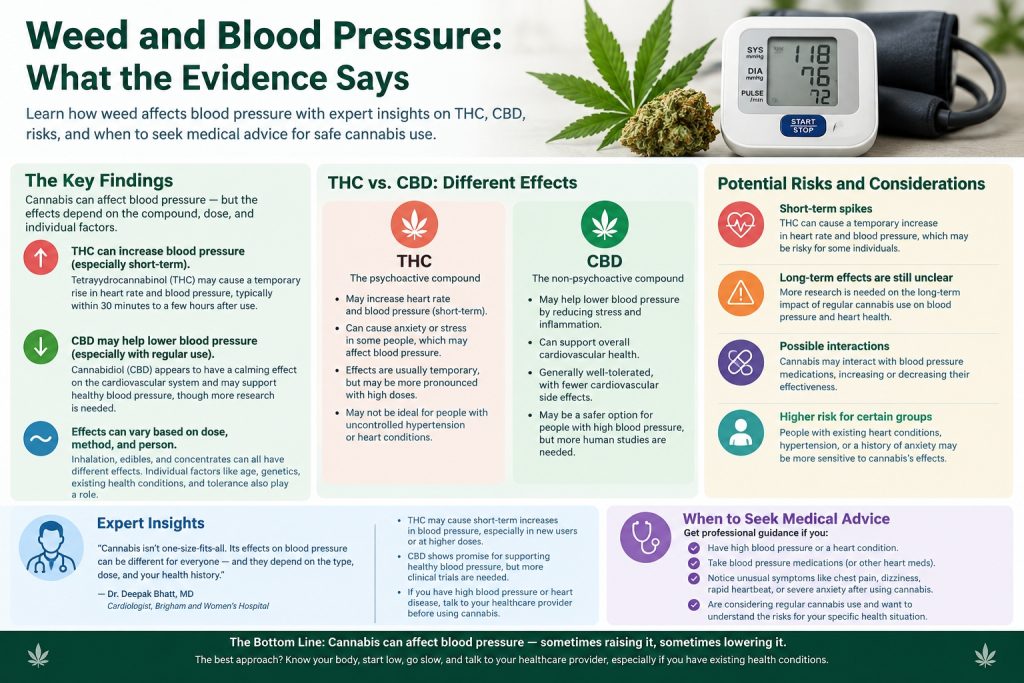
The short version: cannabis can cause meaningful cardiovascular changes, but those changes vary by person, dose, product, and route of administration. Research suggesting possible blood-pressure benefits is preliminary and doesn’t establish cannabis as a treatment for hypertension. Meanwhile, observational studies have raised concerns about heart attack, stroke, and abnormal rhythms, particularly among frequent users and people who already have cardiovascular disease.
This article is educational. Kush Station sells cannabis, including THC and CBD products, but this article doesn’t recommend any product, and it isn’t affiliated with any medication manufacturer. It can help you prepare for a candid conversation with your clinician or pharmacist, but it can’t diagnose or treat an individual condition. If you currently have chest pain, severe shortness of breath, fainting, stroke symptoms, or a dangerously high reading, skip the internet rabbit hole and call 911 or seek urgent medical help.
Key Takeaways
- Cannabis can cause variable effects on blood pressure, often raising it shortly after use due to THC, but also causing dizziness and drops in pressure upon standing.
- Long-term impacts of cannabis on blood pressure remain uncertain; preliminary studies suggest potential benefits, but risks such as heart attack and stroke are noted, especially with frequent use and existing cardiovascular conditions.
- THC and CBD differ significantly: THC can increase heart rate and blood pressure, while CBD’s effects are less certain and generally non-intoxicating but may still interact with medications.
- Cannabis consumption methods affect onset and duration of blood pressure changes, with edibles causing delayed and prolonged effects that increase the risk of overdosing and symptoms.
- People using blood-pressure medications should consult a pharmacist due to potential interactions and additive effects causing dizziness or low blood pressure.
- If experiencing dizziness, abnormal symptoms, or severe blood pressure readings after cannabis use, stop usage, seek medical advice promptly, and never replace prescribed hypertension treatments with cannabis.
How weed and blood pressure interact
Cannabis interacts with the cardiovascular system partly through cannabinoid receptors, autonomic nervous system signalling, and changes in blood-vessel tone. THC can stimulate a “fight-or-flight” response soon after use, while other effects may relax blood vessels. That push-pull helps explain why your pressure can rise initially and fall later.
There isn’t one universal cannabis response. Someone new to THC may feel a pounding heart after two inhalations, while a regular user notices little. Even your response on Tuesday may differ from Saturday’s because hydration, food, sleep, anxiety, medications, and product strength matter.
Short-term effects: Blood pressure and heart rate can rise after use
THC commonly increases heart rate shortly after use. Health Canada notes that the higher the THC content, the higher the potential increase, and that a faster heart rate can be dangerous for people with heart conditions. A scientific statement from the American Heart Association describes acute increases in sympathetic activity, oxygen demand, and, in some users, blood pressure. The effect is usually most noticeable in people with little tolerance, after larger doses, or with highly potent products.
Imagine taking several pulls from a vape labelled 85% THC, then checking your pressure while worried about the racing number on your smartwatch. THC, anxiety, and hurried measurement can all push that reading upward. This doesn’t automatically mean chronic hypertension, but it shouldn’t be dismissed if symptoms are severe or readings remain extremely high.
Why blood pressure can also drop: Dizziness and orthostatic hypotension
Cannabis can dilate blood vessels and reduce the body’s ability to maintain pressure when you stand. The result may be orthostatic hypotension: a drop in blood pressure after moving upright. You might see spots, feel weak, become nauseated, or need to grab the counter. In some cases, you can faint.
Risk rises when you’re dehydrated, overheated, fasting, drinking alcohol, taking blood-pressure medicine, or using a stronger dose than usual. Standing quickly after sitting through a long movie, especially after an edible, can provide an unpleasant demonstration. Move slowly, sit back down at the first warning, and don’t try to “walk it off.” Falls cause more immediate harm than an imperfect number on the monitor.
Long-term effects: What remains uncertain about regular cannabis use
Researchers haven’t established a clear, consistent long-term effect of cannabis on resting blood pressure. Some studies report lower readings among selected users; others find higher cardiovascular risk or little meaningful difference. These findings aren’t necessarily contradictory: populations, products, doses, and definitions of “use” differ substantially.
Tolerance may reduce certain immediate effects, but it doesn’t prove that frequent use is harmless. Smoking introduces combustion products, and regular users may also differ in tobacco use, alcohol intake, diet, stress, and access to care. Modern concentrates are also far more potent than cannabis studied decades ago. Until stronger prospective trials are available, claims that long-term marijuana use reliably lowers, or inevitably raises, blood pressure go beyond the evidence.
Understanding high and low blood pressure
Blood pressure reflects the force of blood against artery walls and is reported in millimetres of mercury, or mm Hg. Persistently high pressure can damage blood vessels and increase the risk of heart disease, stroke, kidney disease, and vision problems. Pressure that’s too low may reduce blood flow to your brain and other organs, especially when accompanied by fainting, confusion, or weakness.
For most adults in Canada, the 2025 Hypertension Canada guideline and provincial health advice are a useful reference:
| Reading | Systolic | Diastolic |
|---|---|---|
| Below the hypertension threshold | Under 130 | And under 80 |
| Hypertension (when readings are consistently this high) | 130 or higher | And/or 80 or higher |
| Medication generally recommended for all adults | 140 or higher | And/or 90 or higher |
| Severely elevated: get help now | 180 or higher | And/or 110 or higher |
Sources: Hypertension Canada (130/80 definition), Hypertension Canada’s 2025 guideline FAQ (140/90 treatment threshold; higher-risk adults may be treated from a systolic of 130), and HealthLink BC (180/110).
These categories guide evaluation: they aren’t a substitute for your clinician’s interpretation, particularly during pregnancy or when you have kidney or cardiovascular disease.
What systolic and diastolic readings mean, and why one reading is not a diagnosis
The top number, systolic pressure, measures pressure when your heart contracts. The bottom number, diastolic pressure, reflects pressure while it relaxes between beats. Either number can matter. For example, 152/76 is still a high reading even though the diastolic number is below 80.
One measurement is only a snapshot. Recent cannabis, caffeine, nicotine, exercise, pain, stress, a full bladder, crossed legs, conversation, or the wrong cuff size can alter it. Hypertension is generally diagnosed using repeated, properly obtained readings, sometimes confirmed through home or 24-hour ambulatory monitoring.
If a surprising number appears, rest quietly for five minutes and repeat it correctly. Don’t repeatedly check every 30 seconds: that can feed anxiety and produce a parade of increasingly confusing results.
Why cannabis affects blood pressure differently from person to person
Your cardiovascular response depends on more than whether a package says “cannabis.” Genetics, age, health conditions, tolerance, dose, cannabinoid ratio, delivery method, and other substances all influence the experience. Product labelling can add uncertainty: an unregulated CBD bottle may contain a different dose, or some THC, than its label claims.
This variability is why your friend’s calm experience with a gummy can’t predict yours. Bodies aren’t copy-and-paste templates.
THC versus CBD: Different compounds, different cardiovascular effects
THC is intoxicating and can acutely increase heart rate, sympathetic activity, and sometimes blood pressure. It can also contribute to blood-vessel dilation and postural pressure drops. Anxiety or panic after a large dose may amplify palpitations and temporary elevations.
CBD isn’t intoxicating in the same way. Small experimental studies suggest it may influence vascular relaxation and stress responses, but doses used in research can be much higher than those in typical retail products. CBD can still cause sleepiness, diarrhea, appetite changes, and medication interactions.
A 1:1 THC-to-CBD gummy shouldn’t be treated as “CBD only.” If it contains 10 mg of THC, that THC remains pharmacologically active regardless of the CBD beside it.
Smoking, vaping, and edibles: Differences in onset, duration, and exposure
Route changes both timing and risk:
| Method | Typical onset | Typical duration | Key concern |
|---|---|---|---|
| Smoking | Minutes | Roughly 2–4 hours | Combustion products; rapid THC delivery |
| Vaping | Minutes | Roughly 2–4 hours | High potency; device or contaminant risks |
| Edibles | 30 minutes–2+ hours | 6–12 hours, sometimes longer | Delayed onset encourages redosing |
| Oils/tinctures | About 15–90 minutes | Several hours | Absorption varies by use and formulation |
These are broad ranges, not timers. A fatty meal can alter edible absorption, and liver metabolism converts swallowed THC into 11-hydroxy-THC, which can feel stronger and last longer.
The classic mistake is taking another gummy after 45 minutes because “nothing’s happening.” Then both doses arrive at once. If blood-pressure changes, panic, or dizziness follow, the extended edible duration can make the episode harder to manage.
How dose, potency, tolerance, alcohol, and nicotine influence the response
Higher THC doses generally make rapid heart rate, anxiety, impaired balance, and pressure changes more likely. Tolerance may blunt some effects, but product switches can defeat that familiarity: a flower user trying a concentrated dab is not making a like-for-like change.
Alcohol can worsen impairment, dehydration, and dizziness. Nicotine independently increases heart rate and blood pressure, so a tobacco-and-cannabis blunt creates a mixed exposure that’s difficult to interpret. Caffeine, stimulants, decongestants, and intense exercise can add further strain.
If you choose to use cannabis despite the potential risks, avoid stacking substances, use the lowest practical THC dose, and don’t redose quickly. “Start low and go slow” sounds worn out, but it beats spending six hours negotiating with your own pulse.
What research actually shows about cannabis and blood pressure
Cannabis research presents a frustrating mix: controlled experiments can identify short-term physiological changes, but they’re often small and brief. Large observational studies capture more people and longer periods, yet they can’t cleanly separate cannabis from tobacco, socioeconomic factors, medical conditions, or other behaviours.
Decades of legal restrictions, inconsistent product composition, and reliance on self-reported use have also hindered research. “Uses marijuana” might mean one low-dose edible monthly or high-potency concentrate several times daily, hardly comparable patterns.
The older-adult ambulatory blood pressure study: Findings and limits
A frequently cited study in the European Journal of Internal Medicine followed 26 adults aged 60 or older with hypertension who were newly prescribed medical cannabis. After three months, 24-hour ambulatory monitoring showed reductions in systolic and diastolic pressure, with the lowest values occurring about three hours after administration. Researchers also observed a higher proportion of normal nighttime dipping.
That finding is interesting, not definitive. The study was small, lacked a randomized placebo control, and involved a narrowly selected population under medical supervision. Participants used different cannabis formulations, making it difficult to identify which compound or dose produced the result.
It supports further research. It does not establish that dispensary cannabis treats hypertension or that similar effects occur in younger adults.
Why small studies, confounding factors, and observational data limit conclusions
A small trial may miss uncommon harms or produce a result that doesn’t hold in a larger group. Observational research has the opposite problem: it can reveal associations across thousands of people but usually can’t prove cannabis caused the outcome.
Important confounders include:
- Tobacco, alcohol, stimulant, and other drug use
- Baseline cardiovascular health and prescribed medications
- Income, stress, diet, sleep, and physical activity
- Dose, potency, frequency, and years of exposure
- Whether cannabis was smoked, vaped, or eaten
Self-reporting adds another wrinkle because people may underestimate use or not know a product’s potency. Stronger conclusions require randomized studies, standardized products, adequate follow-up, and objective exposure measurements. For now, certainty sells better than nuance online, but nuance is what the evidence warrants.
Can marijuana or CBD treat high blood pressure?
No cannabis product is established as a standard treatment for hypertension. Health Canada has not approved cannabis or CBD to lower blood pressure, and no non-prescription CBD health product is authorized in Canada yet: CBD is still regulated as cannabis under the Cannabis Act, and cannabis products can’t carry health claims. Prescription cannabinoid medicines in Canada, such as nabilone and Epidiolex, have limited indications, and hypertension isn’t among them.
This matters because high blood pressure often causes no symptoms while gradually damaging arteries and organs. Feeling relaxed after cannabis doesn’t tell you what your average pressure is, or whether cardiovascular risk has improved.
Why cannabis is not an established hypertension treatment or a replacement for prescribed care
Proven hypertension care may include weight management, regular activity, reduced dietary sodium, adequate sleep, limited alcohol, smoking cessation, and medications such as ACE inhibitors, angiotensin receptor blockers, calcium-channel blockers, or thiazide-type diuretics. Your plan depends on your readings and overall risk.
Don’t stop prescribed medication because cannabis produced one lower number. Abruptly stopping certain drugs, including clonidine or some beta blockers, can trigger rebound hypertension or other complications.
If side effects make your current treatment difficult, say so. Your clinician may adjust the dose, timing, or medication class. That’s safer than silently swapping a well-studied therapy for a product whose potency and cardiovascular effects may fluctuate.
CBD and blood pressure: Preliminary findings versus proven benefits
Small human experiments have found that acute CBD doses may modestly reduce resting or stress-related blood pressure in certain settings. But these studies often involve few participants, controlled conditions, and relatively large pharmaceutical-grade doses. Results don’t establish durable reductions in people with hypertension.
Retail CBD is another issue. Independent testing has repeatedly found inaccurate cannabinoid labelling in some products, and contamination is possible. Even accurately labelled CBD can inhibit liver enzymes involved in medication metabolism.
If you’re considering CBD, treat it as a biologically active substance, not wellness-flavoured water. Choose products with recent third-party certificates of analysis and discuss the exact brand, dose, and frequency with your pharmacist. Most importantly, keep taking prescribed care unless your clinician changes the plan.
Cardiovascular risks beyond blood pressure
A blood-pressure reading is only one cardiovascular marker. Cannabis may also affect heart rate, vascular function, oxygen demand, inflammation, and blood clotting. Smoking introduces carbon monoxide and fine particles, which is particularly concerning for people with narrowed coronary arteries.
A normal reading after use therefore doesn’t clear every other risk. You can have a textbook 118/76 while experiencing an abnormal rhythm, or have underlying coronary disease that a home cuff can’t detect.
Reported links with heart attack, stroke, and abnormal heart rhythms
Observational studies and case reports have linked cannabis use with myocardial infarction, stroke, atrial fibrillation, and other arrhythmias. A large 2024 analysis published in the Journal of the American Heart Association found that more frequent cannabis use was associated with higher odds of adverse cardiovascular outcomes, including among adults who had never smoked tobacco.
Association isn’t proof of causation. Yet the signal is substantial enough that clinicians shouldn’t wave it away, especially when cannabis is smoked or used frequently. Timing may matter too: acute increases in heart rate and cardiac workload could pose greater risk soon after use in vulnerable people.
Who needs extra caution: People with hypertension, heart disease, or a history of fainting
You should seek individualized medical advice before using cannabis if you have uncontrolled hypertension, coronary artery disease, heart failure, a previous heart attack or stroke, an arrhythmia, or recurrent fainting. Older adults often face added risk because they may take several medications and are more vulnerable to falls; Health Canada advises adults over 55 not to use cannabis if they have serious heart or blood vessel disease.
Pregnant people and anyone with serious kidney, liver, or neurological disease should also consult a qualified clinician rather than relying on dispensary advice. Budtenders may know products well, but they generally don’t have your ECG, laboratory results, or complete medication list.
If cannabis reliably causes chest tightness, near-fainting, or sustained palpitations, don’t keep experimenting to find your “perfect strain.” That pattern deserves medical evaluation.
Can weed interact with blood pressure medications?
Yes. Cannabis can interact with antihypertensive drugs through overlapping physiological effects and, potentially, altered drug metabolism. Evidence varies by medication, and many predicted interactions haven’t been tested in robust clinical trials. Still, caution is appropriate because the consequences (fainting, falls, or inadequate medication control) can be significant.
Bring your pharmacist a complete list that includes prescriptions, over-the-counter medicines, supplements, THC products, CBD, alcohol, and nicotine. “Natural” products belong on that list too.
Potential additive effects: Low blood pressure, dizziness, and falls
Cannabis-related vasodilation can compound the effects of medications that lower pressure. These may include ACE inhibitors, ARBs, beta blockers, calcium-channel blockers, diuretics, alpha blockers, and nitrates. The combination doesn’t guarantee a problem, but it may increase dizziness, particularly after standing.
Diuretics can contribute to dehydration; alpha blockers and nitrates can already cause orthostatic symptoms. Add an edible, a hot shower, and a quick trip upstairs, and the risk becomes more practical than theoretical.
If you feel unsteady, don’t independently skip your medication. Record what you took, when symptoms occurred, and any carefully measured readings. Contact your prescriber or pharmacist for advice about dosing and timing.
THC, CBD, and drug metabolism: Why a pharmacist should review your medications
THC and CBD are processed through liver enzyme systems, including cytochrome P450 pathways. CBD can inhibit enzymes such as CYP2C19 and CYP3A4, potentially changing concentrations of certain medicines. The clinical importance depends on dose, frequency, formulation, and the specific drug.
Concern extends beyond blood-pressure pills. Interactions may involve blood thinners, antiseizure medicines, sedatives, antiarrhythmics, and drugs with narrow therapeutic ranges. CBD also carries a risk of liver-enzyme elevations, particularly at prescription-level doses.
A pharmacist can screen your actual regimen rather than guessing from a general interaction list. Bring the package or a photo showing cannabinoid content. “A gummy” isn’t enough detail; neither is “some CBD oil in a blue bottle,” tempting though that shorthand may be.
What to do if blood pressure changes after using weed
First, pay attention to symptoms rather than chasing the number alone. Sit somewhere safe, breathe slowly, and avoid taking more cannabis, nicotine, alcohol, caffeine, or someone else’s medicine. If you can measure your pressure correctly, do so after resting, but don’t delay emergency care to find a cuff.
Write down the product, estimated THC and CBD dose, time used, other substances, symptoms, and readings. Those details are far more useful to a clinician than “weed made me feel weird.”
When to seek emergency help: Chest pain, stroke symptoms, fainting, or severely elevated readings
Call 911 for chest pain or pressure, severe shortness of breath, fainting, a seizure, blue or grey lips, inability to awaken, or signs of stroke. Use FAST: face drooping, arm weakness, speech difficulty, time to call 911. Don’t drive yourself.
A reading of 180/110 or higher is much higher than normal, so recheck it after resting. If it remains that high and you have chest pain, neurological symptoms, breathing difficulty, vision changes, or other signs of organ injury, call 911. Without symptoms, contact your doctor or your provincial health line (811 in most provinces) right away for guidance.
In Canada, poison control at 1-844-POISON-X (1-844-764-7669; in Quebec, 1-800-463-5060) can advise about accidental or excessive cannabis exposure.
Immediate precautions for dizziness: Sit or lie down, avoid driving, and do not use more cannabis
At the first wave of lightheadedness, sit or lie down so you don’t fall. If possible, raise your legs and have a sober person stay nearby. Loosen tight clothing, move away from excessive heat, and stand only when symptoms have clearly settled, slowly, with support.
Don’t drive, cycle, shower alone, climb stairs unnecessarily, or take another dose. Avoid alcohol. Small sips of water may help if dehydration contributed, but don’t force fluids if you have heart failure, kidney disease, or a prescribed fluid restriction.
If dizziness persists, repeatedly returns, or accompanies an irregular heartbeat, weakness, confusion, or fainting, seek medical assessment. “Sleeping it off” isn’t the right response to serious warning signs.
How to monitor blood pressure at home and discuss cannabis use with your clinician
Use a validated automatic upper-arm monitor with the correct cuff size; Heart & Stroke suggests choosing a device recommended by Hypertension Canada. For 30 minutes beforehand, avoid cannabis, smoking, caffeine, and exercise unless you’re specifically documenting a post-use response. Empty your bladder, sit quietly for five minutes, keep your back supported and feet flat, and position your bare arm at heart level.
Take two readings one minute apart, morning and evening, for several days if your clinician recommends it. Record symptoms and cannabis timing rather than selectively saving only the “good” numbers.
Tell your clinician how often you use cannabis, route, approximate potency, and why you use it. You’re not confessing: you’re supplying medically relevant information. Ask directly: Could this interact with my condition or medications, and what symptoms should change my plan?
Frequently asked questions
Cannabis questions often sound simple but depend heavily on dose, route, tolerance, and health history. These answers provide practical ranges and decision points, not personalized clearance.
How long can blood pressure changes last after smoking weed or taking an edible?
After smoking or vaping, cardiovascular effects can begin within minutes and may be most noticeable during the first hour or two, although impairment and symptoms may last several hours. Edibles take longer to start, sometimes more than two hours, and effects may persist for 6–12 hours or beyond, particularly after a large dose.
Product potency, food intake, liver metabolism, tolerance, and co-use of alcohol or medication all change the timeline. Don’t assume you’re safe to drive merely because your pressure has normalized. If palpitations, faintness, chest discomfort, or extreme readings continue beyond the expected intoxication period, get medical advice.
Can quitting weed temporarily raise blood pressure?
Possibly. Cannabis withdrawal after frequent, sustained use can involve irritability, anxiety, poor sleep, sweating, reduced appetite, and restlessness. Limited studies have reported temporary blood-pressure increases in some heavy users during abstinence, while others haven’t found a consistent effect.
If you have hypertension and plan to stop heavy daily use, home monitoring and clinician support may be sensible. Withdrawal usually isn’t medically dangerous in the way alcohol withdrawal can be, but severe anxiety, insomnia, or rising readings still deserve attention. Don’t restart cannabis solely to correct a number without discussing it with a healthcare professional.
Can using weed before a blood pressure check affect the reading?
Yes. Recent cannabis can alter heart rate and pressure, while anxiety, smoking, vaping, and other substances can further distort the result. Tell the person taking your blood pressure what you used and when. That context is clinically useful, not an invitation for judgment.
For a routine baseline measurement, avoid cannabis beforehand and follow the clinic’s preparation instructions. If you’ve already used it, don’t hide that fact or attempt to manipulate the reading. Your clinician may repeat the measurement later or arrange home monitoring. For safety-critical visits involving sedation, surgery, or anesthesia, disclosure is especially important.
Does a normal blood pressure reading mean cannabis is safe for your heart?
No. A normal blood-pressure value doesn’t rule out rapid heart rate, abnormal rhythm, impaired oxygen delivery, vascular effects, or increased cardiac workload. Nor does it account for risks from smoke inhalation, medication interactions, intoxication, or falls.
Think of the cuff as one dashboard gauge, not a full mechanical inspection. Your cardiovascular risk also depends on age, cholesterol, diabetes, smoking, kidney function, family history, existing heart disease, dose, and frequency of cannabis use.
If you have cardiovascular disease, or symptoms after using cannabis, ask for an individualized risk assessment even when your home readings look reassuring.
Key takeaways: Variable effects, uncertain long-term evidence, and individualized medical advice
The evidence on weed and blood pressure points to variability, not a dependable therapeutic effect. THC can temporarily raise heart rate and blood pressure, yet cannabis can also lower pressure when you stand, causing dizziness or fainting. Edibles may delay and prolong these changes, while smoking adds combustion-related cardiovascular exposure.
Long-term evidence remains unsettled. A few small studies suggest possible reductions under specific conditions, but they don’t prove that marijuana or CBD treats hypertension. Observational research linking cannabis with heart attack, stroke, and abnormal rhythms also can’t prove causation, but it provides good reason for caution, particularly if you use frequently or already have heart disease.
Your practical next steps are straightforward:
- Don’t replace prescribed blood-pressure treatment with cannabis or CBD.
- Ask a pharmacist to check interactions, especially if you use antihypertensives, blood thinners, antiarrhythmics, or sedatives.
- Measure accurately and record context, including dose, route, timing, and symptoms.
- Stop using more cannabis if you become dizzy or unwell, and don’t drive.
- Call 911 for chest pain, stroke symptoms, fainting, severe breathing trouble, or a severely elevated reading with concerning symptoms.
You don’t need a perfect explanation before asking for help. Bring honest details to your clinician, make one safer decision at a time, and let your real health history, not a viral claim, guide what happens next.