
Nov
If you’ve ever forgotten why you walked into a room after using cannabis, you may have wondered: does weed damage brain cells, or are you simply experiencing temporary intoxication? The honest answer is more nuanced than the old “marijuana kills brain cells” warning, and more cautious than claims that cannabis is harmless because it’s natural.
Current human evidence does not show that typical cannabis exposure directly kills neurons in the way a stroke, severe head injury, or certain toxins can. Cannabis can, however, temporarily disrupt memory, attention, coordination, reaction time, and judgment. Heavy or frequent use, especially beginning during adolescence, has also been associated with longer-lasting cognitive difficulties, altered patterns on brain imaging, cannabis use disorder, and a higher risk of psychosis in vulnerable people.
The key word is associated. Researchers must untangle cannabis exposure from alcohol and tobacco use, sleep disruption, mental health conditions, genetics, socioeconomic circumstances, and differences that may have existed before someone began using. Product potency further muddies the picture: today’s high-THC concentrates aren’t comparable to lower-potency cannabis used in many older studies.
This evidence review examines recreational cannabis and its effects on cognition and brain health. It doesn’t evaluate every possible medical use or replace personal advice from a clinician. You’ll learn what studies establish, where uncertainty remains, which patterns appear riskiest, and what you can do if weed seems to be affecting your memory or daily life. No scare tactics, no “it’s totally fine, bro” shrug, just a practical reading of the science.
Key Takeaways
- Current evidence does not support the claim that weed damages brain cells by killing neurons directly, but THC does alter brain function temporarily.
- Frequent, heavy use of high-THC cannabis, especially starting in adolescence, is linked to longer-lasting cognitive difficulties and increased mental health risks.
- THC impairs memory, attention, coordination, reaction time, and judgment, which can affect daily activities like driving and learning.
- Risks increase with early initiation, high potency products, frequent use, and co-use with substances like alcohol or tobacco.
- Cognitive impairment from cannabis often improves with abstinence, though recovery varies and persistent symptoms should prompt medical evaluation.
- Reducing cannabis risks involves delaying use, choosing lower-THC products, avoiding mixing substances, and not driving while impaired.
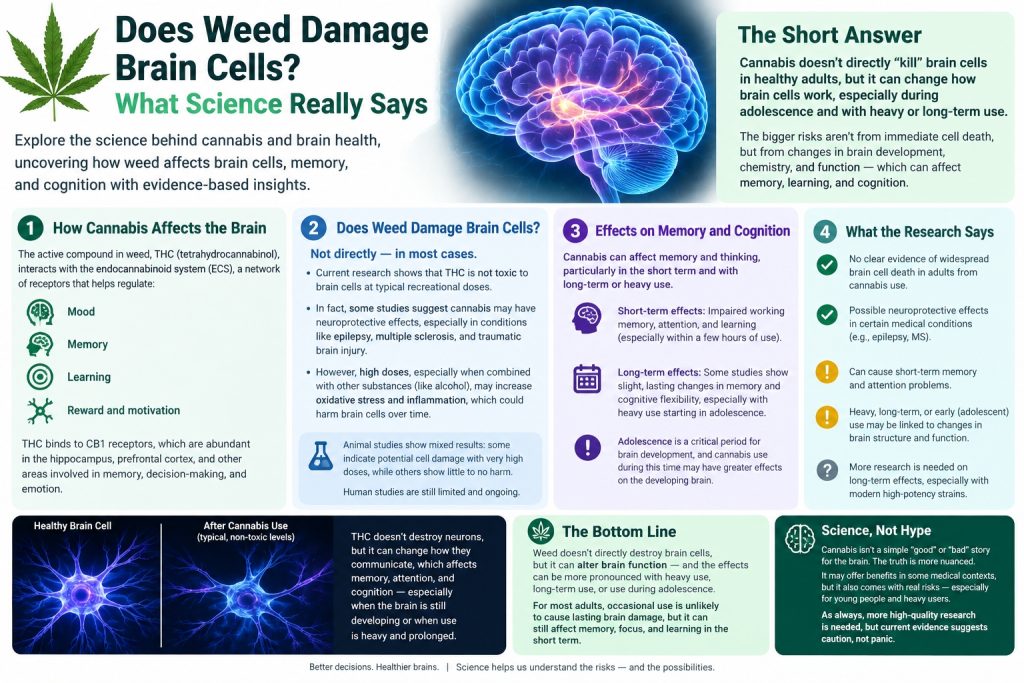
The short answer: does weed damage brain cells?
There’s no convincing evidence that ordinary cannabis use simply destroys large numbers of human brain cells. That familiar claim reduces a complicated biological question to a bumper sticker.
Still, “not proven to kill neurons” doesn’t mean “harmless.” THC changes signalling in brain networks involved in learning, memory, reward, movement, and decision-making. The resulting impairment may be temporary, but frequent exposure can become consequential, particularly with high doses, early initiation, or an underlying vulnerability to addiction or psychosis.
Killing brain cells vs. changing brain function: an important distinction
A neuron doesn’t have to die for a drug to affect how well you function. THC can change neurotransmitter release and interfere with communication among living neurons. Think of it less like smashing your phone and more like scrambling its signal: the hardware remains, yet messages arrive late or not at all.
Scientists distinguish neurotoxicity, meaning direct cellular injury or death, from changes in synaptic activity, network efficiency, or behaviour. Cannabis clearly produces the latter during intoxication. Whether prolonged, heavy exposure causes subtle structural or enduring functional changes in some people remains under investigation.
What human research establishes, and what remains uncertain
Controlled studies reliably show acute impairment in memory, attention, reaction time, and coordination. Observational studies also connect heavier use with poorer cognitive performance and certain mental health outcomes. Confidence drops when researchers ask whether cannabis caused permanent biological injury.
Why? Randomly assigning teenagers to use potent cannabis for years would be unethical. Researchers hence rely heavily on observational cohorts, self-reported histories, and brain imaging. These tools are valuable but can’t eliminate every confounder. The fairest conclusion is that cannabis can impair brain function, while claims of widespread neuron death in humans go beyond the available evidence.
How cannabis affects the brain
Cannabis produces its effects by interacting with a regulatory network already present in your body. The experience depends on the plant’s chemical profile, THC dose, route of administration, previous exposure, biology, and setting. One person may feel relaxed after a low dose: another may become disoriented or panicky.
Effects also aren’t limited to the stereotypical “high.” Cannabis may alter sensory perception, appetite, pain processing, mood, time perception, motivation, and sleepiness. Dose matters enormously, and labels on unregulated products may be inaccurate.
THC, CBD, and the endocannabinoid system
Your endocannabinoid system helps regulate memory, stress responses, appetite, pain, movement, and other processes. Its CB1 receptors are abundant in areas such as the hippocampus, cerebral cortex, basal ganglia, and cerebellum.
THC partially activates CB1 receptors, changing neurotransmitter release. This helps explain altered memory, coordination, and perception. CBD acts differently and doesn’t cause the same classic intoxication, but its pharmacology is complex: it can also interact with medications.
CBD may modify some THC effects under particular experimental conditions, yet it isn’t a dependable antidote. Product ratios, dose, timing, and individual biology all matter. A gummy labelled “CBD-rich” can still impair you if it contains meaningful THC.
Short-term effects of weed on thinking and behaviour
Short-term cognitive effects are among the best-established findings in cannabis research. They usually begin within minutes after inhalation and later after eating THC. Duration varies: an edible can affect you for many hours, even after the obvious high fades.
How impaired you become depends on dose, tolerance, product potency, and whether you combine cannabis with alcohol or sedating drugs. Feeling normal isn’t proof that reaction time or judgment has fully recovered.
Memory, attention, and learning while intoxicated
THC can make it harder to encode new memories, sustain attention, manipulate information in working memory, and learn unfamiliar material. You may follow a conversation in the moment but discover later that the details never properly “saved.” Anyone who has reread the same paragraph four times knows the vibe.
This doesn’t necessarily mean neurons died. It reflects disrupted signalling, especially in memory-related networks involving the hippocampus. Familiar or automatic tasks may feel easier than complex ones, but confidence can outpace performance. Studying, operating equipment, managing medication, or making financial decisions while high is hence a poor bet.
Reaction time, coordination, judgment, and driving safety
Cannabis can slow responses, impair lane control, distort distance or time estimates, and weaken divided attention. Those deficits matter behind the wheel, where you must monitor mirrors, pedestrians, speed, and unexpected hazards simultaneously.
Health Canada’s cannabis and driving guidance warns that cannabis can impair skills needed for safe driving, and drug-impaired driving is a criminal offence in Canada. Combining THC and alcohol is especially risky because their effects may compound.
There’s no universal waiting period guaranteeing safety after use. Edibles complicate timing, and blood THC levels don’t map neatly onto impairment. The practical rule is uncomplicated: if you’ve used an intoxicating product, don’t drive. Arrange a sober ride before consuming, not halfway through the evening when planning has become suspiciously philosophical.
Long-term cannabis use: what studies show about brain health
Long-term findings are mixed rather than reassuringly blank or uniformly alarming. Some studies identify small cognitive differences among frequent users: others find that differences shrink after abstinence or careful adjustment for background factors.
Risk isn’t evenly distributed. Daily high-THC use beginning at 15 is a different exposure from occasional low-dose use beginning at 35. Unfortunately, headlines often place both under one vague label: “marijuana use.”
Persistent cognitive difficulties and claims about IQ decline
A well-known New Zealand cohort linked persistent cannabis dependence, particularly when use began during adolescence, with decline across several cognitive domains. That study attracted “weed lowers IQ” headlines, but later research has complicated the story.
Studies of twins and longitudinal cohorts suggest family background, genetics, education, and other substance use explain at least part of the association. Reviews generally find small average deficits among long-term heavy users, with verbal learning and memory commonly implicated. Some improve after abstinence.
So, does cannabis permanently reduce everyone’s IQ? Evidence doesn’t support that sweeping claim. But repeated heavy exposure may contribute to meaningful difficulties for some people, especially when it disrupts school, sleep, or sustained learning during adolescence.
Brain volume and connectivity: what imaging can and cannot prove
MRI studies have reported differences in regions involved in memory, reward, and emotional processing, including the hippocampus and amygdala. Other studies find minimal differences after accounting for alcohol use, sex, mental health, and intracranial volume. Results vary by sample and method.
A scan showing a statistical difference doesn’t establish dead cells, irreversible damage, or even reduced real-world ability. Brain structure naturally varies, and imaging can’t always determine whether a difference preceded cannabis use.
Functional imaging also finds altered activation or connectivity during cognitive tasks. That may indicate adaptation, inefficiency, compensation, or a preexisting trait. Brain scans are powerful research tools, not tiny courtroom cameras recording causation.
Psychosis and other mental health risks are distinct from brain cell death
Cannabis use is associated with psychotic experiences and psychotic disorders, with higher risk linked to frequent use, potent THC products, and earlier initiation. People with personal or family vulnerability may face greater risk. Cannabis can also provoke acute paranoia, panic, or hallucinations at high doses.
Psychosis isn’t evidence that neurons were killed. It’s a clinical syndrome involving perception, thinking, and behaviour. Keeping these concepts separate prevents both minimization and fearmongering.
Evidence concerning depression and anxiety is less straightforward because people may use cannabis to cope with symptoms already present. Nevertheless, if weed repeatedly worsens your mood, triggers panic, or makes you suspicious of others, that reaction deserves attention, not another experiment with a stronger strain.
Why association is not causation, and animal findings do not directly establish human harm
People who use cannabis frequently may differ from nonusers in sleep, stress, income, childhood adversity, tobacco exposure, or access to healthcare. Researchers adjust for measured differences, but unknown or poorly measured factors can remain. Reverse causation matters too: attention problems may encourage substance use rather than result from it.
Animal and cell studies permit tighter control and can reveal plausible biological mechanisms. Yet rodents receive doses under conditions that don’t perfectly resemble human use, and a petri dish isn’t a person.
These findings shouldn’t be dismissed: they help identify risks worth testing. But they also shouldn’t be translated directly into “cannabis kills human brain cells.” Human clinical conclusions require human evidence.
Does age change the risks of cannabis use?
Age changes both your baseline vulnerability and the practical consequences of impairment. A teenager is building academic and social foundations, while an older adult may be balancing medications, fall risk, and age-related changes in drug metabolism.
Across both groups, evidence is limited by inconsistent doses and products. Still, researchers are especially cautious about adolescent exposure because brain development continues into young adulthood.
Teenagers and young adults: cannabis and the developing brain
The adolescent brain is refining connections involved in planning, impulse control, learning, and emotional regulation. THC exposure during this period could interfere with those processes, although precisely how much impairment is caused directly by cannabis remains debated.
Earlier and more frequent use correlates with worse educational outcomes, cannabis dependence, and certain cognitive or psychiatric risks. School absence and reduced engagement can also create an indirect pathway: even temporary memory impairment matters if it repeatedly occurs during algebra class.
The Canadian Paediatric Society advises that youth should not use cannabis recreationally. Delaying initiation is a practical risk-reduction step, particularly when there’s a family history of psychosis or substance use disorder.
Middle-aged and older adults: cognition, aging, and evidence gaps
Research on older cannabis users is thinner, despite rapidly increasing interest in cannabis for pain, sleep, and other symptoms. Aging can change sensitivity to THC, balance, cardiovascular responses, and medication metabolism.
For an older adult, short-term dizziness or slowed reaction time may translate into a fall, driving collision, or medication error. THC and CBD can also interact with drugs processed by liver enzymes, including some blood thinners, seizure medications, and sedatives.
Evidence hasn’t established that cannabis accelerates normal cognitive aging, but it hasn’t proved protection either. If you notice new confusion or memory loss, don’t assume cannabis, or age, is the entire explanation. Medication effects, sleep apnea, thyroid problems, depression, infection, and neurological illness may need evaluation.
Which patterns of cannabis use may increase risk?
Cannabis risk works more like a dimmer switch than an on/off button. Frequency, potency, dose, age of initiation, product reliability, and co-use with other substances all influence the outcome.
A useful self-check is to document what you use, how much, when, and what happens afterward. “One dab” isn’t a standardized dose: neither is “half a brownie my friend made,” a sentence that has launched many uncomfortable evenings.
Frequent use, high THC doses, and potent concentrates
Daily or near-daily use creates repeated periods of impairment and increases the likelihood of tolerance, withdrawal, and cannabis use disorder. High-THC products also raise the odds of anxiety, vomiting, paranoia, and severe disorientation.
Concentrates marketed as wax, shatter, resin, or distillate may contain dramatically more THC than traditional flower. A person accustomed to a low-potency joint can be overwhelmed by a dab or concentrated vape.
Product labels should state THC in milligrams or concentration, but accuracy varies outside regulated markets. Beginners are safer avoiding concentrates and high-dose edibles altogether. More THC isn’t necessarily more therapeutic or enjoyable: sometimes it’s simply more regret per dollar.
Smoking vs. vaping vs. edibles: different routes do not eliminate cognitive risks
Changing delivery methods changes certain hazards, not THC’s fundamental capacity to impair cognition.
| Route | Typical concern | Common beginner pitfall |
|---|---|---|
| Smoking | Combustion products and rapid intoxication | Taking repeated inhalations before effects peak |
| Vaping | High potency: contaminants in illicit products | Assuming vapour is harmless |
| Edibles | Delayed onset and long duration | Redosing too soon |
Edibles may take 30 minutes to two hours, or longer, to feel fully active, depending on food, metabolism, and formulation. Inhaled effects arrive faster but can still be stronger than expected. None of these routes makes driving or complex work safe while intoxicated.
Alcohol, tobacco, sleep, and other factors that complicate the evidence
Alcohol commonly accompanies cannabis and can worsen impairment. Tobacco brings independent cardiovascular, respiratory, and cognitive health risks. Poor sleep can produce the same foggy attention and memory complaints users sometimes attribute entirely to weed.
Mental health symptoms, ADHD, chronic pain, medications, and socioeconomic stress can influence both cannabis use and cognitive performance. Good research tries to adjust for these variables, but self-reports aren’t perfect, and lifetime exposure is difficult to reconstruct.
For your own informal test, change one variable at a time. A two- to four-week cannabis break accompanied by a simple sleep and symptom diary can reveal more than switching strains every three days and hoping “Purple Something” solves the mystery.
Synthetic cannabinoids such as K2 and Spice: why their risks differ
K2 and Spice aren’t merely extra-strong cannabis. They are shifting mixtures of laboratory-made chemicals sprayed onto plant material or sold in liquids. Many activate cannabinoid receptors more powerfully and unpredictably than THC.
Synthetic cannabinoids have been linked to seizures, extreme agitation, psychosis, kidney injury, cardiovascular emergencies, coma, and death. Packaging may omit ingredients, and two packets with the same branding may contain different compounds.
The evidence about ordinary cannabis cannot be used to declare these products safe. If someone develops seizures, collapses, has chest pain, becomes dangerously agitated, or can’t be awakened after using one, call 911 immediately.
Can memory and brain function improve after stopping weed?
Often, yes. Acute impairment fades as THC’s intoxicating effects resolve, and research suggests at least some cognitive differences associated with frequent use improve during abstinence. Recovery isn’t identical for everyone, though.
Improvements can be hard to notice during early withdrawal, when poor sleep and irritability temporarily make concentration feel worse. That uncomfortable stretch can create the illusion that cannabis was helping everything when it may have been relieving withdrawal between uses.
Recovery timelines: intoxication, withdrawal, and longer-term improvement
After inhalation, obvious intoxication often subsides within several hours, though subtle impairment may persist. Edibles can last much longer. With frequent use, withdrawal commonly begins within one or two days and may include irritability, anxiety, sleep disruption, reduced appetite, restlessness, and vivid dreams.
Symptoms often peak during the first week and improve over the following weeks. Memory and attention may also improve over days to several weeks of abstinence, but studies report variable timelines.
Try a structured break rather than relying on impressions: record sleep, mood, cravings, mistakes, and concentration for 30 days. If stopping feels unmanageable, that’s useful clinical information, not a character failure.
Persistent brain fog or memory problems: when to seek medical evaluation
Talk with a healthcare professional if cognitive problems persist after intoxication and withdrawal should have passed, worsen progressively, or interfere with work, school, medication use, or personal safety.
Seek assessment sooner when symptoms include:
- Getting lost in familiar places
- New difficulty speaking, walking, or using one side of your body
- Fainting, seizures, or a severe sudden headache
- Hallucinations or paranoia that continue when sober
- Major personality change or inability to manage basic tasks
Sudden neurological symptoms can signal an emergency: call 911. For gradual brain fog, bring a list of cannabis products, doses, medications, sleep patterns, and other substances to your appointment. Honest details help clinicians, no moral lecture required.
How to reduce cannabis-related risks and get support
The lowest-risk option is not using cannabis, especially if you’re underage (19 in most provinces and territories, 18 in Alberta, 21 in Quebec), pregnant, driving, or vulnerable to psychosis. If you do use, practical boundaries can reduce, though not erase, harm.
This isn’t about winning a purity contest. The goal is to protect your memory, relationships, safety, and ability to do tomorrow’s tasks without wondering why your car keys are in the refrigerator.
Avoiding use, reducing exposure, and protecting sleep and daily functioning
Useful steps include:
- Delay or avoid use, particularly before age 25.
- Choose lower-THC products and avoid concentrates.
- Don’t mix cannabis with alcohol, opioids, benzodiazepines, or other sedatives.
- Never drive, swim alone, supervise children, or operate machinery while impaired.
- Store products locked away from children and pets.
- Schedule cannabis-free days and track whether your tolerance is increasing.
- Protect consistent sleep, meals, exercise, and morning responsibilities.
If you use cannabis medically, discuss cognitive effects and alternatives with the health care practitioner who authorized it. Don’t abruptly change prescribed treatment without guidance.
Signs of cannabis use disorder and symptoms that require urgent care
Warning signs include craving, unsuccessful efforts to cut down, increasing tolerance, withdrawal, hazardous use, and continuing despite school, work, relationship, or health consequences. Health Canada notes that some people who use cannabis develop cannabis use disorder.
Support may include a primary-care clinician, addiction specialist, cognitive behavioural therapy, motivational enhancement therapy, or mutual-help groups. In Canada, Health Canada’s Get help with substance use page lists free national and provincial services, including Drug Rehab Services (1-877-254-3348) for confidential referrals.
Call 911 for severe confusion, trouble breathing, chest pain, seizures, loss of consciousness, dangerous behaviour, or persistent psychosis. If you or someone else may attempt suicide, call or text 9-8-8, the Suicide Crisis Helpline.
Frequently asked questions about weed and brain cells
The questions below separate common fears from findings that are actually supported. Individual risk still varies, so unusual or severe symptoms deserve personalized medical advice.
Can trying weed once cause permanent brain damage?
Permanent brain injury from trying ordinary cannabis once is not the expected outcome, and evidence doesn’t show that a typical single exposure routinely kills brain cells. One use can still cause serious short-term harm through panic, psychosis-like symptoms, vomiting, falls, unsafe behaviour, or a crash.
Risk rises with an unexpectedly large edible dose, a potent concentrate, contaminants, synthetic cannabinoids, or a coexisting heart or psychiatric condition. Children who accidentally eat cannabis can become severely ill and require urgent evaluation.
If symptoms are intense, contact your poison centre at 1-844-POISON-X (1-844-764-7669) (in Quebec, 1-800-463-5060): call 911 for collapse, seizure, breathing difficulty, or inability to wake.
Does cannabis use increase the risk of dementia?
Current research doesn’t establish that cannabis causes, or prevents, Alzheimer’s disease or other dementias. Studies of older adults are relatively limited, exposure is difficult to measure, and cannabis users may differ from nonusers in important ways.
Laboratory findings about cannabinoids and inflammation are sometimes marketed as proof of dementia prevention. They aren’t. A biological effect in cells or animals doesn’t demonstrate that dispensary products preserve human memory.
Meanwhile, intoxication can mimic or worsen everyday cognitive problems, and frequent use may obscure early symptoms. If you’re forgetting appointments, repeating questions, mishandling finances, or becoming lost, arrange a medical evaluation rather than self-treating with THC or CBD.
Does CBD protect the brain from THC-related effects?
CBD may moderate certain THC effects in some studies, but results depend on dose, ratio, timing, and route. Commercial “balanced” products aren’t guaranteed to prevent memory impairment, anxiety, or psychosis-like reactions.
CBD itself can cause sleepiness, diarrhea, appetite changes, and medication interactions. Products sold without rigorous oversight may contain more THC, or less CBD, than their labels indicate. Health Canada’s review of cannabidiol outlines unresolved safety questions.
Treat CBD as an active compound, not a magical helmet for the brain. If THC repeatedly causes unpleasant or impairing effects, adding CBD isn’t as reliable as reducing or avoiding THC.
Scientific sources and evidence limitations
The strongest conclusions come from combining controlled experiments, longitudinal cohorts, systematic reviews, and public-health surveillance. Each answers a different question. Controlled trials clarify immediate effects but are usually short: cohorts observe real life but can’t fully remove confounding: imaging detects differences without automatically explaining their cause or significance.
Useful starting points include the Canadian Centre on Substance Use and Addiction’s Clearing the Smoke on Cannabis: Regular Use and Cognitive Functioning, Health Canada’s information for health care professionals on cannabis and cannabinoids, and Health Canada’s overview of the health effects of cannabis. These organizations update guidance as evidence develops.
Major limitations remain: THC potency and dose are often estimated poorly: self-reported use can be inaccurate: CBD content varies: illicit products may be contaminated: and many studies don’t adequately separate occasional adult use from early, daily use. Research also disproportionately reflects smoked cannabis, while concentrates and modern edibles have changed the marketplace.
So, does weed damage brain cells? Science doesn’t support the simplistic claim that standard cannabis use routinely kills neurons. It does show that THC can impair how your brain functions, sometimes severely, and that frequent high-potency use, particularly during adolescence, carries greater cognitive, addiction, and psychiatric risks.
Your most useful next step is personal and concrete: notice the dose, frequency, timing, and consequences. If cannabis is interfering with memory, sleep, school, work, driving, or relationships, reduce exposure and ask for help. You don’t need proof of dead brain cells before taking a problem seriously, and you don’t need to face it alone.