
Blog 2026
High THC Strains: 10 Potent Picks and Safety Tips
Nov
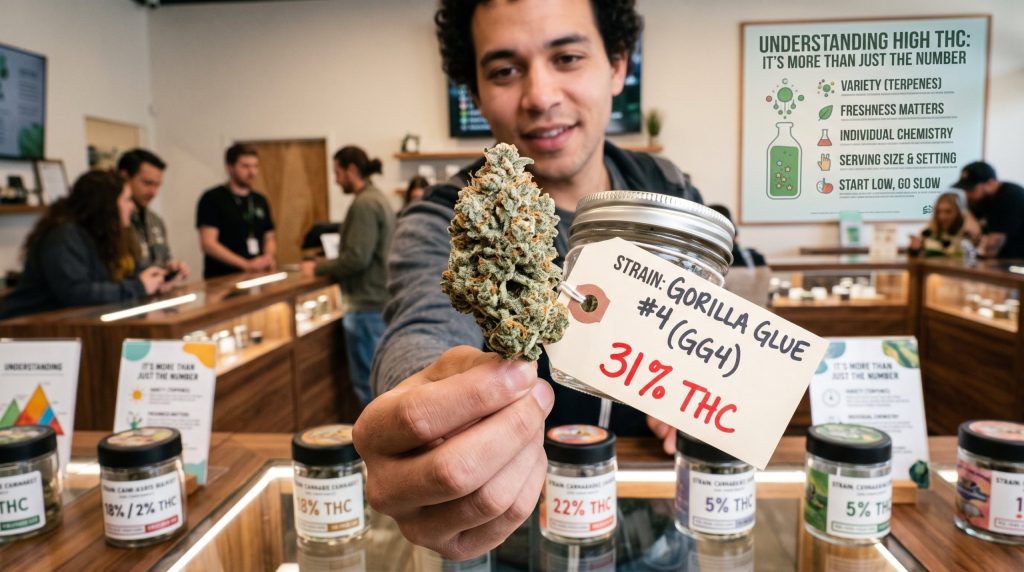
A frosty bud labelled 31% THC can look like the obvious winner in a dispensary display. Bigger number, stronger experience, right? Not necessarily. Cannabis is more like coffee than rocket fuel: the number on the package matters, but variety, freshness, serving size, body chemistry, and setting can completely change how it feels.
This review examines high THC strains commonly sold in Canada, including their reported lab ranges, dominant terpenes, likely effects, and practical use cases. It focuses on flower rather than recommending a specific grower or batch. Because strain names aren’t standardized and test results vary, the ranges below are guideposts, not potency guarantees. No producer paid for placement, and there are no affiliate relationships influencing the selections.
You’ll find familiar heavy hitters such as Gorilla Glue #4, Wedding Cake, Bruce Banner, Gelato #41, and GMO Cookies. More importantly, you’ll learn why a fresh 23% flower with a rich terpene profile may feel better, or even stronger, than dry flower claiming 30%. That’s useful when you’re standing beneath fluorescent dispensary lights while a menu scrolls past faster than you can decode it.
Potent cannabis also deserves respect. High THC can cause anxiety, dizziness, impaired coordination, nausea, or a racing heartbeat, particularly if you’re new to cannabis or redose too quickly. It can impair driving and may interact with medications. This article provides education and harm-reduction guidance, not medical advice: discuss therapeutic use with a cannabis-informed clinician.
The goal isn’t to crown one strain as the universal strongest. It’s to help you read the evidence, recognize marketing hype, choose for your actual goal, and use less while getting a more predictable result. Let’s start with the short version.
Key Takeaways
- High THC strains generally start at around 20% THC, with over 25% considered very potent and requiring cautious use.
- THC percentage alone doesn’t determine the experience; terpenes, minor cannabinoids, freshness, dose, tolerance, and setting deeply influence effects.
- Always check the certificate of analysis (COA) for batch-specific data on THC, terpenes, and contaminant tests before purchasing high THC strains.
- Start with a small dose—one inhalation for flower—and wait 10–15 minutes before consuming more to avoid adverse effects like anxiety or dizziness.
- Choose high THC strains based on your desired effects, such as relaxation, creativity, or energy, considering their terpene profiles and sativa/indica leanings.
- Store cannabis properly in airtight containers away from light and heat to maintain high THC potency and flavour over time.
Key takeaways: choosing high THC strains safely
If you remember only a few things while shopping, make them these:
- “High THC” generally starts around 20% in flower. Products above 25% are very potent: verified results above 30% are unusual and deserve closer inspection.
- THC percentage doesn’t predict your entire experience. Terpenes, minor cannabinoids, tolerance, dose, and mood matter.
- Buy the batch, not merely the strain name. Review the certificate of analysis (COA), package date, terpene content, and contaminant results.
- One inhalation may be enough. Wait 10–15 minutes before deciding whether you need another.
- Edibles require a different plan. Beginners should consider 1–2.5 mg THC and wait at least two to three hours before taking more.
- Don’t drive or mix THC with alcohol. Store every product away from children and pets.
The best high THC strains aren’t automatically those with the largest printed number. Your best choice is the product that has credible testing, good freshness, a suitable chemical profile, and effects that match your plans.
What counts as “high THC” (and what’s considered very high)?
There’s no universal legal definition of “high THC” flower. In modern licensed markets, but, flower testing at 20% THC or more is commonly marketed as high potency. Context matters: cannabis flower from past decades generally contained much less THC, while selective breeding and intensive cultivation have pushed today’s retail numbers upward.
THC % tiers (20–24%, 25–29%, 30%+): what to realistically expect
| Label result | Practical interpretation | Sensible approach |
|---|---|---|
| 20–24% | High potency for most consumers | One small inhalation, then pause |
| 25–29% | Very high potency | Best approached cautiously, even with experience |
| 30%+ | Exceptional flower or a result worth verifying | Check the COA, test date, and calculation method |
A label showing 25% total THC means roughly 250 mg per gram before losses from combustion, incomplete inhalation, and absorption. It does not mean your body receives 250 mg from smoking the gram.
Also check whether the package lists THCA, delta-9 THC, or total THC. Raw flower contains mostly THCA, which converts into intoxicating THC when heated. Laboratories commonly estimate total THC with this formula:
Total THC = delta-9 THC + (THCA × 0.877)
That conversion factor accounts for molecular weight lost during decarboxylation.
Lab testing basics: batch variation, COAs, and why labels differ
Two jars bearing the same strain name can test several percentage points apart. Genetics establish potential, but light intensity, nutrients, harvest timing, curing, storage, and even the sampled portion of a plant influence the result.
A COA should connect to the exact lot or batch number on your package. It typically reports cannabinoids, terpenes, and screening results for pesticides, microbes, mycotoxins, heavy metals, or residual solvents, depending on the product and the lab.
Results also differ because laboratories use different instruments, sampling procedures, and moisture corrections. A dry sample can produce a higher percentage by weight without containing more total resin. Treat a suspiciously precise claim, say, 34.72%, as one measurement with uncertainty, not a sacred number carved into a stone tablet.
Does THC percentage equal a stronger high?
THC percentage affects potency, but it isn’t a reliable one-number forecast of subjective intensity. In a University of Colorado study of cannabis potency, concentrate users developed much higher blood THC levels than flower users without reporting proportionally greater intoxication. That doesn’t make potency irrelevant: it shows that human response isn’t a simple fuel gauge.
A lower-testing flower may feel more satisfying because it’s fresh, aromatic, and chemically balanced. Conversely, a dry 30% batch with little aroma can produce a blunt, short-lived experience.
Entourage effect: terpenes + cannabinoids that change perceived potency
The “entourage effect” proposes that cannabinoids and aromatic compounds interact to shape cannabis effects. It’s plausible and widely reported by consumers, but clinical evidence remains incomplete. Terpenes shouldn’t be treated as guaranteed prescriptions for sleep, focus, or pain.
Still, they’re useful shopping clues:
- Myrcene: earthy, musky, sometimes associated with heavier relaxation
- Limonene: citrus aroma and a brighter perceived character
- Caryophyllene: peppery or woody: unusual because it interacts with CB2 receptors
- Pinene: pine aroma, often described as clear or alert
- Linalool: floral and lavender-like, commonly associated with calm
Minor cannabinoids such as CBD, CBG, and CBC may also alter the overall profile. A strain containing some CBD can feel less sharp than THC-dominant flower, although it won’t reliably “cancel” intoxication.
Tolerance, set/setting, and consumption method (flower vs vape vs edibles)
Your tolerance may matter more than a five-point difference on the label. Someone using cannabis daily can experience 28% flower as manageable, while a first-time consumer may find one draw of 18% flower overwhelming.
“Set and setting” matters too. The same strain can feel playful at home with friends and uncomfortable in a noisy crowd when you’re already stressed. Sleep, food, expectations, and alcohol use can shift the experience.
Method changes the timeline:
- Inhaled flower or vapour: effects begin within minutes and are easier to titrate.
- Concentrate vapes: often contain 70–90% THC and can deliver a large dose quickly.
- Edibles: take longer, last longer, and produce 11-hydroxy-THC in the liver, which many people experience as more intense.
In other words, “just one gummy” isn’t a dose. Milligrams are.
Top high THC strains (lab-tested ranges, effects, flavour, and best for)
The ranges below reflect commonly reported retail results, not promises. Any named cultivar can fall outside its typical range, and effects are based on consumer reports plus known chemistry, not clinical guarantees. Availability varies by province, and the legal age is 19 in most of Canada, 18 in Alberta and 21 in Quebec.
| Strain | Common THC range | General direction | Signature notes |
|---|---|---|---|
| GG4 | 20–28% | Heavy hybrid | Diesel, earth, chocolate |
| Wedding Cake | 20–27% | Relaxing hybrid | Vanilla, pepper, dough |
| Bruce Banner | 20–29% | Uplifting hybrid | Berry, diesel |
| Gelato/#41 | 20–27% | Balanced hybrid | Sweet citrus, cream |
| Ghost Train Haze | 20–27% | Sativa-leaning | Citrus, floral, haze |
| GMO Cookies | 22–30% | Heavy hybrid | Garlic, fuel, earth |
| White Tahoe Cookies | 20–28% | Indica-leaning | Nutty, earthy, citrus |
| Triangle Kush | 20–26% | Indica-leaning | Pine, lemon, fuel |
| Kosher Kush | 20–29% | Indica-leaning | Earth, spice, fuel |
| Silver Haze | 18–24% | Sativa-leaning | Citrus, herbs, haze |
Gorilla Glue #4 (GG4), typical THC range, effects, and terpene profile
Also sold as Original Glue for trademark reasons, GG4 commonly tests around 20–28% THC. Its name hints at its sticky resin, and at the tendency to glue you to the sofa if you overshoot.
Caryophyllene, myrcene, and limonene often dominate, creating diesel, damp earth, cocoa, and sour notes. Consumers commonly report an initially euphoric mood followed by substantial body relaxation. It may suit an unhurried evening, but it’s a poor match for a beginner trying to stay sharp at a dinner party. Dry mouth and heavy eyelids are common complaints.
Wedding Cake, typical THC range, effects, and terpene profile
Wedding Cake, sometimes linked to Triangle Mints genetics, often lands between 20% and 27% THC. Don’t expect literal birthday frosting: good batches combine sweet dough and vanilla with pepper, earth, and tangy fuel.
Limonene and caryophyllene frequently lead, with myrcene appearing prominently in some batches. The experience is often described as cheerful and mentally hazy before settling into physical calm. It’s a popular after-dinner option for relaxing, listening to music, or watching a movie you may need to rewind. Consumers sensitive to racing thoughts should keep the first dose small.
Bruce Banner, typical THC range, effects, and terpene profile
Bruce Banner commonly tests around 20–29% THC, with occasional batches reaching higher. Descended from OG Kush and Strawberry Diesel, it tends to smell of berries, citrus, and pungent fuel.
Myrcene, caryophyllene, and limonene are frequently reported. Even though the comic-book name, the experience isn’t always pure smash-and-sleep. Many consumers describe fast cerebral uplift, talkativeness, or creative momentum followed by looser body effects. It may fit an art project or relaxed social afternoon, provided your tolerance is established. At larger doses, that upbeat launch can become distraction or anxiety.
Gelato (incl. Gelato #41), typical THC range, effects, and terpene profile
Gelato phenotypes usually appear near 20–27% THC. Gelato #41 is especially popular, although menus sometimes use “Gelato” loosely for related genetics or crosses. Verify the producer and batch rather than assuming every colourful jar is identical.
Caryophyllene, limonene, and myrcene commonly deliver creamy berry, orange peel, lavender, and pepper notes. Effects are often described as balanced: a warm mental lift without immediately sacrificing the ability to hold a conversation. Higher servings can turn that balance toward sedation. It’s a versatile evening hybrid, especially when you want relaxation without an instant date with the couch.
Ghost Train Haze, typical THC range, effects, and terpene profile
Ghost Train Haze typically tests around 20–27% THC and has a reputation for forceful, sativa-leaning effects. Terpinolene, limonene, and myrcene may contribute sharp citrus, floral herbs, pine, and classic incense-like haze.
Many experienced consumers report energetic, imaginative, or intensely cerebral effects. That can work for hiking, music, or brainstorming, but only when impairment won’t create risk. If you’re prone to anxiety, panic, or overstimulation, this may be the wrong train to board. Choose a calmer cultivar or take one very small inhalation in familiar surroundings.
GMO Cookies, typical THC range, effects, and terpene profile
GMO Cookies, also called Garlic Cookies, often falls between 22% and 30% THC. It doesn’t contain genetically modified organisms: “GMO” is a cultivar nickname commonly interpreted as Garlic, Mushroom, Onion.
Caryophyllene, limonene, and myrcene frequently create a loud mixture of garlic, soil, skunk, and diesel. Subtle it is not. Effects are usually described as powerful, euphoric, and physically weighty, making GMO better suited to late evenings than a packed schedule. Odour-conscious consumers should also plan storage carefully. A flimsy sandwich bag will surrender immediately.
White Tahoe Cookies, typical THC range, effects, and terpene profile
White Tahoe Cookies commonly tests around 20–28% THC. Genetics vary by source, but it’s generally associated with The White, Tahoe OG, and Girl Scout Cookies lineage.
Its terpene profile often emphasizes limonene, caryophyllene, and myrcene, producing earthy nuts, citrus, herbs, and fuel. Consumers tend to report a quick mood lift that develops into soothing, sometimes sleepy body effects. It may suit quiet evenings or low-key entertainment. Because the onset can feel deceptively manageable, wait before taking a second hit: this strain has a habit of arriving late to the meeting and then taking over the agenda.
Triangle Kush, typical THC range, effects, and terpene profile
A Florida-associated cultivar with old-school mystique, Triangle Kush usually tests near 20–26% THC. Its exact history is debated, but it’s widely connected to OG Kush genetics and Southern Florida cannabis culture.
Limonene, myrcene, and caryophyllene commonly support aromas of lemon cleaner, pine, soil, and gasoline. The experience is often calm, euphoric, and body-forward without always producing immediate sleepiness. It can suit an evening wind-down or a familiar creative hobby. Potent batches may cloud short-term memory, so finish precision work, and locate the snacks, before consuming.
Kosher Kush, typical THC range, effects, and terpene profile
Kosher Kush frequently lands around 20–29% THC and is known for a deeply pungent mix of earth, spice, pine, and fuel. The name is branding, not a guarantee that the product was prepared under religious kosher certification.
Myrcene and caryophyllene often feature heavily, with limonene providing brightness. Consumers commonly describe strong physical relaxation, appetite stimulation, and drowsiness. It’s best considered an end-of-day cultivar when you don’t need to drive, work, or negotiate anything more complicated than choosing a streaming show. New consumers should treat it as advanced-level flower.
Silver Haze, typical THC range, effects, and terpene profile
Silver Haze often tests around 18–24% THC, putting some batches below today’s flashy “ultra-potent” category. Yet it remains a useful reminder that a well-grown 21% strain can feel plenty strong.
Terpinolene, myrcene, pinene, and caryophyllene may produce citrus, herbs, pepper, and incense. Reported effects lean lively, conversational, and mentally stimulating, with less body heaviness than GMO or Kosher Kush. It may fit daytime creative tasks for experienced consumers, but high servings can make focus scatter rather than sharpen. More THC isn’t a productivity cheat code, sadly.
High THC strains by type: sativa vs indica vs hybrid (what to expect)
The familiar sativa/indica system is useful retail shorthand, but it doesn’t reliably predict chemistry. Modern cultivars are extensively hybridized, and two “indicas” can contain very different terpene and cannabinoid profiles. Use the category as a starting direction, then inspect the batch COA and ask how the product was grown and cured.
High-THC sativa-leaning picks (energy, focus, anxiety considerations)
Ghost Train Haze, Silver Haze, and some Bruce Banner batches are common sativa-leaning options. They’re often chosen for social energy, music, outdoor activity, or creative work.
That “up” quality can have a jagged edge. High doses may produce racing thoughts, restlessness, or intense awareness of your heartbeat. If anxiety is familiar territory, prioritize a moderate THC level, some CBD, and calmer terpenes rather than selecting the highest number. Consume at home first, not five minutes before entering a crowded concert.
High-THC indica-leaning picks (sleep, body effects, couch-lock risk)
Kosher Kush, Triangle Kush, White Tahoe Cookies, and heavier GMO batches generally lean toward physical relaxation. Consumers often choose them when the day is finished and sleep is approaching.
Still, “indica” doesn’t guarantee sleep, and cannabis can alter sleep architecture even when it helps you fall asleep. Too much may also cause dizziness, next-morning grogginess, or couch-lock. If you need to wake at 6 a.m., test a very small amount on a low-stakes evening rather than conducting the experiment before an important presentation.
High-THC hybrids (balanced effects and how to choose a direction)
GG4, Wedding Cake, Gelato, and Bruce Banner are broadly sold as hybrids, but “balanced” doesn’t mean mild. Look beyond the category: limonene-forward Gelato may feel brighter, while myrcene-rich GG4 may land more heavily.
Choose direction based on your goal and schedule. For conversation or creative play, seek citrus, pine, or terpinolene notes and use a tiny dose. For settling in, earthy myrcene- or caryophyllene-rich flower may be more suitable. The budtender’s description helps, but your own notes from previous batches are more valuable over time.
How to pick the right high THC strain for your goal
Start with the outcome you want, then work backward through chemistry, dose, and timing. Don’t choose 30% flower simply because it seems like better value. If one inhalation leaves you uncomfortable, the extra potency bought you nothing.
For relaxation/sleep vs pain relief vs creativity vs social energy
For relaxation or bedtime, consider myrcene- and caryophyllene-rich batches of Kosher Kush, GMO, or White Tahoe Cookies. Use them well before you need to sleep so you can assess the response.
For creativity or social energy, a modest serving of Bruce Banner, Silver Haze, or Gelato may feel more flexible. Ghost Train Haze is an experienced-user choice because its stimulation can become anxiety.
For pain, evidence supports certain cannabinoid medicines for some chronic pain conditions, but strain-level claims are much weaker. THC can reduce perceived discomfort for some people while worsening dizziness or function for others. Consult a clinician, particularly if you use sedatives, anticoagulants, or heart medication. Health Canada’s information for health care professionals on cannabis and cannabinoids provides an evidence-focused overview.
Terpene-led selection: myrcene, limonene, caryophyllene, pinene
Instead of asking only for “the strongest,” try: “What’s fresh, above 1.5% total terpenes, and rich in limonene?” That question often produces a better recommendation.
- Choose myrcene when you enjoy earthy fruit and heavier relaxation.
- Try limonene for citrus aroma and a brighter character.
- Consider caryophyllene for peppery, fuel-like depth.
- Look for pinene when you prefer crisp pine and a clearer sensory profile.
These are tendencies, not medical promises. Keep a simple log with strain, producer, THC, top three terpenes, dose, and effect. After four or five sessions, your pattern will be more useful than internet folklore.
How to shop smarter: reading a COA and spotting inflated THC claims
A trustworthy package makes it easy to match the product with its laboratory report. Scan the QR code, then confirm the laboratory name, sample date, batch number, and product type. If the QR code opens a brand homepage rather than a batch-specific COA, ask the retailer for the report.
What to check: harvest date, moisture, terpene %, and contaminants
Use this quick COA checklist:
- Batch match: The lot number on the report and jar should agree.
- Cannabinoid math: Determine whether the headline number is THCA or calculated total THC.
- Harvest and test dates: A two-year-old result says little about current freshness.
- Moisture or water activity: Extremely dry flower may test higher by weight but smoke harshly.
- Total terpenes: Around 1–3% is common in aromatic flower, although method and genetics matter.
- Safety panels: Look for passing results for required pesticide, microbial, mycotoxin, heavy-metal, and foreign-material tests.
Be skeptical when every strain from one brand tests above 30%, the packaging lacks a batch number, or the dispensary can’t produce a complete COA. Regulators and researchers have documented potency-label discrepancies in legal markets: shopping by a narrow THC cutoff can also encourage laboratory shopping.
Freshness and storage: keeping potency and flavour from degrading
THC and terpenes deteriorate with oxygen, light, and heat. Buy smaller quantities if you consume infrequently. Flower should smell distinct and feel slightly springy, not crumble into confetti when touched.
At home, use an airtight glass jar in a cool, dark cabinet. Avoid a sunny windowsill, hot car, refrigerator moisture swings, and repeated handling. A two-way humidity pack around 58–62% relative humidity can help protect texture, although it won’t resurrect stale cannabis.
Label the container and keep it locked away from children and animals. Original child-resistant packaging is preferable, especially in a shared household. And no, a decorative cookie jar isn’t ideal when the contents could be mistaken for kitchen ingredients.
High THC risks and side effects (and who should be cautious)
High-potency cannabis increases the chance that a small measuring error becomes an unpleasant experience. Frequent use can also lead to tolerance, dependence, withdrawal symptoms, and cannabis use disorder. Some observational research links high-potency products and frequent use with greater psychosis risk, although individual risk varies and causation is complex.
Common issues: anxiety/panic, dizziness, nausea, rapid heart rate
Too much THC may cause:
- Anxiety, panic, paranoia, or confusion
- Dry mouth and red eyes
- Dizziness, poor balance, and impaired judgment
- Rapid heart rate or uncomfortable palpitations
- Nausea or vomiting
- Short-term memory and coordination problems
If you become uncomfortably high, stop consuming, move somewhere quiet, sip water, and remind yourself that inhaled effects usually ease with time. Don’t drive. A trusted sober person can help you stay grounded.
Seek urgent medical help for chest pain, fainting, difficulty breathing, seizure, severe agitation, persistent vomiting, or symptoms suggesting self-harm (in Canada, call 911 or call or text 9-8-8). Recurrent vomiting relieved by hot showers may indicate cannabinoid hyperemesis syndrome and warrants medical evaluation.
Higher-risk groups: new users, teens, pregnancy, heart/anxiety disorders
New consumers should avoid ultra-high-potency products because they have no established tolerance. Adolescents and young adults face additional concerns because the brain continues developing into the mid-20s. Legal age restrictions exist for good reason.
Health Canada advises against cannabis during pregnancy and breastfeeding. People with a personal or family history of psychosis, severe panic, bipolar disorder, cardiovascular disease, or substance-use disorder should discuss cannabis with a qualified clinician or avoid it.
Older adults and anyone taking prescription medication should also be careful. THC can worsen falls and confusion, while cannabinoids may affect how some drugs are metabolized. “Natural” doesn’t mean interaction-free.
Safety & dosing tips for high THC strains
Plan the session before opening the package. Choose a familiar place, clear your driving responsibilities, eat normally, and avoid alcohol or other intoxicants. Keep the product label nearby so you know what you took.
Start low, go slow: flower/vape dosing and pacing
For high-potency flower, take one short, gentle inhalation and wait 10–15 minutes. You don’t need to hold smoke in your lungs: doing so mainly increases irritation. If the effect is comfortable but insufficient, take one more small inhalation.
Vapes can be deceptive because they’re smooth and concentrated. Use a one- or two-second draw, then pause. Avoid unregulated cartridges, and remember that a 90% THC vape is fundamentally different from 22% flower.
Helpful guardrails include:
- Don’t mix THC with alcohol.
- Don’t drive, cycle in traffic, swim alone, or operate equipment.
- Use lower potency after a tolerance break.
- Stop when you reach the desired effect, not when the joint is finished.
Edibles warning: onset times, redosing traps, and a conservative plan
Edibles may begin working in 30–120 minutes, sometimes later after a large meal. Effects often last six to eight hours and can linger beyond that. The classic mistake is taking more at minute 45, feeling both servings arrive together, and spending the evening negotiating with the ceiling fan.
A conservative beginner plan is 1–2.5 mg THC. Wait at least two to three hours before considering more: when testing an unfamiliar product, waiting until another day is safer. Even 5 mg can be strong for a sensitive consumer, while a 10 mg serving, the most a legal edible package can hold in Canada, may be overwhelming.
Keep gummies and chocolates in child-resistant packaging, clearly separated from ordinary food. If a child consumes THC, contact your local poison centre promptly at 1-844-POISON-X (1-844-764-7669) (in Quebec, 1-800-463-5060), or call 911 for severe symptoms.
FAQ: high THC strains
Here are concise answers to the questions that usually surface when the dispensary menu starts looking like a cannabinoid spreadsheet.
What’s the highest THC strain available right now?
There’s no permanent, verifiable winner. THC applies to a specific tested batch, not a strain name forever. Cultivars such as GMO Cookies, Bruce Banner, Future #1, Godfather OG, and certain Cookies crosses are sometimes marketed above 30%, but results vary by grower and laboratory.
Concentrates are much stronger by percentage than flower, commonly reaching 60–90% THC. If a retailer claims one flower is “the world’s strongest,” ask for its batch-specific COA and independent confirmation. A credible answer should identify the producer, lot, laboratory, and test date, not merely repeat a legendary strain name.
Is 30% THC real, and why do numbers vary by batch?
Yes, flower can genuinely test at or above 30% total THC. But such results are uncommon, and the number carries measurement uncertainty. Genetics, plant position, cultivation, harvest timing, drying, and sample moisture all affect the result. Laboratories also differ in preparation methods, calibration, and reporting.
Check whether 30% refers to THCA or total THC. For example, 30% THCA doesn’t equal 30% active delta-9 THC before heating: the total-THC calculation applies the 0.877 conversion factor. One tested sample also can’t perfectly represent every bud in a large batch.
What’s stronger: high-THC flower, concentrates, or edibles?
By concentration, concentrates are strongest: many vapes, waxes, and resins contain several times the THC percentage of flower. But perceived intensity depends on the delivered dose.
Edibles can feel stronger and last longer because the liver converts THC into potent 11-hydroxy-THC. A 10 mg edible may overwhelm someone who comfortably takes one puff of flower. Meanwhile, a large dab can deliver a rapid dose that’s difficult to titrate.
For predictability, inhaled flower allows small steps. For lung avoidance, a carefully measured low-dose edible may be preferable, but its slow onset demands patience. Product percentage alone doesn’t establish your dose.
How long do high-THC effects last (smoking vs vaping vs edibles)?
Smoking and vaping usually begin affecting you within minutes, peak around 15–30 minutes, and produce noticeable effects for roughly two to four hours. Impairment can last longer with large doses, limited tolerance, or potent concentrates.
Edibles may take 30 minutes to two hours, or longer, to begin. Effects commonly last six to eight hours, with residual grogginess possible the next morning. Individual metabolism, food intake, dose, and frequency of use change those windows.
The bottom line: high THC strains can offer powerful effects, but the smartest purchase isn’t necessarily the jar with the loudest percentage. Compare verified batches, prioritize freshness and terpenes, and select chemistry that fits your goal. Then take one small dose and wait.
That patient approach may feel less exciting than chasing a 35% label, yet it gives you something more valuable: control. Start a simple strain journal, note how each batch actually feels, and let your own response, not dispensary hype, guide the next choice.