
Blog 2026
Weed vs Alcohol: Which Is Riskier in 2026?
Nov
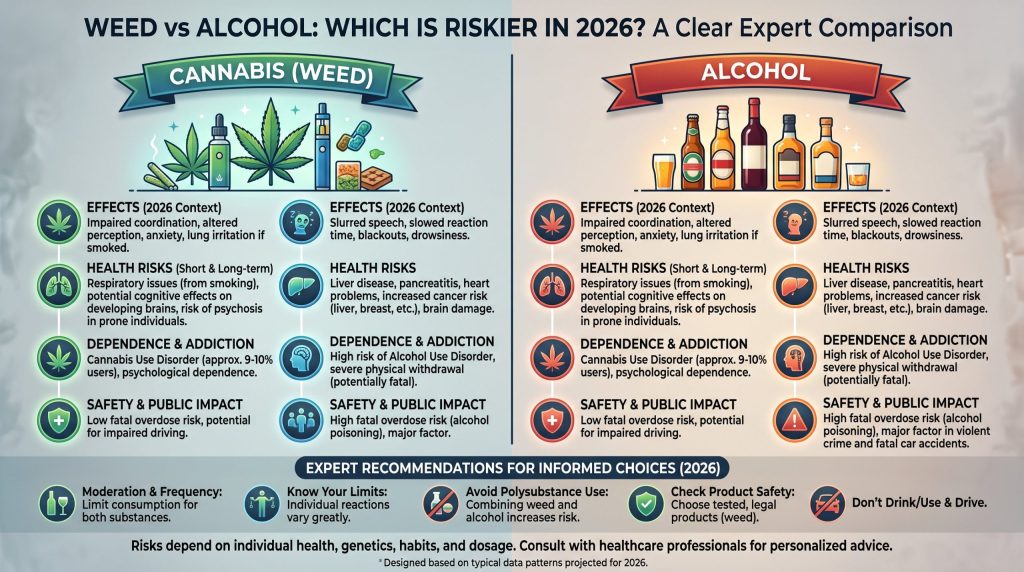
A drink can feel socially ordinary: cannabis can feel comparatively harmless. Neither impression tells the whole story. In this weed vs alcohol review, you’ll get a practical comparison based on acute impairment, dependence, overdose, long-term disease, mental health, and everyday risks such as driving. The short answer? Alcohol has stronger evidence for fatal poisoning, cancer, liver disease, and dangerous withdrawal. Cannabis is far less likely to cause a fatal overdose by itself, but it can still impair driving, worsen anxiety, trigger psychosis in vulnerable people, and become habit-forming, especially with frequent, high-THC use.
This isn’t personalized medical advice, and “safer” doesn’t mean safe. Your dose, age, health, medications, product potency, and pattern of use matter enormously. There’s also no affiliation with cannabis or alcohol companies here. The goal is simple: help you understand the trade-offs without scare tactics, stoner mythology, or the equally unhelpful idea that a legal substance must be a low-risk one.
Key Takeaways
- Alcohol poses higher risks of fatal poisoning, cancer, liver disease, and dangerous withdrawal compared to cannabis.
- Cannabis is less likely to cause fatal overdose but can impair driving, increase anxiety, and trigger psychosis in vulnerable individuals.
- The risks of both substances depend greatly on dose, frequency, potency, and individual health factors, making responsible use essential.
- Mixing weed and alcohol intensifies impairment and increases the risk of accidents and poor decision-making.
- Both substances can lead to dependence, but alcohol withdrawal can be life-threatening, requiring medical supervision during detox.
- Using cannabis or alcohol affects memory, coordination, judgment, and next-day function, so planning safe transportation is critical after use.
Weed vs Alcohol at a Glance: Key Differences and Risks
At a population level, alcohol causes more clearly documented deaths and chronic physical disease. Cannabis has a lower direct fatal-toxicity risk, but modern concentrates, delayed-dose edibles, and daily use deserve more caution than the phrase “just weed” suggests.
Side-by-Side Comparison: Effects, Dependence, Overdose, and Long-Term Harm
| Issue | Alcohol | Cannabis |
|---|---|---|
| Typical acute effects | Disinhibition, slowed reactions, poor balance | Altered perception, slowed reactions, memory problems |
| Fatal poisoning | Possible | Extremely uncommon from THC alone |
| Dependence | Can be severe: withdrawal may be fatal | Possible: withdrawal is usually not life-threatening |
| Established long-term harm | Liver, heart, nerve, and cancer risks | Respiratory harm if smoked: mental-health and cardiovascular concerns |
Why the Answer Depends on Dose, Frequency, Potency, and Individual Health
One low-dose exposure isn’t equivalent to nightly heavy use. A 5-milligram THC edible differs dramatically from a high-potency dab, just as one standard drink differs from half a bottle of whiskey. Your tolerance, genetics, age, psychiatric history, and heart or liver health can shift the risk considerably.
Short-Term Effects: How Being High Differs From Being Drunk
Alcohol often lowers inhibition before you recognize how impaired you are. Cannabis more commonly changes time perception, attention, short-term memory, and sensory experience. Either can cause nausea, panic, accidents, or decisions that seemed much smarter at midnight.
Onset and Duration: Alcohol, Smoked Cannabis, Vapes, and Edibles
Alcohol effects usually begin within minutes and rise as it’s absorbed. Inhaled cannabis acts within minutes and commonly lasts several hours. Edibles may take 30 minutes to two hours, or longer, to peak and can impair you for six hours or more. Redosing because “nothing’s happening” is the classic edible mistake.
Effects on Memory, Coordination, Judgment, and Next-Day Function
Both substances impair reaction time, coordination, judgment, and memory. Alcohol more predictably produces stumbling, aggression, blackouts, and hangovers at high doses. Cannabis may cause anxiety, distorted perception, and poor tracking of moving objects. High doses can leave some people foggy the next morning, even without a traditional hangover.
Long-Term Physical Health Risks of Weed and Alcohol
The evidence isn’t equally mature. Researchers have studied alcohol for decades using large populations and clearer dose measures. Cannabis studies must contend with changing THC potency, illegal-market products, tobacco co-use, and inconsistent dosing, gaps that make “no proof of harm” a shaky synonym for “safe.”
Liver Disease, Heart Health, and Cancer: What the Evidence Shows
Heavy alcohol use can cause fatty liver, hepatitis, cirrhosis, pancreatitis, high blood pressure, cardiomyopathy, and stroke. The World Health Organization’s alcohol guidance also links drinking with several cancers.
Cannabis hasn’t shown the same liver-disease burden, but THC can raise heart rate and alter blood pressure. Cardiovascular risks remain under study and may matter more if you have existing heart disease.
Smoking, Vaping, and Edibles: How Cannabis Delivery Changes Risk
Cannabis smoke contains irritants and toxic combustion products: regular smoking can produce cough, phlegm, and bronchitis symptoms. Vaping avoids smoke but isn’t harmless, unregulated cartridges may contain contaminants. Edibles spare your lungs, yet delayed onset makes accidental overconsumption easier. Product testing and child-resistant storage matter.
Brain, Mental Health, and Sleep Effects
Weed and alcohol can temporarily quiet uncomfortable thoughts, which is exactly why self-medication can become sticky. Relief tonight may be followed by worse sleep, tolerance, or anxiety tomorrow. If you’re treating distress rather than recreation, that pattern deserves attention, not judgment.
Anxiety, Depression, and Psychosis: Immediate Effects vs. Longer-Term Associations
Alcohol may initially relax you but can worsen mood, impulsivity, and anxiety as it wears off. THC can feel calming at a low dose yet provoke panic or paranoia at a higher one. Frequent high-THC use is associated with psychosis risk, particularly among younger people and those with personal or family vulnerability. Association doesn’t prove cannabis is the sole cause, but it’s not a signal to shrug off.
Sleep Quality, Tolerance, and Rebound Insomnia
Alcohol may help you fall asleep, then fragment later sleep and suppress REM patterns. Cannabis can shorten sleep onset for some users, but frequent use may create tolerance. Stopping either after regular use can cause rebound insomnia and vivid dreams. A substance that “fixes” sleep only when you keep increasing it isn’t fixing much.
Addiction and Dependence: Is Weed or Alcohol More Addictive?
Both can become compulsive. Alcohol use disorder often brings greater medical danger, while cannabis use disorder can still disrupt motivation, finances, relationships, and school or work. The decisive question isn’t whether a substance is addictive in theory: it’s whether your use is becoming difficult to control.
Comparing Use Disorder Risk Without Confusing Different Statistics
You’ll encounter conflicting percentages because studies measure different populations, eras, products, and definitions. Risk rises with early initiation and frequent use for both substances. Warning signs include craving, failed attempts to cut back, increasing tolerance, neglecting responsibilities, and continuing despite obvious harm.
Withdrawal Differences and Why Alcohol Withdrawal Can Be Life-Threatening
Cannabis withdrawal may cause irritability, insomnia, low appetite, anxiety, and vivid dreams. Alcohol withdrawal can cause sweating, tremor, hallucinations, seizures, or delirium tremens. If you drink heavily or have previously experienced withdrawal, don’t stop abruptly without medical guidance. Supervised detox can be lifesaving.
Overdose and Deaths: Alcohol Poisoning, Cannabis Toxicity, and Indirect Harms
Alcohol poisoning can suppress breathing, impair temperature control, and cause choking on vomit. THC alone rarely causes fatal poisoning, but excessive cannabis can produce severe panic, confusion, vomiting, psychosis-like symptoms, falls, or heart complications.
Indirect harm counts too. Either substance can contribute to crashes, drowning, unsafe sex, falls, violence, or delayed medical care. Cannabis edibles also pose a serious accidental-ingestion risk to children and pets; if a child eats one, call your poison centre at 1-844-POISON-X (1-844-764-7669) (in Quebec, 1-800-463-5060). If someone can’t be awakened, is breathing irregularly, or has a seizure, call emergency services, don’t assume they can “sleep it off.”
Driving on Weed vs. Alcohol: Impairment, Crash Risk, and Testing Limitations
Alcohol and cannabis both impair driving, though not identically. Alcohol commonly increases risk-taking while reducing coordination and reaction speed. Cannabis can impair lane tracking, divided attention, distance judgment, and response time. Combining them is worse than using either alone.
A breath alcohol result has a relatively established relationship to recent drinking. THC testing is murkier: metabolites can remain after noticeable impairment fades, especially in frequent users. That limitation doesn’t make cannabis-impaired driving safe, it makes enforcement and measurement harder. Your best rule is wonderfully boring: arrange a sober driver, taxi, or rideshare before using.
Mixing Weed and Alcohol: Why Combined Use Is Riskier
Using both can multiply impairment rather than neatly add it. Alcohol may increase THC absorption, intensifying dizziness, nausea, poor coordination, and the dreaded room-spinning experience. You’re also less able to judge how intoxicated you’ve become.
Warning Signs of a Medical Emergency and When to Call Emergency Services
Call 911 if someone has:
- Slow, irregular, or stopped breathing
- Blue, grey, or unusually pale skin
- A seizure, collapse, or chest pain
- Repeated vomiting with reduced consciousness
- Severe confusion, violent agitation, or inability to awaken
Place an unconscious but breathing person on their side. Stay with them. Coffee, cold showers, and motivational speeches do not reverse poisoning.
Who Faces Greater Risks From Either Substance?
Risk isn’t evenly distributed. Age, pregnancy, medications, mental-health history, and chronic disease can turn an “average” dose into a poor gamble. People with low tolerance are also easier to surprise, particularly with homemade edibles, mystery-strength cocktails, or products shared without labels.
Teenagers and Young Adults: Brain Development, Learning, and Prevention
The developing brain is more vulnerable to disrupted learning, memory, and impulse control. Early, frequent use of either substance is associated with greater risk of later problems. Prevention works better when adults use specific facts and calm boundaries instead of melodrama. “Don’t drive after using” lands better than claims teenagers can disprove in 12 seconds.
Pregnancy, Breastfeeding, Medication Interactions, and Existing Health Conditions
The safest recommendation during pregnancy is to avoid alcohol and cannabis: no safe amount of alcohol has been established. THC can cross the placenta and enter breast milk. Both substances may interact with sedatives, sleep medicines, opioids, anticoagulants, and psychiatric drugs. Ask a clinician or pharmacist if you have liver, heart, seizure, or mental-health conditions.
Replacing Alcohol With Weed: What Does “California Sober” Really Mean?
“California sober” usually means avoiding alcohol and harder drugs while continuing cannabis, though there’s no clinical definition. For someone moving away from dangerous drinking, substitution may reduce certain harms. But replacing one compulsive nightly ritual with another isn’t automatically recovery, it may simply change the packaging.
What Short-Term Alcohol Reduction Studies Can, and Cannot, Tell Us
Some observational research suggests certain cannabis users report drinking less. That’s encouraging but doesn’t prove cannabis reliably treats alcohol use disorder. Self-selection, short follow-up periods, variable THC doses, and simultaneous lifestyle changes muddy the picture. Reduced drinking is meaningful: researchers still need to establish who benefits and what new risks emerge.
Medical Cannabis vs. Evidence-Based Treatments for Alcohol Use Disorder
Cannabis isn’t approved by Health Canada as a treatment for alcohol use disorder. Evidence-based options include behavioural therapy, mutual-support groups, and medications such as naltrexone and acamprosate. A clinician can match treatment to your goals and medical history. You don’t have to embrace a single recovery identity, or hit “rock bottom”, to ask for help.
Reducing Harm: Avoid Mixing, Recognize Delayed Effects, and Never Drive Impaired
If you choose to use either substance, a few unglamorous habits prevent a lot of chaos:
- Don’t combine alcohol, cannabis, opioids, or sedatives.
- Eat beforehand and pace alcohol with nonalcoholic drinks.
- Start cannabis low: wait several hours before taking more edible THC.
- Avoid high-potency concentrates if you’re inexperienced.
- Use tested, clearly labelled products where legal.
- Lock edibles away from children and pets.
- Plan transportation before the first dose.
Set your limit while sober. Negotiating with intoxicated-you is like letting a raccoon manage the snack cupboard: energetic, confident, and not especially strategic.
When to Seek Help: Warning Signs, Treatment Options, and Support
Consider support if you use more than intended, hide your use, need increasing amounts, experience withdrawal, miss obligations, or keep using despite health or relationship problems. A primary-care clinician can screen confidentially and discuss medication, counselling, or supervised withdrawal.
In Canada, Health Canada’s Get help with substance use page lists free national and provincial services, including Drug Rehab Services for confidential treatment referrals at 1-877-254-3348. If you may harm yourself or someone else, call or text 9-8-8: call 911 for immediate medical danger. Asking early is not overreacting, it gives you more choices.
Frequently Asked Questions About Weed and Alcohol
These quick answers cover common comparisons, but they can’t account for your medications, tolerance, or health history. When in doubt, bring the specifics, including product strength and frequency, to a clinician.
Is Using Weed Every Night Safer Than Drinking Every Night?
Not automatically. Nightly heavy drinking has well-established risks, including liver disease, cancer, dependence, and dangerous withdrawal. Nightly cannabis avoids some of those harms but can still produce tolerance, cannabis use disorder, impaired memory, respiratory symptoms if smoked, and rebound insomnia. Frequency and dose matter more than the “natural versus synthetic” debate.
How Do Weed and Alcohol Compare for Calories, Appetite, and Weight?
Alcohol contains about seven calories per gram: mixers can add substantial sugar. Cannabis itself contributes few meaningful calories when inhaled, but THC may increase appetite, hello, accidental family-size chips. Edibles can contain sugar and fat. Weight outcomes depend on dose, food choices, sleep, activity, and whether intoxication regularly becomes a second dinner.
Is There a Reliable Cannabis Dose Equivalent to One Alcoholic Drink?
No. A Canadian standard drink contains 13.45 grams of pure alcohol, but there’s no scientifically reliable THC equivalent. Cannabis effects vary with route, potency, THC-to-CBD ratio, tolerance, and metabolism. Even a labelled 5-milligram edible can affect two people very differently.
Bottom line: In the overall weed vs alcohol comparison, alcohol carries the clearer burden of fatal poisoning, cancer, liver damage, and medically dangerous withdrawal. Cannabis generally has lower direct lethality, not zero risk. High-potency products, daily use, youth exposure, impaired driving, and psychiatric vulnerability can change the equation quickly. If your use is affecting sleep, mood, safety, money, or relationships, try one concrete step today: track it honestly for a week, schedule a substance-free day, or speak with a clinician. You don’t need a catastrophe before making a course correction.