Blog 2026
Can Weed Help Anxiety? What the Evidence Really Says
Nov
A few puffs, a quieter mind, that’s the promise many people associate with cannabis. Yet for someone else, the same product can produce a racing heart, spiralling thoughts, and the uncomfortable certainty that everyone in the room has noticed. So, can weed help anxiety, or is that apparent relief misleading?
The honest answer is: sometimes cannabis may temporarily reduce how anxious you feel, but it can also worsen anxiety, trigger panic, or complicate long-term recovery. The outcome depends on tetrahydrocannabinol (THC) exposure, cannabidiol (CBD) content, dose, product type, your biology, your surroundings, and how frequently you use it. Even your expectations going in can tilt the experience.
This is an evidence review, not an endorsement of cannabis or a substitute for personalized medical care. It examines recreational and medical cannabis, THC and CBD products, different consumption methods, safety concerns, and better-supported anxiety treatments. It does not assume that dispensary availability means a product has been proven to treat an anxiety disorder. Those are very different standards.
There are no affiliate relationships or cannabis products promoted here. Research is cited from sources including Health Canada, Canada’s Lower-Risk Cannabis Use Guidelines, systematic reviews, and professional medical guidance. One important limitation runs through the evidence: cannabis products differ enormously, while many studies are small, short, observational, or based on products unlike those sold today.
If anxiety is disrupting your sleep, work, relationships, or ability to leave home, you deserve more than trial and error with a gummy. Let’s sort out where cannabis might offer short-lived relief, where the risks increase, and what you can do instead.
Key Takeaways
- Cannabis, including weed, may provide temporary relief from anxiety for some adults but is not a reliable or proven treatment for anxiety disorders.
- THC can both relax and trigger anxiety or paranoia depending on dose, potency, individual sensitivity, and context, making its effects unpredictable.
- CBD shows promise in experimental settings but is not clinically proven or standardized as an anxiety treatment; product quality and dosage vary widely.
- Heavy or frequent cannabis use can lead to tolerance, dependence, and withdrawal-related anxiety, complicating long-term anxiety management.
- Lifestyle changes and evidence-based treatments like cognitive behavioural therapy and prescribed medications are safer and more effective for ongoing anxiety than cannabis use.
- Discuss cannabis use honestly with a healthcare professional to evaluate risks, interactions, and alternative treatments tailored to your needs.
When can weed help anxiety—and when can it make it worse?
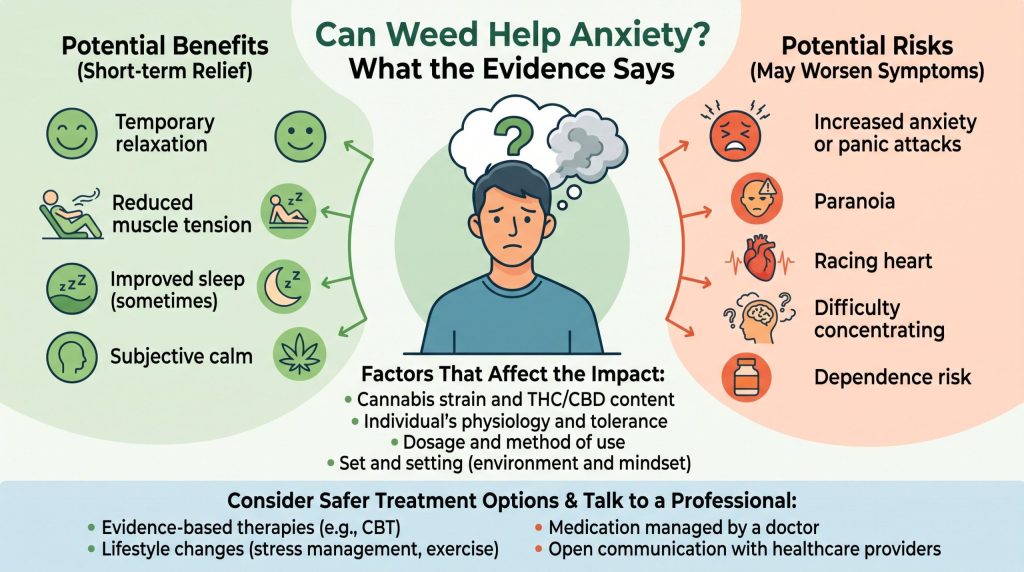
Some adults report that cannabis helps them unwind, fall asleep, or interrupt anxious rumination. Lower THC exposure, or a product containing little THC, may feel calming in certain circumstances. Relief may also come indirectly: reduced pain, fewer trauma-related nightmares, or the ritual of stepping away from a stressful environment can make anxiety feel less intense.
But subjective relief isn’t proof that cannabis treats the underlying condition. THC has a biphasic effect: smaller amounts may feel relaxing, while larger amounts are more likely to cause anxiety, paranoia, rapid heart rate, and distorted perception. The line between “pleasantly relaxed” and “why is my heart doing THAT?” can be surprisingly thin.
Cannabis is more likely to make anxiety worse when you:
- Use a high-potency THC product or take more than intended
- Have previously experienced panic, paranoia, psychosis, or mania
- Combine it with caffeine, stimulants, alcohol, or other drugs
- Use an edible and redose before the first serving takes effect
- Are already frightened, sleep-deprived, or in an unfamiliar setting
- Rely on it daily and experience rebound anxiety between uses
The most defensible conclusion is that cannabis may alter anxiety symptoms in the moment, but it isn’t a reliably effective treatment for an anxiety disorder.
How cannabis affects the brain and anxiety symptoms
Cannabis interacts with the body’s endocannabinoid system, which helps regulate stress responses, mood, memory, appetite, sleep, and pain. THC and CBD affect this system differently, and cannabis contains many other compounds whose clinical relevance remains uncertain.
THC partially activates cannabinoid type 1 receptors, which are abundant in brain regions involved in threat detection, emotional learning, and memory. That can change sensory perception and make thoughts feel unusually significant. Sometimes that shift feels soothing. Under the wrong conditions, a harmless bodily sensation can suddenly feel like evidence of danger.
CBD has a different pharmacological profile and doesn’t produce the classic THC “high.” Still, “non-intoxicating” doesn’t mean risk-free, and it definitely doesn’t mean clinically proven.
THC: Why feeling relaxed can turn into anxiety or paranoia
THC can temporarily dampen tension and produce euphoria, particularly at lower exposure levels. As exposure rises, but, it may increase heart rate, impair short-term memory, and amplify attention to internal sensations. If you interpret a pounding heart as dangerous, that physical effect can feed a panic loop: My heart is racing, so something must be wrong: that thought scares me, so it races faster.
Potency matters. Cannabis flower and concentrates available today may contain substantially more THC than products used in older studies. Concentrates such as wax, shatter, and some vape oils can deliver especially large amounts quickly. Your response also depends on tolerance, genetics, prior experiences, and vulnerability to anxiety or psychosis.
Paranoia isn’t simply “overthinking.” THC may alter how you assign meaning to ambiguous events, making a stranger’s glance or an ordinary sound seem threatening. That reaction usually passes, but it can be deeply distressing.
CBD: How it differs from THC and why it is not a proven anxiety treatment
CBD doesn’t intoxicate you in the same way as THC. Early human studies suggest that particular laboratory doses may reduce experimentally induced anxiety, including anxiety during simulated public speaking. Those findings are interesting, but they don’t establish that store-bought CBD reliably treats generalized anxiety, panic disorder, or social anxiety disorder.
Study doses are often hundreds of milligrams, while retail gummies may contain 10–25 mg. Formulations, absorption, and product quality also vary. Some products marketed as CBD contain more or less CBD than stated, and full-spectrum products can contain THC.
Health Canada has approved a purified CBD medication, Epidiolex, for certain seizure disorders, not anxiety. CBD can cause sleepiness, diarrhea, appetite changes, and liver enzyme abnormalities. It may also interact with medications metabolized by the liver, including some antidepressants, sedatives, and blood thinners. Treat CBD as a biologically active substance, not herbal wallpaper.
What research actually shows about cannabis for anxiety
Research doesn’t support a simple “cannabis cures anxiety” or “cannabis always causes anxiety” verdict. Observational studies often find that people use cannabis to cope with stress, insomnia, and anxiety. They also find associations between frequent cannabis use and poorer mental-health outcomes in some groups. The tricky part is determining cause and effect.
Did cannabis worsen anxiety? Did anxiety lead to heavier cannabis use? Did trauma, sleep problems, pain, or another factor contribute to both? Often, the data can’t tell us.
Reviews generally conclude that evidence for cannabinoids as anxiety treatments is limited and inconsistent. Products, doses, participants, and outcome measures differ too much to confidently recommend a standard cannabis treatment.
Clinical trials versus self-reported benefits: Understanding the evidence gaps
A testimonial can be sincere and still fail to answer a medical question. If someone says a THC gummy helps them relax, that tells you about their experience, not whether it outperforms a placebo, works long term, or is safe for you.
Randomized controlled trials reduce expectation effects and other biases, but high-quality trials of cannabis for primary anxiety disorders remain limited. Many studies:
- Enrol small groups
- Measure one dose rather than months of treatment
- Test isolated CBD instead of dispensary cannabis
- Exclude people with complex psychiatric or substance-use histories
- Use self-reported outcomes without long-term follow-up
Legal restrictions have also historically made cannabis research difficult. Meanwhile, commercial products have evolved faster than the evidence. A study using a controlled oral CBD dose doesn’t validate a high-THC vape labelled “Chill Mode.” Same broad plant category, very different exposure.
Short-term symptom relief versus long-term anxiety management
Short-term relief and long-term improvement aren’t interchangeable. Cannabis may help you feel detached from worry for several hours, just as avoiding a feared situation can provide immediate relief. But repeated avoidance can preserve anxiety by preventing you from learning that you can tolerate discomfort safely.
Frequent cannabis use can create another cycle. You feel anxious, use cannabis, experience relief, and gradually come to believe you can’t relax or sleep without it. Tolerance may lead you to use more. When you reduce or stop, withdrawal symptoms, including irritability, insomnia, restlessness, reduced appetite, and anxiety, can reinforce the urge to resume.
That doesn’t happen to everyone, and occasional use isn’t equivalent to cannabis use disorder. Still, if your baseline anxiety is rising, your dose is creeping upward, or sober evenings feel unbearable, the coping tool may be taking more than it gives.
Does the evidence differ for generalized anxiety, social anxiety, and panic disorder?
Evidence varies, but none of these conditions has a well-established cannabis treatment protocol.
| Condition | What limited evidence suggests | Key concern |
|---|---|---|
| Generalized anxiety disorder | Some people report temporary calming: clinical evidence for lasting benefit is insufficient | Daily coping use may mask symptoms or produce dependence |
| Social anxiety disorder | Small experimental CBD studies show possible benefit during stressful speaking tasks | Findings don’t establish routine effectiveness: THC may increase self-consciousness or paranoia |
| Panic disorder | No strong evidence supports cannabis as treatment | THC-related heart racing, dizziness, and altered perception can imitate panic sensations |
| PTSD-related anxiety | Some patients report improved sleep or fewer nightmares: evidence remains mixed | Avoidance, dependence, and worsening mood may occur |
If panic attacks are your main concern, THC deserves particular caution. Its physical effects can closely resemble the sensations you fear. Evidence-based exposure therapy instead helps you reinterpret those sensations without needing to suppress them.
Why weed can cause or worsen anxiety
Cannabis-related anxiety usually isn’t a sign that you’re weak or “bad at being high.” It’s a predictable interaction among the product, dose, your nervous system, and the situation. Understanding those variables can help you recognize risk before an unpleasant experience begins.
THC potency, amount consumed, and individual sensitivity
THC exposure is one of the clearest practical risk factors. A single inhalation from a high-potency vape may affect you differently from one inhalation of low-THC flower. Edible labels can further confuse matters because one package may contain multiple servings.
Sensitivity differs dramatically. A dose that barely affects a frequent user may overwhelm someone with no tolerance. Body size alone doesn’t reliably predict the experience: metabolism, genetics, food intake, medications, tolerance, and prior exposure all matter.
Be especially cautious with concentrates and homemade edibles, where dose estimation can be difficult. And don’t assume an unpleasant experience means you merely need to “build tolerance.” Repeated exposure isn’t a sensible self-directed treatment for paranoia or panic.
How stress, surroundings, and expectations can influence the experience
“Set and setting” sounds like vintage counterculture language, but it describes something clinically relevant. Set is your internal state, mood, expectations, fatigue, and current stress. Setting is the physical and social environment.
Imagine using THC at home after a calm dinner versus taking the same amount before entering a crowded concert with security checks, flashing lights, and a nearly dead phone. Chemically identical: psychologically, not even close.
Anxiety becomes more likely when you feel unsafe, pressured, overstimulated, or unable to leave. Worrying that cannabis will cause panic can also make you monitor every sensation, increasing distress. This doesn’t mean the reaction is “all in your head.” Expectations and pharmacology can interact, each turning up the other’s volume.
Tolerance, dependence, and withdrawal-related anxiety
Tolerance means you need more cannabis to achieve a previous effect. Dependence means your body has adapted enough that stopping produces symptoms. Cannabis use disorder involves continued use even though harm, loss of control, cravings, or significant disruption, not simply using cannabis regularly.
Withdrawal commonly begins within a day or two after stopping heavy or frequent use. Symptoms may include anxiety, irritability, vivid dreams, insomnia, sweating, stomach discomfort, and low mood. They often peak during the first week, though sleep and mood changes can last longer.
If you use every evening and feel anxious each afternoon, consider whether you’re treating an anxiety disorder, early withdrawal, or both. Don’t beat yourself up. Bring the pattern to a clinician, who can help you taper when appropriate and manage the original symptoms.
Do cannabis products, strains, and methods of use matter?
Yes, but not in the neat, colour-coded way dispensary menus sometimes imply. Delivery method changes how quickly effects begin, how long they last, and how easily you can judge exposure. Product chemistry matters more than a catchy strain name.
Smoking, vaping, and edibles: Differences in onset, duration, and risks
| Method | Typical onset | Typical duration | Anxiety-related concern |
|---|---|---|---|
| Smoking | Minutes | Roughly 2–4 hours | Rapid THC delivery: smoke exposes lungs to harmful combustion products |
| Vaping | Minutes | Roughly 2–4 hours | Potent oils can deliver large doses quickly: unregulated cartridges may contain contaminants |
| Edibles | About 30 minutes to 2+ hours | Often 6–12 hours, sometimes longer | Delayed onset encourages redosing: effects can be stronger and harder to reverse |
These are broad ranges, not timers you can set your watch by. Edibles are particularly unpredictable because digestion, food, metabolism, and formulation affect onset. The liver converts THC into 11-hydroxy-THC, which can produce strong, prolonged effects.
The classic mistake is taking another serving after 45 minutes because “nothing’s happening.” Then both servings arrive together like two buses you absolutely didn’t need.
Indica versus sativa: Why strain names do not reliably predict anxiety relief
Dispensaries often describe indica as sedating and sativa as energizing. Those labels may help organize retail shelves, but they don’t reliably predict your psychological response. Modern cannabis varieties are heavily hybridized, and products sharing a strain name may have different cannabinoid and terpene profiles.
THC amount, CBD amount, dose, route, and your personal response are more informative than whether a jar says indica or sativa. Terpenes may influence aroma and possibly effects, but marketing claims frequently run ahead of clinical evidence.
If someone recommends “Blue Dream” or “Granddaddy Purple” for anxiety, remember that a familiar name isn’t standardized medicine. Batch testing can vary, and even a consistent chemical profile won’t guarantee a consistent experience across people.
THC-to-CBD ratios, labelling accuracy, and why no universal anxiety dose exists
A product with less THC generally carries a lower risk of THC-induced anxiety than a high-THC product. CBD may modify some THC effects, but it doesn’t reliably cancel an excessive THC dose. A 1:1 label is a ratio, not a safety guarantee: 2 mg THC plus 2 mg CBD is very different from 50 mg plus 50 mg.
Label accuracy is another concern, especially in poorly regulated markets. Independent studies have found discrepancies between stated and measured cannabinoid content in some products. Intoxicating cannabinoids such as delta-8 THC, which Health Canada regulates as cannabis, may also be synthesized or formulated inconsistently.
There’s no universal anxiety dose because trials haven’t established one, products aren’t interchangeable, and individual sensitivity varies. If you choose to use cannabis even though the uncertainties, avoiding high-THC products and not rapidly redosing may reduce, not eliminate, risk.
Who should avoid cannabis or seek medical advice first?
Cannabis isn’t equally risky for everyone. Your age, pregnancy status, psychiatric history, heart health, medications, and substance-use history can change the safety calculation. A clinician can discuss these issues confidentially: their job is to reduce harm, not award detention.
Adolescents, pregnancy, and people with psychosis, bipolar disorder, or substance use histories
Adolescents and young adults should be particularly cautious because the brain continues developing into the mid-20s. Earlier and heavier use is associated with greater risks involving learning, attention, dependence, and mental health.
Major health organizations advise avoiding cannabis during pregnancy and breastfeeding because THC crosses the placenta and can enter breast milk. “Natural” doesn’t equal pregnancy-safe.
Cannabis, especially high-THC use, can provoke or worsen psychotic symptoms in vulnerable people. If you or a close relative has experienced psychosis or schizophrenia, medical guidance is essential. THC may also destabilize mood in bipolar disorder or contribute to manic symptoms.
A history of alcohol or drug problems doesn’t automatically determine what will happen, but it raises the importance of monitoring cravings, control, and consequences. Safer choices should reflect your whole history, not just today’s symptom.
Interactions with anxiety medications, alcohol, and other substances
Cannabis can add to the sedation, dizziness, poor coordination, or cognitive impairment caused by alcohol, benzodiazepines such as alprazolam (Xanax), sleep medicines, antihistamines, opioids, and some psychiatric drugs. Mixing substances also makes an adverse reaction harder to interpret.
CBD and THC can affect liver enzymes involved in medication metabolism. The clinical impact varies, but potential interactions matter with antidepressants, antipsychotics, antiseizure drugs, blood thinners, and other medicines with narrow dosing margins.
Never stop a prescribed anxiety medication abruptly to replace it with cannabis. Benzodiazepine withdrawal can be dangerous, and suddenly discontinuing some antidepressants can cause distressing symptoms. Ask a prescriber or pharmacist to review the specific cannabis or CBD product, dose, frequency, and all supplements you use. “It’s just a gummy” isn’t enough information.
What to do if weed makes you anxious or triggers panic
Most cannabis-related anxiety improves as the drug’s effects wear off. In the moment, though, ten minutes can feel like a feature-length film. Your priority is reducing stimulation, preventing injury, and watching for symptoms that need medical attention.
Immediate steps: Stop using, move somewhere calm, and seek trusted support
Stop consuming cannabis: don’t take CBD, alcohol, medication, or another drug in an improvised attempt to “cancel” it unless a healthcare professional directs you. Move to a quiet, familiar place away from traffic, balconies, water, crowds, and other hazards. Don’t drive.
Try this simple sequence:
- Tell a trusted sober person what you took, how much, and when.
- Sit or lie somewhere safe and loosen restrictive clothing.
- Breathe gently, making the exhale slightly longer than the inhale.
- Sip water if you can swallow normally.
- Remind yourself: “This is a drug effect. It feels frightening, but it will change.”
Avoid doom-scrolling symptoms. If possible, keep the package so a poison centre specialist or clinician can identify the product.
When chest pain, trouble breathing, confusion, or other symptoms need urgent care
Don’t assume every symptom is “just anxiety.” Call emergency services for severe chest pain, significant trouble breathing, a seizure, fainting, extreme agitation, inability to wake, dangerous behaviour, or signs of stroke or heart attack. Seek urgent help for severe confusion, hallucinations, suicidal thoughts, or suspected poisoning, particularly if a child consumed the product.
In Canada, you can call 1-844-POISON-X (1-844-764-7669), a toll-free line to your local poison centre (in Quebec, 1-800-463-5060). Call 911 for an emergency. For thoughts of suicide, call or text 9-8-8, the 9-8-8 Suicide Crisis Helpline.
Be honest about what you used. Medical teams need accurate information, not a creative cover story involving “a weird brownie.” Their goal is to keep you safe.
Better-supported treatments for ongoing anxiety
If anxiety keeps returning, you have options with stronger evidence and clearer dosing than cannabis. Treatment doesn’t have to mean medication forever or years on a therapist’s couch discussing a forgotten kindergarten snack. It can be practical, targeted, and adjusted to your goals.
Cognitive behavioural therapy and clinician-prescribed medications
Cognitive behavioural therapy (CBT) helps you identify unhelpful predictions, change avoidance patterns, and gradually face feared sensations or situations. Exposure-based CBT is especially useful for panic disorder, phobias, and social anxiety. Unlike temporary numbing, it teaches your brain that discomfort can rise and fall without catastrophe.
Clinicians commonly prescribe selective serotonin reuptake inhibitors (SSRIs), such as sertraline or escitalopram, and serotonin-norepinephrine reuptake inhibitors (SNRIs), such as venlafaxine or duloxetine. These medications aren’t instant: benefits often develop over several weeks. Side effects and discontinuation plans should be discussed with your prescriber.
Benzodiazepines can reduce acute anxiety but carry tolerance, dependence, sedation, and withdrawal risks. They’re generally used selectively rather than as an automatic long-term solution. Your best plan may combine therapy, medication, and habit changes.
Sleep, exercise, breathing techniques, and reducing caffeine
Lifestyle changes aren’t a moral test, and they don’t replace care for severe anxiety. They can, but, lower the background “static” that makes symptoms easier to trigger.
Start with a realistic week:
- Keep your wake time consistent, even after a rough night.
- Get regular movement, perhaps a 20-minute brisk walk after lunch.
- Reduce caffeine gradually, especially energy drinks and afternoon coffee.
- Eat consistently: hunger and low blood sugar can mimic anxious sensations.
- Practise slow breathing while calm, not only during panic.
- Set a short daily “worry period,” then redirect worries that appear outside it.
Track sleep, caffeine, anxiety, and cannabis use for two weeks. Patterns are often more revealing than memory. If every high-caffeine morning or post-edible night ends badly, your notebook may provide the intervention’s least glamorous, but most useful, plot twist.
How to discuss cannabis and anxiety with a healthcare professional
You don’t need to arrive with a perfectly organized confession. A direct opening works: “I use cannabis for anxiety, but I’m not sure whether it’s helping anymore.” If you’ve had panic, paranoia, withdrawal symptoms, or trouble reducing use, say so. Accuracy leads to safer advice.
Review symptoms, cannabis use, medications, and treatment goals
Before the appointment, note:
- Your anxiety symptoms, triggers, frequency, and duration
- Product names and THC/CBD amounts, if known
- How you consume cannabis and how often
- What improves immediately and what happens the next day
- Prescription drugs, supplements, alcohol, nicotine, and caffeine use
- Previous therapy, medication, panic, mania, or psychosis
- Your goal: better sleep, fewer panic attacks, reduced use, or stopping entirely
Ask whether another condition could be contributing. Thyroid disorders, medication effects, sleep deprivation, stimulant use, and heart rhythm problems can resemble anxiety. A clinician may recommend screening for anxiety disorders and cannabis use disorder rather than treating every symptom as one undifferentiated stress blob.
Medical cannabis eligibility, local laws, and approval versus availability
Cannabis laws vary by province, territory, and country, and a health care practitioner may or may not support medical cannabis for anxiety. A practitioner’s medical document generally means you meet the requirements for medical access: it doesn’t mean Health Canada has approved cannabis as an anxiety treatment.
That distinction matters. Legal availability, medical authorization, and evidence of effectiveness are three separate things. Dispensary staff may understand products, but they can’t replace a psychiatric assessment or medication-interaction review.
Check current local rules on possession, driving, workplace testing, housing, travel, and firearm ownership. Never drive while impaired, and don’t carry cannabis across borders simply because it was legal where you bought it. If you participate in a medical program, request products with verified laboratory testing and keep a record of effects rather than relying on strain folklore.
Frequently asked questions about weed and anxiety
Quick answers can’t capture every individual response, but these address two of the most common practical concerns.
How long can anxiety last after using weed?
After smoking or vaping, anxiety often eases within a few hours as intoxication declines. Edible-related anxiety may persist for six to 12 hours or longer, depending on dose, metabolism, food intake, and the product. Grogginess or a psychological “aftershock” can carry into the next day.
Seek medical advice if anxiety remains severe after the expected intoxication window, repeatedly returns, or comes with insomnia, paranoia, hallucinations, mania, depression, or suicidal thoughts. Frequent users who stop may experience withdrawal-related anxiety for days, with some symptoms lasting several weeks.
If you’re currently frightened, focus on safety rather than the clock. A trusted sober person, your poison centre, or urgent medical care can help you decide what’s appropriate.
Can weed help anxiety-related sleep problems without worsening anxiety?
Cannabis may shorten the perceived time it takes to fall asleep for some people, particularly in the short term. Yet THC can alter sleep architecture, tolerance may develop, and stopping frequent use can cause vivid dreams and rebound insomnia. A product that “works” at midnight may still worsen daytime anxiety, concentration, or dependence.
CBD evidence for insomnia is also inconclusive, and retail doses vary. Before using cannabis as a sleep aid, address caffeine timing, sleep apnea symptoms, inconsistent schedules, pain, medication effects, and nighttime worry. Cognitive behavioural therapy for insomnia (CBT-I) has stronger support for chronic insomnia and doesn’t require escalating a dose.
If you already use cannabis for sleep, track morning function and sober-night sleep, not merely whether it knocks you out. Sedation and restorative sleep aren’t always the same thing.
References and evidence review
This review prioritizes government health guidance, peer-reviewed systematic reviews, and clinical resources over commercial cannabis claims. The evidence remains limited by inconsistent products, small trials, self-selection, and rapidly changing THC potency. Relevant sources include:
- Health Canada: Cannabis and your health
- Health Canada: Cannabidiol (CBD)
- Canada’s Lower-Risk Cannabis Use Guidelines
- Health Canada: Information for health care professionals: Cannabis and the cannabinoids
- Society of Obstetricians and Gynaecologists of Canada: Your health and cannabis (pregnancy and breastfeeding)
- National Academies review of cannabis health effects
- Centre for Addiction and Mental Health (CAMH): Anxiety disorders
- Black N, Stockings E, Campbell G, et al. Cannabinoids for the treatment of mental disorders and symptoms of mental disorders: a systematic review and meta-analysis. The Lancet Psychiatry. 2019.
So, can weed help anxiety? It may give some adults short-term subjective relief, but current evidence doesn’t support cannabis, particularly high-THC cannabis, as a dependable first-line treatment for anxiety disorders. CBD is promising enough to study, not proven enough to self-prescribe confidently.
Your most useful next step is simple: track what you use and how you feel, then discuss the pattern honestly with a qualified healthcare professional. If cannabis repeatedly causes panic, increases your baseline anxiety, or becomes necessary just to feel normal, that’s not failure. It’s information, and a good reason to choose a better-supported path.