
Blog 2026
Can Cannabis Cause Cancer? What the Evidence Says
Nov
You’ve probably heard two confident, and completely opposing, claims: cannabis cures cancer, or cannabis causes it. The evidence supports neither sweeping statement.
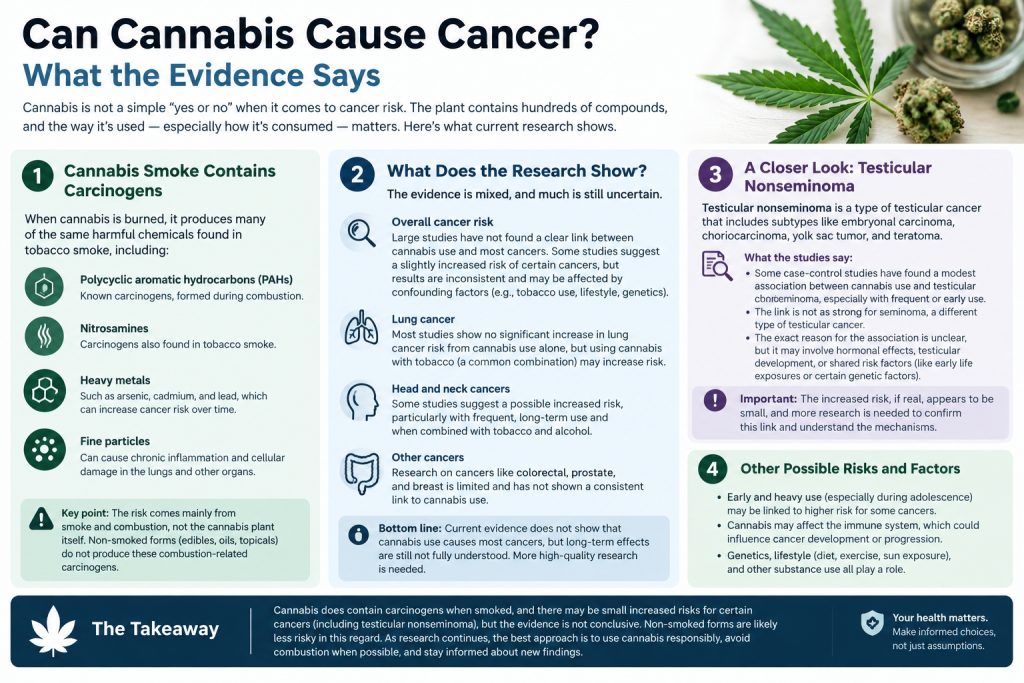
So, can cannabis cause cancer? Cannabis smoke contains carcinogens and fine particles also found in tobacco smoke, giving scientists a sound biological reason for concern. Yet human studies haven’t established a clear causal relationship between cannabis alone and most cancers. Testicular germ-cell tumours, particularly nonseminoma, are the most consistent warning signal, although the research remains observational.
This evidence review examines cancer risk, not cannabis laws, impairment, dependence, pregnancy, or every potential medical use. It separates smoked cannabis from vaping and oral products because your method of use changes the exposure. It also distinguishes symptom relief during cancer treatment from treating the cancer itself.
Here’s the honest version: uncertainty doesn’t mean harmless. If you use cannabis, understanding what’s known, and what’s still frustratingly fuzzy, can help you make a lower-risk choice.
Key Takeaways
- Cannabis smoke contains carcinogens similar to tobacco, making it biologically plausible to increase cancer risk, though human studies have not conclusively proven cannabis causes most cancers.
- The strongest evidence links frequent cannabis use with testicular nonseminoma, but more research is needed to confirm causation.
- Smoking cannabis, particularly when mixed with tobacco, increases exposure to harmful chemicals, so avoiding combustion methods can reduce cancer risk.
- Vaping and edible cannabis products avoid combustion-related toxins but lack long-term cancer safety data; use caution and prefer regulated sources.
- Cannabis can help relieve certain cancer treatment symptoms but has not been proven to cure cancer and should never replace conventional therapies.
- Reducing frequency of smoked cannabis and avoiding tobacco use lowers carcinogen intake, and discussing cannabis use openly with healthcare providers improves safety and treatment outcomes.
The Short Answer: can cannabis cause cancer?
Cannabis hasn’t been proven to cause most cancers in humans. But, burning and inhaling cannabis exposes you to carcinogens, so scientists cannot call cannabis smoke safe. Research summarized by the National Cancer Institute and the National Academies identifies substantial gaps, especially for heavy, decades-long use.
What Research Shows, and What Remains Uncertain
The clearest findings are:
- Cannabis smoke contains cancer-causing chemicals and airway irritants.
- Regular smoking can cause cough, phlegm, and bronchitis symptoms.
- Several studies report an association between frequent cannabis use and testicular nonseminoma.
- Evidence for lung, head and neck, bladder, and most other cancers is limited, inconsistent, or insufficient.
- Today’s high-potency products also differ considerably from cannabis used by participants in older studies.
Why an Association Does Not Prove Cannabis Causes Cancer
Suppose cannabis users develop a cancer more often. Cannabis could be responsible, but tobacco, alcohol, HPV, socioeconomic factors, or another shared exposure could explain the difference. That’s confounding.
Researchers look for dose-response patterns, biological plausibility, consistent results, and well-controlled prospective data before inferring causation. Cannabis studies often rely on people remembering years of use, making a tidy cause-and-effect conclusion difficult.
Why Cannabis Smoke Raises Cancer Concerns
The concern begins with combustion. When plant material burns, it produces a chemical stew you wouldn’t voluntarily order with your morning coffee. Deep inhalation and breath-holding may increase how much tar and particulate matter settle in your airways, although real exposure varies with the device, dose, and smoking style.
Carcinogens in Cannabis Smoke: Chemicals Shared With Tobacco Smoke
Cannabis and tobacco smoke both contain substances such as benzene, formaldehyde, polycyclic aromatic hydrocarbons, and fine particulate matter. Some can damage DNA or promote inflammation, mechanisms involved in cancer development.
Chemical similarity doesn’t establish equal cancer risk. Many cannabis users smoke fewer times per day than cigarette smokers, while inhalation patterns differ. Still, smoke is smoke, and “natural” isn’t protective chemistry.
Cannabis With Tobacco: Spliffs, Blunts, and Overlapping Exposures
Spliffs combine cannabis with tobacco. Blunt wrappers are commonly made from tobacco leaf and may add nicotine and tobacco-related toxicants even when the filling contains no loose tobacco.
This overlapping exposure raises risk and muddies research results. If you smoke either format, don’t assume you’re evaluating cannabis alone. Nicotine dependence can also make quitting considerably harder, the unwanted two-for-one deal.
Cannabis and Specific Cancer Types: An Evidence-by-Evidence Breakdown
Cancer isn’t one disease, so a single yes-or-no verdict hides important differences. Here’s where the evidence currently lands.
| Cancer type | Current signal | Main limitation |
|---|---|---|
| Lung | Inconclusive | Tobacco confounding: few very heavy users |
| Testicular nonseminoma | Repeated association | Small observational evidence base |
| Head and neck | Mixed | Tobacco, alcohol, and HPV |
| Bladder and others | Limited | Sparse or inconsistent studies |
Lung Cancer: Why Findings Remain Inconclusive Despite Smoke Exposure
It seems intuitive that cannabis smoking would cause lung cancer. Human studies, however, haven’t consistently shown that relationship after accounting for cigarettes.
That isn’t a safety certificate. Lung cancer may take decades to appear, and studies have included relatively few exclusive, high-exposure cannabis smokers. Meanwhile, cannabis smoke can injure airways and produce chronic bronchitis symptoms even without a cancer diagnosis.
Testicular Cancer: The Reported Association With Nonseminoma
Several case-control studies have linked frequent or long-term cannabis use with testicular germ-cell tumours, especially nonseminoma, an often faster-growing subtype. The National Academies review found limited evidence of an association between current, frequent, or chronic cannabis smoking and nonseminoma, while emphasizing that more research is needed.
These studies don’t prove causation, but the recurring pattern deserves attention, particularly for younger men, among whom testicular cancer is more common.
Head and Neck Cancers: Mixed Findings and Important Confounding Factors
Studies of oral, throat, and other head and neck cancers have produced conflicting results. Interpretation gets tangled because tobacco, heavy alcohol use, and human papillomavirus are established risk factors and may overlap with cannabis use.
Some research suggests no independent association: other studies report possible site-specific links. At present, you shouldn’t treat either reassuring or alarming headlines as a settled verdict.
Bladder and Other Cancers: Where Evidence Is Limited
For bladder, prostate, colorectal, liver, and many other cancers, evidence is too sparse or inconsistent for firm conclusions. A small study can generate an intriguing signal, but it cannot settle risk across different doses, products, and populations.
Absence of convincing evidence is not evidence of zero risk. It means the research hasn’t answered the question reliably yet.
Does Cancer Risk Differ Between Smoking, Vaping, and Edibles?
Yes, mainly because these methods expose your body differently. Avoiding smoke removes combustion products, but no method has enough decades-long evidence to earn a blanket “cancer-safe” label.
Smoking Joints, Pipes, and Bongs: Water Filtration Does Not Make Smoke Safe
Joints, pipes, bubblers, and bongs all involve combustion. Bong water can cool smoke and trap some material, but it does not remove all carcinogens, carbon monoxide, or microscopic particles. Cooler smoke may simply feel smoother.
If your throat doesn’t burn, that doesn’t mean your lungs received filtered mountain air. Larger or deeper inhalations can offset some filtration benefits.
Vaping Cannabis: Unknown Long-Term Cancer Risk and Separate Lung-Injury Concerns
Vaping avoids burning flower, potentially reducing exposure to some combustion toxicants. But long-term cancer risk remains unknown, particularly for concentrated oils and modern high-temperature devices.
Unregulated cartridges may contain pesticides, metals, solvents, or cutting agents. The 2019 EVALI outbreak was strongly linked to vitamin E acetate in illicit THC products, according to the CDC’s EVALI findings. Legal sourcing reduces certain risks: it doesn’t prove long-term safety.
Edibles, Oils, and Tinctures: Avoiding Smoke Does Not Establish Long-Term Safety
Edibles and tinctures avoid smoke exposure, making them a lower-lung-exposure option. Their main hazards are different: delayed effects, accidental overconsumption, impairment, and access by children or pets.
A 10-mg edible may feel mild to one person and overwhelming to a beginner. Effects can take hours to peak. Start low only after discussing suitability with a clinician, and don’t redose impatiently because “nothing’s happening.” Famous last words.
THC vs. CBD: What We Know About Cannabinoids and Cancer Risk
Neither THC nor CBD has been established as a cause of human cancer. Nor has either been proven to cure cancer.
Laboratory experiments show cannabinoids can affect cancer cells under certain conditions, but cells in a dish aren’t a human tumour. CBD and THC can also alter drug metabolism. Product labels may be inaccurate, particularly in unregulated markets, making real exposure harder to judge.
How Much Cannabis Use Could Increase Cancer Risk?
Researchers haven’t identified a precise amount that flips risk from safe to dangerous. Cancer usually reflects accumulated exposure, genetics, age, environment, and plain bad luck, not one dramatic Saturday night.
Frequency, Years of Use, and Why No Safe Smoking Threshold Is Established
Daily smoking for 20 years plausibly creates more cumulative exposure than occasional use, but studies haven’t defined a dependable cannabis “pack-year” threshold. Joint size and potency vary wildly, too.
Public-health guidance hence favours reducing both frequency and combustion. If you smoke, fewer smoking sessions likely mean less toxic exposure, but no level of inhaled smoke has been established as risk-free.
Research Limitations: Tobacco Use, Self-Reporting, and Changing Cannabis Products
Cannabis research faces awkward obstacles:
- Users may also smoke cigarettes or drink alcohol.
- Illegal status historically discouraged accurate reporting.
- Product strength, contamination, and serving size vary.
- Cancer latency can span decades.
- Older studies don’t reflect today’s concentrates or high-THC flower.
These problems can conceal a genuine effect or create an apparent one. Better long-term studies of exclusive cannabis users are still needed.
Can Secondhand Cannabis Smoke Cause Cancer?
Secondhand cannabis smoke contains fine particles and many of the same toxic chemicals found in directly inhaled smoke. Whether typical household exposure measurably increases human cancer incidence hasn’t been established, largely because long-term data are scarce.
Still, avoiding exposure is sensible, especially around children, pregnant people, and anyone with asthma or heart or lung disease. Smoke outdoors where local rules allow, away from doors and windows: ventilation or an air freshener won’t make an enclosed room safe. Your car counts as enclosed, even with the window cracked.
Can Cannabis Treat Cancer—or Only Help With Certain Symptoms?
Cannabis-based medicines may help selected symptoms, but that is fundamentally different from shrinking or curing a tumour. If someone selling gummies says otherwise, your skepticism is working perfectly.
Symptom Relief Is Not a Cancer Cure: Human Evidence vs. Laboratory Findings
Certain cannabinoids may help chemotherapy-related nausea, appetite loss, or pain for some patients. In Canada, nabilone (Cesamet) is approved by Health Canada for severe nausea and vomiting associated with cancer therapy. Dronabinol is approved in the US but is no longer marketed in Canada.
Preclinical studies sometimes show slowed cancer-cell growth: other experiments show complex or opposing effects. No cannabis product has been proven in high-quality human trials to cure cancer. Don’t postpone surgery, radiation, immunotherapy, or chemotherapy in favour of cannabis.
Potential Interactions With Cancer Treatments and Other Medicines
THC and CBD may interact with sedatives, anticoagulants, seizure medicines, and drugs processed by liver enzymes. CBD can affect levels of some therapies: cannabis may also worsen dizziness, low blood pressure, confusion, or sedation.
Tell your oncologist and pharmacist exactly what you use, including brand, THC/CBD strength, dose, and frequency. This isn’t confession time. It’s medication-safety information.
How to Reduce Cannabis-Related Smoke Exposure and Health Risks
You don’t need an all-or-nothing lecture to make a useful change. Start with the exposure creating the clearest concern: combustion.
Avoid Combustion, Tobacco Mixing, and Secondhand Smoke Exposure
Practical harm-reduction steps include:
- Don’t mix cannabis with tobacco or use tobacco-leaf wraps.
- Avoid smoking indoors or in vehicles.
- Don’t inhale deeply or hold smoke in your lungs.
- Never use unregulated vaping oils.
- Store products in child-resistant packaging.
- Don’t drive while impaired.
If you use cannabis medically, ask whether a regulated non-inhaled formulation could meet your needs. If stopping is difficult, a clinician can help without judging you.
When to Seek Care for Persistent Cough, Coughing Blood, or a Testicular Lump
Arrange medical care for a cough that persists, recurrent wheezing, unexplained weight loss, chest pain, or worsening shortness of breath. Coughing blood requires prompt evaluation: heavy bleeding or severe breathing trouble warrants emergency care.
A painless testicular lump, swelling, heaviness, or persistent ache also needs timely examination. Most symptoms won’t turn out to be cancer, but waiting doesn’t improve the possibilities.
Frequently Asked Questions About Cannabis and Cancer
Does Quitting Cannabis Smoking Lower Cancer Risk?
Direct cannabis-specific cancer data are limited, so researchers can’t calculate how quickly risk changes after quitting. But stopping smoke exposure immediately reduces your intake of carcinogens and irritants, and cough or phlegm may improve.
If you also use tobacco, quitting both matters. Call 1-866-366-3667 for free tobacco-cessation support from your provincial or territorial quitline: ask your healthcare professional about help with cannabis withdrawal or dependence.
Is Long-Term Medical Cannabis Use Safe for People With Cancer?
Safety depends on the product, route, dose, diagnosis, medicines, and your risk of falls, confusion, heart effects, or dependence. Smoking is generally the least attractive route when lung exposure matters.
Use cannabis with your oncology team’s knowledge, preferably through regulated products with clear dosing. Reassess whether it actually improves the target symptom rather than letting an old prescription drift on autopilot.
Evidence Sources, Medical Review, and Last Updated Date
This independent educational review has no cannabis-industry affiliation and does not replace individual medical advice. Key evidence sources include the National Cancer Institute cannabis evidence summary, National Academies review, American Cancer Society cannabis guidance, and the Canadian Cancer Society. It was last updated November 10, 2026. No individual clinician review is claimed.
So, can cannabis cause cancer? The most accurate conclusion is that cannabis smoke creates credible carcinogenic exposure, while human evidence remains inconclusive for most cancers and concerning for testicular nonseminoma. Avoiding burned cannabis and tobacco is the clearest risk-reduction move. If cannabis helps a medical symptom, discuss a regulated, non-smoked option with your care team, and never substitute it for proven cancer treatment.