
Blog 2026
How to Make Weed Brownies: A Safer Dosing Guide
Nov
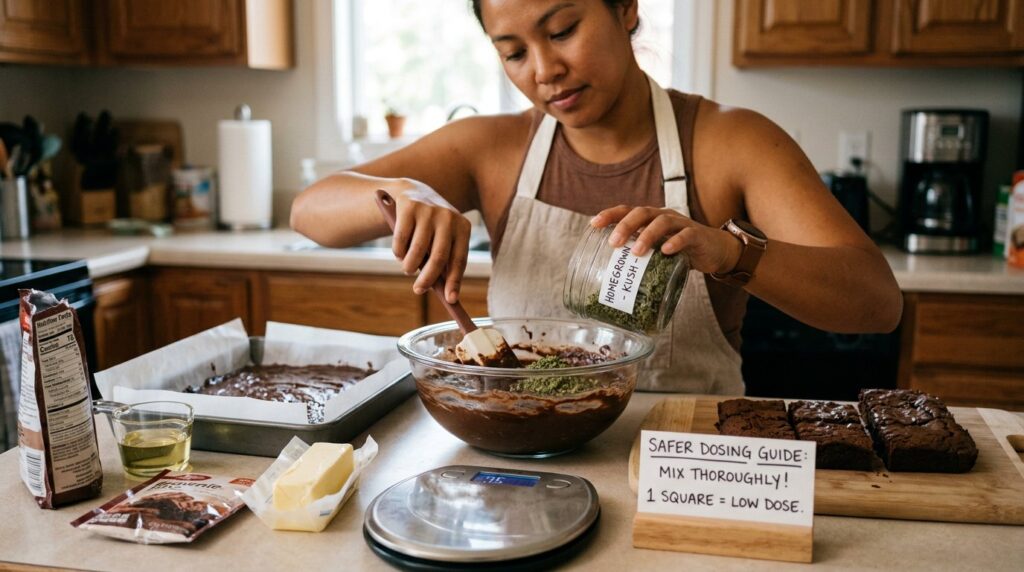
Weed brownies have a reputation for being easy: add cannabis, bake, enjoy. In reality, the brownie part is easy: getting predictable potency is where things can go sideways. One poorly mixed batch can produce nine mild squares and one brownie that cancels somebody’s weekend.
This guide shows you how to make weed brownies with flower, infused butter or oil, or THC distillate. You’ll learn how to estimate milligrams per serving, decarboxylate flower, prevent concentrated “hot spots,” and choose between a boxed mix and a fudgy from-scratch recipe.
Before starting, make sure you’re of legal age in your province or territory (19 in most of Canada, 18 in Alberta and 21 in Quebec). Keep every ingredient and finished brownie away from children and pets, and never drive after consuming one. Edibles can take two hours, or occasionally longer, to reach full strength, so careful dosing matters far more than bravado. Your goal isn’t to make the strongest brownie possible. It’s to make one whose effects you can reasonably predict.
Key Takeaways
- Making weed brownies requires precise dosing to ensure predictable potency and a safe experience.
- Decarboxylate cannabis flower at 110–116°C (230–240°F) for 30–45 minutes to activate THC before infusion into butter or oil.
- Infuse cannabinoids into the recipe’s fat rather than adding raw plant material directly to avoid uneven potency and strong herbal flavours.
- Use the dosage formula (grams of cannabis × THC% × 1,000 × infusion efficiency) to calculate milligrams of THC per serving for controlled effects.
- Mix infused butter or oil thoroughly with the batter to prevent hot spots and uneven distribution of THC.
- Label and store weed brownies securely, away from children and pets, with clear dosage information to ensure responsible consumption.
What “weed for brownies” means (and which cannabis forms work best)
“Weed for brownies” can mean cannabis flower, leftover shake, kief, concentrate, or an already activated product such as distillate. They can all work, but they aren’t interchangeable. Each form has a different cannabinoid concentration, flavour, preparation requirement, and margin for dosing error.
For most home bakers, labelled flower infused into butter or oil offers the best mix of accessibility and control. Distillate is simpler and less herbal tasting, but its high potency demands accurate measurement. Whatever you choose, buy it from a source that provides cannabinoid testing whenever possible. Guessing the strength of an untested product makes the final dose a guess too.
Flower vs shake vs kief vs concentrates (distillate/live resin) vs tinctures: pros, cons, and potency differences
| Cannabis form | Typical strength | Advantages | Drawbacks |
|---|---|---|---|
| Flower | Roughly 15–30% THC | Easy to find and calculate | Must be decarbed: noticeable flavour |
| Shake | Highly variable | Often inexpensive | Less predictable: may contain stems |
| Kief | Roughly 30–60% cannabinoids | Potent with less plant material | Easy to overuse: still requires decarbing |
| THC distillate | Often 80–95% THC | Usually activated: mild flavour | Tiny measurement errors matter |
| Live resin | Product-specific | Rich terpene profile | May require activation: strong flavour |
| Tincture | Listed in mg per bottle | Convenient labelled dose | Alcohol-based products need special handling |
Flower is forgiving because you can weigh it with an ordinary 0.01-gram kitchen scale. Shake can work similarly, though you shouldn’t assume it matches the potency of whole buds.
Kief contains more trichomes and less fibrous material, reducing the grassy taste. Its higher concentration means you need less of it, and need to calculate more carefully.
Most retail distillate syringes are already decarboxylated, although the label should confirm this. Live resin and other concentrates vary: some contain mostly THCA and need decarboxylation, while activated “ready-to-eat” oils do not.
With tinctures, read the carrier and directions. Oil-based tinctures can often enter the recipe’s fat directly. Never pour a large amount of alcohol tincture into batter and put it near an open flame: reduce it only when the manufacturer explicitly permits culinary use.
Choosing the best weed for brownies: potency, strain, and flavour
The best cannabis isn’t necessarily the one with the loudest strain name or highest THC number. For brownies, you want a tested product whose potency fits the batch you intend to make. A modest-strength flower can be easier to portion than an ultra-potent concentrate.
In Canada, cannabis labels list both THC and Total THC, so check which number you’re working from. Avoid cannabis showing mould, an ammonia-like odour, or unknown additives. Baking doesn’t make contaminated material safe.
THC% vs total cannabinoids: how to read labels and avoid surprise potency
Raw flower commonly contains THCA, the acidic precursor that becomes intoxicating THC when heated. Some labels list THC and THCA separately: others provide “Total THC,” which has already accounted for the conversion.
When separate values are shown, potential total THC is commonly estimated as:
Total THC% = THC% + (THCA% × 0.877)
The 0.877 factor reflects the mass lost when THCA converts to THC. Don’t apply it again if the package already lists Total THC. “Total cannabinoids” may include CBD, CBG, or other compounds, so it isn’t automatically the same as THC potency.
Also check the package’s testing date and serving information. Laboratory results still have a margin of error, and home infusion loses some cannabinoid content. Your calculation is an estimate, not pharmaceutical precision.
Terpenes and taste: how to reduce “weedy” flavour without losing potency
Brownies hide cannabis better than vanilla cake because cocoa, roasted sugar, espresso, and salt provide assertive flavours. Strains described as earthy, nutty, coffee-like, or citrusy tend to blend more comfortably than sharply piney selections, although terpene names don’t reliably predict your experience.
To control herbal flavour:
- Use kief or distillate instead of large quantities of flower.
- Infuse only the fat the recipe needs: don’t add wet plant material directly.
- Strain gently through cheesecloth without crushing every leaf fragment.
- Add Dutch-process cocoa, dark chocolate, espresso powder, or toasted nuts.
- Avoid overheating, which creates a bitter, burnt-plant taste.
A teaspoon of instant espresso powder can deepen chocolate without making brownies taste like coffee. Peppermint extract also masks herbal notes, but use it cautiously, your brownie should not taste like mouthwash.
THC-only vs balanced THC:CBD brownies (effects, anxiety considerations, beginner-friendly options)
High-THC edibles can feel intense because swallowed THC is metabolized partly into 11-hydroxy-THC, a potent metabolite. Some people find products containing both THC and CBD gentler, but CBD does not reliably “cancel” THC or guarantee an anxiety-free experience.
If you’re sensitive, consider a low-dose serving with a balanced ratio such as 1:1 THC to CBD. For example, a brownie containing 2.5 mg THC and 2.5 mg CBD offers a more cautious starting point than one containing 20 mg THC. Individual reactions still vary with tolerance, food, medications, sleep, and body chemistry.
Strain labels such as indica and sativa are poor dosing tools. The tested cannabinoid content, serving size, and your own response matter more.
Edible dosing made simple (mg THC per brownie)
Dose the batch before you preheat the oven. This five-minute calculation prevents the classic mistake of discovering, after licking the spoon, that every square may contain an uncomfortable amount.
You need four numbers: cannabis weight, THC concentration, estimated infusion efficiency, and the number of equal portions. Use a digital scale for plant material and a syringe marked in millilitres for liquid concentrates.
Dosage formula: grams of cannabis × THC% × 1000 × infusion efficiency
For flower labelled with Total THC, use:
Estimated batch THC (mg) = grams × THC decimal × 1,000 × efficiency
Then calculate:
THC per brownie = estimated batch THC ÷ number of pieces
Convert percentages to decimals: 20% becomes 0.20. Home infusion efficiency varies with decarboxylation, temperature, time, and straining. A conservative planning estimate is often 70–80%, but you can’t verify it without laboratory testing. This guide uses 75% in its flower examples.
If the label lists THCA rather than Total THC, first use the 0.877 conversion described above. For commercial distillate, use the labelled total milligrams whenever available, it’s more reliable than rebuilding the calculation from volume.
Write the estimated batch total on paper. It’s surprisingly easy to confuse “milligrams in the pan” with “milligrams in each piece,” especially once chocolate enters the situation.
Beginner, intermediate, strong: recommended mg THC ranges per serving
These are cautious general reference points, not guarantees:
- 1–2.5 mg THC: microdose or highly sensitive beginner range
- 2.5–5 mg: low serving for many occasional consumers
- 5–10 mg: moderate and potentially strong for a beginner
- 10–20 mg: strong for many people: generally unsuitable as a first serving
- 20+ mg: high dose with a greater risk of prolonged adverse effects
In Canada, legally sold edibles are capped at 10 mg THC per package. That doesn’t mean 10 mg is an appropriate starting point for everyone. If you’re new, 2.5 mg, or less, is the more prudent test.
Wait at least two full hours, and preferably longer if you’ve eaten a large meal, before considering more. Taking a second brownie at minute 45 is how an ordinary evening turns into a lengthy negotiation with the ceiling fan.
Worked examples: 1g at 20% THC, 3.5g at 25% THC, and distillate dosing
Example 1: 1 gram at 20% Total THC
1 × 0.20 × 1,000 × 0.75 = 150 mg estimated THC per batch. Cut into 24 pieces, that’s approximately 6.25 mg each.
Example 2: 3.5 grams at 25% Total THC
3.5 × 0.25 × 1,000 × 0.75 = 656 mg per batch. Even at 24 pieces, each would contain roughly 27 mg, far too strong for most beginners. Dilute the infused fat across multiple batches rather than forcing all of it into one pan.
Example 3: distillate
Suppose a syringe contains 1 gram of oil labelled 90% THC, or approximately 900 mg THC. Using one-quarter of it gives about 225 mg. Divided among 30 pieces, that’s 7.5 mg each.
Because thick distillate is difficult to divide by eye, use package markings or calculate from labelled milligrams per millilitre. If the syringe isn’t graduated accurately, making a measured master mixture is safer than squeezing out a guessed blob.
Decarboxylation (don’t skip): time, temperature, and smell-control tips
Fresh cannabis is rich in THCA rather than active THC. Decarboxylation uses controlled heat to remove a carboxyl group, converting much of that THCA into THC. Simply stirring raw flower into batter produces weaker, less predictable results because the moist centre of a brownie doesn’t heat as evenly as a dedicated decarb process.
A practical home range for flower is approximately 110–116°C (230–240°F) for 30–45 minutes. Oven accuracy varies dramatically, so an inexpensive oven thermometer is more useful than a fancy strain name. Kief may finish toward the shorter end because its particles are fine and exposed.
The cannabis should become dry, lightly toasted, and somewhat darker, not black or smoking. Let it cool before opening its container or transferring it to fat.
Smell is unavoidable, but you can reduce it:
- Use a covered oven-safe mason jar or tightly folded foil packet.
- Run the range hood and open windows where lawful and appropriate.
- Avoid grinding the flower into powder before heating.
- Let a sealed jar cool before opening it outdoors or near ventilation.
A jar contains odour better, but never place a cold jar directly into a hot oven. Use a clean, heat-safe canning jar, inspect it for cracks, leave the lid slightly loosened while heating, and handle it with oven gloves. Thermal shock and sealed pressure are not the sort of kitchen drama you need.
Decarbing concentrates requires product-specific guidance. Distillate and many ready-to-use oils are already activated: heating them again only adds unnecessary degradation.
Oven decarb step-by-step + jar/foil methods
Why separate decarboxylation from baking? Control. You’re giving cannabis a consistent heat treatment instead of hoping the brownie’s crust, centre, and edges activate it equally.
Use this straightforward oven method:
- Check the label and calculate your intended dose. Weigh only the amount required.
- Preheat the oven to 116°C (240°F) and verify it with an oven thermometer.
- Break flower into rice-sized pieces by hand. Don’t pulverize it.
- Spread it in a thin, even layer on parchment paper.
- Cover the baking sheet loosely with foil to limit odour and airflow.
- Heat for approximately 35–40 minutes, gently redistributing it once halfway through.
- Remove it when dry and lightly browned. Cool while covered.
- Infuse it into butter or oil rather than adding the plant matter directly to batter.
For the foil-packet method, fold heavy-duty foil around the cannabis and crimp the edges without compressing the contents. Set the packet on a baking sheet and follow the same temperature range.
For the jar method, place coarsely broken flower in a heat-safe canning jar no more than one-third full. Fasten the lid only finger-loose, set the jar on a damp kitchen towel on a tray, and heat it carefully. Rotate the jar every 10–15 minutes using oven mitts. Cool it before tightening or opening.
Common decarb mistakes (too hot, too long, uneven grind) and how to avoid them
Too hot: Temperatures above the intended range can scorch plant material, worsen flavour, and accelerate cannabinoid degradation. Don’t trust an oven dial that hasn’t been checked.
Too long: More time doesn’t mean more potency forever. Once conversion has occurred, continued heat can degrade THC and terpenes.
Powder-fine grinding: Fine particles heat quickly, pass through strainers, and contribute bitter flavour. Aim for small, relatively uniform pieces.
Crowding: A thick mound heats unevenly. Use a larger tray or divide the material.
Skipping the calculation: Decarboxylating the entire jar because “it didn’t look like much” is how accidental megadoses begin. Weigh first.
Opening immediately: Hot aromatic compounds escape quickly, carrying a powerful smell. Let the covered tray, packet, or jar cool first.
If the material smells burnt or has turned nearly black, don’t assume it became extra strong. It’s more likely overheated and unpleasant tasting.
Make infused ingredients for brownies (choose one)
Cannabinoids dissolve well in fats, which is why butter and oil remain the standard brownie carriers. Choose the fat your recipe already uses, calculate its total potency, and keep the amount consistent with the recipe. Adding extra butter to “capture more THC” can leave you with an oily slab rather than brownies.
Cannabutter for brownies: infusion steps, straining, and potency notes
For one pan, combine your measured, decarbed cannabis with the amount of butter required by the recipe, plus a small allowance for loss during straining. Clarified butter loses less water and stores well, but regular unsalted butter works.
- Melt the butter over very low heat.
- Add the decarbed cannabis and enough water to help moderate temperature, if desired.
- Hold the mixture around 71–88°C (160–190°F) for roughly two hours. Don’t boil or fry it.
- Stir occasionally and monitor with a thermometer.
- Strain through cheesecloth or a fine-mesh filter into a clean container.
- Press lightly: aggressive squeezing pushes bitter plant compounds through.
- If water was used, refrigerate until solid and pour off the separated water.
Measure the finished butter. If straining left you short, top it up with plain butter to the recipe’s required quantity. The estimated THC remains the same, but distributing it through the correct fat volume makes recipe performance easier to predict.
Canna-oil (coconut/vegetable) for brownies: when oil is better than butter
Oil is ideal for boxed mixes and dairy-free recipes. Refined coconut oil is neutral, solid at cool room temperature, and rich in saturated fat. Unrefined coconut oil contributes a distinct coconut aroma. Neutral vegetable or avocado oil keeps brownies soft but can be harder to strain cleanly.
Use the same low-temperature process: combine decarbed cannabis with the recipe’s measured oil, maintain approximately 71–88°C (160–190°F) for around two hours, and strain. A small slow cooker may work, but many run hotter than their settings suggest, so check the actual temperature.
Choose oil when the package specifically calls for it. Substituting solid coconut oil for liquid vegetable oil can produce a firmer refrigerated brownie: that isn’t dangerous, just a texture choice. For cleaner flavour, infuse a concentrated portion of oil, strain it, and blend it thoroughly with plain oil to reach the recipe’s total volume.
Using THC distillate (no decarb needed): how to mix evenly and prevent hot spots
Confirm that the distillate is activated and labelled for edible use. Warm the sealed syringe in a cup of warm, not boiling, water for several minutes so the oil flows. Never microwave the syringe.
Blend the measured distillate into warm melted butter or oil before it touches the batter. Stir or whisk until no streaks remain, then scrape the sides and bottom of the bowl. A little liquid sunflower lecithin can assist dispersion, although it doesn’t rescue careless mixing or guarantee greater potency.
For better precision, dilute the full syringe into a known amount of warm carrier oil, mix thoroughly, and measure the fraction you need. Example: 900 mg THC mixed evenly into 9 tablespoons of oil yields approximately 100 mg per tablespoon. Label and lock away any remainder immediately.
Never dot concentrate directly over finished batter. Those innocent-looking amber streaks become hot spots, tiny portions containing wildly disproportionate doses.
Weed brownies recipe (boxed mix): fastest, most consistent method
A boxed mix is a sensible shortcut, not culinary defeat. Brands such as Ghirardelli, Betty Crocker, and Duncan Hines have standardized ratios, which means fewer texture variables while you concentrate on dosing. Follow the exact eggs, water, pan, and oven temperature printed on your specific box.
For a typical mix requiring 1/3 cup oil:
- Calculate the batch THC and intended number of servings.
- Measure enough infused oil to provide that batch total.
- Add plain oil until you reach exactly 1/3 cup.
- Whisk the infused and plain oils together thoroughly.
- Combine with the mix, eggs, and water as directed.
- Stir until uniform, scraping the bowl several times.
- Spread the batter evenly and bake according to the package’s timing.
- Cool completely before cutting into measured portions.
Avoid tasting raw batter. Besides making your dose impossible to track, uncooked flour and eggs can carry foodborne pathogens.
Ingredient swaps: replacing oil/butter with infused fat without changing texture
Replace recipe fat one-for-one by volume or weight, depending on the directions. If a box calls for 1/2 cup vegetable oil, the combined infused and plain oil should still equal 1/2 cup.
You don’t need every drop to be infused. Suppose your calculated dose requires only two tablespoons of canna-oil, but the recipe needs eight. Use two tablespoons infused oil plus six tablespoons plain oil. This dilution keeps the brownie’s structure intact while controlling potency.
Melted cannabutter can replace oil, but it creates a slightly denser, more cake-like crumb depending on its water content. Conversely, substituting liquid oil in a butter-based recipe may remove some buttery flavour and alter the glossy crust. Match the specified fat when consistency matters most.
Pan size, cut count, and how that changes mg per brownie
Pan dimensions change thickness and baking time, not total THC. Cutting changes the dose per piece.
If a batch contains 120 mg THC:
| Cut pattern | Pieces | Approximate THC each |
|---|---|---|
| 3 × 4 | 12 | 10 mg |
| 4 × 4 | 16 | 7.5 mg |
| 4 × 6 | 24 | 5 mg |
| 6 × 8 | 48 | 2.5 mg |
Use a ruler and mark equal intervals before slicing. For microdoses, bake in a pan and cut accurately rather than filling mini-muffin wells by eye: spoonfuls can vary substantially.
Don’t switch a 20 cm (8-inch) pan for a 23 × 33 cm (9 × 13-inch) pan without adjusting the package instructions. Thin batter cooks faster, and overbaked edges taste especially harsh when cannabis is involved.
Weed brownies recipe (from scratch): fudgy, even dosing, better flavour
From-scratch brownies give you more control over flavour and fat distribution. This formula makes one 20 cm (8-inch) square pan. Your THC level depends entirely on the infused portion of the butter, not on the recipe itself.
Ingredients
- 1/2 cup (113 g) unsalted butter, with infused butter replacing only the calculated portion
- 4 oz (113 g) bittersweet chocolate, chopped
- 3/4 cup (150 g) granulated sugar
- 1/4 cup (50 g) light brown sugar
- 2 large eggs, at room temperature
- 1 teaspoon vanilla extract
- 1/2 cup (60 g) all-purpose flour
- 1/3 cup (30 g) unsweetened cocoa powder
- 1/2 teaspoon fine salt
- Optional: 1 teaspoon instant espresso powder
Line the pan with parchment, leaving handles on two sides. Preheat the oven to 160°C (325°F). Calculate the dose before mixing, and blend infused butter with plain butter to total exactly 113 grams.
Step-by-step method: mixing order, avoiding overbaking, and achieving a glossy top
- Melt the butter and chopped chocolate gently over a double boiler or in short microwave bursts. Stir until smooth, then let it cool slightly.
- Whisk both sugars and the eggs vigorously for about two minutes. The mixture should look lighter and a little foamy. Dissolving some sugar and incorporating a controlled amount of air helps create that paper-thin glossy top.
- Whisk in the vanilla and warm chocolate-butter mixture. Scrape the bowl thoroughly so the infused fat can’t settle along one side.
- Sift in the flour, cocoa, salt, and optional espresso powder.
- Fold only until the last dry streak disappears. Overmixing develops gluten and makes the brownies tougher.
- Spread the batter level in the lined pan, pushing it into the corners.
- Bake for approximately 22–28 minutes. Begin checking early.
A toothpick inserted near the centre should emerge with moist crumbs, not liquid batter. Waiting for a perfectly clean toothpick often means dry brownies after carryover cooking.
Cool the pan completely, at least one hour, before lifting and slicing. For exceptionally clean cuts, refrigerate the slab for 20 minutes and wipe the knife between passes.
Mix-ins such as toasted walnuts or chocolate chips are fine, but scatter them evenly. Large nut clusters can make equal pieces differ in weight, which slightly undermines your careful portioning.
Baking temperatures and cannabinoid safety (maximum heat, best practices)
A 160–175°C (325–350°F) oven does not mean the interior of a moist brownie instantly reaches that temperature. Water in the batter moderates its internal temperature, while the edges and exposed surface become hotter. Properly infused brownies can hence bake at ordinary recipe temperatures without immediately destroying all their THC.
Still, extreme heat and unnecessary baking time can reduce quality. Use the temperature specified by a tested recipe, verify your oven with a thermometer, and remove the pan as soon as the centre is set. Don’t increase the oven to 220°C (425°F) to finish faster.
Keep infused fat away from direct flames and smoking-hot pans. If butter browns aggressively or oil smokes during infusion, it has become too hot. Apart from cannabinoid degradation, overheated fat contributes acrid flavours.
“Cannabinoid safety” also means preventing accidental exposure. Wash infusion tools separately, wipe counters, and don’t leave a THC-coated spatula in the sink where somebody might mistake it for ordinary chocolate batter.
Why “low and slow” matters: preserving potency and preventing burnt taste
Low, controlled heat makes decarboxylation and infusion more predictable. It reduces scorching and limits the extraction of bitter, chlorophyll-heavy flavours. But “low and slow” has limits: simmering butter for eight hours doesn’t automatically make it stronger.
Think of the process as three separate jobs:
- Decarb gently to activate the flower.
- Infuse below a simmer to transfer cannabinoids into fat.
- Bake only until done to set the brownie.
Monitor each stage instead of using one prolonged blast of heat. An oven thermometer and an instant-read probe cost less than replacing scorched cannabis, and are considerably less frustrating.
If your oven runs hot, lower the setting enough to achieve the recipe’s true temperature. Glass pans can retain heat longer than light-coloured metal pans, so begin checking sooner. Dark metal pans brown edges faster: reducing the set temperature by about 15°C (25°F) may be appropriate when the manufacturer recommends it.
Customization options (dietary + potency control)
Dietary substitutions are straightforward when you change one major variable at a time. Potency adjustments require the same discipline: preserve the recipe’s total fat and liquid while changing how much of that fat is infused.
Vegan, gluten-free, and dairy-free weed brownies
For vegan brownies, use infused refined coconut oil or a neutral vegetable oil. Replace eggs with a tested recipe’s recommended substitute rather than improvising. Commercial products such as Bob’s Red Mill Egg Replacer are more predictable than swapping in applesauce without adjusting moisture.
For dairy-free brownies, choose oil or plant-based baking sticks clearly labelled dairy-free. Check chocolate chips too: many contain milk even when the batter doesn’t.
For gluten-free brownies, use a reputable 1-to-1 gluten-free flour blend containing xanthan gum, or select a brownie formula designed specifically for almond flour. A direct almond-flour substitution changes fat absorption and structure.
Cross-contact matters for people with celiac disease or severe allergies. Use clean tools, uncontaminated cocoa, and a dedicated strainer if your usual kitchen equipment handles allergens.
Whatever the diet, the dosing equation stays the same. Coconut oil doesn’t make THC stronger by magic, and gluten-free flour doesn’t reduce it.
Microdose batch strategy: make a potent base, then dilute for precise servings
A master infusion can simplify low-dose baking, provided you know its estimated total potency and mix it thoroughly. Suppose 1 cup of oil contains an estimated 400 mg THC. After fully homogenizing it, each tablespoon contains about 25 mg because one cup holds 16 tablespoons.
For a batch intended to contain 60 mg total, use 2.4 tablespoons of infused oil and enough plain oil to reach the recipe’s required amount. Cut the finished pan into 24 equal pieces for approximately 2.5 mg each.
For easier measurement, create a weaker working oil. Blend one part of the 25-mg-per-tablespoon oil with four equal parts plain oil. The diluted mixture contains approximately 5 mg per tablespoon. Label both containers distinctly.
Don’t use a household teaspoon to measure thick concentrate directly: residue and inaccurate fill levels introduce large errors. A graduated oral syringe is more suitable. Even then, home calculations remain estimates, so begin with a fraction of one serving when testing a new batch.
Troubleshooting: common weed brownie problems and fixes
Most failed weed brownies trace back to one of four issues: weak mixing, altered fat ratios, excessive baking, or too much plant material. Fortunately, you can prevent nearly all of them before the pan enters the oven.
Uneven potency, greasy texture, dry/crumbly brownies, and strong cannabis taste
Uneven potency or hot spots: Concentrate was probably added directly to batter, or infused fat wasn’t blended first. Warm the distillate, dissolve it completely into the recipe’s fat, and scrape the bowl repeatedly. Spread batter to an even depth and cut equal portions.
Greasy brownies: Too much total fat was added, often because infused oil was treated as an extra ingredient. The infused and plain fats together must equal the recipe amount. Greasiness can also come from underbaking or a broken chocolate emulsion. Measure by weight where possible.
Dry or crumbly texture: The pan likely baked too long, the oven ran hot, or too much flour was packed into the measuring cup. Weigh flour and remove fudgy brownies when a tester shows moist crumbs. Cooling will finish the structure.
Strong cannabis taste: Use less plant material by selecting stronger tested flower, kief, or distillate. Strain carefully, avoid squeezing the filter hard, and support the chocolate with espresso, vanilla, salt, toasted nuts, or dark cocoa.
Brownies seem weak: Don’t immediately eat several. Effects may be delayed by a large meal or individual metabolism. If the entire batch repeatedly seems weak, review whether the flower was decarbed, whether you used Total THC correctly, and whether infusion temperatures were controlled.
Brownies seem unexpectedly strong: Recalculate the total and portion count. You may have used THC% as a whole number instead of a decimal, confused THCA with Total THC, or cut fewer pieces than planned. Relabel the batch and divide each piece further. Never serve questionable brownies without a clear warning.
Storage, shelf life, and labelling (safety-first)
Cannabis brownies look and smell like ordinary dessert, which makes secure storage non-negotiable. Don’t rely on a verbal warning or a sticky note that can fall off. Use a locked, child-resistant container that is clearly different from your everyday food storage.
Room temp vs fridge vs freezer + childproofing and clear mg-per-piece labels
At cool room temperature, plain brownies generally keep for about two to three days in an airtight container. Refrigeration extends quality to roughly a week, though it can make them firm. For longer storage, wrap individual portions and freeze them in a sealed container for up to two or three months.
Label the outer container and each wrapped piece with:
- “CONTAINS THC, ADULT USE ONLY”
- Estimated THC per piece
- Number of pieces
- Preparation date
- Major allergens
Store it in a locked box, away from ordinary snacks, medications, and pet food. A high shelf alone isn’t childproof. Dogs are especially vulnerable to both THC and chocolate: if a pet eats any, contact a veterinarian or animal poison-control service immediately.
Don’t bring infused brownies to a party without the host’s explicit knowledge. Never leave them on a communal dessert table, and don’t transport them across borders or into places where possession is prohibited.
Responsible use: onset time, duration, and what to do if you took too much
Effects commonly begin in 30 minutes to two hours, but delayed onset beyond two hours can happen. The experience may last six hours or longer, with residual impairment extending into the next day after a large dose. Eat in a safe setting, avoid alcohol and other intoxicants, and don’t drive, cycle in traffic, cook over flames, or operate machinery.
If you take too much, remind yourself that the effects are temporary. Move somewhere quiet, sip water, reduce stimulation, and stay with a calm, trusted adult. Don’t try to “cancel” the dose with more substances. CBD and black pepper are often discussed online, but neither is a dependable antidote.
Seek urgent medical help for chest pain, trouble breathing, seizures, loss of consciousness, severe confusion, repeated vomiting, dangerous behaviour, or suspected ingestion by a child or pet. In Canada, call 911 in an emergency, or call 1-844-POISON-X (1-844-764-7669) to reach your local poison centre (in Quebec, the Centre antipoison du Québec at 1-800-463-5060). Be honest about what was consumed: accurate information helps professionals respond appropriately.
FAQ: weed for brownies
The arithmetic and safety rules matter more than any single recipe. Use tested cannabis, activate flower correctly, mix cannabinoids into fat before adding them to batter, and label every portion. If you can’t estimate the dose with reasonable confidence, don’t serve the batch to anyone else.
How much weed do you need for brownies?
There isn’t one universal amount. Work backward from the desired milligrams per serving.
For 24 brownies at 5 mg each, you need about 120 mg THC in the batch. With flower containing 20% Total THC and an assumed 75% infusion efficiency:
Required grams = 120 ÷ (0.20 × 1,000 × 0.75) = 0.8 gram
That may look surprisingly small. A traditional suggestion such as “use an eighth” could create several hundred milligrams in one pan. Potency, efficiency, and portion count, not folklore, determine the amount.
For distillate, use the labelled milligrams. If it contains 900 mg per syringe and you need 120 mg, you need roughly 13.3% of that syringe. Because measuring such a small fraction can be difficult, dilute it into a known volume of oil first.
Do you have to decarb weed for brownies?
You should decarb raw flower, shake, kief, and THCA-rich concentrates before infusing them. Brownie baking alone isn’t a dependable activation method because the moist interior heats unevenly and remains cooler than the oven air.
You generally don’t need to decarb THC distillate or products labelled activated, decarboxylated, or ready for oral use. Check the certificate or package rather than assuming. Reheating an activated concentrate for an extended period can diminish flavour and potency.
Can you put ground weed directly into brownie batter?
Technically, yes, but it’s a poor method. Raw flower may not activate evenly, plant particles create a gritty texture, and the flavour can become aggressively grassy. Direct addition also makes cannabinoid distribution harder to control.
Decarb the cannabis first, infuse it into the recipe’s butter or oil, and strain it. This separates activation from extraction and lets you mix the active ingredient evenly through the batter. If you intentionally retain finely decarbed material to avoid infusion loss, expect a stronger herbal taste and less refined texture.
What’s the best THC mg per brownie for beginners?
A cautious beginner serving is generally 1–2.5 mg THC. Someone who already knows they tolerate edibles may choose up to 5 mg, but 10 mg can be uncomfortably strong for a first experience.
Start with one measured portion after eating a normal meal. Wait at least two hours, and longer if effects are still developing, rather than stacking servings. Your response can change between batches because home infusion isn’t perfectly uniform.
The best first brownie is not the one that proves your tolerance. It’s the one that lets you understand your response without panic, unsafe behaviour, or an accidental all-night adventure. Calculate carefully, cut evenly, label clearly, and treat every new batch as stronger until experience shows otherwise.