
Blog 2026
How Long Does Weed Take to Wear Off? A Clear Guide
Nov
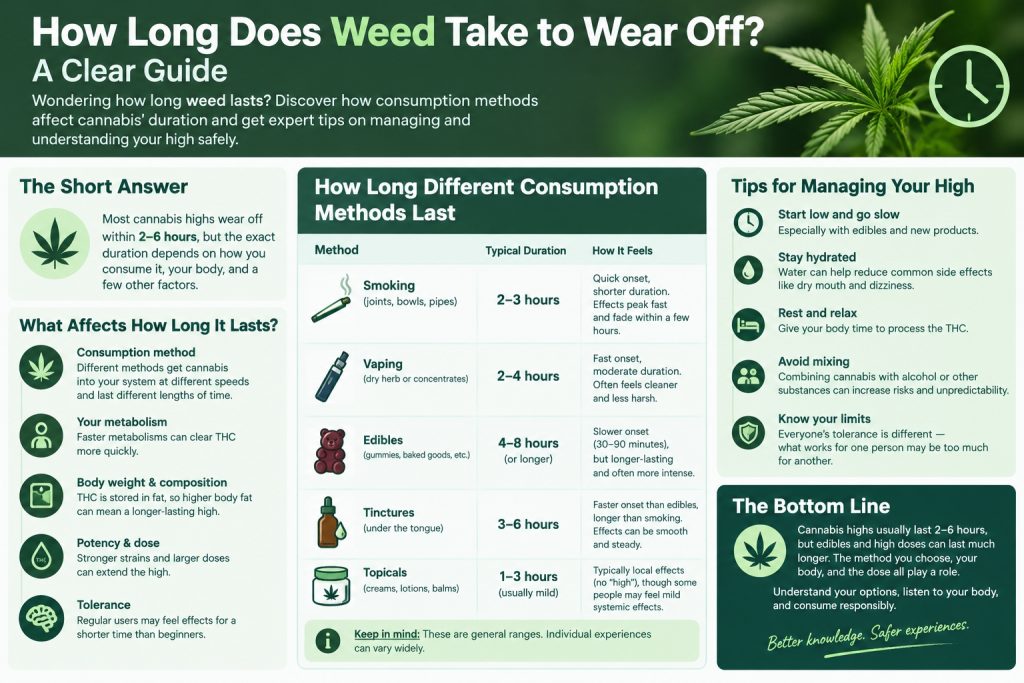
You expected to relax for an hour or two. Instead, the clock is crawling, your mouth feels like a desert, and you’re wondering: how long does weed take to wear off? For most people, inhaled cannabis effects fade substantially within two to four hours, while edible effects commonly last six to 12 hours. Strong doses can last longer, and residual sleepiness, slowed thinking, or poor coordination may continue after the obvious high has passed.
The frustrating part is that cannabis doesn’t come with a reliable countdown timer. Duration depends on how you consumed it, how much THC you took, the product’s potency, your tolerance, whether you ate, and whether alcohol or medications are involved. A 5-milligram gummy and a 100-milligram edible are technically the same product category, but they aren’t remotely the same experience.
This evidence-based guide covers the expected onset, peak, and duration of smoking, vaping, edibles, drinks, concentrates, tinctures, and oils. It also explains what you can do when you feel uncomfortably high, which symptoms require urgent help, and why “I don’t feel high anymore” isn’t automatically a green light to drive.
These are general estimates rather than personalized medical advice. Cannabis products vary widely, labels may be inaccurate, and individual reactions aren’t perfectly predictable. If someone has severe symptoms, especially chest pain, difficulty breathing, a seizure, extreme confusion, or an inability to wake, call emergency services rather than waiting for the high to pass.
Key Takeaways
- Inhaled cannabis effects usually wear off within two to four hours, while edibles can take six to 12 hours or longer to fully subside.
- The method of consumption greatly influences the onset and duration of a weed high, with inhalation acting faster than ingestion.
- Higher THC doses and frequent use can prolong effects and impair coordination and judgment even after the noticeable high ends.
- Never drive or operate machinery until you feel fully alert, as residual impairment can last beyond the perceived wearing off of weed.
- If feeling uncomfortably high, stop consuming cannabis, rest in a safe place with a sober companion, and wait for effects to diminish naturally.
- Seek immediate medical help if severe symptoms occur, such as chest pain, seizures, or inability to wake, rather than waiting for the weed to wear off.
Quick answer: how long does weed take to wear off?
A cannabis high usually follows these broad timelines:
| Consumption method | Onset | Strongest effects | Typical noticeable duration |
|---|---|---|---|
| Smoking or vaping | Seconds to 10 minutes | 10–30 minutes | 2–4 hours |
| Edibles | 30 minutes–2 hours | 2–4 hours | 6–12 hours |
| THC drinks | 10 minutes–2 hours | 1–3 hours | 4–12 hours |
| Dabs or concentrates | Seconds to minutes | 10–30 minutes | 2–6+ hours |
| Sublingual tinctures | 15–45 minutes | 1–2 hours | 4–8 hours |
| Swallowed oils | 30 minutes–2 hours | 2–4 hours | 6–12 hours |
These ranges describe noticeable effects, not guaranteed recovery of driving or workplace skills. After a large dose, you might experience impaired attention, fatigue, dizziness, or a “weed hangover” into the next day.
If you’re currently too high, stop consuming cannabis and don’t drive. Move somewhere quiet, stay with a trusted sober person, and remind yourself that uncomplicated THC intoxication generally improves with time. Check the package if possible: knowing whether you took 5, 10, or 50 milligrams can help you and a medical professional assess the situation.
Weed duration by consumption method: Onset, peak, and typical effects
The route cannabis takes through your body shapes the entire experience. Inhaled THC enters the bloodstream through your lungs, so it arrives quickly and declines relatively quickly. Swallowed THC must travel through the digestive system and liver first. That delay creates the classic edible trap: nothing’s happening, so I’ll take another one. Then both doses arrive together.
Smoking and vaping: Effects commonly last 2–4 hours, sometimes longer
Smoking flower or using a cannabis vape can produce effects within seconds, although it may take 10 to 30 minutes to appreciate their full intensity. The strongest subjective high often settles within the first hour and fades substantially over two to four hours.
Dose still matters. One small puff from a low-THC joint isn’t equivalent to several deep pulls from a high-potency cartridge. Modern vape oils may contain 70% to 90% THC, whereas flower commonly contains much less by weight. Efficient inhalation can hence deliver more THC than a beginner expects.
Residual impairment can outlast the feeling of being “stoned.” Reaction time, divided attention, and judgment may remain affected for several hours, particularly after repeated inhalation. If you keep topping up every 20 minutes, your duration effectively resets, and the later decline becomes harder to predict.
Edibles and THC drinks: Effects commonly last 6–12 hours, sometimes longer
Edibles usually begin working within 30 minutes to two hours, but onset can take longer. Effects often peak around two to four hours after ingestion and may remain noticeable for six to 12 hours. Large doses can produce next-day effects.
Your liver converts swallowed delta-9 THC into 11-hydroxy-THC, an active metabolite that can feel intense and long-lasting. That’s why a 10-milligram gummy may feel very different from inhaling a nominally similar amount. For a new or sensitive consumer, even 10 milligrams may be too much: regulated markets often treat 5 or 10 milligrams as a standard serving, not necessarily a beginner dose.
THC beverages vary. Nanoemulsified drinks may begin working faster than brownies or gummies, while conventional drinks can behave more like other edibles. Don’t assume a quicker onset guarantees a quicker finish. Read the label, count the total milligrams in the whole container, and avoid redosing for at least two hours, longer if the package advises it.
Dabs and concentrates: High THC doses can intensify and prolong effects
Wax, shatter, rosin, and other concentrates can contain several times the THC concentration of cannabis flower. Effects begin rapidly when dabbed or vaporized, but a high dose may cause intense anxiety, vomiting, dizziness, rapid heart rate, or pronounced sedation.
The main issue isn’t that concentrates follow a completely different biological clock. It’s that they can deliver a substantial dose in one inhalation. A large dab may feel powerful for several hours, with fogginess or fatigue continuing afterward. Repeated dabs extend that window further.
Beginners can’t reliably judge a concentrate dose by the size of the blob, “a grain of rice” isn’t exactly laboratory measurement. If you choose to use concentrates, start with the smallest practical amount, avoid mixing substances, and wait before taking more. High-potency products are particularly risky for people prone to panic, psychosis, or severe cardiovascular symptoms.
Tinctures and oils: Under-the-tongue use versus swallowing
A tincture held under your tongue may be absorbed partly through the tissues in your mouth, leading to effects in roughly 15 to 45 minutes. These effects often last around four to eight hours, depending on the dose and how much is swallowed.
If you immediately swallow the liquid, or use a THC oil in food, it behaves more like an edible. Onset may take 30 minutes to two hours, with effects lasting six to 12 hours or longer after a large dose.
Real-world use blurs the categories because some liquid inevitably gets swallowed. Measure with the product’s marked dropper rather than eyeballing it. Also check whether the label lists milligrams per millilitre, per dropper, or per bottle. Confusing a 1 mL serving with the entire bottle is the sort of tiny math error that creates a very, very long evening.
What affects how long a weed high lasts?
Cannabis duration isn’t determined by body weight alone, and two people taking the same labelled dose may have very different experiences. Product chemistry, tolerance, genetics, health, environment, and other substances all contribute.
THC dose, product potency, and taking additional doses
Dose is one of the strongest predictors of intensity and duration. More THC generally means stronger effects, a later return to baseline, and a greater chance of next-day fatigue. Potency tells you the concentration, but your total dose depends on how much product you actually consume.
For flower, THC percentage and inhalation technique both matter. For edibles, focus on milligrams per serving and per package. A chocolate bar labelled “100 mg THC” may contain ten 10-milligram pieces: eating the bar is ten servings, not one ambitious dessert.
Redosing stacks effects. With inhaled cannabis, rapid feedback makes dosing somewhat easier, though repeated puffs still accumulate. With edibles, delayed onset makes accidental overconsumption common. Write down the time and dose before consuming. It sounds overly cautious until two hours later, when your short-term memory decides not to cooperate.
Frequency of use and tolerance: Why feeling less high does not mean unimpaired
Frequent consumers often develop tolerance, meaning the same dose produces less obvious intoxication. They may also report a shorter-feeling high. But tolerance doesn’t guarantee normal reaction time, judgment, tracking, or divided attention.
This distinction matters behind the wheel and in safety-sensitive work. Someone who uses cannabis daily may appear composed while still performing worse on complex tasks. Conversely, an infrequent consumer may feel overwhelmed by a dose that a regular user considers modest.
Tolerance can decline after a break. Returning to your previous dose after several cannabis-free weeks can cause unexpectedly strong effects. Treat your old “normal” as potentially too high, particularly with concentrates and edibles. Familiarity may reduce anxiety, but it doesn’t make THC disappear faster.
Individual sensitivity, metabolism, and food intake
Genetics, liver enzyme activity, age, sleep, stress, and previous cannabis experience can all influence duration. People who are sensitive to THC may experience panic or altered time perception at relatively low doses, making a few hours feel substantially longer.
Food complicates edible timing. Taking THC with a meal, particularly one containing fat, may increase absorption, while the meal can also delay stomach emptying. In practice, an edible after a large dinner may come on later and feel stronger or last longer than expected. An empty stomach isn’t a reliable shortcut: it may simply make the experience less predictable.
Health conditions affecting the liver, digestion, heart, or nervous system may alter risk. If you repeatedly experience unusually prolonged effects, faintness, severe nausea, or confusion at low doses, pause use and discuss it with a clinician.
Alcohol, medications, and other substances
Alcohol and cannabis can amplify dizziness, nausea, impaired coordination, and poor judgment. Drinking before cannabis may also increase THC absorption in some circumstances. The combination is far less charming than people imagine, often less “fun night out,” more “floor suddenly feels trustworthy.”
Sedating medications can compound impairment. These include benzodiazepines, sleep aids, opioids, some antihistamines, muscle relaxants, and certain psychiatric medicines. Cannabis can also interact with medications through liver-enzyme pathways, although the clinical significance depends on the drug and dose.
Don’t stop prescribed medication on your own. Ask a pharmacist or clinician about interactions, especially if you take blood thinners, seizure medicines, sedatives, or drugs with narrow safety margins. Mixing cannabis with unknown illicit substances creates additional uncertainty because potency and contamination may be impossible to verify.
Why you may still feel high or foggy the next day
Waking up groggy after cannabis doesn’t necessarily mean you’re experiencing the same active high as the night before. It may reflect residual THC effects, disrupted sleep, dehydration, a very large dose, or the plain old consequences of staying awake waiting for an edible to stop rearranging time.
The difference between an active high and lingering fatigue or impaired attention
An active high may involve euphoria, altered sensory perception, time distortion, impaired short-term memory, increased appetite, or anxiety. Lingering effects are often subtler: heavy eyes, slow thinking, low motivation, poor concentration, headache, or mild dizziness.
That distinction is useful, but it isn’t a safety test. If you feel foggy, unsteady, unusually sleepy, or unable to concentrate, you shouldn’t drive, operate machinery, work at heights, or make high-stakes decisions. Sleep duration matters too. Taking a strong edible at midnight and waking at 6 a.m. combines possible residual impairment with sleep deprivation.
Give yourself additional recovery time, eat normally, hydrate, and reassess. If symptoms are getting worse rather than gradually improving, or include chest pain, repeated vomiting, severe agitation, hallucinations, or weakness, seek medical advice.
Why edible metabolism and delayed redosing can make effects last longer
Edibles can produce a long tail because absorption continues over time and the liver creates active 11-hydroxy-THC. If you redose before the first serving peaks, you may create overlapping waves rather than one clean rise and fall.
Consider a common scenario: you eat 10 milligrams at 7 p.m., feel little at 8 p.m., and take another 10. The first dose peaks around 9 or 10, while the second is still rising. Instead of an early bedtime, you may have strong effects after midnight and residual fog the next morning.
Large doses, slow digestion, and late-night timing increase this possibility. Keep a simple note on your phone showing the product, milligrams, and time consumed. Future-you will appreciate the receipt.
What to do if you feel too high
Most uncomplicated cannabis intoxication improves with time and supportive care. Your immediate job isn’t to “flush out” THC. It’s to reduce risk, stay calm, and recognize symptoms that need medical attention.
Stop taking cannabis, rest somewhere calm, and stay with a trusted person
Stop consuming cannabis, alcohol, and other recreational substances. Move away from traffic, balconies, pools, stoves, and anything else that becomes a bad idea when balance and judgment are impaired.
Try this sequence:
- Sit or lie down somewhere quiet and familiar.
- Tell a sober person what you took, how much, and when.
- Breathe slowly, emphasizing a longer exhale.
- Reduce bright lights, noise, and crowded conversation.
- Keep the package available in case professional help is needed.
A trusted person can offer reassurance and monitor you without arguing about whether your fear is “rational.” Avoid driving to seek help. In Canada, call 911 for emergencies or your local poison centre at 1-844-POISON-X (1-844-764-7669) (in Quebec, 1-800-463-5060) for case-specific guidance. Be honest about what was consumed: clinicians need accurate information, not a heroic cover story.
Water, food, coffee, cold showers, and exercise: Comfort measures versus sobriety myths
Small sips of water can help with dry mouth, and a light snack may settle an empty stomach. Neither removes THC from your bloodstream. Coffee may make you feel more awake, but it doesn’t restore judgment or coordination, and caffeine can worsen racing thoughts and a rapid heartbeat.
A cold shower can be startling, not sobering. It may increase fall risk if you’re dizzy. Intense exercise is also a poor choice while your coordination or heart rate is affected. Fresh air may feel pleasant, but only use a safe, supervised space.
There’s no proven home remedy that abruptly ends a THC high. Black pepper, lemon, and CBD are frequently promoted online, but evidence that they reliably reverse intoxication in humans is inadequate. Choose low-risk comfort measures, wait, and seek help if symptoms become severe.
When to get urgent help: Chest pain, trouble breathing, seizures, or inability to wake
Call 911 or your local emergency number immediately if someone has:
- Chest pain, severe shortness of breath, or blue/grey lips
- A seizure, collapse, or loss of consciousness
- Extreme confusion, violent agitation, or dangerous behaviour
- An inability to wake or respond normally
- Repeated vomiting with inability to keep fluids down
- Signs of stroke, such as facial drooping or one-sided weakness
- A possible co-ingestion, contaminated product, or unknown substance
- Suicidal thoughts, severe paranoia, or hallucinations that create danger
Place an unconscious but breathing person on their side and monitor breathing. Don’t force food, drinks, or vomiting. If they aren’t breathing normally, begin CPR if you know how and follow the dispatcher’s instructions.
Children and pets require special caution. A child who consumes THC should receive prompt professional guidance even if symptoms initially seem mild. Call a poison centre at 1-844-POISON-X: contact a veterinarian or animal poison service for a pet. Older adults, pregnant people, and anyone with significant heart or psychiatric conditions should also have a lower threshold for medical evaluation.
When can you drive or work safely? Why elapsed time alone is not enough
You shouldn’t drive while high or experiencing residual impairment. Unfortunately, there’s no universal waiting period that guarantees safety for every dose, product, and person.
Canadian lower-risk guidance recommends waiting at least six hours after cannabis use before driving, but even six hours may be insufficient after edibles, high doses, mixed alcohol use, or persistent symptoms. The Criminal Code also sets THC blood limits that apply within two hours of driving, and a minimum interval isn’t a sobriety certificate.
Before driving or returning to hazardous work, you should be fully alert, coordinated, and able to concentrate, without dizziness, slowed thinking, altered perception, or sleepiness. If you’re debating whether you’re safe, that uncertainty is useful information: don’t drive.
Arrange a sober driver, taxi, rideshare, or overnight stay. For work involving vehicles, patients, weapons, heavy machinery, electricity, or heights, follow workplace policy and allow a wider margin. A shower, coffee, eye drops, or “acting normal” doesn’t prove that complex skills have recovered.
Wearing off versus staying in your system: Effects are not the same as detection
Feeling sober and testing negative are two completely different timelines. Psychoactive effects usually last hours, while THC metabolites may remain detectable for days or weeks. A positive result also doesn’t reliably show exactly when cannabis was used or whether you were impaired at the time of testing.
Urine, saliva, blood, and hair tests: Why detection windows vary
Detection depends on dose, frequency, body composition, test sensitivity, specimen type, and laboratory cutoff. Broad estimates, not guarantees, include:
| Test | General pattern |
|---|---|
| Urine | Days after occasional use: potentially several weeks after frequent use |
| Saliva | Often hours to a few days, depending on the test and use pattern |
| Blood | Usually a shorter window for active THC, though metabolites persist longer |
| Hair | May reflect exposure over roughly 90 days, but has important limitations |
Urine tests typically look for inactive THC metabolites rather than intoxication. Frequent use can lead to accumulation in body tissues and longer detection. Hair testing has a long retrospective window but may miss recent exposure and is vulnerable to interpretation issues.
Home test results aren’t legal or medical guarantees. If testing has employment, court, treatment, or medical consequences, ask what specimen, cutoff, confirmation method, and collection rules apply.
Why detox products cannot reliably speed THC clearance or guarantee a negative test
Detox drinks, cleansing kits, niacin, vinegar, and extreme water intake don’t reliably accelerate the body’s elimination of THC metabolites. Some products mainly dilute urine, which laboratories may identify through creatinine, specific gravity, or other validity checks.
Drinking excessive water can cause dangerously low sodium, leading to confusion, seizures, or worse. Aggressive exercise immediately before a test isn’t a dependable solution either and may alter metabolite concentrations unpredictably.
Time and abstinence are the only broadly reliable factors. Don’t trust a product promising a guaranteed negative result by tomorrow morning: biology has not signed that marketing contract.
Frequently asked questions about weed wearing off
The practical questions below address common situations, but individual responses vary. When symptoms are severe, unusual, or worsening, seek professional care rather than relying on a timeline.
How long does one hit of weed take to wear off?
One small hit may produce noticeable effects for one to three hours, with subtler impairment potentially lasting longer. The result depends on flower potency, vape concentration, puff size, inhalation technique, tolerance, and individual sensitivity.
“One hit” isn’t a standardized dose. A brief puff from low-potency flower can be far weaker than a long draw from an 85% THC cartridge or a concentrate vaporizer. If you’re new to cannabis, wait and assess rather than assuming one hit is automatically mild.
Don’t drive simply because the obvious buzz faded. If attention, balance, vision, reaction time, or judgment still feels different, allow more time.
Does sleeping make weed wear off faster?
Sleep doesn’t make your liver clear THC at turbo speed, but it allows time to pass in a safe, low-stimulation setting. You may wake feeling normal after a modest dose, or foggy after a strong edible, late redosing, or inadequate sleep.
Before going to bed, make sure you aren’t experiencing emergency symptoms. If you’re severely confused, repeatedly vomiting, having chest pain, or difficult to wake, “sleep it off” is not appropriate. A sober person should monitor you and get help.
Once awake, assess how you actually feel. Don’t use the fact that you slept as proof that you’re ready to drive.
Can CBD stop or shorten a THC high?
CBD is often suggested as an antidote to THC, but current evidence doesn’t show that an over-the-counter CBD dose can reliably stop an established high. CBD and THC interact in complex, dose-dependent ways: some research suggests CBD may modify certain THC effects, while other studies find little protection or even stronger effects under specific conditions.
CBD products may also contain mislabelled amounts of CBD or unexpected THC. Taking another cannabinoid when you’re already uncomfortable adds uncertainty. Calm surroundings, reassurance, time, and appropriate medical support remain more dependable responses.
What should you do if you still feel high after 24 hours?
Stop using cannabis and other intoxicants, don’t drive, and contact a clinician or a poison centre (1-844-POISON-X) for guidance. Prolonged effects can follow a very large edible dose, but feeling distinctly high after 24 hours deserves individual assessment, especially if the amount or product contents are uncertain.
Seek urgent care for worsening confusion, hallucinations, chest pain, breathing difficulty, fainting, severe agitation, persistent vomiting, weakness, or inability to stay awake. Save the packaging and report other substances or medicines taken. Synthetic cannabinoids sold as “Spice” or “K2” can be substantially more dangerous and unpredictable than cannabis.
When should recurring or prolonged cannabis effects be discussed with a clinician?
Talk with a clinician if small doses repeatedly cause panic, faintness, vomiting, hallucinations, heart symptoms, or next-day impairment. You should also seek advice if cannabis is disrupting sleep, work, relationships, memory, or your ability to cut back.
Recurring episodes of severe vomiting relieved by hot showers may suggest cannabinoid hyperemesis syndrome, particularly with frequent long-term use. Treatment often requires stopping cannabis rather than changing strains.
A clinician can also review medication interactions and screen for anxiety, psychosis risk, cardiovascular concerns, or cannabis use disorder. Be candid about product type, potency, and frequency. The goal is safer care, not a lecture.
Medical references and evidence behind cannabis duration estimates
Duration estimates in this guide are ranges synthesized from public-health guidance and research: no source can predict your exact recovery time. Useful references include Health Canada’s health effects of cannabis overview, Health Canada’s information for health care professionals on cannabis and cannabinoids, and Canada’s Lower-Risk Cannabis Use Guidelines.
For acute exposures, 1-844-POISON-X connects you to your local poison centre. Health Canada’s cannabis impairment page explains why there’s no standard waiting time to drive after cannabis use and notes that some effects, such as drowsiness, can last up to 24 hours. Justice Canada’s drug-impaired driving FAQ sets out the Criminal Code THC limits.
The evidence has limitations. Product potency and labelling differ across regulated and unregulated markets, controlled studies can’t reproduce every real-world dosing pattern, and regular users may report intoxication differently from occasional users. Research also hasn’t established a simple THC blood level that maps neatly onto impairment for every person.
So, how long does weed take to wear off? Plan on roughly two to four hours for inhaled cannabis and six to 12 hours for edibles, while allowing longer after high doses or if symptoms persist. Don’t treat those numbers as a countdown to driving. Stop dosing, give yourself time, use a sober ride, and seek urgent help when symptoms cross from uncomfortable into dangerous.