
Blog 2026
Vaping Weed vs Smoking Weed: Which Is Safer?
Nov
The difference between inhaling cannabis smoke and pulling from a sleek vape pen can feel obvious. One burns plant material and leaves an unmistakable smell; the other produces a lighter aerosol and disappears into a pocket. But when you compare vaping weed vs smoking weed, “less smoke” doesn’t automatically mean “safe.” The device, cannabis form, THC concentration, temperature, additives, and product source all change the equation.
This review compares smoking flower, dry-herb vaporizing, THC oil cartridges, disposable pens, and concentrate vaporizers. It focuses on respiratory and cardiovascular risks, intoxication, convenience, cost, and practical harm reduction. It does not treat every vape as equivalent: heating plain flower in a quality dry-herb vaporizer is fundamentally different from inhaling oil from an unregulated cartridge.
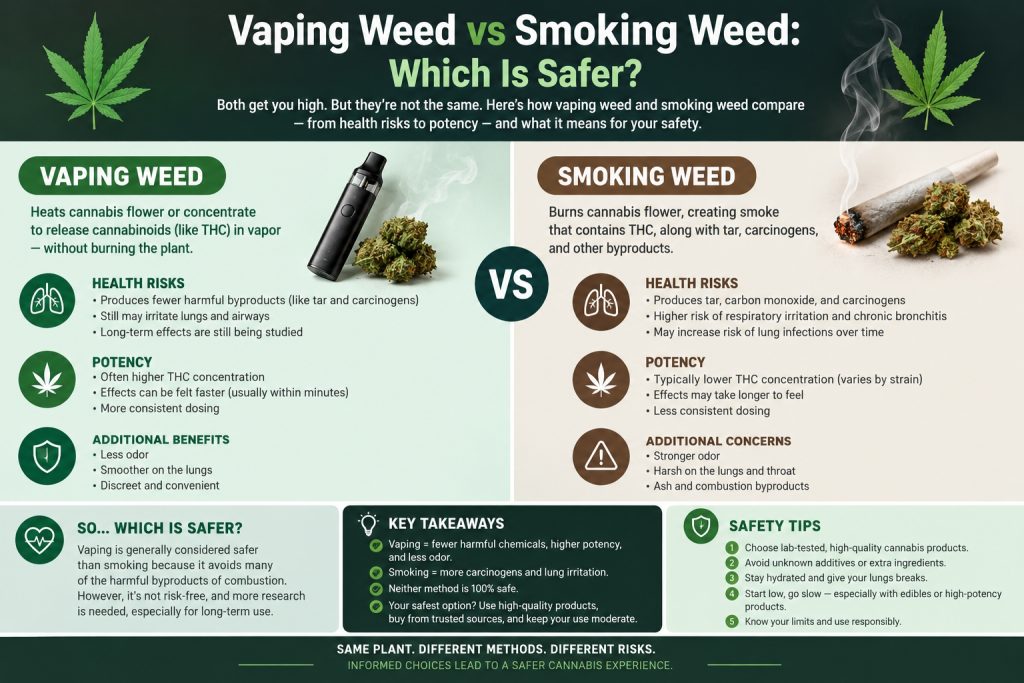
The short version? Smoking exposes your lungs to combustion products, including fine particles and toxic chemicals. A regulated dry-herb vaporizer may reduce exposure to some combustion-related contaminants, but its aerosol can still irritate your airways. Oil cartridges introduce additional concerns, including solvents, metals, flavouring chemicals, and, especially in illicit products, unknown additives. Meanwhile, high-potency concentrates can deliver far more THC than you intended before you realize how impaired you are.
You’ll find uncertainties here, too. Cannabis research has historically been limited by legal restrictions, rapidly changing products, self-reported use, and the fact that many participants also smoke tobacco. Long-term vaping data are particularly thin. So rather than declaring a universal winner, the goal is to help you understand what changes, and what doesn’t, when you switch inhalation methods.
Bottom line: No inhaled cannabis product is harmless. If you use cannabis, lower-potency regulated products, less frequent use, and avoiding deep inhalation can reduce, but never eliminate, risk.
Key Takeaways
- Vaping weed generally exposes your lungs to fewer combustion products than smoking, especially with quality dry-herb vaporizers, but it is not completely safe.
- Smoking weed produces smoke with harmful chemicals like tar and carbon monoxide, which can cause respiratory issues; vaping avoids combustion but still irritates airways and may include contaminants.
- THC oil cartridges and concentrates can have very high potency and unknown additives, increasing risks of over-intoxication and health complications.
- Choosing regulated, lower-potency cannabis products and using them less frequently can reduce risks associated with both vaping and smoking weed.
- Regardless of method, cannabis use may impair memory, coordination, and judgment, so avoid driving or operating machinery while under the influence.
- Non-inhaled forms like edibles offer alternatives that avoid lung exposure but have delayed and longer-lasting effects, requiring careful dosing and precautions.
Vaping Weed vs Smoking Weed: At-a-Glance Comparison
Here’s the practical comparison before we dig into the medical details. “Vaping” is separated by product type because placing dry flower and mystery oil cartridges in one bucket hides important differences.
| Factor | Smoking flower | Dry-herb vaporizer | THC oil cartridge or disposable |
|---|---|---|---|
| What you inhale | Smoke from combustion | Aerosol from heated flower | Aerosolized cannabis extract and ingredients |
| Combustion products | High | Generally lower | No plant combustion, but thermal byproducts are possible |
| Product uncertainty | Flower can contain contaminants | Depends on flower and device | Can be substantial, especially in unregulated carts |
| Typical potency | Often moderate | Depends on flower | Frequently high or very high |
| Odour | Strong and persistent | Milder, shorter-lived | Usually faint but still detectable |
| Dose control | Difficult | Potentially more gradual | Easy to take repeated, concentrated puffs |
| Maintenance | Ash and resin cleanup | Chamber and screen cleaning | Minimal for disposables; battery care for reusable pens |
| Key concern | Smoke-related airway injury | Irritation and incomplete long-term evidence | Potency, additives, metals, solvents, and counterfeit products |
If your only question is whether vapour usually contains fewer combustion products than smoke, the answer is yes, particularly with dry-herb devices. If your question is whether vaping weed is safe, the answer is no. Product quality and your pattern of use matter at least as much as the label on the device.
How Smoking and Different Cannabis Vapes Work
The word vape covers devices that work in very different ways. Understanding the hardware helps you interpret both the experience and the health evidence.
Smoking Flower: Combustion in Joints, Pipes, and Bongs
A joint, blunt, pipe, or bong ignites dried cannabis at temperatures high enough to cause combustion. That reaction releases cannabinoids such as THC, but it also creates tar, carbon monoxide, fine particulate matter, volatile organic compounds, and polycyclic aromatic hydrocarbons.
Bongs cool smoke and catch ash, which can make each hit feel smoother. They don’t remove enough toxic material to make combustion safe, though. A smoother hit may even encourage deeper inhalation. Blunts add another issue: their tobacco-based wraps can expose you to nicotine and tobacco-related toxicants.
Dry-Herb Vaporizers: Heating Flower Without Combustion
Dry-herb vaporizers, including models such as the Storz & Bickel Mighty or PAX Plus, heat ground flower without intentionally setting it on fire. Conduction devices warm cannabis against a hot surface; convection models pass heated air through it. Many devices combine both methods.
Avoiding combustion can reduce carbon monoxide and several smoke-related toxicants. Temperature still matters, though. Excessive heat can scorch flower and generate more irritating degradation products. Devices also vary in temperature accuracy, airflow, materials, and cleaning needs. A reputable vaporizer used correctly is not equivalent to a cheap unit with questionable plastics or solder.
THC Oil Cartridges and Disposable Vape Pens
Cartridges contain cannabis extract formulated to flow across a heating coil. Some contain distillate plus botanical or cannabis-derived terpenes; others use live resin or rosin. Disposable pens combine the reservoir, coil, and battery in one unit, while standard cartridges often attach to a rechargeable 510-thread battery.
When activated, the coil creates an aerosol, not harmless “water vapour.” That aerosol may contain cannabinoids, ultrafine particles, terpenes, residual solvents, or metals released from hardware. Composition changes with oil formulation, voltage, coil condition, and storage. Products from Canada’s licensed, tested market generally provide more accountability than anonymous carts, but testing a production lot can’t account for every change during storage and use.
Concentrate Vaporizers, Dab Pens, and Dabbing: Important Distinctions
Wax pens and concentrate vaporizers heat solid or semi-solid extracts such as wax, shatter, budder, rosin, or live resin. Traditional dabbing places concentrate against a heated “nail” or banger, often producing a large aerosol dose almost instantly.
These methods shouldn’t be casually grouped with dry-herb vaporizing. Concentrates commonly contain much more THC than flower, so a dab can deliver an unexpectedly intense dose. Very hot surfaces may also produce irritating thermal-degradation compounds. Electronic dab rigs offer more temperature control, but they don’t neutralize the risks of high potency, contamination, or frequent use.
Is Vaping Weed Safer Than Smoking? Comparing Health Risks
For lung exposure alone, avoiding combustion is a meaningful distinction. Yet “probably less harmful than smoke in some respects” is not the same as healthy. The safest option for your lungs is not inhaling smoke or aerosol.
Lung Health: Smoke, Aerosols, Airway Irritation, and Respiratory Symptoms
Regular cannabis smoking is associated with cough, phlegm, wheezing, and symptoms of chronic bronchitis. Cannabis smoke contains many of the same irritants and carcinogens found in tobacco smoke, although typical use patterns differ. Deep inhalation and prolonged breath-holding can increase particle deposition without meaningfully improving your high.
Dry-herb vaporizing may reduce exposure to combustion products, and some people report fewer respiratory symptoms after switching. Evidence is limited by small studies and short follow-up periods. Oil-vape aerosols can also inflame or irritate airways, particularly when products contain contaminants or are used heavily. If a vape makes you cough, that’s not proof it’s “working”; it’s your airway objecting.
EVALI: The Link to THC Vaping Products and Vitamin E Acetate
In 2019 and early 2020, the United States experienced an outbreak of e-cigarette or vaping product use-associated lung injury, known as EVALI. Most patients reported using THC-containing products, especially products obtained through informal sources.
The Centers for Disease Control and Prevention’s EVALI investigation identified vitamin E acetate as strongly linked to the outbreak. It had been used to dilute or thicken some THC oils. Removing it from much of the supply sharply reduced cases, but that episode exposed a larger problem: inhaled additives can spread faster than safety evidence. Canada also had cases, called vaping-associated lung illness (VALI), but no specific cause was identified here, and vitamin E acetate wasn’t found in any Canadian case. “Vitamin E” may sound wholesome on a bottle of supplements; lungs are a very different delivery route.
Heart and Blood Vessel Effects: Neither Method Is Risk-Free
THC can temporarily increase heart rate, alter blood pressure, and affect how much oxygen the heart needs. Smoke adds carbon monoxide and fine particles, both of which can stress the cardiovascular system. Cannabis use has also been temporally associated with heart attack and stroke, although observational studies can’t always separate cannabis from tobacco use or underlying risk factors.
Vaping removes some combustion exposure but still delivers THC and an aerosol of heated chemicals. Heart & Stroke’s guidance on cannabis recommends caution, particularly for people with heart disease or a higher risk of stroke. If you have chest pain, arrhythmia, uncontrolled blood pressure, or prior stroke, speak with your clinician before using cannabis in any form.
Memory, Coordination, Anxiety, and Other THC-Related Effects
Switching from smoke to vapour doesn’t remove THC’s effects on your brain. Acute intoxication can impair attention, short-term memory, judgment, reaction time, and coordination. That matters when you’re driving, cooking over a flame, watching children, or navigating stairs at 2 a.m., the unglamorous situations where impairment becomes real.
Higher doses can provoke panic, paranoia, vomiting, confusion, or, rarely, psychosis-like symptoms. Risk is greater with high-potency products, inexperienced use, and a personal or family history of psychosis. Adolescents and young adults deserve particular caution because their brains are still developing and earlier, frequent use is associated with worse cognitive and mental-health outcomes.
Dependence and Cannabis Use Disorder: Risks With Either Method
You can develop cannabis use disorder whether you smoke, vape, dab, or eat THC. Warning signs include needing more for the same effect, unsuccessful attempts to cut back, using even when it causes work or relationship problems, and feeling irritable or unable to sleep when you stop.
Vapes can make frequent use easier because they’re discreet, convenient, and require no rolling or setup. A pen on the nightstand can turn an occasional evening habit into “just one puff” throughout the day. High-potency concentrates may accelerate tolerance, though individual vulnerability varies. If your use feels automatic, track every session for one week. The tally is often more informative than your memory.
Cancer Risk and Long-Term Vaping Safety: What Remains Uncertain
Cannabis smoke contains carcinogens, but research hasn’t established cancer risks as clearly as it has for tobacco. Studies face confounding from cigarette smoking, inconsistent dose histories, and relatively small numbers of heavy long-term cannabis-only smokers. Absence of definitive proof isn’t proof of no risk.
Long-term cannabis-vaping evidence is even less mature. Modern cartridges, formulations, and coils change faster than decades-long disease studies can follow them. Researchers have identified potentially harmful compounds and metals in some aerosols, but real-world exposure differs widely. Anyone promising that vaping is harmless is outrunning the evidence, and doing it in suspiciously expensive sneakers.
How Do the High, Onset, and Duration Compare?
Both smoking and vaping deliver THC through the lungs, allowing it to enter the bloodstream quickly. Even so, the experience can vary dramatically with device efficiency, inhalation style, tolerance, and potency.
How Quickly Effects Begin, Peak, and Wear Off
Inhaled cannabis typically begins working within minutes. Effects often build rapidly and may peak within roughly 15–30 minutes, although subjective timing varies. Noticeable intoxication commonly lasts two to four hours, while impairment or residual effects can persist longer after a large dose.
That quick onset allows more dose adjustment than edibles, but only if you wait. Take one small inhalation, then pause for at least 10–15 minutes before deciding whether you need more. Chain-hitting a cartridge because “nothing’s happening” is how a calm evening becomes an anxious discussion with the ceiling fan.
Why Vaping Can Produce Stronger Effects, Especially in Infrequent Users
Controlled research has found that vaporized cannabis can produce stronger drug effects and greater impairment than smoked cannabis at the same labelled THC dose, particularly among infrequent users. One crossover study published in JAMA Network Open reported stronger effects and higher blood THC concentrations after vaporization under study conditions.
A vaporizer may deliver cannabinoids efficiently because less material is lost to sidestream smoke or destroyed during combustion. Oil cartridges and concentrates add another variable: they frequently contain far more THC than flower. If you’re inexperienced, don’t use your friend’s tolerance as a measuring spoon. Start far below what a daily user considers “normal.”
Why Equal THC Content Does Not Guarantee an Equal Delivered Dose
A label stating 20% THC describes product concentration, not exactly how much reaches your bloodstream. Combustion destroys some THC, a joint releases smoke between puffs, and people vary in puff length, inhalation depth, device temperature, and technique.
Vape efficiency also differs by model. Two pens set to the same voltage may have different coil resistance, airflow, and aerosol output. Labels can be inaccurate, particularly in poorly regulated markets. Your safest assumption is that a new product or device may hit differently. Use a small trial dose in a familiar setting rather than trying to mathematically recreate your usual joint.
Practical Differences: Smell, Taste, Convenience, and Cost
Health considerations should lead the decision, but daily practicalities often determine what people actually use. Here’s where vaping tends to feel easier, and where that convenience can quietly backfire.
Odour, Flavour, and Secondhand Smoke or Aerosol Exposure
Cannabis smoke clings to hair, upholstery, jackets, and curtains. Dry-herb vapour smells less intense and usually dissipates sooner; oil aerosols can be subtler still. Subtle doesn’t mean invisible. Other people may smell it, and aerosol particles don’t politely vanish because the room has a scented candle.
Secondhand cannabis smoke can expose bystanders to fine particles and psychoactive compounds. Vape aerosol may contain THC, metals, and other chemicals, though exposure levels vary. Don’t smoke or vape around children, pregnant people, pets, or anyone with asthma. Use outdoors away from doors and windows, and remember that exhaling into your sleeve is concealment, not ventilation.
Upfront Device Costs, Maintenance, and Ongoing Cannabis Costs
A basic glass pipe may cost US$15–40, while established portable dry-herb vaporizers often run from roughly US$100 to more than US$350. A 510-thread battery can cost C$10–C$30, with cartridges and disposables priced according to province, size, brand, and taxes.
| Option | Initial cost | Ongoing issue | Common hidden expense |
|---|---|---|---|
| Joint or pipe | Low | Flower and papers | Wasted sidestream smoke |
| Dry-herb vape | Moderate to high | Flower, screens, seals | Replacement batteries or parts |
| Cartridge pen | Low to moderate | Repeated cartridge purchases | Clogged or unfinished carts |
| Disposable | Low per device | Entire device replaced | Frequent purchases and e-waste |
Cleanable devices require isopropyl alcohol, brushes, and a few minutes of maintenance. A clogged airway or dirty chamber can produce harsh, inconsistent hits. Convenience can also increase consumption: when using takes three seconds, you may use more often, and spend more, without noticing.
Reducing Harm If You Choose to Use Cannabis
There’s no technique that makes cannabis risk-free. Still, practical choices can reduce exposure, accidental over-intoxication, and injury.
Who Should Avoid Cannabis or Seek Medical Advice First?
Avoid cannabis during pregnancy or breastfeeding: THC can cross the placenta and enter breast milk. Adolescents should not use cannabis recreationally, and young adults should understand that frequent high-potency use carries additional developmental and mental-health concerns.
Talk with a qualified clinician first if you have heart or lung disease, take medications with potential interactions, or have a history of psychosis, bipolar disorder, severe panic attacks, or substance use disorder. Older adults should be especially cautious about dizziness, falls, blood-pressure changes, and medication interactions. If cannabis is being considered for a symptom, ask about evidence-based treatments rather than assuming “natural” means compatible with everything in your medicine cabinet.
Product Sourcing, Testing Limits, and Why Unregulated Cartridges Are Risky
Purchase only from licensed retailers; in Canada, that means a provincially or territorially authorized store or website, or a federally licensed seller for medical cannabis. Check for batch identification, cannabinoid content, ingredient disclosure, manufacturer contact details, and a valid certificate of analysis when available. Packaging alone proves little: counterfeiters can copy labels, QR codes, and popular brand artwork.
Canada’s Cannabis Regulations require testing of each lot or batch for microbial and chemical contaminants, but sampling quality varies. A passing result isn’t a lifetime warranty, especially if hardware leaches metals during storage or use. Avoid street cartridges, unusually cheap products, homemade refills, and oils from social-media sellers. If the source is “a guy who knows a lab,” that is not, technically speaking, a laboratory standard.
Device Temperature, Cleaning, and Additives: No Setting Makes Vaping Safe
Follow the manufacturer’s instructions and begin at the lowest effective temperature or voltage. Higher settings can create hotter, harsher aerosol and degrade terpenes or other ingredients. Stop using a cartridge that tastes burnt, leaks, changes colour unexpectedly, or makes the device excessively hot.
Keep mouthpieces, chambers, and screens clean; replace damaged coils or components rather than improvising repairs. Never add vitamin E acetate, essential oils, medium-chain triglyceride oil, or ingredients not specifically intended and tested for inhalation. Even food-safe flavourings aren’t automatically lung-safe. Temperature control can limit scorching, but there is no magical green-zone setting that turns aerosol into mountain air.
Avoid High-THC Products, Mixing Substances, and Driving While Impaired
Choose lower-THC products and avoid concentrates if you have little tolerance. Products with more cannabidiol (CBD) may feel less intoxicating, but CBD doesn’t reliably cancel a large THC dose. Record the product, dose, and time until you learn how it affects you.
Don’t combine cannabis with alcohol, sedatives, or other intoxicants. The mixture can increase impairment, nausea, poor judgment, and accident risk. Never drive, cycle in traffic, operate machinery, or handle firearms while impaired. Because effects differ by person and dose, a simple “wait two hours” rule isn’t dependable. Arrange transportation before using, when sober-you is still running the group chat.
Chest Pain, Breathing Trouble, and Other Symptoms Requiring Urgent Care
Stop using the product and seek urgent medical help for chest pain, severe shortness of breath, blue or grey lips, fainting, confusion, coughing up blood, or worsening breathing symptoms. Persistent cough, fever, vomiting, abdominal pain, and fatigue after vaping also warrant prompt evaluation, particularly if they occur together.
Call 911 if symptoms are severe. Tell clinicians exactly what you used, where it came from, and when you used it: that information helps guide care and isn’t the moment for product-source shyness. For severe anxiety without dangerous physical symptoms, move somewhere quiet, avoid taking more, and stay with a trusted sober person. If you’re uncertain, call poison control at 1-844-POISON-X (1-844-764-7669), or 1-800-463-5060 in Quebec, or contact a healthcare professional.
Non-Inhaled Alternatives: Edibles, Oils, and Their Different Risks
Edibles, capsules, tinctures, and oral oils avoid exposing your lungs to smoke or aerosol. That can make them a reasonable alternative for someone with respiratory concerns, but they introduce a slower, less predictable dosing curve.
Edibles may take 30 minutes to two hours or longer to produce noticeable effects, depending on the product, meal timing, and your metabolism. Effects can last six hours or more, with residual impairment sometimes lingering into the next day. The classic mistake is taking a second serving after 30 minutes because the first “did nothing.” Both doses then arrive together, fashionably late and wildly overdressed.
If you’re inexperienced, consider no more than 1–2.5 mg THC initially, then wait the full label-recommended period before taking more. Even 5 mg can feel strong to some people. Keep products in child-resistant packaging, clearly labelled and locked away from children and pets. Gummies look like ordinary candy, and accidental ingestion can require emergency care.
Sublingual tinctures may act faster than swallowed products, but some of the dose is inevitably swallowed. Topical cannabis generally isn’t intoxicating unless formulated for transdermal delivery. As always, regulated products with clear dosing are preferable to homemade items whose strength may vary from one brownie corner to the next.
Frequently Asked Questions
These are the questions that often get lost between “smoke is bad” and “vapour is clean.” The honest answers need a little nuance.
Does Bong Water Make Smoking Weed Safer?
Not in any meaningful, risk-free sense. Water cools smoke and captures some ash and water-soluble compounds, but substantial amounts of fine particles, carbon monoxide, and toxic combustion products still reach your lungs. Cooling may make it easier to inhale a larger volume or hold smoke longer.
Change the water and clean the bong regularly to limit microbial growth and resin buildup, but treat that as hygiene, not detoxification. Avoid sharing mouthpieces, especially when someone is sick. If reducing respiratory exposure is your priority, moving away from combustion matters more than buying a more elaborate water pipe.
Will Switching From Smoking to Vaping Improve a Cough?
It might, particularly if you completely stop smoking flower and use a well-regulated dry-herb device. Some observational and small clinical studies have reported fewer respiratory symptoms among people who switch away from combustion. But improvement isn’t guaranteed, and continuing to smoke occasionally can preserve symptoms.
Vape aerosol itself may trigger coughing or airway irritation. A persistent cough could also reflect asthma, infection, reflux, tobacco use, or another condition unrelated to cannabis. Don’t use a vape as a diagnostic experiment. If your cough lasts several weeks, worsens, produces blood, or comes with fever, wheezing, weight loss, or breathlessness, seek medical evaluation.
Is Vaping Medical Cannabis Safer Than Smoking It?
A medical label doesn’t change inhalation chemistry. Avoiding combustion may reduce certain toxic exposures, so a clinician may prefer a standardized dry-herb vaporizer or non-inhaled formulation over smoking. But oil cartridges still have device, ingredient, and potency concerns, even when purchased through a medical program.
Medical use should involve a clear treatment goal, the lowest effective dose, and periodic review of benefits and side effects. Product recommendations should account for your condition, medications, age, and cardiovascular or psychiatric history. If your dispensary recommendation conflicts with your clinician’s guidance, remember: retail staff can explain products, but they aren’t substitutes for individualized medical care.
Evidence and Sources: Study Limitations, Product Differences, and Medical Review
Research on vaping weed vs smoking weed is evolving, and broad claims deserve skepticism. Studies may compare different flower strengths, devices, temperatures, or user populations. Many rely on participants remembering how often they used cannabis, while tobacco use and socioeconomic factors can complicate results. Laboratory chemistry studies identify what an aerosol can contain, but they don’t always reproduce years of real-world exposure.
Useful evidence and guidance include:
- The National Academies review of cannabis health effects summarizes evidence across respiratory, mental-health, injury, and therapeutic outcomes.
- Health Canada’s overview of the health effects of cannabis covers short- and long-term effects on the brain and lungs, mental health, pregnancy, and impairment.
- The Canadian Lung Association’s cannabis guidance explains why cannabis smoke remains a respiratory concern.
- Health Canada’s information on cannabis for medical purposes explains how medical access works and notes that Health Canada hasn’t authorized cannabis products to treat any specific disease or symptom; only a few cannabinoid-based drugs, such as Sativex, nabilone, and Epidiolex, are approved as prescription medicines.
This is an independent educational review, not an endorsement of a cannabis brand or device. No manufacturer affiliation or affiliate compensation influenced the comparisons. It also can’t replace medical advice tailored to you.
The most defensible conclusion is straightforward: smoking flower creates the clearest combustion-related burden. Dry-herb vaporizing may lower some of that exposure, but it doesn’t eliminate respiratory or THC-related harm. Oil cartridges avoid plant combustion while adding uncertainties involving formulations, hardware, and counterfeit products. High-potency concentrates can make dose-related problems more likely regardless of how polished the device looks.
If you choose cannabis, favour regulated lower-potency products, use less often, avoid mixing substances, and keep every inhaled product away from other people. And if lung health is your priority, consider a carefully dosed non-inhaled option, or not using cannabis at all. The “best” method isn’t the one with the coolest hardware. It’s the choice that gives you the intended benefit with the least exposure, impairment, and disruption to your life.