
Nov
A racing heart. A mouth that feels lined with cotton. The sudden certainty that everyone in the room can tell you’re high, even though nobody is looking at you. A weed side effect can be mildly uncomfortable, surprisingly intense, or, in uncommon cases, serious enough to require immediate medical care.
Your reaction to cannabis depends on more than whether you smoked a joint or ate a gummy. THC dose, product potency, how quickly you consumed it, your experience level, other substances, medications, and underlying health conditions all matter. Edibles are especially unpredictable because their effects arrive late, tempting you to take another serving before the first has fully kicked in. Concentrates and poorly labelled products add another layer of uncertainty.
This evidence-based guide reviews the short- and long-term effects associated with cannabis, including marijuana, THC edibles, vapes, concentrates, delta-8 products, and synthetic cannabinoids. It also explains what you can do when you feel unwell and which warning signs shouldn’t be handled with snacks, a shower, or a heroic attempt to “sleep it off.”
Most uncomplicated cannabis reactions improve with time and a calm, safe environment. But chest pain, difficulty breathing, seizures, severe confusion, repeated vomiting, or unresponsiveness are different. If you’re unsure whether someone is in danger, err on the side of getting professional help.
Medical note: This article provides general education, not an individual diagnosis. In Canada, call 911 for an emergency, or call your local poison centre at 1-844-POISON-X (1-844-764-7669), or 1-800-463-5060 in Quebec, for immediate guidance about a suspected exposure.
Key Takeaways
- Weed side effects commonly affect mood, memory, coordination, and heart rate, and can range from relaxation to anxiety or panic depending on THC dose and individual sensitivity.
- Edibles pose a higher risk for uncomfortable weed side effects due to delayed onset and potency variability, so it’s crucial to wait sufficiently before redosing and understand serving sizes.
- Severe weed side effects like chest pain, seizures, or unresponsiveness require immediate medical attention; do not rely on home remedies for these emergencies.
- Frequent cannabis use may contribute to long-term risks such as impaired cognitive function, mental health issues, and cardiovascular problems, especially with high-THC products.
- To reduce harm, avoid mixing cannabis with alcohol or sedatives, use lower-THC products, plan transportation ahead, and keep cannabis securely stored away from children and pets.
Common Weed Side Effects at a Glance
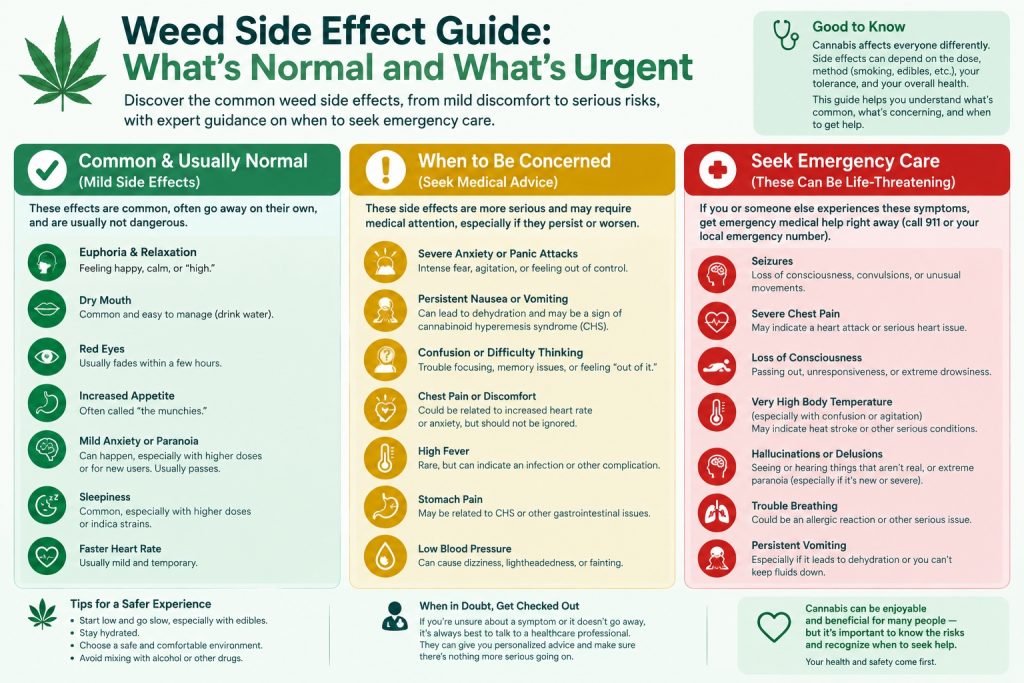
Cannabis affects people differently, but THC, the primary intoxicating cannabinoid, commonly changes mood, perception, coordination, memory, appetite, and heart rate. Effects can range from pleasant relaxation to a deeply unpleasant “I have made a terrible gummy-related decision” evening.
Common short-term reactions include:
| Area affected | Possible weed side effect |
|---|---|
| Mind and mood | Relaxation, euphoria, anxiety, panic, paranoia, confusion |
| Thinking | Poor short-term memory, reduced attention, altered judgment |
| Movement | Slower reaction time, impaired balance and coordination |
| Eyes and mouth | Red eyes, dry mouth |
| Heart and circulation | Faster heartbeat, dizziness, lightheadedness |
| Digestion | Increased appetite, nausea, or vomiting |
| Perception | Altered sense of time, intensified sounds or colours |
The experience is more likely to become uncomfortable with a high THC dose, low tolerance, an unfamiliar setting, or alcohol use. Although many effects resolve without treatment, “common” doesn’t automatically mean harmless, particularly when driving, caring for a child, swimming, cooking, or operating machinery.
When Is a Weed Side Effect an Emergency?
A cannabis reaction deserves emergency attention when the person may not be able to protect their airway, breathe normally, remain conscious, or distinguish reality from dangerous thoughts. Don’t assume cannabis is the only substance involved: regulated and unregulated products can contain unexpected ingredients, and a medical event may simply happen around the same time.
Call emergency services if symptoms are severe, rapidly worsening, or accompanied by injury. You won’t get in trouble with a paramedic for being honest about what was taken. Clear details, product type, estimated dose, time consumed, medications, alcohol, and other drugs, help clinicians make safer decisions.
Chest Pain, Trouble Breathing, Seizures, or Unresponsiveness: Get Emergency Help
Call 911 immediately for chest pressure or pain, severe breathing difficulty, blue or grey lips, seizure activity, collapse, or inability to wake the person. Also seek urgent help for extreme agitation, hallucinations that create danger, suicidal behaviour, or sudden weakness and speech difficulty.
While waiting:
- Place an unconscious but breathing person on their side.
- Move hazards away from someone having a seizure: don’t restrain them or put anything in their mouth.
- Begin CPR if the person isn’t breathing and follow the dispatcher’s instructions.
- Don’t give food, coffee, or a cold shower to someone who isn’t fully alert.
If opioids might also be involved and naloxone is available, use it. Naloxone won’t reverse THC, but it can save a life when opioid contamination or co-use is possible.
Accidental Cannabis Exposure in Children: Contact a Poison Centre Promptly
Children can become seriously ill after eating THC gummies, chocolates, baked goods, or other products that resemble ordinary treats. Symptoms may include unusual sleepiness, poor balance, vomiting, confusion, slowed breathing, or, in severe cases, coma.
In Canada, call your local poison centre at 1-844-POISON-X (1-844-764-7669), or 1-800-463-5060 in Quebec, as soon as you suspect exposure, even if the child looks fine. Don’t wait for symptoms, and don’t induce vomiting. Call 911 if the child has trouble breathing, has a seizure, collapses, or can’t be awakened.
Keep the package for responders. The labelled THC amount, number of missing pieces, and likely exposure time are useful, although labels on unregulated products may be inaccurate. A calm, factual account is far more helpful than guessing, or quietly hoping the mystery gummy incident disappears.
Short-Term Effects of Weed on the Mind and Body
Short-term effects reflect THC’s activity at cannabinoid receptors throughout the brain and body. The exact pattern depends on dose, delivery method, tolerance, metabolism, and surroundings. One person may feel relaxed after a small amount: another may experience dizziness and panic from the same product.
Anxiety, Panic, Paranoia, and Changes in Perception
THC can amplify thoughts, bodily sensations, and emotional cues. At a comfortable dose, that may feel enjoyable. At a higher dose, an ordinary heartbeat can feel ominous, a passing thought can become a looping worry, and ten minutes can seem suspiciously like three hours.
Anxiety, panic, suspiciousness, and altered perception are recognized acute effects. Very high doses may produce hallucinations, delusional thinking, or temporary psychosis-like symptoms. Risk is higher with potent concentrates, limited experience, sleep deprivation, or a personal or family history of psychosis.
If you remain oriented and physically stable, reduce stimulation and remind yourself that THC effects are temporary. But seek medical help for unsafe behaviour, severe confusion, persistent hallucinations, or thoughts of self-harm.
Impaired Memory, Attention, Coordination, and Reaction Time
Even when you feel “basically normal,” cannabis can impair divided attention, short-term memory, judgment, tracking, balance, and reaction time. That combination matters behind the wheel: driving requires you to notice a hazard, interpret it, and respond within seconds.
Health Canada advises against driving after using cannabis. Mixing THC with alcohol generally produces greater impairment than using either alone.
Practical rule? If you’ve used cannabis, don’t drive, cycle in traffic, operate power tools, or make high-stakes decisions. Arrange a ride before consuming, not after, when your planning skills may have clocked out early.
Dry Mouth, Red Eyes, Dizziness, Rapid Heartbeat, and Nausea
Dry mouth and red eyes are familiar cannabis effects. THC can also increase heart rate and contribute to postural dizziness, especially when you stand quickly. Sit or lie down if you feel faint, then rise slowly once stable.
Small sips of water may ease dry mouth, while bland food can be reasonable if you’re alert and mildly nauseated. Avoid guzzling excessive water: more isn’t always better. Severe or persistent vomiting requires medical advice because dehydration and electrolyte disturbances can develop.
A fast heartbeat often settles as intoxication fades, but don’t automatically dismiss it. Chest pain, fainting, severe shortness of breath, or an irregular heartbeat, particularly with known cardiovascular disease, warrants urgent assessment.
How Soon Do Weed Side Effects Start, and How Long Do They Last?
Timing changes substantially by route. Inhaled THC reaches the bloodstream quickly, while swallowed THC must travel through digestion and liver metabolism. Dose, meal timing, product formulation, and individual biology can shift the timeline, so these are practical ranges rather than countdown clocks.
| Method | Typical onset | Strongest effects | Approximate duration |
|---|---|---|---|
| Smoking or vaping | Seconds to minutes | About 10–30 minutes | Often 2–4 hours: impairment may last longer |
| Edibles or drinks | About 30 minutes–2 hours, sometimes longer | Roughly 2–4 hours | Commonly 6–12 hours: occasionally longer |
Smoking, Vaping, and Dabbing: Onset, Peak Effects, and Duration
Smoking and vaping produce effects within minutes, making dose adjustment somewhat easier, but not foolproof. Repeated inhalations can stack quickly before you recognize how impaired you’ve become.
Dabs, wax, shatter, and other concentrates may contain far more THC than cannabis flower. A concentrate dose that looks tiny can deliver a large amount, especially to someone with little tolerance. Effects commonly peak within the first half hour and gradually decline over several hours, although anxiety, sleepiness, or slowed thinking may linger.
Vaping also introduces device and ingredient risks. Avoid informal THC cartridges: the 2019 US outbreak of vaping-related lung injury was linked to vitamin E acetate in unregulated THC products, according to the Public Health Agency of Canada.
Edibles and Drinks: Delayed Effects and the Risk of Taking More Too Soon
Edibles are responsible for a classic cannabis mistake: “Nothing’s happening,” followed by a second dose, followed by everything happening at once. Effects may take two hours or longer to become obvious, particularly after a large meal.
Swallowed THC is converted in the liver to 11-hydroxy-THC, an active metabolite that can produce strong, long-lasting intoxication. Product labels can also be confusing. A package may contain several servings even when it looks like one snack.
Read the total THC content and serving size separately. Beginners should avoid high-dose products and wait long enough to assess the full effect rather than redosing impulsively. If the label is unclear, that isn’t a fun mystery to solve with your nervous system.
Next-Day Effects, Driving Impairment, and Why Drug Detection Is Different
After a strong edible or late-night dose, you may wake with fatigue, foggy thinking, headache, or reduced concentration. Don’t drive merely because you slept. If you still feel altered, slowed, dizzy, or unusually drowsy, you may remain impaired.
Drug detection is a separate issue. THC effects generally last hours, but metabolites can remain detectable for days or weeks, especially after frequent use. A positive urine result hence doesn’t prove that someone was impaired at the time of testing. Blood and oral-fluid tests have their own limitations, and no cannabis measurement functions exactly like a breath-alcohol concentration.
For workplace, legal, or clinical testing questions, get advice specific to the test and jurisdiction rather than relying on home-testing folklore.
What to Do If Weed Makes You Feel Unwell
Your first task is simple: prevent an unpleasant experience from becoming an unsafe one. Most mild reactions improve with time, reassurance, and reduced stimulation. You don’t need to “beat” the high: you need to stay protected while it passes.
Stop Using, Stay Somewhere Safe, and Get Support From a Sober Person
Stop consuming cannabis and move to a quiet, familiar place away from traffic, balconies, pools, stoves, and other hazards. Sit or lie down if you’re dizzy. Loosen restrictive clothing and take slow, comfortable breaths, without forcing exaggerated breathing that makes you more lightheaded.
Tell a trusted sober person what you took and when. Ask them to stay nearby, monitor changes, and seek help if you become difficult to wake or develop emergency symptoms. Keep the packaging if available.
A useful grounding exercise is to name five things you see, four you feel, three you hear, two you smell, and one you taste. It won’t chemically reverse THC, but it can interrupt a panic spiral.
Avoid Driving, Alcohol, and Unproven Ways to Sober Up
Don’t drive yourself to urgent care. Ask a sober person, use emergency services when appropriate, or call a poison centre (1-844-POISON-X) for guidance. Avoid alcohol, sedatives, and additional cannabis: combining substances can worsen impairment, nausea, and poor judgment.
Coffee, cold showers, exercise, peppercorns, and internet “detox” products don’t reliably make you sober. Caffeine may actually intensify shakiness or a racing heart. CBD is sometimes promoted as a THC antidote, but evidence doesn’t support relying on it to treat an acute adverse reaction, and taking another poorly labelled product adds uncertainty.
When in doubt, focus on boring basics: stop, stay put, reduce stimulation, involve a sober person, and escalate care if warning signs appear. Boring is underrated when your ceiling fan has suddenly become emotionally significant.
Long-Term Health Risks of Frequent Cannabis Use
Frequent cannabis use isn’t guaranteed to cause lasting harm, but risk generally rises with earlier initiation, greater frequency, higher THC exposure, and underlying vulnerability. Research is complicated by changing products, self-reported use, tobacco co-use, and differences between association and causation.
Memory, Learning, and Attention: What Research Shows
Cannabis can acutely impair learning, attention, and memory. With frequent use, some studies find poorer cognitive performance, especially when use begins during adolescence. How fully performance recovers after prolonged abstinence remains unsettled and likely varies by person, exposure, and age of initiation.
Researchers are still examining whether observed long-term differences result directly from cannabis or from overlapping factors. That uncertainty isn’t proof of safety: it means simplistic claims in either direction outrun the evidence.
If you rely on memory-heavy work or study, try a cannabis-free period and track concentration, recall, sleep, and productivity. Your own pattern can provide a useful reason to discuss use with a clinician.
Mental Health and Psychosis Risk: Associations and Higher-Risk Groups
Frequent cannabis use, particularly high-potency THC, is associated with a higher risk of psychosis and earlier onset among susceptible people. The relationship is complex: cannabis may contribute to symptoms, people with emerging symptoms may be more likely to use it, and shared risk factors may influence both.
Risk appears more concerning if you have a personal or family history of schizophrenia or another psychotic disorder. THC can also worsen anxiety in some people, even though others reporting temporary relief.
New paranoia, hallucinations, disorganized behaviour, or a sharp decline in functioning deserves professional evaluation, especially if symptoms continue after intoxication should have resolved. If you already receive mental-health care, discuss cannabis honestly: the goal is safer treatment, not a courtroom cross-examination.
Lung and Oral Health: Smoke Exposure, Cough, Dry Mouth, and Gum Problems
Burning cannabis creates smoke containing irritants and many of the same toxic compounds found in tobacco smoke. Regular smoking is associated with cough, phlegm, wheezing, and bronchitis symptoms. Evidence linking cannabis alone to lung cancer remains less conclusive, partly because exposure patterns and tobacco co-use are difficult to separate.
Vaping avoids combustion but isn’t risk-free. Aerosols can contain contaminants, metals, solvents, or additives, depending on the device and product.
Frequent dry mouth may also increase the risk of cavities, bad breath, and gum problems. Brush with fluoride toothpaste, clean between your teeth, stay reasonably hydrated, and keep dental appointments. Persistent mouth sores, bleeding gums, or tooth pain shouldn’t be written off as “just cottonmouth.”
Heart and Blood Vessel Risks, Especially With Existing Cardiovascular Disease
THC can acutely raise heart rate and alter blood pressure. Observational research has associated cannabis use with heart attack, stroke, and other cardiovascular events, but product variability and confounding factors make precise risk estimates difficult.
Heart & Stroke advises talking with your healthcare provider about how cannabis may affect your personal health, especially if you have a higher risk of heart disease and stroke. Concern is greater if you have coronary artery disease, an arrhythmia, previous stroke, uncontrolled blood pressure, or multiple cardiac risk factors.
Ask your clinician before using cannabis for sleep, pain, or recreation if you have cardiovascular disease. And treat new chest pain, fainting, one-sided weakness, or severe breathlessness as an emergency, not an opportunity to search symptom forums.
Cannabinoid Hyperemesis Syndrome: Repeated Vomiting and Dehydration
Cannabinoid hyperemesis syndrome, or CHS, occurs in some people who use cannabis frequently over a prolonged period. It causes cycles of intense nausea, abdominal pain, and repeated vomiting. Hot showers may provide temporary relief, a distinctive clue that often appears in patient histories.
CHS can lead to dehydration, kidney injury, and dangerous electrolyte abnormalities. Emergency evaluation may be needed when you can’t keep fluids down, urinate very little, faint, become confused, or see blood in vomit.
Anti-nausea medicines don’t always work well for CHS. The only established way to prevent recurrence is stopping cannabis. Symptoms returning after resumed use further supports the diagnosis, but other causes of vomiting must still be excluded by a clinician.
Cannabis Dependence, Use Disorder, and Withdrawal
Cannabis use disorder describes a pattern in which use causes meaningful difficulty or harm, yet stopping or cutting down remains hard. It isn’t a character flaw. THC affects reward, learning, stress, and habit systems, the same machinery that makes many behaviours stubbornly repeat themselves.
Tolerance and Signs That Cannabis Use Is Becoming Difficult to Control
Tolerance means needing more cannabis to achieve an effect you once got from less. It doesn’t protect you from impaired driving, cardiovascular strain, or dependence.
Possible warning signs include:
- Using more or for longer than intended
- Repeatedly trying and failing to cut back
- Spending substantial time obtaining, using, or recovering
- Neglecting work, school, relationships, or responsibilities
- Continuing even though anxiety, memory problems, conflict, or health effects
- Giving up activities you once valued
- Using in hazardous situations
A practical test is to plan several cannabis-free days. If that feels impossible, repeatedly gets postponed, or triggers significant distress, it’s worth discussing with a healthcare or addiction professional.
Withdrawal Symptoms, Typical Timeline, and Treatment Options
After frequent use stops, withdrawal may cause irritability, anxiety, restlessness, low appetite, sleep difficulty, vivid dreams, depressed mood, headache, sweating, or stomach discomfort. Symptoms often begin within one or two days, peak during the first week, and improve over one to two weeks: sleep changes can last longer.
Withdrawal is usually not medically dangerous, but it can be miserable enough to trigger relapse. Behavioural treatments, including cognitive behavioural therapy, motivational enhancement, and contingency management, have evidence for cannabis use disorder. No medication is specifically approved in Canada to treat it, although clinicians may address individual symptoms.
In Canada, Health Canada’s Get help with substance use page lists free, confidential services, including Drug Rehab Services at 1-877-254-3348 for treatment referrals. Seek urgent help for suicidal thoughts, psychosis, or inability to care for yourself, and call or text 9-8-8 if you’re thinking about suicide.
What Makes Weed Side Effects More Likely or More Severe?
Severe reactions rarely come down to one factor. Think of risk as a stack: potent THC, a large dose, no tolerance, an edible with delayed onset, an unfamiliar setting, and a few drinks. Remove several pieces from that stack and the experience is generally more predictable.
THC Dose, Potency, Frequency, and Individual Sensitivity
Higher THC exposure increases the likelihood of anxiety, confusion, vomiting, and substantial impairment. Modern products vary enormously: flower may contain more than 20% THC, while concentrates can reach much higher levels. A “hit” or “dab” isn’t a standardized dose.
Your response also depends on tolerance, body chemistry, age, sleep, food intake, and expectations. Someone who uses cannabis daily may feel little from a dose that overwhelms a beginner, but greater tolerance often reflects heavier exposure and possible dependence.
Choose products with clearly stated THC per serving, avoid mixing formats, and record what you used if you’re learning your sensitivity. Memory gets unreliable during intoxication: a note made beforehand beats reconstructing the evening from crumbs and existential dread.
THC vs. CBD, Delta-8 Products, and Synthetic Cannabinoids
THC causes intoxication: CBD generally doesn’t produce a traditional high. But CBD can still cause side effects and interact with medicines, and commercial products may contain more THC than their labels claim.
Delta-8 THC is psychoactive and shouldn’t be treated as harmless “diet weed.” Health Canada counts delta-8 THC among the intoxicating cannabinoids covered by the Cannabis Act, notes that data on their effects is very limited, and says products containing them pose an increased risk to public health.
Synthetic cannabinoids sold under names such as Spice or K2 are not cannabis. Their effects can be far less predictable and may include seizures, severe agitation, kidney injury, abnormal heart rhythms, and death. Avoid them entirely: if a severe reaction occurs, call emergency services.
Alcohol, Sedatives, and Other Medication Interactions
Alcohol and cannabis can compound dizziness, vomiting, poor coordination, and driving impairment. Sedating medications, including benzodiazepines, sleep aids, opioids, and some antihistamines, may add to drowsiness and confusion.
Cannabinoids can also affect liver enzymes involved in medication metabolism. Clinically important interactions may occur with drugs such as warfarin, certain seizure medicines, immunosuppressants, and other narrow-therapeutic-index treatments. CBD isn’t exempt: prescription cannabidiol carries interaction and liver-monitoring warnings.
Before combining cannabis with medication, ask a pharmacist or prescriber who can review your actual dose and product. Don’t stop prescribed medicine abruptly because of something you read online. Bring the cannabis label or a photo, “the blue gummy from my cousin” gives a pharmacist limited material to work with.
Added Risks for Teens, Older Adults, and People Who Are Pregnant or Breastfeeding
Adolescents face added concerns because the brain continues developing into the mid-20s, while early and frequent use is associated with poorer educational and mental-health outcomes. Delaying use reduces exposure during this vulnerable period.
Older adults may be more susceptible to dizziness, falls, confusion, low blood pressure, and medication interactions. Products used for sleep can still create nighttime instability or next-morning impairment.
During pregnancy, THC crosses the placenta. Major medical organizations, including the Society of Obstetricians and Gynaecologists of Canada, advise avoiding cannabis during pregnancy and breastfeeding because safety hasn’t been established and exposure may affect development. “Natural” doesn’t mean pregnancy-safe. If you use cannabis for nausea, pain, or sleep, ask your prenatal clinician about better-studied alternatives.
Reducing Harm: Avoiding High-Potency Products, Smoke Exposure, and Unsafe Storage
No cannabis use is completely risk-free, but practical choices can reduce preventable harm. The safest option is not to use: if you do use, lower THC exposure and better planning matter.
- Avoid concentrates and synthetic cannabinoids. Their potency or composition can be difficult to predict.
- Choose lower-THC products with reliable labels. Don’t assume a whole package equals one serving.
- Go slowly, especially with edibles. Delayed onset makes premature redosing a common cause of distress.
- Don’t mix cannabis with alcohol or sedatives. Combined impairment can be substantially worse.
- Avoid smoke exposure. Non-combustible products remove smoke but introduce different dosing and contamination risks: they aren’t harmless.
- Plan transportation first. Use a sober driver, taxi, or rideshare.
- Don’t use alone if you’re inexperienced or medically vulnerable. A sober person can recognize deterioration.
- Keep products locked, labelled, and separate from food. Child-resistant packaging isn’t childproof.
Treat gummies like medication, not pantry snacks. Store them in a locked container, high and out of sight, and never in a candy bowl or unmarked bag. Pets can also become seriously ill from THC: contact a veterinarian or animal poison service after suspected exposure.
Finally, review your pattern. If potency and frequency keep creeping upward, take a planned break or ask for support before the habit begins making decisions on your behalf.
Evidence, Uncertainties, and Medical References
Cannabis evidence has real limitations. Products have changed faster than many long-term studies can follow: a low-potency joint studied decades ago isn’t equivalent to today’s concentrate. Researchers must also account for tobacco, alcohol, socioeconomic factors, mental-health conditions, and inaccurate self-reporting. Observational associations can identify concern without proving that cannabis alone caused an outcome.
For reliable updates, use sources that clearly separate established findings from open questions:
- Health Canada: Health effects of cannabis
- Health Canada: Information for health care professionals on cannabis and cannabinoids
- Health Canada: Intoxicating cannabinoids, including delta-8 THC
- Health Canada: Cannabis poisonings in children and the 1-844-POISON-X poison centre line
- Health Canada: Get help with substance use
The bottom line is reassuring but not dismissive: many short-term reactions pass with time, a safe setting, and sober support. Still, every weed side effect should be judged by severity, not by the assumption that cannabis “can’t hurt anyone.” Chest pain, breathing difficulty, seizures, collapse, dangerous behaviour, unresponsiveness, and severe or persistent vomiting need professional attention.
If side effects recur, interfere with your responsibilities, or force you to use more just to feel the same result, pause and speak with a clinician. Bring specific details about the product, THC amount, route, frequency, medications, and symptoms. That conversation isn’t about judgment. It’s about making your next decision with better information, and keeping an uncomfortable evening from becoming a medical crisis.
Frequently Asked Questions About Weed Side Effects
What are common short-term side effects of weed?
Common short-term effects of weed include relaxation, euphoria, anxiety, paranoia, poor memory, impaired coordination, red eyes, dry mouth, increased heart rate, dizziness, nausea, and altered perception of time and senses.
How long do weed side effects typically last?
The duration varies by consumption method: smoked or vaped weed effects usually last 2 to 4 hours, while edibles can cause effects lasting 6 to 12 hours or more, with onset delayed up to two hours or longer.
When should I seek emergency medical attention for a weed side effect?
Call 911 if you or someone experiences chest pain, severe breathing difficulty, seizures, unresponsiveness, extreme confusion, hallucinations causing danger, or suicidal thoughts after cannabis use.
Can weed impair driving and reaction time?
Yes, weed impairs short-term memory, attention, coordination, and reaction time, increasing the risk of accidents. Combining weed with alcohol worsens impairment, so driving after consumption is unsafe.
What causes anxiety or paranoia when using weed, and how can it be managed?
Anxiety or paranoia can result from high THC doses, low tolerance, or an unfamiliar setting. To manage this, stop using, move to a calm environment, breathe slowly, and have a sober person provide reassurance.
Are there long-term risks associated with frequent cannabis use?
Frequent cannabis use may affect memory, learning, and mental health, especially when begun during adolescence or with high-THC products. Risks include increased chances of psychosis in susceptible individuals and potential lung irritation from smoke.