
Blog 2026
Weed vs Hash: 12 Key Differences You Should Know
Nov
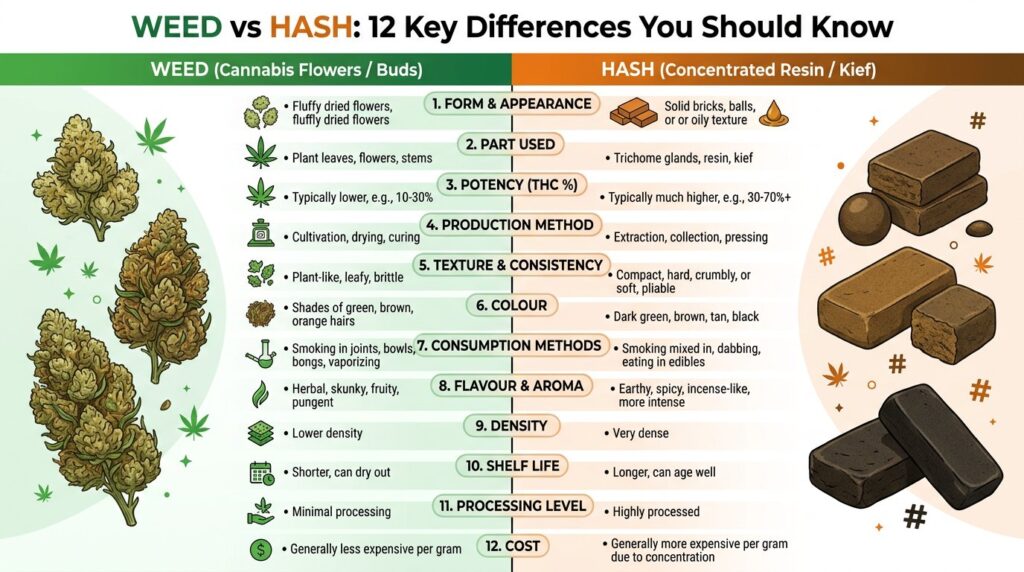
Picture two products on a legal dispensary menu: a jar of bright green flower labelled 22% THC and a small, dark puck of hash labelled 48%. Both come from cannabis, but treating them as interchangeable would be a rookie mistake, rather like assuming espresso and drip coffee belong in the same-size cup.
The weed vs hash comparison starts with concentration. Weed, or marijuana flower, is the dried, cured part of the cannabis plant. Hashish is made by collecting and compressing the plant’s resin-rich trichomes. That processing generally gives hash more cannabinoids and flavour compounds in less material, although strength and quality vary enormously.
This review compares weed and traditional hash across production, potency, effects, flavour, consumption methods, safety, medical considerations, legality, and cost. It focuses on cannabis flower and solventless hash, not high-potency extracts such as butane hash oil, distillate, wax, or shatter, which can behave quite differently.
If you’re new to cannabis, the practical takeaway is simple: hash usually demands more cautious dosing. A piece that looks comically small can still contain as much THC as a noticeably larger pinch of flower. Your response will also depend on tolerance, product chemistry, medications, setting, and how you consume it.
Cannabis laws and product-testing standards vary by location, and neither product is risk-free. This article provides general education rather than medical or legal advice. It isn’t sponsored, and no brand or retailer has influenced the comparisons. With that cleared up, here’s what actually separates weed from hash, and how to decide whether either one suits your circumstances.
Key Takeaways
- Weed refers to dried cannabis flowers with typically 10–30% THC, offering easier dosing flexibility, while hash is concentrated cannabis resin with 20–60% or more THC, demanding more cautious dosing.
- Hash is more potent than weed because it contains compressed trichomes, so small amounts of hash can deliver the same THC dose as a much larger amount of flower.
- Choosing between weed vs hash depends on experience, desired effects, legal considerations, and budget, with weed generally better for beginners and hash suited to experienced users seeking compact potency.
- Proper storage and buying from sellers that share lab results ensure quality and safety for both weed and hash, as contaminants and poor handling reduce product effectiveness and increase risks.
- Methods of use differ: weed is commonly smoked or vaporized as flower, whereas hash can be mixed with flower, smoked in pipes, or vaporized in concentrate-compatible devices, each affecting onset and duration of effects.
- Medicinal benefits, side effects, and legal regulations vary; consult qualified professionals and the rules in your province or territory, and start low and slow to manage THC response and avoid overconsumption.
Weed vs hash: quick comparison (at-a-glance chart)
The easiest way to understand weed vs hash is to compare flower with concentrated resin. Weed gives you more plant material and usually more dosing flexibility: hash packs more resin into a smaller amount.
| Feature | Weed (marijuana flower) | Hash (hashish) |
|---|---|---|
| What it is | Dried cannabis flowers, sometimes with small leaves | Separated and often pressed trichomes/resin |
| Typical appearance | Green, purple, or brown buds | Tan, blond, brown, or black powder, slabs, balls, or bricks |
| Common THC range | Roughly 10–30% in regulated modern flower | Often 20–60%: premium full-melt products may be higher |
| Dosing difficulty | Generally easier | Harder because a small amount can be potent |
| Flavour | Herbal, floral, fruity, skunky, or earthy | Often denser, spicier, richer, or more resinous |
| Common uses | Joints, pipes, bongs, dry-herb vaporizers | Added to flower, smoked in suitable pipes, or vaporized |
| Preparation | Usually grind and use | May need crumbling, warming, or careful portioning |
| Storage | Airtight container: protect from heat and light | Airtight, cool storage: some types benefit from refrigeration |
| Beginner fit | Usually the more manageable choice | Better approached after you understand your THC response |
These ranges aren’t promises. A mild CBD-rich hash can be less intoxicating than powerful flower, while old or poorly stored hash may underperform its label. The package’s laboratory results matter more than the category name.
Definitions: what is weed (marijuana flower) vs what is hash (hashish concentrate)?
“Weed” is a broad slang term, but in this comparison it means dried marijuana flower. Hash, short for hashish, is concentrated cannabis resin. Both may contain THC, CBD, minor cannabinoids, terpenes, and other plant compounds, but the ratio of resin to leafy material is different.
That distinction explains much of what follows. Flower is the original botanical material: hash is a processed product made from that material.
Weed explained: plant parts used, common forms (bud, shake), typical cannabinoid/terpene profile
Commercial flower primarily comes from resinous female cannabis inflorescences, commonly called buds. Whole buds are often sold by weight. “Smalls” or “popcorn” are smaller buds, while shake consists of loose fragments that collect in a container. Trim contains more leaf and usually less resin, so don’t assume all green material offers equal quality.
Flower can be THC-dominant, CBD-dominant, or balanced. Regulated products commonly list total THC and CBD, sometimes alongside terpenes such as myrcene, limonene, pinene, linalool, and beta-caryophyllene. Those compounds may influence aroma and the overall experience, but strain names alone don’t reliably predict effects.
A label saying “Blue Dream” is less informative than a recent certificate of analysis. Cultivation conditions, harvest timing, curing, and your biology all matter.
Hash explained: resin/trichomes, common types (dry sift/kief, bubble hash, charas, pressed hash)
Hash begins with trichomes, tiny resin glands that make frosty flower sparkle. They contain much of the plant’s cannabinoid and terpene content. Producers separate those glands and may press them with heat or pressure.
Common forms include:
- Dry sift or kief: Loose trichomes mechanically screened from dried cannabis.
- Pressed hash: Kief compressed into coins, slabs, or bricks.
- Bubble hash: Trichomes separated using ice water and filter bags, then carefully dried.
- Charas: Resin traditionally hand-collected from living plants, with deep roots in parts of India, Nepal, and the Himalayan region.
- Temple balls: Aged, polished hash formed into glossy spheres, often associated with Nepalese traditions.
Not every loose pile of kief is technically finished hash, but retailers and consumers sometimes use the terms loosely. Traditional hash also differs from solvent-based oils: it’s typically produced through mechanical separation rather than hydrocarbons.
How they’re made: cultivation vs extraction/processing
Flower production aims to preserve an intact, aromatic bud. Hash production adds another goal: separate resin glands from the bulk plant material without dragging along excessive leaf, dirt, moisture, or contaminants.
This extra processing can raise hash’s price, but it can also turn small buds and trim into a useful concentrated product. “Made from trim” isn’t automatically an insult: the quality of the input and separation still determines the result.
How weed is produced: growing, harvesting, drying/curing, storage
Cannabis may be grown indoors, outdoors, or in greenhouses. Cultivators manage genetics, light, irrigation, nutrition, humidity, pests, and airflow. At harvest, branches or individual buds are cut and dried slowly enough to reduce moisture without destroying their aroma.
Curing then allows moisture to equalize inside the flower. Done well, it improves burn quality and reduces the sharp, grassy character associated with hurried drying. Done badly, it produces hay-smelling buds, or, worse, traps enough moisture for mould.
After curing, flower should be stored in a sealed, food-safe container away from direct light and heat. Extreme dryness makes trichomes brittle and smoke harsh: excessive humidity invites microbial growth. A humidity-control pack can help, but it can’t resurrect old flower. If your bud smells like a damp basement, don’t conduct a heroic “test puff.” Dispose of it according to local guidance.
How hash is produced: separation methods, pressing/aging, quality factors (contaminants, melt)
Dry-sift producers pass dried material over fine screens so trichome heads fall through. Bubble-hash makers agitate cannabis in ice water, filter the resin through progressively sized mesh bags, and thoroughly dry the collected material. Charas is gently rubbed from fresh plants by hand.
The resin may remain loose or be pressed. Heat and pressure rupture some glands, changing texture, colour, aroma, and oxidation over time. Proper aging can create a soft, fragrant product: careless storage creates a dull, hard lump.
Hash quality is often discussed in terms of melt. High-grade “full-melt” hash liquefies with relatively little residue because it contains abundant clean resin heads. Lower grades leave more char from plant matter. Melt isn’t the sole measure of safety, though.
Watch for grit, hair, visible mould, chemical odours, or suspiciously oily material. Illicit hash has historically been adulterated to alter weight or texture. Choose products tested for pesticides, microbes, heavy metals, and, where relevant, residual solvents.
Potency & strength: THC/CBD ranges and why hash is usually stronger
Hash is usually stronger because processing removes much of the low-resin plant material while retaining trichomes. Imagine panning for gold: the final pan is smaller, but the valuable material is more concentrated.
Potency isn’t the same as quality. An aromatic 18% THC flower may offer a more enjoyable experience than flavourless 50% hash. Higher numbers also increase the chance that an enthusiastic evening becomes an anxious examination of whether your heartbeat has “always sounded like that.”
Typical THC ranges and what “concentrate” means in practice
Modern regulated flower commonly falls around 10–30% total THC, although products outside that range exist. Traditional hash often lands around 20–60% THC. Refined solventless hash can test higher, while CBD-rich hash may contain little intoxicating THC.
Consider 0.1 gram of 20% THC flower: it contains about 20 milligrams of THC before losses from heating and inhalation. The same weight of 50% hash contains about 50 milligrams before losses. You won’t absorb all of that, but the comparison shows why eyeballing equal-sized portions is misleading.
Laboratory percentages have limitations. Sampling methods, measurement uncertainty, label tolerances, age, and storage can affect the number. Use potency as a dosing guide, not a scoreboard.
Tolerance, dosing, and why small amounts of hash can feel overwhelming
If you rarely use THC, start with flower or a very small quantity of lower-potency hash. Take one modest inhalation, then wait at least 10–15 minutes before deciding whether to take another. Deep breath-holding doesn’t meaningfully improve the experience: it mostly increases irritation and light-headedness.
Tolerance can reduce perceived effects, but it isn’t armour. A familiar user can still overconsume when switching products or methods. Hash hidden inside a joint may also create uneven “hot spots,” producing unexpectedly strong pulls.
Edibles require even more patience. Effects may take 30 minutes to two hours, or longer, to become obvious and can last many hours. Don’t redose merely because the first hour feels uneventful. That particular plot twist is so common it practically has its own genre.
Effects comparison: high profile, onset time, and duration
When inhaled, both weed and hash usually begin working within minutes and peak relatively quickly. Hash often feels more intense because each inhalation may deliver more THC, but product chemistry and dose matter more than folklore.
| Method | Typical onset | Broad duration window |
|---|---|---|
| Smoked or vaporized flower | Minutes | About 1–3 hours, with residual effects possible |
| Smoked or vaporized hash | Minutes | Often 2–4 hours, depending on dose and potency |
| Edible cannabis or hash | 30 minutes to 2+ hours | Commonly 4–8+ hours |
These are rough windows, not appointment times. Food intake, metabolism, tolerance, and dose can shift them considerably.
Weed effects: common mental/body effects and variability by strain/terpenes
THC-rich flower may produce euphoria, laughter, altered time perception, increased appetite, sensory enhancement, relaxation, or sleepiness. It can also cause dry mouth, red eyes, impaired coordination, racing thoughts, paranoia, and short-term memory difficulties.
You’ll often hear “sativa for energy, indica for sleep.” Those labels can describe lineage or plant structure, but they’re weak effect guarantees. A better approach is to note the THC/CBD ratio, terpene profile, dose, and your previous response. Even then, expectations and setting matter.
For example, the same flower might feel sociable at a backyard barbecue and uncomfortably intense in a crowded airport hotel. Context isn’t printed on the label, yet it’s part of the experience.
Hash effects: intensity, “heavier” feel, and why it can last longer
Users often describe hash as warmer, denser, or “heavier” than flower. Traditional pressed hash may produce pronounced body relaxation, while fragrant full-spectrum hash can feel vivid and mentally immersive. These descriptions are subjective, not distinct pharmacological categories.
The stronger or longer experience generally comes down to dose. A bowl topped with hash burns slowly and may deliver substantially more THC than flower alone. Some hash also contains a broad range of cannabinoids and aromatic compounds, but evidence doesn’t support predicting a precise effect from appearance or origin.
If you need to remain alert, drive, supervise children, operate equipment, or handle anything sharper than a butter knife, neither is appropriate. Save it for a legal, low-stakes setting where you have time to let the effects pass.
Taste & smell: terpene differences, freshness, and why hash can taste richer
Fresh flower can smell like citrus peel, pine needles, fuel, berries, pepper, damp earth, or an exceptionally determined skunk. Its aroma comes largely from terpenes and other volatile compounds. Proper drying and cool, airtight storage help preserve them: heat, oxygen, and light gradually flatten the bouquet.
Hash can taste richer because it concentrates resin while removing much of the leafy material. Good dry sift may echo the source flower with sharper definition. Bubble hash can deliver a clean, intense flavour, while aged pressed hash often develops spicy, incense-like, leathery, or earthy notes.
But “strong smell” doesn’t automatically mean “good.” An ammonia odour may indicate poor storage or microbial problems. A perfume, plastic, diesel-fuel, or burnt-rubber smell that seems unrelated to cannabis can signal contamination. Natural fuel-like cultivars do exist, admittedly making this test annoyingly imperfect.
Texture provides clues too. Flower should feel slightly springy rather than wet or dust-dry. Hash ranges from sandy to brittle to pliable depending on type and temperature. A soft product isn’t inherently pure, and a hard one isn’t necessarily fake.
For the clearest flavour, use clean glassware or a temperature-controlled vaporizer compatible with the product. A dirty pipe can make premium hash taste like last month’s campfire, an expensive way to learn about maintenance.
Ways to use: smoking, vaping, and edibles (weed vs hash)
Your consumption method changes onset, flavour, dose control, and risk. Combustion creates smoke and respiratory irritants: vaporization avoids burning but isn’t harmless. Eating cannabis avoids smoke, yet delayed onset makes accidental overconsumption easier.
Never drive after using THC. Keep all products locked away from children and pets, especially edibles that resemble ordinary sweets.
Weed: joints/blunts, pipes/bongs, dry-herb vaping
Joints are portable and easy to share, but they continuously burn and can make dose tracking fuzzy. Blunts add tobacco or a tobacco-derived wrap, bringing nicotine and additional health risks. Pipes use less material, while bongs cool smoke but do not make smoking safe or remove all harmful compounds.
Dry-herb vaporizers, such as models from Storz & Bickel, PAX, or Arizer, heat flower below combustion temperatures. They can improve flavour and make small doses easier to manage, though device accuracy and build quality vary. Use only equipment from reputable manufacturers and clean it as directed.
A beginner-friendly routine is straightforward: grind a small amount, loosely fill the chamber, take one gentle inhalation, and pause. You don’t need to finish a chamber just because you started it.
Hash: mixing with flower, hash pipes, vaporizing, decarbing/cooking considerations
Hash can be crumbled over flower in a bowl or rolled into a joint. Place it between layers of flower to promote even burning rather than dropping a large chunk on top. Purpose-built hash pipes and screens can handle resin without letting it melt into the airway.
Only vaporize hash in a device explicitly designed for concentrates or compatible resin. Sticky melted hash can damage a dry-herb unit, block airflow, or create a tiny cleaning nightmare. Full-melt hash often works at lower concentrate-vaporizer temperatures, preserving flavour.
For edible use, cannabinoids generally need decarboxylation, controlled heating that converts acidic cannabinoids such as THCA into active THC. Hash may already be partly decarboxylated through heat and age, but not reliably. Even distribution in fat is essential: otherwise, one brownie whispers while the next one delivers a TED Talk.
Homemade edible potency is difficult to calculate. Clearly labelled low-dose edibles are usually more predictable.
Benefits & medical-use considerations (potential pros and cons)
Some people use cannabis for chronic pain, nausea, sleep difficulties, muscle spasticity, or anxiety symptoms. Evidence varies by condition and product, and stronger THC doesn’t automatically mean greater therapeutic benefit. THC may help certain symptoms while worsening concentration, balance, anxiety, or sleep quality over time.
Medical use deserves the same care you’d give any psychoactive medication. Discuss it with a qualified clinician, particularly if you’re pregnant or breastfeeding, under 25, older and prone to falls, living with heart disease, or taking sedatives, anticoagulants, antiseizure drugs, or psychiatric medication.
Sleep, pain, anxiety: when weed may be preferable vs when hash may be preferable
For a new or THC-sensitive user, lower-potency flower may be preferable because you can take one inhalation and evaluate the response. Balanced THC:CBD flower may feel more manageable than a THC-heavy concentrate, although CBD doesn’t guarantee protection from anxiety.
Hash may appeal to experienced medical users who need a compact product, dislike inhaling larger volumes of plant matter, or require stronger effects. Yet inhaling concentrated smoke isn’t a lung-friendly medical strategy. A lab-tested tincture, capsule, or vaporizer may offer more repeatable dosing.
For sleep, THC can shorten the time it takes some people to drift off, but frequent use may produce tolerance, next-day grogginess, or rebound sleep disruption after stopping. For pain, cannabis may reduce symptom intensity for some people without treating the underlying cause. For anxiety, low doses may feel calming: high doses can do the exact opposite, sometimes spectacularly.
Track the product, dose, timing, symptom change, and unwanted effects for two weeks. That plain little diary is more useful than chasing dramatic strain names.
Side effects & risks: short-term effects, dependency risk, and mental health considerations
Both weed and hash can impair attention, reaction time, judgment, coordination, and short-term memory. Common physical effects include dry mouth, red eyes, dizziness, elevated heart rate, coughing, and increased appetite. High THC doses are more likely to provoke panic, vomiting, confusion, or paranoia.
Frequent use can lead to tolerance and cannabis use disorder. Warning signs include using more than intended, repeatedly failing to cut down, neglecting responsibilities, and continuing even though problems. Withdrawal after heavy regular use may involve irritability, poor sleep, anxiety, appetite changes, and vivid dreams.
High-THC products deserve particular caution if you or a close relative has experienced psychosis, schizophrenia, or bipolar disorder. Cannabis may worsen symptoms or contribute to an earlier psychotic episode in vulnerable people. Adolescents and young adults face additional concerns because the brain is still developing.
Smoking either product exposes your lungs to combustion products. Hash potency doesn’t cancel that risk: it may simply mean inhaling less material for a given THC dose.
Overconsumption signs and what to do if you’ve had too much
Signs include intense anxiety, shaking, nausea, dizziness, confusion, rapid heartbeat, and the conviction that time has stopped cooperating.
If that happens:
- Stop consuming cannabis. Don’t add alcohol or other drugs.
- Move somewhere quiet, cool, and familiar.
- Sit or lie safely, breathe slowly, and sip water.
- Remind yourself that inhaled effects typically ease with time.
- Ask a calm, sober person to stay with you.
Call 911 for chest pain, trouble breathing, seizures, loss of consciousness, severe agitation, suspected poisoning, or risk of self-harm. Call 1-844-POISON-X (1-844-764-7669), or 1-800-463-5060 in Quebec, if a child ingests cannabis, and contact a veterinarian or animal poison line if a pet does. Don’t induce vomiting unless a professional instructs you to.
Safety & quality: contaminants, additives, and how to spot good hash/weed
Buying from a seller that shares batch test results is your strongest quality-control step. Look for batch-specific testing, intact packaging, cannabinoid results, harvest or packaging dates, allergen information for edibles, and a producer you can identify.
Good flower generally has visible trichomes, an appropriate moisture level, and an aroma consistent with cannabis. Avoid buds with white webbing, fuzzy patches, blackened interiors, insect debris, or a musty smell. Extremely vivid colours or glitter-like residue may indicate added material rather than premium genetics.
Quality hash should match its stated style. Dry sift may look sandy: bubble hash can range from granular to greasy: pressed hash may be firm at room temperature and soften with warmth. It shouldn’t contain visible fibres, grit, plastic, mould, or pockets of unexplained liquid.
Use this quick purchasing checklist:
- Source: Is it traceable, and are you of legal age in your province or territory?
- Testing: Were pesticides, microbes, heavy metals, and potency assessed?
- Packaging: Is it sealed, labelled, and child-resistant where required?
- Aroma: Does it smell fresh rather than chemical, mouldy, or rancid?
- Claims: Is the seller promising absurd potency or “zero-risk” effects?
Don’t spray flower with flavourings, essential oils, or homemade additives. And don’t assume a flame “purity test” can identify safe hash. Burning behaviour is influenced by moisture, resin, plant matter, and technique: a laboratory can tell you far more than a bubbling corner of a mystery brick.
Legality: weed and hash in legislation (and why hash may be treated differently)
Cannabis law is a patchwork. In Canada, the federal Cannabis Act makes adult use legal nationwide, while each province and territory sets its own legal age, where you can buy, and where you can consume. Rules may also differ between municipalities, First Nations communities, and private workplaces.
Under the Cannabis Act, hash is a cannabis concentrate, so it counts differently from dried flower toward possession limits. Elsewhere, it can fall under stricter concentrate rules. The distinction can affect possession limits, criminal penalties, retail availability, taxation, and whether home production is permitted. In Canada, using an organic solvent such as butane or propane to make concentrates at home is prohibited, even though mechanical methods aren’t covered by that ban.
Possession limits, concentrate rules, and travel considerations (general guidance)
In Canada, adults can carry up to 30 grams of dried cannabis in public, or the equivalent in other forms. Health Canada counts 1 gram of dried cannabis as 0.25 grams of concentrate, so the public limit for hash on its own is 7.5 grams. Because hash is more potent by weight, carrying the same number of grams can have very different legal consequences. Check current government guidance, such as Health Canada’s public possession calculator, rather than relying on a dispensary conversation, a friend’s memory, or an article that may become outdated.
Never cross an international border with cannabis. It’s illegal to take cannabis into or out of Canada, whether you’re leaving or entering and even if it’s legal where you’re going. On flights within Canada, you can generally carry up to the 30-gram public possession limit, but the rules of the province or territory you land in still apply. Mailing hash or flower out of Canada, or into it, is also illegal.
Driving while impaired by cannabis is a criminal offence across Canada, even though possession is legal. Most provinces and territories also require cannabis in a vehicle to be sealed or out of reach, much like open-container alcohol rules. Hotels, landlords, universities, and employers can ban possession or smoking independently of legalization.
Medical authorization from one region may not be recognized elsewhere. Before travelling, verify possession, packaging, age, public-use, and vehicle-storage rules at both ends of the trip. When the law is unclear, leave the product at home. It’s boring advice, and considerably less boring than explaining hash to border officers.
How to choose between weed vs hash: decision guide by goal, experience level, and budget
Your best choice isn’t the product with the largest THC number. It’s the one that fits your experience, desired effect, legal setting, health considerations, and ability to dose it predictably.
| Your priority | Better starting option | Why |
|---|---|---|
| You’re completely new to THC | Low-potency or balanced flower | Easier to portion one inhalation at a time |
| You want maximum flavour | Fresh flower or tested full-melt hash | Both can be expressive: hash concentrates resin flavours |
| You have a low tolerance | Flower | Smaller cannabinoid load per equal-weight portion |
| You’re an experienced user seeking compact potency | Hash | More THC can fit into less material |
| You want the simplest preparation | Pre-ground or whole flower | Hash may need crumbling and compatible hardware |
| You need consistent medical dosing | Lab-tested measured product | Neither loose flower nor hash is ideal for precision |
| You’re watching your budget | Compare cost per milligram, not price per gram | Hash costs more per gram but may require less |
For example, a C$35 eighth-ounce of 20% flower contains a theoretical 700 milligrams of THC before consumption losses. A C$30 gram of 45% hash contains 450 milligrams. The hash is pricier by weight but not necessarily by cannabinoid content. Of course, buying potency you don’t enjoy isn’t savings: it’s just efficient regret.
Before choosing, ask yourself:
- Do you know how THC affects you?
- Can you verify potency and contaminant testing?
- Do you have suitable equipment and secure storage?
- Are you free from driving, work, and caregiving duties?
- Could THC aggravate a medical or mental health condition?
For most beginners comparing weed vs hash, lower-potency flower is the more forgiving entry point. Hash makes more sense when you already understand your tolerance, want concentrated flavour or strength, and can portion tiny amounts carefully.
Whichever you choose, start low, wait before taking more, and keep a note of what worked. Labels and legends can guide you, but your actual response is the useful evidence. The winning product isn’t weed or hash in the abstract, it’s the legal, tested option you can use responsibly, predictably, and without turning tomorrow’s plans into collateral damage.
Frequently Asked Questions About Weed vs Hash
What is the main difference between weed and hash?
Weed refers to dried cannabis flowers, while hash is a concentrated form made by collecting and compressing resin-rich trichomes, resulting in higher cannabinoid levels and potency per volume.
Why is hash usually stronger than weed?
Hash concentrates the resin glands that hold cannabinoids, often ranging from 20–60% THC compared to weed’s typical 10–30%, making small amounts of hash more potent than equal weights of flower.
How should beginners approach dosing hash compared to weed?
Beginners should dose hash cautiously because its potency is higher; starting with very small amounts and waiting 10–15 minutes between inhalations helps manage effects safely.
Can you use hash in the same ways as weed?
Hash can be smoked, vaporized, or added to flower in joints or pipes, but it may require specialized equipment or preparation like crumbling and is best vaporized in devices designed for concentrates.
Is hash legal everywhere cannabis flower is legal?
Not always; cannabis laws vary by location and hash may be subject to stricter concentrate regulations, affecting possession limits, retail availability, and penalties differently than flower. In Canada, hash is legal for adults and counts toward the 30-gram public possession limit at 0.25 grams of hash per gram of dried cannabis, or 7.5 grams of hash on its own.
What medical advantages does hash have over weed?
Hash offers a compact, potent option for experienced medical users who prefer less plant material but consistent, strong effects; however, neither is ideal for precise dosing compared to lab-tested, measured medical products.