
Blog 2026
How Long Does a High Last? Timelines by THC Type
Nov
You took a gummy, waited 40 minutes, and felt nothing, so you took another. Then the first one arrived, the second followed, and suddenly your quiet evening became an extremely close examination of the living-room carpet. It’s a familiar cannabis mistake, especially for beginners.
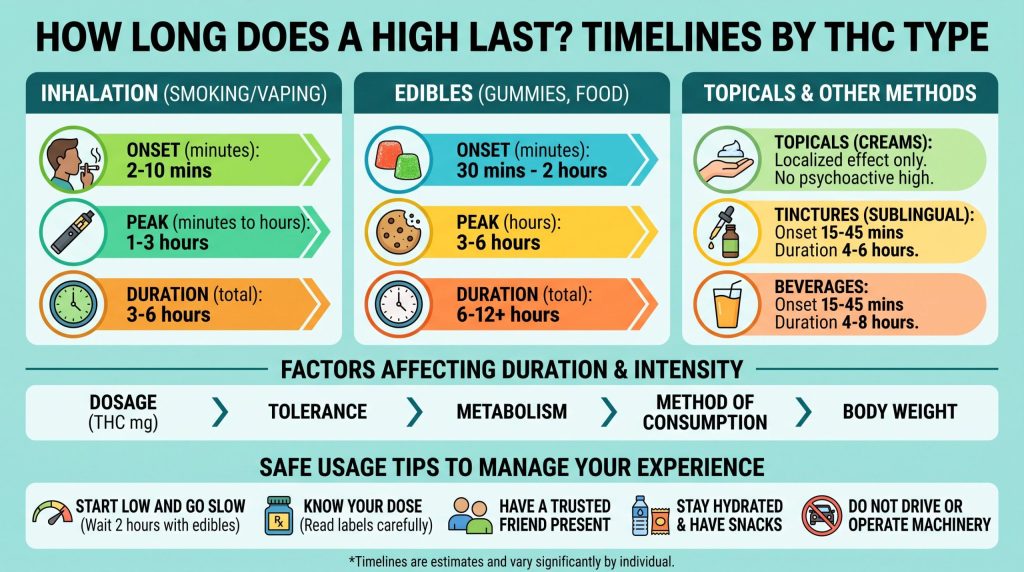
So, how long does a high last? Inhaled cannabis usually produces noticeable effects for about one to three hours, although impairment or subtler effects may continue for several more. Edibles commonly last four to eight hours and can affect some people for 12 hours or longer. Dose, THC potency, tolerance, food, medications, and individual sensitivity can shift those estimates considerably.
This guide reviews how long THC intoxication typically lasts by consumption method. It also explains what can prolong a high, what the comedown may feel like, when driving remains unsafe, and what to do if you’ve consumed too much. The timelines are practical estimates rather than countdown clocks: cannabis products aren’t perfectly standardized, and two people taking the same labelled dose can have very different experiences.
One important distinction before going further: feeling high, being impaired, and testing positive for THC are not the same thing. The obvious euphoria may disappear while reaction time and judgment remain affected. Meanwhile, THC metabolites can be detectable long after intoxication ends.
If you’re currently having severe symptoms, such as chest pain, trouble breathing, a seizure, or inability to wake, skip the timeline and seek emergency help now. Otherwise, take a breath. Most uncomfortable cannabis reactions improve with time, a calm setting, and no additional THC.
Key Takeaways
- A typical cannabis high lasts about 1–3 hours when inhaled and 4–8 hours for edibles, but individual experiences may vary based on dose and sensitivity.
- Inhaled cannabis effects appear within minutes, making it easier to dose safely by waiting and reassessing before consuming more.
- Edibles have a delayed onset (30 minutes to 2 hours) and can cause longer, stronger highs that last up to 12 hours or more.
- Tolerance, potency, metabolism, and concurrent use of alcohol or medications significantly influence how long a high lasts and its intensity.
- Feeling less euphoric doesn’t mean impairment is gone; avoid driving or operating machinery for at least six hours after consumption and longer when edibles or alcohol are involved.
- If you feel too high, stay calm in a safe place, avoid more THC, hydrate, and seek medical help if severe symptoms like chest pain or seizures occur.
Quick answer: how long does a high last by consumption method?
For most people, the fastest cannabis highs are produced by smoking, vaping, or dabbing because THC reaches the bloodstream through the lungs within minutes. Edibles take longer to start but generally last much longer. Tinctures and drinks fall somewhere between those categories depending on formulation and whether you swallow them.
Treat these windows as ranges, not promises. A large edible can remain noticeable well beyond eight hours, while a small inhaled dose may fade in under two.
At-a-glance comparison: onset, peak, typical duration, and lingering effects
| Consumption method | Usual onset | Approximate peak | Typical noticeable high | Possible lingering effects |
|---|---|---|---|---|
| Smoked cannabis | Seconds–10 minutes | 15–30 minutes | 1–3 hours | 3–6 hours |
| Dry-herb or standard THC vape | Seconds–10 minutes | 15–30 minutes | 1–3 hours | 3–6 hours |
| Dab or high-potency vape | Almost immediate–10 minutes | 10–30 minutes | 1–3+ hours | 4–8+ hours |
| Edible or gummy | 30 minutes–2 hours | 2–4 hours | 4–8 hours | 8–12+ hours |
| Sublingual tincture | 15–45 minutes | 1–2 hours | 2–6 hours | Up to 8 hours |
| Swallowed tincture | 30 minutes–2 hours | 2–4 hours | 4–8 hours | 8–12+ hours |
| Fast-acting THC drink | 10–30 minutes, sometimes longer | 30–90 minutes | 2–4 hours | 4–6+ hours |
The distinction between the “noticeable high” and lingering effects matters. You may stop feeling euphoric yet remain tired, distracted, slow to react, or mildly anxious. Higher doses can stretch every estimate in the table.
How long do different types of cannabis highs last?
The route THC takes into your body helps determine both the shape and length of the experience. Inhalation creates a steep, quick rise. Swallowed THC follows a slower route through digestion and the liver, producing a delayed, and often less predictable, curve.
Smoking and vaping cannabis flower
When you smoke a joint, use a pipe, or vape dry flower, effects may begin within seconds and usually become clear within 10 minutes. The high often peaks around 15 to 30 minutes after the final inhalation. Strong effects commonly ease within one to three hours, though measurable impairment or residual fogginess can persist longer.
That quick feedback makes inhaled cannabis easier to titrate than an edible: you can take one inhalation, wait 10 to 15 minutes, and reassess. Still, deep inhalation and breath-holding aren’t needed and may simply increase irritation or lightheadedness.
The amount actually delivered varies with flower potency, inhalation technique, device temperature, and how much of the joint or bowl you consume. A few puffs of 15% THC flower are a very different proposition from repeatedly vaping flower labelled above 25%.
Dabbing concentrates and using high-potency THC vape pens
Concentrates such as wax, shatter, rosin, and distillate can contain far more THC than cannabis flower. Effects arrive almost immediately and may peak within 10 to 30 minutes. The obvious high often lasts one to three hours, but a large dab or repeated hits can produce impairment, anxiety, or fatigue for six hours or more.
Potency is the trap here. A concentrate labelled 75% THC contains roughly three times the THC concentration of 25% flower by weight. That doesn’t mean every inhalation delivers exactly three times as much, but it leaves much less room for error.
Vape hardware also complicates dosing: a “three-second pull” isn’t a standardized unit. Voltage, airflow, oil formulation, and inhalation depth all matter. If you’re new to concentrates, a tiny inhalation followed by a proper pause is safer than trying to match someone with years of tolerance.
Edibles and gummies: delayed onset and longer-lasting effects
Edibles usually begin working in 30 minutes to two hours, although a full stomach or slow digestion can delay onset further. Effects commonly peak two to four hours after consumption and last four to eight hours. With a high dose, you may feel altered for 12 hours or wake up groggy the next morning.
Swallowed THC travels through the liver, where some is converted into 11-hydroxy-THC, an active metabolite that can feel especially potent. This delayed process explains the classic redosing mishap: at 45 minutes, you assume the gummy “didn’t work”: at two hours, both servings show up to the party.
For a beginner, 10 mg isn’t automatically a mild dose. In regulated markets, many public-health agencies advise beginning with 2.5 mg THC or less and waiting before taking more. Product labels, serving sizes, and local guidance differ, so check all three.
THC tinctures: under-the-tongue absorption versus swallowing
A tincture held under your tongue may begin producing effects in roughly 15 to 45 minutes because some cannabinoids can enter through oral tissues. Effects may last two to six hours. If you immediately swallow the oil, or mix it into food, it behaves more like an edible: onset may take 30 minutes to two hours, with effects lasting four to eight hours or longer.
Real-world use often combines both routes because it’s difficult to absorb the entire dose sublingually. That can create a two-stage experience: an earlier shift followed by stronger effects after digestion.
Measure tinctures with the marked dropper or provided dosing device. “One dropper” is meaningless unless you know its volume and THC content. For example, a 30 mL bottle containing 300 mg THC supplies about 10 mg per mL: half a millilitre would contain approximately 5 mg.
THC drinks and fast-acting products: why timing varies
Traditional cannabis beverages may act much like edibles, especially when their THC is swallowed and processed through digestion. Newer products may use emulsified or “fast-acting” cannabinoids designed to disperse in water. Some users notice effects within 10 to 30 minutes, with a peak around 30 to 90 minutes and a two-to-four-hour high.
But “fast acting” doesn’t guarantee an exact schedule. Formulation, dose, recent food intake, and your biology still count. A drink can also be easy to consume quickly, particularly when it tastes like ordinary seltzer rather than cannabis.
Read the total THC per container, not only the serving amount. A 355 mL can may be one serving: another bottle may contain two or more. And don’t combine THC drinks with alcohol just because both arrived in festive packaging.
What affects how long a cannabis high lasts?
Consumption method establishes a rough timeline, but dose and personal physiology fill in the details. Your friend’s two-hour experience can’t reliably predict yours, even if you split the same brownie.
THC dose and potency: why 5 mg and 10 mg edibles can feel different
Ten milligrams is only five more than 5 mg mathematically, but the subjective effect may feel much more than twice as intense. Cannabis responses aren’t neatly linear, particularly for people with little tolerance. Moving from pleasantly relaxed to dizzy, anxious, or disoriented can happen within a narrow dosing range.
Higher doses generally produce stronger effects and can extend the comedown. Potency labels matter, but they’re not perfect. Homemade brownies and unregulated products can have uneven THC distribution or inaccurate claims. Even regulated products have permitted testing tolerances that vary by jurisdiction.
If you’re inexperienced, choose a clearly labelled product and divide it only when the product is designed for accurate portioning. Cutting a gummy into quarters is reasonably intuitive: estimating one-tenth of a brownie made by your cousin’s roommate is… less scientific.
Tolerance, frequency of use, metabolism, and individual sensitivity
Frequent THC exposure can produce tolerance, meaning you may need more to notice the same effects. A daily consumer might feel relatively normal after a dose that leaves a first-time user intensely impaired. Tolerance doesn’t make driving safe, and it doesn’t eliminate cardiovascular or coordination effects.
Your age, body composition, liver function, genetics, sleep, stress, and prior cannabis experience may all influence duration. Metabolism matters, but there’s no reliable home formula based on weight or body size. A smaller person won’t necessarily have the longest high, and a fast runner doesn’t automatically “metabolize THC faster.”
Sensitivity can also change from one occasion to another. The edible that felt manageable last month may hit differently when you’re exhausted, anxious, dehydrated, or in an unfamiliar setting. Context isn’t just atmosphere, it can shape how intensely you interpret the effects.
Food, alcohol, medications, and other substances
Food can alter edible absorption. A meal, particularly one containing fat, may increase cannabinoid absorption while also delaying stomach emptying, making timing harder to predict. Taking an edible on an empty stomach may feel faster for some people, but it isn’t a reliable dosing strategy.
Alcohol can increase impairment and may raise blood THC concentrations when used around the same time. The combination is more likely to cause dizziness, nausea, poor judgment, or vomiting than either substance alone. If you’re learning how cannabis affects you, mixing substances muddies the experiment, and raises the risk.
Sedatives, sleep aids, opioids, antihistamines, and some anxiety medications may add to drowsiness or confusion. THC can also interact with medicines processed through certain liver enzymes. Ask a pharmacist or clinician about your specific medications, especially if you take blood thinners, seizure medicines, or drugs with narrow safety margins.
What does a cannabis high feel like as it wears off?
A high rarely ends like someone flipped a switch. It generally declines in layers: intense effects soften, attention becomes easier to direct, and physical heaviness or tiredness may remain.
The typical progression: onset, peak effects, and comedown
During onset, you may notice dry mouth, altered time perception, relaxation, laughter, increased appetite, or a faster heartbeat. At the peak, sensory changes and impaired short-term memory are often strongest. Some people experience euphoria: others become self-conscious or anxious, sometimes both within the same hour.
During the comedown, thoughts usually become less immersive and coordination gradually improves. You may feel hungry, quiet, sleepy, or emotionally flat. With inhaled cannabis, this curve can unfold over a few hours. With edibles, the plateau and decline may occupy most of an evening.
Use function, not vibes alone, to judge recovery. Can you follow a conversation, walk steadily, read and retain a paragraph, and make ordinary decisions? Improvement is reassuring, but it still doesn’t prove that you’re ready for safety-sensitive tasks.
Lingering grogginess, anxiety, and next-day effects
After a large dose, you may wake with fatigue, dry mouth, a headache, poor concentration, or a vaguely “off” feeling. These next-day effects are reported more often after strong edibles because their effects can overlap with sleep. Dehydration, lost sleep, alcohol, and anxiety may contribute too.
Mild residual symptoms usually improve with rest, regular meals, and time. Avoid taking more THC to correct the comedown: that can restart or extend it. If anxiety lingers, reduce stimulation, breathe slowly, and remind yourself that the sensation is temporary.
Persistent confusion, repeated vomiting, severe agitation, or symptoms lasting much longer than expected deserve medical advice. A product may have contained more THC than labelled, another ingredient, or a synthetic cannabinoid. Don’t assume every substance sold as a “weed gummy” is conventional cannabis, particularly if it came from an unverified source.
What to do if you feel too high
An overly intense high can feel frightening, but uncomplicated THC intoxication commonly resolves with supportive care and time. Your priorities are preventing injury, reducing stimulation, and recognizing warning signs.
Stay somewhere safe, avoid more THC, and contact a trusted sober person
Move to a quiet, familiar room where you can sit or lie down safely. Don’t drive, cook over a flame, shower alone if you’re dizzy, or wander outside to “walk it off.” Put the cannabis away so you don’t absentmindedly consume more.
Tell a trusted sober person what you used, approximately how much, and when. Ask them to stay with you or check in. Slow breathing can interrupt the anxiety loop: try inhaling gently for four counts and exhaling for six. A familiar show, dim lighting, and simple reassurance may help more than an intense conversation.
Sip fluids rather than chugging them. If you can comfortably eat, choose a light snack. Write down the dose and time: when minutes feel like hours, an objective timestamp can be surprisingly grounding.
Can you sober up faster? Limits of water, food, coffee, CBD, and black pepper
There’s no proven switch that immediately reverses a THC high. Water can relieve dry mouth but doesn’t flush THC from your brain. Food may settle your stomach, yet it won’t reliably stop absorbed THC. Coffee can make you feel more awake while leaving judgment and coordination impaired, and caffeine may worsen a racing heart or anxiety.
CBD is sometimes promoted as a THC counterbalance, but human evidence is mixed, effects depend on dose and timing, and adding another cannabinoid isn’t a dependable rescue treatment. Smelling or chewing black pepper is another popular tip based partly on terpene theories: clinical evidence that it sobers you up is lacking.
In short: don’t build an emergency plan around peppercorns. A calm environment, sober supervision, no additional substances, and time are more sensible. If symptoms become severe or you’re uncertain what was consumed, contact a medical professional or poison centre.
When to seek medical help for cannabis effects
Embarrassment shouldn’t keep you from asking for help. Medical teams care about stabilizing you, not critiquing your snack choices. Be honest about the product, dose, timing, and any alcohol or medications involved.
Emergency warning signs: chest pain, breathing problems, seizures, or unresponsiveness
Call 911 or your local emergency number for chest pain, trouble breathing, a seizure, collapse, blue or grey lips, severe confusion, dangerous behaviour, or inability to wake the person. Place an unconscious but breathing person on their side if you can do so safely, and follow the dispatcher’s instructions. Don’t induce vomiting.
Severe panic can resemble a medical emergency, but you shouldn’t diagnose chest pain or breathing difficulty at home. The threshold for seeking help should be lower for someone who is pregnant, elderly, medically fragile, or affected by heart disease.
Synthetic cannabinoids, sometimes sold as Spice or K2, are not equivalent to cannabis and may cause extreme agitation, seizures, organ injury, or death. Unknown vape liquids and unregulated edibles can also contain unexpected substances. Bring the package to clinicians if it’s safe to do so.
Persistent symptoms, accidental ingestion, and when to contact poison control
Call your local poison centre at 1-844-POISON-X (1-844-764-7669) (in Quebec, 1-800-463-5060) for individualized, confidential guidance after accidental ingestion or an unexpectedly strong reaction. Call immediately for a child or significant symptoms. Outside Canada, use your regional poison centre or emergency service.
Children can become seriously ill after eating THC gummies that resemble candy. Don’t wait for obvious intoxication before calling. Pets need prompt veterinary advice: chocolate, xylitol, and other edible ingredients may add separate hazards.
Seek clinical guidance for repeated vomiting, inability to keep fluids down, severe anxiety that isn’t easing, unusual psychotic symptoms, or impairment extending well beyond the expected window. Recurrent vomiting in a frequent cannabis user may indicate cannabinoid hyperemesis syndrome, which requires evaluation rather than another home remedy.
When is it safe to drive? Why feeling less high does not prove you are unimpaired
You shouldn’t drive, cycle in traffic, operate machinery, or perform hazardous work while high. Cannabis can affect reaction time, divided attention, tracking, coordination, and judgment. The tricky part? Subjective confidence may return before all those skills do.
No universal waiting period guarantees safety for every dose and product. Some public-health authorities recommend waiting at least six hours after using cannabis before driving, and longer after high doses, edibles, or combined alcohol use. That is a minimum-risk guideline, not a biological clearance certificate. If you still feel any effects, don’t drive.
Edibles deserve extra caution because the peak may arrive hours after consumption and residual impairment can continue into the next morning. Alcohol plus cannabis makes driving riskier and calls for a longer delay. Local laws may also impose stricter requirements or zero-tolerance rules.
Plan transportation before consuming: use a designated sober driver, rideshare, public transit, or stay overnight. Coffee, a cold shower, and “I feel basically normal” don’t establish fitness to drive. When uncertain, leave the keys where they are. An inconvenient morning beats a life-changing crash.
High duration versus drug-test detection: how long THC stays in your system
The intoxicating high lasts hours: a positive drug test can persist for days or weeks. Tests usually look for THC or its metabolites, and their detection window depends on the sample, cutoff level, dose, frequency of use, and individual biology.
| Test type | General detection pattern |
|---|---|
| Blood | Often hours: sometimes longer with frequent use or specialized testing |
| Oral fluid | Commonly hours to roughly one or two days, depending on the test |
| Urine | Several days after occasional use: potentially weeks after frequent use |
| Hair | May reflect exposure over approximately 90 days, but not recent impairment |
These aren’t pass/fail guarantees. Urine testing primarily detects an inactive metabolite, so a positive result doesn’t prove that you were high at the time of collection. Conversely, a negative result doesn’t necessarily settle whether impairment existed earlier.
Detox drinks, excessive water, saunas, and punishing workouts can’t reliably erase THC metabolites on demand. Diluted urine may simply produce an invalid or suspicious sample, while extreme water intake can be dangerous. If testing affects employment, treatment, athletics, or legal proceedings, review the actual policy and consult an appropriately qualified professional rather than relying on an online calculator.
How to reduce the risk of getting too high: labels, delayed effects, and avoiding early redosing
The easiest difficult high to manage is the one you avoid. Start by confirming milligrams of THC per serving and per package. Don’t confuse THC with the total weight of the gummy, and don’t assume “one piece” equals one low dose.
If you’re new or sensitive, consider no more than 1–2.5 mg of edible THC in a comfortable environment. Wait at least two hours, and preferably longer for a slow-onset product, before deciding whether to take more. Avoid stacking different formats, such as eating a gummy and vaping because you’re impatient.
A simple beginner plan looks like this:
- Choose a free evening with no driving, childcare, work, or important decisions.
- Use a regulated, clearly labelled product, and only if you’re of legal age in your province or territory.
- Record the dose and time in your phone.
- Stay with people you trust.
- Skip alcohol and other intoxicants.
- Store leftovers in child-resistant packaging, away from children and pets.
For inhaled cannabis, take one small puff and pause for 10 to 15 minutes. With concentrates, be even more conservative. You can always take more later: you can’t negotiate THC back out of your bloodstream once the edible plot twist begins.
Frequently asked questions about how long a high lasts
Individual experiences vary, but these answers cover three of the most common timing concerns.
Does a high last longer the first time you use cannabis?
It can. First-time users usually have little or no tolerance and may be more sensitive to THC, so a modest dose can feel intense or seem to last longer. Unfamiliar sensations can also distort time, an hour may feel like an entire director’s cut.
But first use doesn’t guarantee a long or pleasant high. Some people inhale inefficiently and notice little: others consume too much while waiting. Product strength, consumption method, and dose remain more predictive than whether it’s technically your first time.
If you choose to use cannabis, keep the dose low, avoid concentrates, and stay in a calm place with someone you trust. Don’t let an experienced friend select your dose based on theirs. Their tolerance isn’t transferable, no matter how confidently they say, “You’ll be fine.”
Can you still feel high after 12 or 24 hours?
Yes, especially after a large edible dose. At 12 hours, residual intoxication, fatigue, slowed thinking, anxiety, or dizziness can still occur. Feeling distinctly high after 24 hours is less typical but possible after a very high dose, in a highly sensitive person, or when other substances are involved.
If symptoms are steadily improving and mild, rest and avoid driving or taking more THC. If they’re severe, worsening, or accompanied by repeated vomiting, chest pain, hallucinations, inability to stay awake, or unusual behaviour, obtain medical help.
Also consider what was actually consumed. Delta-8 THC, hemp-derived intoxicants, homemade products, and synthetic cannabinoids can have inconsistent doses or contaminants. Keep the label and batch information. “It came in a colourful bag” isn’t meaningful quality control.
Does sleeping make a high wear off faster?
Sleep doesn’t rapidly remove THC, but it lets time pass while your body metabolizes it. After a moderate dose, you may wake feeling normal. After a strong edible taken late at night, you might wake groggy or mildly impaired because the drug’s effects outlasted your sleep.
Only go to sleep if you’re otherwise stable, breathing normally, and able to respond appropriately. Someone who is difficult to wake, repeatedly vomiting, or breathing abnormally needs urgent assessment, not instructions to “sleep it off.” If you’re very intoxicated, having a sober person nearby is sensible.
Before bed, place water within reach, avoid sedatives or alcohol, and set aside enough time the next morning before driving. Sleeping for four hours after a midnight edible doesn’t magically turn 4 a.m. into a safe commute.
When frequent cannabis use, tolerance, or withdrawal may warrant support
A rising tolerance can quietly change cannabis from an occasional choice into a routine you no longer feel fully in charge of. Warning signs include using more than intended, unsuccessful attempts to cut down, craving, missing obligations, continuing despite anxiety or relationship problems, and spending substantial time obtaining or recovering from cannabis.
Regular users may experience withdrawal after stopping: irritability, sleep difficulty, vivid dreams, reduced appetite, restlessness, anxiety, low mood, headache, or stomach discomfort. Symptoms often begin within one or two days, peak during the first week, and improve over one to two weeks, although sleep disruption can linger.
Support doesn’t require hitting a dramatic “rock bottom.” A primary-care clinician, therapist, or addiction specialist can help you assess use without moralizing. In Canada, Health Canada’s Get help with substance use page lists free national and provincial services, including Drug Rehab Services for confidential treatment referrals at 1-877-254-3348. If you’re in emotional crisis or at risk of self-harm, call or text 9-8-8 through 9-8-8: Suicide Crisis Helpline.
Try tracking when, why, and how much you use for two weeks. That small record often reveals more than memory does, and gives you a concrete starting point for change.
Sources and evidence behind cannabis duration estimates
Cannabis-duration research has unavoidable limitations. Products, doses, tolerance, and study methods differ, while self-reported “highness” doesn’t perfectly match functional impairment. Accordingly, the ranges in this review synthesize clinical guidance and research rather than claiming one exact cutoff.
Key evidence and safety resources include:
- Health Canada’s Health effects of cannabis page for health effects, impairment, and higher-risk use.
- Health Canada’s information for health care professionals on cannabis and cannabinoids for pharmacology, health effects, and cannabis use disorder.
- Canada’s Lower-Risk Cannabis Use Guidelines, including advice about delayed edible effects and driving.
- A peer-reviewed review of cannabis and driving impairment, which discusses duration, tolerance, route, and the mismatch between blood THC and impairment.
- Health Canada’s cannabis poisonings in children information and Canada’s poison centres (1-844-POISON-X) for accidental ingestion and symptom-based assistance.
Eventually, how long does a high last depends most on route, dose, potency, tolerance, and what else you’ve consumed. Expect roughly one to three hours of prominent effects after inhalation and four to eight hours after an edible, while allowing extra time for lingering impairment. Start low, wait patiently, and arrange transportation in advance. If your symptoms feel dangerous or don’t follow the expected pattern, seek help rather than trying to tough it out.