
Blog 2026
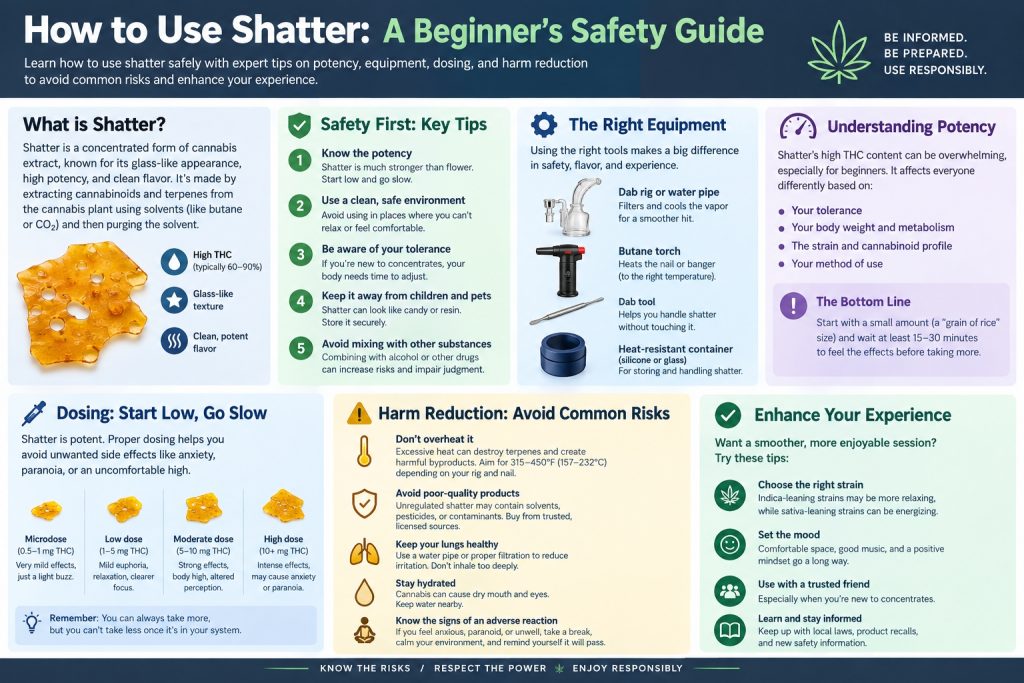
How to Use Shatter: A Beginner’s Safety Guide
Nov
Shatter can look deceptively simple: a thin amber sheet, a concentrate tool, and a device. But learning how to use shatter responsibly involves more than heating a glassy fragment and inhaling. Cannabis concentrates may contain far more THC than flower, and their strength makes accidental overconsumption especially easy for beginners.
This guide provides a safety-focused review of common consumption methods, equipment, product labels, storage, and potential risks. It does not cover making shatter, which can involve flammable solvents and should never be attempted at home. It also doesn’t assume cannabis is legal or medically appropriate for you. Laws vary sharply by location, and cannabis can interact with medications or worsen certain health conditions.
There’s another important limitation: no inhaled cannabis product is risk-free. Vapour and smoke can expose your lungs to irritants, while hot equipment creates a genuine burn hazard. Evidence about the long-term effects of frequently inhaling high-potency concentrates is still developing. If you choose to consume shatter, the lower-risk approach is to use a regulated, laboratory-tested product: choose equipment specifically designed for concentrates: avoid mixing substances: and give the effects time to develop before considering more.
You won’t find a supposedly universal “perfect dab” here. Human tolerance, product potency, device performance, and even how much concentrate sticks to a tool can change the experience. Instead, you’ll learn how to interpret those variables and recognize situations in which the safest decision is not to use the product at all.
Key Takeaways
- Learning how to use shatter safely involves understanding its high THC potency and using laboratory-tested products from legal, authorized sources.
- Use equipment specifically designed for concentrates, such as regulated e-rigs or concentrate vaporizers, to reduce risks like burns and inhalation of harmful aerosols.
- Always read product labels carefully, check cannabinoid percentages, and avoid improvised dosing since visual size is an unreliable indicator of THC content.
- Start with a low dose and wait sufficiently to feel effects before considering more to prevent overconsumption and adverse reactions.
- Avoid mixing shatter with alcohol or other substances and never drive or operate machinery while impaired by cannabis concentrates.
- Store shatter securely in child-resistant packaging and avoid homemade extracts to prevent contamination, accidental ingestion, and safety hazards.
What Is Cannabis Shatter?
Cannabis shatter is a concentrated extract that commonly has a firm, translucent, or brittle consistency. It contains cannabinoids, often predominantly tetrahydrocannabinol (THC) or its acidic precursor, THCA, along with varying amounts of aromatic compounds called terpenes.
Commercial shatter is generally produced by licensed processors using extraction and purification equipment. Depending on the jurisdiction and producer, hydrocarbons such as butane may be used during processing and later removed under controlled conditions. That history is one reason independent laboratory results matter: a polished package cannot tell you whether residual solvents, pesticides, microbes, or heavy metals are present.
Shatter belongs to a broader family of cannabis concentrates that includes wax, budder, crumble, rosin, and live resin. Names usually describe texture, processing, or starting material, not a guaranteed level of safety or quality.
Why Shatter Looks Like Glass, and Why Appearance Does Not Prove Quality
Shatter’s glass-like appearance comes from its physical structure. When kept cool and undisturbed, some extracts solidify into a smooth, amorphous sheet rather than forming visible crystals. It may snap when cold, soften between warm fingers, or turn sticky in a hot room.
Colour can range from pale gold to dark amber. Consumers sometimes treat light-coloured, perfectly transparent shatter as automatically superior, but that shortcut is unreliable. Colour may be influenced by the cannabis material, processing choices, age, heat exposure, and pigments. A darker sample isn’t necessarily contaminated, just as a clear one isn’t necessarily clean.
Watch for information rather than Instagram-worthy sparkle. A sealed package from a legal source should identify its producer, lot number, cannabinoid content, and packaging date, and carry the standardized cannabis symbol and a health warning, plus a provincial excise stamp. Unexpected chemical odours, damaged packaging, visible debris, or missing lot or label details are reasons not to consume it.
Shatter vs. Wax, Live Resin, and Flower: Potency and Texture Differences
Shatter and wax can have similar cannabinoid concentrations even though one snaps and the other scoops. Wax, budder, and crumble have opaque or whipped textures created by composition and processing. Texture mainly changes handling: it does not reliably predict potency.
Live resin is made from cannabis that was frozen soon after harvest rather than conventionally dried and cured. It often has a strong aroma and a saucier consistency because producers aim to retain volatile compounds. That doesn’t make it harmless or automatically stronger. Rosin, meanwhile, is produced without hydrocarbon solvents, although it can still contain pesticides or other contaminants carried over from the plant.
| Product | Typical form | General potency pattern | Practical difference |
|---|---|---|---|
| Shatter | Brittle or glass-like sheet | Often high in THC | Can splinter or become sticky |
| Wax/budder | Soft, opaque concentrate | Often comparable to shatter | Usually easier to portion, but still imprecise |
| Live resin | Sticky or sauce-like | Varies by product | Strong aroma: difficult to handle neatly |
| Flower | Dried cannabis buds | Usually less concentrated | Combustion produces smoke and more plant material |
Exact percentages matter more than category names. Compare verified labels, not texture or marketing language.
Before Using Shatter: Potency, Product Labels, and Equipment
Before opening a package, confirm that the product came from an authorized cannabis retailer in your province or territory, remains within its recommended use period, and has an intact seal. Then read the label all the way through, the tiny print isn’t decorative, even if it seems designed for ants.
Check whether the displayed cannabinoid number is a percentage, milligrams per gram, or total milligrams in the package. Also review warnings and the certificate of analysis, when available. If the package and laboratory record disagree, contact the retailer or producer rather than guessing.
Plan your environment as carefully as your equipment. Avoid driving, cooking over an open flame, swimming, climbing, or supervising children while impaired. Ideally, you should be in a familiar place with a sober, trusted adult nearby, especially if you’re inexperienced or trying an unfamiliar product.
How to Read THC, THCA, CBD, and Laboratory Testing Information
THC is the principal intoxicating cannabinoid most consumers associate with feeling high. THCA is its non-intoxicating acidic precursor, which converts substantially, but not perfectly, into THC when heated. Labels may report both values or provide a calculated “total THC” figure.
A common laboratory calculation estimates potential total THC as:
Total THC ≈ THC + (THCA × 0.877)
The conversion factor accounts for molecular weight lost during decarboxylation. It does not tell you exactly how much THC your body will absorb. Device efficiency, temperature, inhalation pattern, and product loss all affect exposure.
CBD is not intoxicating in the same way as THC, but it isn’t a guaranteed antidote to excessive THC. It can also interact with medications. Look beyond cannabinoid potency to screening results for residual solvents, pesticides, heavy metals, microbes, and mycotoxins. A certificate of analysis should match the package’s batch number and come from a qualified laboratory. “Tested” without accessible, batch-specific results is a weak claim.
Why High-THC Shatter Can Be Overwhelming for Beginners
Concentrates can deliver a substantial amount of THC quickly. Someone accustomed to lower-potency flower may underestimate the difference because the piece of shatter looks so small. Visual size is a lousy measuring cup.
Too much THC may cause anxiety, panic, confusion, dizziness, nausea, a rapid heartbeat, impaired coordination, or paranoia. The experience can feel alarming even when it does not require emergency treatment. Risk is influenced by your tolerance, sleep, food intake, emotional state, medications, and whether you’ve also used alcohol or other substances.
Frequent exposure to high-potency products may increase tolerance and can contribute to cannabis use disorder. Some observational evidence also links frequent high-potency cannabis use with a greater risk of psychotic symptoms, particularly among susceptible people, although individual risk varies.
If you have little or no cannabis experience, shatter is not the most forgiving starting format. Choosing a lower-THC product with clearly measurable servings, or deciding not to use cannabis, is easier to control.
Equipment Checklist: Concentrate-Compatible Devices and Handling Tools
Only use equipment explicitly rated for concentrates. A typical setup may involve:
- A regulated e-rig, concentrate vaporizer, or dab pen with a concentrate chamber
- The manufacturer-approved chamber, atomizer, or insert
- A small nonflammable handling tool intended for concentrates
- The product’s original container or clean parchment supplied by the producer
- A stable, heat-resistant surface
- Cotton swabs or cleaning materials approved by the device maker
- A child-resistant storage container
Traditional dab rigs may use a torch-heated component, but exposed flames and extremely hot surfaces materially increase burn and fire risks. For beginners, a temperature-controlled electronic device eliminates the torch, though it does not eliminate inhalation, battery, or burn hazards.
Don’t improvise with kitchen knives, foil, plastic tools, or damaged glass. Never place cannabis oil into an ordinary nicotine vape unless its manufacturer specifically supports that material. Incompatible oils can leak, spit, clog, overheat, or damage the device.
How to use shatter: Comparing Consumption Methods
When people ask how to use shatter, they’re usually comparing three broad options: a dedicated rig, a concentrate-compatible portable vaporizer, or combining it with flower. None is risk-free, and the safest choice may be not to inhale it, particularly if you have respiratory or cardiovascular concerns.
This section compares the equipment and exposure patterns without prescribing a universal temperature, inhalation technique, or dose. Those details vary by device and can create unnecessary risk when copied from a generic tutorial. Follow the instructions for your exact model, including its chamber limits, charging requirements, and cleaning procedure.
Buy regulated products and devices where available. Counterfeit cartridges, mystery batteries, and unlabelled concentrates don’t become trustworthy merely because a friend says, “It’s fine, bro.”
Dab Rigs and E-Rigs: How They Work and Their Main Risks
A dab rig routes vapour from a heated concentrate surface through a glass body, often with water filtration. Traditional rigs commonly rely on a torch to heat a quartz, ceramic, or titanium component. E-rigs use an electric heater and usually provide preset or adjustable temperature control.
Water may cool the aerosol, but it doesn’t make inhalation harmless or reliably remove cannabinoids and contaminants. Excessive heat can produce harsh aerosol and degrade terpenes or other constituents. A surface that looks cool may also remain hot enough to burn skin.
Traditional rigs carry the additional risks of open flames, unstable equipment, fuel storage, and accidental contact with hot glass or metal. E-rigs avoid the torch but introduce rechargeable-battery and electrical hazards. Use the supplied charger, inspect the device for damage, and keep it away from water while charging.
Whichever format you choose, place it on a stable, uncluttered, heat-resistant surface and keep children, pets, sleeves, hair, and enthusiastic elbows away.
Concentrate Vaporizers and Dab Pens: Check Compatibility First
Portable concentrate vaporizers, often called wax pens or dab pens, heat a small chamber designed for solid or semi-solid extracts. They’re more discreet than desktop equipment, but discretion shouldn’t be mistaken for safety. Their small size can encourage repeated use before you’ve assessed the effects.
Confirm that the model accepts shatter. A dry-herb chamber, nicotine pod, or oil-cartridge battery isn’t automatically interchangeable with a concentrate chamber. Even within one brand, such as Puffco, Dr. Dabber, or Yocan, components may have different loading limits and cleaning rules.
Avoid overfilling. Excess material can leak into the airflow path or heating assembly, leading to clogging, splatter, or device failure. Because exact capacity differs, consult the manual rather than copying someone else’s setup.
Stop using a device if its battery swells, becomes unusually hot, emits an electrical smell, or has damaged wrapping or charging contacts. Don’t charge it unattended or with a random high-output adapter unless the manufacturer confirms compatibility.
Adding Shatter to Flower: Combustion Risks and Uneven Potency
Some consumers place shatter alongside cannabis flower in a pipe or rolled product. This avoids specialized concentrate equipment, but it introduces smoke from combustion. Cannabis smoke contains many of the same toxins, irritants and carcinogens as tobacco smoke, according to the Canadian Centre on Substance Use and Addiction.
This method also makes exposure difficult to predict. Concentrate can melt into one area, burn unevenly, or produce a stronger inhalation late in the session. Sharing adds another layer of uncertainty because you can’t know how much each person received.
Never apply shatter to tobacco if your goal is harm reduction. That combines cannabis impairment with nicotine dependence and tobacco smoke exposure. And avoid loosely placing brittle fragments where they can fall onto clothing or furniture while burning.
If you have asthma, chronic bronchitis, or another lung condition, discuss inhaled cannabis with a qualified clinician rather than assuming flower is gentler than vapour, or vice versa.
Comparing Methods by Equipment, Convenience, and Exposure Risks
No method wins every category. Your health history, local rules, product quality, and ability to operate the equipment safely matter more than trendiness.
| Method | Required equipment | Convenience | Key exposure or injury concerns |
|---|---|---|---|
| Traditional dab rig | Rig, concentrate surface, torch, tools | Low to moderate | Open flame, severe burns, breakable glass, concentrated aerosol |
| E-rig | Electronic rig and approved charger | Moderate | Hot chamber, battery failure, concentrated aerosol |
| Dab pen | Compatible portable vaporizer | High | Easy repeat use, clogging, battery risk, device-dependent aerosol |
| Added to flower | Smoking device or rolling material | Moderate | Combustion smoke, uneven potency, fire risk |
A regulated e-rig or concentrate vaporizer with clear temperature controls may reduce some handling hazards compared with a torch setup. It does not make the aerosol safe, and device quality varies.
If you choose to consume, use one method at a time. Switching between a pen, rig, and infused flower in the same session makes it nearly impossible to track your exposure or identify what caused an unpleasant reaction.
Cleaning and Maintaining Equipment According to Manufacturer Instructions
Residue can restrict airflow, interfere with sensors, damage seals, and alter flavour. More importantly, aggressive cleaning can crack hot glass, expose electronics to liquid, or leave flammable solvent where it shouldn’t be.
Turn equipment off, unplug it, and let it cool completely before handling removable parts. Follow the manufacturer’s instructions for disassembly and approved cleaning agents. Isopropyl alcohol is commonly recommended for certain glass or removable components, but it may damage plastics, coatings, adhesives, or electronic parts. Never assume.
Allow approved cleaning fluid to evaporate fully before reassembly or heating. Don’t heat alcohol to speed things up, and never use it near a flame. Replace cracked glass, degraded seals, chipped ceramic, or damaged atomizers rather than trying a heroic DIY repair.
For shared devices, clean mouthpieces between users. Sharing can transfer saliva and respiratory pathogens. Finally, empty water from rigs after use and refresh it regularly: stagnant rig water is not a quirky science project you want growing on the counter.
Understanding Shatter Potency, Dosing Uncertainty, and Effects
Shatter dosing is inherently uncertain outside tightly controlled systems. A label may accurately describe cannabinoid concentration while your actual absorbed dose remains unknown. Material left on a tool, trapped in a chamber, lost to side-stream vapour, or degraded by heat changes exposure.
For perspective only, a gram of concentrate labelled 70% total THC theoretically contains about 700 milligrams of THC before device loss and incomplete absorption. That does not mean you’ll absorb all 700 milligrams, nor does it convert cleanly into a certain number of inhalations. It demonstrates why eyeballing a fragment can go wrong so quickly.
A sensitive scale may measure total material, but converting that weight into an inhaled dose still involves assumptions. Beginners should not interpret calculation as precision.
Why a Small-Looking Piece Is Not a Reliable THC Dose
Two fragments that look identical may have different weights, thicknesses, and THC concentrations. A clear sliver can fold over on itself: a sticky piece may remain on the tool: and a brittle shard may split into several nearly invisible fragments. Warm material is particularly difficult to judge by eye.
The underlying math illustrates the uncertainty. If a concentrate contains 70% THC by weight, 10 milligrams of concentrate contains up to roughly 7 milligrams of THC before losses. But accurately measuring such a small quantity requires a suitable precision scale, and the amount delivered by a device may still differ.
Don’t use comparisons such as “a grain of rice” as universal dosing advice. Rice grains vary, shatter density varies, and tolerance varies even more. If dependable dosing is essential, for example, because you use cannabis medically, ask a clinician or pharmacist familiar with cannabis about a regulated format offering clearly labelled, consistent units.
When Inhaled Effects Begin, How Long They May Last, and Why Waiting Matters
Inhaled cannabis can begin producing noticeable effects within minutes, but the experience may continue intensifying after the first sensation. The strongest effects often occur earlier than with swallowed edibles, yet impairment can persist for several hours. Residual attention, coordination, or judgment changes may last longer, especially after high exposure.
That delay creates a familiar trap: you feel little immediately, assume the product “didn’t work,” and consume more. Then both exposures catch up. Give the first exposure ample time to develop, and don’t chase an instant result. There is no single waiting interval that guarantees safety because products and bodies differ.
Your response may also vary from one day to another. Fatigue, anxiety, an empty stomach, medications, and alcohol can all change the experience. Plan not to drive for the rest of the session and longer if you still feel impaired. Feeling normal and being ready for complex traffic are not necessarily the same thing.
Shatter Risks and Harm-Reduction Precautions
The risks of shatter extend beyond feeling “too high.” They include burns, falls, impaired decisions, drug interactions, lung irritation, contamination, dependence, and worsening psychiatric or cardiovascular symptoms. Higher THC concentration can magnify several of these concerns.
Basic precautions make a meaningful difference:
- Use only legal, batch-tested products where available.
- Avoid homemade or untraceable concentrates.
- Don’t consume alone if you’re inexperienced.
- Keep a charged phone and your location information available.
- Don’t drive, cycle in traffic, or operate machinery.
- Avoid alcohol and other impairing substances.
- Store the product and equipment securely after use.
If cannabis is causing repeated anxiety, missed obligations, financial strain, tolerance, or unsuccessful attempts to cut back, talk with a healthcare professional. That conversation isn’t a moral judgment: it’s ordinary healthcare.
Burns, Hot Surfaces, and Inhalation Risks
Concentrate surfaces can reach temperatures capable of causing serious burns. Quartz and ceramic don’t always glow when dangerously hot, while glass can crack if exposed to rapid temperature changes. Treat every recently used component as hot until it has cooled fully.
If a minor burn occurs, move away from the heat source and cool the area under cool, not icy, running water. Don’t apply butter, oil, or cannabis products. Seek medical care for deep burns, blistering over a large area, burns to the face or hands, electrical burns, or any injury involving breathing difficulty.
Inhalation may trigger coughing, chest irritation, wheezing, or shortness of breath. Aerosol composition varies with product ingredients, contaminants, equipment, and temperature. Health Canada’s guidance on the health effects of cannabis notes that cannabis can affect lung health and heart rate and impair your ability to react quickly.
Stop immediately if inhalation causes chest pain, significant breathing trouble, faintness, or severe wheezing. Those symptoms warrant urgent assessment rather than another attempt at a “smoother hit.”
Residual Solvents, Contaminants, and Why Home Extraction Is Dangerous
Hydrocarbon extraction can involve butane or propane, both highly flammable. Their vapours may travel to an ignition source, including a pilot light, appliance, switch, or static spark, and flash back. Ventilation through an open window does not make a residential extraction setup safe.
Never attempt to manufacture shatter at home. In Canada it’s also illegal: the Cannabis Act prohibits altering cannabis with an organic solvent, and Health Canada names butane, isobutane, propane and propylene among the explosive or highly flammable solvents you can’t use at home. Licensed facilities use engineered ventilation, explosion-rated equipment, environmental controls, and testing procedures that a kitchen or garage cannot replicate.
Finished concentrates can also contain residual solvents, pesticides, heavy metals, microbes, or processing contaminants. Some risks come from the original plant: others can be introduced during manufacturing or through low-quality hardware. Vitamin E acetate, for example, was strongly associated with the 2019 US outbreak of vaping-associated lung injuries in illicit THC products, as documented by the US CDC’s EVALI investigation.
A regulated laboratory report reduces uncertainty but doesn’t prove zero risk. Avoid products with no batch traceability, altered packaging, implausible potency claims, or prices far below the legal market.
Avoid Driving and Mixing Cannabis With Alcohol or Other Impairing Substances
THC can impair reaction time, lane control, divided attention, and judgment. You may feel relaxed while still being measurably worse at handling a sudden stop or pedestrian crossing. Coffee, cold showers, and loud music don’t reverse impairment.
Alcohol and cannabis can intensify dizziness, nausea, poor coordination, and bad decisions. Combining cannabis with sedatives, sleep medications, opioids, or other substances may further increase impairment and accident risk. Some prescription medicines can also interact with cannabinoids through metabolic pathways or overlapping side effects.
Arrange transportation before using shatter. That might mean staying home, choosing a sober driver, or using a taxi or rideshare where lawful. Don’t ride a bike or scooter in traffic as a workaround.
In Canada, the Criminal Code makes it an offence to have 2 ng or more of THC per mL of blood within two hours of driving, but compliance with a numerical limit doesn’t guarantee fitness to drive. If you feel any effect, or aren’t sure, don’t take the wheel.
Who Should Avoid Cannabis or Seek Medical Advice First
You should avoid cannabis during pregnancy and breastfeeding. Health Canada says the safest choice is not to use cannabis when pregnant or breastfeeding because it can harm your baby’s growth and development.
Seek individualized medical advice before using shatter if you have:
- Heart disease, rhythm problems, fainting episodes, or poorly controlled blood pressure
- Asthma, chronic obstructive pulmonary disease, or unexplained breathing symptoms
- A personal or close family history of psychosis or schizophrenia
- Severe anxiety, panic disorder, bipolar disorder, or unstable depression
- A history of substance use disorder
- Liver disease or medications with significant interaction potential
- Upcoming surgery or anaesthesia
Children and adolescents should not use high-THC concentrates outside appropriately supervised medical care. The developing brain is more vulnerable to cannabis-related effects, and earlier frequent use is associated with greater dependence risk.
Older adults should also be cautious. THC-related dizziness and blood-pressure changes can contribute to falls, particularly when combined with sedatives or antihypertensive medicines.
Unwanted Effects: When to Stop and When to Seek Urgent Help
If you become anxious, dizzy, nauseated, or disoriented, stop consuming. Move to a quiet, safe place: sit or lie down to prevent a fall: breathe slowly: and ask a sober person to stay with you. Sip water if you can swallow normally. Don’t add alcohol, sedatives, or more cannabis in an attempt to “balance” the experience.
Seek emergency help for chest pain, severe difficulty breathing, a seizure, collapse, loss of consciousness, extreme agitation, dangerous behaviour, or symptoms suggesting a stroke. Call for urgent guidance if a child or pet may have consumed the product. In Canada, you can call your local poison centre at 1-844-POISON-X (1-844-764-7669), or 1-800-463-5060 in Quebec: call 911 for life-threatening symptoms.
Persistent vomiting, especially repeated hot showers for relief, may signal cannabinoid hyperemesis syndrome and deserves medical evaluation. Be honest about what was consumed. Clinicians need accurate information, not a detective story.
How to Handle and Store Shatter
Good storage protects more than texture. It helps prevent accidental ingestion, contamination, product mix-ups, and access by children or pets. Keep shatter in its original, labelled, child-resistant packaging whenever possible. That preserves batch information and avoids the classic freezer mystery: “Is this concentrate or caramel?”
Wash and dry your hands before handling the package, but avoid touching the concentrate directly. Skin oils, lint, moisture, and debris can transfer to it. Use a clean tool intended for concentrates and place the container on a stable surface so brittle pieces don’t scatter.
Never leave shatter or a loaded device unattended. A tiny fragment may be difficult to see but still contain considerable THC.
Managing Sticky or Brittle Shatter Without Contaminating It
Temperature changes shatter’s behaviour. Cold material may snap and send fragments across a counter, while warm material may stretch, smear, and adhere to skin or clothing. Let the closed package approach a manageable temperature gradually and follow any storage directions printed by the producer.
Work over a clean, nonporous surface where dropped material can be identified. Avoid carpet, bedding, or food-preparation areas. Don’t hold brittle shatter near your face while breaking it, and don’t use bare fingers to catch splinters.
If it sticks to a tool, don’t scrape it with an improvised blade while holding the device in your other hand. That’s how a minor inconvenience becomes an urgent-care anecdote. Pause, stabilize everything, and follow the equipment manufacturer’s loading guidance.
Discard material that has collected hair, dust, unknown liquid, cleaning residue, or fragments from damaged hardware. Trying to rescue a contaminated speck is rarely worth the uncertainty.
Protecting Shatter From Heat, Light, Moisture, Children, and Pets
Heat and light can soften shatter and accelerate chemical changes. Moisture can introduce contamination and may cause condensation when a cold container is opened. Store the sealed package in a cool, dark, dry location consistent with the producer’s directions.
Cold storage may help preserve some products, but freezing can make shatter extremely brittle. Opening a cold container immediately can also allow condensation to form. If refrigeration is recommended, keep the package airtight and let it warm while still sealed.
Child-resistant packaging is not childproof. Put it inside a locked box or cabinet, separate from food, candy, and medications. Use packaging that clearly displays the cannabis symbol and product name rather than a snack bag or mint tin.
Pets can be seriously affected by THC. Store used swabs, residue, and loaded devices securely too, not just the main package. If a pet becomes unusually sleepy, unsteady, incontinent, agitated, or unresponsive after possible exposure, contact a veterinarian or animal poison service promptly.
Frequently Asked Questions About Using Shatter
These common questions highlight why device compatibility, product chemistry, and local law matter. Shatter cannot simply be treated like vape juice, dried flower, or a ready-to-eat edible. When a package or manual doesn’t clearly support a proposed use, don’t experiment.
Can You Use Shatter in a Regular Vape or Dry-Herb Vaporizer?
Usually not. A standard nicotine vape is designed for a specific liquid formulation, while many dry-herb vaporizers are built for ground plant material. Solid concentrate can melt into air channels, damage heating elements, leak toward the battery, or produce unpredictable aerosol.
Some dry-herb vaporizers offer an official concentrate insert or pad. Use that accessory only if the manufacturer explicitly approves shatter for your exact model. An aftermarket cup that happens to fit is not the same as tested compatibility.
Similarly, a 510-thread battery does not itself vaporize shatter. It powers a compatible attachment or prefilled cartridge. Don’t open a cartridge and refill it with solid concentrate: cartridge oils are formulated differently, and improvised mixtures can clog or expose you to unsafe additives.
Check the manual, model number, chamber material, capacity, and cleaning instructions. If the documentation says “dry herb only,” take it literally.
Can You Eat Shatter Raw, and How Does It Differ From an Edible?
Raw shatter may contain substantial THCA, which does not produce the same intoxicating effects as THC until heat converts it through decarboxylation. Commercial shatter may already contain some THC because of processing, so eating it is still unpredictable. It also isn’t formulated, portioned, or tested as a food.
Edibles use cannabinoids prepared for oral consumption and divided into labelled servings. Swallowed THC is processed by the liver into 11-hydroxy-THC, which can produce stronger and much longer-lasting effects than inhalation for some people. Effects may take considerably longer to appear, making premature redosing a common problem.
Don’t cook with shatter based on an internet recipe if you cannot verify potency, food safety, and serving uniformity. One brownie may end up mild while another becomes the final boss. If you want an oral product, a regulated edible with clearly marked servings provides better consistency, though it still requires cautious use and secure storage.
Is Shatter Legal, and What Local Age and Purchase Rules Apply?
Legality depends on your country, province or territory, and sometimes municipality. In Canada, the Cannabis Act allows adults to buy cannabis extracts such as shatter from authorized retailers, and to carry up to 30 grams of dried cannabis or its equivalent in public. For concentrates, 0.25 grams equals 1 gram of dried cannabis, so shatter alone tops out at 7.5 grams. Provinces and territories may separately limit where you can buy and use cannabis, home cultivation, or transportation.
Legal age requirements also vary. The minimum age is 19 in most of Canada, 18 in Alberta, and 21 in Quebec. Never take cannabis across the Canadian border, in either direction, even if it was purchased legally at the starting point.
Check your provincial or territorial government’s cannabis information, not a retailer’s social post, for current rules. Employers, landlords, schools, and federally regulated jobs may impose additional restrictions even where possession is lawful.
Eventually, learning how to use shatter safely starts with recognizing its limits: high potency, uncertain inhaled dosing, hot equipment, and uneven product quality. If you choose to use it, stick with regulated products, compatible devices, sober surroundings, and conservative decisions. Read every label, allow effects to develop, and stop when something feels wrong. There’s no prize for keeping up with an experienced friend, and your lungs, hands, and future self will appreciate the lack of heroics.