
Nov
You take a hit, settle into the couch, and suddenly your heart seems to be auditioning for a drum solo. Is your blood pressure climbing too, or is anxiety making every heartbeat feel louder?
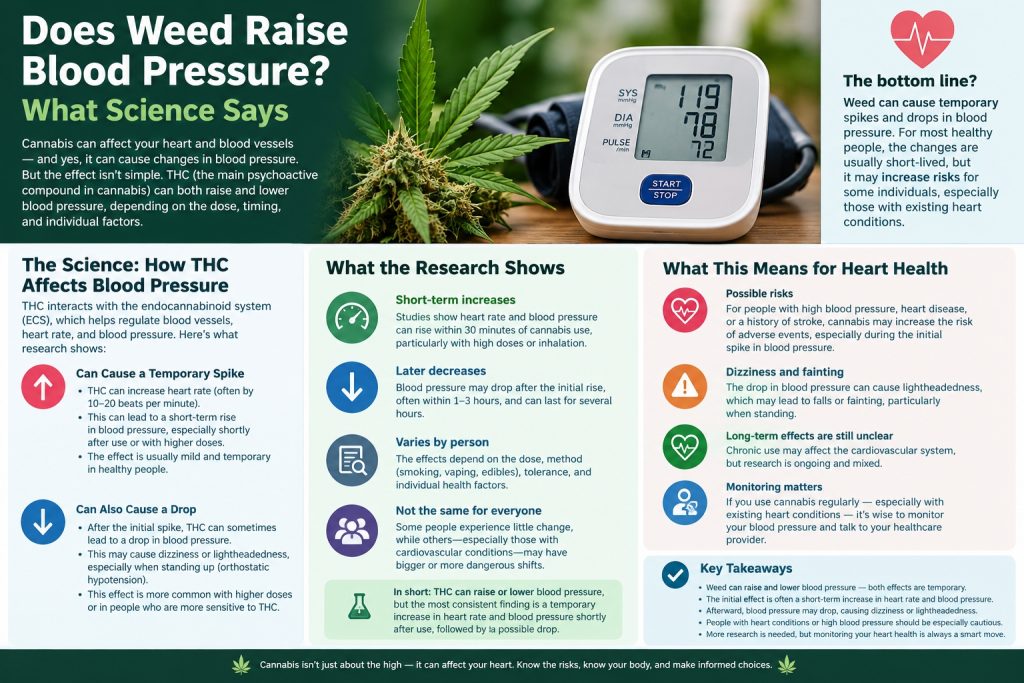
The honest answer is nuanced: cannabis can raise blood pressure temporarily, particularly soon after using THC. It may also cause blood pressure to fall later, especially when you stand up. Your response depends on the dose, product, delivery method, tolerance, health history, and whatever else is in your system. That unpredictability matters if you have hypertension or cardiovascular disease.
This evidence review examines the question “does weed raise blood pressure?” across smoked cannabis, vapes, edibles, THC, and CBD. It covers immediate cardiovascular effects, longer-term research, medication interactions, warning signs, and practical monitoring. It does not rank dispensary products or tell you that one method is universally safe; current evidence can’t support that promise.
Much of the research is observational, and modern high-potency products aren’t well represented in older studies. Cannabis users may also smoke tobacco, drink alcohol, or differ from nonusers in other important ways. Those limitations make cause-and-effect conclusions difficult. Still, major health organizations, including Health Canada and Heart & Stroke, advise caution because cannabis can affect heart rate, blood pressure, and blood vessels.
This article is educational, not a diagnosis or substitute for individual medical care. Kush Station sells cannabis, including THC and CBD products, but this article doesn’t recommend any product. If you have heart disease, take cardiovascular medication, or develop concerning symptoms after cannabis, your clinician, not a strain name or Reddit thread, is the right source of personalized guidance.
Key Takeaways
- Weed, particularly THC, can cause a temporary rise in blood pressure and heart rate soon after use, followed by a possible drop, especially when standing.
- The cardiovascular effects of cannabis vary widely based on dose, tolerance, product type, and individual health factors, making responses unpredictable.
- Long-term cannabis use has unclear links to persistent hypertension, but potential associations with heart attack, stroke, and arrhythmias warrant caution.
- Smoking cannabis poses additional risks due to combustion-related toxins, while edibles and vaping carry their own cardiovascular concerns without proven safety.
- People with hypertension, heart disease, or cardiovascular risks should consult clinicians before using cannabis, as it can interact with medications and exacerbate conditions.
- Monitoring blood pressure consistently while using cannabis and discussing real-world use openly with healthcare providers are crucial for safe management.
The short answer: does weed raise blood pressure?
Yes, weed can raise blood pressure shortly after use, especially when it contains THC. It commonly increases heart rate at the same time. But the response isn’t one-way: blood pressure can later decrease, and some people become dizzy when standing.
That means two apparently contradictory stories, “my pressure shot up” and “weed made me lightheaded,” can both be plausible. Effects vary considerably, so a normal reading on one occasion doesn’t guarantee the same response next time.
The safest summary is:
- THC may cause a short-lived increase in blood pressure and heart rate.
- A later decrease, including orthostatic hypotension, can occur.
- High doses and panic may produce a stronger spike.
- Evidence that cannabis directly causes persistent hypertension remains inconclusive.
- Temporary changes may still be important if your heart or blood vessels are vulnerable.
Why blood pressure can rise initially and drop afterward
THC activates cannabinoid receptors involved in the nervous and cardiovascular systems. Soon after exposure, sympathetic nervous system activity may increase, essentially pressing your body’s accelerator. Your heart can beat faster, cardiac oxygen demand can rise, and blood pressure may increase.
Later, blood vessels may relax or dilate. When you stand, gravity pulls blood toward your legs: if your body doesn’t compensate quickly enough, pressure drops and you may feel woozy, weak, nauseated, or see “stars.” This is called orthostatic hypotension.
For a simple mental picture, imagine adjusting a shower with an overly sensitive faucet: first too hot, then too cold. Cannabis-related cardiovascular responses can swing rather than remain steady. That’s one reason a single blood pressure reading tells only part of the story.
How cannabis affects blood pressure and heart rate
Cannabis contains many compounds, but THC drives most intoxicating effects and many of the immediate cardiovascular changes. After THC exposure, your resting heart rate may increase substantially for a period, although the magnitude differs by person and dose. Blood pressure may rise while you’re sitting or lying down, then decline when you stand.
These effects matter because your heart may need more oxygen while smoke exposure can reduce efficient oxygen delivery. The combination is more concerning for someone with narrowed coronary arteries than for a healthy young adult, but “young” doesn’t mean invincible.
THC, cannabinoid receptors, and the cardiovascular response
THC acts primarily as a partial agonist at CB1 receptors, which are found in the brain and throughout tissues involved in cardiovascular regulation. Its effects can alter autonomic signalling, vascular tone, heart rate, and the release of stress hormones.
With repeated use, tolerance may blunt certain immediate effects. That doesn’t make heavy use harmless: it just means a frequent user may respond differently from someone taking a 10-milligram edible for the first time. Product labels aren’t always perfectly accurate either, particularly in unregulated markets.
Researchers are still untangling direct cannabinoid effects from smoke exposure, anxiety, underlying illness, and use of other substances. Biology rarely respects neat marketing categories such as “energizing” and “relaxing.”
CBD versus THC: different effects, limited evidence
CBD doesn’t usually cause THC-like intoxication. Small experimental studies suggest it may lower resting or stress-related blood pressure in certain circumstances, but the studies are generally brief and involve relatively few participants. That is not enough evidence to recommend CBD as a hypertension treatment.
CBD products create additional complications:
- Doses used in studies may differ greatly from store-bought gummies or oils.
- Products can contain more or less CBD than the label claims.
- “THC-free” products may contain detectable THC.
- CBD can affect liver enzymes that process prescription medicines.
A bottle labelled natural isn’t automatically gentle or interaction-free. Hemlock is natural too, admittedly an extreme example, but you get the point.
How anxiety and panic can temporarily increase blood pressure
THC can cause uneasiness, paranoia, or panic, particularly at high doses or in unfamiliar surroundings. Anxiety activates the fight-or-flight response, which can raise heart rate and blood pressure independently of THC’s direct effects.
A common loop looks like this: you notice a forceful heartbeat, interpret it as dangerous, become frightened, and release more adrenaline. The stronger sensation then seems to confirm that something is wrong. A smartwatch can make this worse if you refresh it every twelve seconds.
Sit somewhere quiet, avoid taking more cannabis, and breathe slowly. But don’t assume every symptom is “just anxiety.” Chest pressure, severe shortness of breath, fainting, weakness on one side, or trouble speaking warrants urgent medical assessment.
How quickly do blood pressure changes start, and how long can they last?
Timing depends heavily on how cannabis enters your body. Inhaled THC reaches the bloodstream quickly, while swallowed THC must pass through digestion and the liver. The liver converts some THC into 11-hydroxy-THC, an active metabolite that can produce strong, prolonged effects.
There’s no universal countdown. Dose, meal timing, metabolism, tolerance, and product formulation all matter. If you’re monitoring symptoms, write down the time of use rather than relying on memory later.
Smoking and vaping: rapid onset and variable duration
With smoking or vaping, effects may begin within minutes and intensify relatively quickly. Heart-rate and blood-pressure changes can therefore appear soon after inhalation. Noticeable intoxication often eases over a few hours, but impairment or cardiovascular effects may last longer depending on dose and individual response.
Rapid onset has one practical advantage: you receive feedback before consuming much more. Yet concentrated vape oils can deliver large THC doses in several deep inhalations. Holding smoke in your lungs doesn’t meaningfully improve the experience: it mainly increases exposure to irritants.
If you choose to use despite cardiovascular concerns, avoid repeated inhalations before the first effects are clear. And never drive because you “feel mostly normal.”
Edibles: delayed onset, longer effects, and redosing risks
Edibles may take 30 minutes to two hours, or occasionally longer, to produce obvious effects. They can also last six hours or more, with residual impairment extending beyond the main experience.
The classic mistake goes something like this: you eat a 10-milligram gummy, wait 40 minutes, declare it defective, and take another. Then both doses arrive at once, like two buses after a long wait. High THC exposure may bring panic, vomiting, a rapid pulse, and substantial blood-pressure changes.
For beginners, even 10 milligrams can be too much. Lower-dose products exist, but cardiovascular risk isn’t eliminated at a particular number. Don’t redose early, don’t mix an edible into an unlabelled snack, and store it away from children and pets.
What makes your blood pressure response to weed unpredictable?
Two people can use the same labelled product and have very different experiences. Even your own response can change between Friday night and Tuesday afternoon. Sleep, hydration, food intake, stress, medications, and product composition all shift the equation.
This variability is why strain names aren’t reliable medical guidance. “Blue Dream” from one producer may differ from a product with the same name elsewhere. The THC and CBD amounts, and whether the laboratory result is trustworthy, are more informative.
THC potency, dose, frequency of use, and tolerance
Higher THC exposure generally increases the likelihood of unwanted effects, including anxiety and a racing heart. Modern concentrates can exceed 70% THC, while flower commonly contains far less. A “dab” and one puff from low-potency flower aren’t equivalent units.
Frequency matters too. A regular user may develop tolerance to certain effects, whereas an occasional user may be surprised by a dose their friend considers modest. After a break, old dosing habits can overshoot reduced tolerance.
Other variables include:
- Your age and cardiovascular fitness
- Existing hypertension or rhythm disorders
- Dehydration, illness, or missed meals
- The accuracy of product labelling
- How deeply and rapidly you inhale
- Whether you’re sitting, exercising, or standing suddenly
Start by rejecting the idea that another person’s “usual dose” predicts yours.
Nicotine, alcohol, caffeine, stimulants, and other substances
Nicotine can raise heart rate and blood pressure, whether it comes from cigarettes, pouches, or a tobacco-containing blunt. Caffeine and prescription or illicit stimulants may add to palpitations and anxiety. Alcohol can impair judgment, encourage overconsumption, and contribute to dehydration or later blood-pressure drops.
Combining substances also makes symptoms harder to interpret. Was it THC, the 180-milligram energy drink, the nicotine, or all three? Your cardiovascular system doesn’t care which ingredient had the coolest packaging.
Avoid mixing cannabis with cocaine, methamphetamine, non-prescribed stimulants, or other drugs that strain the heart. If you take ADHD medication, decongestants, or weight-loss medication, ask a pharmacist or clinician about combined cardiovascular effects rather than stopping prescribed treatment yourself.
What research says about long-term cannabis use and heart health
Long-term research raises legitimate concerns but doesn’t provide a clean yes-or-no verdict. Observational studies have linked cannabis use with cardiovascular conditions, while other analyses find weaker or inconsistent relationships after accounting for tobacco and additional risk factors.
Heart & Stroke notes that emerging evidence shows an increased risk of heart disease and stroke, particularly with long-term or excessive use. More recent population studies have also reported associations between frequent use and adverse cardiovascular outcomes. An association, however, isn’t proof that cannabis alone caused each event.
Does regular weed use cause persistent high blood pressure?
Researchers haven’t established that regular cannabis use directly causes chronic hypertension in the way high sodium intake, obesity, or certain kidney diseases can contribute to it. Findings vary according to the population, how cannabis use is measured, and whether analyses account for tobacco, alcohol, diet, and socioeconomic factors.
That uncertainty shouldn’t be misread as proof of safety. Repeated short-term spikes, smoke exposure, medication interactions, and changes in physical activity may still affect cardiovascular health. Conversely, a person who uses cannabis and has hypertension may have developed high blood pressure for unrelated or multiple reasons.
If your home average remains elevated, don’t blame, or dismiss, weed without evaluation. Persistent hypertension deserves proper diagnosis and treatment regardless of the suspected trigger.
Heart attack, stroke, and abnormal heart rhythms: associations versus causation
Reports and observational studies have associated cannabis use with heart attack, stroke, atrial fibrillation, and other rhythm disturbances. Some events occur soon after use, supporting a biologically plausible trigger in susceptible people. THC-related increases in heart rate and oxygen demand, blood-vessel effects, carbon monoxide exposure, and inflammation from smoke are possible mechanisms.
Yet causation is difficult to prove. People may use tobacco or stimulants, and medical records often don’t capture dose, route, or product potency. Rare events can also appear dramatic without revealing the absolute risk for a particular person.
The practical takeaway isn’t “everyone will have a heart attack.” It’s that cannabis may add risk, especially if you already have coronary disease, prior stroke, uncontrolled hypertension, or an arrhythmia.
Why study limitations and conflicting findings matter
Cannabis research has several stubborn obstacles. Legal restrictions historically limited experimental work, self-reported use can be inaccurate, and today’s products differ sharply from those available decades ago.
Common limitations include:
- Confounding: Tobacco, alcohol, income, stress, and other health behaviours may influence results.
- Exposure errors: “Current use” may mean monthly smoking or multiple daily concentrate sessions.
- Product variation: THC potency and contaminants differ.
- Reverse causation: Some people use cannabis because they’re already ill.
- Limited trials: It would be unethical to randomize people to years of heavy smoking and wait for heart attacks.
So, conflicting findings aren’t evidence that nothing is happening. They’re a reminder to discuss uncertainty honestly rather than turning preliminary research into a scare headline, or a wellness claim.
Are edibles or vaping safer for blood pressure than smoking?
No delivery method has been proven cardiovascular-safe. Edibles avoid combustion, which removes smoke-related toxins, but they can deliver unexpectedly high and prolonged THC exposure. Vaping avoids burning plant material but introduces aerosol chemicals, device risks, and often highly concentrated THC.
Here’s the practical comparison:
| Method | Potential advantage | Key cardiovascular concern |
|---|---|---|
| Smoking | Effects appear quickly | Combustion products, carbon monoxide, rapid THC delivery |
| Vaping | No plant combustion | High-potency THC, aerosol exposure, contaminants |
| Edibles | No inhaled smoke or aerosol | Delayed onset, accidental redosing, prolonged effects |
| Tinctures | Dose may be easier to measure | Still produces systemic THC effects |
“Less harmful than smoking” is not the same as harmless.
Smoke-related cardiovascular risks beyond THC
Cannabis smoke contains particulate matter and many chemicals also found in tobacco smoke. Combustion can expose you to carbon monoxide, which reduces the blood’s oxygen-carrying capacity, while fine particles may promote inflammation and impair blood-vessel function.
Smoking technique can deepen exposure: large inhalations, breath-holding, and unfiltered joints all increase the amount of smoke your lungs encounter. Blunts add tobacco leaf and nicotine, creating another cardiovascular burden.
Health Canada lists blood vessels damaged by smoke and an increased heart rate, which can be dangerous for people with heart conditions, among the short-term effects of cannabis. If you have cardiovascular disease, inhaling smoke is particularly difficult to justify as a “healthy” route.
Why avoiding smoke does not eliminate cardiovascular risk
An edible removes smoke, not THC’s systemic actions. Your heart and blood vessels still encounter active cannabinoids after digestion. A strong edible may cause hours of tachycardia, anxiety, or fluctuating pressure, and there’s no quick way to “undo” the dose.
Vaping has its own uncertainties. Unregulated cartridges may contain pesticides, solvents, metals, or diluents. The 2019 outbreak of vaping-related lung injury, strongly linked to vitamin E acetate in illicit THC products, demonstrated how quickly product contamination can become dangerous.
If a clinician recommends a cannabinoid medicine for a specific condition, discuss formulation and dose. Don’t independently switch from smoking to a 50-milligram gummy and assume you’ve solved the cardiovascular problem. You’ve changed the risk profile, not erased it.
Who should be especially cautious about cannabis?
You should treat cannabis as a cardiovascular decision, not merely a lifestyle preference, if you have a condition that reduces your margin for sudden changes in heart rate or blood pressure. Your risk also depends on disease severity and medication use, so individualized advice matters.
People with hypertension, heart disease, prior stroke, or pregnancy
Extra caution is warranted if you have:
- Uncontrolled or severe hypertension
- Coronary artery disease or previous heart attack
- Heart failure, cardiomyopathy, or an arrhythmia
- A previous stroke or transient ischemic attack
- Frequent fainting or orthostatic hypotension
- Significant kidney disease or diabetes
- Pregnancy or breastfeeding
Health Canada warns that cannabis used during pregnancy or breastfeeding can reach the fetus or baby and has been linked to lower birth weight and longer-term developmental effects, not merely blood-pressure concerns.
Older adults may be particularly vulnerable to dizziness, falls, medication interactions, and heart complications. If you use cannabis for sleep or pain, bring that goal to your clinician. There may be safer, better-studied options rather than a simple command to “just stop.”
Blood pressure medications, blood thinners, and other potential interactions
Cannabis products may enhance dizziness or low pressure when combined with antihypertensive medicines. CBD and THC can also affect enzymes involved in drug metabolism, potentially changing medication concentrations. Evidence for individual combinations is incomplete, but caution is sensible with narrow-therapeutic-index drugs.
Important categories include:
- Blood-pressure drugs, including beta-blockers and calcium-channel blockers
- Anticoagulants such as warfarin
- Antiplatelet medicines
- Antiarrhythmics and heart medicines
- Sedatives, seizure drugs, and certain antidepressants
Don’t stop a blood thinner or hypertension medication to accommodate cannabis. That trade could be far more dangerous. Ask a pharmacist to review the exact product, THC/CBD dose, and your complete medication list, including supplements. “It’s just a gummy” isn’t enough information for a safe interaction check.
What to do if weed causes concerning symptoms
If you feel unwell, stop using cannabis and don’t add alcohol, nicotine, caffeine, or another drug to “balance it out.” Sit or lie somewhere safe, ask a sober person to stay with you, and avoid driving. Keep the package if available so clinicians can see the labelled ingredients and dose.
In Canada, you can call poison control at 1-844-POISON-X (1-844-764-7669; in Quebec, 1-800-463-5060) for confidential guidance about unintended or excessive exposure. Call 911 when severe symptoms are present.
When chest pain, trouble breathing, stroke symptoms, or severe blood pressure readings need emergency care
Call 911 for chest pain or pressure, severe trouble breathing, fainting, a seizure, blue lips, extreme confusion, or symptoms of stroke. Stroke warning signs include facial drooping, one-sided weakness, difficulty speaking, sudden vision changes, or a sudden severe headache.
HealthLink BC describes a reading of 180/110 mm Hg or higher as much higher than normal. Rest and recheck. If that reading accompanies chest pain, shortness of breath, weakness, vision changes, or trouble speaking, call 911. Don’t wait for the cannabis to wear off.
If the reading remains at 180/110 or higher without those symptoms, contact your doctor or your provincial health line (811 in most provinces) right away for instructions. Never take extra prescription medicine unless your clinician has given you a specific plan.
Dizziness when standing, fainting, and possible low blood pressure
If you become lightheaded, sit or lie down immediately: falling is the most immediate danger. Raise your legs if comfortable, loosen restrictive clothing, and stand only when symptoms have passed. Move in stages: lying to sitting, pause, then sitting to standing.
Water may help if dehydration contributed, but don’t force fluids if you have heart failure, kidney disease, or a fluid restriction. Avoid hot showers, exercise, and driving until fully recovered.
Fainting, repeated near-fainting, injury from a fall, an irregular pulse, or dizziness with chest discomfort needs medical assessment. Low pressure can reflect cannabis effects, but it can also signal bleeding, infection, an abnormal rhythm, or another condition. A convenient explanation isn’t always the correct one.
How to monitor blood pressure and talk with your clinician
Home monitoring can reveal whether symptoms coincide with measurable changes, but checking compulsively may feed anxiety. Aim for consistent, useful data, not a minute-by-minute suspense series.
Measure at baseline on cannabis-free days if possible, then follow your clinician’s advice about monitoring after use. Don’t intentionally use cannabis merely to test your cardiovascular response.
Use a validated upper-arm monitor and record readings, symptoms, and cannabis use
Choose a validated automatic upper-arm cuff that fits your arm. Hypertension Canada’s recommended devices list shows monitors that have passed its validation process. Wrist and finger devices are more sensitive to positioning and are generally less dependable.
For a standard resting reading:
- Avoid caffeine, nicotine, and exercise for 30 minutes.
- Empty your bladder and sit quietly for five minutes.
- Keep your back supported, feet flat, and legs uncrossed.
- Rest your bare arm at heart level.
- Take two readings one minute apart.
Record the time, readings, symptoms, cannabis route and labelled dose, plus caffeine, alcohol, nicotine, and medicines. A simple seven-day log is far more useful than “it was high once.” Bring the monitor to an appointment occasionally so its results can be compared with office equipment.
Discuss THC dose, product type, medications, and safer treatment options
Tell your clinician what you actually use, not what feels respectable enough to mention. Include flower, concentrates, gummies, delta-8 THC, CBD, and unregulated products. Clinicians need dose, frequency, route, timing, and your reason for using it.
A useful opener is: “I use a 10-milligram THC edible most nights for sleep, and I’ve noticed palpitations about an hour later. Could it interact with my medications?” That gives your clinician something concrete to assess.
If cannabis is helping pain, nausea, or sleep, ask about alternatives and risk reduction rather than assuming the conversation must be all-or-nothing. Depending on your condition, options might include physiotherapy, cognitive behavioural therapy for insomnia, migraine prevention, or regulated cannabinoid medicines. Shared decisions work better when nobody has to play detective.
Frequently asked questions
These answers address two common questions, but they can’t account for your diagnoses or prescriptions. If your blood pressure is repeatedly high, arrange a proper evaluation rather than trying to self-treat from one reading, or one article.
Can weed or CBD treat high blood pressure?
Cannabis is not an established treatment for hypertension. THC may raise blood pressure and heart rate initially, then lower pressure later. That instability isn’t controlled treatment.
Small studies have explored whether CBD affects resting or stress-related blood pressure, but the evidence is too limited to establish an effective dose, long-term benefit, or cardiovascular safety. Over-the-counter CBD products also vary in quality and may interact with medications.
Proven hypertension care includes accurate diagnosis, exercise, dietary changes, adequate sleep, limiting sodium when appropriate, and prescription medication when needed. If side effects make your current treatment difficult, ask for an adjustment. Don’t replace it with CBD without medical guidance.
Can stopping weed temporarily affect blood pressure?
Frequent users can experience cannabis withdrawal after stopping or substantially reducing use. Symptoms may include irritability, anxiety, insomnia, sweating, reduced appetite, headache, and restlessness. Those symptoms can temporarily influence heart rate or blood pressure, although the degree varies and evidence is limited.
Symptoms often begin within a day or two, peak during the first week, and improve over the following days or weeks. Seek medical advice if your pressure is repeatedly elevated, symptoms are severe, or you have cardiovascular disease. A clinician can distinguish withdrawal from unrelated hypertension and help with sleep or anxiety safely.
So, does weed raise blood pressure? It can, most clearly in the short term after THC exposure, while later causing low pressure in some people. Long-term links to hypertension remain uncertain, but possible associations with heart attack, stroke, and arrhythmias justify caution. Your practical next step is simple: avoid mixing substances, document accurate readings, and discuss your real dose and product with a clinician. If chest pain, stroke signs, fainting, severe breathing difficulty, or a symptomatic reading of 180/110 or higher occurs, treat it as an emergency, not a bad high you have to tough out.