
Blog 2026
Best Voltage for Live Resin Carts: A Safer Range
Nov
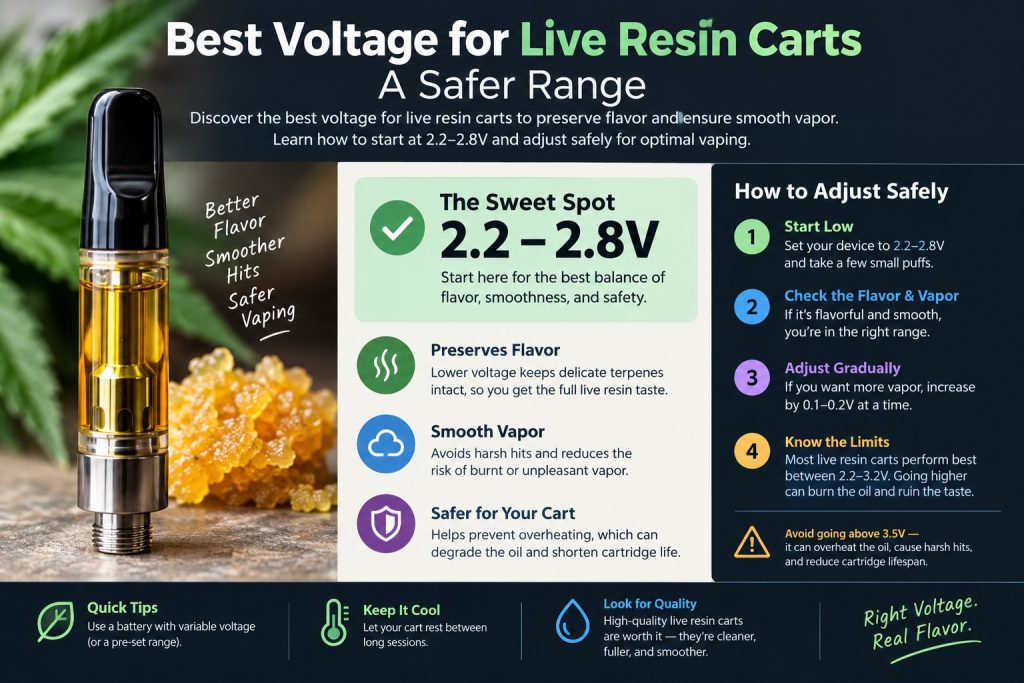
Finding the best voltage for live resin carts isn’t as simple as picking one magic number. Most compatible 510-thread cartridges perform well when you begin around 2.2–2.8 volts, but coil resistance, oil viscosity, hardware design, and puff length all affect the result.
This guide explains how to find a suitable setting without scorching the oil or turning a flavourful cartridge into a tiny cough machine. It covers standard carts used with adjustable batteries, not modified hardware or improvised devices. Always follow the instructions printed on your cartridge and battery, only use regulated products, and check the legal age in your province or territory.
No manufacturer sponsored this guide, and no specific cartridge or battery is being endorsed. The goal is practical harm reduction: start conservatively, make small adjustments, and recognize when poor performance is a hardware problem rather than an invitation to crank up the voltage.
Key Takeaways
- The best voltage for live resin carts typically ranges from 2.2 to 2.8 volts to balance flavour and vapour without overheating.
- Always start at the lowest manufacturer-recommended voltage and make small 0.1–0.2V adjustments to find the ideal setting for your cartridge.
- Voltage affects vapour production and terpene flavour preservation, with higher voltages producing hotter, denser vapour but risking burnt taste and oil waste.
- Coil resistance, oil viscosity, puff length, and cartridge design significantly impact the optimal voltage, so settings may vary even between similar carts.
- Avoid exceeding manufacturer guidelines, stop use if the vapour tastes burnt or the device overheats, and troubleshoot connectivity or airflow issues before increasing voltage.
- Use regulated, compatible batteries, store cartridges properly, and never use open flames or improper heating methods to maintain live resin cart safety and performance.
What Is the Best Voltage for Live Resin Carts? The Quick Answer
For many standard live resin cartridges, 2.2–2.8V is a sensible starting window. Try the lowest supported setting first, often 2.2V or 2.4V, then increase by roughly 0.1–0.2V only if vapour production remains weak.
Some carts are designed for different settings, but. The correct voltage is the lowest manufacturer-approved level that produces consistent vapour and clear flavour without excessive heat, leaking, or burnt notes.
Why 2.2–2.8V Is a Common Starting Range, Not a Universal Rule
Lower voltage generally warms the oil more gently, helping preserve the volatile aromatic compounds that give live resin its distinctive flavour. That makes 2.2–2.8V popular among flavour-focused users.
But voltage alone doesn’t determine heat. A 2.6V setting can behave differently across two cartridges because their coils, airflow, resistance, and oil intake ports differ. Treat the range as a starting map, not a commandment carved into a vape battery.
When Cartridge and Battery Manufacturer Recommendations Take Priority
Use the overlap between the cart maker’s recommended range and the battery’s supported settings. If a cartridge package says 2.5–3.0V, don’t automatically drop to 2.0V or exceed 3.0V based on generic online advice.
Manufacturer instructions matter because the company knows the intended coil and oil formulation. If recommendations conflict, contact the cartridge producer or use a confirmed-compatible battery rather than experimenting.
Why Voltage Matters for Live Resin
Live resin is valued for an aromatic profile derived from cannabis that is frozen soon after harvest. Its flavour can be more heat-sensitive than you might expect. Voltage affects how quickly the heating element warms, how much oil vaporizes, and whether each draw tastes bright or singed.
The aim isn’t maximum cloud size. It’s controlled heating that works with the cartridge.
How Heating Affects Terpene Flavour, Vapour Production, and Harshness
A lower setting commonly produces cooler, lighter vapour with clearer flavour. Increasing voltage can create denser vapour, but it also consumes oil faster and may make a draw hotter or harsher.
Excessive heat can mute delicate flavours and produce a toasted or burnt taste. If your first puff tastes like citrus and the next resembles burnt popcorn, stop. Let the cart cool instead of taking another draw to “check.”
Voltage Is Not Temperature: Understanding Resistance, Power, and Heat
A voltage display doesn’t show the coil’s actual temperature. Electrical power depends partly on resistance and can be approximated with P = V²/R. At 2.8V, for example, a 1.4-ohm coil draws about 5.6 watts: a 1.8-ohm coil draws roughly 4.4 watts.
Airflow, puff duration, oil saturation, and cooling also influence coil temperature. That’s why copying someone else’s voltage may not reproduce their result.
Live Resin Voltage Chart: Lower Settings, Typical Ranges, and Overheating Warnings
Use this chart only when the cartridge manufacturer doesn’t specify a narrower range. Hardware varies, and settings outside the cart’s instructions should be avoided.
| Approximate setting | Likely experience | What to watch for |
|---|---|---|
| 2.0–2.3V | Cool, light vapour: flavour-forward | Vapour may be faint with thick oil |
| 2.4–2.8V | Balanced flavour and output for many carts | Monitor heat during repeated draws |
| 2.9–3.2V | Warmer, denser vapour | Faster oil use, harshness, leaking |
| 3.3V+ | Often unnecessarily hot for live resin | Burnt flavour or coil damage: use only if approved |
Comparing Lower and Higher Settings: Flavour, Vapour, and Trade-Offs
Lower isn’t automatically better. If the coil can’t vaporize oil consistently, you may get weak output or draw too hard, potentially pulling excess oil into the airway. Higher settings produce vapour faster, but they narrow your margin for error.
A good setting feels almost uneventful: steady output, recognizable flavour, and a cartridge that doesn’t become uncomfortably hot. Boring, in this case, is a compliment.
Live Resin vs. Live Rosin vs. Distillate: Why Settings May Differ
Live resin is extracted with solvents and may contain added cannabis-derived terpenes depending on the product. Live rosin is solventless and can have different viscosity or particulate content. Distillate is highly refined and often formulated to tolerate somewhat higher settings.
Those categories don’t guarantee a voltage. Formulation and hardware still control performance, so never assume a setting from a distillate cart belongs on a live rosin or live resin cartridge.
How to Adjust Your Live Resin Cart Voltage
Adjustment should be a slow test, not a race toward the battery’s highest number. Insert the cartridge without overtightening it, keep it upright, and begin with brief, gentle draws. If you’re new to cannabis, remember that vapour output and intoxicating effects aren’t perfectly synchronized: allow time before using more.
Check Compatibility and Start at the Lowest Manufacturer-Recommended Setting
Confirm the battery supports the cartridge’s thread, resistance, and voltage requirements. Popular adjustable models from brands such as Yocan, Vessel, and CCELL offer different controls, but brand recognition doesn’t guarantee compatibility with every cart.
Set the battery to the lowest recommended voltage. Take a short draw, then check flavour, vapour, and device temperature before changing anything.
Make Small Adjustments and Stop if Flavour Turns Burnt or Harsh
If vapour is weak after the cart has reached room temperature, increase the setting by 0.1–0.2V. Test once and reassess. Large jumps make it harder to identify the sweet spot and easier to overheat the coil.
Stop immediately if the flavour becomes burnt, metallic, unusually bitter, or sharply irritating. Lowering the voltage may prevent further damage, but a scorched wick may not recover.
Account for Puff Duration and Cooling Time Between Draws
A five-second draw delivers more energy than a two-second draw at the same voltage. Long pulls and rapid back-to-back hits can hence overheat a cart that performs normally during shorter use.
Follow the maker’s puff limits and give the device time to cool. If the mouthpiece or tank feels unusually hot, put it down. Your cartridge doesn’t need an endurance test.
Factors That Change the Right Voltage for Your Cartridge
Two carts containing similar live resin can behave very differently. The battery setting is only one part of a system that includes coil construction, airflow, oil composition, room temperature, and your draw technique.
This explains why a friend’s perfect 2.7V setting might taste underpowered, or unpleasantly hot, on your hardware.
Coil Resistance, Ceramic Heating Elements, and Cartridge Design
Lower-resistance coils draw more power at a given voltage. Ceramic heating elements may distribute heat evenly, but their size, porosity, and warm-up behaviour vary. Intake-hole placement also controls how quickly oil reaches the heater.
Don’t rely on “ceramic” as proof that a cart can tolerate high voltage. The complete cartridge design matters, including whether its wick remains adequately saturated.
Oil Formulation, Viscosity, and Ambient Temperature
Thicker oil moves more slowly, especially in a cold car or winter climate. A chilled cartridge may produce little vapour even though its normal voltage is appropriate. Warm it gradually to room temperature in your hands or indoors, never with a flame, hair dryer, or dashboard heat.
Very thin oil can flood the airway or leak when overheated. Persistent separation, unusual discolouration, or unexpected consistency deserves caution, not extra voltage.
Choosing and Understanding a Live Resin Cart Battery
A suitable battery offers compatible threading, reliable electrical protection, and enough low-voltage control for the cartridge. Features such as digital displays are useful, but accuracy and build quality matter more than a flashy screen.
Choose products from established sellers, retain the instructions, and use the supplied or manufacturer-approved charging equipment.
Adjustable vs. Fixed Voltage: Compatibility and Low-Voltage Control
An adjustable battery lets you fine-tune output and is usually the more flexible choice for live resin. Models with 0.1V increments provide better control than three-level devices. Fixed-voltage pens are simpler, but some operate too hot for a flavour-sensitive cartridge.
Check the actual output before buying. A battery advertised merely as “510 compatible” may fit physically without offering an appropriate voltage range.
Why Battery Colours and Low, Medium, or High Labels Are Not Standardized
Green doesn’t universally mean low, and red doesn’t always mean high. On one battery, blue might represent 2.8V: on another, it may indicate 3.6V or remaining charge.
Consult that model’s manual rather than trusting colour folklore. If the documentation doesn’t identify the voltage behind each level, ask the manufacturer. Guesswork is a poor control system for a heat-producing device.
Preheat Modes: When Manufacturer Guidance Allows Them and When to Avoid Them
Preheat can help approved cartridges when oil is cool or an airway is mildly restricted. It usually applies low power for several seconds, although implementation varies widely.
Use it only when both devices permit it, and cancel the cycle if the cart becomes hot. Avoid repeated preheats, particularly with a leaking, nearly empty, cracked, or already warm cartridge: prolonged heating can worsen flooding and degrade remaining oil.
Troubleshooting Live Resin Carts Without Automatically Raising Voltage
Weak performance doesn’t always mean insufficient power. A discharged battery, blocked airflow, poor contact, or flooded centre tube can mimic low-voltage behaviour. Raising the setting before diagnosing the cause may turn a small nuisance into burnt oil and a sticky pocket.
Work through simple checks first, and never disassemble a sealed cartridge.
Burnt Taste, Harsh Vapour, or Excessive Heat: Stop and Check the Device
Stop using the cart and let it cool on a stable, nonflammable surface. Confirm that the voltage hasn’t changed accidentally and inspect for cracks, leakage, or a misaligned connection.
If burnt flavour persists at an approved lower setting, the heater or wick may be damaged. Don’t try to rescue it with stronger draws. Contact the retailer or manufacturer about replacement or disposal.
Weak or No Vapour: Check Charge, Connections, and Airflow First
Charge the battery according to its manual, clean external contact points with the device powered off, and make sure the cart isn’t overtightened. Check whether packaging plugs remain in place and whether air inlets are covered by your fingers.
Error lights can indicate a short circuit or unsupported resistance. Look up the exact blink pattern instead of repeatedly firing the device.
Clogging, Leaks, and Spitback: Why More Heat May Make Problems Worse
A clog often consists of condensed oil in the centre airway. Gentle, unpowered draws may clear a minor blockage if the manufacturer recommends that method. Never insert metal objects into the cartridge.
Additional heat can thin the oil, flood the coil, and increase leaking or hot droplets. If problems recur, keep the cart upright and seek a replacement rather than continually reheating it.
Safe Handling, Storage, and Signs a Cartridge Should Not Be Used
Vape products aren’t risk-free. Health Canada’s vaping risks page notes that heavy metals can leach into cannabis vaping concentrates and that higher power and temperature settings can produce more harmful chemicals, while its vaping advisory tells consumers to avoid products from illegal or unregulated sources and not to modify vaping products. Buy regulated products, verify packaging, and keep cannabis away from children and pets.
Store Upright Away From Heat and Avoid Improvised Heating Methods
Store the cartridge upright at moderate room temperature, out of direct sunlight. Don’t leave it in a hot vehicle or freeze it. Remove it from the battery for longer storage if the manufacturer instructs you to do so.
Never use an open flame, oven, microwave, boiling water, or household heater to loosen oil. Those shortcuts can damage seals, batteries, and your afternoon.
Stop Using Damaged, Leaking, or Persistently Overheating Hardware
Retire a cartridge if its glass is cracked, electrical contact is damaged, oil leaks continuously, or the device heats while idle. Swelling, hissing, unusual odours, or a deformed battery require immediate disconnection when safe.
Place malfunctioning hardware away from combustible materials and follow your province’s or municipality’s battery and e-waste rules. Don’t throw a lithium-ion battery into household trash or attempt a DIY repair.
Frequently Asked Questions About Live Resin Cart Voltage
Voltage questions usually come down to three issues: whether a setting is too hot, whether larger clouds mean stronger effects, and whether a disposable device can be adjusted. Here are the concise answers.
Is 3.3V Too High for a Live Resin Cart?
It can be. 3.3V is above the preferred range for many live resin carts, increasing the chance of harsh vapour, muted flavour, and rapid oil consumption. Yet some manufacturers explicitly support it.
Use 3.3V only when the cartridge instructions allow it and lower settings don’t perform adequately. Stop if the flavour changes sharply or the hardware becomes unusually hot.
Does Higher Voltage Increase THC Potency or Just Change Vapour Output?
Higher voltage doesn’t increase the THC concentration inside the oil. It may vaporize more material per second, producing a larger dose in one draw, but it can also waste oil or degrade flavour through overheating.
Don’t use cloud size as a dosing instrument. Product potency, inhaled amount, and individual response all matter. Start low, wait, and avoid driving or operating machinery after cannabis use.
Can You Change the Voltage on a Disposable Live Resin Vape?
Usually not. Most disposables have fixed or automatically controlled output, although a few include multiple power levels. Only use controls documented on the package or manufacturer’s website. Don’t open, modify, or connect a disposable to an external battery.
Eventually, the best voltage for live resin carts is the lowest manufacturer-approved setting that provides clean flavour and consistent vapour, commonly around 2.2–2.8V. Make tiny adjustments, allow cooling time, and troubleshoot connections or airflow before adding heat. If a cart leaks, tastes burnt, or repeatedly overheats, stop using it rather than trying to overpower the problem.