
Nov
Cannabis can make one person feel pleasantly relaxed while leaving another glued to the couch, checking their pulse and wondering whether time has stopped. The difference often comes down to THC dose, product potency, how it was consumed, personal tolerance, and what else is in the body.
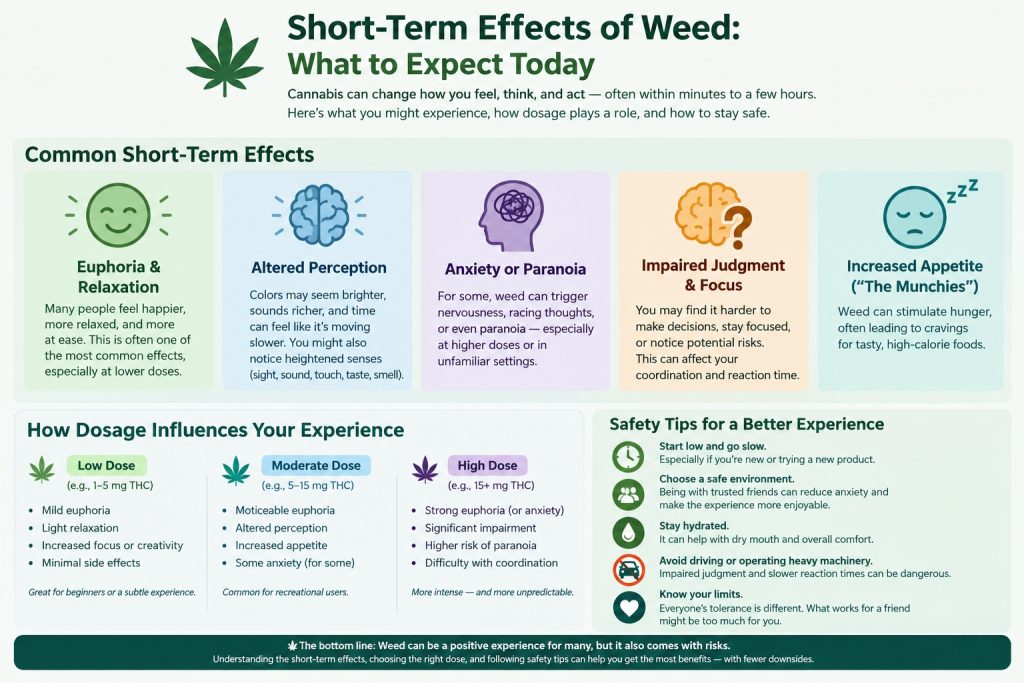
The short-term effects of weed can include euphoria, altered sensory perception, hunger, dry mouth, and sleepiness. They can also include impaired judgment, anxiety, vomiting, dizziness, or, in uncommon but serious cases, psychotic symptoms and cardiovascular complications. “Natural” doesn’t mean predictable, especially when today’s flower, vape cartridges, and concentrates may contain much more THC than older cannabis products.
This evidence-based review explains what you may experience during and immediately after cannabis use, how long the effects generally last, and which warning signs deserve medical attention. It covers inhaled and edible THC, but it isn’t a product endorsement or a substitute for individualized medical advice. Effects vary considerably, and research remains limited by inconsistent products, self-reported use, and legal barriers to controlled studies.
One practical point matters from the start: the amount of THC, not the number of gummies, puffs, or drops, is the more useful measurement. One gummy might contain 2.5 milligrams of THC: another could contain 50. A casual “I only ate one” hence tells you surprisingly little.
If you’re currently feeling too high, skip ahead to the safety section. Move somewhere quiet, stop consuming cannabis, and stay with a trusted sober person. Call 911 for chest pain, severe breathing difficulty, a seizure, collapse, or unresponsiveness. When in doubt, it’s better to ask for help than to spend an hour negotiating with the ceiling fan.
Key Takeaways
- The short-term effects of weed vary widely, including euphoria, altered senses, increased appetite, impaired judgment, and anxiety, all strongly influenced by THC dose and consumption method.
- Inhaled cannabis acts quickly within minutes with effects lasting 2–4 hours, while edibles take longer to onset but can affect the user for up to 12 hours or more.
- Higher THC doses and concentrates increase the risk of unpleasant or serious effects like confusion, panic, psychosis, and cardiovascular symptoms, especially in sensitive individuals or beginners.
- Mixing weed with alcohol or certain medications can amplify impairment and health risks, making it essential to inform healthcare providers about cannabis use.
- If feeling too high, stop use immediately, move to a quiet safe space, stay hydrated, and never drive; seek emergency help for chest pain, severe breathing issues, seizures, or unresponsiveness.
- Store cannabis products securely away from children and pets to prevent accidental ingestion, which can cause severe symptoms requiring urgent medical care.
Common short-term effects of weed on the mind and body
The short-term effects of weed usually reflect THC’s activity at cannabinoid receptors involved in memory, movement, appetite, mood, and sensory processing. CBD can influence the experience, but it doesn’t reliably cancel THC intoxication.
Experiences range from subtle calm to substantial impairment. A person may laugh more, notice music differently, forget the beginning of a sentence, and raid the snack cupboard, all during the same session. Product labels and strain names such as “indica” or “sativa” can’t reliably predict your response.
Mental effects: Euphoria, relaxation, altered senses, and changes in time perception
THC may produce euphoria, calm, sociability, or a dreamy feeling. Colours can appear brighter, sounds may feel more layered, and ordinary food can taste unusually intense. Time perception often changes: ten minutes may feel like forty, which helps explain the classic “How long has this song been playing?” moment.
You may also become more inwardly focused or easily distracted. Thoughts can seem profound while intoxicated but less impressive the next morning, an ancient cannabis tradition, apparently. Higher doses are more likely to cause confusion, anxiety, or disorganized thinking than gentle relaxation.
Your surroundings matter. Familiar company and a comfortable setting may reduce distress, while conflict, crowds, unfamiliar products, or an already anxious mood may make the experience less pleasant. These influences are often called “set and setting,” although dose remains critically important.
Physical effects: Red eyes, dry mouth, increased appetite, and drowsiness
Common physical changes include red or bloodshot eyes, dry mouth, increased appetite, slowed movement, and drowsiness. THC can dilate small blood vessels in the eyes, creating redness: this doesn’t necessarily indicate a dangerously high dose. Reduced saliva production produces the cotton-mouth feeling.
Some people notice heavy limbs, mild dizziness, coughing, or a faster heartbeat. Smoke and hot vapour can irritate the throat and lungs, even when no tobacco is involved. Appetite may increase, though not everyone gets “the munchies.”
The practical fixes are modest: sip water, choose simple food, sit down if dizzy, and avoid tasks requiring coordination. Don’t keep consuming THC merely because you haven’t achieved the effect you expected. Cannabis can intensify unexpectedly, particularly after an edible or several rapid vape inhalations.
How quickly do weed’s effects start, and how long do they last?
Timing depends heavily on the route of administration. Inhaled THC reaches the bloodstream quickly, whereas swallowed THC must pass through the digestive system and liver. The clock also varies with dose, meal timing, metabolism, tolerance, and product formulation.
| Method | Typical onset | Strongest effects | Approximate noticeable duration |
|---|---|---|---|
| Smoking or vaping | Seconds to 10 minutes | 15–30 minutes | 2–4 hours, sometimes longer |
| Dabbing concentrates | Almost immediate | Within minutes | Several hours |
| Edibles or capsules | 30 minutes–2 hours | 2–4 hours | 6–12 hours, occasionally longer |
| Cannabis drinks | 10 minutes–2 hours | Product-dependent | Often 4–8 hours |
These are broad ranges, not countdown timers for driving or work.
Smoking, vaping, and dabbing: Rapid onset and variable duration
Smoking and vaping generally produce effects within minutes. That rapid feedback makes dose adjustment somewhat easier, but taking several inhalations in quick succession can still overshoot the desired effect. Potency, inhalation depth, and device temperature make “one puff” a poor standardized dose.
Dabs, concentrated cannabis extracts such as wax, shatter, or rosin, can deliver a large amount of THC almost immediately. Someone accustomed to 15% THC flower may be caught off guard by a concentrate labelled 70% or more. Anxiety, vomiting, loss of coordination, and severe confusion become more plausible as exposure rises.
Although the obvious high may fade after a few hours, reaction time and judgment can remain affected. Avoid stacking products because the first inhalation felt mild after thirty seconds.
Edibles and drinks: Delayed onset, longer effects, and redosing risks
Edibles are responsible for many miserable “I think I broke time” evenings because their effects arrive late. After swallowing THC, the liver converts some of it into 11-hydroxy-THC, an active metabolite that can create strong, sustained intoxication.
Imagine eating a 10-milligram gummy at 7 p.m., feeling little at 7:45, and taking two more. The original dose may only be getting started. By 10 p.m., all three doses can be active together.
For harm reduction, inexperienced adults should avoid high-dose products and wait at least several hours before considering more: official recommendations vary, and even 2.5 milligrams may strongly affect a sensitive person. Cannabis drinks marketed as “fast acting” can begin sooner, but formulation and individual digestion still make timing uncertain. Keep every edible in its original, child-resistant packaging, not beside ordinary candy.
Next-day effects: Lingering grogginess versus detectable THC
After a large or late dose, you may wake with fatigue, mental fog, headache, dry mouth, or reduced concentration. Edibles are frequent culprits because their active effects can extend through the night. Poor sleep, dehydration, alcohol, and unfamiliar potency can worsen the morning-after experience.
Feeling normal and having no detectable THC are different things. THC metabolites can remain detectable in urine for days or weeks, particularly with frequent use, long after intoxication ends. Blood, saliva, urine, and hair tests also measure different compounds across different windows: a positive result doesn’t always establish current impairment.
Conversely, feeling “mostly fine” doesn’t prove that reaction time has fully recovered. If you’re foggy, dizzy, or slow, don’t drive, operate machinery, supervise water activities, or perform safety-sensitive work.
What determines how strongly weed affects you?
Cannabis response isn’t a fixed personality trait. The same product can affect you differently depending on sleep, food, stress, recent use, and whether alcohol or medication is present. Labels help, but they don’t eliminate uncertainty.
THC potency, CBD content, and high-potency concentrates
THC is the principal intoxicating cannabinoid. As THC concentration and total dose rise, impairment and unpleasant reactions generally become more likely. High-potency flower, vape oils, and concentrates make it easier to consume substantial THC before recognizing the full effect.
CBD isn’t typically intoxicating, and some research suggests it may modify particular THC effects. But commercial ratios, doses, and study findings vary. CBD should not be treated as an emergency antidote for excessive THC.
Check the label for milligrams of THC per serving and per package. With flower, percentage indicates concentration rather than the exact inhaled dose. Products from regulated markets are generally more informative than untested products, although labelling can still be imperfect. Synthetic cannabinoids sold as K2 or Spice are different, less predictable drugs and may cause life-threatening toxicity.
Dose, tolerance, consumption method, and individual sensitivity
Dose is the biggest adjustable factor, but tolerance and biology influence its impact. Frequent users may feel less intoxicated from a dose that overwhelms a beginner. That tolerance doesn’t necessarily remove all impairment, and it can encourage escalating consumption.
Body size alone can’t reliably predict a suitable dose. Genetics, metabolism, cannabinoid sensitivity, age, previous experience, and anxiety susceptibility all matter. An empty stomach may also alter an edible experience, while a fatty meal can affect THC absorption.
A practical beginner mindset is low and slow, not “keep up with the room.” Don’t let an experienced friend choose your dose by comparing it with theirs. If you’re using prescribed cannabinoid medicine, follow the prescriber’s instructions rather than recreational dosing advice from social media or package folklore.
Mixing weed with alcohol, medications, or other drugs
Alcohol and cannabis can amplify dizziness, nausea, poor judgment, and coordination problems. Using alcohol first may increase THC absorption in some circumstances, making a familiar amount of cannabis feel unexpectedly intense. The combination is especially dangerous before driving.
Cannabis may also interact with sedatives, sleep aids, opioids, antihistamines, antiseizure drugs, anticoagulants, and other medicines. Evidence for specific interactions is uneven, but additive drowsiness and impairment are practical concerns. CBD can affect liver enzymes that process certain prescriptions, so non-intoxicating doesn’t mean interaction-free.
Tell your clinician or pharmacist what you use, including gummies, oils, and “wellness” CBD products. Seek tailored advice if you take warfarin, seizure medication, sedatives, or drugs with narrow therapeutic ranges. Never stop a prescription abruptly because you read about a possible interaction online.
Unwanted and potentially serious short-term effects
Most uncomplicated cannabis intoxication improves with time and supportive care. Still, not every symptom should be dismissed as “just being high.” Product contamination, synthetic cannabinoids, co-ingestion, underlying illness, and accidental excessive dosing can produce a more dangerous picture.
Impaired memory, attention, judgment, coordination, and reaction time
THC can interfere with short-term memory, divided attention, decision-making, balance, and reaction time. You may lose track of instructions, underestimate risk, or respond too slowly to a sudden hazard. This matters around vehicles, ladders, cooking flames, firearms, pools, and power tools.
A deceptively common problem is confidence: you may feel capable while your actual performance has declined. Save important texts, financial decisions, childcare handoffs, and ambitious kitchen experiments for later. Nobody needs a midnight deep-fryer saga.
If you must care for a child, older adult, or anyone medically vulnerable, arrange for a sober caregiver before using cannabis. Lock products away immediately after use: impairment makes people more likely to leave packages on counters or confuse an edible with regular food.
Anxiety, panic, paranoia, and possible psychotic symptoms
THC can trigger racing thoughts, panic, suspiciousness, or a sense that something terrible is about to happen. These reactions are more common with high doses, unfamiliar settings, first-time use, and a history of anxiety. Remind yourself that the feeling is drug-related and usually temporary, then reduce noise and stimulation.
More severe symptoms can include hallucinations, delusions, extreme agitation, or losing touch with reality. Cannabis-associated psychotic symptoms may resolve as intoxication fades, but they still warrant prompt professional assessment, especially if the person is unsafe, cannot be reassured, or symptoms persist.
Don’t physically crowd or argue with someone who is paranoid. Use simple sentences, keep exits clear, remove weapons, and seek emergency help if there is aggression, suicidal behaviour, profound confusion, or danger to anyone nearby.
Faster heart rate, blood pressure changes, dizziness, and fainting
Cannabis commonly increases heart rate shortly after use and may cause blood pressure changes, lightheadedness, or fainting, particularly when standing quickly. Sit or lie down if you feel dizzy, and rise slowly once the sensation passes. A sober companion can help prevent a fall.
Heart pounding during anxiety can feel terrifying without necessarily indicating a heart attack. But, you shouldn’t diagnose chest symptoms yourself. Call 911 for chest pain or pressure, severe shortness of breath, collapse, new weakness, or an irregular heartbeat accompanied by significant symptoms.
Risk may be more concerning for people with cardiovascular disease or those combining cannabis with stimulants. Heart & Stroke’s guidance on cannabis describes potential effects on heart disease and stroke risk while noting that more research is needed.
Nausea and vomiting: When recurrent symptoms may indicate cannabinoid hyperemesis syndrome
A large THC dose can cause nausea or vomiting. Repeated, severe episodes in a long-term, frequent cannabis user may indicate cannabinoid hyperemesis syndrome (CHS). Typical clues include cyclical vomiting, abdominal pain, and temporary relief from very hot showers or baths.
CHS can lead to dehydration, electrolyte abnormalities, kidney injury, and repeated emergency visits. Hot water may briefly ease symptoms, but it doesn’t treat the underlying problem and can contribute to dehydration or burns. Sustained cannabis cessation is the key preventive treatment once CHS is diagnosed.
Seek urgent care if vomiting is relentless, you can’t keep fluids down, there is blood in vomit, abdominal pain is severe, or signs of dehydration develop. Other illnesses can mimic CHS, so don’t assume cannabis is the only possible cause.
Who needs extra caution with cannabis?
Anyone can experience adverse short-term effects, but several groups face higher stakes or greater uncertainty. Legal availability doesn’t make cannabis appropriate for every age, health condition, or life stage.
Teens, young adults, and people using weed for the first time
Adolescents and young adults have developing brains and may be more vulnerable to cannabis-related problems, particularly with frequent or high-potency use. Short-term impairment can also intersect with inexperienced driving, school demands, sports, and social pressure.
First-time users lack a personal reference point for dose and response. A beginner can’t assume that half of an experienced friend’s dose will feel half as strong. If an adult of legal age in their province or territory (19 in most, 18 in Alberta, 21 in Quebec) chooses to use cannabis, avoiding concentrates, mixing substances, and rapid redosing reduces preventable risk.
Parents should store cannabis locked, out of sight, and separate from food. A lecture delivered during an emergency won’t help: calm disclosure about what was taken, when, and how much gives clinicians more useful information.
People who are pregnant or breastfeeding
Major medical organizations advise avoiding cannabis during pregnancy and breastfeeding. THC crosses the placenta and can pass into breast milk. Products marketed as natural remedies for nausea haven’t been established as safe substitutes for pregnancy treatments.
Smoking also exposes the lungs, and potentially others nearby, to combustion products. Vaping, edibles, or CBD products don’t solve the broader uncertainty about fetal or infant exposure. CBD products may contain THC or contaminants despite label claims.
If you use cannabis for nausea, pain, sleep, or another symptom, talk candidly with an obstetric clinician. The goal should be practical care, not judgment. The Society of Obstetricians and Gynaecologists of Canada (SOGC) advises that the only safe amount of cannabis during pregnancy is zero and that the safest option is not to use cannabis while breastfeeding, because THC may be passed to the baby through breast milk.
People with heart conditions or a personal or family history of psychosis
If you have coronary disease, arrhythmias, fainting episodes, poorly controlled blood pressure, or prior stroke, discuss cannabis with a clinician before using it. THC-related changes in heart rate and blood pressure may carry more consequence when cardiovascular reserve is limited.
Extra caution is also appropriate if you have experienced psychosis, schizophrenia, mania, or severe paranoia, or have a strong family history of psychotic illness. High-THC products may precipitate acute symptoms in susceptible people, and frequent use is associated with greater psychosis risk, though individual causation is complex.
Choose disclosure over guesswork. A clinician needs the product type, THC/CBD content, frequency, dose, and reason for use, not merely “sometimes.” That detail helps distinguish occasional low-dose exposure from daily concentrate use.
What to do if you feel too high or unwell
Most people who consume too much THC need time, reassurance, a low-stimulation environment, and protection from injury. The objective isn’t to force sobriety instantly, there’s no reliable home method for that, but to stay safe while monitoring for warning signs.
Stop using, move somewhere safe, and stay with a trusted sober person
Stop consuming cannabis, alcohol, and other non-prescribed substances. Move away from traffic, water, balconies, stoves, and crowds. Sit or lie somewhere quiet with a trusted sober person who can monitor you and explain what’s happening without teasing or escalating anxiety.
Try slow breathing: inhale gently for four seconds and exhale for six. Sip water rather than gulping it, and eat a light snack only if you’re alert and not vomiting. Keep the package so you can identify the product and THC amount.
Don’t drive yourself home. If symptoms are concerning but not clearly emergent, call your local poison centre at 1-844-POISON-X (1-844-764-7669) (in Quebec, 1-800-463-5060) for free guidance, 24 hours a day. Be honest about other drugs or medications involved.
When chest pain, trouble breathing, seizures, or unresponsiveness require emergency help
Call 911 or your local emergency number for:
- Chest pain, severe breathing difficulty, or blue/grey lips
- A seizure, collapse, or inability to wake the person
- Extreme agitation, violent behaviour, or immediate self-harm risk
- Sudden weakness, facial drooping, or speech difficulty
- Repeated vomiting with severe dehydration
- Suspected synthetic cannabinoid exposure or unknown substances
Place an unresponsive but breathing person on their side and monitor breathing. Don’t put food, water, or coffee in their mouth. If they aren’t breathing normally, begin CPR if you know how and follow the dispatcher’s instructions.
In Canada, the Good Samaritan Drug Overdose Act protects people who call 911 during an overdose, and others at the scene, from simple drug possession charges, and fear of embarrassment shouldn’t delay lifesaving care. Tell responders exactly what was consumed: they’re treating a patient, not grading anyone’s weekend decisions.
What to do after accidental cannabis ingestion by a child or pet
A child who consumes THC may become extremely sleepy, unsteady, confused, agitated, or have slowed breathing. Call your poison centre immediately at 1-844-POISON-X (in Quebec, 1-800-463-5060), even if symptoms haven’t appeared. Call 911 if the child is difficult to wake, has trouble breathing, experiences a seizure, or collapses. Don’t induce vomiting.
For a pet, contact a veterinarian or animal poison service promptly. Dogs may develop wobbliness, urinary dribbling, unusual sensitivity, vomiting, or profound lethargy. Chocolate-containing edibles create an additional toxic exposure, while sugar-free products may contain xylitol, which is highly dangerous to dogs.
Bring the package and estimate the missing amount. Store cannabis as you would medication: locked, elevated, clearly labelled, and inaccessible, not merely “hidden” in a backpack that a curious child or Labrador can open.
Weed and driving: Why feeling less high does not guarantee safe driving
Cannabis can impair lane tracking, attention, reaction time, distance judgment, and responses to unexpected events. Driving requires these abilities simultaneously: it isn’t a quiet-room test where you get extra time because the edible was stronger than expected.
You also can’t reliably judge your own impairment. The intense high may fade before all driving-related skills return, particularly after high-dose edibles, concentrates, sleep loss, or combined alcohol use. There is no universal waiting period that guarantees safety for every dose and person.
| Situation | Safer decision |
|---|---|
| You currently feel high | Don’t drive |
| You feel groggy or unfocused the next morning | Delay driving and arrange another ride |
| You combined THC with alcohol or sedatives | Don’t drive: impairment may be amplified |
| You used an unfamiliar edible | Plan transportation before consuming it |
Use a sober driver, taxi, rideshare, or public transit. Stay overnight when appropriate. Never ride with a driver who has used cannabis simply because they insist they “drive better high.” Confidence isn’t a field sobriety test.
In Canada, the Criminal Code makes it an offence to have 2 ng or more of THC per mL of blood within two hours of driving, police can use roadside oral fluid screeners, and a medical authorization for cannabis doesn’t exempt you from impaired-driving laws. Drug-impaired driving is dangerous and illegal across Canada. The cleanest plan is wonderfully boring: keys put away before the package opens.
Short-term versus long-term effects: What is the difference?
Short-term effects occur during intoxication or in the hours afterward: altered perception, euphoria, anxiety, red eyes, dry mouth, increased heart rate, impaired coordination, and delayed reactions. Next-day fogginess may follow a larger dose even after the obvious high has ended.
Long-term effects concern patterns that emerge or persist with repeated use over months or years. These may include cannabis use disorder, tolerance, withdrawal symptoms, respiratory problems associated with smoking, and possible effects on learning or mental health. Risk depends on age at initiation, frequency, potency, genetics, health, and other substance use.
| Short-term question | Long-term question |
|---|---|
| What happens after today’s dose? | What changes with repeated exposure? |
| Am I currently impaired? | Have use, tolerance, or cravings increased? |
| Do I need immediate medical help? | Should I discuss my pattern with a clinician? |
The categories overlap. Frequent high-dose use can create acute intoxication today while also contributing to tolerance or dependence over time. Withdrawal after regular use, irritability, sleep trouble, reduced appetite, restlessness, or low mood, is not an immediate effect of a single dose.
If cannabis is interfering with work, relationships, finances, sleep, or your ability to cut down, that deserves support rather than a moral label. A primary-care clinician or Drug Rehab Services at 1-877-254-3348, listed on Health Canada’s Get help with substance use page, can help you explore confidential treatment options.
Frequently asked questions
These answers address two questions that commonly arise during uncomfortable intoxication. They apply to ordinary cannabis exposure, not synthetic cannabinoids or unexplained medical emergencies.
Can you overdose on weed?
You can consume enough cannabis to cause severe intoxication, sometimes called an overdose, even though a fatal overdose from THC alone appears far less likely than with opioids. Severe reactions may involve panic, psychotic symptoms, repeated vomiting, dangerous behaviour, injury, extreme sedation, or cardiovascular complications.
Children are especially vulnerable because a seemingly small edible may represent a large dose for their body. Products may also contain contaminants or other drugs, and combining substances changes the risk.
Don’t use “weed can’t kill you” as shorthand for “nothing bad can happen.” Call 911 for unresponsiveness, seizures, chest pain, major breathing difficulty, or immediate danger. For non-emergency dosing mistakes, a poison centre (1-844-POISON-X, or 1-800-463-5060 in Quebec) can provide case-specific guidance.
Can coffee, food, a shower, or CBD sober you up faster?
No home remedy has been shown to rapidly reverse THC intoxication. Coffee may make you feel more awake, but caffeine can worsen a racing heart or anxiety without restoring judgment and coordination. Food may help if you’re hungry, yet it doesn’t reliably neutralize THC after absorption.
A lukewarm shower may feel calming, but avoid showering alone if you’re dizzy or unsteady. Cold showers add stress and fall risk. CBD is sometimes promoted as a THC counterweight, but evidence doesn’t support treating it as a predictable rescue medication: taking another cannabinoid product can complicate the situation.
Time is the main remedy. Stop using, rest safely, reduce stimulation, and stay with a sober person. If symptoms seem severe or different from ordinary intoxication, seek professional help rather than trying a viral “sobering” hack.
Medical references and evidence limitations
Cannabis research has real limitations. Products used in older studies may contain less THC than many current concentrates. Observational research can identify associations but may struggle to separate cannabis effects from tobacco, alcohol, socioeconomic factors, underlying illness, or reasons for use. Meanwhile, laboratory studies often use controlled doses that don’t perfectly resemble real-world vaping, sharing, or homemade edibles.
Individual variability adds another problem: “one joint” and “one gummy” aren’t standardized exposures. Self-reported frequency may be inaccurate, product labels may be imperfect, and randomized trials can’t ethically test every high-risk scenario. Evidence is hence stronger for some immediate effects, such as impaired reaction time and increased heart rate, than for precise predictions about one person’s experience.
Useful medical and public-health references include:
- Health Canada information on the health effects of cannabis
- Health Canada information for health care professionals on cannabis and cannabinoids
- National Academies review of cannabis evidence
- Canada’s Lower-Risk Cannabis Use Guidelines
- Health Canada guidance on cannabis poisonings in children
This review is for education only. No brand, testing laboratory, or treatment centre paid to be mentioned. Brand-specific products aren’t recommended because formulations change and availability differs by province.
The practical conclusion is straightforward: the short-term effects of weed are dose-dependent, highly individual, and not always harmless. If you choose to use cannabis legally, check THC content, avoid mixing substances, don’t redose impatiently, secure every product, and plan a sober ride before consuming anything.
Most uncomfortable reactions pass with time and calm supervision. But chest pain, breathing difficulty, seizures, unresponsiveness, severe agitation, or accidental ingestion by a child require prompt action. Knowing that line between “unpleasant” and “urgent” is more useful than any strain name, and it may keep an awkward evening from becoming a genuine emergency.