
Blog 2026
Cannabis Terpenes Explained: Why Two Sativas Can Feel Totally Different
Oct
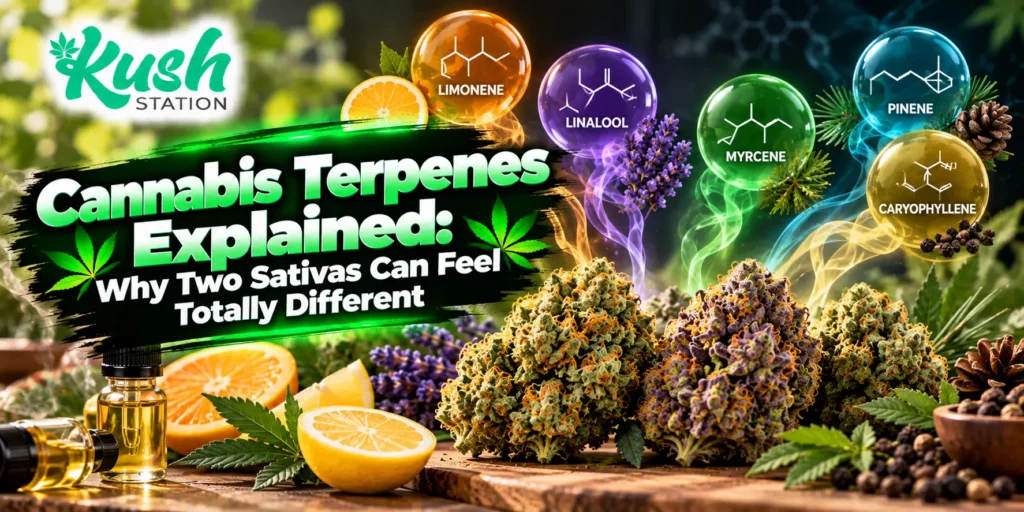
You order two sativas online. Both are labelled “sativa.” Both list THC at around 22%. One tastes like fresh lemon peel and feels bright and chatty. The other smells like pine forest and leaves you quietly focused. Same label, same potency, noticeably different experience.
So what is going on? A big part of the answer is terpenes.
This guide explains what cannabis terpenes are, what the main ones smell and taste like, what the research Dispensary does and does not say about how they affect you, and how to use terpene information to choose products you will enjoy. We also cover how growing, curing, and storage change terpene content, and how to find terpene details when you shop online.
Whether you are new to cannabis or have been buying for years, understanding terpenes is one of the most useful skills you can pick up.
What Are Terpenes?
Terpenes are aromatic compounds produced by plants. They are the reason lavender smells floral, citrus peel smells sharp and bright, and pine needles smell like a forest. You encounter them every day in herbs, fruit, flowers, and trees.
Cannabis produces terpenes too, mostly in the same sticky resin glands (trichomes) that make THC and CBD. More than 100 different terpenes have been identified in cannabis, though a typical strain is dominated by a handful of them.
Plants make terpenes for practical reasons. They deter insects and animals that might eat them, attract pollinators, and help protect against environmental stress. For consumers, terpenes matter for two reasons:
They create the aroma and flavour of a strain. This is the most obvious and well-established role.
They may influence the overall experience. This is a more complicated topic, and we will be honest about what is Weed concentrates proven and what is still being studied.
Terpenes, cannabinoids, and flavonoids
It helps to know where terpenes fit among the other compounds in the plant.
| Compound Group | Examples | Main Role |
| Cannabinoids | THC, CBD, CBG, CBN | Interact with the body’s endocannabinoid system; THC causes the “high” |
| Terpenes | Myrcene, limonene, pinene | Aroma, flavour, and possible influence on the experience |
| Flavonoids | Cannflavins | Pigment and some flavour; less studied |
Terpenes are not cannabinoids and do not cause a high on their own. But they travel with cannabinoids in the plant, and researchers continue to study how they interact.
Why Two Sativas Can Feel Totally Different
Here is the core idea: “sativa” is a loose label, not a precise description of what is in the product.
The label is a rough guide
Indica and sativa started as botanical terms describing plant shape and origin. Over decades of breeding, almost every modern strain became a blend of both. Retailers still use “indica,” “sativa,” and “hybrid” to give shoppers a quick idea of what to expect, and that shorthand can be a helpful starting point. But it says very little about the actual chemistry in the jar.
Genetic and chemical research has found that the indica and sativa labels do not reliably predict a strain’s chemical makeup. Two products carrying the same label can have very different cannabinoid and terpene profiles, and products with different labels can end up chemically similar.
Several things differ between two “sativas”
When two sativa-labelled products feel different, any of these can be the reason:
Different dominant terpenes. One may be rich in limonene and another in pinene or terpinolene.
Different terpene amounts. Total terpene content commonly falls somewhere around 1% to 3% of dry weight and can be higher or lower. A product with 3.5% terpenes will smell and taste far more vivid than one at 0.8%.
Different THC and CBD levels or ratios. Even small amounts of CBD or minor cannabinoids can change how a strain feels.
Different freshness. Terpenes are volatile and fade with heat, light, and time. A fresh jar and a stale jar of the same strain can feel quite different.
Different you. Your tolerance, mood, sleep, food intake, and expectations all affect the experience.
Terpenes are only one variable, but they are one you can actually see and smell on a product page and in the jar.
A simple example
Picture two sativa-dominant strains, each at 22% THC:
| Strain A | Strain B | |
| Label | Sativa | Sativa |
| THC | 22% | 22% |
| Dominant terpene | Limonene | Pinene |
| Smell and flavour | Lemon, orange peel | Pine, fresh herbs |
| Often described as | Bright, upbeat | Clear-headed, crisp |
These descriptions come from user reports and general reputation rather than guarantees, but the example shows why looking beyond the label pays off.
The Main Cannabis Terpenes
Here is a quick reference table, followed by a closer look at each of the most common terpenes.
| Terpene | Aroma and Flavour | Also Found In | Commonly Associated With* |
| Myrcene | Earthy, musky, ripe fruit | Mango, hops, thyme | Relaxed, calm profiles |
| Limonene | Citrus, lemon, orange | Citrus peel | Bright, uplifting profiles |
| Beta-caryophyllene | Peppery, spicy, woody | Black pepper, cloves | Warm, spicy profiles |
| Alpha-pinene | Pine, fresh, resinous | Pine needles, rosemary | Crisp, clear profiles |
| Linalool | Floral, lavender | Lavender, coriander | Soft, soothing profiles |
| Terpinolene | Fresh, herbal, floral, piney | Lilac, apples, nutmeg | Light, energetic profiles |
| Humulene | Woody, earthy, hoppy | Hops, sage, ginger | Earthy profiles |
| Ocimene | Sweet, herbal, tropical | Basil, mint, orchids | Fresh, sweet profiles |
| Bisabolol | Delicate, floral, honey | Chamomile | Gentle, calm profiles |
*These associations come from traditional use, anecdotal reports, and early research. They are not medical claims, and experiences vary.
Myrcene
Myrcene is one of the most abundant terpenes in many modern cannabis strains. It smells earthy and musky, a bit like ripe mango, hops, or fresh thyme. Many strains described as “indica-leaning” or relaxing are rich in myrcene.
You may have heard that mangoes eaten before cannabis “boost” the high. That is a popular story, but there is little solid evidence behind it, so treat it as folklore. Likewise, the idea that myrcene alone causes “couch-lock” is common but not well established. Researchers are still sorting out how much any single terpene contributes.
Limonene
Limonene is the bright citrus terpene, the same compound that gives lemon and orange peel their zing. Strains high in limonene often smell like lemon candy, orange zest, or fresh-squeezed citrus. They are popular for daytime use because many people find the aroma and the overall experience uplifting.
Beta-caryophyllene
Beta-caryophyllene (often shortened to BCP) is the peppery, spicy terpene you also find in black pepper, cloves, and cinnamon. It is notable for a scientific reason: lab studies show it can bind to CB2 receptors, which are part of the body’s endocannabinoid system. That makes it unusual among terpenes, and it is one reason researchers find it interesting. Studies are still early, and nothing here means you should expect any specific effect from a product.
Alpha-pinene
Pinene smells like a walk through a pine forest. It is also found in rosemary, basil, and dill. Pinene-forward strains tend to smell fresh and sharp, with a resinous quality. Some people describe their experience with these strains as clear and focused, though again this is anecdotal.
Linalool
Linalool is the floral, lavender-like terpene. It gives many purple-hued and dessert-style strains their soft, sweet, almost perfumed aroma. It is widely used in cosmetics and aromatherapy products, and cannabis fans often associate it with calm, evening-friendly profiles.
Terpinolene
Terpinolene is less common as a dominant terpene, which makes strains that feature it stand out. It smells fresh, herbal, floral, and slightly piney, with a hint of citrus. Classic sativa-leaning strains such as Jack Herer and Durban Poison are well known for their terpinolene-forward profiles, which helps explain why they smell so different from a myrcene-heavy strain, even when both are called sativa.
Humulene
Humulene is a woody, earthy, slightly hoppy terpene, the same compound that gives beer hops part of their character. It often shows up alongside beta-caryophyllene and adds depth to a strain’s aroma.
Ocimene
Ocimene smells sweet, herbal, and slightly tropical, a bit like basil, mint, or orchids. It is often present in smaller quantities, but it contributes to the fresh, fruity top notes in certain strains.
Bisabolol
Bisabolol is a delicate, floral, honey-like terpene also found in chamomile. It tends to appear in smaller quantities, and it is often noted for its gentle aroma.
The Entourage Effect: What We Know and What We Don’t
You will see the term “entourage effect” on many cannabis websites. It refers to the idea that cannabinoids, terpenes, and other plant compounds work together, producing effects that differ from any single compound alone. In theory, that could help explain why a whole-plant product feels different from an isolated one.
Here is an honest summary:
What seems reasonable: Cannabis contains many active compounds, and it is plausible that they interact. Many experienced consumers report that full-spectrum products feel different from isolate-based ones.
What is not settled: Controlled human research on terpenes in cannabis is limited. Studies on specific terpenes often use isolated compounds, animals, or cell cultures, at concentrations that do not match what you inhale or eat from a typical product. Scientists disagree about how strong the entourage effect really is.
Our takeaway: Treat terpene guides as a useful starting point for choosing aroma and flavour, and as one possible influence on your experience. Do not treat them as predictions or promises. Your own notes will tell you more than any chart.
Also note that cannabis is not a substitute for medical care. If you are using cannabis for a health reason, speak with a doctor or pharmacist.
Popular Strains and Their Typical Terpene Profiles
Terpene content varies from batch to batch, grower to grower, and harvest to harvest, so the same strain name can show different profiles. Still, many well-known strains have a recognizable terpene personality. The table below shows commonly reported dominant terpenes.
| Strain | Type | Commonly Reported Dominant Terpenes | Typical Aroma |
| Jack Herer | Sativa-dominant | Terpinolene, pinene, caryophyllene | Pine, spice, herbs |
| Durban Poison | Sativa | Terpinolene, myrcene, ocimene | Sweet, piney, fresh |
| Sour Diesel | Sativa | Caryophyllene, limonene, myrcene | Fuel, citrus, pungent |
| Super Lemon Haze | Sativa-dominant | Limonene, terpinolene, caryophyllene | Lemon, citrus |
| Blue Dream | Sativa-dominant hybrid | Myrcene, pinene, caryophyllene | Sweet berry, herbal |
| OG Kush | Hybrid | Myrcene, limonene, caryophyllene | Earthy, pine, citrus |
| Girl Scout Cookies | Hybrid | Caryophyllene, limonene, humulene | Sweet, earthy, spicy |
| Wedding Cake | Hybrid | Limonene, caryophyllene, linalool | Sweet vanilla, earthy |
| Granddaddy Purple | Indica | Myrcene, caryophyllene, pinene | Grape, berry |
| Northern Lights | Indica | Myrcene, caryophyllene, limonene | Sweet, spicy, earthy |
Notice how the sativa-leaning strains differ. Jack Herer and Durban Poison lean terpinolene, Super Lemon Haze leans limonene, and Sour Diesel leans caryophyllene. Same family label, very different chemistry, which is exactly why two sativas can feel and smell so different.
How to Find and Read Terpene Information When You Shop Online
Terpene information is more available than it used to be, though it is not always listed. In Canada, THC and CBD content must appear on the label of legal products. Terpene information is not always required, so it depends on the producer and retailer. Here is where to look.
On the product page
Many online retailers list a dominant terpene or the top three terpenes for each product. Some show a percentage, while others simply name them. Descriptions of aroma and flavour (“citrus,” “pine,” “diesel,” “berry”) are also hints about the likely terpene profile.
On the Certificate of Analysis (COA)
A COA is a lab report that shows the tested content of a batch. When available, it can list cannabinoid percentages, terpene percentages, and safety tests such as pesticides and heavy metals. If a retailer or licensed producer publishes COAs, that is a good sign of transparency.
How to interpret the numbers
| What You See | What It Suggests |
| Total terpenes under about 1% | Mild aroma and flavour; may indicate older or lower-aroma product |
| Total terpenes around 1.5% to 3% | A solid, aromatic product |
| Total terpenes above about 3% | Very aromatic and flavourful |
| Top terpene listed first | The terpene present in the greatest amount |
| Several terpenes at similar levels | A more balanced, complex profile |
These ranges are rough guides. Terpene testing methods vary between labs, so compare cautiously.
Use your nose when you can
If you can inspect the product before buying, smell it. Fresh flower should smell vivid and distinct. If a jar smells flat, hay-like, or musty, the terpenes have likely faded, and the experience may fade with them. When ordering online, you cannot sniff the jar first, so check the harvest or packaging date and read reviews that mention aroma.
What Affects the Terpenes in Your Weed?
Two jars of the same strain can differ because terpene content is shaped by many factors along the way.
Genetics
The plant’s genes set the range of terpenes it can produce. This is the biggest factor, which is why breeders can create strains with specific aromas.
Growing conditions
Light, temperature, humidity, nutrients, and growing method all play a role. Plants grown under well-managed conditions often produce richer terpene profiles than stressed or poorly cared-for ones.
Harvest timing
Harvest too early or too late, and both cannabinoid and terpene profiles can shift.
Drying and curing
This step matters more than many shoppers realize. Terpenes are delicate and evaporate easily. Slow, controlled drying and careful curing preserve more aroma. Fast, hot drying can strip it away.
Storage and age
Heat, light, and oxygen all degrade terpenes over time. Even excellent flower will lose aroma if it sits on a shelf for months or is stored carelessly.
Processing
Extraction methods affect terpene retention. Some products are designed to keep the plant’s natural terpenes, while others strip them out and add them back later.
Terpenes Across Different Product Types
Terpenes appear in every cannabis format, but they behave differently depending on how a product is made.
| Product | What Happens to Terpenes |
| Dried flower | Naturally contains the full terpene profile; freshness matters most |
| Pre-rolls | Similar to flower, but quality depends on what was ground into the roll |
| Live resin | Made from fresh-frozen plants to preserve terpenes; often very flavourful |
| Rosin | Solventless; can retain a rich terpene profile |
| Hash | Resin glands carry terpenes; aroma is typically deep and earthy |
| Distillate | Highly refined; most natural terpenes are removed, and some products add terpenes back |
| Vapes | Often use added or reintroduced terpenes for flavour |
| Edibles | Terpenes mostly cooked off or masked; flavour comes from the recipe |
So if you care about aroma and flavour, flower, live resin, rosin, and hash tend to carry the most complex natural terpene character, while distillate-based products may taste more uniform.
Concentrates are also much stronger than flower, usually 60% THC or more, so they are best left to experienced consumers who already know their tolerance.
Temperature and Terpenes: A Note for Vapers
Terpenes evaporate at different temperatures, which is one reason vaporizer settings change the flavour of the same flower. The figures below are approximate and vary by source.
| Terpene | Approximate Boiling Point |
| Humulene | About 106°C (223°F) |
| Beta-caryophyllene | About 130°C (266°F) |
| Alpha-pinene | About 155°C (311°F) |
| Myrcene | About 167°C (333°F) |
| Limonene | About 176°C (349°F) |
| Linalool | About 198°C (388°F) |
Lower temperatures generally preserve more flavour and give a lighter, more aromatic vapour. Higher temperatures produce thicker clouds but burn off delicate terpenes faster. If you vaporize flower, experiment with temperature and see what you prefer. Combustion (smoking) destroys many terpenes, which is why vaporizing is often described as more flavourful.
How to Choose Cannabis by Terpene Profile
Here is a practical way to use terpene information when browsing an online menu. These are starting suggestions rather than promises.
If you like citrus and bright flavours: Look for limonene-dominant strains, with descriptions like lemon, orange, or tangerine.
If you like earthy, musky, and sweet-fruity aromas: Myrcene-forward strains are likely to appeal, with notes of mango, hops, or herbs.
If you like pine and fresh herbal scents: Look for pinene or terpinolene in the profile.
If you like spicy, peppery, or warm aromas: Caryophyllene-heavy strains offer black pepper and clove notes.
If you like soft, floral, perfumed aromas: Linalool-rich strains lean lavender and sweet.
If you want variety: Choose a product with several terpenes at moderate levels for a more layered flavour.
Build your own terpene log
The most useful tool is a simple notebook or notes app. For each product, record:
Strain name and producer
THC and CBD percentages
Top terpenes listed
Aroma and flavour
Amount used and method
How you felt, and when
Whether you would buy it again
After a few orders, patterns emerge. You may notice that you consistently enjoy limonene-forward products or tend to dislike heavy pinene, and that is more reliable than any general guide.
Common Terpene Myths
Myth: Terpenes get you high.
They do not. THC is the main compound responsible for intoxication. Terpenes contribute aroma and may shape the experience, but they are not the reason you feel high.
Myth: Sativa always energizes and indica always relaxes.
These labels are a rough guide only. Chemistry and individual response matter more.
Myth: More terpenes always means a better product.
High terpene content usually means better aroma and flavour, but “better” depends on your preferences. Some people prefer a milder profile.
Myth: A strain name guarantees the same terpenes every time.
Strain names are not tightly standardized, and profiles shift between growers and batches. Check the specific product’s information.
Myth: Terpenes are a proven treatment for medical conditions.
Research is ongoing, and cannabis products should not be used in place of medical advice. In Canada, advertising rules also restrict health claims about cannabis, so reputable retailers avoid them.
Safety and Legal Reminders
Understanding terpenes can improve your choices, but it does not change the basics of responsible use.
You must be of legal age in your province or territory. That is 19 in most places, 18 in Alberta, and 21 in Quebec.
Buy from licensed sellers. Legal online sales in Canada go through provincially authorized retailers. Unlicensed sites may sell untested products with unverified terpene and potency claims.
Start low and go slow, especially with edibles, which can take up to two hours to take effect. A dose of 2.5 to 5 mg of THC is a common starting point for beginners.
Never drive or operate machinery after using cannabis.
Do not take cannabis across the Canadian border, in either direction.
Store products safely in their original packaging, away from children and pets.
Talk to a doctor or pharmacist if you take medication or have a health condition.
Frequently Asked Questions
What are cannabis terpenes?
Terpenes are aromatic compounds found in cannabis and many other plants. They create the smell and flavour of a strain and may influence the overall experience alongside cannabinoids like THC and CBD.
Do terpenes get you high?
No. THC is the main psychoactive compound. Terpenes do not cause intoxication on their own, though researchers are studying how they might interact with cannabinoids.
Why do two sativas feel so different?
Because the label does not capture the chemistry. Two sativa products can have different dominant terpenes, different terpene levels, different THC and CBD ratios, and different freshness. Your own tolerance and mood also play a part.
What is the most common terpene in cannabis?
Myrcene is among the most common in many modern strains, but the dominant terpene varies by strain. Limonene and beta-caryophyllene are also frequently found at high levels.
Are terpenes listed on Canadian cannabis labels?
THC and CBD content must be shown on legal products. Terpene information is not always required on the label, but many producers and retailers include it on product pages or lab reports.
What is the entourage effect?
It is the theory that cannabinoids, terpenes, and other compounds interact to shape the overall effect of a product. It is a popular idea, but the scientific evidence is still limited and debated.
Do concentrates and vapes contain terpenes?
Some do. Live resin and rosin tend to preserve natural terpenes, while distillate-based products are often highly refined, and some add terpenes back in for flavour.
Can terpenes go bad?
Yes. Terpenes evaporate and degrade with heat, light, and oxygen. Store flower in an airtight container in a cool, dark place to keep aroma and flavour fresh.
Does the smell of cannabis tell me how it will feel?
Smell tells you about the terpene profile and freshness, which can hint at the experience, but it cannot predict your exact response. Use it alongside THC and CBD levels and your own notes.
Are terpenes safe?
Terpenes occur naturally in many foods and plants and are widely used as flavourings and fragrances. However, how they behave when inhaled or combined with cannabinoids is still being studied. Use cannabis products responsibly and ask a healthcare professional if you have concerns.
Final Thoughts: Look Beyond the Label
The next time you browse an online menu and see two sativas at the same THC level, remember that the label is only the beginning. Terpenes help explain why one smells like lemon zest and another like pine needles, and why your experiences with them may differ.