
Cannabis
How Long Do Edibles Last? Kick-In Times, Dosage Chart and a Safe Timeline
May
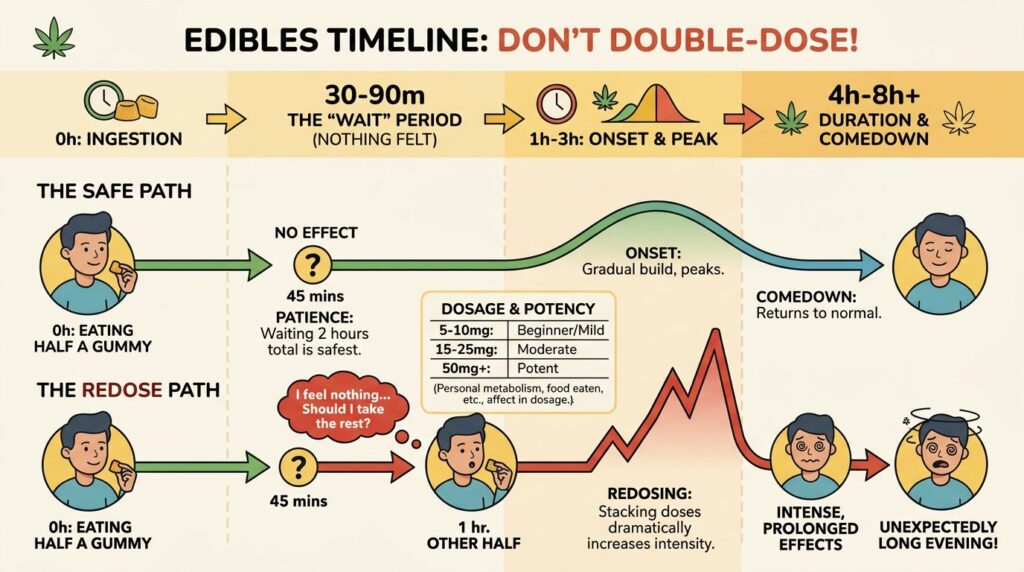
You eat half a cannabis gummy, wait 45 minutes, and feel absolutely nothing. Then comes the dangerous thought: maybe I should take the other half. This is how many unexpectedly long evenings begin.
So, how long do edibles last? For most people, noticeable effects continue for roughly 4–8 hours, although a larger dose can cause impairment for 8–12 hours or longer. Effects commonly kick in 30 minutes to two hours after eating and peak around two to four hours. Even after the obvious high fades, you may feel tired, foggy or less coordinated the next morning.
That broad timeline isn’t a dosing promise. Your experience depends on the THC dose, product type, tolerance, metabolism, recent meals, medications, and whether alcohol is involved. Two people can split the same chocolate bar and have remarkably different nights.
This guide explains each stage of the edible timeline, how gummies compare with drinks and baked goods, why swallowed THC lasts longer than inhaled cannabis, and how long edibles last in your system for drug-testing purposes. You’ll also learn how to avoid taking too much, and what to do if your supposedly relaxing gummy turns the couch into a small, anxious spaceship. It’s written for adults in Canada and isn’t personal medical advice.
Key Takeaways
- Edibles usually kick in within 30 minutes to 2 hours, peak around 2 to 4 hours, and last about 4–8 hours for most people.
- How long edibles last depends on THC dose, tolerance, metabolism, product type, recent meals and other substances such as alcohol.
- Start with a low dose (1–2.5 mg THC) and wait at least two hours before considering more.
- Edible type changes onset more than duration: cannabis drinks tend to act faster, baked goods slower.
- Edibles last longer than smoking because the liver turns THC into a potent compound, 11-hydroxy-THC.
- THC metabolites can stay in your system long after the high fades; urine tests can detect them for days to weeks.
- Store edibles somewhere cool, dark and dry, in the original child-resistant packaging, locked away from kids and pets.
Quick Answer: How Long Do Edibles Last for Most People?
For most adults, a THC edible follows this general schedule:
- Kicks in: 30 minutes to 2 hours
- Strongest effects: about 2–4 hours after eating
- Noticeable high: roughly 4–8 hours
- Possible lingering effects: up to 12–24 hours
A low dose may produce mild effects for only three or four hours. A high-potency edible, especially for a beginner, can cause intoxication for 8–12 hours, with fatigue or mental fog into the next day.
Timing also varies by format. A fast-acting cannabis drink might become noticeable within 15–30 minutes, while a dense brownie eaten after dinner may take two hours or more. That delay is why redosing too early is such a common mistake.
Practical rule: Don’t drive, operate machinery, swim alone or do anything risky while impaired. If you’re new to edibles, keep the rest of the day, and ideally the next morning, free of important obligations. Your calendar will survive. An impulsive drive to the grocery store may not.
Edible Effects Timeline: Onset vs Peak vs Total Duration
An edible experience isn’t one continuous, equally intense high. It has an onset, a climb, a peak and a gradual comedown. Understanding those stages helps you avoid judging a dose before your body has finished absorbing it.
How long do edibles take to kick in?
Traditional gummies, chocolates, capsules and baked goods generally take 30–120 minutes to kick in. Some people need closer to three hours, particularly after a large meal. Fast-acting or water-soluble products may start working in 15–45 minutes, but “rapid onset” on a label doesn’t guarantee an exact arrival time.
Early signs can be subtle: dry mouth, heavier eyelids, altered time perception, relaxation, or a change in how music and food feel. Don’t expect a dramatic switch to flip.
If you feel nothing after 45 minutes, that doesn’t mean the product failed. It’s a familiar pattern: someone takes more, announces that edibles “don’t work,” and then both doses arrive together during the movie’s second act. Wait at least two hours before considering more; beginners should wait longer.
Peak: when effects feel strongest
Effects usually feel strongest two to four hours after eating, though a slow edible may peak later. At the peak you may feel pronounced relaxation, euphoria, laughter, sleepiness, the munchies, altered senses, or difficulty following conversations.
Too high a dose can instead bring anxiety, panic, dizziness, nausea, confusion, a racing heart, or the unnerving feeling that time has stopped. These reactions are generally temporary, but they can feel very real and frightening.
Your peak may also come in waves rather than one clean summit. Eating another meal can sometimes coincide with stronger effects, likely because digestion and absorption are still going. Stay somewhere familiar, keep water nearby, and remind yourself when and how much you took. Writing the dose and time in your phone before you eat it is surprisingly useful when your short-term memory decides to take the evening off.
How long do edibles last? Duration by dose
Dose strongly affects how long edibles last, although milligrams aren’t the whole story. A rough guide for adults:
- Light dose: mild effects may last 3–5 hours.
- Moderate dose: noticeable intoxication often lasts 5–8 hours.
- Strong dose: effects can continue for 8–12 hours or more.
For someone with little tolerance, even a 5 mg or 10 mg edible may feel strong. Someone who uses cannabis regularly may experience the same amount as mild. That doesn’t make high doses risk-free: tolerance can reduce how high you feel without removing impairment or interaction risks.
Lingering sleepiness, slowed reactions, headache or “brain fog” may continue after you no longer feel high. Don’t use the clock alone to decide whether you’re safe to drive. If you still feel altered, wait. Coffee might make you more awake, but it doesn’t reliably reverse THC impairment.
How Long Do Edibles Last by Type? (Gummies, Chocolates, Drinks, Capsules, Baked Goods)
Product format affects onset more consistently than total duration. Once THC reaches your bloodstream and is metabolized, most edible forms stay active for several hours. (For a format-by-format comparison, see THC gummies vs chocolates vs drinks.)
| Edible type | Typical onset | Common duration | Useful detail |
|---|---|---|---|
| Gummies / chews | 30–120 min | 4–8 hours | Easy to portion if accurately labelled |
| Chocolate | 30–120 min | 4–8+ hours | Fat content may support absorption |
| Cannabis drinks | 15–60 min | 2–6 hours | Nanoemulsified products may act faster |
| Capsules | 45–120 min | 4–8+ hours | Consistent format but usually slower |
| Brownies / baked goods | 45–180 min | 6–10 hours | Portions and homemade potency can vary |
A commercial 5 mg gummy is generally easier to dose than a homemade brownie cut “roughly” into squares. THC may not be spread evenly in homemade batter (or homemade cannabutter), so one corner can be mild while another is unexpectedly potent.
Sublingual lozenges and tinctures sit in the middle. Holding the product under your tongue may let some cannabinoids enter the bloodstream through the tissues of your mouth, producing quicker effects. Once you swallow the rest, it behaves more like a regular edible.
Whatever the format, read the label carefully (here’s how to read a cannabis label). A package marked “100 mg THC” may contain ten 10 mg pieces, not one sensible afternoon snack.
Do indica and sativa edibles feel different?
You’ll see indica, sativa and hybrid labels on gummies and chocolates, but with edibles the label matters even less than with flower. Many edibles are made with distillate that has lost much of the plant’s original terpene profile, so the milligrams of THC and CBD, and how long you wait, shape the experience far more than “indica” or “sativa” on the box. For how sativa vs indica effects compare in general, see our full guide.
Why Edibles Last Longer Than Smoking or Vaping
When you smoke or vape cannabis, THC moves from your lungs into your bloodstream within minutes. Effects arrive quickly, usually peak sooner and often fade within two to four hours. (More in edibles vs smoking.)
Swallowed THC takes the scenic route. It passes through your stomach and small intestine before reaching the liver. There, enzymes convert some delta-9 THC into 11-hydroxy-THC, an active metabolite that crosses into the brain efficiently. This “first-pass” metabolism helps explain the deeper, longer and sometimes more intense experience associated with edibles.
Digestion also releases the dose gradually. Meal size, fat content, gut speed and your individual liver enzymes all affect how quickly THC enters circulation. That creates a frustrating gap between eating and feeling, followed by effects that may continue long after an inhaled dose would have faded.
Inhaling isn’t a safe workaround: smoke can harm the lungs, and vaping carries its own risks. The point is simply that the routes behave differently, so don’t estimate an edible dose from the number of puffs you’d normally take. It’s like comparing a slow cooker with a toaster: both create heat, but the timing is emphatically not interchangeable.
Factors That Change How Long Edibles Last
The number on the package is only one part of the equation. Biology, food, tolerance and other substances can change both intensity and duration. That’s why copying a friend’s dose often goes sideways.
Dose, THC potency (mg) and THC:CBD ratio
More THC usually means stronger, longer-lasting effects. For beginners, 2.5 mg THC or less is a cautious starting dose, and 5 mg may already be a lot. A 10 mg edible can be overwhelming for a sensitive or inexperienced person, and products with 20–100 mg per piece carry a much greater risk of prolonged bad effects. In Canada’s legal market, an edible package can contain no more than 10 mg THC in total. [VERIFY; see the notes file before publishing this sentence]
Check whether the label shows THC per piece or per package, and look at other cannabinoids such as CBD. CBD isn’t an emergency antidote to THC and won’t make an excessive dose disappear, but the THC-to-CBD ratio can change the overall experience, and balanced products may feel different from THC-dominant ones.
Product accuracy matters too. Products from untested sources, including some “hemp-derived” delta-8 or other intoxicating cannabinoid products sold outside licensed channels, may have inaccurate labels or contaminants. A clear label from a known producer is the starting point for a predictable dose.
Body factors: metabolism, body fat, tolerance, genetics
Your digestive speed and liver-enzyme activity affect how quickly THC is absorbed and converted. Genetics can influence those enzymes, which helps explain why one person feels a 5 mg gummy intensely while another barely notices it.
Tolerance matters as well. Frequent users may need more THC to feel the same, although a higher dose can still extend impairment. After a break, tolerance can drop quickly, so going straight back to your old dose can bring an unpleasant surprise.
Body size alone isn’t a dependable dosing calculator. THC is fat-soluble and can build up in fatty tissue, particularly with repeated use, but weight doesn’t neatly predict how strong it feels. Age, sleep, hydration, hormones, health conditions and past cannabis experience all play a part.
Treat every unfamiliar product as a fresh test. Use it somewhere safe, choose a low amount and write down the result. Your own careful dose log is worth more than a friend insisting, “Trust me, this one is chill.” Famous last words, honestly.
Food and timing: empty stomach vs after a meal
Taking an edible on an empty stomach may produce a faster or less predictable onset. After a big meal, it may take longer to kick in because digestion is slower, but the eventual effect can still be strong.
Because cannabinoids are fat-soluble, dietary fat can increase absorption. An edible taken with a meal containing avocado, nuts, cheese, eggs or olive oil may hit differently from the same product taken with only a black coffee. Research doesn’t support a universal meal formula, though, so don’t try to engineer the perfect high by buttering everything in sight.
For consistency, take the same product under similar conditions each time. Don’t compare a first try after a normal dinner with a second on an empty stomach at 8 a.m.
Keep ordinary snacks and water handy, but remember that eating won’t instantly sober you up. Above all, don’t redose just because a full stomach delayed the onset.
Alcohol, medications and other substances
Alcohol and THC together can amplify dizziness, nausea, poor judgment and loss of coordination, and alcohol may increase THC absorption in some cases. Mixing them makes your response harder to predict, so the safest beginner plan is to pick one, not build a cocktail with a gummy garnish.
Sedatives, sleep medications, opioids, antihistamines, muscle relaxants and anti-anxiety drugs may increase drowsiness or impairment. Cannabis may also interact with medicines processed by certain liver enzymes, including some blood thinners, seizure medications and psychiatric drugs.
If you take prescriptions, are pregnant or breastfeeding, have heart problems, or have a history of psychosis or severe anxiety, talk to your doctor or pharmacist before using THC. Don’t stop prescribed medication to make room for cannabis.
Call 911 for trouble breathing, collapse, a seizure, severe chest pain, extreme confusion or if someone can’t be woken. For confidential advice, call your provincial poison centre; 1-844-POISON-X (1-844-764-7669) connects you to your local centre. [VERIFY]
How Long Do Edibles Last in Your System? (Drug Test Detection Times)
How long edibles last in your system is a different question from how long the high lasts. You may feel normal after eight hours while THC metabolites stay detectable for days or weeks. Tests look for different compounds and use different cut-off levels, so no chart can guarantee when you’ll test negative. Our guide on how long weed stays in your system covers all forms of cannabis in more depth.
Urine: occasional vs frequent use
Urine tests usually look for the inactive THC metabolite THC-COOH, not current impairment. Approximate windows:
- Single or occasional use: often 1–3 days, sometimes longer
- Several times a week: roughly 5–10 days
- Daily or heavy use: potentially 30 days or more
Dose, frequency, body composition, hydration, test sensitivity and individual metabolism all matter. Edibles can deliver a substantial dose, but there’s no reliable formula that turns one gummy into an exact number of detectable days.
Drinking huge amounts of water won’t safely “flush” stored metabolites. It can cause dangerous electrolyte problems, and labs may flag a diluted sample. Detox drinks and internet cleansing tricks aren’t dependable either.
If a test has legal, medical, athletic or employment consequences, assume the longer window. Only abstinence and time reliably reduce the chance of detection.
Blood and saliva
Blood tests have a shorter practical window than urine tests. THC may be detectable for several hours to a day or two after occasional use, and longer in frequent users. Blood levels also don’t map neatly onto impairment, especially in regular users.
Saliva tests generally target recent use. Detection commonly ranges from several hours to around 24–48 hours, although test sensitivity, dose, mouth contamination and usage patterns vary. Most saliva research has focused on smoked cannabis, so edible-specific predictions are imperfect.
Brushing your teeth, mouthwash or gum can’t guarantee a negative saliva result, and feeling sober isn’t proof a test will be negative.
For driving, take the conservative option: don’t drive while affected or while any impairment remains. In Canada, drug-impaired driving is a Criminal Code offence, there are legal limits for THC in the blood, and police can use roadside saliva screening. [VERIFY] “I waited a few hours” is neither a biological guarantee nor a legal defence.
Hair: long look-back period
Hair testing can look back roughly 90 days when a lab analyzes the 3.8 cm (1.5 in) of hair closest to the scalp. Longer hair can theoretically show a longer history, but many protocols limit the sample for consistency.
Hair tests are better at identifying repeated use than pinpointing a single edible. They can’t reliably show the exact day cannabis was taken or prove someone was impaired. Hair colour, cosmetic treatment, growth rate, environmental contamination and lab procedures can all affect results.
Shaving your head isn’t a clever reset: collectors may use body hair, depending on the protocol. Bleaching and detox shampoos are unreliable and can produce an obviously damaged sample.
If a result has serious consequences, ask whether a confirmatory test (usually chromatography with mass spectrometry) will follow an initial screen. Screening and confirmation are not the same standard.
Edible Dosage Chart: Dose, Onset and Duration
Use this edible dosage chart for planning, not as a countdown clock. Individual responses can fall outside every range listed. For step-by-step first-time dosing, see our THC dosage guide for beginners.
| Stage or dose | Typical timing | What you may notice |
|---|---|---|
| Early onset | 30–120 minutes | Subtle relaxation, dry mouth, sensory changes |
| Delayed onset | 2–3+ hours | More common after a heavy meal or with slow digestion |
| Peak | 2–4 hours | Strongest intoxication and greatest impairment |
| Low dose (about 1–2.5 mg THC) | 3–5 hours | Mild effects for many beginners |
| Moderate dose (about 2.5–10 mg; e.g. a 5 mg edible) | 4–8 hours | Clear intoxication; intensity varies widely |
| High dose (10 mg edible and up) | 6–12+ hours | Greater risk of anxiety and next-day effects |
| Lingering period | Up to 24 hours | Fatigue, fogginess, slower reactions |
These dose labels aren’t universal. For a first-time user, 10 mg may be a very strong dose, not a moderate one. Older adults and people on interacting medications may also be more sensitive.
Plan backwards from your responsibilities. If you need to drive at 7 a.m., testing an unfamiliar edible at 10 p.m. is a poor gamble. Pick a free evening, sort out transportation beforehand, and keep the original package so you know exactly what you took. (Travelling? Read flying with edibles in Canada first.)
Safety: How to Dose Edibles So They Don’t Last Too Long
You can’t switch off an edible after you swallow it. Prevention is much easier than managing an unexpectedly intense eight-hour experience.
Start low, go slow: why “one more” is risky
Health Canada’s advice is “start low, go slow.” If you’re new to THC, start with 1–2.5 mg. Choose a clearly labelled product (or a low-THC option) and split it only if it’s designed to be portioned accurately. A kitchen-knife sliver from a 100 mg brownie isn’t precision dosing.
Wait at least two full hours before even considering more. Three or four hours is more cautious if the product is unfamiliar, you’ve eaten a heavy meal, or you’re especially sensitive. Better yet, take one dose per session and adjust on a different day.
Before taking it, note:
- Product name and cannabinoid content
- Milligrams taken
- Time taken and your last meal
- Any medication or other substance used
- Effects over the following hours
Keep edibles locked away from children and pets, ideally in their original child-resistant packaging. Gummies can look exactly like ordinary candy. If a child eats THC, call your poison centre or 911 right away; don’t wait for symptoms.
What to do if you took too much
First, stop taking cannabis and alcohol. Move to a quiet, familiar space and tell a sober, trusted person what you took, how much and when. Sit or lie somewhere safe, sip water, loosen tight clothing and dim harsh light or noise.
Try slow breathing: in for four counts, out for six. Remind yourself that the effects are temporary and will fade with time. A light snack may help you feel settled, but it won’t neutralize THC. Avoid driving, cold showers, hard exercise and unproven remedies. CBD and black pepper are often suggested online, but evidence that they reliably reverse an edible is limited.
Get urgent medical help (call 911) for:
- Chest pain or serious breathing difficulty
- Seizure, collapse or inability to wake
- Severe agitation, hallucinations or unsafe behaviour
- Persistent vomiting or signs of dehydration
- Any exposure involving a young child
If you’re unsure, call your poison centre or 911. Be honest about the product: health care workers need accurate information, not a heroic cover story.
How Long Do Edibles Stay Good? Shelf Life, Storage and Potency
“How long do edibles last?” can also mean how long they stay safe and potent on the shelf. Those are related but different: the food can spoil before the THC degrades, or the THC can slowly weaken while the product still looks fine.
Expiry vs potency: what changes over time
Follow the manufacturer’s best-before date and storage instructions. Commercial gummies may stay usable for six to twelve months, and chocolate often keeps its quality for about a year when stored properly. Fresh brownies, cookies and other homemade products may last only a few days at room temperature unless refrigerated or frozen.
Moisture, mould, rancid oils, stale ingredients and microbial growth decide food safety. Throw an edible out if it smells sour or rancid, shows mould, leaks unexpectedly or has a suspicious texture. Don’t taste-test a fuzzy brownie in the name of science.
Cannabinoids break down gradually with heat, oxygen and light. THC can oxidize into compounds including CBN over time, which may weaken or change the expected effect. Breakdown isn’t perfectly predictable, so treat an old product as imprecisely dosed, even if it looks normal.
Check Health Canada recall notices and the lot number for licensed products. [VERIFY] If the packaging is missing or you can’t tell the dose, replacing it is safer than guessing.
Best storage practices (heat, light, air, moisture, freezing)
Store edibles in a cool, dark, dry place inside an airtight container. Keep them away from sunny windows, hot cars, ovens and humid bathrooms. Chocolate does well at a normal cool room temperature; gummies need protection from both heat and moisture.
Use the original labelled packaging where possible, then put it inside a locked container. Never move THC gummies into an ordinary candy bag or brownies into an unlabelled freezer bag. Mark the product name, THC per piece, purchase or preparation date and a clear “CONTAINS THC” warning.
Refrigeration can extend the life of baked goods but may cause condensation. Seal products tightly and let the closed container come up to room temperature before opening it. Most brownies, cookies and chocolates can be frozen for longer storage: wrap individual portions, use an airtight freezer container and thaw only what you need. Texture may change, but freezing generally protects cannabinoids better than heat.
Before your next dose, inspect the product, reread the label and start conservatively, especially if it’s old, homemade or already opened. Good storage protects potency; careful dosing protects you. If you’re shopping for something new, our roundup of the best THC edibles in Canada and the full edibles collection are good places to compare THC per piece before you buy.
Frequently Asked Questions About How Long Edibles Last
How long do edibles last?
For most adults, the effects of cannabis edibles last about 4 to 8 hours. Stronger doses can impair for 8 to 12 hours or longer, and lingering fatigue or fogginess can last up to 24 hours.
How long do edibles take to kick in?
Edibles usually kick in 30 minutes to 2 hours after eating and peak around 2 to 4 hours. Drinks and other fast-acting products may start in 15–45 minutes. Wait at least two hours before taking more.
How long do edibles last in your system?
THC from edibles can be detected long after the high ends. In urine, that’s often 1–3 days after a single use, roughly 5–10 days with use several times a week, and 30 days or more with daily use. Saliva tests usually detect THC for up to 24–48 hours and blood tests for hours to a couple of days.
Why do edibles last longer than smoking or vaping?
Edibles go through digestion and the liver, which converts THC into 11-hydroxy-THC, a potent metabolite that reaches the brain efficiently. That slower route makes the experience longer and often more intense than inhaled cannabis.
How does the type of edible affect how long it lasts?
Onset varies most. Cannabis drinks may start in 15–60 minutes and last 2–6 hours, while brownies can take 45–180 minutes to kick in and last 6–10 hours. Gummies and chocolates usually take 30–120 minutes and last 4–8 hours.
What factors change how long edibles affect you?
THC dose, tolerance, metabolism, recent meals, medications, product type and alcohol all matter. Eating an edible on a full stomach can delay onset, and body chemistry can make the same product feel very different for two people.
How should I dose edibles so the effects don’t last too long?
Start with about 1–2.5 mg THC and wait at least two hours before taking more. Use clearly labelled products, don’t redose early, and keep notes on dose, time and effects.
Is a 10 mg edible a lot?
For a beginner, yes. A 10 mg edible can feel strong and last 6 hours or more for someone with little tolerance. Start with 1–2.5 mg (a quarter of a 10 mg piece, if it’s designed to be split) and see how you feel first.