
Nov
Cannabis is supposed to make you relax, until your heart starts pounding, every ordinary sound feels suspicious, and you become intensely aware of how your tongue sits in your mouth. If that’s happened to you, you’re not alone. The relationship between weed and anxiety is genuinely complicated: cannabis may feel calming at one dose, trigger panic at another, or gradually become part of an anxiety-and-relief cycle.
This is an evidence-focused review of how THC, CBD, dose, product type, personal vulnerability, and patterns of use can affect anxiety. It also covers what you can do during a bad reaction, when symptoms require urgent care, and which anxiety treatments have stronger clinical support. It isn’t a diagnosis or a recommendation to use cannabis.
One important distinction before we begin: feeling temporarily nervous while high isn’t automatically an anxiety disorder. Cannabis intoxication can produce short-lived anxiety, panic, paranoia, rapid heart rate, and distorted perceptions. Cannabis use or withdrawal can also aggravate an existing condition. In other cases, someone already experiencing anxiety may use cannabis to cope, meaning anxiety can precede cannabis rather than result from it.
Those possibilities often overlap. Research can identify associations, but it doesn’t always tell us which came first or what will happen to a particular person. Product labels, especially outside regulated markets, add another layer of uncertainty.
If you’re currently having chest pain, serious breathing difficulty, severe confusion, suicidal thoughts, or feel unable to keep yourself or someone else safe, skip ahead and seek urgent help. Otherwise, let’s untangle why the same plant can make one person sink contentedly into the couch while sending another into a 45-minute debate with their own heartbeat.
Key Takeaways
- Weed and anxiety have a complex relationship where THC can both reduce and increase anxiety depending on dose and individual sensitivity.
- High-THC cannabis products, rapid dosing, and unfamiliar settings significantly raise the risk of cannabis-induced anxiety and panic.
- CBD shows potential in reducing anxiety but lacks strong clinical evidence and varies widely in product quality and dosage.
- Frequent cannabis use may lead to tolerance, withdrawal, and a cycle where anxiety is briefly relieved but worsens over time.
- During cannabis-related anxiety, stopping use, moving to a calm environment, and seeking trusted support help manage symptoms effectively.
- Evidence-based anxiety treatments like cognitive behavioural therapy and prescribed medications are more reliable than cannabis for long-term anxiety management.
What is the link between weed and anxiety?
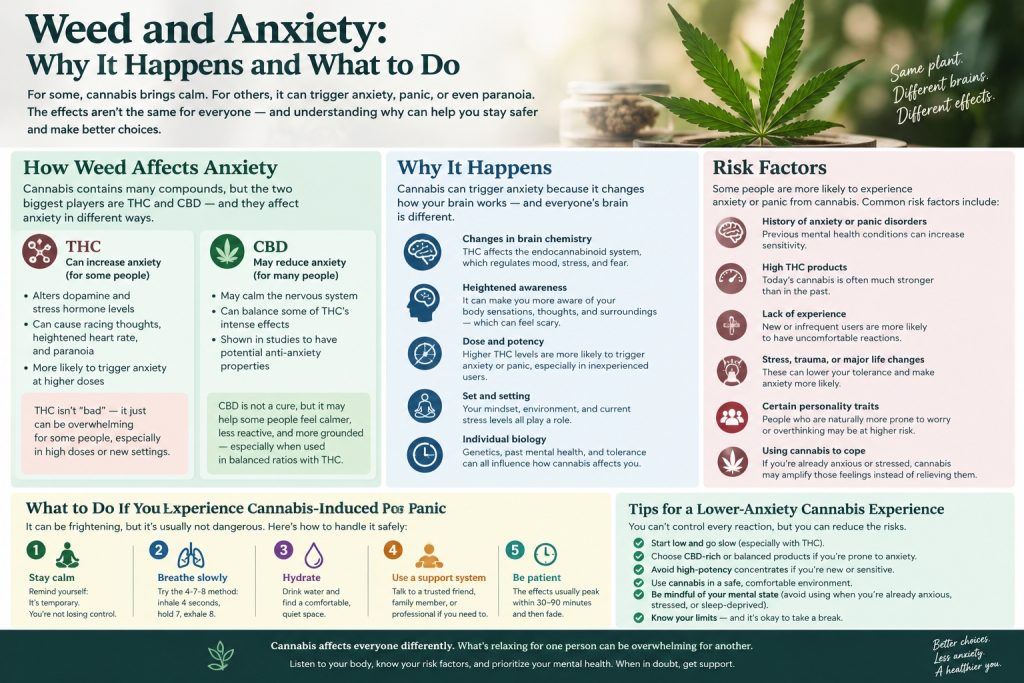
Cannabis can influence anxiety in several directions. Some people report immediate relaxation, less social tension, or easier sleep. Others experience restlessness, racing thoughts, panic, or paranoia. Regular use may briefly suppress symptoms while contributing to tolerance, withdrawal anxiety, or functional problems over time.
The main intoxicating cannabinoid, delta-9-tetrahydrocannabinol (THC), affects brain systems involved in threat detection, memory, reward, and stress. Cannabidiol (CBD) is non-intoxicating and works differently, but evidence supporting it as an anxiety treatment remains limited.
Clinicians may diagnose cannabis-induced anxiety disorder when prominent anxiety or panic develops during or soon after intoxication or withdrawal and cannabis is judged to be the likely cause. That’s different from generalized anxiety disorder, panic disorder, or post-traumatic stress disorder that happens alongside cannabis use.
The practical takeaway is simple: your reaction isn’t determined by the word cannabis. It depends on the chemical dose, how quickly it reaches you, your mental and physical state, other substances or medications, and the environment around you.
Why does cannabis relieve anxiety for some people and worsen it for others?
Picture two people sharing the same labelled product. One takes a small inhalation after dinner and feels physically loose. The other takes several, notices a fast pulse, interprets it as danger, and spirals into panic. Different tolerance, biology, expectations, surroundings, and actual absorbed doses can produce very different evenings.
Previous experiences matter too. If you associate cannabis with safety and familiar company, mild effects may feel pleasant. If you’re already stressed, or worried about becoming anxious, normal intoxication sensations can become threatening. That doesn’t mean the reaction is “all in your head.” The physical and psychological effects amplify each other.
THC, the endocannabinoid system, and dose-dependent effects
THC activates CB1 cannabinoid receptors within the body’s endocannabinoid system. These receptors are widely distributed in brain regions involved in emotion, memory, coordination, and perception. The result can include relaxation and altered sensory experience, but also impaired attention, increased heart rate, distorted time, and heightened threat sensitivity.
THC’s effects are often described as biphasic: lower exposure may reduce anxiety in some people, while higher exposure is more likely to increase it. There’s no universal “calming dose,” however. A dose that feels mild to a frequent user may overwhelm someone with little tolerance.
In controlled human research, THC has repeatedly produced dose-related increases in anxious feelings. Real-world dosing is less tidy. Inhalation depth, potency, metabolism, and inaccurate labelling make the amount absorbed difficult to predict. This is one reason advice based only on “one hit” or “half a gummy” can be misleading.
CBD and anxiety: Potential benefits, evidence limits, and product variability
Small clinical experiments suggest CBD may reduce anxiety in certain situations, such as a simulated public-speaking task. But these studies have often used specific, purified doses that may be much larger than what’s found in an ordinary CBD drink or gummy. Trials involving diagnosed anxiety disorders remain relatively small and inconsistent.
A 2024 systematic review of randomized trials found signals of benefit but emphasized mixed findings, small samples, varied doses, and the need for stronger studies. CBD hence shouldn’t be treated as a proven replacement for cognitive behavioural therapy or prescribed medication.
Product variability is another snag. CBD oils may contain more or less CBD than the label claims, and “full-spectrum” products can contain THC. CBD can also affect liver enzymes that process medications, including some antiseizure drugs, blood thinners, and sedatives.
So, yes, CBD is scientifically interesting. But a gas-station tincture labelled chill isn’t the same thing as a standardized clinical treatment, marketing has a rather generous imagination.
What does research say about cannabis and anxiety disorders?
Population studies generally find that cannabis use and anxiety disorders occur together more often than chance alone would predict. The difficult question is why. Study quality varies, product potency has changed over time, and “cannabis use” may mean anything from one lifetime experiment to daily concentrate use.
Reviews commonly conclude that heavier or problematic use is associated with more anxiety symptoms, while evidence that cannabis directly causes a lasting anxiety disorder is less definitive. Conversely, evidence for cannabis as an effective treatment for anxiety disorders is also insufficient.
Association versus causation: Self-medication and shared risk factors
An association doesn’t establish the direction of cause. You may use weed because you’re anxious, become anxious because of weed, or experience both because of shared influences such as trauma, sleep disruption, genetics, financial stress, depression, or other substance use.
This is the self-medication puzzle. If cannabis quiets your symptoms tonight, it feels effective. Yet relying on it whenever distress appears may prevent you from learning that anxiety can rise and fall without using a substance. Frequent use can then bring tolerance or withdrawal, creating more symptoms to medicate.
Longitudinal studies, those following people over time, help clarify sequence, but they still can’t control every difference between users and nonusers. Randomized long-term trials would be ethically and practically difficult. The fairest interpretation is that cannabis can acutely cause anxiety and may contribute to longer-term problems for vulnerable users, but it isn’t the sole explanation for most anxiety disorders.
What Canadian studies and emergency-department research can, and cannot, tell us
Canadian health databases allow researchers to follow large populations, including people treated for cannabis-related problems. In a large Ontario cohort, people who visited an emergency department because of cannabis use had a substantially higher subsequent rate of anxiety-disorder care than the general population. The association remained after adjustment for several measured factors.
That finding deserves attention, particularly because emergency visits represent severe reactions or risky patterns. But it doesn’t mean a single exposure gives every person the same elevated risk. People reaching an emergency department may already differ in anxiety vulnerability, cannabis frequency, product potency, social circumstances, or access to routine health care. Administrative records also capture diagnoses and visits, not every symptom or unrecorded exposure.
Similarly, increased Canadian emergency visits following legalization can reflect several forces: wider availability, higher-potency products, improved coding, reduced reluctance to disclose use, and genuine increases in harmful reactions. These studies are warning signals, not crystal balls.
Can cannabis terpenes reduce THC-related anxiety? Early findings and limitations
Terpenes give cannabis and many other plants their aromas. Limonene, for example, contributes a citrus scent. In a small controlled study, vaporized d-limonene reduced some anxiety-like effects caused by THC without clearly reducing all of THC’s subjective effects. The finding attracted attention because it offers a possible mechanism behind differing product experiences.
Still, one early laboratory result doesn’t prove that a “limonene-rich” retail strain prevents panic. The study used controlled ratios and known ingredients: commercial flower contains many compounds in variable amounts. Strain names such as Blue Dream aren’t reliable chemical specifications across growers.
The broader “entourage effect”, the claim that cannabis compounds reliably work better together, remains under investigation. Terpene content shouldn’t be used to cancel out a large THC dose or reassure someone with a history of cannabis panic. For now, reducing THC exposure has much firmer harm-reduction logic than hunting for a lemon-scented antidote.
What increases the risk of cannabis-related anxiety?
Risk rises when intoxicating effects become stronger or less predictable. That can happen because of the product, dose, route, personal vulnerability, or situation. Several factors often stack together, a strong edible taken while sleep-deprived at an unfamiliar party is practically anxiety bingo.
High-THC products, concentrates, and taking more than intended
Modern cannabis products vary enormously in potency. Flower may contain well above 20% THC, while concentrates such as wax, shatter, or some vape oils can exceed 70%. A higher label number doesn’t guarantee a better experience: it generally leaves less room for dosing error.
Dabs and high-potency vapes can deliver a large amount quickly. Rapid intoxication, palpitations, coughing, dizziness, and perceptual changes may then be interpreted as an emergency. People with low tolerance are especially susceptible, though experienced users aren’t immune.
Your risk also increases after a tolerance break. Returning to your old amount after several abstinent weeks can hit unexpectedly hard. Unregulated cartridges, synthetic cannabinoids such as K2 or Spice, and products with uncertain ingredients carry additional risks and shouldn’t be treated as equivalent to regulated cannabis.
Edibles, delayed effects, and taking another dose too soon
Edibles are responsible for a classic mistake: “Nothing’s happening, so I’ll take another.” Oral cannabis can take 30 minutes to two hours, or occasionally longer, to become noticeable. Effects often peak later and last much longer than inhaled cannabis.
When THC is eaten, the liver produces 11-hydroxy-THC, an active metabolite that can feel powerful and prolonged. A cookie may also contain an uneven dose if it’s homemade or poorly manufactured.
If you choose to use an edible, check the milligrams of THC per serving, not merely the package total. Don’t redose because the first hour feels uneventful. Full effects can be delayed by food, metabolism, and product formulation. Keep edibles locked away from children and pets: a candy-shaped product looks like candy because, well, it is.
Age, anxiety history, mental health vulnerabilities, and setting
You may be more likely to have a difficult reaction if you have panic attacks, severe anxiety, trauma-related hypervigilance, bipolar disorder, psychosis vulnerability, or a previous cannabis-induced panic episode. A personal or family history of psychosis warrants particular caution because high-THC cannabis is associated with psychotic symptoms and disorders, especially with frequent use.
Adolescents and young adults face additional concerns because the brain continues developing into the mid-20s. Older adults may be more sensitive to dizziness, cardiovascular effects, medication interactions, and falls.
Your setting can turn the volume up or down. Crowds, conflict, driving, police anxiety, unfamiliar people, or feeling trapped may intensify symptoms. So can dehydration, missed meals, sleep loss, caffeine, nicotine, or stimulants. If cannabis has caused panic before, the safest prediction isn’t “next time will be different.” It’s that recurrence is possible.
Feeling anxious or panicky after using weed? What to do now
First, stop consuming cannabis. Remind yourself that anxiety is a known THC effect and commonly subsides as intoxication wears off. You don’t need to “fight” every sensation: the goal is to stay safe and reduce stimulation while your body processes the drug.
Recognizing cannabis-related anxiety, panic, and paranoia
Common symptoms include:
- A racing or pounding heart
- Shaking, sweating, dizziness, or nausea
- Fast breathing or a sense that you can’t get a satisfying breath
- Racing thoughts and an intense fear of losing control
- Feeling unreal, detached, watched, or judged
- Suspicious thoughts that you can still question
Panic symptoms can feel dangerous even when they aren’t medically dangerous. But don’t assume every symptom is “just weed.” Cannabis can coexist with asthma, heart problems, medication reactions, contaminated products, or another emergency.
Severe agitation, hallucinations, inability to recognize familiar people, repeated vomiting, collapse, seizure, or behaviour that threatens safety requires professional assessment. If you’re unsure what was consumed, particularly a synthetic cannabinoid or unknown vape, use a lower threshold for seeking help.
Stop using, find a calm space, and get support from someone you trust
Move somewhere quiet, cool, and familiar. Sit down to reduce fall risk. Loosen restrictive clothing and take slow breaths, emphasizing a longer exhale rather than gulping huge breaths. Try naming five things you see, four you feel, three you hear, two you smell, and one you taste.
Tell a trusted sober person what you took, how much, and when. Ask them to stay nearby and speak simply: “You took THC. You’re safe here. This will pass.” Avoid driving, cooking, showering alone if dizzy, or wandering outside.
Sip water, but don’t force excessive amounts. A light snack may help you feel grounded, although it won’t instantly reverse intoxication. Black pepper, lemon, cold showers, and CBD are popular internet remedies: none should replace monitoring or medical care. And definitely don’t add alcohol or a sedative to “knock yourself out.”
When chest pain, breathing trouble, severe confusion, or safety concerns need urgent help
Call emergency services if you have severe or persistent chest pain, major breathing difficulty, blue or grey lips, fainting, a seizure, extreme confusion, uncontrollable agitation, signs of stroke, or suspected poisoning. Seek urgent help for suicidal thoughts, violent impulses, or an inability to stay safe.
In Canada, call 911 for an immediate emergency. You can also call 1-844-POISON-X (1-844-764-7669), a free, toll-free line to your local poison centre (in Quebec, 1-800-463-5060), for guidance about a possible cannabis exposure. Don’t make yourself vomit unless a clinician specifically instructs you.
Be honest about what you used. Health care professionals need accurate information, not a heroic cover story. If possible, bring the packaging or photograph its label. Calling for help is appropriate even if you’re under the legal age (19 in most provinces and territories, 18 in Alberta, 21 in Quebec) or unsure where a product came from: preserving health is the priority.
How long does anxiety from weed last?
The answer depends on the route, dose, tolerance, metabolism, and whether other substances were involved. The most intense anxiety often fades alongside intoxication, but residual shakiness, fatigue, embarrassment, or worry can linger.
Typical onset and duration after smoking, vaping, or eating cannabis
Smoked or vaped cannabis usually begins working within minutes, with prominent effects commonly lasting a few hours. Anxiety may spike quickly because the change feels abrupt. Impairment or subtle after-effects can persist longer, particularly after a large dose.
Edibles usually begin more slowly and can produce noticeable effects for six hours or more: high doses may cause impairment well into the next day. Individual timelines vary substantially. You shouldn’t drive merely because the clock says a certain number of hours have passed, wait until you’re fully sober and unimpaired.
Concentrates, repeated dosing, liver function, and medication interactions can extend the experience. If symptoms are intensifying rather than gradually settling, or they’re accompanied by medical warning signs, get advice instead of trying to outwait them.
What to do if anxiety continues after the high wears off
After a frightening episode, you may monitor your heartbeat or fear another panic attack. That “aftershock” can persist even after THC has largely worn off. Prioritize sleep, regular meals, gentle movement, hydration, and a temporary break from caffeine, nicotine, alcohol, and cannabis.
Arrange a clinical evaluation if anxiety lasts several days, disrupts sleep or work, keeps recurring, or feels disconnected from intoxication. A professional can assess panic disorder, medication effects, thyroid or cardiovascular issues, and other possible causes.
Persistent paranoia, hallucinations, mania, severe insomnia, or disorganized thinking needs prompt assessment. Cannabis can precipitate longer episodes in susceptible people.
Write down the product, dose, timing, co-used substances, and symptoms while you remember them. That unglamorous little incident report can be surprisingly useful, and more reliable than trying to reconstruct “the gummy situation” three weeks later.
How frequent cannabis use and withdrawal can affect anxiety
Frequent use changes the equation. Cannabis may still feel calming immediately, while tolerance, dependence, sleep disruption, or withdrawal makes your overall anxiety harder to interpret.
Short-term relief, tolerance, and the self-medication cycle
Suppose you use cannabis each night to switch off anxious thoughts. It works at first. Over time, you need more for the same effect, feel edgy before your usual dose, and sleep poorly without it. Using again relieves that discomfort, reinforcing the belief that cannabis is treating your baseline anxiety when it may partly be treating withdrawal.
This doesn’t happen to everyone, and dependence isn’t a moral failure. It’s a learned biological and behavioural cycle.
Try tracking anxiety before use, shortly after use, and the following morning for two weeks. Include THC dose and sleep quality. Patterns become easier to see on paper. If relief is brief but next-day anxiety keeps climbing, that’s useful information, not a reason to shame yourself.
Signs of cannabis use disorder and when to seek support
Cannabis use disorder involves difficulty controlling use despite meaningful consequences. Warning signs include:
- Using more or longer than intended
- Repeated unsuccessful attempts to cut back
- Strong cravings or substantial time spent obtaining and using cannabis
- Neglecting work, school, relationships, or activities
- Continuing despite anxiety, panic, or other health problems
- Hazardous use, including driving while impaired
- Tolerance or withdrawal
You don’t need to “hit rock bottom” before seeking help. Primary-care clinicians, addiction specialists, and therapists can help you set a goal of reduction or abstinence. Treatments often use motivational enhancement, cognitive behavioural strategies, and contingency management. There is currently no medication approved in Canada specifically for cannabis use disorder, although related symptoms can still be treated.
Anxiety after cutting back or quitting: Withdrawal timeline and coping strategies
Cannabis withdrawal can include irritability, anxiety, restlessness, reduced appetite, low mood, vivid dreams, headaches, and sleep difficulty. Symptoms commonly begin within one or two days after stopping, peak during the first week, and improve over one to two weeks. Sleep changes can last longer, especially after heavy daily use.
Plan rather than white-knuckle it. Remove products and paraphernalia, tell a supportive person, reduce schedule pressure during the first several days, and maintain a consistent wake time. Exercise and relaxation exercises can help, even if they don’t feel magical on day two.
Professional support is wise if you use heavily, have serious mental health symptoms, are pregnant, or use other substances. Unlike withdrawal from alcohol or benzodiazepines, cannabis withdrawal is not usually medically dangerous, but severe distress, suicidality, psychosis, or inability to function requires urgent care.
Ways to lower your risk if you choose to use cannabis
No strategy makes cannabis risk-free. Not using THC is the most reliable way to prevent THC-related anxiety, particularly after a previous severe reaction. If you do use, a few decisions can reduce, not eliminate, the chance of trouble.
Avoid high-THC products, delay redosing, and never drive while impaired
Choose regulated products with clearly labelled THC amounts. Lower-THC options are generally less likely to provoke intense intoxication than concentrates. Avoid dabs, unknown vapes, synthetic cannabinoids, and homemade edibles with uncertain distribution.
Use less than you think you need, especially after a break. With edibles, wait long enough to understand the full effect rather than stacking doses. Use in a familiar place with people you trust, and make transportation plans before consuming.
Never drive, cycle in traffic, operate machinery, swim alone, or supervise children while impaired. Coffee, a cold shower, and confidence don’t restore reaction time. Store cannabis in its original child-resistant package, locked and separate from ordinary food.
Avoid mixing substances and check THC or CBD interactions with medications
Alcohol and cannabis together can produce greater impairment, nausea, dizziness, and poor judgment. Stimulants may worsen rapid heartbeat and anxiety. Combining cannabis with opioids, benzodiazepines, sleep medications, or other sedatives can increase drowsiness and accidents.
THC and CBD may interact with medications metabolized by liver enzymes. Clinically important concerns can arise with blood thinners such as warfarin, antiseizure medicines such as clobazam, sedatives, and some psychiatric or transplant medications. Smoking cannabis may introduce additional drug-metabolism considerations.
Ask a pharmacist or prescriber about your specific product, dose, and frequency. “I use CBD sometimes” is less useful than “I take 25 mg of an oral CBD oil nightly.” Don’t stop prescribed medication abruptly to make room for cannabis. Pregnancy, breastfeeding, heart disease, and a history of psychosis are strong reasons to discuss avoidance with a clinician.
Evidence-based alternatives to using weed for anxiety
If cannabis is your main coping tool, replacing it requires more than removing it. You need something workable in the empty space, especially at the hour when you usually reach for it.
Cognitive behavioural therapy, prescribed treatments, and supportive daily habits
Cognitive behavioural therapy (CBT) is a well-supported treatment for anxiety disorders. It helps you identify threat interpretations, reduce avoidance, and gradually face feared situations. Exposure-based methods can be uncomfortable, but that discomfort is purposeful and structured, not simply “thinking positive.”
Depending on your diagnosis, a clinician may discuss selective serotonin reuptake inhibitors (SSRIs), serotonin-norepinephrine reuptake inhibitors (SNRIs), or other treatments. Medication benefits and side effects vary, and some options take several weeks to work.
Daily habits support treatment rather than replace it. A realistic starter routine might include:
- Wake at roughly the same time each day.
- Eat regularly and limit late-day caffeine.
- Take a 20-minute walk after work.
- Practise five minutes of slow breathing before your usual cannabis time.
- Schedule one therapy or support appointment this week.
Small and repeatable beats heroic and abandoned by Thursday.
How to discuss cannabis use and anxiety symptoms with a health care professional
You can say: “I use cannabis four nights a week, usually a 10 mg THC edible. It helps initially, but I’ve started having morning anxiety and panic.” That gives a clinician something concrete to assess.
Mention:
- Product type, THC/CBD content, dose, and frequency
- Why you use it and what happens when you stop
- Panic, paranoia, sleep changes, or functional problems
- Alcohol, nicotine, supplements, and other drugs
- Every prescription and over-the-counter medication
- Your treatment goals, including whether you want to stop or reduce
Ask how cannabis might affect your diagnosis, medication, sleep, and therapy. If you’re worried about judgment, say so directly. A good clinician should respond with curiosity and harm reduction, not a lecture. If they dismiss your concerns, or treat cannabis as either a miracle or pure evil, seeking a more balanced second opinion is reasonable.
Where to find mental health, substance use, and crisis support
You don’t have to wait for your cannabis use or anxiety to become catastrophic. In Canada:
- Call or text 9-8-8, the 9-8-8 Suicide Crisis Helpline, if you’re thinking about suicide or worried about someone else.
- Call 911 for immediate danger, severe medical symptoms, or an inability to remain safe.
- Call 1-844-POISON-X (1-844-764-7669) to reach your local poison centre (in Quebec, 1-800-463-5060) for suspected poisoning or dosing guidance.
- Use Health Canada’s Get help with substance use page, which lists free national and provincial services, including Drug Rehab Services at 1-877-254-3348 for treatment information and referrals.
- Use the Government of Canada’s Mental health support: Get help page to find mental health services.
If you’re outside Canada, use your local emergency number or national crisis service. A family doctor or nurse practitioner, community mental health centre, school counselling office, or licensed addiction program can also help.
When contacting a service, state the immediate issue plainly: “I’m having panic attacks after cannabis,” “I can’t stop using,” or “I don’t feel safe.” Clear words help the person on the other end respond appropriately. If making the call feels impossible, ask someone you trust to sit with you or begin the conversation.
References, evidence limitations, and medical review
This review draws on public-health guidance, diagnostic concepts, observational research, controlled human experiments, and systematic reviews. Useful starting points include Health Canada’s page on cannabis and mental health, Health Canada’s information about cannabis health effects, and the Canadian Centre on Substance Use and Addiction’s review of regular cannabis use and mental health.
Evidence has important limitations. Cannabis products differ in THC, CBD, minor cannabinoids, contaminants, and delivery method. Study participants also differ in age, tolerance, diagnoses, and co-use of substances. Observational findings can’t fully separate cause from self-medication or shared risk factors, while small laboratory studies may not translate neatly to dispensary products and everyday settings.
This article is educational and is not a substitute for individualized medical advice. It does not claim that every cannabis user will develop anxiety or that cannabis reliably treats it. It has not been reviewed by a clinician: it is based on the public-health guidance and studies linked above, so talk with your own doctor, nurse practitioner, or pharmacist about your situation.
The bottom line on weed and anxiety is neither “weed always calms you” nor “weed always causes anxiety.” THC can produce acute anxiety, with risk rising as exposure and vulnerability increase. CBD and terpenes remain promising research subjects, not dependable rescue plans. If cannabis repeatedly triggers panic, worsens your baseline mood, or feels difficult to control, take that pattern seriously. Pause, document what’s happening, and talk with a qualified professional. You’re not weak for reacting badly, and you don’t have to keep repeating the experiment to prove it.