
Blog 2026
Spliff Guide: Effects, Differences, and Rolling Tips
Nov
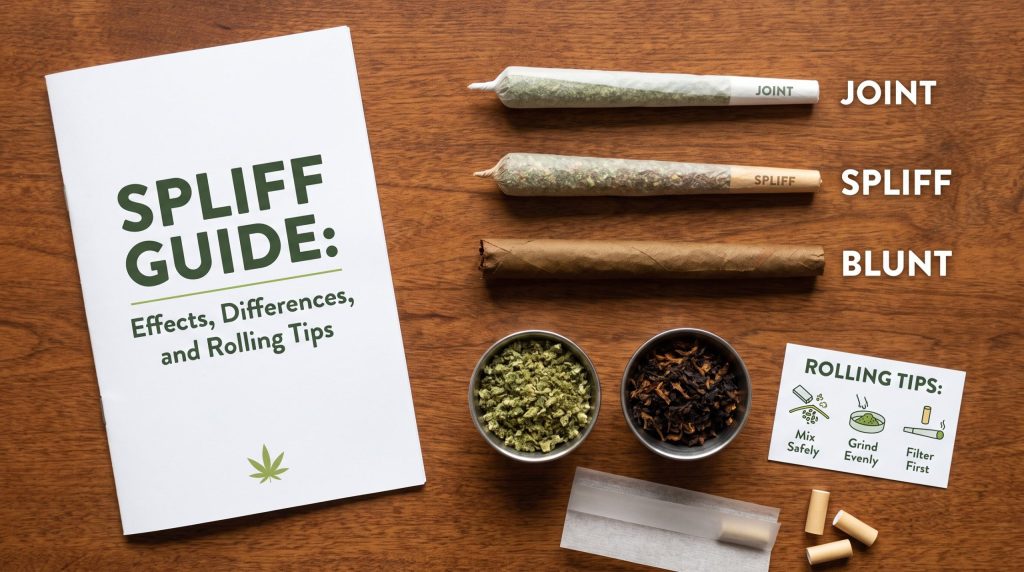
A spliff can look almost identical to a joint, but what’s inside changes the flavour, burn, effects, and health risks. In the most widely accepted sense, a spliff combines cannabis and tobacco in rolling paper. That tobacco may help the roll burn evenly, but it also introduces nicotine, along with its dependence potential and cardiovascular effects.
Terminology isn’t universal, though. Ask for a spliff in London, Kingston, Amsterdam, or Los Angeles and you may get slightly different answers. That regional ambiguity partly explains why joints, spliffs, and blunts are so often confused in conversation and popular culture.
This guide explains what a spliff is, how it compares with a joint and blunt, what mixing nicotine with THC may feel like, and why some people prefer, or deliberately avoid, the combination. You’ll also find rolling guidance, ratio examples, troubleshooting advice, and practical ways to reduce nicotine exposure.
Cannabis and tobacco laws vary by location, and inhaling smoke from either substance carries health risks. Don’t drive or operate machinery while impaired, avoid combining cannabis with alcohol, and keep all materials away from children and pets. If you’ve never used nicotine, a spliff is not a harmless place to start.
Key Takeaways
- A spliff is a hand-rolled cigarette mixing cannabis with tobacco, differing from a joint, which contains only cannabis, and a blunt that uses a tobacco leaf wrap.
- Adding tobacco to cannabis in a spliff changes the flavour, burn rate, effects, and introduces nicotine’s addictive and cardiovascular risks.
- Nicotine in spliffs can cause a quick head rush and may make the smoking experience feel stronger, but it also increases dependence potential and health hazards.
- Rolling a spliff requires balancing cannabis and tobacco ratios to control potency and harshness, with common mixes ranging from 80/20 to 50/50 cannabis to tobacco.
- To reduce nicotine exposure and health risks, beginners and non-nicotine users should choose joints over spliffs and avoid tobacco leaf wraps.
- Proper rolling techniques, moisture control, and choosing the right papers and filters improve the burn quality and smoking experience of a spliff.
What Is a Spliff?
A spliff is generally a hand-rolled cigarette containing cannabis mixed with tobacco. It occupies the middle ground between a cannabis-only joint and a tobacco cigarette, although local vocabulary can muddy that tidy definition.
The mixture is rolled in ordinary paper rather than the tobacco-leaf or cigar-style wrap associated with a blunt. Users control the balance themselves, so one spliff may contain only a pinch of tobacco while another is predominantly tobacco.
Spliff definition (cannabis mixed with tobacco) and common variations by region
In Canada and the United States, “spliff” usually means cannabis flower and loose tobacco rolled together in paper. A joint, by contrast, normally contains cannabis alone. This is the definition used throughout this guide.
Usage changes as you travel. In parts of Europe, particularly the United Kingdom and the Netherlands, mixing cannabis or hashish with tobacco has historically been common. Speakers may casually call the resulting roll a joint, even though a North American would label it a spliff. Amsterdam coffeeshop menus and house rules can create another wrinkle: some venues allow cannabis but prohibit tobacco indoors under smoke-free regulations.
In Jamaica and some Caribbean contexts, spliff may refer more broadly to a large cannabis roll, whether or not tobacco is present. Popular music has helped spread that broader meaning worldwide. So, if ingredients matter to you, don’t rely on the name. Ask what’s actually inside.
Where the word “spliff” comes from (origin and usage)
The word is strongly associated with Jamaican English. The Oxford English Dictionary traces its earliest known printed evidence to a 1929 issue of Kingston’s Daily Gleaner and suggests that its formation may involve words such as “split” and “whiff.” The precise etymology remains uncertain rather than neatly settled.
By the later 20th century, reggae and Rastafarian imagery carried the term far beyond Jamaica. It now appears routinely in journalism, music, film, and everyday cannabis vocabulary. Merriam-Webster’s spliff entry records American use from the 1930s.
Modern usage still reflects that journey: sometimes the word means any cannabis roll, but increasingly, especially in North American product guides, it identifies a cannabis-and-tobacco mixture. Context remains king.
Spliff vs Joint vs Blunt: Key Differences
All three are rolled and smoked, yet their ingredients and wraps create noticeably different experiences. Here’s the quick version:
| Type | Typical filling | Typical wrap | Nicotine source | Usual character |
|---|---|---|---|---|
| Spliff | Cannabis plus tobacco | Rolling paper | Loose tobacco | Lighter cannabis dose, tobacco flavour |
| Joint | Cannabis | Rolling paper | None unless paper contains tobacco | Clearer cannabis flavour |
| Blunt | Cannabis, occasionally mixed | Tobacco leaf or cigar wrap | Wrap, and sometimes filling | Heavier aroma and slower burn |
These are conventions, not universal laws. A hemp-wrapped “blunt,” for example, may contain no nicotine. Always check the ingredients rather than trusting the silhouette.
Spliff vs joint (ingredients, burn, taste, strength)
The defining spliff vs joint difference is the filling. A joint contains cannabis, while a spliff adds tobacco. Because tobacco replaces some flower, a same-sized spliff will often contain less THC than a cannabis-only joint. That doesn’t guarantee it will feel weaker: nicotine can produce an immediate head rush that some users interpret as extra intensity.
Tobacco usually burns readily and may help damp or unevenly ground cannabis stay lit. The trade-off is taste. A joint foregrounds the cultivar’s pepper, citrus, pine, or earthy notes: a spliff overlays them with dry, smoky tobacco flavours. People accustomed to cigarettes may find that familiar. Nonsmokers often find it harsh.
A joint also avoids nicotine dependence, although cannabis smoke itself is not risk-free. If you want to evaluate a flower’s aroma or potency without tobacco complicating the picture, the joint is the more revealing format.
Spliff vs blunt (wrap type, nicotine, harshness, smell)
A spliff normally uses thin rolling paper and gets nicotine from tobacco mixed into its filling. A traditional blunt places cannabis inside a cigar, cigarillo, or tobacco-leaf wrap. Even when the blunt contains no loose tobacco, its wrap can still deliver nicotine.
Blunts tend to be larger, slower-burning, and more pungent. Cigarillos and cigar wraps have a recognizable fermented tobacco aroma that lingers on clothing and upholstery. Spliffs are generally slimmer and use less material, although their odour still combines cannabis with cigarette-like smoke.
Harshness depends on moisture, wrap thickness, tobacco quantity, and how aggressively you inhale. A stale cigar wrap can feel leathery and abrasive: a tobacco-heavy spliff can produce a similarly sharp throat hit. Hemp wraps offer a blunt-style shape without tobacco, but you should verify the package because “natural” doesn’t automatically mean nicotine-free.
Can you use the same rolling papers/wraps? (papers, cones, tobacco wraps)
Joints and spliffs can use the same paper. Thin rice, hemp, or wood-pulp papers from brands such as RAW, OCB, Elements, and Zig-Zag all work, as do pre-rolled cones. Standard 1¼-size papers suit smaller rolls: king-size papers leave room for a longer mixture but require more control.
Tobacco wraps are intended for blunts and behave differently. They’re thicker, often need moistening, and can add nicotine even if you omit loose tobacco. Don’t substitute notebook paper, receipts, gum wrappers, or glossy paper. Inks, coatings, adhesives, and thermal-paper chemicals aren’t designed for inhalation.
For a beginner, an unflavoured paper and a firm paper crutch make results easier to judge. Flavoured papers can disguise stale ingredients, but they can’t repair them, rather like spraying cologne on yesterday’s gym shirt.
Do Spliffs Get You High? Effects and What to Expect
Yes. A spliff containing THC-rich cannabis can get you high. Effects vary with THC concentration, the amount used, your tolerance, inhalation pattern, and whether you’ve eaten. Tobacco adds nicotine’s effects rather than neutralizing the cannabis.
You may notice relaxation, altered sensory perception, slowed reaction time, dry mouth, or impaired short-term memory. Unpleasant possibilities include anxiety, dizziness, nausea, rapid heartbeat, and poor coordination. High-THC flower and low tolerance make those reactions more likely.
How nicotine + THC can change the experience (head rush, perceived intensity, duration)
Nicotine can act quickly, producing brief alertness, light-headedness, or a “head rush.” THC has a different psychoactive profile and may last longer. When both arrive together, the opening minutes can feel unusually intense, especially if you don’t regularly use tobacco.
That sensation doesn’t necessarily mean the cannabis dose is stronger. It may reflect nicotine, deep inhalation, a transient cardiovascular response, or all three. Some users describe a more stimulating onset: others report sweating, queasiness, shakiness, or the dreaded “I need to sit down right now” moment.
Nicotine’s noticeable rush may fade within minutes, while inhaled cannabis impairment can persist for hours. Don’t redose simply because the first wave changes. Pause, hydrate, and assess how you actually feel. If severe chest pain, fainting, confusion, or breathing difficulty occurs, seek medical help.
Why spliffs can feel stronger or harsher (dose, inhalation, burn rate)
A spliff may feel stronger when the tobacco encourages a faster, hotter burn or when you take larger puffs to keep it lit. Holding smoke in doesn’t meaningfully improve the experience: it mainly increases exposure to irritating combustion products.
Ratio matters too. A small roll made with potent flower can deliver considerable THC even after tobacco is added. Meanwhile, a high-nicotine tobacco can make a modest cannabis dose feel more forceful. Empty stomachs, dehydration, alcohol, and unfamiliar surroundings can amplify discomfort.
Harshness usually points to hot smoke, dry tobacco, thick paper, tight airflow, or excessive combustion, not “quality potency.” Smaller puffs and slower pacing reduce heat, but they don’t make smoke safe. If your throat burns or you feel dizzy, stop rather than treating discomfort as a challenge to conquer.
Pros and Cons of a Spliff
Spliff preferences are personal, but the trade-offs aren’t perfectly balanced. Easier burning and adjustable potency are practical features: nicotine exposure is a significant health consideration.
| Potential appeal | Corresponding drawback |
|---|---|
| Uses less cannabis per roll | Adds tobacco and nicotine |
| Ratio can be customized | Dose becomes harder to judge |
| Tobacco may sustain combustion | Smoke can be hotter and harsher |
| Familiar ritual for cigarette smokers | Can reinforce smoking cues and dependence |
Potential benefits (cost efficiency, smoother burn, customizable potency)
Replacing part of the flower with tobacco stretches a cannabis supply. For example, a person who would normally use 0.5 grams in a joint might use 0.35 grams of cannabis plus tobacco in a similarly sized spliff. That isn’t a health benefit, but it explains the economic appeal.
Tobacco can also improve combustion when flower is slightly moist or resinous. A well-balanced mixture may burn more consistently and require fewer relights. Some users prefer the lower cannabis dose per puff, particularly in social settings where a full-strength joint feels excessive.
Customization is the main practical advantage. You can alter size and ratio rather than accepting a fixed product. Still, “smoother” is subjective. Someone accustomed to cigarettes may perceive tobacco as smooth, while a nicotine-naive user may experience coughing, nausea, and dizziness.
Downsides and risks (nicotine dependence, throat irritation, smell, tolerance)
The largest drawback is nicotine. It’s highly addictive, and pairing it with an established cannabis ritual can make the cue especially sticky: the grinder comes out, your brain expects nicotine. Occasional use can become more frequent without an obvious decision point.
Both tobacco and cannabis smoke contain particulates, carbon monoxide, and airway irritants. According to Health Canada, smoking harms nearly every organ of the body, while Health Canada’s cannabis guidance notes that smoked cannabis can hurt your lungs and that cannabis smoke contains many of the same harmful chemicals found in tobacco smoke.
Other disadvantages include persistent odour, coughing, throat irritation, stained fingers, and uncertain dosing. Cannabis tolerance may encourage larger or more potent rolls: nicotine tolerance can encourage more frequent smoking. Pregnancy, heart or lung disease, and interactions with certain medicines warrant particular caution and medical advice.
How to Roll a Spliff (Step-by-Step)
Before proceeding, confirm that you meet the legal age and local rules for cannabis where you live (in Canada, 19 in most provinces and territories, 18 in Alberta, and 21 in Quebec). Rolling technique can reduce waste and uneven burning, but it can’t remove the risks of inhaling tobacco and cannabis smoke. If you don’t already use nicotine, choose a cannabis-only joint, or a noncombustible legal alternative, instead of introducing tobacco.
What you need (cannabis, tobacco, grinder, papers, filter/crutch, optional tools)
A basic setup includes:
- Legally obtained cannabis flower
- A small amount of loose tobacco
- A grinder
- Rolling paper or a pre-rolled cone
- A paper filter tip, also called a crutch
- A clean tray
- A lighter and an ashtray
A small scoop or folded card helps transfer material without decorating the carpet in cannabis confetti. Use fresh ingredients and a clean grinder. Remove hard stems, which can puncture paper and cause uneven airflow.
A crutch keeps the mouth end open and reduces bits of material reaching your lips. It doesn’t filter toxins like a cigarette filter, even though the casual name “filter.” Avoid plastic, printed cardboard, and improvised materials with coatings. Purpose-made unbleached tips are inexpensive, usually a few dollars per pack, and more predictable.
Best spliff ratios for beginners and experienced users (e.g., 80/20, 50/50) and how to choose
Ratios usually describe cannabis first and tobacco second. An 80/20 spliff hence contains roughly 80% cannabis and 20% tobacco by volume or weight. A 50/50 spliff contains equal portions.
| Ratio | General profile | Important consideration |
|---|---|---|
| 90/10 | Mostly cannabis flavour | Still introduces nicotine |
| 80/20 | Light tobacco presence | Easier to notice each ingredient |
| 70/30 | Pronounced tobacco taste | Greater nicotine exposure |
| 50/50 | Tobacco-forward | Often harsh for nonsmokers |
For someone who already uses tobacco and chooses to make a spliff, 80/20 offers more control than starting at 50/50. For someone new to nicotine, the safest ratio is 100/0, a joint, not a spliff. Nicotine strength varies widely across cigarette, pipe, and rolling tobaccos, so percentages don’t predict an exact dose.
Use a small, measured amount and avoid increasing it merely because the first attempt burns imperfectly. Technique, moisture, and grind often matter more than adding extra tobacco.
Rolling steps (prep, mix, pack, shape, seal, twist) + how to fix common problems (canoeing, runs, loose roll)
- Prep: Grind the cannabis to a medium consistency. It should be even, not powdered. Break tobacco into similar-sized strands.
- Mix: Combine the chosen portions thoroughly on a clean tray. Pockets of tobacco create hot spots: clumps of cannabis encourage runs.
- Place the crutch: Set it at one end of the paper with the adhesive strip facing you and positioned along the upper edge.
- Fill and shape: Distribute the mixture evenly, using slightly less near the mouth end. Gently roll the paper between your fingers to form a cylinder or mild cone.
- Tuck: Tuck the nonadhesive edge around the filling, beginning near the crutch. Keep light tension without crushing the roll.
- Seal: Moisten the adhesive sparingly and smooth it down. Saturating the gum can wrinkle or tear the paper.
- Pack and twist: Lightly tamp the open end with a purpose-made packing tool, leaving enough airflow. Twist the tip closed.
If one side burns faster, a problem called canoeing, stop drawing, let the fast edge cool, and relight the slower side evenly. Rotating the roll can help, but repeated runs usually mean uneven grinding, mixing, or packing.
A loose roll burns quickly and may drop embers. Gently tap the crutch end on the tray and tamp the open end before twisting. If it’s already sealed and collapsing, reroll it rather than squeezing aggressively. A roll that’s too tight will have a poor draw: massage it lightly or start over with less filling. Frustrating? Yes. Better than inhaling until your cheeks file a complaint? Also yes.
Tips for a Better-Tasting, Better-Burning Spliff
Good combustion comes from consistency rather than brute force. Even particle size, moderate moisture, a straight crutch, and gentle packing do more for the burn than repeatedly torching the tip.
Light the end while rotating it, then take a small draw only after the edge glows evenly. This initial “toast” reduces early canoeing. Avoid inhaling from the lighter flame itself, and let the roll rest between puffs instead of chain-smoking it hot.
Tobacco choice and moisture control (avoiding harshness)
Dry, stale tobacco burns hot and tastes acrid. Very wet tobacco is difficult to light and may make the roll sputter. Fresh rolling tobacco should feel pliable rather than crispy or damp. Keep it in its original sealed pouch and follow the manufacturer’s storage directions.
Cigarette tobacco can contain flavourings and burn additives, while pipe tobacco is often too moist and coarse for thin paper. “Natural” or additive-free labels don’t make smoke safe: combusted tobacco still produces toxic chemicals.
Cannabis moisture matters as well. Flower that turns to dust is likely too dry, while material that feels wet, smells musty, or shows fuzzy growth may be mouldy and should be discarded. Don’t try to rescue questionable flower with tobacco. And avoid DIY rehydration tricks involving fruit peel, the added moisture can encourage mould and transfer unwanted oils or flavours.
Paper and filter choices (thin papers, flavoured papers, crutch size) and how they affect draw
Thin rice paper interferes less with flavour but can be delicate. Hemp paper is slightly more forgiving, while thicker wood-pulp paper is easy to handle but contributes more paper taste. Pre-rolled cones simplify shaping and are useful if hand mobility or patience is limited.
Flavoured papers add sweetness, yet they can obscure the ingredients and may feel harsher to some users. An unflavoured paper provides a cleaner baseline. If the result tastes unpleasant, you’ll know the mixture, not artificial blueberry, is sending the message.
Crutch diameter controls airflow. Too narrow, and resin or loose particles can clog the opening. Too wide, and smoke arrives hot while small pieces may pass through. Match the crutch to the roll, keeping its folds open rather than compressing them into a solid plug. Your test is simple: before lighting, draw gently. Air should move with mild resistance, not like a blocked straw or an open drainpipe.
Spliff FAQs
Because cannabis vocabulary is regional, many spliff questions are really questions about ingredients. The clearest approach is to ignore slang for a moment and identify the flower, tobacco, paper, and wrap separately.
Is a spliff the same as a joint? Is a spliff always mixed with tobacco?
Under the standard North American definition, no. A joint contains cannabis in rolling paper: a spliff contains cannabis and tobacco in rolling paper. A blunt typically uses a tobacco or cigar-style wrap.
But language varies. Someone in Jamaica may use “spliff” for a cannabis roll without tobacco, while a European speaker may call a cannabis-and-tobacco roll a joint. Media examples sometimes use spliff as a general synonym for a marijuana cigarette, adding to the confusion.
If you’re sharing, or choosing not to share, ask directly: “Does this contain tobacco or nicotine?” That matters for people avoiding nicotine, managing cardiovascular conditions, trying to quit smoking, or simply expecting a different effect. You should also avoid sharing mouthpieces, especially when anyone is sick.
Are spliffs more addictive than joints? How to reduce nicotine exposure
Spliffs carry a nicotine-dependence risk that cannabis-only joints don’t. Whether an individual becomes dependent depends on frequency, tobacco quantity, nicotine strength, biology, and behavioural cues. Cannabis itself can also lead to cannabis use disorder, so “nicotine-free” doesn’t mean dependence-free.
To reduce nicotine exposure:
- Choose a joint rather than a spliff.
- Avoid tobacco-leaf blunt wraps: use verified nicotine-free hemp paper if legal.
- Don’t keep increasing the tobacco ratio to improve the burn.
- Track how often you smoke and whether cravings appear outside cannabis use.
- Don’t use spliffs as a substitute for cigarettes during a quit attempt without clinical guidance.
- Ask a healthcare professional about evidence-based cessation tools.
Health Canada’s quit-smoking services page links each province’s and territory’s free quit-smoking support and an online quit planner. In Canada, you can also call 1-866-366-3667 to reach your provincial or territorial quitline.
Eventually, a spliff is simple in construction but complicated in effect: cannabis supplies THC, tobacco supplies nicotine, and combustion exposes your lungs to smoke from both. If you choose to use one where it’s legal, keep the tobacco proportion low, pace yourself, and never drive impaired. If you don’t currently use nicotine, don’t let an uneven joint persuade you to start, a better grind and careful roll are far safer fixes. Knowing the difference lets you make a deliberate choice rather than discovering the contents after the first dizzy puff.