
Nov
Learning how to decarb weed for butter is the difference between making a reliably infused ingredient and producing an expensive pan of vaguely herbal brownies. Cannabis flower contains cannabinoid acids, primarily THCA and CBDA, rather than large amounts of active THC or CBD. Controlled heat removes a carboxyl group from these compounds, converting them into forms your body can more readily use.
That process is called decarboxylation, or “decarbing.” It sounds like a chemistry-lab assignment, but you can do it in a regular home oven with a baking tray, parchment paper, and an accurate thermometer. The real challenge is controlling temperature: too little heat leaves cannabinoids partially activated, while excessive heat can degrade them and scorch the plant material.
This guide covers oven decarbing, temperature and timing ranges, troubleshooting, butter infusion, storage, and estimated potency. The recommendations are practical rather than laboratory-perfect because home ovens fluctuate and cannabis varies by cultivar, moisture, age, and cannabinoid content. Visual cues help, but they can’t confirm potency, the only definitive measurement comes from analytical testing.
Before beginning, make sure you’re of legal age in your province or territory (19 in most of Canada, 18 in Alberta and 21 in Quebec). Canada’s Cannabis Act lets adults make cannabis food and drinks at home, as long as dangerous organic solvents aren’t used. Keep the kitchen ventilated, avoid open flames, and secure both cannabis and finished butter from children, pets, and unsuspecting housemates. Edibles can take hours to reach their full effect, so conservative portions matter.
One more transparency note: this guide is published by Kush Station, a Canadian online cannabis store. No equipment manufacturer or cannabis brand has paid for placement, and the guide doesn’t recommend specific products. Now, grab an oven thermometer, because the number on your oven dial may be telling a surprisingly creative little story.
Key Takeaways
- Decarboxylation activates the cannabinoids in cannabis, transforming THCA to THC, which is essential for effective cannabutter infusion.
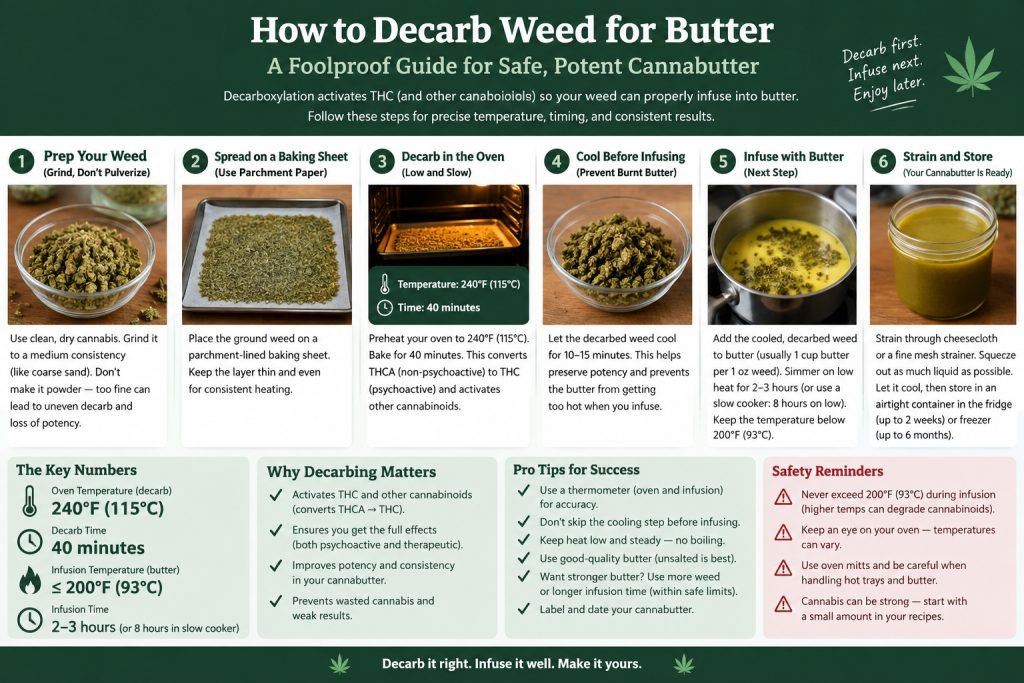
- Use an oven thermometer to maintain a consistent temperature of 110–115°C (230–240°F) for 35–45 minutes when decarbing THC-dominant cannabis to avoid underheating or scorching.
- Break cannabis into rice-sized pieces and spread it evenly on parchment-lined trays to ensure uniform heating during decarb.
- Separately decarb cannabis before infusing it into butter at low heat (70–90°C / 160–190°F) for 2–3 hours to maximize potency and flavour control.
- Accurately estimate cannabutter potency by considering starting cannabis weight, THC percentages, processing losses, and the final butter yield for safe dosage planning.
- Store cannabutter properly in labelled, airtight containers refrigerated or frozen, and keep it securely away from children and pets to ensure safety.
Why Decarboxylation Matters When Making Cannabutter
Decarboxylation uses heat and time to transform acidic cannabinoids into their neutral forms. THCA becomes THC, while CBDA becomes CBD. The reaction also releases carbon dioxide, which explains the “de-carb” part of the name.
This matters because raw flower is not chemically equivalent to an edible made with properly activated cannabis. Some conversion happens naturally as cannabis ages, dries, or heats, but it’s inconsistent. A deliberate decarb gives you more control before the flower ever touches butter.
Decarbing isn’t perfectly efficient, though. Heat, oxygen, storage conditions, and handling can all cause losses. Your goal isn’t to wring out every theoretical milligram: it’s to create a repeatable process without overheating the material.
Decarbing vs. Infusing: Two Different Steps
These steps often get bundled together, but they do different jobs:
- Decarbing activates cannabinoids through controlled heating.
- Infusing transfers cannabinoids from plant material into butterfat.
Think of it like brewing coffee. Grinding the beans prepares them: running water through them extracts the flavour. One step doesn’t automatically complete the other.
Butter can’t compensate for a poor decarb. Likewise, perfectly decarbed flower still needs enough contact with melted fat for extraction. Separating the stages lets you manage each variable more precisely and avoids keeping butter at elevated temperatures longer than necessary.
Why Raw Cannabis and Baking Alone Can Give Unpredictable Results
Could raw cannabis decarb while your brownies bake? Partly, but relying on that is a gamble. Batter contains water, sugar, flour, and fat, and its internal temperature typically remains below the oven setting. Heat also takes time to reach the centre. A 25-minute bake may hence produce uneven conversion.
Sprinkling raw flower into food creates another problem: cannabinoids may not distribute evenly. One brownie could be mild, while its neighbour sends someone to the couch for a six-hour documentary marathon.
Pre-decarbing and infusing allow better mixing and serving estimates. Baking with finished cannabutter may continue changing cannabinoids slightly, but it’s much more predictable than asking activation and extraction to happen simultaneously.
Ingredients and Equipment You’ll Need
You don’t need a countertop full of specialty gadgets. A basic setup includes:
- Legally obtained cannabis flower or trim
- A rimmed metal baking tray
- Unbleached parchment paper
- A standalone oven thermometer
- A coarse grinder or clean fingers
- Heat-resistant gloves
- A timer
- An optional digital scale
- Butter, water, a saucepan, and a fine-mesh strainer for infusion
Avoid grinding cannabis into powder. Tiny particles heat quickly, scorch easily, and slip through strainers. Also skip plastic containers, wax paper, and mystery jars that aren’t explicitly rated for oven use.
A small scale is especially useful. Eyeballing “about an eighth” works until potency calculations depend on whether you actually used 3.0 or 4.1 grams.
Choosing Flower or Trim and Checking Cannabinoid Labels
Flower generally offers higher potency and more predictable label data. Trim can be economical, but its cannabinoid content varies considerably depending on how many sugar leaves and small buds it contains. Fan leaves usually contribute relatively little.
Check the package’s cannabinoid panel. In Canada, dried cannabis labels must show the THC and CBD each batch could yield once THCA and CBDA convert. Labels may show:
- Total THC, an estimate accounting for THCA conversion
- Separate THCA and THC values
- Total CBD, or separate CBDA and CBD values
If only THCA is listed, the theoretical THC after complete conversion is approximately THCA × 0.877, because carbon dioxide is lost during decarboxylation. Add any THC already present. Most labels already perform this calculation, so don’t apply 0.877 twice.
Avoid visibly mouldy cannabis. Heating doesn’t make contaminated flower suitable for food.
Preparing a Baking Tray, Parchment Paper, and Oven Thermometer
Use a light-coloured, rimmed metal tray lined with parchment. Dark pans can absorb more heat and create hotter contact points. Parchment limits sticking and makes it easier to move the finished material without leaving half of it behind.
Place an oven thermometer near the tray’s future position, usually on the centre rack. Preheat long enough for the reading to stabilize. Many ovens cycle 5–14°C (10–25°F) above or below their setting, while older models may miss by considerably more.
If your oven runs hot, adjust the control rather than shortening the process blindly. For example, if a 115°C (240°F) setting produces a measured 127°C (260°F), reduce the dial until the thermometer stays near your target range. That inexpensive thermometer may protect considerably more than its price in flower.
Step-by-Step: How to Decarb Weed for Butter in the Oven
The following method is designed for ordinary THC-dominant flower in a conventional home oven. A useful starting range is 110–115°C (230–240°F) for approximately 35–45 minutes. Cannabinoid researchers use more controlled equipment, so treat home recommendations as ranges, not magical coordinates.
Choose a time when you can remain nearby. Decarbing isn’t difficult, but it shouldn’t be left running while you walk the dog or discover that Canadian Tire somehow consumed two hours of your afternoon.
Step 1: Preheat the Oven and Verify Its Actual Temperature
Set the oven to 115°C (240°F), then allow at least 15–20 minutes after the preheat signal. The beep usually means the heating element reached a programmed threshold, not that the entire oven settled into equilibrium.
Read the independent thermometer. Aim to keep the tray environment around 110–115°C (230–240°F) for THC-dominant flower. If the temperature repeatedly climbs beyond 121°C (250°F), lower the setting and wait for it to stabilize.
Use the middle rack unless your oven’s manual recommends otherwise. Keep the tray away from exposed heating elements, and don’t use broil or convection unless you’ve tested how those modes behave. Convection’s strong airflow can scatter light material and accelerate drying.
Step 2: Break Up the Cannabis and Spread It Evenly
Break flower into pieces roughly the size of rice grains or small peas. You want increased surface area without creating dusty powder. A coarse two-piece grinder works, but clean fingers give you excellent control.
Spread the material across the parchment in one thin, even layer. Separate clumps and avoid piling it into a mound. A crowded tray creates uneven heating because trapped moisture escapes more slowly from the centre.
For a beginner batch, 3.5–7 grams is manageable and limits the stakes if your oven behaves badly. Record the starting weight, cannabinoid percentage, temperature, and time. It feels fussy once: later, those notes become the recipe that keeps your results consistent.
Step 3: Heat Evenly, Monitor Progress, and Avoid Scorching
Place the tray on the centre rack and start the timer. Heat THC-dominant flower for roughly 35–45 minutes at a verified 110–115°C (230–240°F). Gently stir or rotate the material once around the halfway point, especially if your oven has known hot spots.
Open the door only briefly. Every peek dumps heat, forcing another temperature swing. Watch for gradual drying and a shift from green toward muted olive or light brown, not black edges, smoke, or a toasted-to-ashes smell.
Aroma will intensify, so ventilate the room using a range hood that exhausts outdoors or an open window with a fan. Never leave the oven unattended. If the material smokes, remove it safely, turn off the heat, and reassess the oven’s actual temperature.
Step 4: Cool the Decarbed Cannabis Before Infusing or Storing
Remove the tray with heat-resistant gloves and place it on a safe surface. Let the cannabis cool completely on the parchment, usually 20–30 minutes. It should feel dry and crumbly, though not necessarily brittle enough to become dust.
Cooling makes handling easier and prevents residual heat from continuing the reaction inside a closed container. Once cool, infuse it promptly or transfer it into a labelled, airtight glass jar. Store the jar in a cool, dark location for short periods: refrigerate or freeze it for longer storage.
Light, oxygen, and heat encourage cannabinoid degradation. Don’t leave decarbed cannabis uncovered overnight beside a sunny window, unless your goal is expensive potpourri.
Decarb Temperature and Time: A Quick-Reference Chart
Decarb charts differ because experiments use different cultivars, sample sizes, moisture levels, and equipment. The ranges below are conservative home-kitchen starting points, not laboratory guarantees.
| Material | Verified temperature | Approximate time | Practical note |
|---|---|---|---|
| THC-dominant flower | 110–115°C (230–240°F) | 35–45 minutes | Stir once for even heating |
| CBD-dominant flower | 110–115°C (230–240°F) | 50–70 minutes | CBDA often converts more slowly |
| Dry trim | 105–113°C (220–235°F) | 30–45 minutes | Check early: thin leaves scorch easily |
| Fresh or damp material | 110–115°C (230–240°F) | Variable: often longer | Drying consumes part of the heating period |
Don’t combine the highest temperature with the longest time “just to be safe.” More heat isn’t automatically more activation: after a point, it means more degradation.
THC-Dominant vs. CBD-Dominant Flower: Why Recommendations Differ
THCA and CBDA don’t convert at identical rates. CBD-dominant flower commonly receives a longer decarb at a similar moderate temperature. Exact behaviour depends on the sample and oven, which is why published recommendations vary.
For mixed-ratio flower, a middle-ground process may not maximize either cannabinoid, but it can avoid excessive THC exposure while giving CBDA additional time. Start around 115°C (240°F) for 45–55 minutes, monitor closely, and document the outcome.
If precise cannabinoid retention is medically important, home colour cues aren’t enough. Use a regulated, lab-tested product with measured dosing or ask a health care practitioner about access to cannabis for medical purposes. Kitchen decarbing can be repeatable, but it can’t deliver pharmaceutical precision.
How Oven Accuracy, Moisture, and Batch Size Affect Results
A dry, loose 3.5-gram batch reacts differently from 28 grams of moist flower packed onto one tray. Moisture must evaporate before the plant material heats efficiently, while a thick layer limits airflow and creates cool pockets.
Oven cycling matters too. A thermostat may average 115°C (240°F) while repeatedly swinging from 102°C to 129°C (215°F to 265°F). A baking stone on a lower rack can moderate fluctuations in some ovens, but it also changes preheating behaviour and shouldn’t touch the cannabis tray.
For larger batches, use multiple trays rather than one heap, rotating their rack positions carefully. Better yet, work in smaller batches. Consistency beats volume when one scorched ounce can make your kitchen smell like regret.
How to Recognize Common Decarbing Problems
Most problems trace back to three variables: inaccurate temperature, uneven material, or poorly matched timing. Your notes are the fastest troubleshooting tool. Record what you did before changing anything, then adjust one variable per batch.
Don’t taste-test decarbed flower to judge success. Flavour can tell you it’s burnt: it can’t reveal how many milligrams of THC were produced. Similarly, sampling butter repeatedly while cooking is a poor, and potentially overwhelming, form of quality control.
Colour, Texture, and Aroma: Useful Clues, Not Proof of Potency
Properly heated flower commonly changes from lively green to olive green or light golden-brown. It becomes drier and crumbles more easily. The aroma shifts from fresh and grassy to deeper, toasted, and unmistakably cannabis-forward.
These are clues, not a chemical assay. Purple cultivars may stay dark, old flower may begin brown, and CBD-rich varieties can smell different from THC-heavy ones. Colour photographs online are especially unreliable because lighting and phone processing alter hues.
Use sensory signs to detect obvious trouble, smoke, blackening, or wet clumps, not to claim a precise conversion percentage. If potency must be known, a qualified analytical laboratory is the appropriate tool.
Underheated, Scorched, or Unevenly Heated Cannabis: What Went Wrong?
Still moist and bright green: The actual temperature may have been low, the layer too thick, or the material unusually damp. Verify your thermometer and extend heating cautiously in 5–10-minute increments.
Blackened edges or smoke: The tray encountered a hot spot, the oven overshot, or the cannabis was ground too finely. Don’t assume burnt material is “extra strong.” High heat can degrade cannabinoids and produce harsh flavours.
Mixed green and brown patches: The material was clumped or not stirred. Spread it more evenly next time and rotate the tray halfway through.
Very weak finished butter: Possible causes include low-potency flower, incomplete decarbing, poor extraction, inaccurate serving estimates, or tolerance. Don’t immediately double a serving: verify your process first.
From Decarbed Weed to Cannabutter
Once the cannabis has cooled, you can transfer its cannabinoids into butter. Use gentle heat because the activation stage is already complete. Your aim now is prolonged contact between the decarbed material and melted fat, not boiling, frying, or browning the milk solids.
Combine the cannabis with butter and enough water to reduce scorching, then maintain a low temperature for roughly two to three hours. A practical range is about 70–90°C (160–190°F). Stir periodically and avoid a vigorous boil.
Clarified butter or ghee has less water and fewer milk solids, but ordinary unsalted butter works well. Butter contains some water, so your finished yield will normally be lower than the amount you started with.
Choosing a Cannabis-to-Butter Ratio Based on Estimated Potency
Ratios should follow potency and desired serving size, not folklore. “One ounce per pound” could produce dramatically different butter with 8% trim versus 25% flower.
For a beginner-friendly test, you might combine 3.5 grams of 15% total-THC flower with one cup of butter. After plausible processing losses, that could yield roughly 350–400 mg THC in the recovered butter, still potent enough to require careful measurement.
If a recipe uses two tablespoons from that cup, it would contain roughly one-eighth of the batch, or around 44–50 mg before division. Cut into 12 equal cookies, that’s approximately 4 mg each.
Always calculate first. You can add uninfused butter to weaken a strong batch, but you can’t politely ask THC to leave once it’s in the saucepan.
Gentle Infusion, Straining, and Optional Water-Washing for Flavour
Place butter, decarbed cannabis, and water in a saucepan or double boiler. Keep the mixture below a simmer for two to three hours, stirring occasionally. Add a little hot water if the pan begins drying out.
Strain through a fine-mesh sieve lined with cheesecloth into a heat-safe container. Let it drain, then press only lightly: aggressive squeezing pushes bitter plant particles into the butter.
Refrigerate until the fat solidifies. Lift off the butter and discard the water underneath. For a milder herbal flavour, remelt the butter gently with fresh water, chill it again, and separate the layers. This water-washing step can remove sediment and some water-soluble compounds, though it won’t make cannabutter taste completely neutral.
Alternatives to Oven Decarbing: Benefits and Limitations
An oven is accessible, but it isn’t your only option. Alternative methods can improve odour control or temperature stability, although each introduces trade-offs.
| Method | Main benefit | Main limitation |
|---|---|---|
| Home oven | No specialized appliance required | Temperature swings and odour |
| Air fryer | Fast preheating | Strong airflow and small chamber |
| Sous vide | Stable water temperature | Requires suitable sealed bags and longer processing |
| Dedicated device | Automated cycles and odour reduction | Higher purchase price |
Whatever method you choose, use equipment according to its manufacturer’s instructions. Don’t improvise pressure vessels or heat containers that aren’t designed for the job.
Air Fryers: Airflow, Loose Material, and Temperature-Control Concerns
Air fryers are compact convection ovens. Their fans move hot air aggressively, which can blow lightweight cannabis around the basket, onto heating elements, or into inaccessible crevices. That’s both wasteful and potentially hazardous.
Some models also overshoot at low settings or don’t allow precise temperatures below 121°C (250°F). A display reading isn’t proof of chamber temperature, especially in inexpensive units.
If you use one, follow the manufacturer’s rules, verify the temperature with a compatible thermometer, and place material in an approved covered accessory that still permits controlled heating. Never use foil or a container where the manual prohibits it. For most beginners, a conventional oven and rimmed tray are less fiddly.
Sous Vide and Dedicated Decarb Devices: Equipment and Safety Considerations
Sous vide offers stable temperatures and better odour containment. Cannabis is sealed in a heat-rated bag and held in a controlled water bath, usually for longer than oven decarbing because water-bath temperatures are lower. The limitations are equipment cost, bag suitability, sealing quality, and the need to keep the material fully submerged.
Dedicated devices from brands such as Ardent and LEVO automate time and temperature and may reduce odour. They can be convenient for regular use, but they don’t eliminate normal variability or the need for serving calculations.
Compare chamber capacity, minimum batch size, cleaning requirements, warranty, and independent temperature testing. Avoid unverified devices with questionable electrical certification: look for a Canadian certification mark such as CSA, cUL or cETL. Convenience is lovely: countertop fire anxiety is not.
Estimating Cannabutter Potency and Planning Servings
Potency estimates help you divide a batch conservatively, but they depend on assumptions. You need the cannabis weight, label potency, expected conversion or processing loss, recovered butter quantity, and number of servings.
Measure recovered butter instead of assuming one starting cup still equals one finished cup. Water evaporates, butter sticks to equipment, and the plant material retains fat. If you recover only three-quarters of a cup, each tablespoon will be stronger than it would be in a full cup.
For more even distribution, soften the finished butter and stir it thoroughly before portioning. Cannabinoids dissolve in fat, but imperfect mixing can still create variation across a batch.
A Worked THC Calculation Using Label Values, Yield, and Processing-Loss Assumptions
Suppose you use 7 grams of flower labelled 18% total THC:
- Convert grams to milligrams: 7 × 1,000 = 7,000 mg cannabis.
- Calculate theoretical THC: 7,000 × 0.18 = 1,260 mg THC.
- Assume 75% remains after decarbing, infusion, and straining: 1,260 × 0.75 = 945 mg.
- Suppose you recover 12 tablespoons of butter: 945 ÷ 12 = about 79 mg per tablespoon.
- If one tablespoon makes 16 pieces: 79 ÷ 16 = about 4.9 mg per piece.
The 75% factor is a planning assumption, not a universal efficiency rate. Use a more conservative assumption when uncertain, and label the result as estimated.
Why Estimates Are Not Lab Results: Delayed Effects and Safer Serving Decisions
Home calculations can’t measure cannabinoid degradation, uneven extraction, inaccurate labels, or losses left in the strainer. Even laboratory-tested edibles affect people differently based on tolerance, food intake, metabolism, medications, and prior cannabis exposure.
Edible effects may begin in 30 minutes to two hours and can take longer to peak. Health Canada advises starting with a low amount of THC, 2.5 mg or less, and notes it can take up to 4 hours to feel the full effects, so wait before considering more. Some people should wait longer because effects can continue building.
Don’t drive, operate machinery, mix cannabis with alcohol, or use it without medical guidance if you’re pregnant, breastfeeding, taking interacting medication, or managing certain health conditions. When in doubt, ask a qualified healthcare professional.
Storage and Safety: Labelling, Refrigeration, Freezing, and Keeping Cannabis Away From Children and Pets
Treat cannabutter like both a perishable food and a psychoactive product. Place it in a sealed container labelled “CANNABIS, CONTAINS THC,” along with the preparation date, estimated total potency, estimated potency per tablespoon, and any allergens.
Refrigerate it promptly. For longer storage, freeze it in measured portions, an ice-cube tray used only for cannabis butter can help, provided it’s sealed and inaccessible. Quality is generally best within a few weeks refrigerated or several months frozen, though ordinary food-spoilage rules still apply. Discard butter with mould, rancid odours, or suspicious discolouration.
Use child-resistant packaging and keep it locked away from children, teenagers, visitors, and pets. Never store it beside ordinary butter in an unlabelled dish. Dogs can become seriously ill from THC, and chocolate edibles add another toxin.
If accidental ingestion occurs, contact a medical professional, your poison centre, or a veterinarian immediately. In Canada, you can reach your poison centre at 1-844-POISON-X (1-844-764-7669; in Quebec, 1-800-463-5060), and for a pet, your veterinarian or an animal poison-control service. Call 911 for severe symptoms, breathing problems, collapse, or unresponsiveness.
Frequently Asked Questions About Decarbing Weed for Butter
These quick answers address the questions that usually appear halfway through a first batch, often while someone is staring suspiciously through the oven door.
Can You Decarb Weed Directly in Butter or in a Slow Cooker?
Yes, some activation occurs during a long, warm infusion, but it’s harder to control. Water in butter and temperature differences within a slow cooker can slow or unevenly affect the reaction. Slow cookers also vary widely between “warm” and “low,” and older units may cycle above a gentle infusion range.
Separately decarbing the cannabis gives you clearer control over activation before extraction. If you use a slow cooker for infusion, measure the mixture’s temperature rather than trusting the dial, keep it below a vigorous simmer, and stir periodically. Don’t seal a hot mixture in a container that could build pressure.
Can You Reduce Decarbing Odour Without Using Unsafe Oven Containers?
Ventilation is the safest first step. Run an externally vented range hood, open a window, and use a fan to direct air outdoors. Activated-carbon air purifiers may reduce lingering odour, though they won’t make the process invisible to every nearby nose.
Oven-safe roasting bags or purpose-built decarb containers may contain some aroma when used exactly as directed. Don’t heat ordinary mason jars with tightened lids, random plastic bags, or improvised sealed containers. Thermal stress and pressure can crack glass or create other hazards.
Afterward, wash tools promptly and simmer citrus peel or spices if you enjoy the scent, but don’t use fragrance to ignore smoke. Smoke means something is overheating.
Does Baking With Cannabutter Decarb the Cannabis a Second Time?
Baking exposes the cannabinoids to more heat, so additional chemical change can occur. It isn’t a neat second decarb cycle, though. The food’s internal temperature, moisture, baking duration, and cannabinoid distribution all affect what happens.
The centre of a moist brownie won’t reach the oven’s 175°C (350°F) setting: water holds its temperature closer to the boiling point until much of it evaporates. That helps explain why properly made cannabutter can be baked without instantly destroying all its THC.
Still, prolonged high heat can increase degradation. Use normal recipe temperatures and avoid unnecessarily long baking. You don’t need to lower every recipe to 115°C (240°F), the cannabis is buffered inside the food matrix.
Do You Need to Decarb Cannabis That Is Already Labelled Activated?
Usually not. Products labelled activated, decarboxylated, or ready to infuse have generally undergone the conversion step. Decarbing them again may create additional losses without adding a meaningful benefit.
Read the instructions and product label carefully. Cannabis concentrates vary: distillate is typically already active, while products rich in THCA may not be. Rick Simpson Oil and other extracts also differ by manufacturing process. When the label is unclear, ask the producer or retailer rather than guessing.
The practical takeaway is simple: successful how to decarb weed for butter results come from verified temperature, an even layer, conservative timing, and careful serving calculations. Start with a small batch, document every variable, and label the finished butter before it enters your refrigerator. You’re not chasing laboratory perfection, you’re building a repeatable kitchen process that prioritizes predictability and safety.
Once you’ve calculated the estimated potency, choose a deliberately low first serving and give it enough time. That patient approach may feel less exciting than rolling the culinary dice, but your future self, calm, comfortable, and not bargaining with the ceiling fan, will appreciate it.