
Blog 2026
Cannabis Trichomes: Types, Stages and What They Can (and Can’t) Tell You
Nov
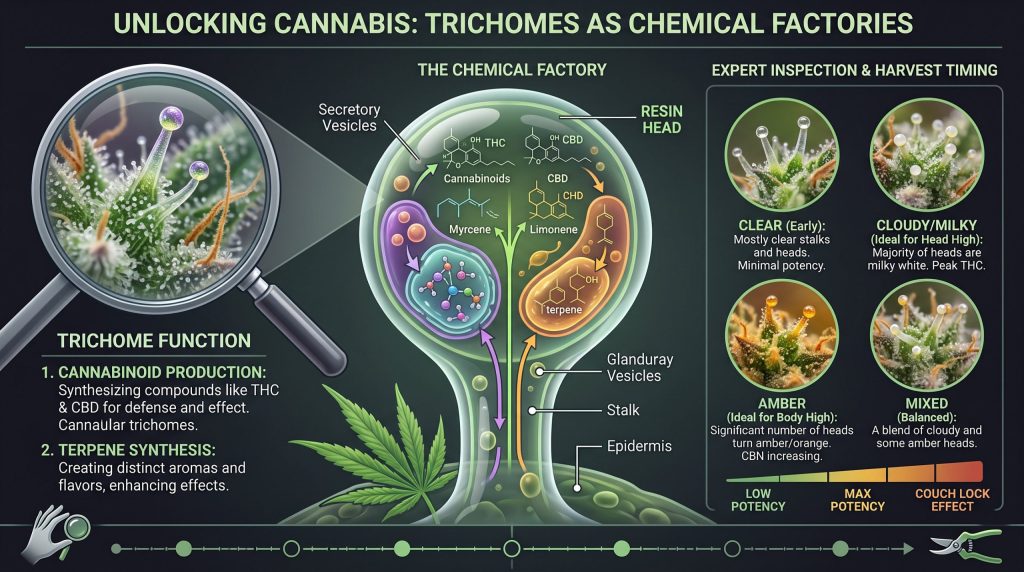
Cannabis trichomes look like a dusting of frost, but they’re working chemical factories, not a decorative bonus. These microscopic structures help defend the plant while producing and storing many of the cannabinoids, terpenes and other compounds associated with cannabis aroma, flavour and effects.
You can also inspect cannabis trichomes for clues about flower development. The tricky part? Clear, cloudy and amber glands don’t function like a universal harvest traffic light. Genetics, growing conditions, flower location and even your lamp can change what you see. A frosty bud isn’t automatically potent, either: only laboratory testing can quantify its chemical profile.
This guide explains trichome anatomy, types, maturation and inspection without leaning on grow-room folklore. You’ll learn what these glands can reveal, what they can’t, and how to distinguish them from pistils, mould and powdery mildew. Think of it as a practical field guide, with fewer myths and considerably more magnification.
Key Takeaways
- Cannabis trichomes are microscopic glands that produce and store cannabinoids, terpenes, and compounds crucial for aroma, flavour, and effects.
- Visual inspection of trichomes—clear, cloudy, or amber—provides clues about flower maturity but cannot reliably indicate potency or chemical content without laboratory testing.
- There are different types of cannabis trichomes, with capitate-stalked trichomes being the most visible and commonly inspected for maturity assessment.
- Proper inspection involves checking multiple flower sites under neutral lighting with appropriate magnification tools to avoid common errors from reflections and uneven maturity.
- Trichome appearance varies with genetics, environment, and plant health, so stable cultivation conditions enhance resin quality more than stress-based techniques.
- Handling and storage significantly affect trichome integrity; gentle handling and cool, dark, airtight storage preserve their chemical profile and potency.
What Are Cannabis Trichomes?
Cannabis trichomes are tiny hair-like outgrowths formed by the plant’s epidermis. Some are glandular, meaning they synthesize and hold resinous secretions. Others are non-glandular hairs with primarily physical roles.
On female flowers, mature glandular trichomes can resemble miniature mushrooms: a narrow stalk supporting a rounded resin head. Inside that head, specialized secretory cells generate cannabinoids, aromatic terpenes and other secondary metabolites.
Where Trichomes Grow and How They Help Protect the Plant
You’ll find trichomes most densely on bracts, the small structures surrounding female flowers, and on nearby “sugar leaves.” They may also occur on stems, petioles, fan leaves and male flowers, although abundance and type vary.
Their secretions may discourage herbivores and insects, while surface hairs can provide a physical barrier. Researchers also associate plant trichomes with protection from ultraviolet radiation and environmental stress. That sticky resin isn’t there for human convenience: it evolved as part of the plant’s defence system.
Types of Cannabis Trichomes
Cannabis develops several trichome forms, distinguishable by size, shape and whether they possess a secretory head. The terminology can vary slightly among studies, but three glandular categories appear repeatedly in cannabis literature.
Bulbous Trichomes
Bulbous trichomes are the smallest glandular type, often measuring only around 10–30 micrometres. They consist of a few cells and sit close to the plant surface. Because they’re near or below the resolving power of many inexpensive loupes, you may not recognize them as distinct resin glands.
Capitate-Sessile Trichomes
Capitate-sessile trichomes have a rounded head and little apparent stalk. They’re larger than bulbous glands and occur across leaves and developing flowers. Research indicates some glands classified as sessile may develop more pronounced stalks as female flowers mature, making trichome categories less static than old diagrams imply.
Capitate-Stalked Trichomes
Capitate-stalked trichomes are the large, mushroom-shaped glands responsible for much of the visible “frost” on mature flowers. Their elevated secretory heads create substantial storage cavities for metabolites. These are generally the easiest cannabis trichomes to inspect with a loupe or digital microscope, and the glands most commonly discussed when evaluating maturity.
Non-Glandular Trichomes: How They Differ From Resin Glands
Non-glandular trichomes lack the rounded resin head used to store cannabinoid-rich secretions. They typically look like simple pointed hairs and can help form a mechanical defence against pests or damaging conditions.
Under magnification, focus on shape: a translucent stalk topped by a sphere suggests a glandular trichome: a tapered hair does not. Not every shiny projection is a tiny jar of THC.
How Glandular Trichomes Produce and Store Cannabinoids and Terpenes
In capitate glands, specialized secretory cells sit beneath a protective cuticle. These cells use biochemical pathways to produce precursor molecules that become cannabinoids and terpenes. The compounds accumulate in a cavity between the secretory cells and cuticle, causing the head to swell.
Fresh plants primarily produce acidic cannabinoids such as THCA and CBDA, not large quantities of neutral THC or CBD. Heat and time can remove a carboxyl group through decarboxylation. Different biosynthetic enzymes, largely determined by genetics, help explain why two equally frosty cultivars can have very different cannabinoid profiles.
Terpene composition also changes with genetics, development and environment. A gland is hence less like a single-purpose THC bubble and more like a compact, evolving chemical workshop.
Cannabis Trichome Stages: Clear, Cloudy and Amber
Growers commonly describe capitate-stalked trichome heads as clear, cloudy or amber. These visual stages can provide context, but they aren’t direct chemical measurements. Colour may reflect gland development, internal contents, cuticle condition, oxidation or optical effects.
Clear Trichomes: Early Development and Its Limitations as a Maturity Signal
Clear heads are transparent and glass-like. They’re frequently associated with younger glands whose secretory cavities are still developing. Yet newly formed trichomes can remain clear while older glands elsewhere are cloudy, so a single clear head says little about the entire flower.
Don’t interpret transparency as proof that cannabinoids are absent. Magnification, glare and cultivar-specific appearance complicate the picture.
Cloudy or Milky Trichomes: Changes in Gland Appearance During Maturation
Cloudy trichomes appear white or opaque as the gland matures and its internal composition and optical properties change. Many cultivators treat widespread cloudiness on flower bracts as one sign of maturity.
It’s still a visual proxy, not a potency test. Cloudy heads don’t prove that THC has reached an exact peak, nor do they reveal terpene retention, contaminants or the broader cannabinoid profile.
Amber Trichomes: Aging, Oxidation and Why Colour Does Not Prove CBN Content
Amber heads range from pale honey to brown. Their colour may accompany aging, oxidation, physical damage or degradation, especially in exposed glands. You’ll often hear that amber automatically means THC has converted to CBN, but appearance alone cannot establish that reaction or quantify either compound.
Only validated laboratory analysis can confirm CBN content. An amber tint may be informative, but it isn’t a built-in chromatograph (sadly).
Visual Trichome Colour Chart: Appearance, Typical Interpretation and Caveats
| Appearance | Typical interpretation | Important caveat |
|---|---|---|
| Clear, glass-like | Younger or actively developing gland | Reflections can make mature glands look clear |
| Cloudy, milky or opaque | More developed secretory head | Does not prove peak THC concentration |
| Amber, gold or brown | Aging, oxidation or gland damage | Does not prove a specific CBN level |
| Collapsed or missing head | Handling, age or environmental damage | Colour ratios become unreliable |
Use this cannabis trichome chart as observational shorthand, not a laboratory report.
How to Identify and Inspect Cannabis Trichomes
Inspect several intact areas rather than choosing the frostiest patch. Stabilize the flower, use neutral lighting and compare glands at similar depths. You’re looking for the predominant appearance and its variation, not hunting for one amber head that confirms what you already hoped to see.
Jeweller’s Loupe, Digital Microscope or Phone Lens: Comparing Viewing Tools
| Tool | Best use | Limitation |
|---|---|---|
| 30×–60× jeweller’s loupe | Fast, inexpensive checks | Shaky at high magnification |
| USB/digital microscope | Photos and detailed comparisons | Focus can be fiddly |
| Clip-on phone macro lens | Convenient close-ups | Quality and magnification vary |
A 10×–20× loupe is often sufficient for identifying large gland heads. A digital microscope is easier for documenting changes, particularly if it includes a stable stand.
Flower Trichomes vs. Sugar-Leaf Trichomes: Why Location Matters
Sugar-leaf trichomes may mature or discolour sooner because they’re more exposed to light, air and handling. If you judge the whole plant from leaf tips, you can get a misleadingly “ripe” picture.
Inspect gland heads on the flower bracts, then sample upper, middle and lower sites. Location consistency makes your observations far more useful.
Lighting, Reflections and Uneven Maturity: Common Inspection Errors
Cool-white LEDs can create harsh reflections that make heads look cloudy: warm lamps can add a false amber cast. Check under neutral white light, reduce glare and adjust the viewing angle.
Other common mistakes include examining damaged heads, touching the sample, focusing on one flower and confusing shallow focus with opacity. Clean the lens, brace your hands and take repeatable photos when possible.
Trichomes vs. Pistils, Mould and Powdery Mildew: Visual Differences
Trichomes are discrete glands or hairs attached to the plant surface. Pistils are longer thread-like flower structures, often white before darkening and curling.
Powdery mildew usually appears as flat, spreading patches that resemble flour and lacks organized stalk-and-head structures. Mould may form fuzzy, web-like growth among tissue and can accompany discolouration or musty odour. If contamination is suspected, don’t consume the material: magnification cannot establish microbial safety.
What Can Trichomes Tell You About Harvest Readiness?
Trichomes can show whether many resin glands still look immature, whether maturation appears uneven and whether heads are becoming damaged or aged. They work best alongside cultivar expectations, flower development, plant health and elapsed flowering time.
They cannot reliably predict an exact psychoactive effect. Claims that cloudy glands guarantee an “energetic” result while amber guarantees sedation oversimplify chemistry, dose and individual response.
Why There Is No Universal Clear-to-Cloudy-to-Amber Harvest Ratio
You may encounter formulas such as “mostly cloudy with 10% amber.” These are grower preferences, not scientifically universal thresholds. Cultivars differ in gland colour, cannabinoid synthesis and maturation pattern: some show little amber even when other indicators suggest maturity.
If you grow at home, check the rules first: federal law allows up to four plants per household, and Quebec and Manitoba prohibit growing non-medical cannabis at home. Compare the same flower locations over time and use ratios as descriptive notes, not commandments carved into a grow tent wall.
Do More Trichomes Mean Stronger Cannabis? Appearance vs. Laboratory Testing
Heavy trichome coverage can indicate abundant resin glands, but it doesn’t reveal what those glands contain. A sparkling CBD-dominant flower may have less intoxicating potential than a less photogenic THC-dominant sample. Even within one flower, gland density and chemistry vary by location.
Potency also depends on cannabinoid concentration, dose, preparation and route of use. Laboratory methods such as high-performance liquid chromatography can quantify major cannabinoids: visual inspection cannot.
Treat frostiness as a botanical trait and possible quality clue, not a numerical potency score. The “shiniest bud wins” rule belongs beside judging coffee solely by how oily the beans look.
What Influences Trichome Production? Genetics, Plant Health and Environment
Genetics establish much of a plant’s potential for trichome density, gland size and chemical profile. Breeding programs often select visibly resinous plants, but appearance and target cannabinoid concentration don’t always move together.
Plant development, nutrition, water availability, light, temperature, humidity, pests and disease can also influence gland formation or preservation. More stress isn’t automatically beneficial: severe heat, drought or excessive light may damage tissue, reduce yield and degrade volatile compounds.
Environmental experiments are difficult to generalize because cultivars respond differently and several variables often change at once. For you, the practical lesson is refreshingly unglamorous: stable plant health and appropriate conditions usually beat dramatic “stress hacks” borrowed from internet lore.
Protecting Trichomes During Handling, Drying and Storage
Mature gland heads are fragile. Friction, heat and repeated handling can rupture or detach them, while oxygen and light contribute to chemical change. Handle flowers by their stems when practical and avoid squeezing them to test “stickiness.” Yes, it’s tempting. No, it isn’t helpful.
During post-harvest handling, controlled drying is preferable to aggressive heat. For storage, use a clean, airtight container kept in a cool, dark place. Glass jars are common because they’re nonporous and easy to inspect, although Health Canada recommends keeping cannabis in a locked container.
Avoid clear containers on sunny windowsills, hot cars and constant opening. Also keep cannabis secured away from children and pets.
Why Trichomes Matter for Kief, Hash and Other Cannabis Extracts
Kief consists largely of detached glandular trichome heads collected through screening or grinding. Traditional dry-sift hash concentrates these glands mechanically, while ice-water hash uses cold water and agitation to separate them by size and density. Regional traditions, from Moroccan dry sifting to hand-rubbed charas in parts of South Asia, developed around the same resin-rich structures.
Trichome size, maturity, integrity and ease of separation can influence extraction yield and quality. But abundant resin still doesn’t guarantee a clean product. Pesticides, microbes, residual solvents and other contaminants require appropriate production controls and testing.
In Canada, it’s illegal to make cannabis extracts at home with explosive or highly flammable organic solvents such as butane or propane. Solvent-based processing can create fire, toxicity and pressure hazards, so it should never be improvised at home.
Frequently Asked Questions About Cannabis Trichomes
When Do Cannabis Trichomes First Appear?
Trichomes occur on cannabis during vegetative growth, but the conspicuous capitate-stalked glands associated with resinous flowers become increasingly abundant during flowering. Timing varies with genetics, sex, tissue and conditions. Early glands may be tiny, so “I can’t see them” often means your magnification isn’t strong enough, not that they’re absent.
Do Male Cannabis Plants Have Trichomes?
Yes. Male plants can form glandular and non-glandular trichomes on leaves and reproductive tissues. They generally don’t develop the same concentration of large resin glands seen on mature, unfertilized female flowers. Their trichomes still contribute to plant defence and can contain cannabinoids and volatile compounds, usually in different quantities.
Can Cannabis Trichomes Turn Purple?
Trichome heads can appear purple or pinkish, particularly when pigments from nearby tissue affect what you see. Genetics, anthocyanin-rich flower tissue, lighting and camera processing may all contribute. Purple-looking glands aren’t evidence of exceptional potency. Check under neutral light before declaring that you’ve discovered grape-flavoured microscopic snow globes.
Do Trichomes Continue to Change After Harvest?
Yes. Harvest stops plant growth, but oxidation, drying, light exposure and heat can continue changing gland appearance and chemistry. Heads may darken, collapse or detach during handling. Storage slows some processes: it doesn’t freeze the sample in time.
That’s why post-harvest amber colour cannot reliably reconstruct the flower’s condition at harvest.
Why Might Trichomes Stay Clear or Never Turn Amber?
Some cultivars naturally retain a translucent appearance or develop little visible amber. New glands may also continue forming while older ones mature, producing a mixed population. Lighting, magnification and inspection location can exaggerate clarity.
If development seems stalled, plant health or environmental conditions may contribute, but colour alone isn’t enough to diagnose the cause.
Scientific References and Further Reading
For deeper reading, start with peer-reviewed work rather than colour-ratio folklore:
- Livingston and colleagues describe the development and metabolite-rich architecture of cannabis glands in Plant trichomes as a model for cannabinoid biosynthesis.
- Happyana and colleagues examine cannabinoids in different glandular trichome types in Analysis of cannabinoids in laser-microdissected trichomes.
- Health Canada’s health effects of cannabis page provides evidence-based health context.
- Health Canada’s Cannabis Act: what you need to know explains Canada’s cannabis rules and product-safety considerations.
Bottom line: Cannabis trichomes offer valuable clues about plant anatomy, gland development and resin condition. But they can’t prove potency, safety, CBN concentration or a perfect harvest date by appearance alone. Inspect multiple flower sites, control your lighting and pair visual observations with trustworthy testing whenever chemistry or safety matters. Use the microscope as a window, not a crystal ball.