
Blog 2026
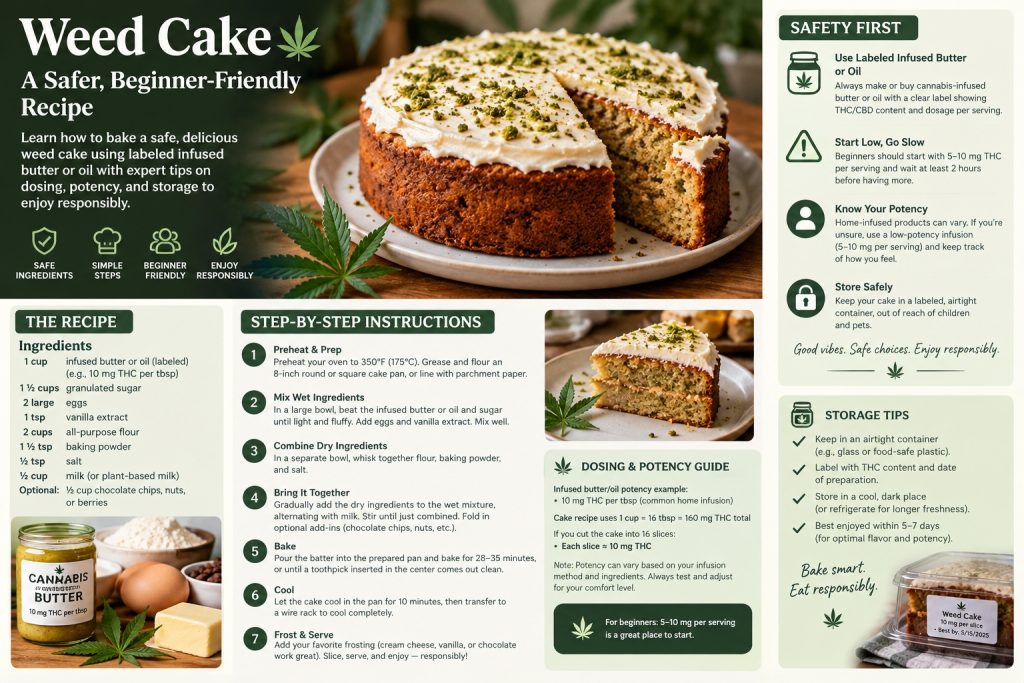
Weed Cake: A Safer, Beginner-Friendly Recipe
Nov
A weed cake can look exactly like an ordinary birthday dessert, golden crumb, glossy frosting, maybe an overambitious cloud of sprinkles, but its effects require far more care than the average sheet cake. Unlike inhaled cannabis, edible THC may take hours to peak and can remain noticeable well into the next day. That delayed response is precisely why beginners sometimes make the classic mistake: “I don’t feel anything, so I’ll have another slice.”
This guide gives you a practical cake recipe using a legally purchased, clearly labelled infused butter or oil. It doesn’t explain how to manufacture cannabis concentrates or infuse raw cannabis at home. That boundary matters because regulated ingredients provide at least a stated THC amount, while homemade infusions can vary dramatically in strength and consistency.
You’ll learn how to read potency labels, estimate THC per portion, bake an evenly mixed cake, and store it where children, pets, and unsuspecting snack hunters can’t reach it. You’ll also find flavour variations, vegan and gluten-free substitutions, troubleshooting advice, and guidance for responding to accidental overconsumption.
No calculation makes homemade baking perfectly predictable. Labels can be misread, batter can be mixed unevenly, and slices rarely emerge from casual freehand cutting as identical geometric citizens. If you’re of legal age in your province or territory and you choose to use cannabis, start with the lowest practical serving, wait long enough before considering more, and never drive afterward.
Important: This article is educational, not medical or legal advice. Cannabis rules and individual health risks vary. Consult a qualified clinician or pharmacist if you take medication, have a health condition, are pregnant or breastfeeding, or have concerns about THC.
Key Takeaways
- A weed cake is a cannabis-infused dessert made with labelled THC-infused butter or oil, requiring careful dosing and clear labelling to ensure safe consumption.
- Edible THC effects are delayed, often taking 30 minutes to 2 hours to onset and lasting several hours, so always wait before consuming more to avoid overconsumption.
- Use regulated, clearly labelled infused ingredients for predictable potency, mix batter thoroughly, cut equal portions, and calculate THC per slice to control dosage effectively.
- Store weed cake securely in child-resistant containers away from children, pets, and uninformed individuals to prevent accidental ingestion.
- Check your provincial cannabis rules and never drive after consuming weed cake, as THC impairs judgment and reaction times regardless of dose size.
- If consuming too much, remain calm, stay in a safe environment, avoid alcohol, and seek medical help if severe symptoms occur.
What Is Weed Cake?
Weed cake is a cake made with a cannabis-infused ingredient, typically butter or oil containing THC, CBD, or both. The finished dessert is an edible cannabis product, so its cannabinoids are absorbed primarily through digestion rather than the lungs.
That distinction changes the experience. After ingestion, THC is metabolized by the liver, including conversion into 11-hydroxy-THC. Effects generally arrive more slowly than they do after smoking or vaping, but they may feel stronger and last considerably longer.
“Weed cake” doesn’t describe one particular flavour. It could be chocolate cake, lemon loaf, vanilla birthday cake, or a boxed mix prepared with infused oil. The defining feature is the cannabinoid-containing ingredient, not green colouring, a herbal taste, or a leaf piped in frosting.
Weed Cake vs. Space Cake: Are They the Same?
The terms are usually interchangeable. Space cake is especially common in Amsterdam coffee-shop culture and across parts of Europe, while “weed cake” and “cannabis cake” are widely used in North America. Both normally mean a baked dessert containing intoxicating cannabis.
Names don’t reveal potency. A café’s “space cake,” a dispensary-packaged brownie, and your homemade vanilla slice could contain very different THC amounts. Never infer strength from the dessert’s size, flavour, or cute cosmic branding.
If somebody offers you an unlabelled homemade serving, ask what infused product was used, how much THC went into the entire batch, and how many equal portions were cut. “My friend said it’s mild” isn’t dosing information, it’s optimism wearing an apron.
Cannabis-Infused Cake vs. the Cake Cannabis Brand
Search results can become confusing because Cake is also used in cannabis-product branding, including disposable vape products and other items sold under similar names. A cannabis-infused cake is a food; a Cake-branded vape or concentrate is a different product category with different ingredients, labelling, and risks.
Brand names alone also don’t establish authenticity or regulatory compliance. Packaging that resembles a familiar commercial label may be counterfeit or sold outside a licensed market. Buy only from legal, regulated retailers where available, and confirm that packaging shows cannabinoid content, ingredients, lot information, warnings, and required testing details.
This recipe refers only to labelled, food-compatible infused butter or oil, not vape liquid, distillate of uncertain origin, or any product not specifically intended for ingestion.
Before You Bake: Legality, Effects, and Safety
Cannabis is legal for adults across Canada, but each province and territory sets its own rules on legal age, where you can use it, and how it’s sold. Baking it into food doesn’t bypass those rules. Before buying an infused ingredient or serving the cake, check the rules governing possession, home preparation, sharing, transportation, and public consumption.
Safety starts before the mixing bowl comes out. Decide who the cake is for, choose a conservative target serving, clear your schedule, and arrange transportation that doesn’t involve driving. Keep ordinary snacks nearby so nobody reaches for a second psychoactive slice simply because dessert was delicious.
Check Provincial Cannabis Laws and Legal-Age Requirements
Use an official provincial, territorial, or federal government source, not a years-old social post, to verify current requirements. In Canada, the legal age is 19 in most provinces and territories, 18 in Alberta and 21 in Quebec. Medical access has separate registration and possession rules.
Federally, the Cannabis Act lets adults make cannabis food and drinks at home, as long as dangerous organic solvents aren’t used. Also check whether you may:
- Share it without payment
- Carry it outside your residence
- Transport it across provincial or territorial boundaries
- Consume it in rentals, hotels, or public spaces
Never take cannabis across an international border: taking cannabis into or out of Canada is illegal, even to or from a place where it’s legal. In public, adults can carry up to 30 g of dried cannabis or its equivalent; Health Canada’s public possession calculator shows how baked goods count toward that limit. And don’t sell homemade weed cake without the required licences, testing, packaging, and food-safety approvals.
How Long Edibles Take to Work and How Long Effects Can Last
Edibles commonly begin producing effects in 30 minutes to two hours, but onset may take longer. Health Canada notes that it can take up to 4 hours to feel the full effects of edibles. Food intake, metabolism, THC tolerance, medications, and the product itself all influence timing.
Effects can last six hours or more, while impairment, fatigue, or mental fog may linger longer. A large or unexpectedly potent serving can affect you into the following morning.
Plan accordingly: stay in a familiar place, avoid alcohol and other intoxicants, and don’t drive, cycle in traffic, swim alone, cook over an open flame, or operate machinery. If you’re new to edibles, having a trusted sober adult nearby can make the experience less stressful.
Who Should Avoid THC Edibles: Pregnancy, Medications, and Health Conditions
You should avoid THC during pregnancy and breastfeeding. Health Canada advises that the safest choice is not to use cannabis when pregnant or breastfeeding, and its science advisory committee on CBD recommends that CBD products not be used during pregnancy or breastfeeding either.
Children and adolescents should never receive recreational THC edibles. You should also seek medical advice before use if you have cardiovascular disease, a history of psychosis, severe anxiety or panic, liver disease, substance-use concerns, or another significant condition.
THC and CBD may interact with prescription and over-the-counter medications, including sedatives, blood thinners, antiseizure drugs, and medicines processed through certain liver enzymes. A pharmacist can review your actual medication list more reliably than an internet interaction checker. If you’ve previously reacted badly to cannabis, cake isn’t a gentler retry simply because frosting is involved.
Understanding THC Content and Serving Sizes
Potency deserves the same attention as oven temperature. The total THC added to the batter is distributed across the whole cake, and each portion contains some fraction of that total. Yet unlike a factory-produced edible, a home-baked cake usually isn’t laboratory-tested after mixing.
For context, in Canada legally sold edibles are capped at 10 milligrams of THC per package, but even that can be far too intense for a new or sensitive consumer. A lower amount, such as 1 to 2.5 milligrams, may still produce noticeable effects. There is no universal “comfortable” dose.
Reading THC Labels on Legally Purchased Infused Ingredients
Read the package twice: once at the store and again before measuring. Look for total THC in the entire container and THC per stated serving. Don’t confuse THC with total cannabinoids, CBD, THCA, concentration by weight, or the number of servings.
Suppose a 100-gram package of infused butter contains 100 mg total THC. If you use half the package, the batter receives approximately 50 mg THC, not 100 mg. Use the manufacturer’s stated serving or weight information rather than eyeballing half a tub.
Confirm that the ingredient is intended for cooking and note its storage instructions and expiry or packaging date. If the label is damaged, ambiguous, or expressed in units you don’t understand, don’t improvise. Ask the licensed retailer or manufacturer for clarification.
Estimating THC per Slice, and Why Homemade Estimates Are Uncertain
Use this basic estimate:
Total THC added ÷ number of equal slices = estimated THC per slice
For example, 40 mg of labelled THC divided among 16 equal pieces gives an estimate of 2.5 mg per piece. If you cut only eight pieces, each theoretically contains 5 mg.
| THC added to cake | Equal portions | Estimated THC each |
|---|---|---|
| 20 mg | 16 | 1.25 mg |
| 40 mg | 16 | 2.5 mg |
| 40 mg | 12 | 3.3 mg |
| 80 mg | 16 | 5 mg |
These are arithmetic estimates, not test results. Label tolerances, measurement errors, residue left in a container, uneven mixing, and cannabinoid degradation can alter the final amount.
Why Uneven Mixing, Unequal Portions, and Early Redosing Increase Risk
Imagine folding infused oil into batter with three lazy stirs, then cutting the cake into one tiny corner and one enormous “just a sliver.” The math may say 2.5 mg per serving, but the physical portions don’t.
Mix the infused fat thoroughly into the other liquid ingredients before adding flour. Scrape the bowl’s bottom and sides, then cut the cooled cake using a ruler or a marked guide. A kitchen scale can improve consistency, although frosting and edge pieces still create variation.
Most importantly, don’t take another serving merely because effects haven’t appeared after an hour. Wait at least the period recommended on the regulated product’s label; for uncertain homemade food, a longer, conservative wait is wiser. Delayed stacking is a common route to an unpleasant night.
Weed Cake Recipe: Ingredients and Baking Method
This beginner-friendly weed cake recipe makes a simple vanilla snack cake in a 20 cm (8-inch) square pan. It uses a small measured portion of commercially prepared, labelled infused butter or oil, combined with ordinary butter or oil to supply the remaining fat.
The recipe does not prescribe a universal THC amount. Choose your target only after reading the product label and considering the people who may consume it. If the arithmetic or labelling feels uncertain, bake a non-infused cake instead. Honestly, vanilla cake has never complained about being the responsible option.
Recipe at a Glance: Prep Time, Bake Time, Pan Size, and Yield
| Detail | Specification |
|---|---|
| Preparation | About 20 minutes |
| Baking | 28–35 minutes |
| Cooling | At least 60 minutes |
| Pan | 20 cm (8-inch) square metal pan |
| Yield | 16 small, equal pieces |
| Oven | 175°C (350°F) |
The yield is intentionally divided into 16 pieces to make conservative portioning easier. Your cake’s estimated THC per piece still depends entirely on the labelled ingredient and amount used.
Bake when you have enough time to cool, portion, label, and secure the cake immediately. Leaving an unlabelled pan on the counter while you wander off to run errands is exactly how an avoidable mix-up begins.
Ingredients, Equipment, and Allergen Information
Cake ingredients
- 1½ cups (180 g) all-purpose flour
- 1½ teaspoons baking powder
- ¼ teaspoon fine salt
- ½ cup (113 g) total softened fat: a measured amount of labelled infused butter plus enough regular unsalted butter to equal ½ cup
- ¾ cup (150 g) granulated sugar
- 2 large eggs, room temperature
- 2 teaspoons vanilla extract
- ½ cup (120 mL) milk
Equipment: 20 cm (8-inch) square pan, parchment, two bowls, digital scale, measuring spoons, mixer or whisk, spatula, cooling rack, and ruler.
The standard recipe contains wheat, milk, and eggs. It may also contain soy, coconut, or other allergens depending on the infused ingredient and frosting. Read every package and warn guests explicitly: cannabis labelling doesn’t replace allergen labelling.
Choosing a Labelled Infused Baking Ingredient: Butter vs. Oil
Infused butter suits vanilla, chocolate, and pound-style cakes because it contributes familiar dairy flavour and aeration when creamed with sugar. Infused oil produces a softer crumb and works conveniently with boxed mixes, but choose a mild oil unless you want olive or coconut flavour.
The important part is the label, not the format. Select a legal product that states total THC clearly and is intended for oral use. Never substitute vape oil.
Keep the recipe’s total fat quantity unchanged. If you use one tablespoon of infused butter, use seven tablespoons of regular butter to reach one-half cup total. More infused fat doesn’t merely increase potency: it can also make the crumb greasy and disrupt the cake’s structure.
Preparing the Pan and Mixing the Cake Batter
Heat the oven to 175°C (350°F). Lightly grease the pan, line it with parchment so two sides overhang, then grease the parchment. This sling helps you lift the cooled cake out cleanly for accurate cutting.
Whisk the flour, baking powder, and salt in one bowl. In a second bowl, beat the infused and regular butter together thoroughly, then beat in the sugar for two to three minutes until lighter and fluffy. Add eggs one at a time, followed by vanilla.
Add the dry mixture in three additions, alternating with milk. Mix on low only until combined. Scrape around the bowl, across the bottom, and through the centre with a flexible spatula to distribute the infused fat. Don’t keep beating once the flour disappears; excess mixing develops gluten and toughens the crumb.
Baking, Checking Doneness, and Cooling
Spread the batter evenly into the prepared pan, pushing it gently toward the corners. Bake on the centre rack for 28 to 35 minutes. Avoid opening the oven during the first 20 minutes, when a sudden temperature drop can collapse the rising centre.
The cake is ready when the top springs back lightly, the edges begin pulling from the pan, and a toothpick inserted near the centre comes out with a few moist crumbs, not wet batter. If you use an instant-read thermometer, many butter cakes finish around 93–99°C (200–210°F) internally, though visual and texture cues still matter.
Cool in the pan for 15 minutes, lift it onto a rack, and cool completely. Warm cake tears easily, melts frosting, and is harder to portion evenly. Patience is doing real safety work here.
Frosting, Portioning, and Clearly Labelling the Finished Cake
For quick frosting, beat 115 g (4 oz) softened cream cheese with 2 tablespoons softened butter, ¾ cup powdered sugar, and ½ teaspoon vanilla. Use non-infused frosting so potency calculations remain straightforward.
Lift out the cold cake. Measure four equal rows in each direction to create 16 pieces. Mark the cuts before slicing, wipe the knife between passes, and keep a written batch record showing:
- Product and lot used
- Total labelled THC added
- Date baked
- Number of portions
- Estimated THC per portion
- Allergen information
Place the cake in an opaque, child-resistant container labelled “CONTAINS THC, ADULTS ONLY, DO NOT DRIVE.” Tell every intended adult what it contains before serving. Decorative cannabis leaves aren’t sufficient labelling, especially once individual slices go into storage.
Flavour Variations and Dietary Substitutions
Once the base method makes sense, you can change the flavour without turning the potency calculation into a scavenger hunt. Keep the labelled infused ingredient and portion count consistent, and avoid adding THC to fillings, syrups, or frosting.
Whenever you alter the recipe, write the variation on your batch record. This is particularly useful if two similar-looking cakes share a freezer, one ordinary, one infused. Better yet, don’t store them in matching containers at all.
Chocolate, Lemon Pound Cake, and Birthday Cake Variations
For chocolate cake, replace ¼ cup of flour with ¼ cup natural unsweetened cocoa and add two tablespoons of milk. A teaspoon of instant espresso powder deepens the chocolate flavour without making the cake taste like coffee.
For a lemon version, add one tablespoon finely grated lemon zest and replace vanilla with one teaspoon each of vanilla and lemon extract. Skip a heavy lemon-soaking syrup because extra liquid can make portions messy and less consistent.
For birthday cake, fold in ⅓ cup rainbow jimmies after the final scrape of the bowl. Use jimmies rather than nonpareils, which tend to bleed colour into batter. And label it unmistakably, bright sprinkles make a cake especially attractive to children.
Vegan and Gluten-Free Ingredient Swaps
For a vegan cake, choose labelled dairy-free infused oil, replace regular butter with neutral oil or vegan block butter, use plant milk, and replace each egg with a tested commercial egg replacer. Verify that the infused product itself contains no dairy.
For gluten-free baking, use a reputable 1-to-1 gluten-free flour blend containing a binder, such as King Arthur Measure for Measure or Bob’s Red Mill 1-to-1. Let the batter rest for roughly 15 minutes before baking so the flour hydrates. Texture may be slightly more delicate.
Dietary labels require caution. “Vegan” doesn’t mean allergen-free, and gluten-free ingredients can still face cross-contact. If you’re baking for someone with celiac disease or a severe allergy, use clean equipment and confirm every packaged ingredient.
Adapting a Boxed Cake Mix
A boxed mix can be the simplest route, particularly if weighing flour isn’t your idea of weekend fun. Betty Crocker, Duncan Hines, and Pillsbury mixes commonly call for water, eggs, and vegetable oil, though formulas vary, follow your specific box.
Replace only part of the requested oil with a measured amount of labelled infused oil, then make up the remainder with regular oil. For example, if the box requires ½ cup oil and you add one tablespoon infused oil, add seven tablespoons regular oil.
Use the pan size, temperature, and baking range printed on the package. Mix the fats together before adding them to the batter, scrape thoroughly, and calculate potency from the actual number of equal pieces, not the serving count suggested on the nutrition panel.
Common Weed Cake Problems and Baking Fixes
Cannabis doesn’t excuse ordinary baking mistakes. Incorrect flour measurement, cold ingredients, overmixing, and an inaccurate oven can still turn your promising dessert into a sweet doorstop.
Use a digital scale when possible and check oven temperature with an inexpensive oven thermometer. If a batch fails structurally, don’t conceal it in a trifle where portions become impossible to judge. Keep the pieces measurable, or discard the batch securely if you can’t determine safe servings.
Dry, Dense, Sunken, or Undercooked Cake
- Dry cake: Too much flour or excessive baking is likely. Weigh flour, begin checking early, and remove the cake when the tester carries moist crumbs.
- Dense cake: Your butter may have been too cold, or the batter was overmixed after flour was added. Use softened, not melted, butter and stop mixing promptly.
- Sunken centre: Common causes include opening the oven early, too much leavening, or removing the cake before its centre sets. Verify measurements and test the centre, not an edge.
- Undercooked middle: Return the cake to the oven promptly and cover loosely with foil if the top is already brown. Don’t eat raw batter: flour and eggs can carry harmful microbes. If you can’t rebake safely, dispose of it where children and animals cannot retrieve it.
Unexpected Potency or No Noticeable Effect: Why Not to Eat More Immediately
A stronger-than-expected response can result from calculation errors, uneven mixing, low tolerance, medication interactions, or an empty stomach. A seemingly weak effect might simply be delayed. Neither situation can be corrected by impulsively eating another piece.
If nothing happens at first, leave the labelled cake secured and wait. Follow the product label’s redosing guidance, and when uncertainty remains, postpone any additional serving until another day. That choice may feel overly cautious at 7 p.m.; it feels brilliant at midnight.
If multiple people report wildly different effects from equal-looking pieces, stop serving the batch. Don’t “test” random slices to map the strong spots. Treat potency as unreliable, record what occurred, and dispose of the remainder securely if necessary.
Storage, Freezing, and Preventing Accidental Ingestion
Store weed cake as though it were medication, not ordinary leftovers. Use an opaque, child-resistant container in a locked cabinet, lockbox, or locked refrigerator compartment. A high shelf alone isn’t child-resistant, and it certainly isn’t determined-teenager-resistant.
Unfrosted cake generally keeps for about two days at cool room temperature or several days refrigerated. Cream-cheese-frosted cake should be refrigerated promptly. For longer storage, wrap individual measured portions, place them in a labelled freezer container, and freeze for up to two or three months for best quality.
Each wrapped slice should display the estimated THC amount, date, and a clear cannabis warning. Never reuse commercial candy packaging, hide infused food in an ordinary cookie tin, or rely on a private code such as “special cake.” Visitors, babysitters, and family members won’t know what that means.
Keep cannabis food away from pets. THC can be toxic to animals, and chocolate, raisins, and some sugar-free sweeteners add further hazards. If a pet eats any, contact a veterinarian or animal poison service immediately.
Before disposal, make the food unusable and inaccessible according to local guidance, for example, mixing it with undesirable waste, sealing it, and placing it in a secured trash receptacle. Don’t compost THC cake where animals may find it.
Weed Cake FAQs
Can you taste cannabis in weed cake?
Possibly. Refined commercial ingredients may taste fairly neutral, while some infused oils have grassy, bitter, or coconut notes. Chocolate, citrus zest, vanilla, and warm spices can complement those flavours, but masking taste doesn’t reduce intoxication.
Can you serve it with alcohol?
It’s safer not to. Combining alcohol with THC may intensify dizziness, nausea, poor judgment, and impairment.
Can you drive after one small slice?
No. Even a low serving can affect reaction time and judgment, and subjective confidence doesn’t prove sobriety. Arrange a ride or remain where you are.
Does putting cake in the refrigerator reduce THC?
Normal refrigeration doesn’t make it non-intoxicating. Cold storage primarily protects food quality and slows spoilage.
Can you mail weed cake?
Within Canada, Canada Post lets adults send cannabis to other adults of legal age, using tracked shipping and odour-proof, tamper-proof, leak-proof packaging. Mailing cannabis out of Canada is illegal. Check official rules first, and don’t assume legality merely because cannabis is allowed where you live.
How do you make portions more consistent?
Mix thoroughly, bake in a square pan, cool completely, measure a grid, and cut with a ruler. A scale can help confirm similar piece weights, but it cannot verify THC distribution.
What Should You Do If You Eat Too Much Weed Cake?
If you consume too much, stop using cannabis and alcohol, move to a quiet, safe setting, and tell a trusted sober person what happened. Remind yourself that panic and distorted time perception can be effects of THC. Sip water, breathe slowly, and avoid driving or trying to “walk it off” near traffic.
Call 911 immediately for chest pain, trouble breathing, a seizure, loss of consciousness, severe confusion, dangerous behaviour, or any other alarming symptom. In Canada, call your local poison centre at 1-844-POISON-X (1-844-764-7669) for individualized guidance (in Quebec, 1-800-463-5060). Don’t induce vomiting unless a medical professional instructs you to do so.
For a child, older adult, pet, pregnant person, or anyone with a serious medical condition, seek expert help promptly rather than waiting for symptoms to worsen. Keep the product label and your batch record available so responders know the estimated THC exposure.
Is CBD Cake Intoxicating, and Can It Still Contain THC?
CBD itself doesn’t produce the classic THC “high,” but a CBD-labelled cake isn’t automatically risk-free or THC-free. Full-spectrum products may contain measurable THC, and poorly regulated products may differ from their labels. Even legal CBD products, which Canada regulates as cannabis, can create impairment concerns if enough THC is present.
CBD can also cause sleepiness, diarrhea, appetite changes, and medication interactions. Health Canada’s expert review of CBD highlights unresolved long-term safety questions and the need for drug-interaction warnings.
If avoiding THC is essential, for employment testing, health, pregnancy, driving, or personal preference, don’t rely on “CBD” printed prominently on the front. Review independent testing where available and discuss use with a clinician. Drug-testing outcomes cannot be guaranteed.
Does Baking Remove THC or Make Weed Cake Non-Intoxicating?
No. Ordinary cake baking doesn’t reliably eliminate THC. Although cannabinoids can degrade under prolonged heat, the batter’s internal temperature stays much lower than the surrounding oven, and enough THC can remain to cause intoxication. You should treat every labelled portion as active after baking.
Heating also isn’t a dependable way to correct a cake that is too strong. Baking it longer may ruin the texture without reducing THC evenly or predictably. Likewise, freezing, microwaving, adding frosting, or leaving a slice on the counter won’t make its dose safe.
The practical takeaway is simple: make potency decisions before the batter enters the oven. Use a regulated, clearly labelled ingredient; measure it carefully; mix thoroughly; cut conservative portions; and lock up the finished cake.
Weed cake can be prepared more responsibly, but it can’t be made risk-free. If any part of the label, calculation, guest list, or storage plan gives you pause, choose a conventional cake. You can always revisit the idea after checking your provincial rules or speaking with a clinician. Dessert should end the evening pleasantly, not turn it into an anxious call to a poison centre.