
Blog 2026
Weed Brownie Recipe: A Safer, Fudgy Beginner Guide
Nov
A good weed brownie recipe has two jobs: produce a genuinely delicious brownie and help you handle cannabis responsibly. The chocolate part is straightforward. The cannabis part deserves more care, because homemade edibles can take a long time to affect you, last for hours, and vary in strength even when every square looks identical.
This beginner-friendly review and recipe uses commercially prepared, laboratory-tested cannabutter or cannabis oil, and is written for adults of legal age in their province or territory. It doesn’t cover extracting or concentrating cannabis at home. That boundary matters: a tested product gives you a labelled THC or CBD amount, while homemade infusions introduce substantially more uncertainty.
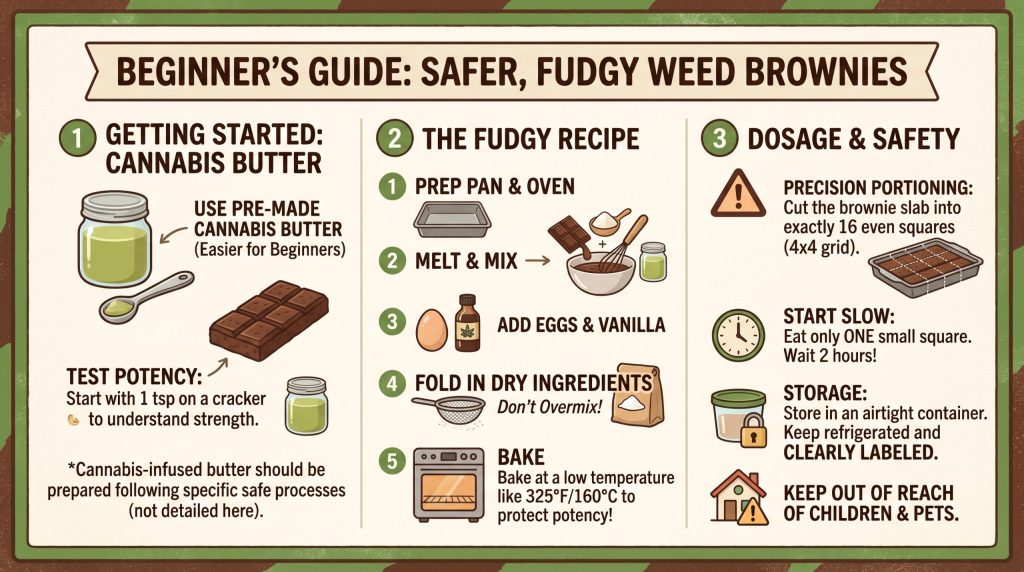
For a fudgy 20 cm (8-inch) pan, you’ll combine 1/2 cup total fat, ordinary butter plus a measured amount of labelled cannabis butter, with sugar, eggs, vanilla, cocoa, flour, and salt. Bake at 160°C (325°F) for roughly 24 to 30 minutes, cool completely, and divide the pan into clearly marked portions. You can substitute a compatible commercial cannabis oil, but only according to its label and without increasing the recipe’s total fat.
Important: Cannabis rules, purchase limits, possession rules, and public-use restrictions differ by province, territory and municipality. Use this information only where lawful. Keep every infused ingredient and finished brownie locked away from children and pets. Never drive after consuming cannabis.
You’ll find the practical baking details below, along with texture fixes, storage guidance, label interpretation, and what to do if someone eats a brownie accidentally. Think of this as a brownie guide with a safety manual baked in, not a challenge to discover how much THC you can tolerate. Start cautiously, keep the chocolate excellent, and let patience do the unglamorous but essential work.
Key Takeaways
- A reliable weed brownie recipe uses commercially prepared, laboratory-tested cannabutter or cannabis oil to ensure accurate THC dosing and responsible consumption.
- Maintain total fat at 1/2 cup by combining unsalted butter with cannabis-infused butter or oil to preserve brownie texture and potency consistency.
- Bake brownies at 160°C (325°F) for 24–30 minutes in a 20 cm (8-inch) metal pan, and cool completely before cutting into clearly marked, small portions to manage dosing safely.
- Start with low doses and wait at least four hours before consuming more to avoid overconsumption due to delayed edible effects.
- Store weed brownies securely in labelled, child-resistant containers away from children, pets, and ordinary food to prevent accidental ingestion.
- Never drive or operate machinery after eating cannabis brownies, and avoid mixing with alcohol or other impairing substances for safety.
Weed Brownie Recipe Overview
This weed brownie recipe makes a dark, fudgy 20 cm (8-inch) pan using a tested, ready-to-use cannabis ingredient. Before mixing anything, read that product’s package for total THC, serving size, storage directions, and whether it is intended for cooking. If the label is missing or unclear, don’t guess.
For the brownie batter, use:
- 1/2 cup total fat, combining unsalted butter with your measured, commercially prepared cannabutter
- 1 cup granulated sugar
- 2 large eggs
- 1 teaspoon vanilla extract
- 3/4 cup unsweetened cocoa powder
- 1/2 cup all-purpose flour
- 1/4 teaspoon fine salt
- Optional: 1/2 cup chocolate chips or chopped walnuts
Heat the oven to 160°C (325°F). Line a 20 cm (8-inch) square metal pan with parchment. Melt the fats together gently, remove them from the heat, and whisk in the sugar. Add eggs and vanilla: whisk until glossy. Fold in cocoa, flour, and salt just until no dry streaks remain. Spread the batter evenly, bake, and cool completely before portioning.
Recipe Information: Prep Time, Baking Time, Cooling, and Yield
| Detail | Estimate |
|---|---|
| Preparation | 15 minutes |
| Baking | 24–30 minutes |
| Cooling | At least 2 hours |
| Pan | 20 cm (8-inch) square metal pan |
| Yield | 16 small squares |
Yield isn’t the same thing as dose. Sixteen equal-looking squares may still have slightly different cannabinoid concentrations, particularly if the fat wasn’t dispersed evenly. Keep portions small, label them clearly, and avoid serving these alongside ordinary brownies.
A glass pan holds heat differently and may require a modest timing adjustment. If that’s all you own, begin checking early rather than automatically adding baking time. A 23 cm (9-inch) pan produces thinner brownies and generally finishes faster.
What to Expect: Chocolate Flavour and Fudgy Versus Cakey Texture
Cocoa supplies a strong chocolate base that can soften, but not reliably conceal, the herbal or bitter notes of some cannabis fats. Dutch-process cocoa tastes mellow and dark; natural cocoa tends to taste sharper. Either works here because the recipe doesn’t depend on baking soda for lift.
For fudgy brownies, avoid extra flour and stop baking while moist crumbs still cling to a toothpick. The centre should look set rather than liquid, and the edges may pull slightly from the pan. If you prefer cakier brownies, whisk the eggs a little longer and bake toward the upper end of the range. Don’t add flour casually: even a few heavy spoonfuls can turn a tender brownie into chocolate drywall. Nobody invited that.
Ingredients and Equipment Overview
Brownies are forgiving, but they aren’t magic. Measuring accurately is especially useful here because fat affects both texture and cannabinoid distribution. A digital scale, an oven thermometer, and a light-coloured metal pan remove much of the guesswork.
Core Brownie Ingredients and Their Baking Functions
Each ingredient has a specific assignment:
- Fat carries flavour, creates tenderness, and provides the recipe’s cannabis component.
- Sugar sweetens, retains moisture, and helps form a shiny top.
- Eggs bind the batter and build structure.
- Cocoa powder supplies concentrated chocolate flavour without adding much sugar.
- Flour gives the brownies enough structure to slice.
- Salt and vanilla round out bitterness and deepen the chocolate flavour.
Measure flour by weight, about 60 grams for 1/2 cup, or spoon it lightly into the cup and level it. Scooping directly from a packed bag can add enough flour to make the brownies dry. Keep the total fat at 1/2 cup: adding cannabis butter on top of that amount may create a greasy, unstable batter as well as an unexpectedly stronger product.
Essential Equipment, Pan Sizes, and Parchment Paper
You’ll need a mixing bowl, whisk, flexible spatula, measuring tools, small saucepan or microwave-safe bowl, and a 20 cm (8-inch) square metal pan. A digital scale is helpful, while an instant-read thermometer can confirm that the centre has reached roughly 93°C (200°F) without being baked into oblivion.
Line the pan with parchment, leaving two overhanging sides as handles. Lightly grease exposed corners. The sling lets you lift the cooled slab out and make more consistent cuts.
Pan size is not cosmetic. A 23 × 33 cm (9-by-13-inch) pan spreads this quantity too thin: doubling the batter is a better match for that size, although cannabinoid calculations and labelling must also be reconsidered. Dark nonstick pans brown edges quickly, so check several minutes early.
Optional Nuts, Chocolate Chips, and Common Allergens
Chocolate chips contribute pockets of sweetness and chopped walnuts or pecans add crunch. Keep additions to about 1/2 cup so the batter remains cohesive. For even pieces, chop nuts to roughly chocolate-chip size and distribute them thoroughly.
Common allergens include wheat, eggs, milk, soy, peanuts, and tree nuts. Chocolate chips frequently contain milk or soy lecithin, while facilities may process other allergens. Read every package rather than trusting the front label.
If you’re sharing, disclose all ingredients before anyone accepts a piece. “It only has a few walnuts” isn’t useful to a person with a serious allergy. Use clean equipment and separate preparation areas when cross-contact is a concern: simply removing visible nuts afterward does not make a brownie safe.
Understanding Cannabis Ingredients
Cannabis ingredients can look deceptively familiar. A jar of infused butter resembles ordinary butter, yet a tablespoon may contain multiple servings. Keep the original package beside you while measuring, and never transfer the ingredient into an unlabelled household container.
Cannabutter Versus Cannabis Oil: Ingredient Differences
Commercial cannabutter behaves much like dairy butter, although its water content and flavour can vary. Cannabis oils may use coconut oil, MCT oil, or another carrier. That affects texture: coconut oil firms when cool, while liquid oils can produce a softer or greasier brownie.
Use only a product labelled as food-compatible, and follow its storage and heating instructions. Replace part of the ordinary fat rather than adding extra fat. If a concentrate isn’t explicitly intended and labelled for culinary use, this recipe isn’t the place to experiment.
Also check whether a product is already activated and ready to eat. Regulated edible ingredients commonly are, but assumptions are risky. Baking does not transform an unknown product into a reliably measured one.
THC Versus CBD: Effects, Impairment, and Label Claims
THC is intoxicating and may alter coordination, reaction time, perception, memory, and judgment. It can also cause anxiety, rapid heart rate, dizziness, or nausea, particularly at an unexpectedly high dose. CBD generally isn’t intoxicating in the same way, but it can cause drowsiness, interact with medications, and affect how your body processes certain drugs.
A product labelled “1:1” ordinarily refers to a ratio of THC to CBD, not one milligram of each. Read the actual milligram amounts per package and serving.
Labels don’t guarantee that two people will have the same experience. Food intake, tolerance, metabolism, medications, and prior cannabis exposure all matter. Beginners should seek lower-dose regulated options and follow local public-health guidance rather than copying a friend’s serving.
Why Tested Product Labels Matter More Than Strain Names
Names such as Blue Dream or Girl Scout Cookies may suggest an expected aroma or effect, but they don’t establish the cannabinoid content of your finished brownie. Strain naming is inconsistent across growers and markets, and oral cannabis behaves differently from inhaled cannabis.
A useful label identifies total THC and CBD, amount per serving, package total, ingredients, allergens, batch or lot number, testing information, and expiry or packaging date. In regulated markets, scan any required verification code or consult your provincial or territorial cannabis regulator if authenticity is questionable.
Testing still has limits, including sampling variation and allowable tolerances. Even so, a traceable regulated product gives you better evidence than a strain nickname, someone’s memory, or the classic “my cousin said it’s mild” measurement system.
Baking Quality and Troubleshooting
Most brownie failures come from small decisions: packed flour, an oversized pan, frantic mixing, or the irresistible urge to bake “five more minutes.” You can prevent nearly all of them by measuring carefully and watching the batter rather than relying only on the timer.
How Mixing and Ingredient Temperature Affect Brownie Texture
Let extremely hot melted fat cool until warm before adding eggs; otherwise, you may create sweet scrambled eggs. Room-temperature eggs blend more readily, but cold eggs aren’t fatal: add them one at a time and whisk thoroughly.
Whisk the sugar into the warm fat, then beat in the eggs until the mixture looks smooth and glossy. Once flour enters, switch to a spatula and fold only until dry pockets disappear. Aggressive mixing develops gluten and can make brownies tough or oddly elastic.
Scrape the bowl’s bottom and sides several times. This isn’t merely good baking practice: thorough, controlled mixing may improve ingredient distribution. Still, mixing cannot make homemade cannabinoid content perfectly uniform, so portion estimates remain estimates.
Recognizing Doneness Without Drying Out the Brownies
Start checking at 24 minutes. Look for a set surface, slightly puffed edges, and a centre that no longer ripples when the pan moves gently. Insert a toothpick between the centre and edge. Moist crumbs are ideal; liquid batter needs more time; a completely clean toothpick may indicate overbaking.
Bake in two- or three-minute increments after the first check. Residual heat continues cooking the centre after the pan leaves the oven.
Ovens routinely run hotter or cooler than their display suggests, so a basic oven thermometer can solve recurring problems. Don’t taste raw batter to evaluate it. Raw flour and eggs may carry harmful bacteria, and cannabis effects won’t appear immediately enough to make tasting a sensible dosing tool.
Cooling and Cutting for Clean, Consistent Portions
Cool the brownies in the pan until they reach room temperature, usually around two hours. For especially neat cuts, refrigerate the cooled slab for 30 to 60 minutes. Lift it out by the parchment and place it on a cutting board dedicated to the task.
Measure before cutting. For 16 pieces, mark four equal rows in each direction. Wipe the knife between passes, or use a plastic knife, which sometimes drags less through fudgy interiors.
Consistent dimensions support more cautious portioning, but they don’t prove equal THC content. If pieces are intended for individual storage, wrap and label each one immediately. Loose, unlabelled squares in the refrigerator are a preventable accident waiting to happen.
Common Causes of Dry, Crumbly, Greasy, or Sunken Brownies
| Problem | Likely cause | Better approach next time |
|---|---|---|
| Dry or crumbly | Too much flour or excessive baking | Weigh flour; check earlier |
| Greasy surface | Too much fat or incomplete emulsification | Maintain total fat; whisk eggs well |
| Sunken centre | Underbaking or abrupt temperature change | Bake until the centre is set |
| Tough texture | Overmixing after adding flour | Fold gently and stop early |
| Burned edges | Dark pan or hot oven | Use light metal; verify temperature |
A slightly sunken fudgy brownie may still taste good if it is fully baked, but a wet, gummy middle should return to the oven promptly. Don’t try to “fix” greasiness by sprinkling flour onto finished batter: flour won’t disperse properly. Take notes instead. Baking has receipts.
Potency, Portioning, and Edible Safety
The safest mindset is simple: potency is a risk-management issue, not a baking flex. Use a regulated ingredient with a readable label, document what went into the pan, and choose conservative portions. If reliable information isn’t available, don’t serve the batch.
A rough label-based estimate can be calculated as:
Labelled milligrams of THC used ÷ number of portions = theoretical milligrams per portion
For example, if a measured ingredient contributes 40 labelled milligrams to a pan cut into 16 pieces, the mathematical estimate is 2.5 milligrams per piece. That number is not a laboratory result for each brownie. Product tolerances, residue left on utensils, heat exposure, mixing, and uneven cuts can all change what someone consumes.
Why Homemade Potency Estimates Are Uncertain
Home kitchens can’t confirm cannabinoid concentration or uniformity. Even when the original product was tested, you may measure imperfectly, leave fat in a saucepan, lose batter on a spatula, or cut unequal pieces. Heat can also degrade cannabinoids, but not in a way that makes the final amount easy to predict.
Calculators may produce impressive decimal places, 2.47 milligrams looks very official, but precision on the screen doesn’t remove uncertainty in the pan. Treat calculations as planning aids, not guarantees.
For people with little or no THC experience, public-health agencies commonly advise starting with a low amount and waiting before taking more. Follow the product label and your province’s or territory’s guidance. When dependable dosing is essential, individually packaged, regulated edibles are generally easier to evaluate than homemade brownies.
Why Equal-Sized Brownies May Not Contain Equal THC
Cannabinoids travel with the fat phase, and batter is not a pharmaceutical manufacturing line. If infused fat pools, sticks to the bowl, or isn’t fully incorporated, one square may contain more than its neighbour. Add-ins can also make equal cutting harder.
Stir deliberately, scrape the bowl, spread the batter level, and use a ruler when portioning. These steps improve consistency: they don’t certify it. Never promise a guest that every piece contains an exact amount unless the finished product itself has been appropriately tested.
Delayed Onset, Long-Lasting Effects, and Premature Redosing
Edible THC may take 30 minutes to two hours, or longer, to become noticeable, and effects can last six hours or more. Timing varies with the person, meal, product, and dose. The familiar mistake goes like this: nothing seems to happen after 45 minutes, a second brownie looks reasonable, and both servings arrive later like badly scheduled buses.
Don’t redose quickly. Follow the product’s directions and Health Canada’s guidance, which notes that it can take up to 4 hours to feel the full effects of edibles; cautious users may choose to wait several hours or until another day before adjusting. Set a phone note recording the time and amount consumed. You may feel forgetful later, which is precisely when that note becomes useful.
Plan a calm environment and clear your schedule. Edibles are a poor match for surprise errands, childcare duties, power tools, swimming, or anything requiring quick judgment.
Avoiding Driving, Alcohol, and Other Impairing Substances
Do not drive, cycle in traffic, operate machinery, cook over open flame, or perform safety-sensitive work after consuming THC. Feeling “mostly fine” isn’t a reliable measure of reaction time. Arrange a sober ride before consumption, not after impairment begins.
Alcohol can intensify impairment and unpleasant effects. Sedating medicines and other substances may also interact with cannabis. Avoid combining them unless a qualified clinician who knows your medications has advised otherwise.
A useful house rule is that one sober adult remains responsible when children, pets, travel, or emergencies are in the picture. And remember: coffee, cold showers, and fresh air may make you feel more awake, but they don’t instantly reverse THC impairment.
Who Should Avoid Cannabis and When to Ask a Clinician
Children and adolescents should not consume these brownies. Avoid cannabis during pregnancy and breastfeeding: THC can reach the fetus and pass into breast milk. People with a history of psychosis, severe anxiety reactions, significant cardiovascular disease, or substance-use concerns should seek individualized medical guidance.
Ask a clinician or pharmacist before using cannabis if you take blood thinners, seizure medicines, sedatives, or drugs with meaningful liver-enzyme interactions. Older adults and people prone to falls may be particularly sensitive to dizziness and impaired balance.
If you use medical cannabis, your health care practitioner’s plan takes priority over a general recipe. Don’t stop prescribed medication or substitute brownies for treatment without professional advice. In Canada, Health Canada’s cannabis health information provides additional safety context.
What to Do After Accidental Ingestion or an Unexpected Reaction
If someone ate an infused brownie accidentally, first determine who, what, how much, and when. Keep the packaging and ingredient label. Move the person to a quiet, safe place and don’t let them drive or walk around unassisted if dizzy.
In Canada, call your local poison centre at 1-844-POISON-X (1-844-764-7669) for case-specific guidance (in Quebec, call the Centre antipoison du Québec at 1-800-463-5060). Call 911 immediately for difficulty breathing, seizure, collapse, severe confusion, chest pain, unresponsiveness, or other life-threatening symptoms. Children and pets deserve prompt professional assessment; contact a veterinarian or animal poison service for an exposed animal.
Don’t induce vomiting unless a professional directs you. Reassure an anxious adult, reduce stimulation, and stay with them. Fear can amplify an unpleasant experience, but reassurance must not replace medical help when warning signs appear.
Storage, Labelling, and Responsible Sharing
Storage isn’t an afterthought. Once cannabis enters a familiar food, appearance alone can’t protect anyone. Your system should make accidental access difficult and intentional use unmistakable.
Refrigeration, Freezing, Thawing, and Signs of Spoilage
After complete cooling, place brownies in an airtight container and follow the cannabis ingredient’s storage directions. As a conservative quality guideline, refrigerate for up to about five days or freeze individual portions for up to two months. Local health guidance and the ingredient label should take precedence.
Wrap frozen pieces separately, then place them inside a labelled, child-resistant outer container. Thaw a portion in its wrapping in the refrigerator or at room temperature, away from children and pets. Avoid repeated freeze-thaw cycles, which damage texture and invite handling mistakes.
Discard brownies with visible mould, an unusually sour or rancid smell, sliminess, pest exposure, or damaged packaging. Freezing preserves food: it does not make questionable food safe or stabilize cannabinoid potency forever.
Child-Resistant Storage Away From Children, Pets, and Ordinary Food
Use a locked box or cabinet, ideally inside a child-resistant container. Store it high and out of sight, but don’t rely on height alone: children climb, and dogs have impressive commitment when chocolate is involved.
Keep infused brownies separate from ordinary snacks and retain the original cannabis package. Don’t use a cartoon-covered lunch box, familiar cookie tin, or resealable bag that suggests normal food. Chocolate itself is toxic to dogs, while cannabis can also cause serious poisoning in animals.
A simple household check helps:
- Is the container locked?
- Does it clearly say cannabis and THC?
- Is it separate from regular food?
- Can visitors, children, or pets reach it?
- Does another responsible adult know what it contains?
Clear Cannabis Labels, Informed Consent, and Provincial Legal Restrictions
Label the container with “CONTAINS CANNABIS/THC,” the preparation date, ingredients, allergens, estimated amount per portion, number of portions, and a warning not to drive. Add “Keep away from children and pets.” Never label an estimate as laboratory-confirmed.
Tell an adult exactly what the brownie contains before offering it, and let them decline without pressure. A wink and “these are special” is not informed consent. Don’t leave infused food on a shared dessert table, bring it to work, mail it, or take it across the Canadian border, which is illegal even when travelling to or from a place where cannabis is legal.
In Canada, adults can make cannabis food at home for personal use, as long as dangerous organic solvents aren’t used, and can share up to 30 grams of dried cannabis or its equivalent with other adults. Rules on public consumption, transport, and possession are also set by provinces, territories, and municipalities, so check your provincial or territorial rules before preparing or sharing them. Selling homemade cannabis food is illegal under the Cannabis Act, even though adult possession is legal.
Frequently Asked Questions
These final questions address three assumptions that cause a surprising number of problems: that oven heat destroys THC, dietary substitutions erase every allergen, and cannabis brownies are always obvious by smell.
Does Baking Eliminate THC or Make Potency Predictable?
No. Normal brownie baking does not reliably eliminate THC, and you shouldn’t use heat as a detoxification method. Some cannabinoids may degrade during storage or heating, but the amount varies with temperature, time, oxygen exposure, product composition, and other conditions.
Baking also doesn’t make an untested infusion predictable. A final calculation remains limited by the accuracy of the source label, measurement, mixing, losses, and portion size. If you no longer want a cannabis brownie, secure it until you can follow local disposal guidance; don’t overbake it and assume it has become ordinary food.
Are Gluten-Free or Vegan Brownies Automatically Allergen-Free?
No. A gluten-free flour blend may contain or encounter soy, milk, nuts, sesame, or other allergens. Vegan chocolate can share equipment with milk products, and many egg substitutes contain legumes or other ingredients that matter to allergic consumers.
For gluten-free brownies, use a certified gluten-free one-to-one baking blend and verify every ingredient, including cocoa and cannabis products. For vegan brownies, choose a tested brownie formula designed around an egg substitute rather than removing eggs from this recipe and hoping for the best. Eggs provide structure and emulsification, so a casual swap can leave you with an oily chocolate puddle.
Dietary preference and allergy safety are separate questions. If severe allergy or celiac disease is involved, account for cross-contact in utensils, pans, counters, and storage containers.
Can You Tell Whether a Brownie Contains Cannabis by Its Taste or Smell?
Not reliably. Some cannabis oils and butters taste grassy, peppery, or bitter. Others are refined or strongly masked by cocoa, espresso powder, vanilla, and chocolate chips. A normal taste hence proves nothing, while an herbal taste doesn’t reveal THC concentration.
That uncertainty is why labelling and locked storage carry so much weight. Never invite someone to identify an infused brownie by sampling it, and don’t place infused and ordinary batches on matching plates.
A responsible weed brownie recipe ends with restraint, not just a clean knife. Use tested ingredients, measure conservatively, wait patiently, prevent driving, and lock every portion away. If you can’t verify the label, protect vulnerable people, or comply with your provincial rules, skip the infused batch and bake the same fudgy recipe with ordinary butter. Excellent chocolate needs no explanation, and safety is always the better finishing touch.