
Blog 2026
Greening Out: Symptoms, Causes, and What to Do
Nov
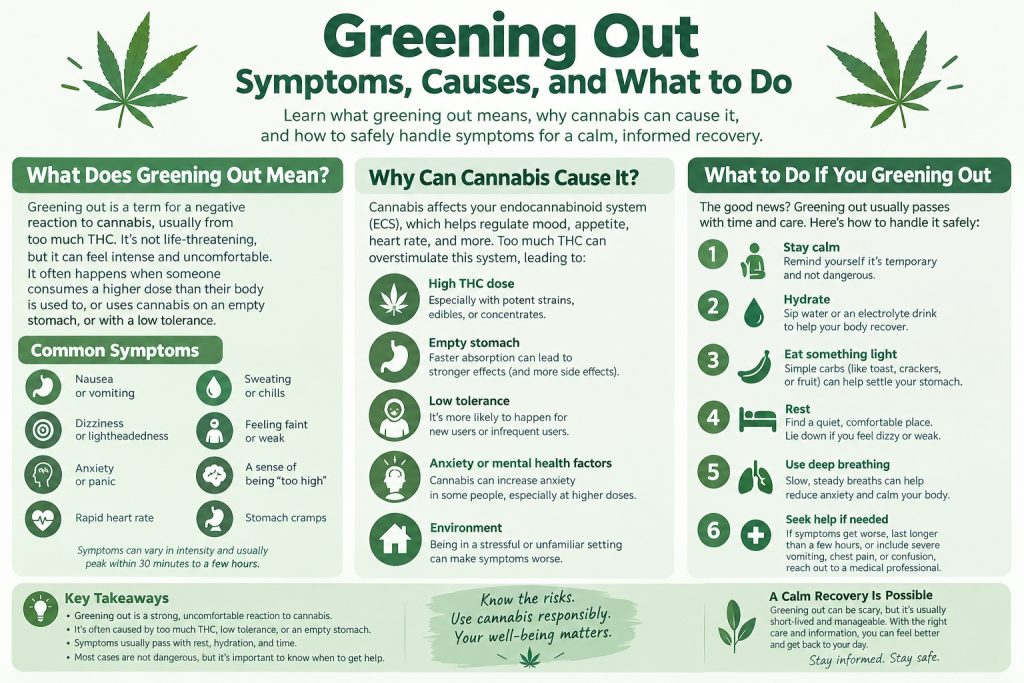
If you’ve ever watched someone suddenly turn pale, panic, sweat, or insist that time has stopped after using cannabis, you may have witnessed a greening out. The phrase sounds almost playful, but the experience can feel intensely frightening. It usually refers to an unpleasant reaction to cannabis, often after consuming too much THC, taking an edible before the first dose has kicked in, or mixing cannabis with alcohol.
Most green outs improve with time, reassurance, and a calm environment. Still, cannabis can affect people very differently, and some symptoms overlap with genuine medical emergencies. That’s why knowing what to watch for matters more than trying to “sleep it off” automatically.
This guide explains what greening out means, why it happens, how long it may last, and how to help someone safely. You’ll also learn when to contact a poison centre or seek emergency care. The information is educational, not a diagnosis: if you’re worried about someone’s breathing, consciousness, chest pain, or safety, call emergency services rather than guessing.
Key Takeaways
- Greening out refers to an unpleasant, often intense reaction to cannabis caused by consuming too much THC, mixing cannabis with alcohol, or taking edibles incorrectly.
- Symptoms of greening out can include nausea, dizziness, sweating, anxiety, confusion, and panic, and require calm reassurance and safe supervision rather than judgment.
- High-potency cannabis products and delayed edible effects increase the risk of greening out, so start with low doses and wait before consuming more, especially with edibles.
- If someone is greening out, stop cannabis use, move to a quiet safe place, stay with them, offer small sips of water if alert, and monitor for emergency warning signs.
- Seek immediate medical attention for severe symptoms such as difficulty breathing, seizures, chest pain, unresponsiveness, or repeated vomiting – these are beyond a typical green out.
- To help prevent greening out, avoid mixing cannabis with alcohol or other drugs, use regulated products responsibly, and avoid cannabis when tired, stressed, or anxious.
What Does Greening Out Mean?
Greening out is an informal term for an uncomfortable or distressing reaction to cannabis, particularly THC. It isn’t a formal medical diagnosis, and people use the phrase somewhat broadly. One person may mean intense dizziness and nausea: another may mean panic, vomiting, confusion, or feeling as though they might faint.
THC can influence coordination, blood pressure, heart rate, perception, memory, and anxiety. When the dose is more than your body can comfortably handle, those effects may arrive all at once. You might feel clammy, notice your heart pounding, or become convinced something is seriously wrong. The sensation can be overwhelming even when the episode is not life-threatening.
A green out is different from simply feeling pleasantly high. It’s the point where the experience becomes physically or psychologically distressing. The trigger may be a potent vape, a homemade edible with an uncertain dose, several drinks followed by cannabis, or simply taking more because the first dose seemed to do nothing.
The safest response is practical rather than judgmental: stop using cannabis, move somewhere quiet, stay with the person, and monitor their condition. Never assume every severe reaction is “just weed.”
Why Does Greening Out Happen?
A green out usually results from too much THC for that person, at that moment. Tolerance, body size, metabolism, food intake, sleep, anxiety, and the product itself can all change the experience. Even someone who regularly uses cannabis can react badly to a stronger-than-expected product.
High-THC cannabis products
Modern cannabis products can contain far more THC than older flower traditionally associated with casual use. Concentrates, cartridges, infused pre-rolls, wax, shatter, and some premium flower may deliver a large amount quickly. A few pulls from a high-potency vape can feel modest at first and then become overpowering.
THC percentage also doesn’t tell you exactly how much reaches your bloodstream. Inhalation technique, product quality, and how deeply you inhale matter. Still, higher-potency products generally leave less room for error, especially if you’re new to cannabis or returning after a long break.
Edibles and delayed effects
Edibles are a classic setup for accidental overconsumption. After you eat cannabis, your body processes THC through the digestive system and liver. Effects may take 30 minutes to two hours, or sometimes longer, to become obvious. If you decide the first gummy “isn’t working” and take another, both doses can arrive together.
The result may last much longer than expected. Edibles can also feel different from smoked cannabis, including stronger changes in perception, anxiety, and physical coordination. A product labelled “10 mg” may mean 10 mg for the entire package or 10 mg per serving, so read the label carefully.
Low tolerance or consuming more than intended
Tolerance can fall quickly after a break. A dose that felt manageable months ago may feel surprisingly strong today. Beginners may also misjudge a puff, forget how many times they inhaled, or share a drink or edible without knowing its strength.
Your setting matters, too. Being tired, dehydrated, hungry, stressed, or already anxious can make cannabis effects harder to manage. None of this means you did something morally wrong: it simply means your body’s response exceeded your comfort zone.
Mixing cannabis with alcohol or other substances
Alcohol can intensify cannabis effects and make dizziness, nausea, poor judgment, and vomiting more likely. Mixing cannabis with prescription sedatives, opioids, stimulants, or other drugs creates additional risks and makes it harder to identify what is causing symptoms.
A common mistake is drinking first and then using cannabis because the combination feels familiar. The opposite order can be risky too. If someone has used multiple substances and becomes difficult to wake, breathes abnormally, has a seizure, or turns blue or grey, treat it as an emergency, not an ordinary green out.
Greening Out Symptoms to Recognize
Symptoms vary from person to person and may build gradually or appear suddenly. A person can be awake and talking while feeling extremely unwell. Stay observant rather than focusing on whether the reaction “looks dramatic.”
Physical symptoms
Common physical signs include:
- Nausea or vomiting
- Dizziness, lightheadedness, or feeling faint
- Sweating, chills, shaking, or clammy skin
- Fast heartbeat or awareness of a pounding heart
- Dry mouth and red eyes
- Poor balance and slowed coordination
- Headache or unusual fatigue
- Pale appearance or weakness
- Changes in blood pressure, sometimes causing near-fainting
Some people lie down because standing makes the dizziness worse. If they feel faint, help them sit or lie safely on their side. Don’t let them wander near stairs, traffic, balconies, hot surfaces, or water.
Psychological symptoms
Psychological symptoms may include anxiety, panic, paranoia, confusion, racing thoughts, distorted time, and an intense fear of dying or losing control. Short-term memory can become patchy, so the person may ask the same question repeatedly. That isn’t necessarily defiance: their attention and recall may be impaired.
You may hear statements such as, “My heart is going to stop,” or “I can’t feel time.” Arguing forcefully rarely helps. A calm, simple response, “You’re having a strong reaction, you’re safe, and I’m staying with you”, is usually more useful.
Watch for symptoms that go beyond a typical cannabis reaction, including inability to wake the person, severe breathing problems, seizure, chest pain, one-sided weakness, serious injury, or dangerous agitation. Those signs require urgent medical attention.
How Long Does Greening Out Last?
There is no precise countdown. Duration depends on the dose, product, route of use, tolerance, metabolism, and whether alcohol or other substances were involved. A person may feel the worst effects for a few hours and remain tired, foggy, or anxious afterward.
How long symptoms can last after smoking or vaping
Inhaled cannabis acts relatively quickly. Effects often begin within minutes, peak during the first hour or so, and gradually ease over several hours. A mild green out after smoking may improve within two to four hours, but stronger products can cause noticeable effects for six hours or longer. Anxiety and fatigue may linger after the main intoxication fades.
Do not use the clock as your only safety test. Someone who is still very sleepy but wakes normally and breathes comfortably may need quiet observation. Someone who is becoming less responsive needs medical help, even if several hours have passed.
How long symptoms can last after edibles
Edible effects usually start later and last longer. Symptoms may continue for six to twelve hours, with residual grogginess or mental fog into the next day after a large dose. In some cases, the experience lasts even longer, particularly with concentrated products or multiple servings.
Avoid taking more cannabis to “smooth out” the feeling. There’s no reliable home shortcut that instantly reverses THC. Time, supervision, hydration when appropriate, and a low-stimulation environment are usually the most useful measures.
What to Do If Someone Is Greening Out
Your job isn’t to perform a dramatic detox. It’s to reduce immediate risks, keep the person calm, and notice signs that require professional help.
Stop using cannabis and move to a calm, safe place
Have the person stop consuming cannabis. Move away from crowds, loud music, bright lights, traffic, cooking appliances, and water. A quiet room with comfortable seating is ideal. If they feel faint, help them sit or lie down: don’t let them stand suddenly.
Keep the environment cool and reassuring. Lower the music, limit the number of people talking, and put away phones if everyone is filming or commenting. One calm helper is often better than a semicircle of worried friends.
Stay with them and offer reassurance
Stay nearby and speak slowly. Use short, honest statements: “You took cannabis, and it may be causing these feelings. I’m here with you. We’ll check your breathing and get help if needed.” Avoid promising that nothing can possibly be wrong.
Ask simple questions, such as their name, what they took, roughly how much, and when. If they can answer normally, that information may help a poison centre or clinicians. Don’t interrogate them or threaten punishment: fear can make panic worse and may cause them to hide important details.
Offer small sips of water if they are alert
If the person is awake, sitting up safely, and swallowing normally, offer small sips of water. A dry mouth can feel miserable. Don’t force fluids, and don’t give anything by mouth to someone who is unconscious, extremely drowsy, actively vomiting, or having trouble swallowing.
A light snack may be reasonable for an alert person who wants one, but food is not an antidote. Avoid caffeine, more alcohol, and unverified “sobering” remedies.
Keep them from driving or using more substances
Take away car keys and prevent biking, swimming, climbing, or operating equipment. Arrange a sober adult to remain with them. Do not let them use more cannabis to counter anxiety, drink alcohol to sleep, or take someone else’s medication.
If they vomit, help them lean forward or turn onto their side rather than lying flat on their back. Check that they continue breathing normally.
Contact a poison centre or a healthcare professional for advice
In Canada, you can call your regional poison centre at 1-844-POISON-X (1-844-764-7669), or the Centre antipoison du Québec at 1-800-463-5060 in Quebec. The service is free and available 24 hours a day. Specialists can discuss the product, dose, timing, age, symptoms, and other substances involved. You don’t need to wait until the situation becomes dramatic.
For an urgent but non-life-threatening concern, contact a healthcare professional or local urgent-care service. Call 911 immediately for severe symptoms, loss of consciousness, breathing trouble, seizure, chest pain, or another emergency warning sign.
What Not to Do During a Green Out
Good intentions can accidentally create more danger. Avoid these common responses:
- Don’t leave the person alone. They could fall, vomit, wander into traffic, or become less responsive.
- Don’t make them “walk it off.” Walking won’t remove THC and may worsen dizziness or cause a fall.
- Don’t induce vomiting. It can cause choking or aspiration, especially if the person is drowsy.
- Don’t give coffee, energy drinks, cold showers, or more drugs. These can intensify anxiety, strain the heart, or create new risks.
- Don’t restrain them unless there is an immediate safety threat. Physical force can increase panic and injury.
- Don’t dismiss their fear. Saying “You’re fine” may feel invalidating. Offer calm reassurance without making guarantees.
- Don’t let them sleep unsupervised if they’re unusually difficult to wake. Normal rest is different from impaired consciousness.
If you’re uncertain, call a poison centre or emergency services. Asking for help is not “overreacting”: it’s a sensible safety decision.
When to Get Emergency Medical Help
Warning signs that need urgent attention
Call 911 or your local emergency number if the person has any of the following:
- Trouble breathing, irregular breathing, or blue, grey, or very pale skin
- Loss of consciousness or inability to wake normally
- A seizure
- Severe chest pain, collapse, or a dangerously irregular heartbeat
- Repeated vomiting with inability to keep fluids down
- Severe confusion, extreme agitation, hallucinations with unsafe behaviour, or inability to recognize danger
- A serious fall, head injury, choking, or possible poisoning involving other drugs
- Signs of a stroke, such as facial drooping, one-sided weakness, or trouble speaking
- Suicidal statements or an immediate risk of self-harm
Put the phone on speaker and follow the dispatcher’s instructions. Tell responders what was taken, how much you think was used, when it happened, and whether alcohol, medications, or other drugs were involved. Accurate information helps clinicians choose safer treatment: it is more important than avoiding embarrassment.
If the person is unconscious but breathing, place them on their side if you can do so safely and monitor their breathing. If they aren’t breathing normally, begin emergency first aid as directed by the dispatcher. Don’t put food, water, or objects in their mouth.
Is Greening Out the Same as a Cannabis Overdose?
Not exactly. Greening out is a casual term for an unpleasant cannabis reaction. “Cannabis overdose” can imply a toxic exposure involving too much THC, but it isn’t used as consistently as terms such as alcohol poisoning or opioid overdose.
A fatal overdose from cannabis alone is considered unlikely, but that does not make a severe reaction harmless. High doses can cause extreme anxiety, vomiting, confusion, impaired coordination, fast heart rate, and dangerous accidents. Children who accidentally ingest cannabis products require prompt professional advice, even if they initially appear okay.
The bigger concern may be what else was taken. Alcohol, opioids, sedatives, stimulants, prescription drugs, and contaminated or mislabelled products can change the risk substantially. You can’t reliably identify the substance from appearance alone.
Think of the label as less important than the symptoms: if someone is difficult to wake, breathing abnormally, having a seizure, or suffering chest pain, call emergency services. Don’t wait for a debate over whether the experience qualifies as a “green out.”
Can Greening Out Cause Long-Term Effects?
For most adults, an isolated green out resolves without permanent physical effects. Temporary anxiety, poor concentration, fatigue, headache, or a lingering sense of unease can continue after the main intoxication has ended. A frightening episode may also make you more anxious the next time you notice a fast heartbeat or altered sensation.
Long-term risk depends on more than one unpleasant evening. Repeated heavy cannabis use, especially beginning in adolescence, is associated with concerns involving attention, learning, mental health, and dependence. Cannabis can also worsen psychosis-related symptoms in vulnerable people. That doesn’t mean one green out predicts a permanent disorder, but persistent paranoia, hallucinations, severe depression, or major changes in behaviour deserve professional evaluation.
Physical harm can happen indirectly. Falls, crashes, burns, choking, and impaired decisions are real risks while intoxicated. If vomiting, confusion, anxiety, or unusual behaviour continues well beyond the expected window, contact a clinician or a poison centre. Keep a note of the product, estimated amount, timing, and other substances: memory is unreliable during a frightening event.
If the episode has changed how safe you feel using cannabis, that’s worth taking seriously. A healthcare professional can discuss your symptoms confidentially and help you decide whether stopping, reducing, or getting support is appropriate.
How to Help Prevent Greening Out
There is no guaranteed way to predict your reaction, but you can reduce avoidable risk. The safest choice is not to use cannabis, particularly if you’re pregnant, underage, taking interacting medication, or have a personal or family history of psychosis. If you choose to use it, make decisions before you’re intoxicated.
Choose a low dose and be cautious with high-THC products
Start with a small amount, especially after a break. Be wary of concentrates, high-THC vapes, infused beverages, and products with unclear labelling. A low-THC or balanced THC/CBD product may feel more manageable for some people, but “balanced” does not mean risk-free.
Use a legal, regulated product where available, and read the serving size rather than guessing from the package. Don’t assume a friend’s preferred dose will suit your body.
Wait before taking more, especially with edibles
With inhaled cannabis, wait and assess before taking another hit. With edibles, wait much longer, often at least two hours, and preferably follow the product’s guidance, because effects can arrive late. Keep cannabis away from children and pets, and store edibles in their original, clearly labelled packaging.
Write down what you consumed and when. It sounds nerdy, but a note in your phone can prevent the classic “Wait, did I already take one?” mistake.
Avoid combining cannabis with alcohol or other drugs
The simplest rule is one substance at a time. Don’t mix cannabis with alcohol, sedatives, opioids, stimulants, or unknown pills. Use only in a familiar place with someone you trust, and have a sober ride plan before starting.
Skip cannabis when you’re exhausted, severely stressed, dehydrated, or already panicky. If you repeatedly experience panic, vomiting, or loss of control, consider stopping and discussing it with a healthcare professional rather than trying to outsmart the reaction.
Greening Out in Teens: What Parents and Caregivers Should Know
Teens may be especially vulnerable because the brain is still developing, product strength can be confusing, and peer pressure can encourage rapid or repeated use. Cannabis edibles can also resemble ordinary candy, creating an accidental-ingestion risk at home.
If you suspect a teenager is greening out, focus first on safety. Use a calm voice, remove access to more substances, stay with them, and ask what they took without turning the moment into a lecture. Call a poison centre at 1-844-POISON-X (1-844-764-7669), or 1-800-463-5060 in Quebec, for guidance, or call 911 for emergency symptoms. Tell clinicians the truth about cannabis and any other substances: secrecy can delay appropriate care.
Once the immediate episode has passed, revisit the conversation when everyone is calm. Ask what happened, how much they think they used, and whether anyone pressured them. Explain that products vary widely and that delayed edibles are a frequent reason people take too much. Set clear storage rules, particularly for gummies and beverages.
Watch for ongoing changes: declining school performance, secrecy, withdrawal, mood changes, frequent use, or using cannabis to cope. Those signs don’t prove a substance-use disorder, but they’re reasonable reasons to involve a family doctor, paediatrician, counsellor, or adolescent substance-use specialist.
Frequently Asked Questions About Greening Out
Can CBD stop or reduce greening out?
CBD is sometimes marketed as a counterbalance to THC, but it is not a reliable emergency antidote. Research on CBD’s effect on acute THC anxiety is mixed, products vary in quality, and adding another substance can complicate the situation. Don’t give CBD to someone who is very drowsy, vomiting, confused, or having emergency symptoms. Use calm support and contact a poison centre or a healthcare professional instead.
Can secondhand cannabis smoke cause greening out?
Typical brief exposure to secondhand cannabis smoke is unlikely to cause a severe green out in an adult, especially in a ventilated space. But, heavy exposure in an enclosed area may cause symptoms such as headache, dizziness, or irritation, and children, pets, pregnant people, and people with breathing conditions deserve extra protection. Move into fresh air. If symptoms are significant, persistent, or involve breathing difficulty, seek medical advice.
Can symptoms last until the next day?
Yes. After a strong dose, particularly an edible, you may feel tired, foggy, anxious, or mildly nauseated the next day. Don’t drive, work at heights, or operate machinery while impaired. Rest, eat normally if you can, and avoid more cannabis or alcohol. Symptoms that are severe, worsening, or not gradually improving should be assessed by a healthcare professional. Persistent hallucinations, chest pain, trouble breathing, inability to wake, or repeated vomiting need urgent care.
Greening Out: The Practical Bottom Line
A green out can feel terrifying, but most cannabis-related reactions improve when you stop using the product, move somewhere quiet, offer calm reassurance, and allow time to pass. Don’t add alcohol, caffeine, more cannabis, or questionable home remedies. Keep the person away from driving, water, heights, and other hazards.
The key safety skill is knowing when the situation is no longer something to monitor at home. Trouble breathing, unresponsiveness, seizures, chest pain, severe agitation, repeated vomiting, serious injury, or suspected mixing with other drugs are reasons to call emergency services. In Canada, your regional poison centre at 1-844-POISON-X (1-844-764-7669), or 1-800-463-5060 in Quebec, can provide free, case-specific guidance 24 hours a day.
If you’ve had a green out yourself, treat it as useful information, not a personal failure. Reconsider the dose, product, setting, and combinations that led there. Sometimes the clearest takeaway is also the simplest: your body gave you a very firm “no thanks.”