
Blog 2026
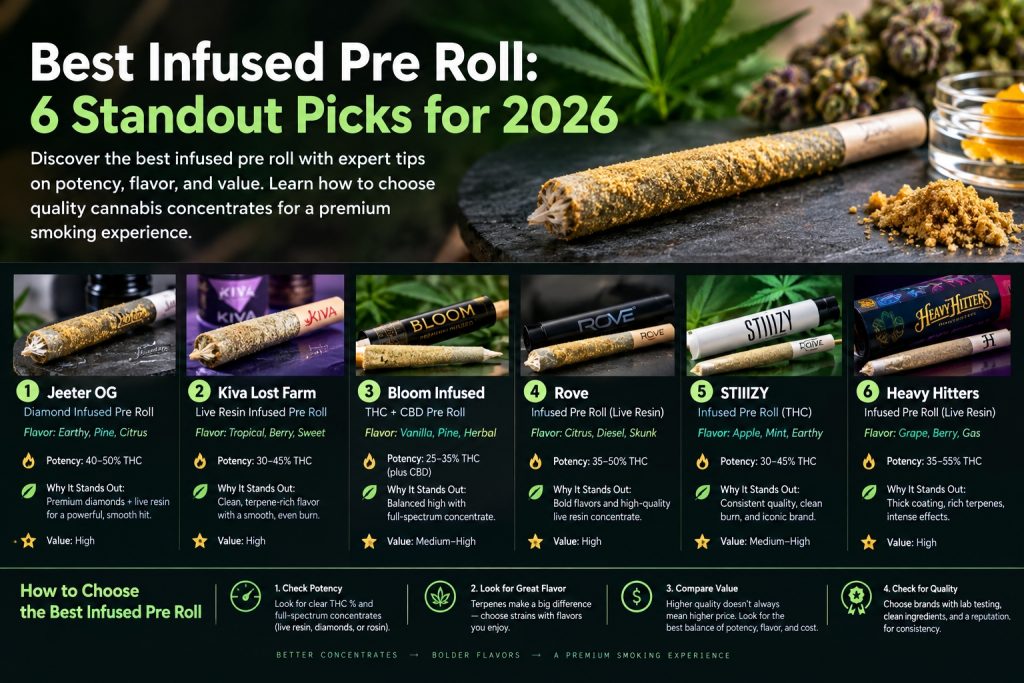
Best Infused Pre Roll: 6 Standout Picks for 2026
Nov
An infused pre-roll can turn a five-minute smoke into a surprisingly serious commitment. One minute, you’re admiring a neat little joint dusted with kief: the next, you’re wondering why the snack cupboard feels 12 metres away.
That extra intensity comes from combining cannabis flower with a concentrate such as hash, rosin, live resin, distillate, or THCA diamonds. Done well, the result delivers fuller flavour, a slow burn, and more potency than an ordinary pre-roll. Done badly, it tastes artificial, clogs halfway through, or burns down one side while expensive concentrate drips onto your shoe. Not exactly the premium experience promised on the tube.
This best infused pre roll review compares widely distributed product lines and formats rather than pretending one batch is identical nationwide. Cannabis markets are fragmented: formulations, prices, lab results, and even products sold under the same brand can change by province, licensed producer, and harvest date. So, every recommendation below is conditional on checking the package and batch-level certificate of analysis, or COA, where one is available.
Our shortlist emphasizes recognizable ingredients, fresh flower, credible testing, sensible construction, and value, not simply the largest THC number printed in shiny type. You’ll also learn how distillate differs from rosin, why “liquid diamonds” can be a fuzzy marketing term, and how to spot an infused joint that may burn like a tiny canoe.
Review disclosure: Kush Station sells cannabis products, including infused pre-rolls. The picks below are product formats, not brands, and no brand paid for placement or reviewed this guide. Because inventory and testing records change constantly, treat listed prices and potency ranges as shopping benchmarks, not permanent specifications. Cannabis can impair you: you must be of legal age in your province or territory, and you should follow provincial and local rules.
Key Takeaways
- The best infused pre roll balances quality flower, high-grade concentrate, consistent burn, and flavour without relying solely on THC percentage.
- Verify infusion ingredients and batch-specific lab results for transparency before purchasing to ensure potency, safety, and flavour authenticity.
- Consider your tolerance and occasion when choosing infused pre rolls; minis suit short sessions, while high-potency options are better for experienced users.
- Different infusion types like distillate, live resin, and solventless rosin affect flavour, cost, and smoking experience—choose based on your flavour preference and budget.
- Proper storage keeps infused pre rolls fresh and prevents burning issues like clogging or uneven burn, enhancing your smoking session.
- Responsible use is critical: start with small doses, avoid mixing substances, and never drive impaired to ensure safety.
Find the best infused pre roll: Quick Comparison of Top Picks
The strongest candidate isn’t automatically the best one. A well-built 35% total-THC hash joint can taste better and burn more predictably than a 50% product soaked in distillate. These picks represent product formats with notable strengths: availability varies substantially by province.
| Category | Product line to check | Typical infusion | Why it stands out | Common drawback |
|---|---|---|---|---|
| Best overall | 0.5-gram concentrate-and-kief minis that list every input | Concentrate plus kief | Consistent small format and broad flavour selection | Added flavour may overwhelm flower |
| Best value | Moon-rock-style pre-rolls and blunts, compared by price per gram | Distillate and kief | High potency for the purchase price | Dense construction can burn unevenly |
| Best solventless | Rosin- or ice-water-hash-infused pre-rolls | Cannabis rosin or ice water hash | No hydrocarbon-derived concentrate: flower-forward profile | Higher price and limited availability |
| Best flavour | Small-batch craft infused releases that name the flower and the hash or resin | Product-dependent: verify package (often ice water hash or cured resin) | Premium-flower focus and expressive profiles | Small drops sell out quickly |
| Best high potency | Liquid-diamond or distillate-and-kief infused pre-rolls | Liquid diamonds/distillate plus kief, depending on product | Strong, widely recognized infused format | Not suitable for low tolerance |
| Best minis | Infused mini multipacks | Concentrate and kief | Shareable mini portions in a resealable pack | Flavouring and packaging add cost |
Expect roughly C$12–C$30 for a single infused joint or small pack, before tax, in Canada. Prices differ by province because provincial distribution and markups shape the category, and infused pre-rolls are taxed like cannabis extracts, based on their total THC. Compare the actual gram weight, not just the number of joints.
How We Evaluate Products: Evidence, Scoring, and Review Disclosures
Our evaluation framework gives ingredient and batch transparency more weight than branding. Products are assessed across five areas: flower and concentrate quality (30%), lab documentation and labelling (25%), construction and expected burn performance (20%), flavour integrity (15%), and price-adjusted value (10%).
This is an editorial market review, not a controlled laboratory trial or a claim that every listed batch was personally smoked. Rankings synthesize regulated labels, manufacturer disclosures, retailer menus, extraction information, product construction, and recurring consumer observations. Brand claims are treated as claims unless supported by batch-specific evidence.
Batch-Level Lab Results, Flower Quality, Ingredients, and Freshness
A useful label identifies the producer, licence number, lot, packaging date, cannabinoid content, and ingredients. A linked COA should match that lot and report more than potency. Depending on what the producer publishes, look for screening of pesticides, microbes, heavy metals, residual solvents, and mycotoxins.
Whole-flower language is encouraging, but it doesn’t prove quality. “Premium flower” can still mean dry material, while “indoor” says nothing about freshness. Favour a recent packaging date, an intact seal, and clearly named infusion, such as cold-cured rosin or bubble hash, instead of unexplained “premium oil.”
External kief should look evenly applied. Excessive oil stains, crumbling paper, or a stale hay aroma suggest poor storage or construction.
Burn Consistency, Flavour, Price, and Availability: Hands-On Findings vs. Brand Claims
A brand may promise a slow, even burn, but physical design controls whether that happens. Uniform filling, moderate density, a centred concentrate line, and an unobstructed filter matter more than gold leaf or dramatic packaging.
When credible hands-on reports repeatedly mention clogging, harshness, or canoeing, that pattern informs our assessment, but it doesn’t establish that every batch is defective. Storage, lighting technique, and humidity also affect performance.
Flavour is judged by whether the flower and concentrate remain identifiable. Candy-like intensity can be enjoyable, yet it shouldn’t be mistaken for natural cultivar expression. For value, divide the pre-tax price by total grams, then consider concentrate type. A C$28 rosin-infused gram may offer better ingredient value than a C$20 distillate-coated gram, even if its THC number is lower.
Top Infused Pre-Roll Picks by Category
There’s no universal winner because your ideal product depends on tolerance, flavour preferences, session size, and local inventory. The following recommendations identify a practical starting point in each category. Always confirm the current package: brands sometimes reformulate familiar product names without much fanfare.
Best Overall: Balanced Quality, Flavour, and Burn Performance
A 0.5-gram concentrate-and-kief mini earns the overall nod as a format: it’s widely available, easy to portion, and more manageable than a full-size infused joint. Its infused flower and kief coating create a slower, more forceful session than a standard mini joint.
The caveat is important: many varieties lean unapologetically sweet. If you want flower flavour rather than a watermelon-cloud experience, inspect the ingredients for added botanical terpenes or flavouring. Potency also varies by batch.
For a better burn, light the entire circumference without inhaling, let the cherry establish, and take short draws. Pulling like you’re trying to start a lawn mower can overheat the concentrate and clog the tip.
Best Value: Quality and Transparent Pricing per Gram
Moon-rock-style pre-rolls and blunts often provide competitive potency-per-dollar, particularly when compared by gram rather than package price. The familiar moon-rock formula, flower, concentrate, and kief, delivers a dense, slow-smoking product without entering luxury hash-hole pricing.
Value depends on the menu. A C$25 one-gram joint costs C$25 per gram: a C$42 two-pack totalling 1.5 grams costs C$28 per gram. Taxes can scramble the apparent bargain, so compare out-the-door totals.
Moon-rock-style material is sticky and can restrict airflow. Check that the paper isn’t visibly saturated and store the tube upright. If premium solventless flavour matters more than sheer strength, spending a little more on rosin may make sense.
Best Solventless Option: Rosin and Bubble Hash Picks
Look first for pre-rolls that name rosin or ice water hash as the infusion. Rosin is produced using heat and pressure rather than hydrocarbon solvents, and the best solventless lines pair that concentrate with named cannabis flower.
“Solventless” doesn’t mean harmless or chemical-free: combustion still creates irritants, and cannabis plants naturally contain many compounds. It simply describes how the concentrate was separated.
Check whether the package says rosin, live rosin, or hash, because those aren’t interchangeable. Also inspect the date. Terpene-rich rosin loses its aromatic edge with heat and time, turning a potentially nuanced purchase into a pricey, vaguely toasted joint.
Best for Flavour: Flower and Concentrate Quality Over Added Aromas
Small-batch craft infused releases deserve attention when the label clearly pairs quality flower with hash or resin. The appeal is less about syrupy flavouring and more about recognizable cannabis character, pepper, citrus peel, fuel, or damp earth, depending on the cultivar and batch.
Because releases change, don’t buy solely on a brand name. Read the infusion method and terpene declaration, then check the packaging date through your provincial retailer. Some drops may be more flower-forward than others.
Whatever the brand, prioritize a fresh live-rosin or bubble-hash joint that names both inputs. If the ingredient panel lists flavouring agents or botanical terpenes, expect a louder but less cultivar-faithful taste.
Best High-Potency Option for Experienced Consumers
Liquid-diamond and distillate-and-kief infused pre-rolls are designed for intensity. Depending on the product, they may combine flower with concentrate marketed as liquid diamonds or distillate, often with added terpenes, followed by a kief coating. Batch totals can reach well beyond ordinary flower potency.
That strength comes with trade-offs: added flavours may dominate, the experience can become uncomfortable if you overshoot, and “liquid diamonds” isn’t a standardized scientific category. Verify whether the ingredient is THCA-derived oil, distillate, sauce, or a blend.
If you’re experienced, you still don’t need to finish one. Take one modest puff, extinguish it carefully, and reassess after 10–15 minutes. Competitive smoking belongs in cartoons, not your patio.
Best Small-Format Option: Mini Pre-Rolls and Multipacks
Infused mini multipacks make portioning easier than a single full-size infused joint. Check the pack for the number and weight of the minis, because package sizes differ by province and release. The resealable container is useful when you want one short session without leaving a large joint half-smoked.
Minis also work better for sharing across separate occasions, but don’t confuse “mini” with mild. Their infused construction can deliver considerably more THC than a standard half-gram pre-roll.
Before paying a premium for convenience, compare net weight and ingredients with other concentrate-and-kief minis. And check local freshness: five beautifully branded minis that have spent a year beside a warm store window are no bargain.
What Is an Infused Pre-Roll, and How Does It Compare With a Regular Joint?
A regular pre-roll contains ground cannabis flower wrapped in paper, usually with a filter or crutch. An infused pre-roll adds concentrated cannabis material, increasing cannabinoid density and often changing flavour, airflow, price, and burn speed.
| Feature | Regular pre-roll | Infused pre-roll |
|---|---|---|
| Contents | Primarily flower | Flower plus concentrate or sifted trichomes |
| Typical strength | Usually lower | Usually higher, but verify the label |
| Burn | Simpler and more predictable | Often slower: more prone to clogging |
| Flavour | Mostly flower-driven | Can be richer or heavily flavoured |
| Price | Lower | Higher |
“Infused” doesn’t guarantee premium inputs. It describes construction, not quality. Poor flower covered in strong oil is still poor flower wearing a fancy coat.
How Infused Pre-Rolls Are Made: Internal Infusion, External Coating, and Concentrate Cores
Internal infusion distributes oil, hash, or kief through ground flower. This can produce fairly consistent potency, though too much sticky concentrate restricts airflow. External products coat the paper with oil and roll it in kief, the classic fuzzy “moon rock” look. They’re visually impressive but messy and vulnerable to uneven burning.
A concentrate-core joint places a narrow line of rosin or resin through the centre. When rolled properly, the core melts into a visible ring around the cherry, inspiring the term donut or hash hole. These usually require more flower and concentrate, so they cost more.
No method is inherently best. Internal infusion suits compact minis: hash holes reward slow group sessions: external coatings prioritize impact and presentation.
Infusion Types Compared: Ingredients, Flavour, Potency, and Cost
Extraction language can feel like alphabet soup after three menu pages. Focus on the input material, separation method, added ingredients, and batch date.
| Infusion | Typical character | Relative cost | Main question to ask |
|---|---|---|---|
| Distillate | Potent, neutral base: often flavoured | $ | Are terpenes or flavours added? |
| Live resin | Aromatic, extract-rich | $$ | Was it produced by a licensed processor? |
| Live rosin | Solventless and terpene-forward | $$$ | How fresh is it? |
| Bubble hash/kief | Traditional, flower-adjacent | $$ | Is it evenly distributed? |
| Diamonds | High cannabinoid concentration | $–$$$ | What does the brand mean by “diamonds”? |
Distillate-Infused Pre-Rolls: Added Terpenes and Ingredient Transparency
Distillate is a highly refined cannabis extract concentrated through distillation. It can supply substantial THC while contributing little cultivar-specific aroma on its own. Producers hence often add cannabis-derived terpenes, botanical terpenes, or flavouring.
That doesn’t automatically make distillate inferior. It can deliver predictable potency at a lower price, and plenty of consumers genuinely enjoy bold grape or peach profiles. Transparency is the dividing line.
Look for an ingredient panel that distinguishes concentrate from added terpenes and flavour ingredients. Avoid assuming a strain name proves the oil came from that cultivar. “Blue Dream” may describe the intended flavour profile rather than a traceable single-source extraction.
Live Resin vs. Live Rosin: Extraction Methods and Flavour Differences
Live resin is commonly made from fresh-frozen cannabis using a hydrocarbon solvent, often butane or propane, in a licensed closed-loop system. Proper purging and regulated residual-solvent testing are essential. It tends to preserve aromatic compounds that are lost when flower is dried and stored.
Live rosin also begins with fresh-frozen material, usually processed into ice-water hash and then pressed with heat and pressure. No hydrocarbon solvent is used. Production yields can be lower, helping explain the premium price.
Both can taste excellent. Live rosin isn’t automatically tastier, and live resin isn’t automatically unsafe. A fresh, skilfully produced resin may outperform old rosin. Let the batch date, test results, producer reputation, and your palate settle the argument.
Hash, Bubble Hash, and Kief: How These Infusions Differ
Kief is loose trichome material sifted from cannabis. It’s economical and easy to sprinkle through flower, though purity varies. Green-looking kief may contain more plant matter and taste harsher than pale, clean sift.
Hash compresses or otherwise processes separated trichomes. Bubble hash specifically uses ice water, agitation, and fine filter bags to separate trichome heads. Higher-quality “full-melt” hash leaves little residue when heated, although pre-roll producers may use less refined grades suitable for combustion.
These infusions often retain a traditional cannabis taste without the candy-shop intensity of flavoured distillate. They can still canoe if clumped unevenly. A uniform blend or precisely centred hash core generally behaves better than random sticky chunks.
THCA Diamonds, Caviar, and Hash Holes: Concentrates vs. Product Formats
THCA diamonds are crystalline concentrations of tetrahydrocannabinolic acid. Heat converts THCA into psychoactive THC through decarboxylation. Diamonds may be crushed into flower or blended with terpene-rich sauce: “liquid diamonds” often refers to a processed liquid formulation, but the term lacks one universal definition.
Caviar usually describes flower coated or infused with concentrate and kief. Some brands use it interchangeably with moon rocks, while others reserve “moon rocks” for whole buds.
A hash hole is a joint format, not an extraction type: flower surrounds a central cylinder of rosin or hash. In other words, diamonds and hash describe ingredients: caviar and hash holes usually describe finished-product construction. Ask what’s actually inside, the nickname alone won’t tell you.
How to Choose an Infused Pre-Roll for Your Preferences and Budget
Start with the occasion. A 0.5-gram mini makes more sense for a short solo session than a two-gram hash hole built for several experienced adults. Next, choose your priority: natural flavour, maximum potency, solventless processing, or lower cost. You usually can’t maximize all four.
Use this quick checklist at the counter:
- Confirm the package is sealed and recently dated.
- Identify every flower, concentrate, terpene, and flavour ingredient.
- Match the lot to available test results.
- Calculate price per gram after tax.
- Choose a portion appropriate for the least-tolerant participant.
If the budtender can’t explain what “premium infusion” means, that mystery shouldn’t command a premium price.
Read THC Labels and Certificates of Analysis: Why Higher THC Is Not Always Better
Labels may list THC, THCA, or total THC. A commonly used estimate is total THC = THC + (THCA × 0.877), accounting for the molecular weight lost during decarboxylation. On Canadian labels, the THC and total THC figures already account for THCA conversion, so compare those numbers rather than redoing the math.
Potency testing has limitations. Sampling may not perfectly represent a sticky, unevenly infused batch, and laboratory incentives have prompted regulatory scrutiny in several jurisdictions. Treat a 44% label as an estimate, not a promise carved into stone.
Higher THC can mean more anxiety, dizziness, nausea, or impairment without delivering better flavour. Review contaminant results, ingredients, freshness, and serving size alongside potency. Your best experience may come from a balanced hash joint, not the menu’s numerical champion.
Compare Terpenes and Ingredients Without Relying on Strain Labels or Guaranteed Effects
Terpenes contribute aroma, limonene can smell citrusy, pinene forest-like, and caryophyllene peppery, but a terpene name doesn’t guarantee a specific emotional or medical effect. Human responses depend on dose, individual biology, tolerance, setting, and the product’s complete chemical profile.
Likewise, “indica” and “sativa” labels are unreliable shortcuts. Two products with the same strain name may have different genetics and chemistry, especially across unrelated producers.
Choose by sensory preference and documentation. If you dislike perfumed vapour, avoid products listing added botanical flavour. If you want cultivar expression, seek named flower paired with single-source live rosin or resin. Be skeptical of promises that one joint will reliably create sleep, creativity, romance, or sudden expertise in jazz.
Compare Price per Gram, Pack Size, Taxes, and Packaging Dates
Divide the out-the-door price by total cannabis weight. Suppose one 1-gram infused joint costs C$32 after tax, while five 0.5-gram minis cost C$55. The single costs C$32 per gram: the pack costs C$22 per gram. The pack is cheaper by weight, provided you actually want 2.5 grams.
Then account for infusion quality. Rosin commands more because its production is labour-intensive: distillate generally shouldn’t carry the same premium without an exceptional reason.
Check packaging dates before chasing a clearance sticker. Older products may be dry, muted, or more prone to cracking. A discounted joint that tastes like scorched cardboard isn’t frugal, it’s just a small, smoky lesson in false economy.
Where to Check Legal Availability: Licensed Retailers, Local Stock, and Current Prices
Check your province’s or territory’s list of authorized cannabis retailers before trusting a storefront or delivery service. Licensed retailer menus, official brand store locators, and provincial online stores can help identify stock, but call ahead: menus lag, batches sell out, and similarly named products create confusion.
At pickup, confirm that the product name, weight, ingredients, lot, and advertised price match your order. Avoid social-media sellers offering shipping across the border, no age check, or branded products at suspiciously low prices. Counterfeit packaging can look convincing.
Prices quoted online may exclude excise duty, GST/HST or PST, or delivery fees. Ask for the final total before making a long trip. Nothing tests inner peace quite like crossing town for a “C$25” joint that becomes C$39 at checkout.
Canadian Rules: Age Requirements, Possession Limits, and Infused Pre-Roll Caveats
Canada permits adult-use cannabis under the federal Cannabis Act, but minimum ages, retail systems, public-use rules, and some possession details differ by province or territory. The minimum age is 19 in most of Canada, 18 in Alberta, and 21 in Quebec. Buy through authorized provincial or licensed private channels. Taking cannabis into or out of Canada is illegal, even to or from a place where it’s legal.
Health Canada treats a pre-roll fortified with kief, hash, or oil as a cannabis extract product, not dried cannabis. That matters in three ways. Extract packages are capped at 1,000 mg of THC. They count more heavily toward the 30-gram public possession limit, because 1 gram of dried cannabis equals 0.25 grams of extract, so a 1.5-gram infused pack counts as 6 grams. And the 10 mg THC limit you may have heard about applies to edibles, not to pre-rolls. Inhaled extracts may contain flavouring agents but not sugars, sweeteners, or colouring agents, and their packaging can’t suggest confectionery, dessert, soft drink, or energy drink flavours.
Products sold as hemp-derived delta-8 THC or THCA aren’t a loophole in Canada: Health Canada treats intoxicating cannabinoids such as delta-8 THC as cannabis under the Cannabis Act. “Ships nationwide” doesn’t prove legality, safety, or compliant testing. Check current federal, provincial, and municipal rules before ordering or travelling.
Responsible Use: High-Potency Risks, Delayed Effects, and Avoiding Impaired Driving
Infused pre-rolls can deliver a large dose quickly. If your tolerance is uncertain, choose regular lower-THC flower instead. Otherwise, take one small puff and wait at least 10–15 minutes before deciding whether to continue. Inhaled effects usually begin quickly, but intensity can keep building, especially when conversation distracts you from counting pulls.
Use in a calm setting with people you trust. Don’t combine cannabis with alcohol or other impairing substances. Keep products away from children and pets, and don’t use cannabis while pregnant or breastfeeding unless you’ve discussed the risks with a qualified clinician.
Never drive, cycle in traffic, operate machinery, or handle firearms while impaired. There’s no dependable trick, coffee, cold showers, and confidence included, that makes an impaired person safe to drive. Arrange a sober driver, taxi, rideshare, or overnight stay beforehand.
Seek urgent medical help for chest pain, trouble breathing, seizure, loss of consciousness, severe confusion, or persistent vomiting: call 911, or call your poison centre at 1-844-POISON-X (1-844-764-7669; in Quebec, 1-800-463-5060) for advice. If anxiety becomes uncomfortable, stop consuming, move somewhere quiet, hydrate normally, and stay with a calm sober person.
How to Store Infused Pre-Rolls and Recognize Stale or Damaged Products
Keep infused pre-rolls sealed, upright, and away from light, heat, moisture, children, and pets. A cool cabinet is usually better than a refrigerator, where condensation and food odours can cause trouble. Don’t leave the package in a hot car: concentrate may migrate into the paper or filter.
For opened multipacks, use the original child-resistant container or an airtight glass container with a small humidity-control insert designed for cannabis. Avoid direct contact between a humidity pack and a sticky external coating.
Watch for these warning signs:
- Stale: papery or hay-like aroma, brittle wrapper, muted flavour.
- Heat damaged: oil pooled near the tip, stained paper, warped joint.
- Too moist: difficult draw, repeated extinguishing, soft wrapper.
- Possible mould: fuzzy growth, musty basement odour, unusual webbing.
- Compromised: broken seal, missing label, mismatched lot information.
Don’t smoke a product that appears mouldy, contaminated, or tampered with. Return it to the licensed retailer and keep the package, receipt, and lot number for a complaint.
Frequently Asked Questions About Infused Pre-Rolls
These quick answers cover the practical questions that tend to appear only after you’re standing at the counter, squinting at six nearly identical tubes.
Are Infused Pre-Rolls Suitable for Beginners or People With Low THC Tolerance?
Usually, no. Concentrate can make a few puffs much stronger than expected, and uneven distribution makes precise dosing difficult. Beginners are better served by a small regular pre-roll with modest THC, clearly labelled flower, and no infusion.
If you nevertheless choose an infused product, select the smallest format, avoid chasing extreme potency, take one brief puff, and wait. Don’t consume alone, mix it with alcohol, or plan to drive. People with heart conditions, a history of psychosis, significant anxiety, or medication concerns should speak with a qualified health care professional before using cannabis. Your tolerance isn’t a character test: declining the nuclear mini joint is perfectly respectable.
Are Infused Pre-Rolls Always Stronger Than Regular Pre-Rolls?
Not always, though they usually contain more cannabinoids by weight. A lightly kief-infused joint can test lower than exceptionally potent uninfused flower, and label calculations differ among markets. Poor mixing can also create hot spots, making one section stronger than another.
Compare batch-level total cannabinoid results and net weight rather than relying on the word “infused.” Remember that concentration isn’t the full experience. Terpenes, minor cannabinoids, inhalation depth, tolerance, and session pace all influence perceived intensity. Most importantly, don’t interpret a lower percentage as permission to inhale aggressively: an infused product can still catch up with you after several quick pulls.
Do Infused Pre-Rolls Burn Longer, and Do Their Effects Last Longer?
They often burn more slowly because concentrate and tightly packed material reduce combustion speed. But construction matters: a dry, loosely filled infused joint may burn quickly, while an overloaded one may repeatedly go out.
Effects may feel stronger or last longer because you consumed more THC, not because infusion creates a special clock-extending property. Duration varies with dose, tolerance, physiology, and other substances. Inhaled cannabis effects commonly peak earlier and resolve sooner than edible effects, but meaningful impairment can persist after the most obvious sensation fades.
Plan conservatively. If you need to be sharp later, the safest schedule is not to use beforehand.
Why Do Some Infused Pre-Rolls Clog, Canoe, or Burn Unevenly?
Concentrate can melt toward the filter and obstruct airflow. Canoeing, when one side burns faster, can result from uneven packing, a crooked core, excess oil, wind, dry paper, or an incomplete initial light.
To reduce problems, store the joint upright, gently roll it between your fingers if the fill feels uneven, and light the full rim before drawing. Take slow, shallow puffs rather than forceful pulls. Rotate the joint occasionally and shelter it from wind. If one side races ahead, dampen the fast-burning edge very lightly and relight the lagging side.
Don’t poke deeply into a clogged infused joint: you may rupture the paper or push hot oil toward your mouth.
Are Infused Pre-Rolls Worth the Extra Cost?
They can be, if you value stronger sessions, concentrate flavour, portability, and not having to roll sticky ingredients yourself. Rosin or bubble-hash products may justify their premium through costly processing and expressive flavour. Multipacks can also reduce waste when portions are sensibly sized.
They’re poor value when artificial flavour masks stale flower, lab records are missing, or your tolerance means most of the joint goes unfinished. Regular flower plus a clean reusable device may be cheaper and easier to control.
The best infused pre roll is ultimately the fresh, transparently labelled product that fits your tolerance, not the loudest package or biggest percentage. Compare ingredients and price per gram, verify the batch, start with less than you think you need, and give the joint time to answer before taking another puff.