Nov
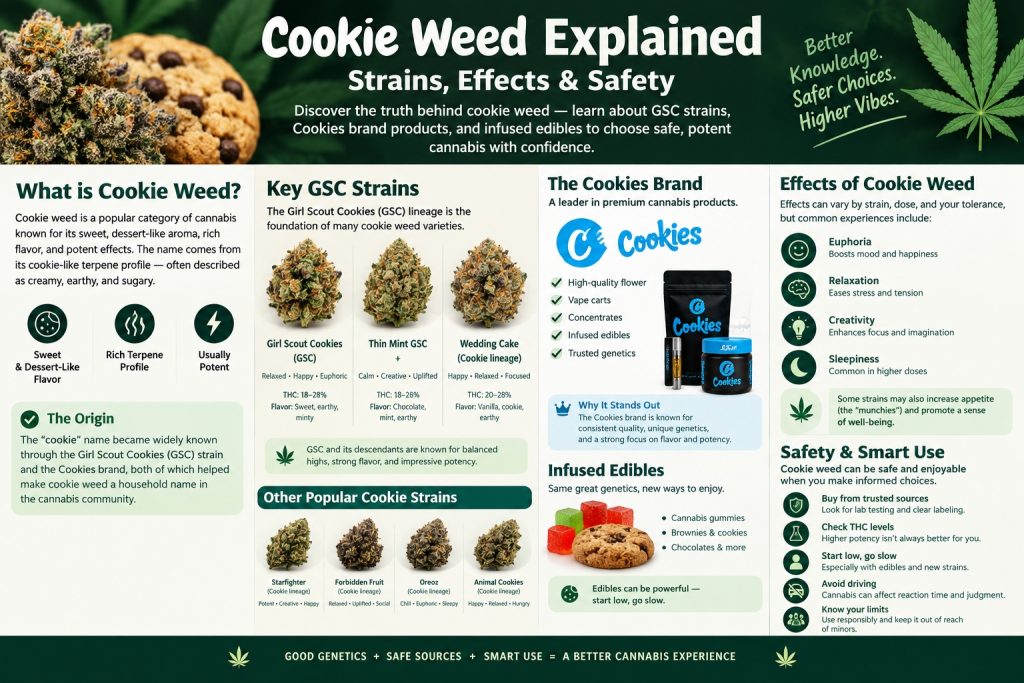
“Cookie weed” sounds straightforward until you try to buy it. One person may mean GSC flower, another may be talking about the Cookies cannabis brand, and someone else is picturing a chocolate-chip edible with THC inside. Those are very different products, with different effects, risks, legal rules, and serving considerations.
This review untangles the terminology without pretending every Cookies-related strain behaves identically. You’ll learn how GSC became connected to the modern Cookies brand, how popular cultivars such as Gary Payton compare, what THC and terpene labels can, and can’t, tell you, and how to evaluate flower or infused cookies before spending your money.
A quick boundary note: this is an educational review, not medical advice or an endorsement of cannabis use. Effects vary with dose, tolerance, genetics, medications, setting, and product quality. Cannabis laws also change quickly, so verify current rules in your province or territory. No cannabis products are recommended in this review, and no affiliate relationship influenced the comparisons.
If you’re a beginner, pay special attention to the edible-safety and label-reading sections. A frosted cookie can look harmless while containing several adult servings. That’s where people get into trouble, not because the brownie was plotting against them, but because delayed effects make it tempting to eat more.
The central lesson is simple: cookie weed isn’t one standardized product. The name may identify a brand, a genetics family, a strain nickname, or an edible. Before choosing anything, determine which meaning applies, check the package and laboratory report, and approach intoxicating products cautiously.
Key Takeaways
- “Cookie weed” is a broad term that can refer to GSC flower, Cookies brand cannabis products, related strains, or cannabis-infused edible cookies, each with distinct effects and legal considerations.
- GSC (Girl Scout Cookies) helped found the popular Cookies cannabis brand, but products under the Cookies name vary widely in genetics, potency, and experience.
- Always verify product details through packaging labels and lab reports to confirm THC/CBD levels, batch information, and testing for contaminants before purchase.
- Cannabis-infused cookies have delayed onset and longer duration than flower; beginners should dose cautiously to avoid accidental overconsumption.
- Check provincial or territorial laws, retailer licensing, and product authenticity to ensure safe, legal purchases; counterfeit packaging poses health risks due to unknown contents.
- Safe storage away from children and pets is essential, and never drive or operate machinery impaired by any Cookies cannabis product.
What Does “Cookie Weed” Mean?
In casual conversation, cookie weed usually refers to one of four things:
- GSC, formerly widely called Girl Scout Cookies
- A strain descended from or associated with GSC genetics
- Cannabis sold under the Cookies lifestyle and cannabis brand
- A baked cookie infused with THC, CBD, or both
The ambiguity matters. A jar labelled Cookies might contain branded flower such as Gary Payton, while a dispensary menu’s “Cookies” category may loosely group sweet, dessert-style genetics. Meanwhile, someone offering a “weed cookie” is probably referring to an edible, not a cultivar.
Names aren’t reliable chemical specifications. Two products carrying the same strain name can have different cannabinoid concentrations, terpene profiles, harvest dates, and effects. Treat the name as a starting clue, then verify the actual format and batch information.
The Cookies Cannabis Brand vs. Cookies-Family Strains
Cookies is a cannabis and apparel brand co-founded by Bay Area rapper and entrepreneur Berner, with breeder Jai often credited as a central genetics partner. The company operates through licensed markets and partnerships, although the exact products and operators differ by jurisdiction.
“Cookies-family strains” is a broader, less precise expression. It can refer to GSC descendants, cultivars bred or promoted by Cookies, or products using dessert-oriented names. Not every strain with cookie in its title is necessarily produced, licensed, or genetically authenticated by the brand.
Think of it like “cola”: it can indicate a specific trademarked product or a whole beverage category. Check the producer, licence information, cultivar lineage, batch number, and official market presence rather than relying on familiar blue packaging alone.
Cannabis Flower vs. Cannabis-Infused Cookies: Quick Comparison
| Feature | Cannabis flower | Cannabis-infused cookie |
|---|---|---|
| Typical label unit | THC/CBD percentage | Milligrams per serving and package |
| Onset | Usually within minutes when inhaled | Commonly 30 minutes to 2+ hours |
| Duration | Often a few hours | Frequently 6 hours or longer |
| Dose adjustment | Faster feedback, but easy to over-inhale | Measurable when regulated, but delayed |
| Main concern | Smoke exposure and rapid impairment | Redosing too soon and accidental ingestion |
Flower is dried cannabis intended for inhalation, generally by smoking or vaporization. Infused cookies are oral products that pass through digestion and liver metabolism. The experience can hence feel stronger, longer, or simply different, even when the label appears modest.
Neither format is risk-free. Smoking introduces combustion products, while edibles create a higher risk of delayed overconsumption. Your safest comparison starts with the label, not the dessert-like name.
The Origins of Cookies Cannabis
Cookies emerged from California’s cannabis culture, particularly the San Francisco Bay Area, where music, streetwear, breeding, and informal cannabis markets overlapped long before broad adult-use legalization. Berner helped turn a sought-after strain identity into recognizable branding, retail stores, apparel, and licensed product collaborations.
That origin story is commercially important, but it’s also difficult to document with laboratory-level certainty. Cannabis breeding happened for decades under prohibition, so pedigrees were often preserved through growers’ accounts rather than formal registries. Competing lineage stories aren’t unusual.
The brand’s growth also created a predictable side effect: imitation. Cookies-style bags and logos became easy to find online, including empty packaging that could be filled with unknown material. A polished pouch isn’t proof that its contents came through a regulated Cookies supply chain.
How GSC Genetics and the Cookies Brand Are Connected
GSC is commonly reported as a cross involving OG Kush and Durban Poison, although historical accounts and specific cuts vary. The cultivar developed a reputation for dense flower, high THC, and an aroma that could combine sweet dough, earth, spice, and fuel.
Its popularity gave the Cookies name cultural weight. That identity eventually expanded beyond one cultivar into a portfolio of branded genetics and collaborations. In other words, GSC helped build the foundation, but the modern Cookies catalogue isn’t just GSC sold under different labels.
Genetic labels deserve a little skepticism. Cannabis plants are commonly propagated through clones, yet mislabelled clones, seed variation, environmental stress, and different cultivation methods can produce noticeable differences. If lineage matters to you, look for breeder or producer details and compare the product’s laboratory profile, not just the strain story printed in elegant lettering.
Popular Cookies-Related Strains Compared
Cookies-related menus can feel like reading the dessert board after everyone has invented a nickname. GSC, Gary Payton, Gelato, Cereal Milk, London Pound Cake, the names are memorable, but they don’t guarantee a particular experience.
This comparison summarizes commonly reported lineages and sensory traits. Availability, chemistry, and naming can differ by market.
| Cultivar | Commonly reported lineage | Often-described aroma | General market position |
|---|---|---|---|
| GSC | OG Kush × Durban Poison | Sweet, earthy, minty, spicy | Widely recognized: many versions |
| Gary Payton | The Y × Snowman | Gas, herbs, pepper, sweetness | Frequently sold as premium flower |
| Gelato | Sunset Sherbet × Thin Mint GSC | Cream, fruit, citrus, fuel | Broadly available in legal markets |
| Cereal Milk | Y Life × Snowman | Sweet cream, fruit, dough | Popular but less universal |
| London Pound Cake | Often reported as Sunset Sherbet × unknown | Berry, citrus, cake, fuel | Lineage descriptions may vary |
GSC (Girl Scout Cookies): Lineage, Aroma, and Reported Effects
GSC is generally marketed as a high-THC hybrid. Consumers commonly describe an initial uplift followed by substantial physical relaxation, although those reports aren’t controlled clinical evidence. A low-tolerance user may instead experience dizziness, anxiety, or an unexpectedly heavy feeling.
The aroma often combines baked sweetness with earth, mint, pepper, or fuel. Those notes depend on volatile compounds, storage, cultivation, and your nose, one person’s cookie dough is another person’s damp forest floor.
GSC also illustrates why batch labels outrank strain mythology. One jar may test near 20% total THC while another exceeds 25%, depending on the producer and laboratory. Don’t assume the famous name makes it suitable for your tolerance. If you choose to use it, begin with a small amount and wait before taking more.
Gary Payton (GP20): Genetics, Flavour, and Reported Effects
Gary Payton, named after the Hall of Fame basketball player, is associated with Cookies and Powerzzz Genetics. It’s commonly described as a cross between The Y and Snowman. “GP20” may appear as a phenotype or selection reference, but labelling practices aren’t uniform across producers.
Its aroma is often sharper than the word Cookies suggests: pepper, diesel, herbs, earth, and a little sweetness. Reported effects frequently include mental intensity, sociability, and body relaxation. Again, that’s consumer language, not a promise.
Gary Payton flower is often positioned in the premium price tier and may carry high measured THC. Beginners shouldn’t interpret celebrity branding or a playful name as softness. If the label shows 25% THC, for example, that means roughly 250 milligrams of THCA/THC-related content per gram before accounting for conversion, losses, and consumption method, not that you’ll absorb all of it.
Other Cookies-Related Strains: Comparing Lineage, Flavour, and Availability
Gelato is one of the most widespread GSC-connected cultivars, commonly linked to Sunset Sherbet and Thin Mint GSC. It tends to be described as creamy, fruity, and slightly gassy. Because the name is used so broadly, Gelato from one producer may bear little resemblance to another.
Cereal Milk often leans sweet and creamy, with fruit or vanilla-like notes. London Pound Cake is typically presented as rich, berry-forward, citrusy, and fuel-tinged, although published lineage accounts differ. Apples and Bananas, another Cookies-associated name, is commonly marketed around bright fruit, spice, and gas.
Availability depends on provincial and territorial rules and on which producers carry a cultivar. California, where the brand started, may have a larger branded selection than a Canadian province with a different mix of producers. Instead of chasing a name across the country, compare licensed local options by freshness, chemistry, contamination testing, and retailer reputation. The less glamorous jar can sometimes be the better buy.
Cookies Cannabis Effects, Potency, and Flavour
Cookies cannabis products are often marketed around potency and bold flavour, but neither characteristic is consistent across every item. Flower chemistry changes with genetics, plant health, harvest timing, curing, storage, and analytical methods. Vape products and concentrates can be formulated very differently from flower carrying the same cultivar name.
Your response matters just as much as the product. Tolerance, food intake, sleep, anxiety level, other substances, and surroundings can shift an experience. A strain that one friend calls “creative” may leave you staring at the same streaming-service menu for 40 minutes. Human biology refuses to read marketing copy.
THC and CBD Levels: Why Potency Varies by Product and Batch
THC is the main intoxicating cannabinoid in cannabis. Raw flower contains substantial THCA, which converts to THC with heat. Labels may show separate values or “total THC,” often calculated using a conversion factor because THCA loses molecular weight during decarboxylation.
CBD is usually low in Cookies-associated high-THC flower unless the product has been specifically bred or formulated to include it. CBD doesn’t reliably cancel THC intoxication, and it can still cause side effects or interact with medications.
Laboratory values aren’t perfectly interchangeable. Sampling methods, moisture, measurement uncertainty, and lab practices can affect results. A one- or two-point difference may not be meaningful. Prioritize a credible certificate of analysis, clear serving information, freshness, and a cannabinoid profile appropriate for your tolerance rather than automatically selecting the highest number.
Terpenes and Sweet, Earthy, or Gassy Aromas: What They Can Tell You
Terpenes are aromatic compounds found in cannabis and many other plants. Cookies-related products may contain notable amounts of caryophyllene, limonene, myrcene, or linalool, but there’s no universal Cookies terpene recipe.
They can help you anticipate aroma:
- Caryophyllene: peppery, woody, spicy
- Limonene: citrus-like and bright
- Myrcene: earthy, herbal, musky
- Linalool: floral or lavender-like
Terpene data can distinguish batches that share a strain name, but don’t treat it like an effects horoscope. Claims that one terpene guarantees sleep or another ensures energy outrun current human evidence. Use the profile as a sensory and comparison tool. A muted smell, brittle texture, or hay-like aroma may also indicate age or poor storage, though appearance and smell can’t establish safety.
Possible Side Effects, Impairment, and Who Should Avoid Cannabis
Common short-term effects include impaired attention, slower reaction time, altered perception, dry mouth, red eyes, increased heart rate, anxiety, and poor coordination. Higher doses can cause panic, paranoia, vomiting, confusion, or, less commonly, psychotic symptoms requiring medical attention.
Avoid driving, cycling in traffic, swimming alone, operating machinery, or caring for someone who needs close supervision while impaired. Mixing cannabis with alcohol can intensify impairment and nausea.
People who are pregnant or breastfeeding, under the legal age, or at elevated risk of psychosis should avoid cannabis unless receiving individualized medical guidance. Anyone with cardiovascular disease, a history of severe reactions, or medications that may interact should consult a qualified clinician or pharmacist. Health Canada’s overview of cannabis health effects provides a useful summary of recognized risks.
Call 911 for chest pain, seizures, loss of consciousness, breathing difficulty, severe agitation, or dangerous behaviour.
How to Compare Cookies Cannabis Products
Start by comparing products within the same category. A 1-gram vape, an eighth-ounce of flower, and a 10-milligram edible package aren’t equivalent simply because all three say Cookies.
Use this quick buying sequence:
- Confirm that the retailer and producer are licensed.
- Identify the format and total package quantity.
- Check THC and CBD per serving, not only per package.
- Review the batch date and testing information.
- Examine ingredients, allergens, and storage instructions.
- Compare the final checkout price, including taxes.
Packaging quality and celebrity associations can raise the price without improving freshness. Your goal isn’t to win the highest-THC Olympics. It’s to choose a legal, clearly labelled product that fits your tolerance and intended setting.
Reading Labels and Lab Reports: Cannabinoids, Contaminants, and Batch Dates
In Canada, a legal cannabis label should identify the brand and manufacturer contact details, the lot number and packaging date, net quantity, total THC and CBD, the yellow health warning, and an excise stamp. Edibles should show THC per unit or per package and the number of units in the package.
When a certificate of analysis is available, match its batch number to your package. Review results for pesticides, microbial contamination, heavy metals, and residual solvents where relevant. Testing requirements vary by jurisdiction, so “lab tested” alone tells you very little.
Dates matter too. Flower gradually loses aroma and moisture, while improperly stored edibles may spoil. Be wary of QR codes that lead only to a homepage, reports without matching lot numbers, altered labels, or cannabinoid values that contradict the package. If a budtender can’t explain where the report came from, leave the mystery for a detective novel.
Is Cookies Cannabis Suitable for Beginners? Potency and Risk Considerations
Many Cookies-associated products are high in THC, so they may be unforgiving for someone without tolerance. That doesn’t mean every product is automatically unsuitable. It means beginners should compare actual chemistry and format instead of trusting a hybrid label or friendly flavour name.
For inhaled cannabis, one small inhalation followed by a generous pause provides more feedback than several quick hits. For regulated edibles, Health Canada advises choosing products with 2.5 milligrams of THC or less as a cautious starting amount, though even that may be uncomfortable for a highly sensitive person. Don’t redose quickly.
Choose a familiar, calm setting with no driving planned. Avoid combining cannabis with alcohol, and tell a trusted adult what you took. If you’re using cannabis for pain, sleep, anxiety, or another health concern, speak with a clinician: self-treatment can delay appropriate care or aggravate symptoms.
Cannabis-Infused Cookies: THC, CBD, and Edible Safety
Infused cookies deserve separate treatment because their familiar appearance disguises a pharmacologically different product. A cookie may contain one serving, multiple servings, or no reliable dose at all if it was homemade.
Regulated products should state total cannabinoids and milligrams per serving. Still, you need to read the fine print. Canada caps legal edible cannabis at 10 milligrams of THC per package, so a package divided into four pieces contains 2.5 milligrams per piece, and a single cookie may hold the full 10 milligrams, an amount that can be intense for a new consumer. If the “piece” is one large cookie divided by score marks, portioning may be awkward.
Also check allergens and ingredients. Cannabis doesn’t make peanuts, dairy, wheat, or sugar disappear. Unfortunately, it doesn’t make calories disappear either. Rude, but scientifically consistent.
THC vs. CBD vs. Balanced Cookies: Key Differences and Limitations
THC cookies are intoxicating and can impair memory, judgment, coordination, and perception. CBD cookies generally don’t produce the same high, but labelling accuracy varies, and some products may contain enough THC to matter, particularly with repeated servings.
A balanced cookie, such as a 1:1 THC-to-CBD product, contains both cannabinoids. CBD may modify some subjective effects for certain users, but it shouldn’t be treated as an antidote that guarantees a gentle experience.
| Type | Expected intoxication | Main caution |
|---|---|---|
| THC-dominant | Likely, depending on dose | Delayed anxiety or excessive impairment |
| CBD-dominant | Usually limited | Drug interactions and possible trace THC |
| Balanced THC:CBD | Still possible | Ratio doesn’t erase THC-related risk |
People subject to drug testing should know that full-spectrum CBD products may produce a positive THC result. Product labels can’t promise otherwise.
Edibles vs. Inhaled Cannabis: Onset, Duration, and Delayed Effects
Inhaled cannabis commonly takes effect within minutes, allowing faster dose feedback. Edibles may begin working after 30 minutes, but two hours or longer isn’t unusual, especially after a large meal. Effects may peak later and persist for six hours or more, with residual impairment sometimes lasting into the next day.
When THC is swallowed, the liver produces 11-hydroxy-THC, an active metabolite that can contribute to a potent, long-lasting experience. This is why inhalation tolerance doesn’t translate neatly into edible tolerance.
Picture a common mistake: you eat half a cookie at 7 p.m., feel nothing at 7:45, and finish it. At 9:30, both servings arrive at once like guests who ignored the RSVP. Prevent that scene by taking a measured serving and waiting several hours before considering more.
Serving Size, Uneven Homemade Potency, and What to Do After Overconsumption
Homemade cookies can have “hot spots” if infused butter or oil wasn’t mixed evenly. Estimating dose from the amount of cannabis used is unreliable because potency, decarboxylation, extraction efficiency, and portion size all vary. Don’t serve homemade edibles to anyone without explicit consent and clear warnings.
If you consume too much:
- Stop taking cannabis, alcohol, and other substances.
- Move somewhere quiet and safe.
- Sip water, breathe slowly, and stay with a trusted sober adult.
- Don’t drive yourself for medical care.
- Contact your poison centre at 1-844-POISON-X (1-844-764-7669; in Quebec, 1-800-463-5060) for case-specific guidance.
Call 911 for severe confusion, chest pain, seizures, trouble breathing, collapse, or risk of self-harm; for suicide crisis support, call or text 9-8-8. There’s no reliable home trick that instantly reverses intoxication. Reassurance and time may help mild reactions, but serious symptoms need professional assessment.
Legal Availability, Authenticity, and Price
Cannabis is legal for adults across Canada under the federal Cannabis Act, but each province and territory sets its own minimum age and decides who may sell cannabis and where stores can be located. Public-use rules also differ by province, territory, and municipality.
Taking cannabis into or out of Canada is illegal, even to or from a place where it’s legal. Legal purchase at home doesn’t make possession legal at your destination.
Prices vary just as dramatically. A branded eighth of flower might cost roughly C$25–C$45 before tax in one market, while promotions, local supply, and taxes produce very different totals elsewhere. Treat those figures as examples, not a national price guide.
Checking Local Laws, Age Requirements, and Retailer Licensing
Use your province or territory’s official cannabis information, not a random map graphic from social media, to verify possession limits, age rules, public-use restrictions, and authorized retailers. Adults can carry up to 30 grams of dried cannabis or equivalent in public anywhere in Canada. The minimum age is 19 in most provinces and territories, 18 in Alberta, and 21 in Quebec, while medical access has its own federal rules.
A legitimate store should display or provide licensing information and sell products carrying an excise stamp and the required warning labels. Delivery services should likewise appear in the provincial or territorial list where licensing is required.
Don’t assume a busy storefront means legal retail. And don’t consume in public, in a vehicle, or anywhere provincial or municipal rules forbid it without checking specific rules. Landlords and employers may maintain restrictions even where possession is legal. If you’re uncertain, ask the relevant provincial regulator or a qualified local lawyer rather than relying on the cashier’s cousin’s interpretation.
Verifying Cookies Branding and Recognizing Counterfeit Warning Signs
Look for the Cookies name through official brand channels, then confirm that the local retailer is licensed. Authenticity indicators vary by market, so there isn’t one universal hologram or package design that proves legitimacy. In Canada, the provincial excise stamp is one consistent check.
Warning signs include:
- Sales through unlicensed social-media accounts
- Missing producer, batch, or licence details
- Packaging with spelling errors or blurry printing
- QR codes unrelated to the product lot
- Implausible potency claims
- Prices far below the regulated local market
- Loose flower placed into branded bags after purchase
Counterfeit packaging is especially concerning because it tells you nothing about pesticides, microbes, synthetic cannabinoids, or residual solvents. Don’t taste-test an unknown product to investigate it. If something looks wrong, keep it away from others and follow local disposal or Health Canada reporting guidance.
What Affects Price? Product Format, Package Size, Taxes, and Region
Flower pricing depends on cultivation scale, indoor versus outdoor production, hand finishing, freshness, branding, package size, and local supply. Concentrates and vapes require additional processing and hardware. Edibles add manufacturing, food ingredients, testing, and child-resistant packaging.
Compare usable units, not sticker prices. For flower, calculate cost per gram. For edibles, compare cost per labelled milligram only after considering serving design, ingredients, and testing. A cheaper 10-milligram package isn’t a bargain if the portions are difficult to divide safely.
Taxes can transform a C$40 shelf price at checkout: federal excise duty is usually built into the shelf price, and GST, HST, or provincial sales tax is added on top. Ask for the out-the-door total. Older flower may be discounted for a reason, so check harvest and package dates. Paying for premium branding can be worthwhile if you value a specific producer, but the logo itself doesn’t improve chemistry.
Storing Cannabis Flower and Infused Cookies Safely Away From Children and Pets
Store every cannabis product locked, labelled, and out of sight, ideally in its original child-resistant package inside a dedicated lockbox. A high kitchen shelf isn’t enough: children climb, teenagers recognize branding, and pets can chew through surprisingly determined obstacles.
Keep infused cookies separate from ordinary food. Don’t place them in a sandwich bag beside school snacks, and never call them “special treats” around children. Add a clear adult-only label if local packaging lacks one. Guests and caregivers should know that cannabis is present and secured.
For flower, use an airtight container in a cool, dark, dry location. Excess heat and light accelerate degradation, while excessive moisture can encourage mould. Avoid the refrigerator, where temperature changes may create condensation. Freezing can make trichomes brittle and generally isn’t necessary for routine household storage.
Pets, especially dogs, can become severely ill after ingesting THC products. Chocolate, raisins, xylitol, or macadamia nuts in baked goods may add separate toxic risks. If a child may have consumed cannabis, call 1-844-POISON-X (1-800-463-5060 in Quebec) promptly, and call 911 if the child loses consciousness or has trouble breathing. For a pet, call your veterinarian or an emergency veterinary clinic. Don’t wait for dramatic symptoms, and don’t induce vomiting unless a professional instructs you to do so.
When discarding cannabis, make it unusable and inaccessible according to local guidance. Remove or obscure personal information from labels, but retain product details if you’re reporting a reaction.
Frequently Asked Questions About Cookie Weed
Because the phrase covers brands, genetics, flower, and food, the most useful answer usually begins with a follow-up question: Which cookie product do you mean? These final distinctions address the issues that names and dispensary descriptions often blur.
Is Cookies Weed Indica, Sativa, or Hybrid, and Do Those Labels Predict Effects?
Most GSC and Cookies-related cultivars are marketed as hybrids, sometimes with an indica- or sativa-leaning qualifier. Those categories aren’t dependable predictions of how you’ll feel. Commercial labels often reflect plant ancestry, growth traits, or convention rather than a standardized chemical classification.
A better comparison uses the actual batch’s THC, CBD, and terpene results alongside your own tolerance and previous experiences. Dose and setting may influence the outcome more than a menu’s “70% indica” claim.
If you want daytime functionality, don’t assume a sativa label protects you from impairment. Likewise, “indica” doesn’t guarantee sleep. Keep notes on product, dose, method, time, food, and effects. A tiny personal log is less glamorous than strain lore, but it’s considerably more useful.
Does Cookies Cannabis Have Proven Medical Benefits?
No Cookies-branded strain has been proven to treat a specific disease simply because of its cultivar name. Some cannabinoid medicines have evidence and regulatory approval for limited conditions, for example, prescription cannabidiol for certain seizure disorders, but that doesn’t validate dispensary flower as an equivalent treatment.
Research suggests cannabinoids may help some patients with particular symptoms, including certain forms of chronic pain or chemotherapy-related nausea, yet benefits, product formulations, and evidence quality vary. Cannabis can also worsen anxiety, impair cognition, interact with medications, or contribute to cannabis use disorder.
If your goal is medical, discuss it with a clinician who understands cannabinoids and your health history. Bring the label or certificate of analysis. Don’t stop prescribed treatment, and be cautious with health claims made by influencers, packaging, or retail staff.
Can You Travel With Cookies Cannabis or Cannabis-Infused Cookies?
Taking cannabis across the Canadian border, in either direction, is illegal, even when cannabis is legal at both endpoints, and a Canadian medical authorization doesn’t change that without a Government of Canada permit or exemption. Within Canada, provinces and territories set their own rules for carrying cannabis in vehicles and in public, while international travel can carry much more serious consequences.
Don’t mail cannabis out of the country, hide infused cookies among ordinary snacks, or remove labels to make a product harder to identify. That doesn’t solve the legal issue: it may make the situation worse. Review official rules for the departure point, destination, transportation authority, and any province, territory, or country you’ll cross.
The practical conclusion is unglamorous but important: leave it at home unless you have verified that possession and transport are lawful throughout the trip.
Eventually, cookie weed is a category-shaped nickname, not a quality guarantee. Confirm whether you’re considering branded flower, GSC-related genetics, or an edible: then evaluate the batch, dose, testing, legality, and storage needs. If you choose to consume, start conservatively, allow enough time, and never drive impaired. A famous logo or dessert aroma can make cannabis feel approachable, but informed caution is what keeps the experience manageable.