
13
Nov
Nov
A cannabis experience can turn uncomfortable quickly: your heart pounds, the room tilts, and an ordinary thought suddenly feels like a five-alarm emergency. These cannabis overdose symptoms are often called “greening out.” Although most uncomplicated cases improve with time and supportive care, severe symptoms can resemble, or occur alongside, conditions that need urgent treatment.
“Overdose” doesn’t necessarily mean a fatal dose. In this text, it means using enough THC or another cannabinoid to cause significant intoxication or poisoning. The risk is especially easy to underestimate with edibles, drinks, concentrates, and products whose potency isn’t reliable. Children can become seriously ill from amounts that may look small to an adult.
This guide explains how to recognize physical and mental warning signs, what you can safely do, what clinicians may check, and when you should call emergency services or a poison centre. It covers plant-derived cannabis and common THC products, not individualized diagnosis or a substitute for medical care. Synthetic cannabinoids such as K2 and Spice are addressed separately because their effects can be much less predictable.
If someone is unconscious, having trouble breathing, experiencing a seizure, or reporting chest pain, call 911 now. In Canada, you can also call your regional poison centre at 1-844-POISON-X (1-844-764-7669), or the Centre antipoison du Québec at 1-800-463-5060 in Quebec, for free guidance, 24 hours a day. Don’t wait for every symptom on a checklist to appear. When something feels genuinely wrong, getting expert help is the sensible move, not an overreaction.
Key Takeaways
Cannabis overdose symptoms, including rapid heartbeat, dizziness, anxiety, and nausea, can vary widely but require attention to prevent injury and complications.
Recognize emergency warning signs like breathing difficulties, seizures, chest pain, or unresponsiveness and call 911 immediately.
Children are especially vulnerable to cannabis overdose; contact a poison centre promptly after suspected ingestion, even if symptoms are not yet visible.
Avoid inducing vomiting, mixing cannabis with alcohol or other substances, and do not let an affected person drive or be alone during intoxication.
Use regulated products with clear THC labelling, start with low doses, avoid redosing too early, and store cannabis securely to reduce poisoning risks.
Seek expert help when symptoms worsen or persist, and share accurate information about the product, dose, and timing with clinicians for effective care.
When to Call Emergency Services or a Poison Centre
Call 911 for an immediate threat to life. For concerning symptoms without an obvious emergency, your regional poison centre (1-844-POISON-X, or 1-800-463-5060 in Quebec) can help you decide whether home observation, an urgent evaluation, or an ambulance is appropriate. Its specialists consider age, weight, product type, estimated THC dose, timing, symptoms, and possible co-exposures.
Don’t let fear of embarrassment delay the call. Tell responders what was taken as accurately as you can: their priority is treatment. 1-844-POISON-X doesn’t cover Nunavut, so there, contact your local health centre or public health unit. If you’re outside Canada, use your local emergency number or poison-information service.
Emergency Warning Signs: Trouble Breathing, Unresponsiveness, Seizures, or Chest Pain
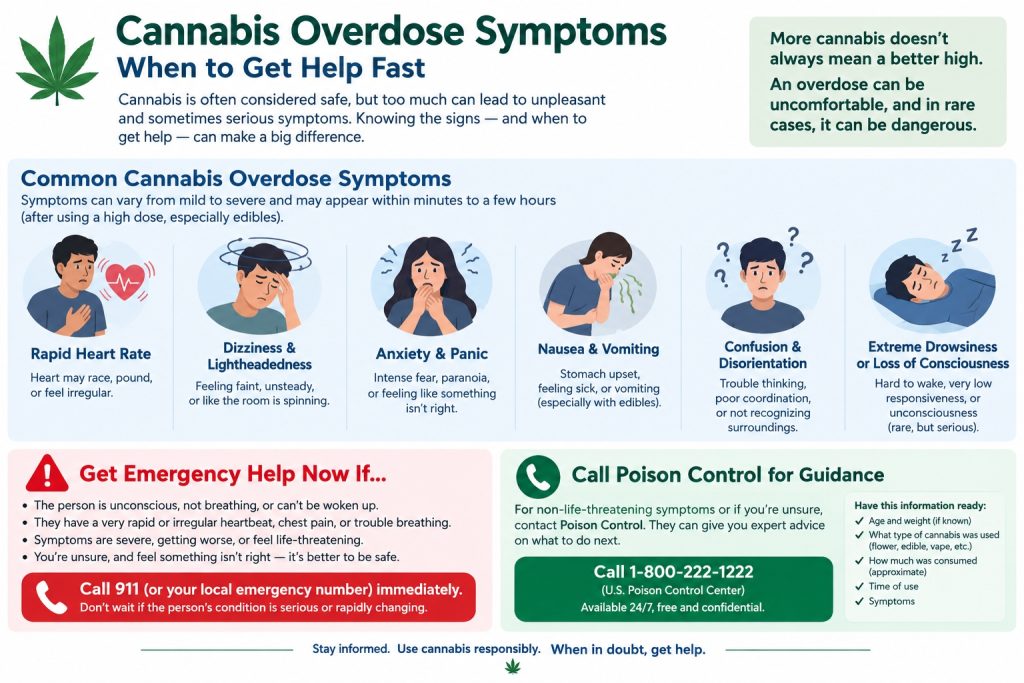
Get emergency help if the person has:
Slow, irregular, difficult, or stopped breathing
Blue, grey, or unusually pale lips or skin
A seizure, collapse, or loss of consciousness
Chest pain, severe pressure, or a markedly irregular heartbeat
Extreme agitation, violent behaviour, or psychosis that creates danger
Repeated vomiting with inability to stay awake or keep fluids down
New weakness, facial drooping, severe headache, or another possible stroke sign
A serious fall, head injury, or suspected traffic injury
Try to wake the person by speaking loudly and gently tapping a shoulder. If they don’t respond normally, call 911. Put a breathing but unconscious person on their side if you can do so safely. If they aren’t breathing, begin CPR and follow the dispatcher’s instructions.
Suspected Cannabis Ingestion in Children: Get Poison Centre Advice Immediately
A child who eats a THC gummy may initially seem fine. That quiet interval is not proof that the dose was harmless. Edible effects can be delayed, and young children may develop profound sleepiness, poor balance, vomiting, slowed breathing, or, in severe cases, coma.
Call a poison centre immediately after any suspected pediatric ingestion, even if symptoms haven’t started. Don’t wait to calculate the dose perfectly. Keep the package, photograph its label, and note how many pieces may be missing. Call 911 if the child is difficult to awaken, has breathing trouble, collapses, or experiences a seizure.
Never make a child vomit or give food as a home “antidote” unless a medical professional specifically directs you. Products such as brownies may also contain chocolate, while gummies can create a choking risk, details the specialist needs to know.
Common cannabis overdose symptoms: Physical and Mental Signs
Cannabis poisoning doesn’t look identical in everyone. Dose, tolerance, metabolism, product formulation, setting, and other substances all influence the reaction. One person may become sleepy and nauseated: another may be terrified, restless, and convinced something catastrophic is happening.
Common cannabis overdose symptoms include rapid heart rate, dizziness, dry mouth, red eyes, impaired movement, anxiety, confusion, nausea, and unusual drowsiness. Symptoms alone can’t reliably prove that THC is the only cause, so take severe or unexpected changes seriously.
Physical Symptoms: Racing Heart, Dizziness, Nausea, Vomiting, and Poor Coordination
THC can increase heart rate and alter blood pressure. You may feel pounding in your chest, lightheadedness when standing, shakiness, weakness, or a floating sensation. Other physical signs include:
Nausea or vomiting
Dry mouth and thirst
Red or irritated eyes
Slurred speech
Trembling
Marked sleepiness
Poor balance, delayed reactions, and clumsy movement
Poor coordination creates practical danger. A staircase, shower, swimming pool, or drive home can become risky even when the person insists they’re “basically fine.” Have them sit or lie somewhere safe and keep walking to a minimum.
A racing heart can occur with uncomplicated intoxication, but chest pain, fainting, severe shortness of breath, or a persistently irregular rhythm needs urgent assessment, particularly in someone with cardiovascular disease.
Mental Symptoms: Panic, Paranoia, Confusion, and Hallucinations
Too much THC can distort time, intensify ordinary sensations, and make thoughts feel unusually significant. That may lead to panic, suspiciousness, disorientation, depersonalization, or the frightening sense that the experience will never end. High doses can also cause hallucinations or short-lived psychotic symptoms.
Use calm, concrete language: “You took THC. You’re in a safe room. I’m staying with you.” Don’t debate paranoid beliefs or laugh at them, even if the situation sounds implausible. To the affected person, it feels real.
Confusion becomes more concerning when the person can’t identify familiar people, wanders into danger, becomes impossible to redirect, or alternates between extreme agitation and unresponsiveness. Hallucinations after a supposedly small dose may indicate unexpectedly potent THC, another drug, synthetic cannabinoids, or an underlying medical condition. Seek professional guidance rather than assuming it’s just a bad high.
What to Do if Someone Has Used Too Much Cannabis
Your job isn’t to “cancel” the high, there’s no dependable household antidote. Your priorities are preventing injury, watching for deterioration, reducing fear, and bringing in medical expertise when needed.
First, identify immediate hazards. Move away from traffic, water, balconies, cooking equipment, and crowds. Ask what was used, when, how much, and whether alcohol, medications, opioids, or other drugs were involved. Save the packaging without turning the moment into an interrogation.
Stay With Them, Reduce Stimulation, and Monitor Breathing and Responsiveness
Choose a quiet, comfortably lit space. Encourage slow breathing, loosen restrictive clothing, and keep the room at a normal temperature. If the person is fully awake and swallowing normally, small sips of water may help with dry mouth. Don’t force fluids or food.
Stay nearby and periodically check whether they can answer simple questions. Watch their breathing rate, skin colour, vomiting, and level of alertness. If they fall asleep, make sure they’re breathing normally and can be awakened: “sleeping it off” isn’t safe when someone is unusually difficult to rouse.
A simple handoff note can help if care is needed:
Product name and labelled THC per serving
Estimated amount and time taken
Current symptoms and changes
Alcohol, prescriptions, or other substances used
Relevant medical conditions
What Not to Do: Driving, Taking More Substances, or Inducing Vomiting
Don’t let the affected person drive, cycle, swim, cook over a flame, or “walk it off” alone. Judgment and reaction time may remain impaired after the panic fades.
Avoid common improvised fixes:
Don’t induce vomiting. It can cause choking or aspiration, especially with drowsiness.
Don’t add alcohol, sedatives, stimulants, or more cannabis. Mixing can worsen impairment or obscure dangerous symptoms.
Don’t use a cold shower as a reset button. Dizziness and poor balance make bathrooms prime territory for falls.
Don’t restrain an agitated person unless necessary to prevent immediate harm: call emergency services instead.
Don’t rely on peppercorns, caffeine, CBD, or a large meal as an antidote. Evidence is insufficient, and none replaces monitoring.
And please don’t film the episode for social media. Anxiety plus an audience is rarely therapeutic.
Naloxone Does Not Reverse THC Effects: When Suspected Opioid Exposure Changes the Response
Naloxone reverses opioid effects: it doesn’t reverse THC intoxication. But, an unknown vape, pill, powder, or mixed drug supply introduces a different risk. If someone is unresponsive, breathing slowly, making choking or gurgling sounds, or has pinpoint pupils, treat the situation as a possible opioid overdose.
Call 911, give naloxone if available, and provide rescue breathing or CPR as directed. Naloxone generally won’t harm someone who hasn’t taken opioids, and temporary improvement after a dose is not a reason to cancel emergency care. Its effect may wear off before the opioid does. In Canada, take-home naloxone kits are available at most pharmacies without a prescription, and some provinces offer them free.
Standard regulated cannabis products aren’t expected to contain opioids, but self-reported substance histories can be incomplete and unregulated products may be mislabelled. Respond to the person’s breathing and consciousness, not the assumption that “it was only weed.”
Can You Overdose on Cannabis? Intoxication, Poisoning, and Greening Out Explained
Yes. You can use enough cannabis to experience clinically significant poisoning, even though THC differs from opioids in how it affects breathing and fatal overdose risk. “Greening out” is slang for an unpleasant episode that may include pallor, sweating, nausea, dizziness, panic, and near-fainting. It isn’t a medical diagnosis or a guarantee that the situation is harmless.
Intoxication describes expected mind and body changes after use. Poisoning implies harmful effects requiring observation, poison centre guidance, or medical treatment. The boundary isn’t a neat THC number. A 10-milligram edible may feel manageable to one adult and overwhelming to a new user: a child can become dangerously sedated after ingesting a product intended for adults.
Can Cannabis Overdose Be Fatal? Understanding Severe Toxicity and Indirect Risks
Deaths caused solely by plant-derived THC toxicity appear uncommon, and no simple lethal human dose has been established. But “rarely directly fatal” shouldn’t be translated as “risk-free.” Severe intoxication can contribute to aspiration after vomiting, dangerous heart symptoms, falls, drowning, exposure, self-harm, and motor-vehicle crashes.
Children can develop severe central nervous system depression and need respiratory support. Adults with heart disease may be more vulnerable to rapid heart rate or blood-pressure changes. Extreme paranoia or psychosis can also create unsafe behaviour.
The practical question isn’t whether cannabis has the same overdose profile as fentanyl. It doesn’t. The useful question is whether this person is breathing normally, responsive, protected from injury, and improving. If the answer is unclear, call a poison centre or emergency services.
When Do Symptoms Start, Peak, and Wear Off?
Timing offers important clues, but it isn’t a stopwatch. Route of use, dose, food, metabolism, tolerance, and product design all matter. The onset printed on a package is an estimate, not an appointment.
Write down when the product was used and when symptoms began. This prevents the classic late-night puzzle where everyone remembers “sometime after dinner” but nobody remembers whether that was 45 minutes or three hours ago.
Smoking and Vaping: Rapid Onset and Earlier Peaks
Inhaled THC usually begins affecting you within minutes. Effects often build quickly, commonly peaking within roughly 15–30 minutes, although intensity and timing vary. The noticeable high may ease over a few hours, while coordination, attention, or reaction time can remain impaired longer.
That rapid feedback makes dose titration easier than with edibles, but high-potency flower, concentrates, and deep repeated inhalations can still overshoot the desired effect. Vaping also brings product-quality concerns: breathing difficulty or chest pain after vaping shouldn’t automatically be blamed on ordinary THC intoxication.
If symptoms intensify long after inhalation, consider whether an edible, alcohol, medication, contaminant, or unrelated illness may also be involved.
Edibles and Drinks: Delayed Effects and the Risk of Taking More Too Soon
Edibles commonly take 30 minutes to two hours to produce noticeable effects, and sometimes longer. The peak may arrive several hours after ingestion. Food intake, digestion, and formulation can change that timeline: some beverages and fast-acting emulsions may begin sooner.
Here’s the familiar trap: at 7:00 p.m., someone eats one gummy. At 7:45, nothing seems to be happening, so they take two more. By 9:00, all three doses are arriving at the party, and none of them brought moderation.
Check both the THC per serving and the servings per package. A chocolate bar labelled 100 mg total might contain ten 10 mg portions. In Canada, a legal edible package holds no more than 10 mg of THC in total. For beginners, even 10 mg may be too much: delaying additional intake for several hours is safer than chasing an effect.
How Long Symptoms Can Last and When Persistent or Worsening Symptoms Need Care
After inhalation, major effects often improve within several hours. Edible effects may last six hours or longer, with residual sleepiness or cognitive impairment sometimes continuing into the next day after a large dose. High doses, slow metabolism, interactions, and unfamiliar products can extend the experience.
Contact a poison centre or a clinician when symptoms are worsening rather than stabilizing, vomiting prevents hydration, severe anxiety can’t be calmed, or confusion persists beyond the expected window. Emergency signs, breathing trouble, seizure, unresponsiveness, chest pain, severe agitation, or neurologic deficits, require immediate care regardless of timing.
Don’t drive just because you no longer feel intensely high. If attention, balance, or judgment still feels “off,” you’re still impaired.
What Increases the Risk of Cannabis Poisoning?
Cannabis poisoning usually reflects several overlapping factors rather than one spectacular mistake. Potency, route, experience, body size, health conditions, product accuracy, environment, and additional substances all influence risk.
A useful rule: unfamiliar product + uncertain dose + impatient redosing is a rough combination. Add alcohol, and the evening can become much less predictable.
High THC Doses, Concentrates, Delta-8 Products, and Uncertain Potency
Modern concentrates, including wax, shatter, distillate, and high-potency vape oils, can deliver far more THC than lower-potency flower. A rice-grain-sized dab isn’t intuitively measurable, especially for someone whose reference point is a single puff from a joint.
Delta-8 THC products can also cause intoxication and poisoning. “Hemp-derived,” a label common on US products, doesn’t mean non-intoxicating or medically harmless. In Canada, Health Canada treats delta-8 THC as cannabis under the Cannabis Act and says these products pose an increased risk to public health.
Risk rises with homemade edibles, products bought outside regulated systems, unclear labels, and packages that resemble ordinary candy. Without reliable testing, the stated dose may not match the dose you actually receive.
Mixing Cannabis With Alcohol, Medications, or Other Drugs
Alcohol and cannabis can amplify dizziness, nausea, poor judgment, and coordination problems. Sedating medications, such as benzodiazepines, sleep aids, some antihistamines, gabapentinoids, and opioids, may increase drowsiness and fall risk. Stimulants can complicate racing heart, agitation, and chest symptoms.
Drug interactions are product- and patient-specific. Cannabinoids may affect liver enzymes involved in processing certain prescriptions, but the clinical importance varies. If you take blood thinners, seizure medicines, sedatives, transplant drugs, or medications with narrow dosing margins, ask a pharmacist or clinician before using cannabinoid products.
Be direct about everything taken. “Just cannabis” may accidentally omit three tequila shots, a sleep medication, and a friend’s mystery vape, all details that change the response.
Higher-Risk Groups: Children, Older Adults, New Users, and People With Certain Health Conditions
Children face disproportionate risk because of their smaller bodies and sensitivity to THC. Older adults may be more susceptible to falls, medication interactions, blood-pressure changes, and confusion. New or infrequent users lack tolerance and may misjudge potency.
Extra caution is appropriate for people with:
Heart rhythm problems or cardiovascular disease
A history of psychosis, severe panic, or bipolar disorder
Seizure disorders
Pregnancy or breastfeeding
Significant liver disease or complex medication regimens
Tolerance doesn’t make someone immune. It may encourage larger doses, while a break from regular use can lower tolerance unexpectedly. A dose that once felt routine may hit very differently after several weeks away.
How Clinicians Assess and Treat Cannabis Poisoning
There’s no routine antidote that instantly removes THC. Treatment is generally supportive: clinicians protect breathing, manage dangerous symptoms, correct dehydration when necessary, and rule out other causes. Many patients improve with observation and time, while severe cases need hospital monitoring.
You can make that evaluation faster by bringing accurate product and timing information. No detective novel required, just the best facts you have.
What to Tell Clinicians: Product, Estimated Dose, Timing, and Other Substances
Bring the original container or clear photographs of the front, ingredients, cannabinoid panel, serving size, and batch information. Tell the care team:
Whether it was smoked, vaped, eaten, or swallowed as oil
Labelled THC per serving and estimated servings used
When exposure occurred and when symptoms started
Alcohol, prescriptions, supplements, and recreational drugs involved
Baseline medical conditions, pregnancy status, age, and approximate weight
If the product was homemade or unregulated, say so plainly. Don’t guess with false precision. “Between two and four gummies, each labelled 10 mg” is more useful than confidently reporting 20 mg when you aren’t sure.
Assessment, Monitoring, Supportive Treatment, and When Hospital Care Is Needed
Clinicians may check vital signs, oxygen level, blood glucose, mental status, heart rhythm, hydration, and signs of trauma. An ECG, blood tests, imaging, or toxicology testing may be used when symptoms suggest another condition or co-ingestion. A urine drug screen can support exposure history but generally can’t show the exact dose or prove that current symptoms are caused solely by THC.
Treatment may include a calm environment, observation, IV fluids for dehydration, anti-nausea medication, oxygen, and carefully selected medicines for severe agitation. Hospital care is more likely with breathing compromise, persistent altered consciousness, severe psychosis, recurrent vomiting, cardiac symptoms, injury, dangerous co-exposure, or significant pediatric poisoning.
Most uncomplicated cases recover without lasting harm, but discharge should include safe supervision and no driving until impairment has fully resolved.
Conditions That Can Resemble or Complicate Cannabis Overdose
A positive cannabis history can become an easy explanation for every symptom. That’s a mistake. Low blood sugar, stroke, infection, head injury, medication toxicity, panic attacks, heart rhythm disorders, and other drug exposures can overlap with cannabis poisoning.
A sudden or severe presentation deserves broader thinking, especially when the reported THC dose seems too small to explain it.
Cannabinoid Hyperemesis Syndrome: Recurrent Vomiting Versus Acute Overconsumption
Cannabinoid hyperemesis syndrome, or CHS, is typically associated with prolonged, frequent cannabis use, not one accidental oversized edible. It causes repeated episodes of severe nausea, abdominal pain, and vomiting. Many patients report temporary relief from very hot showers or baths, though that behaviour isn’t diagnostic.
Acute overconsumption can also cause vomiting, so the pattern matters. Recurrent attacks separated by relatively well periods, ongoing heavy use, and symptom improvement after sustained cannabis cessation support CHS. Hot bathing can cause burns or worsen dehydration, and sipping water may not replace significant fluid and electrolyte losses.
Seek care for blood in vomit, severe abdominal pain, fainting, minimal urination, confusion, or inability to keep fluids down. Long-term resolution usually requires stopping cannabis, not merely switching brands or routes.
Synthetic Cannabinoids Such as K2 or Spice: Different and Potentially More Severe Toxicity
K2, Spice, and related synthetic cannabinoids aren’t simply “strong weed.” They comprise changing laboratory-made chemicals that activate cannabinoid receptors in unpredictable ways. Products sold under the same name may contain different compounds from one packet to the next.
Possible effects include extreme agitation, seizures, psychosis, dangerously high heart rate or blood pressure, kidney injury, vomiting, loss of consciousness, and breathing problems. Routine drug screens may not identify these compounds.
If synthetic cannabinoid exposure is suspected, call a poison centre or seek emergency care, particularly for severe behaviour changes, chest pain, seizure, collapse, or breathing difficulty. Keep the package if doing so is safe, but don’t handle unknown powders unnecessarily. This is not a “sleep it off and see” category.
How to Reduce the Risk of Cannabis Poisoning
Risk reduction starts before anyone opens the package. Potency literacy, slower pacing, sober transportation, and secure storage prevent more trouble than any after-the-fact home remedy.
If you choose to use cannabis, do so in a familiar setting with people you trust. Avoid operating a vehicle, boat, or machinery, and make your ride-home plan while judgment is still fully online.
Read THC Labels, Avoid Early Redosing, and Do Not Mix Substances
Look for milligrams of THC per serving, servings per package, cannabinoid type, and testing information. Don’t confuse product weight with THC content: a 2-gram gummy doesn’t necessarily contain 2 grams of THC.
Use the lowest practical dose, especially with a new product or after a tolerance break. Wait long enough to judge an edible’s full effect: taking another serving after 30–60 minutes is a common route to overconsumption. Avoid combining cannabis with alcohol or other drugs, and discuss medication interactions with a pharmacist.
Labels such as “natural,” “hemp,” or “full spectrum” don’t guarantee predictable intoxication. Choose regulated, clearly labelled products where legal, and avoid mystery cartridges or homemade concentrates. In Canada, legal cannabis is for adults 19 and older in most provinces and territories, 18 in Alberta and 21 in Quebec.
Prevent Accidental Exposure With Locked Storage, Original Packaging, and Safe Disposal
Child-resistant packaging, required on legal edibles in Canada, is helpful, but it isn’t childproof. Store cannabis in a locked box or cabinet, high and out of sight, separately from regular food and medicine. Keep products in their original packages so dose information remains available.
Avoid putting gummies in a sandwich bag, brownies on a shared counter, or infused drinks in ordinary bottles. Guests, children, older relatives, and pets can’t identify THC by smell or appearance. Use a clearly communicated household rule: if it contains cannabis, it gets labelled and locked immediately.
Dispose of unwanted products according to local regulations and package directions. Make them unusable and inaccessible before discarding: don’t leave intact edibles in an open trash can. If a pet is exposed, contact a veterinarian or animal poison service, human poison centres handle human exposures.
When Repeated Overconsumption Signals a Need for Ongoing Support
One accidental overconsumption episode can happen because an edible was stronger or slower than expected. Repeated episodes deserve a closer look, particularly when they lead to emergency visits, missed responsibilities, risky driving, panic, vomiting, or conflict at home.
Warning signs include using more than intended, unsuccessful attempts to cut down, needing increasing amounts, spending substantial time recovering, or continuing even though physical and emotional harm. These can fit cannabis use disorder, a treatable condition, not a character flaw.
Start with a primary-care clinician, addiction-medicine professional, or therapist. You can also use Health Canada’s Get help with substance use page, which lists free, confidential help, including Drug Rehab Services at 1-877-254-3348, and services in your province or territory. Support may include motivational counselling, cognitive behavioural approaches, sleep or anxiety treatment, and a realistic reduction or cessation plan.
Try one concrete step today: record what you use, the dose, why you reached for it, and how you felt afterward. Patterns become harder to dismiss once they’re visible on paper.
Medical Sources and Emergency Support Resources
For evidence-based guidance and immediate support, use these resources:
1-844-POISON-X (1-844-764-7669): Your regional poison centre, free and 24/7; Centre antipoison du Québec 1-800-463-5060 in Quebec
Health Canada: Cannabis poisonings in children: Health effects, poisoning risks, and prevention guidance
Health Canada: Guidance on cannabis products with intoxicating cannabinoids: Regulatory and product-safety information
Health Canada: Health effects of cannabis: Symptoms, timing, and short- and long-term effects
Health Canada: Get help with substance use: Mental health and substance-use support; for a crisis, call or text 9-8-8
911: Trouble breathing, unresponsiveness, seizure, chest pain, dangerous behaviour, severe injury, or another immediate threat
The central takeaway is simple: most uncomplicated cannabis overdose symptoms improve with calm supervision and time, but you shouldn’t use that fact to explain away red flags. Stay with the person, prevent driving and falls, don’t induce vomiting, and avoid adding other substances. With children, call a poison centre as soon as ingestion is suspected.
When you’re torn between “wait a little longer” and “ask for help,” make the call. A poison specialist can often clarify the next step in minutes, and emergency responders would rather evaluate someone early than arrive after breathing, consciousness, or behaviour has deteriorated.
Cannabis Overdose Symptoms: Frequently Asked Questions
What are common physical symptoms of a cannabis overdose?
Typical physical symptoms include rapid heart rate, dizziness, nausea, vomiting, dry mouth, red eyes, poor coordination, slurred speech, trembling, and unusual drowsiness. These signs can indicate significant THC intoxication requiring monitoring.
When should I call emergency services for cannabis overdose symptoms?
Call 911 immediately if the person has trouble breathing, is unresponsive, experiences seizures, chest pain, severe agitation, repeated vomiting with inability to stay awake, or signs of stroke or serious injury. These symptoms indicate urgent medical attention is needed.
Can children suffer severe effects from cannabis overdose?
Yes, children are especially vulnerable and can develop severe symptoms like profound sleepiness, poor balance, vomiting, slowed breathing, or coma even from small amounts. Call a poison centre (1-844-POISON-X, or 1-800-463-5060 in Quebec) immediately if you suspect a child ingested cannabis products.
How long do cannabis overdose symptoms typically last?
Symptoms from inhaled cannabis usually peak within 15–30 minutes and improve over a few hours. Edible effects may start 30 minutes to 2 hours after ingestion and last six hours or longer, with residual impairment sometimes continuing into the next day.
Is cannabis overdose fatal?
Cannabis overdose deaths from THC alone are very rare. However, severe intoxication can cause indirect risks like aspiration, falls, psychosis, or dangerous heart symptoms. Always monitor breathing, consciousness, and safety, and seek medical help if unsure.
What should I do if someone has used too much cannabis?
Stay with them in a quiet, safe place, reduce stimulation, encourage slow breathing, and monitor their responsiveness and breathing. Do not induce vomiting or give other substances. Seek emergency help if symptoms worsen or if serious warning signs appear.