
Nov
Raw cannabis may smell potent, but adding it straight to brownie batter usually produces disappointing results. The missing step is decarboxylation, controlled heating that converts cannabinoid acids into forms such as THC and CBD.
This guide explains how to decarb weed in a conventional oven, compare alternative methods, estimate potency, and avoid the mistakes that can waste a batch. It focuses on cannabis flower and general home preparation, not commercial manufacturing or medical dosing. Because ovens, products, and laboratory methods differ, no home technique guarantees complete activation or a precise final potency.
Before starting, make sure you’re of legal age in your province or territory (19 in most of Canada, 18 in Alberta and 21 in Quebec). Canada’s Cannabis Act lets adults make cannabis food and drinks at home, as long as dangerous organic solvents aren’t used. Keep the entire project away from children and pets, plan for a noticeable odour, and label everything clearly. Edibles can take much longer to act than inhaled cannabis, so careful preparation is only half the job, responsible use matters just as much.
Key Takeaways
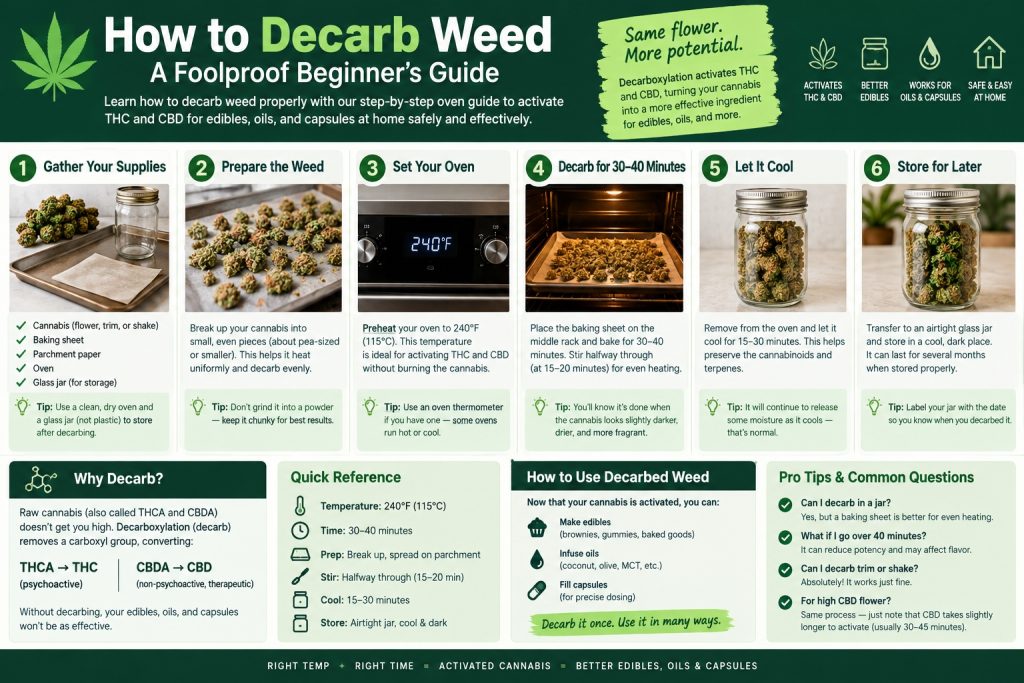
- Decarbing weed involves gently heating cannabis at about 115°C (240°F) for 30–40 minutes to activate THC and CBD for edibles and infusions.
- Accurate oven temperature and evenly sized cannabis pieces are crucial to avoid underheating or overheating, which can reduce potency or degrade cannabinoids.
- Use parchment paper on a baking tray and spread cannabis in a single layer to ensure even decarboxylation and prevent scorching.
- Alternative decarb methods like mason jars, sous vide, or dedicated devices vary in control, odour, and safety, with ovens remaining the most accessible option.
- Proper storage of decarbed weed in airtight, labelled containers away from light and heat preserves potency and prevents spoilage.
- Responsible use includes confirming provincial and territorial cannabis rules, monitoring edible dosage carefully due to delayed effects, and securing products away from children and pets.
Decarbing Weed at a Glance: What Beginners Need to Know
To decarb weed, you gently heat cannabis before using it in an edible, tincture, capsule, or infusion. A practical starting point for THC-rich flower is approximately 115°C (240°F) for 30–40 minutes, although no universal setting works perfectly for every batch.
The basic workflow is simple:
- Check the flower and preheat a verified oven.
- Break it into coarse, evenly sized pieces.
- Spread it in one layer on a lined tray.
- Heat it without scorching.
- Cool it completely before infusing or storing.
Expect an herbal smell. Open windows, use an externally vented range hood, and keep the kitchen supervised.
What Is Cannabis Decarboxylation, and Why Does It Matter?
Fresh and properly dried cannabis contains substantial amounts of cannabinoid acids, including THCA and CBDA. Decarboxylation removes a carboxyl group from these molecules, releasing carbon dioxide and changing their chemical structures.
Smoking and vaporizing supply this heat almost instantly. Edible preparation usually doesn’t, especially when cannabinoids are first extracted into butter or oil, hence the separate decarb step.
How Heat Converts THCA to THC and CBDA to CBD
Heat converts THCA into THC and CBDA into CBD over time. This isn’t an on/off switch: conversion increases progressively, while prolonged or excessive heat can degrade cannabinoids and volatile aromatic compounds.
THC is intoxicating: THCA generally isn’t intoxicating in the same way. CBD doesn’t produce a classic cannabis high, but converting CBDA still changes the product’s chemical profile.
When Decarbing Is Necessary for Edibles, Oils, and Other Uses
Decarb raw flower before making cannabutter, infused cooking oil, capsules, or alcohol-based preparations when activated cannabinoids are your goal. You can also mix decarbed flower directly into food, though its grassy texture isn’t exactly Michelin-star material.
You generally don’t need another full cycle for distillate, many commercial oils, or already-vaped cannabis. Check the label or the product information first.
Decarb Temperature and Time: Finding the Right Balance
Temperature and time work together. Lower heat generally requires longer exposure: higher heat accelerates conversion but narrows your margin for error. Household ovens also cycle above and below their displayed setting, so treat any recipe as a starting range rather than laboratory law.
Time-and-Temperature Reference Chart for THC- and CBD-Rich Flower
| Material | Starting range | Approximate time | Important limitation |
|---|---|---|---|
| THC-rich flower | 110–118°C (230–245°F) | 30–45 minutes | Higher heat may increase degradation |
| CBD-rich flower | 110–118°C (230–245°F) | 45–60 minutes | CBDA may require longer processing |
| Mixed flower | About 115°C (240°F) | 35–50 minutes | Results depend on starting chemistry |
These are conservative home-use ranges, not validated potency guarantees. Research uses controlled equipment and testing that kitchen methods can’t reproduce.
How Oven Accuracy, Moisture, Batch Size, and Particle Size Affect Results
A damp, dense batch heats differently from dry, airy flower. Large piles develop uneven temperatures: powder exposes more surface area and can scorch quickly. Break flower into raisin-sized pieces and keep the layer shallow.
An inexpensive ThermoPro or Taylor oven thermometer can reveal surprising swings, I’ve seen an oven set to 115°C (240°F) wander past 129°C (265°F). If yours runs hot, adjust the dial rather than trusting its cheerful little display.
Equipment and Safety Checks Before You Start
You’ll need a rimmed baking sheet, parchment paper, an oven thermometer, a timer, and heat-resistant gloves. Use clean equipment and inspect flower for fuzzy growth, musty odours, or other signs of mould. Heating doesn’t make contaminated cannabis safe.
Remove nearby clutter, verify that smoke alarms work, and never leave the oven unattended. Foil can work in a pinch, but parchment prevents sticking and makes transferring the cooled material easier. Don’t use wax paper, it isn’t designed for oven heat.
How to Decarb Weed in the Oven: Step-by-Step
A conventional oven is accessible and inexpensive, though not exceptionally precise. The goal is consistent, moderate heating, not roasting the flower until it resembles coffee grounds.
Prepare the Flower, Line the Tray, and Verify the Oven Temperature
Preheat the oven to approximately 115°C (240°F) and place a separate thermometer near the centre rack. Line your tray with parchment. Remove obvious stems, then break the flower apart by hand or pulse it briefly in a grinder.
Wait until the thermometer stabilizes. If the actual temperature repeatedly overshoots, lower the setting and check again.
Spread Evenly and Monitor Heating Without Relying on Colour Alone
Arrange the cannabis in a loose, single layer. Heat THC-rich flower for roughly 30–40 minutes, rotating the tray once if your oven has hot spots. Avoid repeatedly opening the door: each peek drops the temperature.
The flower may become drier, fragrant, and slightly darker, but colour is an unreliable endpoint. Naturally purple flower, old material, and different cultivars all change appearance differently.
Cool the Cannabis Before Handling, Storing, or Infusing
Remove the tray with oven gloves and place it on a stable, heat-safe surface. Let the cannabis cool completely before transferring it. Warm material can create condensation inside a closed jar, introducing unwanted moisture.
Once cool, use it promptly for infusion or place it in an airtight, clearly labelled container. Clean the tray and surrounding surfaces so stray crumbs don’t find their way into someone’s innocent Tuesday-night dinner.
Alternative Decarb Methods Compared: Control, Cost, Odour, and Limitations
No home method is entirely odourless or perfectly controlled. Choose according to your equipment, tolerance for smell, and willingness to monitor the process.
| Method | Control | Odour | Main drawback |
|---|---|---|---|
| Conventional oven | Moderate | Noticeable | Temperature cycling |
| Mason jar in oven | Moderate | Reduced, not eliminated | Glass and pressure hazards |
| Sous vide | Good water-temperature control | Usually lower | Long processing time |
| Dedicated device | Often good | Usually contained | Higher purchase price |
Mason Jar Methods: Glass Suitability, Thermal Shock, and Pressure Risks
A heat-rated canning jar can contain some odour, but sealing and heating glass introduces risk. Temperature changes may crack damaged glass, and heated contents can increase internal pressure. Never use decorative or chipped jars.
Follow the jar manufacturer’s heat guidance, avoid sudden cold-to-hot transitions, and don’t open a hot container. A jar method is not automatically safer merely because TikTok made it look tidy.
Sous Vide: Temperature Control, Longer Processing, and Packaging Considerations
A sous vide circulator maintains a stable water-bath temperature, which reduces oven cycling. But, lower temperatures demand longer processing, and the cannabis must remain dry and properly contained.
Use packaging explicitly rated for the selected temperature. Keep seals above water when appropriate, prevent leaks, and follow the circulator manufacturer’s instructions. Precise bath temperature still doesn’t equal verified cannabinoid conversion inside the package.
Toaster Ovens vs. Dedicated Decarb Devices: Consistency and Evidence
Small toaster ovens often have intense heating elements close to the tray, creating hot spots. Test yours with a thermometer and use a small batch first.
Dedicated devices from brands such as Ardent and LEVO automate heating and may contain odour better. They’re convenient, not magical: performance varies by model, and manufacturer claims aren’t a substitute for independent cannabinoid testing. Their price makes most sense if you prepare cannabis regularly.
Flower vs. Concentrates: Which Cannabis Products Need Decarbing?
Raw flower, kief, and some solventless concentrates can contain predominantly acidic cannabinoids and may need decarbing. Their heating requirements differ because concentrates have little plant material and can melt, bubble, or stick. Use a heat-safe container and product-specific guidance rather than blindly applying a flower recipe.
Distillate is normally already activated. Commercial tinctures, oils, and edible ingredients may be activated too, but labels vary. In Canada, the THC and CBD figures on a label already count what THCA and CBDA could convert into, so the number alone doesn’t tell you whether a product is activated. When in doubt, ask the producer.
How to Tell Whether Decarbing Worked—and Why Appearance Cannot Confirm Potency
Properly heated flower often feels crisp and smells toasted, but those clues can’t confirm conversion. Brown cannabis isn’t necessarily activated, and green cannabis isn’t necessarily underdone. Appearance tells you about browning and drying, not molecular composition.
Only analytical testing, commonly high-performance liquid chromatography, can quantify cannabinoids before and after processing. At home, your best safeguards are verified temperature, consistent particle size, careful timing, and conservative dosing. Record each batch’s weight, settings, and results: that humble kitchen note can prevent repeat mistakes.
Common Decarbing Mistakes and Troubleshooting
The usual problems are an inaccurate oven, pulverized flower, an overcrowded tray, or the assumption that darker means stronger. Another classic: turning up the temperature to finish faster. That’s less shortcut, more cannabinoid roulette.
If a batch seems weak, don’t immediately eat more. Uneven mixing, slow digestion, and inaccurate starting-potency information may be responsible.
Underheating, Overheating, and the Trade-Off Between Activation and Degradation
Underheating can leave more THCA or CBDA unconverted. Overheating can degrade THC and strip volatile compounds, especially when high temperatures persist. You can’t reliably rescue a scorched batch.
For suspected underheating, review the thermometer reading and elapsed time before deciding whether to continue. With unknown potency, treat the finished material cautiously rather than assuming it failed.
Managing Odour Without Assuming Any Method Is Smell-Proof
Use an externally vented hood, open windows, and close doors to adjoining rooms. An activated-carbon air purifier may reduce lingering odour: candles merely add “lavender dispensary” to the situation.
Covered devices and jars can contain some aroma, but opening them releases concentrated vapours. Don’t compromise fire safety by blocking detectors, and remember that oven exhaust may still carry odour outdoors or into shared spaces.
What to Do With Decarbed Cannabis: Infusion vs. Direct Use
You can infuse decarbed flower into butter, coconut oil, or another edible fat, then strain out the solids. Infusion improves texture and makes portioning easier, although some cannabinoids remain in the discarded plant material.
Direct use avoids that extraction loss: mix finely crumbled material into yogurt, peanut butter, pesto, or capsules. The flavour and gritty texture are more noticeable, though. Whichever route you choose, mix thoroughly so one serving doesn’t become the accidental superhero dose.
Estimating Edible Potency: Conversion Factors, Processing Losses, and Uncertainty
For a rough theoretical estimate:
Potential THC (mg) = flower weight (g) × 1,000 × THCA fraction × 0.877
For example, 3.5 grams at 20% THCA contains a theoretical maximum near 614 mg THC before processing. Decarboxylation, infusion, straining, storage, and uneven mixing reduce or redistribute that amount.
Home calculations are estimates, not dosing guarantees. Without laboratory testing, begin with a very small portion and wait fully before considering more.
How to Store Decarbed Weed: Containers, Light, Heat, and Shelf-Life Limits
Place fully cooled cannabis in an airtight glass container, label it with the product, date, and estimated potency, then store it somewhere cool, dry, and dark. Light, oxygen, heat, and moisture can accelerate chemical changes or encourage spoilage.
Avoid transparent jars on a sunny shelf and don’t mix decarbed material with ordinary herbs, no one wants surprise oregano. For longer storage, refrigeration or freezing may slow degradation, but repeated temperature changes can create condensation. Inspect for moisture, mould, or unusual odours before use. There’s no universal home shelf life because storage conditions and starting material vary.
Responsible Use: Local Laws, Delayed Edible Effects, and Child-Safe Storage
Cannabis rules differ by province and territory, municipality, housing agreement, and age. Federal law lets adults make cannabis food and drinks at home without organic solvents, but confirm the rules governing public use and sharing where you live. Never drive or operate machinery while impaired.
Edible effects may take 30 minutes to two hours or longer to appear and can last several hours. Food intake, metabolism, medication, and tolerance all matter. Start low, wait patiently, and don’t stack servings because “nothing’s happening.” That sentence has launched many uncomfortable evenings.
Store cannabis in child-resistant packaging inside a locked location, separate from normal snacks. If a child or pet consumes it, call 911 in an emergency, your poison centre at 1-844-POISON-X (1-844-764-7669; in Quebec, 1-800-463-5060), or a veterinarian promptly.
Frequently Asked Questions About Decarbing Weed
These answers cover common beginner questions, but product labels and laboratory results should override broad assumptions.
Can You Decarb Weed Without Heat?
Cannabinoid acids can change slowly through age, light, and environmental exposure, but those processes are inconsistent and difficult to control. For predictable kitchen preparation, controlled heat is the practical method. Simply leaving flower on a windowsill won’t provide reliable activation and may degrade it unevenly.
Can You Decarb Weed in a Microwave, and Why Is It Unreliable?
A microwave heats unevenly and can create localized hot spots, particularly with small or dry samples. Power settings also differ considerably among models. That makes scorching and incomplete conversion more likely. Use a temperature-monitored oven or purpose-built device instead.
Do You Need to Decarb Already-Vaped Cannabis or Commercial Cannabis Oils?
Already-vaped cannabis has undergone substantial heating and generally doesn’t need another full decarb cycle, though its remaining potency is uncertain. Dark, heavily vaped material may contain little usable cannabinoid content.
Commercial distillates and many oils are already activated. Check the product information or ask the producer rather than reheating automatically.
Will Baking Edibles Decarb the Cannabis, or Can It Heat Already-Decarbed Weed Twice?
Baking raw cannabis inside wet batter may produce incomplete, uneven conversion because the food’s interior often remains cooler than the oven setting. Decarbing separately provides better control.
Already-decarbed cannabis can be baked into food without necessarily being ruined, the edible’s internal temperature matters, but prolonged high heat can cause losses. Avoid unnecessary reheating and follow a recipe designed for infused ingredients.
Scientific References, Testing Limitations, and Expert Review
Cannabis decarboxylation research supports the central relationship among time, temperature, conversion, and degradation, but laboratory conditions don’t perfectly translate to a home oven. Useful starting points include the peer-reviewed studies by Dussy and colleagues on cannabinoid decarboxylation and Taschwer and colleagues on temperature effects.
Published results can differ because of cultivar, moisture, sample geometry, oxygen exposure, equipment, and analytical methods. This guide is educational and hasn’t been individualized by a clinician: consult a qualified healthcare professional about cannabis interactions, pregnancy, cardiovascular concerns, or other medical risks.
The practical conclusion is straightforward: when you decarb weed, use moderate verified heat, keep careful records, and assume potency remains uncertain without testing. Start with a small batch, label it, store it securely, and approach the finished edible patiently. Precision beats bravado here, and patience is considerably cheaper than sacrificing both your flower and your Saturday night.