
Blog 2026
How Long Does Weed Last? 3 Timelines You Should Know
Nov
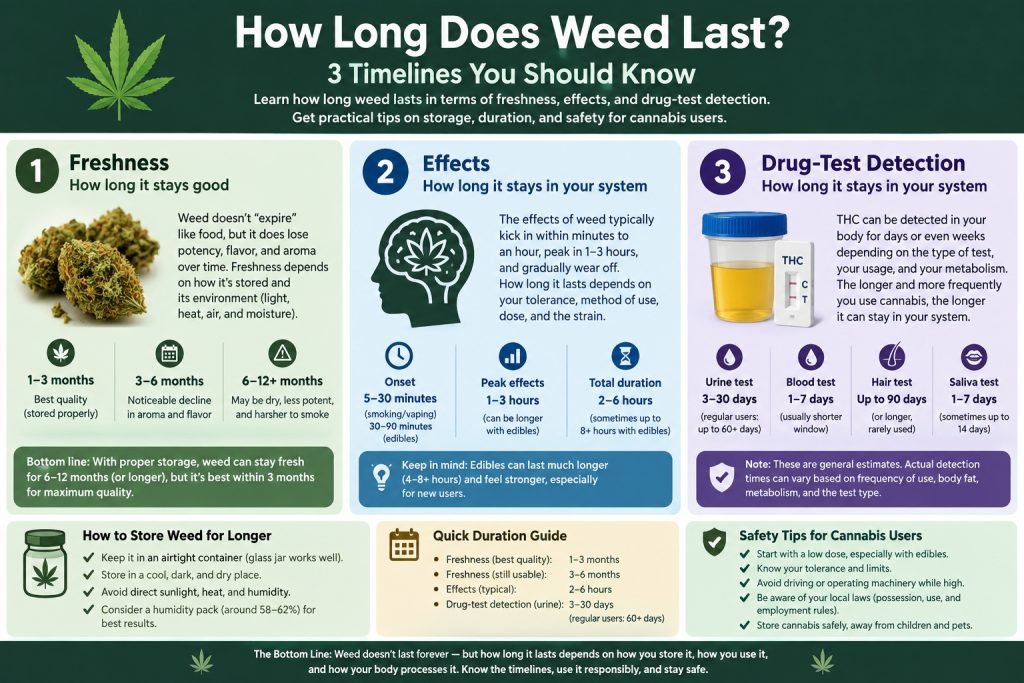
How long does weed last?” sounds like one question, but it usually means one of three very different things: How long does cannabis stay fresh? How long will the high continue? Or how long can THC be detected by a drug test? Mixing up those timelines can leave you with stale flower, an unexpectedly long evening, or an unpleasant surprise at work.
Here’s the short version. Properly stored cannabis flower often retains acceptable quality for roughly six months to one year, although it gradually loses aroma and potency. Inhaled cannabis effects generally last a few hours, while edibles can affect you for much longer and may cause next-day impairment. Drug-test detection ranges are less predictable: THC metabolites may remain detectable for days or weeks after the noticeable effects have ended.
This guide reviews all three meanings of cannabis “lasting.” You’ll find practical shelf-life estimates for flower, pre-rolls, edibles, vapes, concentrates, and tinctures; warning signs that a product should be discarded; typical effect durations; and realistic testing windows. The figures are ranges rather than guarantees because cannabis chemistry, dose, storage conditions, individual metabolism, and testing thresholds all matter.
A quick safety note before we open the proverbial stash jar: laws differ by province and territory, cannabis can impair coordination and judgment, and no home inspection can prove that a questionable product is free from mold or contaminants. When the package label, local regulations, or advice from a qualified healthcare professional conflicts with a general estimate here, follow the more specific guidance. And if a product looks or smells suspicious, don’t conduct a one-person taste test in the name of science.
Key Takeaways
- Properly stored cannabis flower typically stays fresh and usable for 6 to 12 months, but its aroma and potency gradually decline over time.
- The effects of inhaled cannabis usually last 2 to 4 hours, while edibles can cause impairment for 6 to 8 hours or more, sometimes extending into the next day.
- THC or its metabolites may be detectable in your system from a few hours to several weeks, depending on usage frequency, metabolism, and the type of drug test.
- Always inspect weed for signs of spoilage like mold, unusual odour, or discolouration, and discard any product that appears contaminated or has passed expiration dates.
- Store cannabis in airtight, cool, dark places with humidity control to maintain freshness and prevent mold, and avoid common myths like using fruit peels or freezers for storage.
- Feeling sober does not guarantee a negative drug test or absence of impairment; always follow safety guidelines and legal requirements regarding cannabis use.
Quick answer: how long does weed last?
The answer depends on what you’re measuring:
- Shelf life: Flower commonly stays in reasonable condition for six to 12 months when stored correctly. Manufactured products should follow their labelled expiration or best-by dates.
- Noticeable effects: Smoking or vaping typically affects you for about two to four hours. Edibles commonly last six to eight hours and sometimes longer.
- Drug-test detection: THC or its metabolites may be detectable from several hours to several weeks, depending on the specimen, frequency of use, body chemistry, and test cutoff.
These timelines don’t move together. Weed can be old but still intoxicating, and you can feel completely sober while remaining test-positive.
At-a-glance comparison: shelf life, duration of a high, and drug-test detection
| What you mean by “last” | Typical estimate | Important catch |
|---|---|---|
| Stored flower | 6–12 months for good quality | May remain usable longer if uncontaminated, but quality declines |
| Edibles | Until labelled expiration/best-by date | Food ingredients may spoil before cannabinoids substantially degrade |
| Vape cartridges/concentrates | About 6–12+ months | Formulation, seal, heat, and light exposure matter |
| Inhaled effects | Roughly 2–4 hours | Impairment may outlast the obvious high |
| Edible effects | Roughly 6–8 hours, sometimes 12+ | Delayed onset makes accidental redosing common |
| Urine detection | Days to several weeks | Frequent use can produce much longer windows |
| Blood or oral fluid | Usually shorter than urine | Test type and purpose dramatically affect interpretation |
| Hair detection | Often discussed as approximately 90 days | Less useful for recent use and vulnerable to interpretation limits |
Treat every number as a planning range, not a countdown clock.
Weed shelf life by product: a comparison chart
Cannabis products age differently because they aren’t chemically or physically identical. Loose flower is sensitive to humidity and oxygen. A gummy contains water, sugar, gelatin or pectin, flavourings, and sometimes perishable ingredients. Vape oil lives inside hardware that can leak, clog, or corrode.
| Product | Practical quality window when properly stored | Main signs of decline |
|---|---|---|
| Flower | About 6–12 months | Faded aroma, dryness, harsh smoke, potency loss |
| Pre-roll | About 3–12 months | Dry paper, stale odour, uneven burn |
| Commercial edible | Follow package date; often months | Texture, odour, colour, or package changes |
| Cannabis beverage | Follow labelled date; refrigerate if required | Separation, swelling, sour odour, leakage |
| Vape cartridge | Commonly 6–12 months | Darkening, separation, leakage, burnt or unusual odour |
| Concentrate | Roughly 6–12+ months | Texture, aroma, colour, or consistency changes |
| Tincture | Often 1–2 years unopened | Cloudiness, sediment, odour changes, damaged seal |
Manufacturer instructions outrank broad estimates because formulations vary.
Flower and pre-rolls: how long properly stored buds stay fresh
Well-cured flower kept airtight, dark, and moderately cool can retain good aroma and usability for six months to a year. It doesn’t suddenly “expire” on day 366; its volatile terpenes and cannabinoids change gradually. Older flower may smell muted, crumble more easily, and feel less potent.
Pre-rolls can decline faster because grinding creates more surface area for oxygen and because paper offers little protection. A pre-roll left in a hot car may become stale within days, while one sealed in its original tube and stored in a cupboard can remain acceptable for months.
The key distinction is stale versus unsafe. Dry flower may be unpleasant, but visible mold, mustiness, or suspicious fuzz means discard it.
Edibles and drinks: why ingredients and expiration labels matter
With edibles, ordinary food safety is often the limiting factor. A shelf-stable gummy and a homemade brownie containing butter and eggs shouldn’t share the same timeline. Commercial products may include preservatives and undergo stability testing; homemade items generally don’t.
Follow the package’s storage directions and expiration or best-by date. Refrigerate products labelled “keep refrigerated,” and don’t assume THC somehow protects food from spoilage; it doesn’t wear a tiny superhero cape.
Discard edibles with mold, unusual discolouration, rancid smells, slime, swollen packaging, or unexplained texture changes. Cannabis drinks deserve the same caution as other beverages. Once opened, their useful life may shrink from months to days. Also keep everything in child-resistant, clearly labelled packaging: an unmarked gummy is far too easy to mistake for ordinary candy.
Vape cartridges, concentrates, and tinctures: unopened versus opened storage
An unopened, correctly sealed product generally lasts longer because less oxygen, moisture, and contamination can enter. Once opened, every use introduces air and handling.
Vape oil may darken naturally through oxidation, but severe discolouration, leaking, crystallization inconsistent with the product, a burnt smell, or damaged hardware warrants caution. Store cartridges upright when the manufacturer recommends it, away from sun and heat. Never use an illicit or visibly compromised cartridge.
Concentrates such as rosin, resin, wax, and shatter have different storage needs; follow the processor’s label. Alcohol-based tinctures are often comparatively stable, while oil-based drops may become rancid sooner. If a tincture smells sour or rancid, shows unexpected growth, or has a broken seal, replace it rather than guessing.
Does weed expire, or does it just lose potency?
Cannabis can do both. Flower typically experiences a gradual quality decline rather than flipping from “good” to “expired” overnight. Yet contamination, excess moisture, and poor storage can make it unsafe. Edibles, oils, and beverages can genuinely spoil because their non-cannabis ingredients deteriorate.
Old, clean flower may simply be dry and disappointing. Its aroma becomes flatter, flavour grows harsher, and effects may change as cannabinoids and terpenes degrade. That isn’t the same as moldy flower, which shouldn’t be inhaled.
So ask two separate questions:
- Is it safe based on its condition, packaging, and history?
- Is its remaining quality worth using?
You can tolerate mediocre flavour if you choose. You can’t reliably make contaminated cannabis safe by smoking, baking, or trimming off the suspicious patch.
How THC and terpenes change over time, and why potency-loss estimates vary
Light, heat, and oxygen encourage chemical change. Delta-9 THC can oxidize and degrade into other compounds, including cannabinol-related products, while aromatic terpenes evaporate or transform. That’s why forgotten flower may smell like dry grass rather than citrus, pine, or fuel.
You’ll sometimes see precise claims that cannabis loses a particular percentage of THC each year. Treat those figures cautiously. Actual loss depends on temperature, light exposure, oxygen, packaging, initial moisture, product form, and laboratory methods. Research under controlled conditions doesn’t perfectly reproduce a jar repeatedly opened in a humid kitchen.
And no, old cannabis doesn’t reliably become a “sleep strain” merely because some THC has changed. The chemistry and human response are more complicated than the popular THC-to-CBN bedtime story suggests.
Reading harvest dates, packaging dates, lab results, and expiration labels
A harvest date tells you when the plant was cut, not when curing ended or when you bought it. A packaging date reveals how long the product has been sealed. Neither date alone confirms good storage. In Canada, legal cannabis labels must show the packaging date and lot number, while an expiry date is optional.
A certificate of analysis may list cannabinoid potency, contaminant screening, batch identification, and test date. Check that the batch number matches your package and, where possible, verify the laboratory report through the producer’s official QR code or website. Potency measured shortly after production may not represent a product stored badly for a year.
“Best by” generally concerns expected quality, while “expiration” may carry a stronger instruction depending on the product and jurisdiction. Don’t cover an expired label with optimism. For manufactured products, use the company’s printed date and storage directions as your primary guide.
How to tell whether weed has gone bad
Inspect cannabis under bright light before using it, especially if you don’t know how it was stored. Look at the product and container, then smell it without placing your face inside the jar.
Warning signs include:
- White, grey, or dark fuzzy growth
- Web-like material that isn’t normal trichome coverage
- A musty basement, wet hay, mildew, sourness, or ammonia-like odour
- Damp, spongy flower accompanied by an off smell
- Insects, unusual dust, or obvious foreign material
- Leaking, swollen, rusted, cracked, or unsealed packaging
- Rancid oil or severe, unexplained changes in an edible
Trichomes can resemble frost, which makes mold identification tricky. Trichomes look crystalline and are naturally concentrated on the flower; mold often appears fuzzy, powdery, irregular, or webbed. If you can’t confidently distinguish them, don’t use the product.
Dry, stale flower versus mold: appearance, texture, and smell
Dry flower usually feels brittle, crumbles readily, and has a faint, hay-like aroma. That suggests quality loss, not necessarily microbial contamination. Moldy flower may show fuzzy patches, powder, thread-like structures, discolouration, or an odour reminiscent of a damp towel forgotten in a gym bag. You know the one.
Texture alone can’t settle the question. Proper flower should have some resilience but shouldn’t feel wet. Excessively moist buds stored in a closed jar create favourable conditions for microbial growth.
A jeweller’s loupe can help you inspect suspicious material, but it isn’t laboratory testing. Some contamination is invisible, and absence of visible mold doesn’t prove safety. People with asthma, lung disease, immune suppression, or mold allergies should be particularly cautious and seek medical advice about cannabis inhalation.
When to discard cannabis, and why tasting or smoking it is not a safety test
Discard cannabis if you see suspected mold, detect mustiness, find pests, notice compromised packaging, or can’t verify the history of a suspicious product. Seal it so children and animals can’t access it, then follow local disposal guidance. Don’t compost intoxicating edibles where pets may reach them.
Taking “just one hit” isn’t a valid test. Inhaling contaminated material is the exposure you’re trying to avoid, and combustion doesn’t guarantee that every harmful contaminant or by-product becomes harmless. Nor should you bake questionable flower into brownies: heat isn’t a universal reset button.
If cannabis use is followed by breathing difficulty, chest pain, fainting, severe vomiting, confusion, or an allergic reaction, seek urgent medical help. In Canada, you can also call your local poison centre at 1-844-POISON-X (1-844-764-7669) (in Quebec, 1-800-463-5060) for case-specific guidance.
What makes weed deteriorate faster?
Cannabis deteriorates fastest when several stressors work together. A clear plastic bag on a sunny windowsill combines light, heat, oxygen, and weak moisture control, essentially a tiny greenhouse for bad decisions.
The major factors are:
- Heat: Accelerates chemical reactions and can dry flower or damage oils.
- Ultraviolet and visible light: Promote cannabinoid and terpene degradation.
- Oxygen: Encourages oxidation each time a container is opened.
- Moisture: Too little makes flower brittle; too much increases microbial risk.
- Contamination: Dirty hands, shared tools, and unclean containers introduce debris or microbes.
- Time: Even excellent storage slows deterioration; it doesn’t stop it.
Product quality at purchase matters too. Poorly cured or already-old flower won’t become fresher inside an expensive jar. Buy from a regulated retailer, retain the original label, and inspect the package before leaving the store.
Heat, light, oxygen, and repeated handling
Heat can evaporate volatile terpenes, alter texture, increase leakage from cartridges, and speed oxidation. Avoid car glove compartments, windowsills, radiators, ovens, and cabinets directly above warm appliances. “Room temperature” should mean a stable, comfortable indoor environment, not an attic in July.
Light is another quiet troublemaker. Opaque containers or dark cupboards offer better protection than clear jars displayed on a shelf. That beautiful jar may look like interior décor, but your flower didn’t audition for a lifestyle magazine.
Repeated opening also exchanges the container’s controlled air for the room’s atmosphere. Keep a small working supply if you use cannabis regularly rather than opening your entire reserve several times a day. Use clean utensils for concentrates and tinctures, and avoid touching products unnecessarily.
Excess moisture, humidity swings, and contamination
Flower needs balance. Excess humidity can support mold, while very dry conditions make buds brittle and strip away aroma. Repeated movement between a cold location and a warm room may create condensation, especially if you open the container before it reaches room temperature.
Contamination can come from more ordinary sources than people expect: damp grinders, food crumbs, pet hair, shared mouthpieces, fingers, or a jar that wasn’t fully cleaned and dried. Never return partially smoked material to a clean supply.
If a humidity pack becomes hard, damaged, swollen, or otherwise reaches the replacement condition specified by its manufacturer, change it. A pack regulates moisture within limits; it can’t rescue wet, moldy, or badly cured flower. Check stored cannabis periodically so a small problem doesn’t colonize the whole jar.
How to store weed to preserve freshness
Good cannabis storage is pleasantly boring: stable temperature, darkness, a clean airtight container, limited handling, and secure access. You don’t need a laboratory or a gadget with twelve blinking lights.
Keep products in their original child-resistant packaging when practical because it preserves labels, batch details, and warnings. If you transfer flower, retain the label with the container. Separate strains and product types rather than combining them; differing moisture levels and aromas can affect one another.
Store cannabis where children, teenagers, visitors, and pets can’t access it, ideally in a locked box. Child-resistant isn’t childproof, and edible packaging can look remarkably similar to familiar snacks. Also separate cannabis from ordinary food and medications. Nobody wants to discover that the “mint” grabbed before a morning commute contained 10 milligrams of THC.
Use airtight containers in a cool, dark, secure location
A clean glass jar with a sound airtight seal works well for flower. Choose a container close to the amount being stored; huge volumes of empty air aren’t helpful. Opaque glass or a dark cabinet protects against light.
For other products, manufacturer packaging is often best. Store vape cartridges as directed, usually upright and at moderate temperature. Keep tincture caps tightly closed, and wipe the dropper without touching it to your mouth. Refrigerate edibles only when the label calls for it.
Add a purchase or opening date to the package. This tiny habit prevents the classic cupboard mystery: “Did I buy this last month or during that phase when everyone made sourdough?” Review stored products occasionally for leaks, odour changes, condensation, or damaged seals.
Control flower humidity with product-appropriate humidity packs
Two-way humidity packs from brands such as Boveda and Integra Boost are designed to buffer relative humidity inside a sealed container. Products marketed around 58% or 62% relative humidity are commonly used for flower, although your product’s condition, climate, and manufacturer guidance should determine the choice.
Use the correct pack size for the amount of flower and don’t improvise by soaking a dried-out pack. Avoid mixing different humidity ratings in one jar; they’ll work against each other. Packs also need an adequately sealed container.
Most importantly, humidity control is for maintaining properly cured flower. It isn’t mold remediation. If flower arrives unusually wet, smells musty, or shows growth, return it to the licensed retailer when possible rather than sealing it with a pack and hoping for botanical redemption.
Storage myths: freezers, refrigerators, plastic bags, and fruit peels
Freezing flower can make trichomes brittle, while thawing and refreezing may introduce condensation. Refrigerators fluctuate in humidity and contain food odours. Unless a manufacturer specifically requires cold storage, a cool cupboard is usually simpler and safer for flower.
Thin sandwich bags aren’t ideal for long-term storage. They aren’t reliably airtight, can crush buds, and provide little protection from light or temperature swings. Use compliant original packaging or an appropriate sealed container instead.
And skip orange peel, bread, lettuce, or damp paper towel as DIY rehydration tools. Organic material can introduce microbes and excessive moisture. If dry flower is otherwise clean, a commercial humidity pack used according to its instructions is the more controlled option. Rehydration may improve texture; it won’t reverse cannabinoid degradation or restore vanished terpenes.
How long do weed effects last?
The felt duration depends heavily on the route of administration. Inhaled THC reaches the bloodstream quickly, so effects arrive and fade relatively fast. Swallowed THC must travel through digestion and liver metabolism, producing a later, often longer experience.
These are common ranges, not promises:
| Method | Typical onset | Strongest period | Common total duration |
|---|---|---|---|
| Smoking or vaping | Seconds to 10 minutes | Around 15–30 minutes | About 2–4 hours |
| Edible or swallowed oil | 30 minutes–2 hours | Roughly 2–4 hours | About 6–8 hours, sometimes 12+ |
Subtle impairment may persist after the most noticeable effects fade. Don’t use a chart to decide you’re safe to drive. If you feel altered, sleepy, slow, anxious, dizzy, or unfocused, you’re not ready.
Smoking and vaping: typical onset, peak, and duration
After smoking or vaping, you may notice effects within seconds or minutes. Intensity often peaks during the first half hour, then gradually declines over two to four hours. A high dose, potent concentrate, or low tolerance can extend that timeline.
Fast onset makes inhalation somewhat easier to titrate than an edible, but “easier” doesn’t mean foolproof. Take one small inhalation and wait before deciding whether you need more. Rapidly stacking hits can turn mild relaxation into racing thoughts and an intense awareness that your tongue exists.
Vaping isn’t risk-free. Avoid unregulated cartridges, and don’t use damaged or leaking hardware. Smoking introduces combustion products, while vaping can expose you to aerosols and contaminants. People with respiratory or cardiovascular conditions should discuss cannabis use with a clinician.
Edibles and swallowed oils: delayed onset and longer-lasting effects
Edibles commonly begin working in 30 minutes to two hours, but onset can take longer. Their effects often peak two to four hours after ingestion and last six to eight hours; high doses may cause impairment for 12 hours or into the next day.
The classic mistake is redosing after 45 minutes because “nothing is happening.” Then both doses arrive together. If you’re inexperienced, choose a clearly labelled low dose and wait at least the full period recommended on the package before considering more. Many public-health agencies advise beginners to start around 2.5 mg THC or less, though sensitivity varies substantially.
Swallowed oils behave more like edibles than inhaled products. Products held under the tongue may have mixed absorption, so their onset can be less predictable than marketing language suggests.
How dose, tolerance, food, and other substances affect duration and next-day impairment
A larger THC dose usually means stronger and potentially longer effects. Frequent users may feel less affected at a given dose, but tolerance doesn’t guarantee safe driving or a negative test. New users can be surprisingly sensitive.
Food changes edible absorption. A meal, especially one containing fat, may alter timing and intensity, but the direction and magnitude aren’t perfectly predictable. Your metabolism, body composition, sleep, stress level, and product formulation matter too.
Avoid combining cannabis with alcohol, sedatives, opioids, or other impairing substances. The combination can worsen dizziness, nausea, poor judgment, and coordination. Check medication interactions with a pharmacist or clinician.
If you use an edible in the evening, leave a generous buffer before driving, working around machinery, caring for someone, or making consequential decisions the next morning. “I slept” isn’t proof that impairment has ended.
What to do if a cannabis high lasts longer than expected
An unexpectedly strong high can feel frightening, but uncomplicated cannabis intoxication generally improves with time. Move to a quiet, familiar place and remind yourself that the effects are temporary. Sit or lie down if you’re dizzy, sip water, and reduce noise, bright screens, and crowds.
A trusted sober adult can stay with you and help monitor symptoms. Don’t try to cancel THC with alcohol, prescription medication, or another drug. Internet remedies involving peppercorns, cold showers, or heroic quantities of lemon juice aren’t dependable treatments.
If you’re caring for someone who consumed cannabis, keep the package so medical professionals can see the dose and ingredients. Children and pets require prompt professional guidance because even a product that seems modest to an adult can cause serious symptoms in a smaller body.
Avoid more cannabis and driving, stay somewhere safe, and recognize when to seek urgent help
Stop consuming cannabis and don’t drive, cycle in traffic, cook over an open flame, swim, or operate machinery. Arrange a sober ride if you must move. If you’re alone, contact someone you trust.
Call emergency services for chest pain, trouble breathing, seizure, collapse, severe confusion, dangerous behaviour, inability to awaken, or repeated vomiting with signs of dehydration. Severe agitation, hallucinations, or thoughts of self-harm also require urgent assistance. Be honest about what was taken: clinicians need accurate information, not a creative cover story.
Contact your local poison centre at 1-844-POISON-X (1-844-764-7669) (in Quebec, 1-800-463-5060) for immediate advice, particularly after accidental ingestion by a child. If a pet consumed cannabis, call a veterinarian or animal poison service rather than waiting for symptoms to pass.
How long does weed stay in your system?
THC’s noticeable effects and its detectability are separate. Drug tests may look for parent THC or metabolites produced as your body processes it. Some metabolites are stored and released over time, particularly after repeated use.
Detection depends on dose, frequency, route, time since use, body composition, metabolism, specimen type, laboratory cutoff, and whether screening results receive confirmatory testing. So, no calculator can tell you the exact date you’ll test negative.
A person who used once may clear a urine cutoff relatively quickly; a frequent, long-term user may remain positive for weeks. Products sold as CBD can also contain enough THC to matter, especially full-spectrum or inaccurately labelled products. If testing has legal, medical, or employment consequences, review the relevant policy and obtain qualified advice rather than relying on anecdotes.
Urine, blood, saliva, and hair: detection-window comparison and limitations
| Specimen | Broad detection pattern | Key limitation |
|---|---|---|
| Urine | Often days; potentially several weeks after frequent use | Detects metabolites, not current impairment |
| Blood | Usually hours to a few days, depending on method and use pattern | THC levels don’t map neatly onto impairment |
| Oral fluid | Commonly recent use over hours to roughly 1–3 days | Collection method and cutoff strongly affect results |
| Hair | Often evaluated over an approximately 90-day segment | Poor for very recent use; cosmetic treatment and contamination complicate interpretation |
These aren’t guaranteed maximums. A test designed for roadside screening differs from a sensitive forensic laboratory analysis. Initial immunoassay screens can also produce presumptive results, which is why consequential positives should be interpreted according to applicable confirmation procedures.
Hair testing is especially easy to oversimplify. Hair grows gradually, and the portion nearest the scalp represents an approximate historical period, not an exact calendar of each use.
Why feeling sober does not mean testing negative, and why detox shortcuts are unreliable
The high ends when active effects diminish; a test can remain positive because metabolites persist. Drinking litres of water, sweating in a sauna, or exercising aggressively can’t guarantee a negative result. Excessive water intake can be dangerous, and laboratories may flag diluted urine.
Commercial “detox” drinks typically manipulate hydration rather than instantly removing stored THC metabolites. Home tests may offer limited information at a stated cutoff, but they can’t guarantee the outcome of a different laboratory test.
Time and abstinence are the only broadly reliable factors, and even then the timeline varies. Don’t stop prescribed medication or attempt extreme fasting to influence a cannabis test. If the result affects medical care, disclose your use honestly. If it involves probation, custody, or employment, consult the relevant written policy and seek appropriate legal or professional advice.
Frequently asked questions about old weed
Old cannabis creates awkward judgment calls because age alone doesn’t reveal storage history. A nine-month-old jar stored carefully may be in better shape than flower left for one week in a hot, damp car. Use the package date as context, then examine the seal, product, aroma, and storage conditions.
Don’t use an old product if you can’t identify it, determine its approximate potency, or rule out obvious contamination. This is especially important for homemade edibles and loose concentrates. An unlabelled brownie from the back of the freezer isn’t mysterious in a charming way; it’s just an avoidable gamble.
When replacement is inexpensive and doubt is substantial, discarding the product is usually the sensible choice. Your lungs and stomach don’t award points for thriftiness.
Can you use weed that is a year old or older?
Possibly, if it has remained sealed, dry but not damp, protected from heat and light, and free of mold or pests. One-year-old flower may have weaker aroma, harsher flavour, and reduced or altered potency. Age alone doesn’t prove danger, but it raises the importance of inspection.
For edibles, drinks, vape cartridges, oils, and tinctures, follow the labelled expiration and storage instructions. Don’t use expired products with perishable ingredients, damaged seals, leaking hardware, rancid odour, or unexplained separation. A manufacturer may provide batch-specific advice if the label is unclear.
If you choose to use older flower that appears sound, remember that its potency is uncertain. Don’t compensate automatically with a large amount. Start cautiously, wait for the appropriate onset, and never drive after consuming it.
Can you rehydrate dried-out weed, and will that restore its potency?
You can sometimes improve dry flower’s texture with a correctly sized two-way humidity pack in an airtight container. Check it periodically and follow the pack manufacturer’s directions. Don’t add water directly or use fruit peel, bread, damp cotton, or lettuce; these methods can create uneven moisture and introduce mold.
Rehydration does not restore degraded THC or recreate evaporated terpenes. Think of it like softening stale bread: the texture may improve, but the chemistry hasn’t travelled backward through time. The resulting flower may burn less quickly and feel less brittle, yet it won’t become freshly cured again.
Never attempt to rehydrate material that smells musty or shows suspicious growth. Added moisture can worsen an existing contamination problem.
References and evidence behind shelf-life, effects, and detection estimates
Cannabis evidence is evolving, and exact shelf-life research is thinner than many confident internet charts imply. The estimates in this review synthesize controlled cannabinoid-stability research, public-health guidance, clinical reviews, food-safety principles, and drug-testing literature. Useful starting points include:
- Health Canada’s overview of the health effects of cannabis.
- Canada’s Lower-Risk Cannabis Use Guidelines and Health Canada’s Cannabis: lower your risks.
- Health Canada’s consumer information about cannabis impairment and lower-risk use.
- Health Canada’s guide to reading a cannabis product label, including packaging dates and storage conditions.
- The Canadian Centre for Occupational Health and Safety (CCOHS) resources on impairment at work.
- The Society of Hair Testing’s published consensus and guidance resources.
Research gaps remain around real-world home storage, newer formulations, minor cannabinoids, device aging, and the relationship between measured THC concentrations and functional impairment. Product labels and provincial and territorial rules also vary, so broad ranges shouldn’t replace case-specific instructions.
Eventually, how long does weed last has three answers. Properly stored flower commonly maintains decent quality for six to 12 months; inhaled effects usually last several hours, while edibles can affect you for much of the day; and drug-test detection may continue long after you feel sober. Check labels, store products airtight and securely, discard anything suspicious, dose conservatively, and leave driving to someone unimpaired. Those simple habits matter more than any supposedly exact countdown.