
Blog 2026
CBN for Sleep: Does It Work? A Science-Backed Review
Nov
You’re awake at 2:17 a.m., negotiating with your pillow and wondering whether that CBN gummy on your nightstand is the answer. Its label may promise “deep,” “restful,” or “dreamy” sleep, but the science behind CBN for sleep is considerably less settled than the marketing.
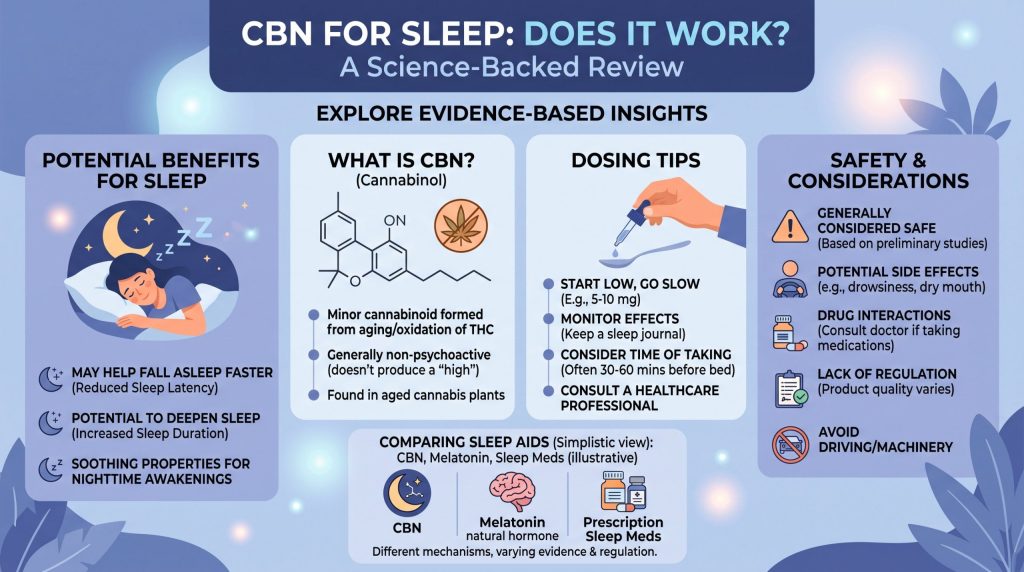
Cannabinol, or CBN, is a cannabinoid found in cannabis and hemp. It’s often described as sedating, yet that reputation grew largely from cannabis folklore, laboratory research, and experiences with aged cannabis, not a deep catalogue of high-quality human trials. Early clinical findings are interesting, especially for nighttime awakenings, but they don’t establish CBN as a proven insomnia treatment.
This evidence-based review examines CBN’s potential benefits, studied doses, side effects, drug interactions, product quality, and legal complications. It also compares CBN with CBD, THC, melatonin, and better-established insomnia care. Because commercial formulas often combine several cannabinoids, we’ll distinguish research on CBN itself from research on gummies or oils containing CBN plus CBD, THC, melatonin, or herbs.
No CBN manufacturer sponsored this review, and no product earns a recommendation merely for having attractive packaging or a moon on the label. Product examples and price ranges are illustrative: formulas, test results, and regulations change. CBN isn’t authorized by Health Canada to diagnose, treat, cure, or prevent insomnia.
If you’re pregnant, take prescription medication, have a safety-sensitive job, or regularly struggle to sleep, speak with a qualified clinician before experimenting. “Natural” doesn’t mean interaction-free, and feeling sleepy isn’t necessarily the same as getting healthier sleep.
Key Takeaways
- Preliminary studies suggest CBN may help reduce nighttime awakenings but lacks strong evidence for improving sleep onset or curing insomnia.
- No standardized CBN dosage for sleep exists; start with verified, low-dose products and avoid THC to minimize risks and impairment.
- Products combining CBN with THC, CBD, melatonin, or herbs make it difficult to isolate CBN’s sleep effects, so simpler formulas are preferable for evaluation.
- Possible side effects include drowsiness, dizziness, and dry mouth; long-term safety and tolerance remain unstudied, so cautious use is advised.
- Always consult a healthcare professional before using CBN for sleep, especially if pregnant, taking medications, or dealing with chronic sleep disorders.
- CBN should not replace treatments like cognitive behavioural therapy for insomnia (CBT-I) or medical evaluation for conditions such as sleep apnea or restless legs syndrome.
Key Takeaways: What to Know Before Trying CBN
The short version? CBN may help some people sleep, but the evidence remains preliminary. Here’s what deserves space in your decision:
- Small human trials suggest certain CBN formulations may reduce nighttime awakenings or improve perceived sleep quality. Benefits for falling asleep are less consistent.
- There is no medically established CBN dosage for sleep, no validated dose-by-weight chart, and no proven “perfect” CBD-to-CBN ratio.
- Products containing THC, CBD, melatonin, or botanicals can’t tell you what CBN did by itself.
- Possible problems include drowsiness, dizziness, dry mouth, impaired driving, and drug interactions. Long-term nightly safety hasn’t been established.
- CBN product labels aren’t always accurate. Choose recent, batch-specific third-party testing that covers potency, THC, pesticides, solvents, heavy metals, and microbes.
- CBN isn’t a substitute for evaluating sleep apnea, restless legs syndrome, depression, medication effects, or chronic insomnia.
Practical bottom line: If your clinician considers it reasonable, use a verified product, avoid THC initially, begin with the lowest labelled amount, and don’t redose during the night. Test it only when you have at least eight hours available for sleep and no early-morning driving.
What Is CBN?
CBN, short for cannabinol, is one of more than 100 identified cannabinoids associated with Cannabis sativa. Unlike THC, it usually isn’t produced in large quantities by a fresh plant. Instead, THC gradually oxidizes into CBN when cannabis is exposed to oxygen, heat, and light. That’s why older cannabis may contain more CBN.
This origin helped create CBN’s “sleepy cannabinoid” nickname. People sometimes found aged cannabis more sedating and credited CBN, but old material contains numerous changed compounds. Anecdote can generate a hypothesis: it can’t isolate a cause.
Commercial CBN may be extracted, concentrated, or converted from hemp-derived cannabinoids. You’ll find it in gummies, tinctures, softgels, and mixed “nighttime” formulas. CBN appears to be much less intoxicating than delta-9 THC, but “less intoxicating” doesn’t guarantee zero impairment, especially at higher doses or when THC is present.
How CBN Interacts With the Body, and Why That Does Not Prove a Sleep Benefit
CBN can interact with the body’s endocannabinoid system, including CB1 and CB2 receptors, although its receptor activity differs from THC’s. Preclinical work also suggests activity at other molecular targets involved in sensation and inflammation. These mechanisms are biologically plausible, but they don’t automatically equal better sleep.
That distinction matters. A molecule can bind to a receptor in a dish, alter activity in an animal, and still produce little meaningful benefit in people. Sleep also involves circadian timing, arousal, breathing, mental health, pain, medication, and learned behaviours, not one biological switch.
Researchers hence need randomized human trials measuring outcomes such as sleep onset, awakenings, total sleep time, next-day performance, and sleep architecture. Mechanism explains how a benefit might happen. Clinical evidence tells you whether it actually happens, at what dose, and with what trade-offs.
Does CBN for Sleep Work? What the Research Shows
The honest answer is: possibly for selected sleep complaints, but not conclusively. Compared with melatonin, prescription insomnia medicines, or cognitive behavioural therapy for insomnia (CBT-I), CBN has a thin human evidence base.
Older claims often point to small studies from decades ago, many examining CBN alongside THC rather than treating insomnia with isolated CBN. Newer randomized trials are more useful, but they remain few, short, and sometimes funded by cannabinoid companies. Industry funding doesn’t invalidate results: it does make independent replication especially valuable.
A 2024 randomized, double-blind, placebo-controlled study published in Experimental and Clinical Psychopharmacology tested nightly CBN and CBN/CBD combinations in adults reporting poor sleep. A 20 mg CBN treatment reduced nighttime awakenings and overall sleep disturbance versus placebo, but didn’t significantly shorten sleep-onset latency. Adding CBD didn’t clearly improve the main effects. That’s a signal worth studying, not a final verdict.
Human Clinical Trials: Formulations, Doses, Results, and Study Quality
Human studies don’t all test the same thing. Some use isolated CBN: others use multi-ingredient oils or gummies. A commonly cited controlled trial evaluated 20 mg of CBN alone and combinations containing 20 mg CBN with 10, 20, or 100 mg CBD over seven nights. Participants reported fewer awakenings with CBN, while several other sleep and daytime-fatigue measures showed limited or inconsistent differences.
Separate trials of commercial cannabinoid sleep products have reported improvements in self-rated sleep, but formulas may include CBN, CBD, THC, melatonin, or botanical ingredients. If a gummy contains five active compounds, applause for CBN alone is premature.
Key quality questions include:
- Was allocation randomized and blinded?
- Was there an adequate placebo group?
- Did researchers use objective measures or only morning questionnaires?
- Was the study long enough to identify tolerance or delayed harms?
- Who funded it, and was the protocol registered beforehand?
Current studies answer some, not all, of these questions.
Falling Asleep vs. Staying Asleep: Which Outcomes Have Been Studied?
“Better sleep” can mean very different things. Sleep-onset latency measures how long you take to fall asleep. Wake after sleep onset captures time awake after initially dozing off. Researchers may also assess total sleep time, sleep efficiency, morning refreshment, and next-day functioning.
The emerging CBN data look somewhat more encouraging for staying asleep, particularly reducing reported awakenings, than for falling asleep faster. In the seven-night randomized trial, 20 mg CBN didn’t significantly improve sleep-onset latency compared with placebo. So a person who lies awake for 90 minutes may not experience the same result as someone who falls asleep easily but wakes repeatedly.
Self-reports matter, you know when a night felt miserable, but they’re vulnerable to expectation and imperfect recall. Objective tools such as polysomnography or validated actigraphy can show whether perceived improvement corresponds to measurable sleep. CBN research needs more of both.
Research Gaps: Small Studies, Short Follow-Up, and CBN-Blended Products
Three gaps keep the confidence level low.
First, samples have generally been modest. Small studies can miss uncommon side effects and sometimes exaggerate benefits. Second, follow-up often lasts days or weeks rather than months. That tells you little about nightly tolerance, withdrawal, dependence, liver effects, or sustained effectiveness.
Third, blended products muddy attribution. CBD, THC, melatonin, L-theanine, valerian, and terpenes can each alter the experience, or side-effect profile. Even chocolate, sugar, and a reassuring bedtime ritual may influence subjective sleep.
Future trials should compare isolated CBN with placebo and established treatments, use independent laboratories, enrol people with clinically diagnosed insomnia, and track objective sleep plus next-day driving or cognition. They should also include older adults and people taking common medications. Until then, describe CBN as promising but unproven, not as a natural sleeping pill backed by settled science.
CBN vs. Other Sleep Aids: Benefits, Evidence, and Trade-Offs
Choosing a sleep aid isn’t simply a contest to find the ingredient that produces the heaviest eyelids. You’re balancing evidence, the cause of your sleep problem, next-day performance, interactions, and long-term usefulness.
| Option | Best-supported role | Main limitations |
|---|---|---|
| CBN | Preliminary evidence for fewer awakenings | Few short human trials: variable products |
| CBD | Limited, mixed sleep evidence: may help when anxiety or pain contributes | Dose-dependent effects and interactions |
| THC | Can shorten sleep onset for some users | Intoxication, tolerance, dependence, altered sleep architecture |
| Melatonin | Circadian timing, jet lag, delayed sleep phase | Modest insomnia effects: label variability |
| CBT-I | First-line treatment for chronic insomnia | Requires practice and access |
This isn’t a ranking for every person. For example, treating obstructive sleep apnea with a sedating gummy is like turning up the radio because your engine is knocking: you may notice the noise less, but the underlying problem remains.
CBN vs. CBD vs. THC for Sleep
CBN, CBD, and THC aren’t interchangeable. THC strongly activates CB1 receptors and can cause a high, slower reaction time, anxiety, and impaired memory. It may help some people fall asleep in the short term, yet regular use can lead to tolerance: stopping after heavy use may trigger vivid dreams and disrupted sleep.
CBD isn’t typically intoxicating, but research on sleep is mixed. Low and high doses may act differently, and benefits may reflect reduced anxiety, pain, or another symptom rather than direct sedation. Prescription cannabidiol also has clinically important drug-interaction and liver-enzyme warnings.
CBN appears less intoxicating than THC, and early data suggest possible help with awakenings. But it has far less clinical evidence than its popularity implies. If your product combines all three, expect THC to contribute substantially to both subjective effects and drug-test risk.
CBN vs. Melatonin: Different Mechanisms, Uses, and Limitations
Melatonin is a hormone signalling biological night. It works best as a timing tool, for jet lag, shift-related schedule changes, or delayed sleep-wake phase, not as a knockout pill. Timing can matter more than dose, and taking it randomly at midnight may shift your body clock in an unwanted direction.
CBN acts through cannabinoid-related pathways and isn’t established as a circadian treatment. The two hence address different hypotheses. A person whose bedtime drifts to 3 a.m. may benefit more from properly timed light and melatonin guidance than from CBN.
Neither product category is perfectly controlled. Studies have found substantial melatonin label variability, while cannabinoid products may contain unexpected THC or inaccurate potency. Combining CBN and melatonin could increase sleepiness, but there’s no strong evidence defining an ideal combination. More ingredients don’t automatically mean more restorative sleep: sometimes they just make troubleshooting harder.
CBN Dosage for Sleep: What Is Known and What Is Not
There is no Health Canada-approved or clinically established CBN dosage for sleep. Human studies have examined specific products and doses, often around 20 mg CBN, but that doesn’t make 20 mg universally effective or safe. Your age, liver function, medications, cannabinoid experience, product format, and THC exposure can all change the result.
If a clinician agrees that a trial is reasonable, avoid treating a study dose as a starting command. Select a product with clear, independently confirmed potency and begin with the lowest labelled serving. Don’t stack it with alcohol, cannabis, antihistamines, or sleep medication. Keep a simple log of dose, timing, awakenings, morning alertness, and side effects.
Stop if you experience marked dizziness, confusion, palpitations, worsening anxiety, allergic symptoms, or persistent next-day impairment. A supplement experiment should produce useful information, not become an escalating nightly guessing game.
Studied Doses vs. Product Labels: Why There Is No Established Sleep Dose or Validated Weight Chart
Research doses and retail servings vary. You may see 2.5 mg CBN in one gummy, 10 mg in another, and 20 mg or more in a full-dropper tincture. Meanwhile, a clinical trial’s standardized formulation may absorb differently from a store-bought candy.
Be skeptical of online charts assigning CBN milligrams by body weight. No validated clinical calculator supports those recommendations for insomnia. Cannabinoid response isn’t determined by body weight alone, and doubling body weight doesn’t mean someone needs twice the CBN.
Also read whether potency is listed per piece, per serving, or per package. A bottle shouting “600 mg” may contain 30 servings with 20 mg total cannabinoids each, and only 5 mg CBN. Confirm the serving with the batch certificate of analysis rather than relying on front-label arithmetic. Tiny print has ruined many otherwise peaceful evenings.
When to Take CBN: Onset, Duration, and the Risks of Redosing Too Soon
CBN-specific onset data are limited, so timing guidance often borrows from oral cannabinoid pharmacology. Swallowed gummies and capsules may take roughly 30 minutes to two hours to become noticeable, with effects potentially lasting several hours. A tincture held under the tongue may feel faster, although much of it can still be swallowed.
Food, especially a high-fat meal, may increase or delay cannabinoid exposure. That makes the “nothing happened after 40 minutes” verdict unreliable. Redosing too early can turn a mild experiment into 3 a.m. dizziness followed by a foggy commute.
Take the product only when your evening responsibilities are finished and you have a full sleep window. Don’t drive, cook over an open flame, supervise risky activities, or make important decisions after taking it. If morning grogginess appears, don’t keep increasing the dose in pursuit of stronger sedation.
CBD-to-CBN Ratios and Added THC: Is There Evidence for an Ideal Blend?
No convincing evidence establishes an ideal CBD-to-CBN ratio. Marketing terms such as “1:1 sleep synergy” or “entourage formula” sound scientific, but controlled evidence hasn’t identified a winning ratio. In one randomized study, adding 10 to 100 mg CBD to 20 mg CBN didn’t consistently outperform CBN alone on the central sleep outcomes.
Low-dose THC may increase perceived sedation, but it also introduces intoxication, anxiety, impaired coordination, tolerance, dependence risk, and a greater chance of a positive drug test. Even 1–2.5 mg can affect a THC-sensitive beginner.
For troubleshooting, simpler is better. A single-cannabinoid product makes it easier to connect benefits or side effects with an ingredient. If you use a blend, record every active component, including melatonin and herbal extracts. Otherwise, when you wake refreshed or feeling like a dropped lasagna, you won’t know what caused it.
CBN Side Effects and Safety Risks
CBN’s safety profile isn’t fully mapped. Reported or plausible cannabinoid-related effects include sleepiness, dizziness, dry mouth, headache, nausea, changes in appetite, and impaired attention or coordination. Product contaminants and undisclosed THC create additional risks.
Short studies can make a compound look well tolerated while missing rare or cumulative problems. Supplement reporting systems also capture less safety information than large prescription-drug trials. So “no serious events observed” should not be translated into “proven safe for everyone.”
Use extra caution with high-potency extracts, products lacking laboratory documentation, and formulas combining multiple sedating ingredients. Store gummies in child-resistant packaging away from children and pets: colourful cannabinoid candy looks painfully ordinary. If a child consumes one, contact your poison centre promptly. In Canada, call 1-844-POISON-X (1-844-764-7669; in Quebec, 1-800-463-5060). Call 911 or seek emergency care for severe confusion, breathing difficulty, collapse, or inability to awaken.
Next-Day Grogginess, Impairment, and Driving Precautions
Feeling normal doesn’t guarantee normal reaction time. CBN-specific driving research is scarce, and products may contain THC even when labelled “broad spectrum” or “THC-free.” Oral cannabinoids can also last longer than expected, especially after a large serving or late-night redose.
The safest approach is to avoid driving or operating machinery until you know how a verified product affects you, and never drive while drowsy, dizzy, slowed, or intoxicated. Your first trial shouldn’t happen before a dawn flight, school run, forklift shift, or presentation to the entire office. Pick a low-stakes morning.
If impairment persists after waking, arrange other transportation. Coffee can make you feel more awake without reliably reversing cannabinoid-related psychomotor effects. Employers in transportation, healthcare, public safety, and other regulated fields may also prohibit cannabinoid use regardless of retail legality.
Potential Interactions With Alcohol, Sleep Medicines, and Other Drugs
CBN interaction studies in humans are limited, but caution is warranted because cannabinoids can produce additive sedation and may affect drug-metabolizing enzymes. Alcohol, opioids, benzodiazepines such as alprazolam, Z-drugs such as zolpidem, sedating antihistamines such as diphenhydramine, gabapentin, and some antidepressants can compound drowsiness or poor coordination.
Potential metabolic interactions may matter with blood thinners, seizure medicines, transplant drugs, and other treatments with narrow safety margins. Evidence from CBD can’t simply be pasted onto CBN, yet it’s enough to justify professional review rather than DIY mixing.
Ask a pharmacist to check the exact ingredient panel, including CBD and THC, not merely the product name. Avoid alcohol during your trial. If you use prescription sleep medicine, don’t replace, combine, or taper it without your prescriber. Abruptly stopping certain sedatives can be dangerous.
Who Should Avoid CBN or Consult a Clinician First?
Avoid CBN during pregnancy or breastfeeding because fetal and infant safety hasn’t been established. Children and adolescents shouldn’t use over-the-counter CBN sleep products without specialist guidance.
Consult a clinician first if you:
- Take prescription or multiple sedating medications
- Have liver, kidney, cardiovascular, psychiatric, or neurologic disease
- Have a history of cannabis use disorder or severe reactions to THC
- Are an older adult at risk of falls or confusion
- Have suspected sleep apnea, breathing disease, or unexplained daytime sleepiness
- Need drug testing or perform safety-sensitive work
- Have surgery planned, since anesthesia teams need to know about cannabinoid use
Choose urgent evaluation rather than another gummy if sleep loss accompanies mania, suicidal thoughts, chest pain, severe breathlessness, or dangerous confusion. Supplements belong far down the priority list in those situations.
Can You Take CBN Every Night? Long-Term Safety, Tolerance, and Dependence Unknowns
There isn’t enough evidence to say nightly CBN remains effective and safe over months or years. Trials lasting about a week can’t establish whether tolerance develops, doses creep upward, sleep worsens after stopping, or subtle cognitive and liver effects emerge.
CBN’s dependence potential is also poorly characterized. It appears less intoxicating than THC, but many nighttime products contain THC, and habitual reliance can become behavioural even without classic physical dependence. If you feel unable to sleep without a gummy, keep increasing your serving, or use it despite daytime impairment, pause and seek guidance.
A practical trial should have a defined goal and review date. Track sleep for two weeks rather than judging one dramatic night. If there’s no clear improvement, or you’re progressively groggier, stop chasing the label’s promise. Persistent insomnia deserves an assessment, not an indefinite subscription shipment.
How to Choose a CBN Sleep Product
Product quality may matter as much as the number on the front. In Canada, CBN products aren’t Health Canada-approved insomnia treatments, and retail rules vary by province and territory. Look beyond stars, influencer codes, and phrases such as “pharmaceutical grade,” which may have no defined meaning on a cannabinoid label.
Use this buying sequence:
- Confirm the product is legal where you live.
- Find a recent, batch-specific certificate of analysis (COA) from an ISO/IEC 17025-accredited laboratory.
- Match the COA batch number to the package.
- Verify CBN, CBD, delta-9 THC, and other cannabinoid amounts.
- Check contaminant panels and serving math.
- Review the entire ingredient list for allergens and sedatives.
Prefer manufacturers with reachable customer support, clear return policies, child-resistant packaging, and transparent testing. A QR code that leads only to the homepage isn’t transparency: it’s a tiny digital scavenger hunt.
CBN Gummies vs. Oils vs. Capsules: Dosing Clarity, Convenience, and Added Ingredients
| Format | Advantages | Watch-outs |
|---|---|---|
| Gummies | Convenient, premeasured, discreet | Sugar, variable piece potency, slow onset |
| Oils | Flexible dosing: easier to make small adjustments | Dropper errors, taste, concentration math |
| Capsules/softgels | Clear serving and no measuring | Harder to reduce dose: delayed onset |
Gummies suit people who value convenience, but confirm whether one serving means one or two pieces. Oils can support cautious titration if the dropper is marked and the label states milligrams per millilitre. Capsules remove the late-night “was that 0.25 or 0.75 mL?” debate, though they offer less flexibility.
Check for melatonin, THC, valerian, kava, artificial sweeteners, and common allergens. A “CBN gummy” may contain more CBD than CBN and enough melatonin to explain the morning headache. Keep all formats locked away from children and pets.
How to Read a Certificate of Analysis: CBN Potency, THC, and Contaminants
Start with identity: product name, batch or lot number, testing date, and laboratory. Then compare the reported CBN concentration with the label. For oil, determine whether results are listed per gram, millilitre, bottle, or serving. Ask the company for clarification if the units require a calculator and an act of faith.
Review all THC variants, not only delta-9 THC. “ND” usually means not detected above the laboratory’s reporting limit, not proof that absolutely zero exists. Full-spectrum products may legally contain trace THC yet still create impairment or drug-test concerns.
A complete COA should also address:
- Heavy metals, including lead, arsenic, cadmium, and mercury
- Pesticides
- Residual solvents
- Microbial contamination and mycotoxins
Potency-only testing is incomplete. Avoid expired reports, mismatched batches, screenshots with cropped laboratory details, or products that fail to provide results before purchase.
Comparing Cost per Serving and Spotting Unsupported Sleep Claims
Compare cost per verified CBN serving, not bottle price. If a C$45 bottle contains 30 gummies with 5 mg CBN each, that’s C$1.50 per serving and C$0.30 per milligram. A C$60 oil containing 600 mg verified CBN costs C$0.10 per milligram, but only if you can measure it accurately and will actually use it.
Price doesn’t establish purity or effectiveness. Nor do testimonials saying someone “slept 11 hours straight.” Watch for unsupported claims such as “clinically proven to cure insomnia,” “guaranteed REM sleep,” or “works instantly for everyone.” In Canada, health-benefit claims aren’t allowed on cannabis labels, so disease-treatment claims can also signal regulatory noncompliance.
Check whether the cited “clinical study” tested the exact finished formula, not one ingredient in a different dose. Subscription discounts can be useful, but avoid a multi-month commitment before learning whether the product leaves you rested, unchanged, or auditioning for the role of Morning Zombie.
When Sleep Problems Need More Than a Supplement
Occasional rough nights happen. Chronic insomnia is different: difficulty falling asleep, staying asleep, or waking too early despite adequate opportunity, accompanied by daytime consequences. If it occurs at least three nights per week for three months, it may meet the clinical pattern for chronic insomnia and deserves proper evaluation.
Sleep trouble can arise from sleep apnea, restless legs syndrome, pain, menopause symptoms, depression, anxiety, bipolar disorder, thyroid disease, reflux, alcohol, caffeine, or medication. CBN won’t correct an obstructed airway or an iron deficiency.
Before buying another bottle, keep a two-week sleep diary recording bedtime, estimated sleep, awakenings, wake time, naps, caffeine, alcohol, and supplements. Bring it to your clinician. That small record often reveals more than a wearable’s seductive “sleep score,” and it gives you something concrete to work with.
CBT-I and Sleep Habits: Better-Established Options for Chronic Insomnia
The American Academy of Sleep Medicine and American College of Physicians recommend CBT-I as first-line care for chronic insomnia. It combines stimulus control, sleep scheduling, cognitive techniques, and education. Unlike generic “sleep hygiene,” CBT-I directly targets the patterns that perpetuate insomnia.
Useful basics still matter:
- Keep a consistent wake time, including after a poor night.
- Get morning daylight and regular daytime movement.
- Limit late caffeine, alcohol, and nicotine.
- Reserve bed for sleep and sex rather than work or doom-scrolling.
- If you’re awake and frustrated, briefly move to a dim, quiet activity.
Don’t aggressively restrict time in bed without guidance if you have bipolar disorder, seizures, severe sleepiness, or certain medical risks. CBT-I is available through trained clinicians and validated digital programs. It takes effort, yes, but its benefits tend to outlast a gummy.
When to Seek Help for Persistent Insomnia, Snoring, or Daytime Sleepiness
Book an evaluation if sleep difficulty persists for several weeks, disrupts work or mood, or requires escalating substances. Seek assessment for loud habitual snoring, witnessed breathing pauses, gasping, morning headaches, high blood pressure, or excessive daytime sleepiness: these can indicate obstructive sleep apnea.
Other red flags include irresistible leg sensations at rest, sudden sleep attacks, dream enactment, frequent nightmares after trauma, or unusual nighttime behaviours. Don’t drive if you struggle to remain awake. Drowsy driving can be dangerous even when no supplement is involved.
A primary-care clinician can review medications and basic medical causes, while a sleep specialist may recommend testing or targeted treatment. Bring your CBN package and COA to the appointment. “I take a sleep gummy” isn’t enough detail when that gummy contains CBN, CBD, THC, melatonin, and three herbs wearing botanical disguises.
Frequently Asked Questions About CBN for Sleep
CBN questions often sound simple, but the answer depends on formulation, dose, testing sensitivity, jurisdiction, and your individual response. These concise answers reflect current evidence rather than marketing certainty.
Does CBN Make You High?
Purified CBN appears much less intoxicating than delta-9 THC, and many people don’t report a classic cannabis high at common retail servings. Still, evidence is limited, higher doses may cause psychoactive or impairing effects, and individual sensitivity varies.
More importantly, the bottle may contain THC. Full-spectrum formulas intentionally include it, while poorly manufactured products may contain more than their labels disclose. Combining CBN with THC, alcohol, sedatives, or other cannabinoids can intensify dizziness and impairment.
Treat a first dose as potentially impairing. Use it at home when you have no driving or safety-sensitive responsibilities. If avoiding intoxication is essential, a laboratory-verified THC-free product lowers, but may not eliminate, risk. “I didn’t feel high” also isn’t a reliable legal or driving-safety test.
Can CBN Products Cause a Positive Drug Test?
Yes, particularly if the product contains detectable THC. Standard workplace urine tests generally look for THC metabolites, not CBN itself, but full-spectrum hemp products can provide enough THC to trigger a positive result after repeated use. Label inaccuracies and cross-contamination add uncertainty.
Some cannabinoid metabolites may also complicate certain screening assays, although confirmatory laboratory testing is more specific. No manufacturer can credibly guarantee that its cannabinoid product will never affect a drug test.
If testing has employment, athletic, probation, immigration, or medical consequences, the lowest-risk choice is to avoid CBN and other hemp-derived cannabinoid products. A “THC-free” label or nondetectable COA isn’t an insurance policy, especially with frequent use. Ask the testing authority about its policy rather than relying on a retailer’s FAQ.
Is CBN Legal in Canada and the United States?
In Canada, CBN is regulated as a cannabinoid under the Cannabis Act. Legal products must come through authorized provincial, territorial, or federally licensed channels and follow cannabis packaging and possession rules. It isn’t an ordinary natural health supplement.
In the United States, the 2018 Farm Bill let hemp-derived products containing no more than 0.3% delta-9 THC by dry weight fit the federal definition of hemp. A 2025 federal law narrows that definition from November 12, 2026, counting total THC, capping finished products at 0.4 mg of THC and similar cannabinoids per container, and excluding cannabinoids synthesized outside the plant. CBN’s regulatory position isn’t frictionless either: the FDA hasn’t approved it as a dietary ingredient or insomnia treatment, and state laws may restrict cannabinoid manufacturing, sales, age limits, or product types. Marijuana-derived CBN remains subject to federal cannabis restrictions.
Rules change, and crossing an international border with cannabis products can be illegal even when possession is permitted on both sides. Check current federal, provincial, territorial, and local guidance before buying or travelling.
Does CBN Improve Deep Sleep or REM Sleep?
There isn’t convincing human evidence that CBN reliably increases deep sleep, improves REM sleep, or produces an objectively “better” sleep-stage pattern. Most available studies emphasize self-reported quality, awakenings, or overall disturbance rather than comprehensive overnight polysomnography across long treatment periods.
Wearables can estimate sleep stages, but consumer watches and rings don’t measure brain waves as directly as clinical polysomnography. A dashboard showing 14 extra minutes of “deep sleep” after a gummy isn’t proof that CBN caused the change, or that the estimate is accurate.
THC can alter sleep architecture and suppress REM in some contexts, which matters when a CBN formula includes THC. For now, view claims about “boosting deep sleep” or “optimizing REM” skeptically unless they’re supported by peer-reviewed trials of the exact formula using objective measurements.
References and Medical Review
This review synthesizes human clinical research, professional insomnia guidance, cannabinoid safety information, and current regulatory resources. Key sources include:
- Safety and effects of CBN with and without CBD on sleep quality, randomized, double-blind, placebo-controlled study published in Experimental and Clinical Psychopharmacology.
- American Academy of Sleep Medicine clinical practice guidelines, evidence-based guidance for insomnia and other sleep disorders.
- American College of Physicians guidance on chronic insomnia, recommendation supporting CBT-I as initial treatment.
- Health Canada information for health care professionals on cannabis and the cannabinoids, Canadian regulatory and safety context.
- Health Canada cannabis health information, Canadian regulation and consumer guidance.
- Canada’s Lower-Risk Cannabis Use Guidelines, evidence and safety summary.
Medical content should be reviewed and periodically updated by a clinician or pharmacist with expertise in sleep medicine and cannabinoid pharmacology. Publication review doesn’t replace individualized medical advice.
The final word: CBN for sleep has an intriguing early signal, particularly for nighttime awakenings, but current research doesn’t justify calling it a proven insomnia remedy. If you decide to try it, make the experiment boring, in the best way. Choose verified potency, avoid complicated blends, use the lowest labelled amount, allow a full night, and track next-day function rather than chasing a dramatic sedative feeling.
Most importantly, don’t let a supplement delay effective care. Chronic insomnia responds better to CBT-I than to endless product roulette, and snoring with breathing pauses needs medical attention. Better sleep isn’t about becoming unconscious faster: it’s about waking safely, functioning well, and addressing what’s keeping your system on alert.