
Nov
Five years sounds like a neat medical checkpoint: smoke cannabis for that long, look at your lungs, and get a definitive verdict. Human bodies aren’t nearly so tidy. Weed smokers’ lungs after 5 years can range from having no obvious symptoms to producing daily phlegm, wheezing during workouts, or experiencing repeated bouts of bronchitis.
Your outcome depends on far more than the calendar. How often you smoke, how deeply you inhale, whether you use blunts or mix cannabis with tobacco, your asthma history, occupational exposures, and even the ventilation in the room all matter. Someone smoking two joints every evening has a radically different exposure from someone sharing one joint twice a month, even though both can honestly say they’ve smoked for five years.
This evidence-based review examines what cannabis smoke may do to your airways, which changes can improve after quitting, and where research remains frustratingly uncertain. It focuses on inhaled cannabis and respiratory health, not cannabis’s broader effects on memory, mental health, pregnancy, driving, or cardiovascular risk. It also can’t diagnose your lungs from your smoking history or an online photograph.
The short version? Regular marijuana smoking is consistently associated with airway irritation and chronic-bronchitis symptoms. The evidence connecting cannabis alone with COPD, lung cancer, or permanent loss of lung function is less conclusive, partly because studies often involve younger participants, inconsistent exposure measurements, and people who also smoke tobacco.
So, no scare tactics, and no comforting fiction that “natural” smoke is harmless. Here’s what five years of smoking may mean for your breathing and what you can do next.
Key Takeaways
- After five years of regular cannabis smoking, lungs often show airway irritation, chronic bronchitis symptoms like cough, phlegm, and wheezing, especially with daily use.
- The extent of lung impact varies widely depending on smoking frequency, inhalation depth, use of tobacco products, personal health factors, and environment.
- Current research shows clear links between cannabis smoking and airway inflammation but is inconclusive on causing COPD, lung cancer, or irreversible lung damage within five years.
- Quitting or reducing cannabis smoking can significantly improve respiratory symptoms over time, although some structural lung changes may not fully reverse.
- No method of smoking cannabis, including joints, bongs, or blunts, eliminates exposure to harmful smoke particles and irritants that affect lung health.
- If persistent respiratory symptoms or severe issues like chest pain or coughing blood occur, medical evaluation is crucial; routine lung cancer screening is not recommended based on cannabis use alone.
Quick Answer: What Can Five Years of Smoking Weed Do to Your Lungs?
After five years, regular cannabis smoking may leave your airways inflamed and more reactive. You might notice a persistent cough, extra mucus, wheezing, chest tightness, or more frequent bronchitis symptoms. These problems are especially plausible with daily or near-daily use.
That doesn’t mean every smoker develops visible scarring, COPD, or cancer within five years. Research is strongest for respiratory symptoms and airway irritation, not for predicting irreversible disease in an individual. Some people have few symptoms despite substantial exposure: others develop problems sooner because of asthma, infections, tobacco use, workplace dust, or genetic susceptibility.
Bottom line: Five years is enough time for smoking-related symptoms to develop, but duration alone cannot reveal how healthy your lungs are.
Why Five Years Is Not a Fixed Threshold for Lung Damage
Lungs don’t suddenly cross a damage line on the fifth anniversary of your first joint. Exposure accumulates, while inflammation and healing can occur at the same time.
Age, frequency, dose, inhalation style, product potency, and baseline health change the picture. Smoking in a poorly ventilated bedroom every night may produce more irritation than occasional outdoor use. Asthma can make smaller exposures feel dramatic, while good fitness may temporarily conceal reduced respiratory comfort.
Cannabis research also lacks a standardized lifetime-exposure measure used consistently across studies. So, “five years” may describe anything from a few dozen sessions to thousands. It’s a useful reason to check in, not a diagnosis.
Daily vs. Occasional Use: Frequency, Joint-Years, and Tobacco Exposure
Researchers sometimes use joint-years, where one joint-year generally means smoking one joint daily for one year. It’s a rough tool: joints vary in size and potency, people share them, and inhalation patterns differ. Still, five joint-years represents far more smoke than five years of monthly use.
| Pattern over five years | Approximate exposure | Important caveat |
|---|---|---|
| One joint monthly | 60 smoking sessions | Not harmless, but relatively low cumulative smoke |
| Three joints weekly | About 780 joints | Repeated airway exposure |
| One joint daily | About 1,825 joints, or 5 joint-years | Greater likelihood of bronchitic symptoms |
| Daily blunts | Similar cannabis frequency plus tobacco-wrapper exposure | Nicotine and tobacco risks complicate the picture |
Mixing cannabis with cigarettes or using blunt wraps makes attribution difficult, and generally raises concern.
Weed Smokers’ Lungs After 5 Years: Symptoms and Possible Changes
The most consistently reported changes involve the large airways rather than a single distinctive disease visible on a scan. Smoke can increase mucus production, irritate the bronchial lining, and provoke inflammation.
Symptoms don’t prove cannabis is the cause. Asthma, allergies, reflux, viral infections, tobacco, and workplace exposures can look remarkably similar. But if a cough appeared after your smoking became frequent, or reliably improves during breaks, that pattern is worth telling a clinician.
Persistent Cough, Phlegm, Wheezing, and Bronchitis Symptoms
A “smoker’s cough” isn’t a quirky membership badge. Cough and phlegm are protective responses: your airways are trying to move mucus and trapped particles out. Regular cannabis users report these symptoms more often than nonusers in many observational studies.
Common signs include:
- Coughing soon after waking
- Clearing thick or discoloured mucus
- Wheezing, especially after smoking or in cold air
- Chest tightness
- Repeated episodes described as bronchitis
“Chronic bronchitis” in research often refers to a symptom pattern, typically cough and sputum over a defined period, not necessarily permanent obstruction. If fever, worsening breathlessness, or foul/bloody mucus accompanies your cough, don’t assume it’s merely smoke irritation.
Shortness of Breath and Changes in Exercise Tolerance
You may first recognize a problem during something ordinary: climbing two flights of stairs, chasing a bus, or finishing a familiar Peloton session. Your lungs might feel tight, recovery may take longer, or coughing may interrupt exercise.
Reduced stamina isn’t specific to cannabis. Deconditioning, anemia, anxiety, asthma, heart problems, respiratory infection, and tobacco can all contribute. Cannabis can also raise heart rate temporarily, which may make exertion feel harder even without measurable lung impairment.
Track the pattern for one or two weeks: activity, symptoms, cannabis use, and recovery time. That small record is far more useful at an appointment than “I get winded sometimes.”
Can You Have Airway Irritation Without Noticeable Symptoms?
Yes. Your lungs have considerable reserve, and gradual changes are easy to normalize. You may unconsciously avoid steep hills or accept morning throat-clearing as routine. Meanwhile, airway inflammation can exist without dramatic breathlessness.
The reverse is also possible: distressing symptoms can occur while spirometry remains within a normal range. Standard breathing tests measure airflow and volume: they don’t capture every form of irritation, mucus production, or small-airway dysfunction.
No symptoms is reassuring, but it isn’t proof that smoke has had no biological effect. If you use cannabis daily, have asthma, combine it with tobacco, or work around fumes or dust, discuss those exposures during routine care.
How Marijuana Smoke Affects the Airways
Burning plant material creates a complex aerosol of fine particles, gases, and combustion chemicals. Although cannabis and tobacco aren’t identical, their smoke contains several of the same respiratory irritants and toxic compounds.
Cannabis users may inhale deeply and hold their breath to maximize the perceived effect. That technique can increase particle deposition: holding smoke longer doesn’t meaningfully improve the experience enough to make the extra exposure a clever trade. Your lungs, alas, don’t award bonus points for endurance.
Smoke Particles, Irritants, and Airway Inflammation
Hot smoke contacts the mouth, throat, and bronchial lining. Particles and chemicals can impair normal airway defences, stimulate mucus-producing cells, and recruit inflammatory cells. The result may be swelling, mucus, cough, and heightened airway sensitivity.
Laboratory findings don’t automatically predict a person’s future disease, but they explain why repeated exposure can produce chronic-bronchitis symptoms. Cannabis smoke may also affect immune activity in the respiratory tract, although the clinical importance of those changes remains uncertain.
The key distinction is between hazard and individual risk. Smoke contains hazards: your actual risk depends on dose, duration, susceptibility, and co-exposures. “Plant-based” doesn’t neutralize combustion, campfire smoke is natural too, and nobody recommends inhaling it nightly.
Joints, Bongs, and Blunts: Why Smoking Method Does Not Eliminate Risk
A bong cools smoke and may trap some material, but it doesn’t make combustion products disappear. Cooler smoke can even feel smoother, encouraging larger inhalations. Pipes and joints likewise deliver particles and irritants directly to the respiratory tract.
Blunts add another concern: many wrappers are made from tobacco and can expose you to nicotine and tobacco-specific toxicants. Spliffs, which mix cannabis with tobacco, also make respiratory and dependence risks harder to separate.
| Method | What it changes | What it does not solve |
|---|---|---|
| Joint or pipe | Simple delivery: no tobacco required | Combustion smoke and hot particles |
| Bong | Cools and water-filters smoke | Toxic gases and fine-particle exposure |
| Blunt | Slow burn and different flavour | Tobacco-wrapper and nicotine exposure |
| Dry-herb vaporizer | Avoids combustion at suitable temperatures | Aerosol exposure, device quality, or drug-related risks |
There is no lung-safe way to inhale smoke.
What Research Shows About Long-Term Lung Health
Cannabis evidence is messier than many headlines suggest. Most long-term studies are observational rather than randomized, which is appropriate ethically, since researchers can’t assign people to smoke for decades. But observational work must contend with inaccurate recall, changing cannabis potency, tobacco use, and relatively young participants.
The clearest signal is increased cough, sputum, wheeze, and bronchitis symptoms among frequent smokers. Outcomes such as COPD and cancer need longer follow-up and better exposure measurement.
Lung Function Tests vs. Respiratory Symptoms: Why Study Findings Differ
Spirometry commonly measures FEV1, air forcefully exhaled in one second, and FVC, the total amount forcefully exhaled. Tobacco-associated obstruction often appears as a reduced FEV1-to-FVC ratio.
Cannabis studies have produced mixed spirometry findings. Some report little reduction in FEV1 at lower cumulative exposure: others identify changes with heavier use. An increased FVC has appeared in some cohorts, but that shouldn’t be interpreted as cannabis “improving” lung health. Deep inhalation habits, participant selection, and other physiological effects may influence the measurement.
Symptoms and spirometry answer different questions. You can have inflamed, mucus-producing airways with a broadly normal test, especially when you’re young. Conversely, abnormal results require evaluation rather than automatic blame on cannabis.
Chronic Bronchitis and COPD: Distinguishing Established Findings From Uncertainty
The association between regular cannabis smoking and chronic-bronchitis symptoms is reasonably well established. Evidence that cannabis alone causes chronic obstructive pulmonary disease is less consistent.
COPD means persistent airflow limitation, usually confirmed with post-bronchodilator spirometry, not simply having a cough. Tobacco is a major established cause, and combined tobacco-cannabis use may carry greater risk than either exposure history suggests in isolation.
The uncertainty isn’t a declaration of safety. Heavy cannabis-only users have historically been less common in long-duration cohorts, and many participants haven’t yet reached ages when COPD becomes more apparent. The sensible takeaway is nuanced: bronchitic symptoms are a demonstrated concern: the size of independent COPD risk remains unresolved, particularly at high lifetime exposure.
Marijuana and Lung Cancer: What Is Known and What Remains Unclear
Cannabis smoke contains carcinogens and causes cellular changes that create biological concern. Yet population studies have not established a clear, consistent lung-cancer risk from cannabis alone at typical reported exposures.
Why the gap? Lung cancer can take decades to develop. Many cannabis users are relatively young, exposure reporting is imprecise, and tobacco can overwhelm the statistical signal. Some studies suggest possible risks with heavy use, while others find no meaningful association after adjustment.
This does not prove cannabis smoke cannot cause lung cancer. It means current evidence can’t quantify the risk confidently. Your tobacco history remains crucial because cigarette smoking has a strong, dose-dependent relationship with lung cancer and determines eligibility for provincial lung screening programs in Canada.
Bullae and Collapsed Lung: Reported Associations and Evidence Limitations
Case reports have described large air-filled spaces called bullae, and spontaneous pneumothorax, or collapsed lung, in heavy cannabis smokers, sometimes at unusually young ages. Deep inhalation, breath-holding, coughing, and smoke exposure have been proposed as contributors.
Case reports are warning signals, not proof of causation. Many reported patients also used tobacco, and unusual cases are more likely to be published than ordinary ones. Researchers hence can’t reliably estimate how often cannabis causes these conditions.
Still, sudden one-sided chest pain and shortness of breath after smoking deserve urgent assessment. A collapsed lung isn’t something to “sleep off,” even if you’re young, athletic, or otherwise healthy.
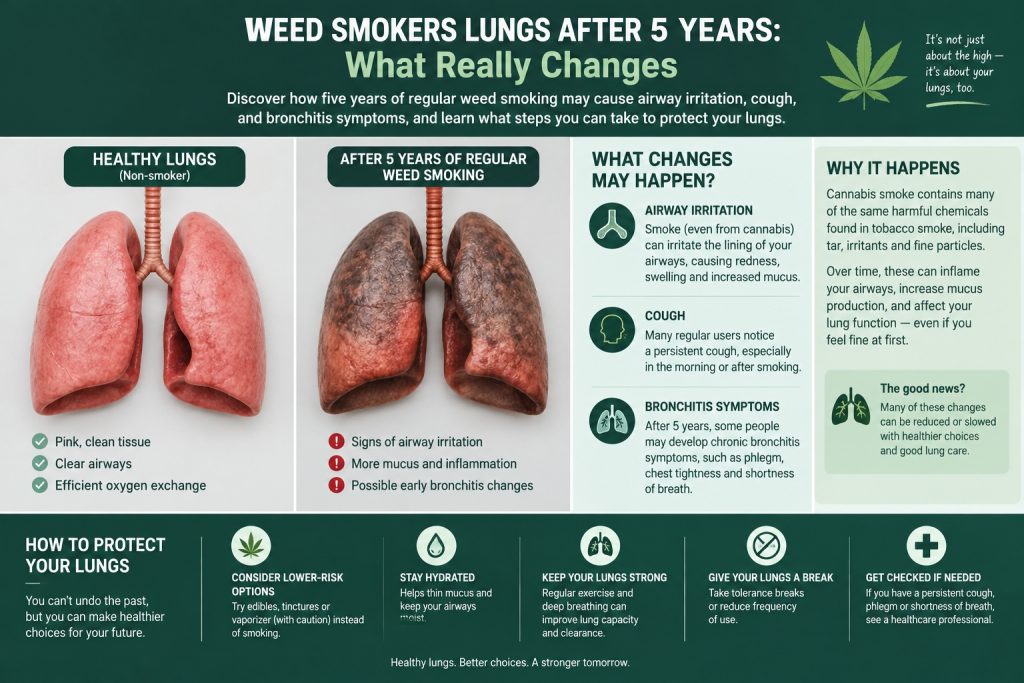
What Do Lungs Look Like After Five Years of Smoking Weed?
There is no standard appearance for cannabis-exposed lungs after five years. They don’t reliably turn into the dramatic blackened organs shown in social posts, nor can a routine image reveal every microscopic or functional change.
Airway irritation mainly concerns tissue lining and mucus production, which may not appear on a basic chest X-ray. Imaging could be normal despite a persistent cough, or show an unrelated finding that has nothing to do with cannabis.
Why Online Lung Photos Cannot Show Your Personal Level of Damage
Viral side-by-side pictures usually omit essential context: Was the specimen exposed to tobacco? Did the person have occupational disease, infection, or cancer? Is the image edited, mislabelled, or taken after decades rather than five years?
A photograph also can’t tell you how well your lungs exchange air. Pathology specimens, CT images, and educational models show different things and shouldn’t be treated as personalized forecasts.
Your useful evidence is less cinematic: symptoms, oxygen level when clinically relevant, physical examination, spirometry, exposure history, and selectively ordered imaging. If you’re worried, bring your actual usage pattern to a clinician instead of bringing a frightening TikTok screenshot. It’ll be a better conversation.
When Clinicians May Recommend Spirometry, a Chest X-Ray, or a CT Scan
Testing depends on symptoms and clinical findings, not simply reaching year five.
- Spirometry may be appropriate for persistent cough, wheeze, breathlessness, suspected asthma, or reduced exercise tolerance.
- Chest X-ray may help investigate ongoing cough, fever, chest pain, recurrent infection, or other concerning signs.
- CT scanning provides more detail but involves greater radiation and may uncover incidental nodules that require follow-up. It isn’t normally a casual reassurance test.
A clinician may first recommend a period without inhaled cannabis, treatment for another suspected condition, or repeat assessment. Normal imaging doesn’t rule out airway irritation, while an abnormal image doesn’t automatically establish cannabis as the cause.
Can Your Lungs Recover After You Stop Smoking Weed?
Often, at least partly. Studies following people who reduce or stop cannabis smoking suggest that cough, sputum, and wheeze can improve. Removing the recurring irritant allows inflamed airways to settle and mucus production to normalize.
Recovery isn’t an overnight “reset,” though. The outcome depends on total exposure, tobacco use, asthma, infections, and whether permanent structural disease is present. A temporary increase in coughing can happen as mucus shifts, but worsening or prolonged symptoms still deserve medical attention.
How Cough and Phlegm May Improve After Quitting, and Why Timelines Vary
Some people notice easier breathing or less morning mucus within days to weeks. For others, improvement takes several weeks or months. There is no scientifically guaranteed day when every symptom disappears.
Try a practical experiment: record your morning cough, mucus, wheeze, and activity tolerance before quitting, then reassess weekly. Avoid smoke, including second-hand smoke, during the trial. If you stop for a weekend but spend it beside a smoky firepit, the results will be… scientifically unhelpful.
Persistent symptoms after quitting don’t necessarily mean irreversible damage. Asthma, reflux, allergies, infection, and tobacco exposure may still require treatment. Book an evaluation instead of repeatedly extending your self-imposed deadline.
What May Be Reversible and Why Complete Recovery Cannot Be Guaranteed
Inflammation, excess mucus, and many bronchitic symptoms may improve substantially after smoke exposure ends. That is the encouraging part, and a solid reason to stop sooner rather than later.
Structural changes, established emphysema, scarring, or persistent airflow obstruction may not fully reverse. Current evidence cannot tell an individual user whether those changes have occurred based only on years smoked. Tobacco co-use raises the possibility of irreversible disease considerably.
Don’t let uncertainty become an excuse to keep smoking. Risk is cumulative, and stopping removes an ongoing exposure even when prior effects can’t be erased. Think of quitting as closing the tap, not magically drying every floorboard.
Practical Quitting Support and Why Lung Detox Products Are Not Proven
“Lung-cleanse” teas, gummies, oils, and supplements haven’t been shown to remove tar or reverse smoke injury. Some can interact with medicines, and inhaled essential oils may irritate lungs further. Your liver and kidneys already handle detoxification: your job is to stop adding smoke.
A workable plan may include:
- Choose a quit date and remove smoking equipment.
- Identify triggers such as bedtime, stress, or particular friends.
- Replace the ritual with a walk, shower, gum, tea, or paced breathing.
- Ask a clinician about cannabis withdrawal, sleep difficulties, or anxiety.
- Use confidential support through your provincial or territorial helpline, listed on Health Canada’s Get help with substance use page, or a local substance-use professional.
Withdrawal can include irritability, insomnia, low appetite, and vivid dreams. It’s uncomfortable, not a character flaw.
Are Vaping or Non-Inhaled Cannabis Products Safer for Your Lungs?
For lung exposure specifically, avoiding inhalation removes combustion smoke from the equation. But “not smoked” doesn’t mean “safe overall.” Each route changes onset, dosing, impairment, and product-quality concerns.
If you use cannabis medically, discuss formulation and dose with a qualified clinician. If you use it recreationally, the Cannabis Act, provincial rules, workplace rules, driving restrictions, and product regulation still apply.
Why Cannabis Vaping Is Not Risk-Free
Vaping may reduce exposure to some combustion products, but your lungs still inhale an aerosol containing ultrafine particles and potentially irritating chemicals. Risks depend on whether you use dry herb, regulated cartridges, concentrates, flavourings, or contaminated informal products.
The 2019 US outbreak of e-cigarette or vaping product use–associated lung injury, known as EVALI, was strongly linked to vitamin E acetate in many illicit THC products. Canada also had cases, but the Public Health Agency of Canada did not identify a specific cause and has not found vitamin E acetate in any Canadian case. Regulation has improved in some markets, but counterfeit cartridges haven’t politely retired.
Avoid black-market products, modified devices, and oils not intended for inhalation. Stop vaping and seek care for chest pain, breathlessness, cough, fever, nausea, or rapidly worsening symptoms.
Edibles and Other Non-Inhaled Options: Avoiding Smoke Without Eliminating Other Risks
Edibles, capsules, tinctures used orally, and some prescribed cannabinoid products avoid direct smoke exposure. Their trade-off is less predictable timing: edible effects may begin after 30 minutes to two hours or longer and can last much longer than inhaled cannabis.
That delay creates the classic mistake, “nothing’s happening”, followed by a second dose and an unexpectedly intense evening. Use clearly labelled, regulated products where legal, start with a low dose, and wait long enough before considering more.
Keep products locked away from children and pets: candies and brownies are especially easy to mistake for food. If a child eats one, call 1-844-POISON-X (1-844-764-7669; in Quebec, 1-800-463-5060), or 911 if symptoms are severe. Don’t drive while impaired, mix cannabis casually with alcohol or sedatives, or assume non-inhaled use is appropriate during pregnancy.
When to Get Medical Help for Respiratory Symptoms
You don’t need to wait until symptoms become dramatic. A primary-care clinician can assess your breathing, listen for wheeze, review tobacco and cannabis exposure, and decide whether testing is warranted.
Be honest about frequency, method, and co-use. This is medical information, not a morality test. Saying “daily bong use plus weekend cigarettes” is more useful than “social smoking.”
Persistent Cough, Wheezing, or Reduced Stamina: When to Book an Appointment
Arrange a non-emergency appointment if you have:
- A cough lasting more than several weeks
- Recurrent wheezing or nighttime coughing
- Daily or frequent phlegm
- Repeated “chest colds” or bronchitis
- Breathlessness during activities you previously tolerated
- Symptoms that persist after reducing or stopping cannabis
Seek assessment sooner if you have asthma, immune suppression, significant tobacco exposure, or occupational contact with silica, asbestos, fumes, or dust. Bring a concise symptom and use diary. Your clinician may consider asthma testing, spirometry, infection, reflux, allergies, or heart-related causes rather than assuming cannabis explains everything.
Sudden Chest Pain, Severe Breathlessness, or Coughing Blood: When to Seek Urgent Care
Call 911 or seek emergency care for severe breathing difficulty, blue or grey lips, confusion, fainting, crushing chest pressure, or rapidly worsening symptoms. Sudden sharp one-sided chest pain with breathlessness may indicate pneumothorax and requires prompt evaluation.
Coughing up more than a small streak of blood is urgent: even a small amount should be discussed promptly, particularly if it recurs. Other warning signs include low oxygen readings accompanied by symptoms, high fever with breathing difficulty, or swelling of the face or throat.
Don’t drive yourself if you’re severely breathless, faint, or impaired. And don’t take another hit to see whether anxiety is causing it. That home diagnostic method has, shall we say, design flaws.
Frequently Asked Questions
These answers address two common questions about weed smokers’ lungs after 5 years. They provide general guidance rather than a personal risk calculation.
Is Smoking Weed as Harmful to Your Lungs as Smoking Cigarettes?
There isn’t a scientifically sound one-to-one conversion between joints and cigarettes. Both produce combustion particles and respiratory irritants, but typical frequency, product composition, filters, inhalation style, and lifetime exposure differ.
Cigarettes have overwhelming evidence linking them to COPD, lung cancer, cardiovascular disease, and premature death. Cannabis smoking has clearer evidence for cough, phlegm, wheeze, and chronic-bronchitis symptoms: its independent long-term relationships with COPD and cancer remain less certain.
That does not make marijuana smoke harmless. If you use both, quitting tobacco is especially urgent (free provincial and territorial quitlines: 1-866-366-3667), and stopping all smoked products gives your lungs the cleanest break. Blunts and spliffs should be counted as tobacco exposure, not filed mentally under “weed only.”
Do You Need Lung Cancer Screening After Five Years of Cannabis Smoking?
Cannabis use alone is not part of the eligibility criteria for low-dose CT lung-cancer screening in Canada. The Canadian Cancer Society suggests screening for people aged 55 to 74 who currently smoke tobacco or used to, especially with a smoking history of 20 years or more. Provincial screening programs set their own rules, using age, years of tobacco smoking, and a risk calculator, so check what your province or territory offers.
A pack-year means smoking an average of one cigarette pack daily for one year. Joint-years don’t substitute for years of tobacco smoking or pack-years under these criteria.
Screening recommendations apply to people without symptoms. If you cough blood, lose weight unexpectedly, develop persistent chest pain, or have an unexplained ongoing cough, you need diagnostic assessment, not a routine screening appointment. Tell your clinician about both cannabis and tobacco exposure.
Evidence Sources, Study Limitations, and Unanswered Questions
Major conclusions in this review align with evidence summaries from the National Academies report on cannabis and cannabinoids, respiratory guidance from the Canadian Lung Association, and clinical information from Health Canada.
Interpret the research with several limitations in mind:
- Exposure is difficult to measure. Joint size, THC concentration, sharing, inhalation depth, and periods of abstinence vary.
- Tobacco confounds results. Many cannabis smokers have also smoked cigarettes or used blunt wraps.
- Products have changed. Today’s concentrates, cartridges, and high-potency flower differ from products used decades ago.
- Follow-up is often too short. Cancer and COPD may take decades to emerge.
- Heavy cannabis-only cohorts are limited. This reduces confidence about uncommon long-term outcomes.
- Healthy-user and selection effects matter. People who develop symptoms may quit, potentially making continuing users appear healthier in later analyses.
Researchers still need long-duration studies with objective exposure markers, separate analysis of smoking and vaping, better accounting for tobacco, and enough older heavy users to evaluate COPD and cancer reliably. The effects of potency, contaminants, deep inhalation, and repeated respiratory infections also need clearer answers.
For now, the most defensible conclusion is neither “five years destroys your lungs” nor “weed smoke is safe.” Weed smokers’ lungs after 5 years may show no obvious abnormality, but regular users can develop meaningful airway inflammation, cough, mucus, wheeze, and reduced respiratory comfort. Severe permanent disease is harder to predict from cannabis duration alone.
Your next step can be simple: stop or reduce inhaled exposure, track symptoms, and arrange medical care if coughing, wheezing, or reduced stamina persists. Seek urgent help for sudden chest pain, severe breathlessness, or coughing blood. You can’t rewrite five years, but you can change what your lungs encounter tomorrow.