
Blog 2026
CBN Weed: Sleep Benefits, Safety, and Buying Guide
Nov
You spot a jar labelled “CBN weed” at a dispensary, and the promise practically writes itself: deeper sleep, fewer midnight wake-ups, no morning fog. Tempting, especially when you’ve already tried chamomile tea, blackout curtains, and the deeply unhelpful advice to “just relax.” But CBN’s reputation as cannabis’s sleep cannabinoid has raced ahead of the evidence.
Cannabinol, or CBN, is a minor cannabinoid created largely as THC ages and oxidizes. It may cause mild psychoactive effects, particularly at higher amounts or when combined with THC, but it isn’t simply “sleepy THC.” Nor is old cannabis automatically a reliable CBN product. Chemical composition, storage conditions, dose, product formulation, and your own sensitivity all matter.
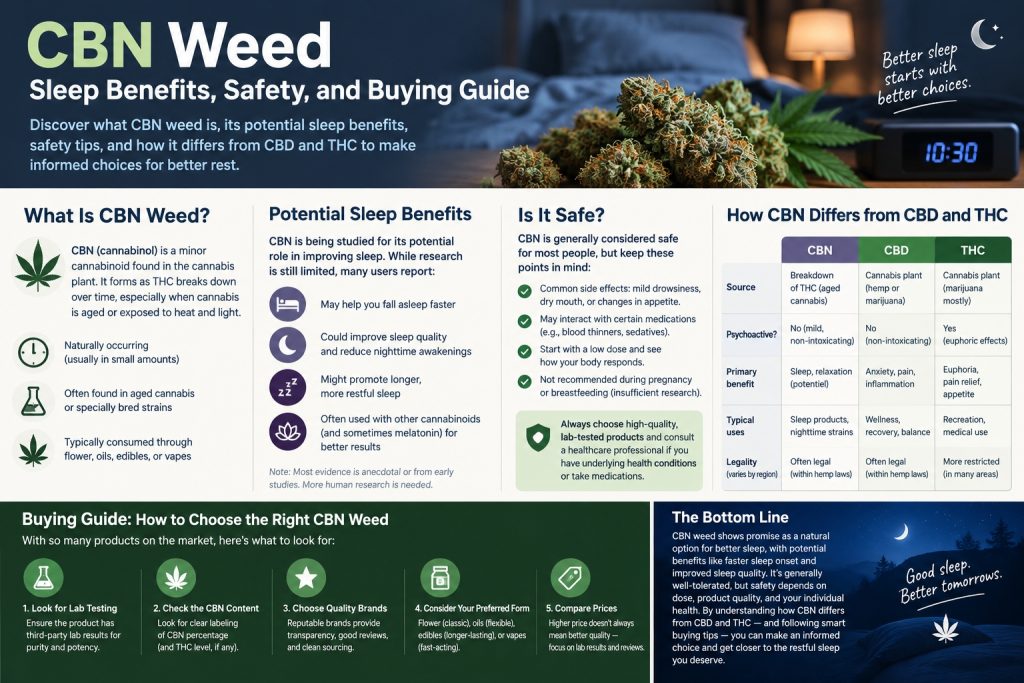
This evidence-focused review examines what CBN feels like, whether it can help you sleep, how it compares with CBD, THC, and CBG, and what safety concerns deserve attention. It also covers labels, laboratory reports, drug testing, legality, and practical precautions. Scientific findings are separated from marketing claims so you can make a clearer decision rather than trusting the moon-and-pillow artwork on a gummy bottle.
Research remains limited. Small human trials offer some encouraging signals, but they haven’t established CBN as a proven treatment for insomnia, pain, or another medical condition. Products also vary enormously: one “nighttime” gummy might contain CBN alone, while another adds CBD, intoxicating THC, melatonin, or sedating herbs.
This article is educational, not personalized medical advice, and it has no affiliation with the brands or products mentioned. If you’re pregnant, take prescription medicine, have a substance-use history, or live with persistent sleep problems, speak with a qualified clinician before experimenting with CBN weed or concentrated CBN products.
Key Takeaways
- CBN weed refers to cannabis products containing cannabinol, a minor cannabinoid formed as THC ages, but its content and effects vary widely depending on product formulation and storage.
- Preliminary research suggests CBN may help reduce nighttime awakenings and improve some aspects of sleep, though evidence is limited and not definitive for treating insomnia.
- CBN is generally less intoxicating than THC but can cause drowsiness and impairment, especially when combined with THC or other sedatives, so caution is needed with driving or operating machinery.
- Labels and strain names don’t guarantee CBN content or effects; verifying laboratory reports with batch-specific cannabinoid data is essential for informed use.
- Because CBN products vary in dose and ingredient blends, starting with low doses in a controlled setting and tracking sleep outcomes helps users evaluate effectiveness safely.
- In Canada, CBN is regulated as cannabis under the Cannabis Act whether it comes from hemp or other cannabis, and provincial and territorial rules add more; consumers should research regulations and be aware that many CBN products may cause positive drug tests.
What Is CBN Weed? Cannabinol Explained
“CBN weed” is informal language rather than a standardized botanical or regulatory category. It can describe aged cannabis flower containing measurable cannabinol, flower infused with CBN isolate, or products marketed around CBN’s supposed nighttime effects.
CBN is one of more than 100 cannabinoids identified in Cannabis sativa. Fresh plants generally contain very little of it. Unlike major cannabinoids produced directly through the plant’s biosynthetic pathways, much of the CBN found in stored flower develops after harvest as delta-9 THC changes over time.
CBN interacts with the body’s endocannabinoid system, including cannabinoid receptors, but its pharmacology isn’t identical to THC’s. Laboratory findings suggest relatively weak activity at CB1 receptors, the receptors most closely associated with cannabis intoxication, and activity at CB2 and other biological targets. Exactly how those actions translate into meaningful human effects remains unsettled.
The practical takeaway: CBN is a real cannabinoid, but “CBN weed” doesn’t tell you its dose, purity, intoxicating potential, or likely effect. For those answers, you need a batch-specific certificate of analysis.
How THC Degrades Into CBN as Cannabis Ages
Heat, oxygen, ultraviolet light, and time can encourage THC to oxidize through several intermediate chemical changes, eventually increasing CBN. That’s why old, poorly sealed flower may test lower in THC and higher in CBN than it did when fresh.
This isn’t a clean one-for-one conversion, though. Degradation produces multiple compounds, and the rate depends on humidity, temperature, light exposure, packaging, and initial chemistry. A forgotten bag in a hot car is not a precision cannabinoid laboratory, it’s mostly a recipe for dry, harsh flower.
Aging also changes volatile terpenes responsible for aroma and flavour. Those compounds can evaporate or oxidize, leaving cannabis smelling like dusty hay rather than pine, citrus, or fuel. Microbial contamination becomes another concern when flower is stored in damp or uncontrolled conditions.
So yes, aged cannabis may contain more CBN. No, you can’t estimate the amount by colour, smell, or birthday.
CBN in Cannabis Flower: Why Strain Names Do Not Guarantee CBN Content
Names such as Granddaddy Purple, Northern Lights, or “Sleepy Kush” may suggest an effect, but they don’t guarantee a particular cannabinoid profile. Plants sold under the same strain name can differ by producer, genetics, growing conditions, harvest timing, curing, and storage.
That problem is especially pronounced with CBN because freshly harvested flower usually contains only trace quantities. If a package claims unusually high CBN, check whether the flower was intentionally aged, infused with isolate, or coated with a cannabinoid distillate. Infused flower may deliver substantially different effects from naturally aged material.
Ignore front-label adjectives for a moment and find the numbers. A useful laboratory report should state CBN, delta-9 THC, THCA, CBD, and CBDA as percentages or milligrams per gram. Confirm that the batch or lot number on the report matches the package.
Think of a strain name as a playlist title: it hints at the mood, but you still need the track list.
What Does CBN Feel Like, and Can It Get You High?
CBN is generally considered much less intoxicating than delta-9 THC, but describing it as entirely nonpsychoactive is too absolute. Human evidence is sparse, dose-dependent effects aren’t well mapped, and commercial CBN products often contain other active ingredients.
Some users report relaxation, heaviness, dry mouth, or sleepiness. Others notice almost nothing from CBN alone. Those anecdotes can’t establish efficacy because expectations, prior cannabis use, THC contamination, concurrent medications, and formulation all influence the experience.
A label saying “25 mg CBN” also doesn’t reveal how much reached your bloodstream. Oral absorption varies with food, metabolism, and delivery system. Meanwhile, inhaled products act faster and can feel more abrupt, especially when THC is present.
If a product contains measurable THC, assume impairment is possible. “I only took a sleep gummy” won’t restore reaction time, or persuade a roadside officer that driving was a grand idea.
CBN Alone vs. CBN With THC: Intoxication, Drowsiness, and Impairment
CBN alone appears less likely than THC to produce euphoria, altered time perception, anxiety, or marked cognitive impairment. Limited historical human research found CBN produced few THC-like effects on its own, although it could modify some effects when combined with THC.1
Combination products are harder to predict. THC may produce a noticeable high, while CBN, CBD, melatonin, alcohol, antihistamines, or prescription sedatives can add to drowsiness. Even without feeling “stoned,” you could experience slower reactions, poor balance, or reduced attention.
Tolerance matters too. A regular cannabis user might consider 2.5 mg of THC subtle: a beginner could find it distinctly intoxicating. The safest rule is straightforward: use a new product at home, don’t drive or operate machinery, and don’t assume a clear-headed feeling means your performance is unaffected.
If next-morning grogginess appears, the blend, timing, and total dose deserve scrutiny, not just the CBN number.
CBN vs. CBD vs. THC vs. CBG: Key Differences at a Glance
Cannabinoids share a plant source, but they aren’t interchangeable. Their receptor activity, evidence base, legal treatment, and likelihood of intoxication differ.
| Cannabinoid | Typical experience | Evidence and common uses | Key cautions |
|---|---|---|---|
| CBN | Usually subtle: possible relaxation or drowsiness | Early sleep research: mostly marketed for nighttime use | Limited human data: products may contain THC |
| CBD | Generally nonintoxicating | Prescription cannabidiol is approved by Health Canada for specific seizure disorders: consumer wellness evidence varies | Drug interactions, liver effects at high clinical doses, labelling problems |
| Delta-9 THC | Intoxicating: may alter mood, perception, memory, and coordination | Evidence supports certain medical applications, including some pain and nausea contexts | Anxiety, impairment, dependence risk, drug-test detection |
| CBG | Generally described as nonintoxicating | Mostly preclinical research: marketed for focus, mood, and discomfort | Human efficacy and dosing remain poorly established |
CBD has been studied far more extensively than CBN or CBG, but CBD sold by cannabis retailers is not equivalent to prescription Epidiolex. THC has the clearest intoxicating profile and a larger clinical literature, yet its benefits come with meaningful cognitive and safety trade-offs.
CBN occupies an awkward middle ground: commercially popular, biologically plausible, and intriguing, but still under-researched. Choosing it over CBD or THC should depend on your goal, risk tolerance, local law, and the actual formulation, not a catchy cannabinoid acronym.
Does CBN Help With Sleep? What the Research Shows
The honest answer is possibly, but the evidence doesn’t yet support calling CBN a proven insomnia treatment.
Its sleepy reputation partly grew from the observation that aged cannabis seemed sedating. That association was often attributed to CBN, even though other possible explanations: degraded terpene profiles, remaining THC, expectations, dose, and differences between old and fresh cannabis.
Modern clinical work has started testing CBN more directly. Results provide preliminary reasons for interest, particularly around nighttime awakenings and sleep disturbance, but studies remain few. Researchers still need to determine which populations benefit, whether effects continue with nightly use, and how CBN compares with established behavioural treatments or placebo over longer periods.
Sleep is also multidimensional. Falling asleep faster, waking less often, sleeping longer, and feeling functional the next day are different outcomes. A product might improve one while worsening another through morning sedation.
Reality check: Feeling drowsy isn’t the same as improving restorative sleep or treating insomnia’s underlying cause.
Human Clinical Studies: Sleep Outcomes, Limitations, and Unanswered Questions
A randomized, double-blind, placebo-controlled trial evaluated nightly CBN at several doses, with and without CBD, among adults reporting poor sleep. The findings suggested 20 mg of CBN could reduce nighttime awakenings and overall sleep disturbance, while adding CBD didn’t consistently improve results. Effects on sleep-onset latency were less compelling.2
That’s useful evidence, but it isn’t a final verdict. The study relied substantially on participant-reported outcomes, ran for a limited period, and doesn’t answer questions about months or years of nightly use. One trial also can’t establish broad effectiveness across chronic insomnia, sleep apnea, restless legs syndrome, shift-work disorder, or sleep disrupted by pain.
More independent replication is needed, along with objective measures such as actigraphy or polysomnography, larger samples, and direct comparisons with cognitive behavioural therapy for insomnia (CBT-I).
The encouraging interpretation is that CBN deserves further study. The responsible interpretation is that further study is still required.
CBN Alone vs. Blends With CBD, THC, or Melatonin
Nighttime formulas often stack ingredients because a blend tells a more persuasive marketing story. It also makes the result harder to interpret.
CBD isn’t reliably sedating at ordinary consumer doses and may feel neutral or even alerting to some people. Low-dose THC can make certain users sleepy, but it can also cause anxiety, rapid heartbeat, or next-day impairment. Regular THC use may produce tolerance, and stopping after frequent use can temporarily disrupt sleep.
Melatonin can help adjust circadian timing, particularly with jet lag or delayed sleep schedules, but it isn’t a universal knockout switch. Higher amounts may cause vivid dreams, headaches, or morning grogginess. Combining it with CBN could increase sedation without guaranteeing better-quality sleep.
For a beginner, a single-ingredient CBN product is easier to evaluate than a four-ingredient gummy. If you choose a blend, record the exact doses and change only one variable at a time. Otherwise, when you wake up refreshed, or feeling like your pillow won the fight, you won’t know what caused it.
Other Potential CBN Benefits: Early Evidence vs. Proven Treatments
CBN is marketed for discomfort, inflammation, appetite, relaxation, and neurological health. Most of these claims rest on cell experiments, animal studies, or extrapolation from other cannabinoids rather than strong human clinical evidence.
That distinction matters. Preclinical research can identify mechanisms worth investigating, but it can’t tell you whether a store-bought gummy treats arthritis, protects nerves, or improves appetite safely. Laboratory concentrations may not correspond to realistic oral doses, and animal metabolism differs from human metabolism.
Health Canada’s information for health care professionals states that cannabis is not an approved therapeutic product unless a specific product has been issued a drug identification number (DIN), so cannabis products haven’t been evaluated as broadly effective treatments simply because they’re sold for wellness.
Be especially skeptical of claims using words such as “cures,” “reverses,” or “clinically proven” without a linked human trial. A molecule can be scientifically interesting without being ready to replace medical care.
Pain, Inflammation, and Appetite: What Preclinical Findings Can and Cannot Tell Us
Animal studies have explored CBN for pain sensitivity, inflammatory signalling, appetite, and neuroprotective effects. For example, cannabinoid combinations have reduced muscle sensitization in rodent models. Such work helps researchers generate hypotheses, but a mouse model of pain isn’t the same thing as a person managing osteoarthritis during an eight-hour shift.
Appetite findings are similarly preliminary. CBN has stimulated feeding in some animal research, creating interest in whether it could affect appetite without THC’s stronger intoxication. Human trials establishing an effective dose, duration, and safety profile are lacking.
If you have chronic pain, unexplained weight loss, or persistent inflammation, don’t let CBN delay diagnosis. Those symptoms may reflect conditions requiring targeted treatment.
A fair description is experimental wellness product, not proven therapy. If you still try it, define a measurable goal, such as the number of nightly awakenings or pain score before bed, and stop if there’s no meaningful improvement.
CBN Side Effects and Safety Considerations
CBN’s safety profile hasn’t been characterized as thoroughly as CBD’s or THC’s. Reported or plausible effects include sleepiness, dizziness, dry mouth, headache, and changes in alertness. Products containing THC can also trigger anxiety, rapid heart rate, altered perception, or coordination problems.
Risk depends on more than CBN itself. Inaccurate labels, residual solvents, pesticides, heavy metals, microbes, and undeclared cannabinoids can all turn a seemingly simple product into a guessing game. Children and pets are particularly vulnerable to accidental ingestion, so gummies should be locked away, not stored beside ordinary candy.
Seek urgent help for severe confusion, fainting, chest pain, breathing difficulty, repeated vomiting, or an extreme behavioural reaction. In Canada, your poison centre offers guidance at 1-844-POISON-X (1-844-764-7669; in Quebec, 1-800-463-5060). Call 911 in an emergency.
Drowsiness, Dizziness, and Driving Risks
Don’t drive, cycle in traffic, operate machinery, or perform hazardous work after taking CBN until you know how the exact product affects you. This is crucial for formulas containing THC, but “THC-free” isn’t permission to gamble with your reaction time.
Oral products can peak hours after ingestion. You might feel normal at 10 p.m., become unsteady around midnight, and remain sluggish after your alarm. Older adults face an added fall risk, particularly when getting up in darkness.
Practical precautions include:
- Take the first dose on a night when you don’t need to drive early.
- Keep a clear route to the bathroom and use a night-light.
- Avoid redosing because effects seem slow.
- Treat morning fog as impairment, not as an invitation for heroic quantities of coffee.
No universal waiting period guarantees safe driving. Product composition, dose, metabolism, sleep duration, and local laws all vary.
Medication Interactions, Alcohol, and Who Should Avoid CBN
Specific CBN interaction studies are limited, but cannabinoids may affect liver enzymes involved in metabolizing medicines. Sedative effects may also compound those of alcohol, benzodiazepines, opioids, sleep medicines, sedating antihistamines, muscle relaxants, and some psychiatric drugs.
Ask a pharmacist or prescriber before use if you take anticoagulants, seizure medication, transplant drugs, heart medicine, or any treatment with a narrow therapeutic range. Bring the product label and lab report: “a purple gummy from my cousin” gives a clinician very little to work with.
Avoid CBN unless a qualified clinician specifically advises otherwise if you’re pregnant or breastfeeding. Extra caution is warranted for adolescents, older adults prone to falls, people with liver disease, and anyone with a history of psychosis, severe cannabis reactions, or substance-use disorder.
Never combine CBN with alcohol merely to “make it work better.” More sedation can mean worse judgment, vomiting, falls, and unpredictable impairment, not better sleep.
Can CBN Products Cause a Positive Drug Test?
Yes. Many CBN products contain delta-9 THC, THCA, or trace THC. Repeated use can increase exposure, and routine workplace urine tests generally screen for THC metabolites rather than asking whether your product was legal.
Even items advertised as broad-spectrum or THC-free may be mislabelled or contaminated. Third-party testing lowers uncertainty but cannot guarantee that you’ll pass a drug test. CBN itself may also create analytical complications with certain testing methods, although confirmatory laboratory testing is more specific than initial immunoassay screens.
If your employment, athletic eligibility, probation, immigration status, or medical care depends on a negative result, the lowest-risk choice is avoiding cannabinoid products. Don’t rely on a package’s hemp leaf, QR code, or “0.0% THC” banner as a legal shield.
If an unexpected screening result occurs, request confirmation using an appropriately specific laboratory method and follow the relevant testing policy.
How to Choose CBN Products
Start by deciding what you actually want to test. If the goal is sleep, you need a measurable CBN amount, minimal mystery ingredients, and enough batch information to verify the label. A neon jar promising “cosmic hibernation” is entertaining: it isn’t evidence.
Favour manufacturers that disclose contact details, ingredient lists, serving sizes, manufacturing dates, and independent laboratory results. Be cautious when a company sells CBN as a treatment for cancer, Alzheimer’s disease, or other serious conditions. Disease-cure claims are a major credibility warning, and in Canada health-benefit claims aren’t allowed on cannabis labels at all.
Price varies widely. Instead of comparing package prices alone, calculate cost per milligram of CBN and consider whether you’re also paying for THC, CBD, melatonin, or premium branding. The cheapest bottle isn’t a bargain if testing is absent.
Cannabis Flower, Gummies, Oils, and Capsules: Comparing Product Formats
| Format | Typical onset | Advantages | Drawbacks |
|---|---|---|---|
| Inhaled flower or vape | Minutes | Fast feedback: easier to pause after an inhalation | Lung exposure: shorter effects: dosing is imprecise: flower may contain THC |
| Gummies | Roughly 30 minutes–2+ hours | Convenient, premeasured, long-lasting | Delayed onset encourages redosing: candy-like appearance: variable absorption |
| Oils/tinctures | About 15 minutes–2 hours, depending on use | Flexible dose: easier to make small adjustments | Droppers can be misread: taste: oral effects may be delayed |
| Capsules | Roughly 30 minutes–2+ hours | Discreet and consistently portioned | Slow onset: difficult to adjust below one capsule |
Smoking and vaping can irritate the lungs, and unregulated cartridges carry additional contamination risks. Oral products avoid smoke but can produce longer, less predictable effects.
For beginners, a clearly labelled oil can make small dose adjustments easier. Gummies and capsules are simpler, but only if the serving amount is appropriate, cutting a gummy doesn’t always divide cannabinoids perfectly.
Reading Labels and Lab Reports for CBN, THC, and Contaminants
Scan the package and certificate of analysis, or COA, together. A credible COA should come from an identifiable laboratory and match the product’s lot number and testing date.
Check five things:
- CBN per serving and package: Don’t confuse a 100 mg bottle with 100 mg per gummy.
- THC forms: Look for delta-9 THC and, in flower, THCA. “Total THC” may account for potential conversion from THCA.
- Other active ingredients: CBD, delta-8 THC, melatonin, valerian, and antihistamine-like ingredients change the experience.
- Contaminants: Seek results for pesticides, heavy metals, microbes, mycotoxins, and residual solvents when relevant.
- Pass/fail limits and measured values: A green badge without numerical results provides little transparency.
Avoid reports with no batch match, cropped pages, expired links, or cannabinoid values wildly different from the label. You can also verify whether the lab appears on Health Canada’s list of laboratories licensed for analytical testing under the Cannabis Regulations.
Using CBN: Dosage Uncertainty and Practical Precautions
There is no universally accepted CBN dose. Commercial servings commonly range from a few milligrams to 25 mg or more, but shelf popularity isn’t clinical validation.
If you and your clinician decide a trial is reasonable, choose a product with low, measurable amounts and no THC when avoiding intoxication is important. Use it in a safe setting, keep other sedatives out of the experiment, and follow the manufacturer’s maximum rather than treating it as a challenge.
A simple sleep diary can prevent wishful thinking. Record the product, dose, time, meals, alcohol or caffeine intake, bedtime, estimated sleep onset, awakenings, wake time, and next-day alertness. Review the pattern after several uses instead of judging from one unusually good, or spectacularly bad, night.
Why There Is No Established CBN Dose for Sleep
An established dose requires replicated trials showing that a particular amount provides more benefit than harm for a defined group. CBN research hasn’t reached that point.
Available studies use particular formulations under controlled conditions. Their results don’t automatically transfer to an infused flower, nano-emulsified drink, homemade oil, or gummy containing THC and melatonin. Absorption may vary substantially across products and people.
Body size alone doesn’t predict cannabinoid sensitivity. Liver metabolism, food intake, genetics, cannabis tolerance, age, medications, and gastrointestinal factors can matter. That’s why copying a friend’s “perfect” 20 mg routine may produce no effect, or an unpleasant morning.
Use the lowest practical labelled amount as a cautious starting principle, not as a medical dosing recommendation. If you need continually larger servings, pause and reassess rather than chasing sedation.
Onset and Duration by Product Type: Avoiding Premature Redosing
Inhaled cannabinoids can be felt within minutes, while oral CBN may take 30 minutes to two hours or longer. A large or high-fat meal can alter timing and absorption. Oral effects may continue for six hours or more, with residual grogginess possible the next day.
The classic mistake looks like this: you take a gummy at 9 p.m., feel nothing at 9:45, take another, and discover at 11:30 that both were merely waiting backstage. Beginners should allow the full label-recommended interval and avoid adding more during the same night.
Time the initial trial conservatively, ideally when you have at least eight hours available for sleep. Don’t mix product formats: combining a vape with an edible makes total exposure difficult to estimate.
Store what you used and photograph the label. If an adverse effect occurs, knowing the exact batch and ingredients helps clinicians or your poison centre provide better guidance.
Is CBN Legal in Canada? Hemp-Derived vs. Cannabis-Derived Products
CBN legality is complicated and can change quickly. In Canada, the Cannabis Act controls every part of the cannabis plant, including its phytocannabinoids, and also molecules identical to them whether they were extracted or synthesized. Industrial hemp is cannabis with 0.3% THC or less in its flowering heads and leaves, but a hemp licence doesn’t cover extracting CBN or any other phytocannabinoid: that requires a cannabis processing licence. So hemp-derived CBN is still regulated as cannabis.
Federal rules don’t settle everything. Provinces and territories set the minimum age, who can sell, and where you can consume. Health product rules add another layer: Health Canada hasn’t approved CBN as a treatment for sleep or any other condition, phytocannabinoids can’t be deliberately added to natural health products, and a cannabinoid product sold with a health claim needs approval as a prescription drug.
Health Canada says legal cannabis products are sold by provincially or territorially authorized retailers or by federally licensed sellers of cannabis for medical purposes. Crossing an international border with cannabis can create problems even when possession is lawful where you purchased it.
Why Location, THC Content, and Current Rules Matter
Check the law where you possess and use the product, not merely the seller’s location. Review current provincial or territorial cannabis regulator guidance because retailer summaries can be outdated or conveniently optimistic.
Pay attention to:
- Whether the product is sold through a legal cannabis channel (CBN from hemp is still cannabis)
- Delta-9 THC concentration and total milligrams per package
- Converted or intoxicating cannabinoids, which Health Canada controls case by case as derivatives or isomers
- Minimum purchase age (19 in most provinces and territories, 18 in Alberta, 21 in Quebec) and delivery restrictions
- Rules for driving, employment, housing, and public consumption
Canada caps THC per package rather than by dry weight: 10 mg of THC per package of edible cannabis, and 10 mg per unit and 1,000 mg per package for cannabis extracts such as capsules and oils. That closes the dry-weight loophole that has let some US hemp edibles carry substantial THC.
Travel is particularly risky. Taking cannabis into or out of Canada is illegal, even to places where it’s legal, and flights, workplaces, and provincial or municipal rules on public consumption can add their own limits. When in doubt, leave the CBN at home. A bedtime gummy isn’t worth turning airport security into your least relaxing evening activity.
Frequently Asked Questions About CBN Weed
CBN weed sits at the intersection of cannabis chemistry, sleep marketing, and evolving law, so simple questions often need qualified answers. These are the practical issues most likely to matter before you buy or use it.
Is Older Weed Always Higher in CBN or More Sedating?
No. Older flower may contain more CBN because THC oxidizes over time, but storage conditions determine how quickly and extensively that happens. It may also have lost potency and terpenes or developed moisture-related contamination.
Sedation isn’t guaranteed. Remaining THC, dose, individual sensitivity, expectations, medications, and other compounds all affect how flower feels. Without laboratory testing, you can’t tell whether a year-old jar contains a meaningful CBN amount.
If cannabis smells musty, shows fuzzy growth, feels unusually damp, or has visible discolouration inconsistent with normal trichomes, don’t use it. Mould risk is not an acceptable sleep aid.
Should You Age Weed at Home to Increase CBN?
Deliberately aging flower is unreliable and generally not worthwhile. You can’t control the final CBN concentration without analytical testing, and exposing cannabis to heat, oxygen, or light degrades flavour and other constituents. Poor humidity control can also invite mould.
If you want to evaluate CBN, a regulated, batch-tested product with a measured dose is more predictable than a forgotten mason jar. Store cannabis as directed, typically sealed, cool, dry, dark, and inaccessible to children, rather than trying to speed up deterioration.
And never attempt chemical conversion using solvents or improvised equipment. Concentrate manufacturing can create fire, toxicity, and contamination hazards.
Is CBN Addictive, and Is Nightly Use Safe?
CBN’s dependence potential hasn’t been adequately established in long-term human research. It appears less intoxicating than THC, but that doesn’t prove nightly use is risk-free. Products containing THC can contribute to tolerance, cannabis use disorder, withdrawal-related sleep disruption, and escalating consumption.
Behavioural reliance can occur too: you may begin believing sleep is impossible without the gummy, even when its benefit is uncertain. Periodically review whether it still helps, whether the dose is increasing, and whether daytime function has changed.
Nightly safety data for isolated CBN remain limited. Discuss prolonged use with a clinician, especially if you take other medication or experience dizziness, memory problems, worsening mood, or persistent grogginess.
When Should You Seek Medical Advice for Persistent Sleep Problems?
Speak with a healthcare professional when sleep trouble lasts several weeks, interferes with daytime functioning, or requires progressively more substances to manage. Seek assessment sooner if you snore loudly, gasp during sleep, experience irresistible daytime sleepiness, have uncomfortable leg sensations, or struggle with depression, mania, trauma symptoms, or substance use.
Chronic insomnia is often treated first with CBT-I, which addresses sleep timing, habits, arousal, and unhelpful beliefs without creating drug dependence. A clinician can also investigate apnea, thyroid problems, medication effects, pain, menopause symptoms, and other causes a cannabinoid can mask rather than fix.
The bottom line on CBN weed is measured optimism. Early research suggests potential sleep benefits, particularly fewer awakenings, but evidence remains too limited for sweeping claims. If you try it, choose a tested product, verify its THC content, avoid alcohol and driving, start cautiously, and track actual outcomes. Better sleep is the goal, not simply feeling more sedated.