Blog 2026
420 Meaning Explained: The True Story Behind the Slang
Nov
If you’ve ever noticed 420 in a dating profile, apartment listing, meme, concert flyer, or suspiciously enthusiastic April calendar, you probably guessed it had something to do with cannabis. You’d be right, but the full 420 meaning is more specific, and far more interesting, than “a random number associated with weed.”
In cannabis culture, 420 is shorthand for marijuana consumption and the community, humour, rituals, and activism surrounding it. People may use 4:20 p.m. as a symbolic time to consume cannabis, while April 20, written 4/20 in the United States, has become an unofficial international cannabis holiday. The phrase “420-friendly” usually signals acceptance of cannabis use, though it doesn’t necessarily mean you can light up wherever you please.
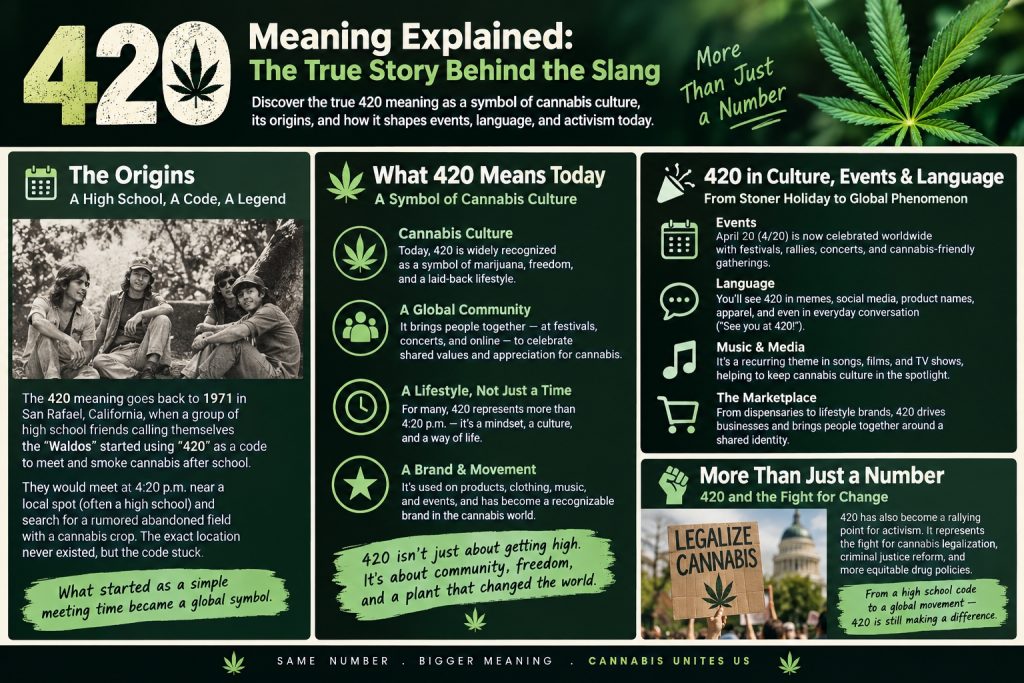
The number’s origin also isn’t the hazy urban legend you might expect. It can be traced to a group of California high school students known as the Waldos, who began meeting at 4:20 p.m. in 1971 while searching for an allegedly abandoned cannabis crop. Their inside joke travelled through connections to the Grateful Dead, entered underground culture, and eventually reached mainstream media.
This guide examines that documented history, explains how people use the term today, and clears up persistent myths involving police codes, Bob Marley, and Adolf Hitler. It also covers the difference between 420 and 710, because apparently cannabis slang needed a sequel. Whether you’re decoding a text or trying not to misunderstand a rental listing, here’s what you need to know.
Key Takeaways
- The term ‘420’ is widely recognized as a symbol for cannabis culture, originating from a 1971 group of California high school students known as the Waldos who used 4:20 p.m. as a meeting time to search for cannabis.
- 420 can refer to cannabis consumption generally, the specific time 4:20 p.m. symbolizing when to consume, the date April 20th as an unofficial cannabis holiday, or indicate acceptance with phrases like ‘420-friendly.’
- Despite popular myths, 420 is not a police code, nor connected to figures like Bob Marley or Adolf Hitler; its authentic origin is well-documented and unrelated to those stories.
- ‘420-friendly’ signals tolerance or acceptance of cannabis use but does not guarantee the legal right to consume cannabis anywhere or anytime, as local laws and rules still apply.
- April 20 (4/20) events range from casual gatherings to large festivals and activism promoting legalization, social equity, and public education around cannabis.
- 420 differs from 710, which refers to cannabis concentrates and oils, showing how cannabis slang evolves alongside product types and culture.
420 meaning (quick definition)
420 means cannabis, cannabis consumption, or acceptance of cannabis culture. You’ll hear it spoken as “four-twenty,” not “four hundred twenty.”
Its meaning changes slightly according to how it appears:
| Form | Usual meaning | Example |
|---|---|---|
| 420 | General cannabis slang | “Are you into 420?” |
| 4:20 | A symbolic time to consume cannabis | “Let’s meet at 4:20.” |
| 4/20 | April 20, the unofficial cannabis holiday | “There’s a 4/20 rally downtown.” |
| 420-friendly | Cannabis use is accepted or tolerated | “The host describes the patio as 420-friendly.” |
| 420 blaze it | A joking or meme-like reference to getting high | “The clock says 4:20, blaze it.” |
Context still matters. The number might simply be an address, room number, area code, product model, or price. If your flight leaves from Gate 420, the airline probably isn’t inviting passengers to smoke.
You should also avoid treating 420 as a legal permission slip. A “420-friendly” event may welcome adults who use cannabis while prohibiting smoking on-site. Provincial and local possession, age, public-consumption, driving, workplace, and housing rules still apply. In short, 420 communicates cultural meaning, not automatic consent, legality, or an instruction to consume.
Where did 420 come from? The real origin story
The best-supported 420 origin story begins in San Rafael, California, in 1971. It doesn’t begin with a police radio code, the number of chemicals in marijuana, or a secret message hidden in a Bob Dylan song.
A group of teenage friends at San Rafael High School used “420” as a private reference to a plan involving cannabis. As that shorthand spread through their social circles, and later through the orbit of the Grateful Dead, it evolved from an appointment time into a broad cultural code.
The story rests on recollections, letters, postmarked correspondence, and other memorabilia retained by the people involved. Some details naturally depend on memories formed decades ago, so it’s sensible to distinguish a well-documented oral history from a laboratory-certified chain of evidence. Still, major accounts from outlets including TIME’s history of 420 and History’s explanation of 4/20 broadly support the Waldos narrative.
San Rafael High School and “the Waldos” timeline
The central figures were five friends who called themselves the Waldos, reportedly because they often gathered near a wall outside their school. The group included Steve Capper, Dave Reddix, Jeffrey Noel, Larry Schwartz, and Mark Gravich.
Here’s the basic timeline:
- Fall 1971: The friends learned about an abandoned cannabis crop supposedly growing near the Point Reyes Peninsula.
- After school: They arranged to meet by a statue of scientist Louis Pasteur on campus at 4:20 p.m. Practice and other after-school commitments made that time convenient.
- “4:20 Louis”: The phrase served as a reminder to meet at the statue and continue searching, reportedly using a treasure map connected to the grower.
- “420”: After several unsuccessful expeditions, the words were shortened. The number became a discreet way to ask whether someone had cannabis or wanted to consume it.
The missing crop was apparently never found. That failure is the funny little hinge in the story: the teenagers didn’t discover the weed, but their search produced one of the world’s most recognizable cannabis expressions.
Their chosen time wasn’t supposedly based on the end of detention, tea time in the Netherlands, or any mystical property of the number. It was practical. School was over, extracurricular activities were winding down, and the friends could assemble before heading out in a 1966 Chevrolet Impala to search.
How 420 spread: Grateful Dead connections and media adoption
The Waldos lived close to San Francisco’s counterculture, and they had personal links to people around the Grateful Dead. Dave Reddix later worked as a roadie for bassist Phil Lesh, while Mark Gravich’s father managed real estate associated with the band. Those connections gave the expression a route beyond one high school friend group.
You can picture how it travelled: a phrase gets used backstage, then among touring fans, then in parking lots and informal communities moving from city to city. No marketing campaign was required. The Deadhead network functioned rather like a pre-internet social platform, only with cassette tapes, tie-dye, and considerably muddier shoes.
A decisive media moment arrived in December 1990. At a Grateful Dead show in Oakland, a flyer circulated inviting people to smoke at 4:20 on April 20. High Times reporter Steve Bloom received a copy, and the magazine later printed it. Although the flyer repeated an inaccurate police-code origin, it helped introduce both the term and the April 20 observance to a much larger audience.
High Times continued using 420, cementing it in cannabis media. By the late 1990s and early 2000s, films, music, message boards, merchandise, and mainstream reporting had carried it internationally. What began as a password among five teenagers became a cultural signal recognizable even to people who had never used cannabis.
What 420 means in cannabis culture today
Today, the 420 meaning in cannabis culture stretches beyond a single smoking session. It can signal identity, humour, political solidarity, commercial promotion, or simply a relaxed attitude toward adult cannabis use.
For some people, 420 remains an underground wink, a low-key way to find others who understand the reference. For businesses, it can be a marketing theme tied to April sales. For activists, 4/20 provides a visible date for discussing legalization, pardons, medical access, taxation, and the unequal consequences of prohibition.
Not everyone who uses the term consumes cannabis regularly. Someone might be “420-friendly” because they don’t object to a roommate using a legal edible on the weekend. Conversely, a medical-cannabis patient may never identify with stereotypical stoner culture. Language is useful, but real people rarely fit into one neat little rolling-paper package.
420 as a time (4:20) vs. 4/20 as a date
Written with a colon, 4:20 usually refers to the time of day. Some enthusiasts treat 4:20 p.m. as a ritual moment for cannabis, much as friends might associate Friday at 5 p.m. with happy hour. The morning version technically exists too, but 4:20 a.m. is more likely to find most people asleep, or regretting their life choices at an airport.
Written with a slash, 4/20 refers to April 20 under the US month/day date format. It’s the annual cannabis holiday marked by festivals, rallies, educational programs, store promotions, and informal gatherings.
That formatting distinction matters outside the United States. In countries using day/month notation, April 20 would ordinarily be written 20/4, yet “4/20” remains recognizable because the expression originated in American culture.
Neither usage requires participation. A person can post a 4/20 joke without consuming cannabis, and a regular consumer may ignore the date entirely. If you’re invited to a 4/20 gathering, ask what kind of event it is rather than assuming. It could be a licensed festival, a policy rally, a product sale, or three friends eating pizza and debating which movie to watch.
420-friendly: what it signals in listings, events, and businesses
420-friendly generally means that cannabis use or cannabis consumers are accepted. The details, though, can vary dramatically.
In a dating profile, it may mean, “I use cannabis and want someone comfortable with that.” In a roommate listing, it might mean cannabis use is allowed outdoors but not inside. A vacation rental may welcome cannabis consumers while banning all smoking because of fire rules and cleaning concerns. And at a business, “friendly” may describe the clientele rather than on-premises consumption.
Before making assumptions, check four things:
- Method: Are smoking, vaping, and edibles treated differently?
- Location: Is use allowed indoors, outdoors, in one designated space, or nowhere on the property?
- Frequency: Does “friendly” mean occasional use or daily use?
- Law and policy: Do provincial or municipal rules, leases, event permits, or employer rules prohibit it anyway?
Here’s a practical example. Suppose a Vancouver host labels a property 420-friendly. Adult cannabis use is legal across Canada, but British Columbia bans smoking and vaping cannabis in many public places, including most parks, and property owners can prohibit smoking. You’d still need the host’s explicit rules. Borders are another complication: taking cannabis into or out of Canada is illegal, even when you’re travelling to or from a place where it’s legal.
The safest reading is hence “cannabis won’t automatically be judged here”, not “anything goes.” If the boundary matters, ask directly and politely. That two-minute message can prevent an awkward check-in, a cleaning charge, or a roommate feud worthy of its own reality show.
Common misconceptions and myths about 420
Once a piece of slang becomes famous, people reverse-engineer explanations for it. The more dramatic the tale, the faster it spreads. That’s why 420 has accumulated stories involving police dispatchers, criminal codes, famous musicians, chemistry, and historical villains.
Most of these claims fail a simple test: they don’t explain why the Waldos were documented using the expression in the early 1970s, or they rely on coincidences discovered after the phrase became popular.
Police code / penal code myth
One of the most repeated myths says 420 is a police radio code for marijuana use in progress. There is no universal US police code with that meaning. Radio codes differ between departments, regions, and agencies: a number used for one incident in one jurisdiction may mean something entirely different elsewhere.
California Penal Code Section 420 also isn’t the source. Historically, that section concerned obstructing access to public land, not cannabis. Other statutes numbered 420 exist around the world (India’s Section 420 famously concerns cheating and dishonestly inducing delivery of property), but a shared number doesn’t create a historical link.
Why does the police-code story persist? It sounds plausible. Drug culture has long borrowed coded language, and many people know “10-4” from radio communication. The 1990 Grateful Dead concert flyer publicized by High Times also repeated a police-code explanation, giving the myth an influential boost even as it helped popularize 4/20 itself.
So, is 420 a police signal? Not in the universal sense implied by the legend. A local agency could assign almost any number internally, but that wouldn’t account for the slang’s documented origin.
Hitler birthday / Bob Marley death / other viral claims
Adolf Hitler was born on April 20, 1889, but that coincidence has no credible connection to cannabis slang. The Waldos’ story concerns 4:20 p.m.; the annual date observance developed later. There’s no evidence the teenagers selected the number because of Hitler’s birthday.
Bob Marley didn’t die on April 20, either. He died on May 11, 1981. Nor is 4/20 reliably established as his birthday; that was February 6, 1945. Marley’s association with cannabis and Rastafari makes the rumour feel culturally convenient, but convenient isn’t the same as true.
Other popular claims include:
- “Cannabis contains exactly 420 chemicals.” Its chemical composition varies, and researchers have identified hundreds of compounds. The number isn’t a fixed scientific total or the source of the slang.
- “Tea time in Holland is 4:20.” Even if someone somewhere takes tea then, no evidence connects that habit to the Waldos.
- “It comes from Bob Dylan’s ‘Rainy Day Women #12 & 35.'” Multiplying 12 by 35 does produce 420, and the song contains the refrain “Everybody must get stoned.” Fun coincidence? Absolutely. Proven origin? No.
- “It’s a California criminal code for cannabis.” As noted above, the relevant numbered statute didn’t carry that meaning.
A useful rule for evaluating viral origin stories is to ask whether there’s contemporary evidence and a credible route of transmission. Arithmetic tricks and celebrity associations are entertaining, but they don’t beat dated documents, identifiable participants, and a plausible social network.
Why is 4/20 considered “Weed Day”?
April 20 became “Weed Day” because the original 4:20 meeting time was eventually converted into the American calendar date 4/20. Grateful Dead fans helped circulate the idea, cannabis media amplified it, and public gatherings made it visible.
The holiday has no central organizer or official rulebook. That flexibility helped it spread. Depending on where you are, 4/20 can resemble a music festival, a protest, a trade promotion, a policy conference, or an enormous picnic with a very predictable aroma.
How 4/20 became a global cannabis holiday
The 1990 Oakland flyer urged readers to gather at 4:20 p.m. on April 20. After High Times published the message and embraced the number, the date gained a repeatable annual format. Fans didn’t need membership cards or a formal institution: they only needed to know the number and show up.
Large gatherings later developed in places such as San Francisco’s Hippie Hill, Denver’s Civic Center Park, Vancouver, London’s Hyde Park, and Parliament Hill in Ottawa. Their character has shifted alongside cannabis law. What once functioned primarily as civil disobedience may now include licensed vendors, sponsorships, music stages, harm-reduction messaging, and voter outreach.
Global adoption is uneven because cannabis laws vary sharply. Canada legalized adult-use cannabis federally in 2018, while US rules remain a patchwork of state legalization and federal restrictions. In other countries, possession can still bring severe criminal penalties. A meme crossing a border doesn’t carry legal protection with it.
Commercialization has also changed the mood. Dispensaries often offer April promotions, and brands release themed products. Some longtime advocates criticize the holiday’s retail focus, especially while people continue facing consequences from old cannabis convictions. That tension, celebration versus unfinished reform, is now part of what 4/20 represents.
Typical 4/20 traditions, events, and modern activism
The most recognizable tradition is a communal countdown to 4:20 p.m., followed by cannabis consumption where lawful and permitted. Concerts, comedy shows, film screenings, educational panels, and dispensary events often surround it.
Modern 4/20 activism may focus on:
- Clearing eligible cannabis convictions, such as through Canada’s no-fee cannabis record suspensions for simple possession
- Improving access to medical cannabis
- Addressing racial disparities in enforcement
- Supporting people incarcerated for cannabis offences
- Establishing fair licensing and social-equity programs
- Promoting responsible-use education and impaired-driving prevention
- Protecting consumers through testing and accurate labelling
If you attend an event, practical planning matters more than matching your socks to a cannabis leaf. Confirm age limits (in Canada, 19 in most provinces and territories, 18 in Alberta, and 21 in Quebec) and entry rules. Don’t carry or consume cannabis where prohibited, don’t drive impaired, and don’t mix substances casually. Keep products away from children and pets, and remember that edible effects can be delayed and long-lasting.
You can also participate without consuming anything. Attend a policy discussion, learn how old cannabis records can be cleared, support a credible reform organization, or simply enjoy the music. No one needs to prove cultural membership by getting higher than intended. That isn’t a rite of passage: it’s usually just an uncomfortable afternoon.
How people use “420” in conversation, texts, and online
In conversation, 420 can act as a noun, adjective, time reference, or coded question. The exact tone depends on your relationship with the speaker.
“Do you 420?” generally asks whether you consume cannabis. “I’m 420-friendly” usually expresses tolerance or participation. A text saying “meet at 4:20” might be literal, playful, or both. Online, adding 420 to a username or biography can signal affinity with cannabis culture without spelling it out.
The term is less secret than it once was. Parents, employers, advertisers, and search engines all know what it means, so you shouldn’t treat it as an invisible code. Writing “420” in a public profile may shape how landlords, clients, schools, or colleagues perceive you, even if your intended audience understands the joke.
Tone can also change its force. Friends may use it affectionately, while someone else might deploy it as a stereotype about laziness or irresponsibility. If you’re describing another person, don’t assume their occasional legal use means they identify as “420.” Let people choose their own labels.
Examples of slang usage (420, 4/20, 420-friendly, 420 blaze it)
These examples show how the language usually works:
- “Are you 420-friendly?”: Are you comfortable with cannabis use?
- “I don’t smoke, but I’m 420-friendly.”: The speaker accepts it but doesn’t personally smoke.
- “Any plans for 4/20?”: Are you attending or doing anything for the cannabis holiday?
- “It’s almost 4:20.”: A literal time observation that may double as a cannabis reference.
- “This apartment is not 420-friendly.”: Cannabis use is not accepted under the property rules.
- “420 blaze it.”: A deliberately exaggerated meme phrase encouraging or joking about cannabis consumption.
“Blaze it” means to smoke cannabis, while the combined phrase “420 blaze it” became prominent in internet meme culture. It’s often paired with intentionally chaotic graphics, air horns, sunglasses, Mountain Dew, Doritos, or other mid-2010s montage-parody imagery. People may say it ironically without intending to consume anything.
If you’re responding to a listing or invitation, use plain language rather than leaning on slang. Ask, “Does 420-friendly mean smoking is allowed on the patio?” That question gets you useful information. “Cool, blaze it?” probably gets you a screenshot in the group chat.
FAQ about 420 meaning
Does 420 mean cannabis in every context?
No. 420 commonly means cannabis only when the surrounding context supports that interpretation. It can also be an ordinary number, time, date fragment, address, hotel room, highway designation, area code, model number, or price.
Look for clues. A dating bio containing “420-friendly” clearly references cannabis. A receipt totalling $4.20 probably doesn’t, unless the cashier gives you a theatrical wink. Likewise, “Meeting in Room 420” should be read literally unless other details suggest otherwise.
International and cultural context matters too. Someone unfamiliar with North American cannabis slang may use 420 without recognizing the association. Don’t infer drug use from a number alone, especially in professional, legal, or safety-sensitive situations.
Is 420 illegal or a police signal?
The number and slang term are not illegal, and 420 isn’t a universal police signal for cannabis. You can say, write, print, or joke about it. What may be regulated is the possession, cultivation, sale, advertising, or consumption of cannabis connected with the conversation.
Laws depend on your age, location, product, amount, and activity. Even though adult possession is legal across Canada, consuming where your province or municipality bans it, carrying more than 30 grams of dried cannabis (or the equivalent) in public, driving while impaired, or taking cannabis across the Canadian border remains unlawful. Employers and landlords may impose additional restrictions.
For current rules where you live, check Health Canada’s provincial and territorial cannabis rules page and your provincial government’s cannabis website. Slang isn’t reliable legal guidance, and neither is a friend who begins a sentence with “Trust me, I do this all the time.”
What’s the difference between 420 and 710?
420 refers broadly to cannabis and cannabis culture. 710 refers more specifically to cannabis oil, concentrates, and dabbing. Turn “710” upside down and it resembles the word OIL, which explains the association.
July 10, written 7/10 in the United States, has become an informal concentrates-themed counterpart to 4/20. It’s sometimes called Oil Day or Dab Day. The term is newer and less universally recognized than 420.
| Term | Main association | Related date |
|---|---|---|
| 420 | Cannabis generally | April 20 |
| 710 | Cannabis oil and concentrates | July 10 |
Concentrates can contain much higher levels of THC than cannabis flower, so unfamiliar users can experience unexpectedly intense effects. Product strength, legality, and health risks deserve more attention than the clever upside-down spelling.
Eventually, the 420 meaning is straightforward: it’s a widely recognized shorthand for cannabis, born from the Waldos’ 4:20 p.m. meetings and expanded into a global cultural symbol. Its history is real enough without police-code myths or celebrity coincidences. When you encounter it, read the context, confirm practical boundaries, and never mistake a cultural signal for legal permission. Now you can decode the number, and, mercifully, stop wondering whether Room 420 has a secret handshake.