Blog 2026
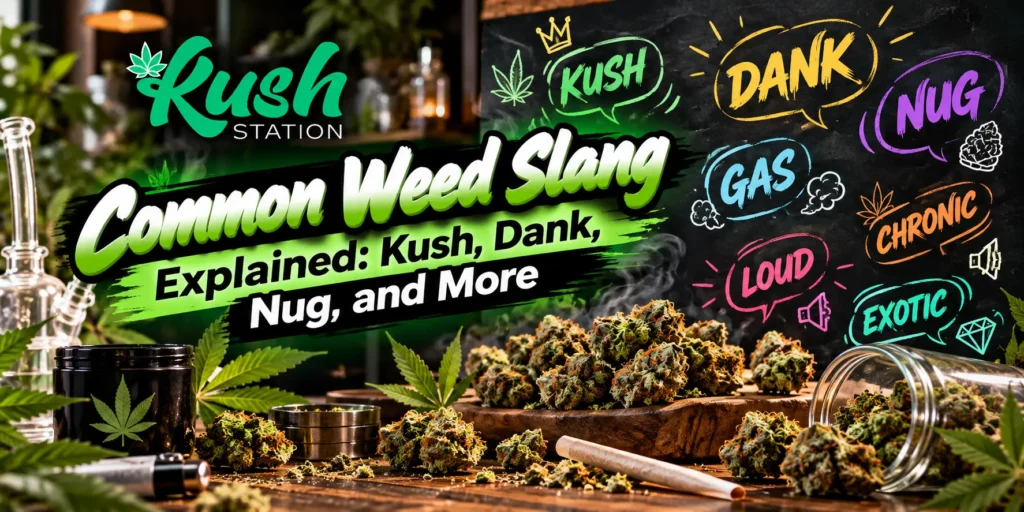
Common Weed Slang Explained: Kush, Dank, Nug, and More
Oct
Walk into any cannabis store, or open any online menu, and you will run into words that sound like a foreign language. Kush. Dank. Nugs. Zips. Dabs. Terps. If you are new to cannabis, the vocabulary can Indica vs sativa feel like a private club with its own password. If you have been around for years, you probably use half of these words without thinking about where they came from.
This guide explains the most common weed slang in plain language. We cover the many nicknames for cannabis itself, the terms people use for quality and quantity, the words for different ways of consuming, and the slang for the experience that follows. We also point out which terms you will actually see on a menu at an online dispensary like Kush Station, and which ones are better left in conversation.
Use it as a quick reference, a conversation starter or a cheat sheet before your next order.
Why Does Cannabis Have So Many Names?
Few products in the world have as many nicknames as cannabis. Linguists and historians point to a few reasons.
A long history of prohibition. For much of the twentieth century, cannabis was illegal across North America. When something is illegal, people talk about it in code. Slang let people discuss cannabis in front of others without being understood, and many of today’s nicknames date back to that era.
Music, film and counterculture. Jazz musicians in the 1920s and 1930s, beat poets in the 1950s, rock bands in the 1960s and hip-hop artists from the 1990s onward all popularized new words. Each generation tends to invent its own vocabulary and keep a few classics from the last one.
Regional and cultural variety. The word people use depends on where they live and who they grew up with. A term common in Vancouver might sound odd in Halifax. Words also arrive from other languages, which is how “ganja” ended up in everyday English.
The product keeps changing. New products create new words. Ten years ago, few people said “live resin” or “rosin.” Today they appear on menus across the country.
Since legalization in 2018, a lot of this vocabulary has also moved from hushed conversation into mainstream retail. That is a good thing. It means you can ask for what you want openly, and it makes understanding the words more useful than ever.
The Many Nicknames for Cannabis Itself
Let’s start with the plant. These are the most common names you will hear for dried cannabis flower.
| Slang Term | What It Means | Notes |
| Weed | The most common everyday word for cannabis | Neutral and widely understood |
| Pot | Another common term, especially among older generations | Popular in Canada since at least the 1940s |
| Grass | Older slang, now a bit retro | Common in the 1960s and 1970s |
| Herb | A casual name, often used in Caribbean and reggae culture | Short and friendly |
| Ganja | From a Hindi word for cannabis | Strongly linked to Jamaica and Rastafari culture |
| Mary Jane | A playful nickname | Possibly a play on the Spanish “marijuana” |
| Reefer | Early 20th century slang | Now mostly used humorously |
| Bud | The flowering part of the plant | Also used as a general term |
| Flower | The industry term for dried buds | The word you will see on most menus |
| Green | A casual, modern term | Also used to mean cannabis in general |
| Trees | Modern slang for good-quality cannabis | Popular in hip-hop and among younger users |
You might also see “cannabis” and “marijuana” used as if they mean the same thing, and in everyday conversation they do. We explain the difference later in this guide.
The Big Three: Kush, Dank and Nug
Three words come up more than any others when people talk about quality cannabis. Each has an interesting story.
What does “kush” mean?
On a menu, “kush” refers to a family of cannabis strains. Off the menu, many people use it to mean cannabis in general or to describe something of high quality.
The word comes from the Hindu Kush, a mountain range that stretches across Afghanistan and Pakistan. Cannabis has Weed concentrates grown there for centuries, and plants from the region became the foundation for many modern indica strains. Growers brought these genetics to North America in the 1970s and later developed some of the best-known varieties in the world.
Today you will see “kush” in strain names such as OG Kush, Bubba Kush, Purple Kush and Master Kush. Kush strains are generally known for earthy, piney or sometimes citrusy aromas, and many have a reputation for relaxing effects. As always, individual experiences vary.
There is a practical point here as well. Because the word sounds appealing, some sellers use it loosely. A strain with “kush” in its name is not guaranteed to have specific genetics, so rely on the THC and CBD percentages and product details rather than the name alone.
What does “dank” mean?
In standard English, “dank” means damp and musty, like a basement. In cannabis culture, the word flipped. “Dank” now describes cannabis that is exceptionally good: sticky, aromatic, potent and well grown.
The reasoning is simple. Fresh, high-quality flower is often pungent and slightly moist, with a strong smell that can be skunky, fruity or fuel-like. People began using “dank” as a compliment for those qualities. The term spread through the 1990s and 2000s and eventually became a general internet word for anything excellent, from memes to music.
When someone calls a product “dank,” they usually mean it has a strong aroma, a frosty appearance and a good cure. It is not a technical grade, so there is no standard for what qualifies.
What does “nug” mean?
“Nug” is short for “nugget.” It refers to a single piece of cannabis flower, one dense bud or a chunk of one. When someone says “a couple of nice nugs,” they mean a couple of good-looking buds.
Nugs are usually described by their appearance. Good ones are dense and chunky, with visible frosty crystals (trichomes), bright orange or amber hairs and a vivid green or purple colour. A dry, airy or crumbly nug usually signals older or poorly stored product.
A related word is “nugget” or “nuggets,” used in exactly the same way. Some people also say “popcorn nugs” for small buds that grow lower on the plant, which are often sold at a lower price.
Slang for Quality: How People Describe Good (and Not-So-Good) Cannabis
Quality slang is where the vocabulary really multiplies. Here are the terms you will hear most often.
| Slang Term | Meaning | Typical Use |
| Fire | Excellent quality | “That batch is fire.” |
| Loud | Very aromatic | Describes a strong, noticeable smell |
| Dank | Top quality, pungent and sticky | See the section above |
| Top shelf | The highest quality on the menu | Premium flower, usually at a premium price |
| Craft | Small-batch, carefully grown cannabis | Often hand-trimmed and slow-cured |
| Exotic | Rare or unusual genetics | Often the newest, trendiest strains |
| Headies | Cannabis that gives a strong head high | Often used for potent, mind-focused strains |
| Mids | Mid-grade, average quality | Reliable and budget-friendly |
| Schwag | Low-quality cannabis | Old-school term, often used negatively |
| Brick weed | Compressed, lower-grade cannabis | Mostly a term from the illegal market |
| Chronic | Potent cannabis | Popular in the 1990s, now fairly retro |
One useful tip: slang about quality is subjective. One person’s “fire” is another person’s “mids.” On a legal menu, trust measurable information such as THC and CBD percentages, terpene profiles, harvest dates and licensed producer details instead of relying on how a seller describes a product.
Slang for Amounts and Measurements
Amount slang causes more confusion than almost any other category, because the names differ from the real measurements. Here is the Canadian cheat sheet.
| Slang Term | Actual Amount | Quick Note |
| Gram | 1 g | The basic unit |
| Dime bag | Roughly a gram or less | Old term from when a bag cost ten dollars |
| Eighth (or “eighth of an ounce”) | 3.5 g | The most popular size for flower |
| Quarter (or “Q”) | 7 g | A quarter ounce |
| Half (or “half-zip”) | 14 g | Half an ounce |
| Ounce (or “zip” or “O”) | 28 g | A full ounce |
| QP | About 113 g | A quarter pound, usually bought in bulk |
The word “zip” is thought to come from the old practice of selling an ounce in a zip-top bag. Some people also say “Z,” which is just a shorter form.
In Canada, retail packages are measured in metric units. An “eighth” is sold as 3.5 grams, and an ounce is sold as 28 grams. The legal public possession limit for adults is 30 grams of dried cannabis (or the equivalent), which is just over an ounce. Check your provincial rules for how much you can keep at home.
If you are new, an eighth is a good starting size. It gives you enough to try a strain several times without a big commitment. We cover how to shop in more detail in our guide to how to buy weed online in Canada.
Slang for How People Consume Cannabis
Many of the funniest and most creative words belong to this category. Here are the most common ones, grouped by consumption method.
Smoking
Joint (or “J”): A cannabis cigarette rolled with paper. Also called a “doobie,” “number” or “spliff.”
Spliff: Technically a joint that contains cannabis mixed with tobacco, although many people use the word to mean any joint, especially outside North America.
Blunt: Cannabis rolled in a cigar wrapper or tobacco leaf. Because the wrap is usually made from tobacco, blunts burn slower and differ in taste from joints.
Pre-roll: A ready-made joint you can buy from a store. Convenient, and the word you will see on menus.
Bowl: A small pipe, or the part of a bong or pipe where you pack the flower. “Packing a bowl” means loading it.
Bong: A water pipe that filters and cools the smoke. Also called a “bubbler” when it is a smaller, handheld version.
One-hitter: A tiny pipe that holds a single small amount.
Roach: The leftover end of a joint.
Vaping and dabbing
Vape: A device that heats cannabis flower or oil without burning it. Vaping produces vapour instead of smoke.
Cart: Short for cartridge, a pre-filled vape container that screws onto a battery.
Dab: A small amount of concentrate, or the act of vaporizing it on a hot surface.
Rig: A specialized water pipe designed for dabbing concentrates.
Dab rig: The full name for the same thing.
Concentrates are significantly more potent than flower, which is why dabbing is better suited to experienced consumers. Our guide to types of weed concentrates breaks down shatter, wax, live resin and more.
Edibles and other products
Edibles: Any food or drink infused with cannabis, such as gummies, chocolates and baked goods.
Gummies: Chewy infused candies. Extremely popular because the dose is easy to measure.
Brownies and “special brownies”: The classic cannabis edible, the subject of countless jokes.
Tincture: A liquid extract, usually taken under the tongue with a dropper.
Topical: A cream, balm or lotion applied to the skin. Topicals are not typically intoxicating.
A reminder about edibles: effects can take anywhere from 30 minutes to two hours to appear, so start with a low dose (such as 2.5 to 5 mg of THC) and wait before taking more.
Common action words
Toke: One puff or inhalation.
Hit: Also one inhalation, as in “take a hit.”
Rip: A big inhalation, usually from a bong.
Puff, puff, pass: The unofficial rule of sharing a joint. Take two puffs and then pass it on.
Hotbox: To smoke in a small enclosed space, such as a car, until the air fills with smoke. Not a pleasant experience for everyone, and not recommended around people who do not want it.
Wake and bake: To use cannabis first thing in the morning.
Slang for the Experience
Once you have consumed cannabis, an entirely different group of words takes over. These describe how it feels.
| Slang Term | What It Describes |
| High | The general feeling of being under the influence of THC |
| Stoned | A deeper, heavier, more relaxed high |
| Baked | Very high, often with a slow, sleepy feel |
| Lit | Energized, happy or buzzing (also used more broadly for excitement) |
| Toasted | Pleasantly high, often used for a mellow buzz |
| Couch lock | A heavy relaxation that makes standing up feel like an effort |
| The munchies | A strong increase in appetite |
| Cottonmouth | A dry, sticky feeling in the mouth |
| Red eye | Bloodshot eyes after use |
| Giggles | Uncontrollable laughter |
| Greening out | Feeling dizzy, nauseous or unwell after using too much |
| Paranoid | A temporary spike in anxiety or suspicion that some people experience |
| Come down | The period when the effects fade |
Two of these deserve extra attention.
Greening out is the term people use for the unpleasant experience of taking too much. It can cause dizziness, sweating, nausea and anxiety. It is not usually dangerous, but it is deeply uncomfortable. If it happens, sit or lie down somewhere safe, sip water, eat something and remind yourself it will pass. Starting with small amounts is the easiest way to avoid it.
Couch lock is the term for deep physical relaxation that makes you want to stay exactly where you are. Some people look for it in the evening, and others avoid it. Strain type, THC level and your own tolerance all play a role.
Whatever the word, remember that cannabis impairs your judgment and reaction time. Do not drive or operate machinery, and plan to stay put until the effects have worn off.
Culture and Community Slang
A few terms are less about the product and more about the culture around it.
- Probably the most famous cannabis number in the world. The most widely told story traces it to a group of high school students in San Rafael, California, in the early 1970s, who met at 4:20 p.m. to search for an abandoned cannabis crop. The habit spread through the Grateful Dead community and then worldwide. Today, April 20 is an unofficial holiday for cannabis fans, and 4:20 is shorthand for the right time of day to light up. Other origin stories exist, but this one is the best documented.
- A newer term, popular among concentrate fans. Turn the number upside down and it reads “OIL.” July 10 has become an unofficial day for concentrates.
Sesh. Short for “session.” A sesh is a social cannabis gathering or simply a period of use.
Stash. Your personal supply, or the place where you keep it. The safest stash is secure and out of reach of children and pets.
Stoner. A person who uses cannabis regularly. It can be friendly or dismissive depending on who says it.
Canna- (as in canna-curious, cannapreneur). A prefix that shows up in everything from business names to lifestyle terms. A “canna-curious” person is someone who is interested in trying cannabis but has not yet.
Legacy market. In Canada, this is the term some people use for the illegal market that existed before legalization and still operates today. Buying from licensed retailers protects you from untested product and supports the regulated system.
Slang You Will Actually See on a Menu
If you are browsing a cannabis store online, here is the vocabulary that appears in real product listings. These are less street slang and more industry terms, but newcomers often find them confusing.
| Term | What It Means |
| Terps (terpenes) | Aromatic compounds that create each strain’s smell and flavour, and may influence its effects |
| Trichomes | The tiny, sticky resin glands that cover the buds and hold most of the THC |
| Cultivar | The proper term for a plant variety, which many growers prefer to “strain” |
| Pheno (phenotype) | A specific expression of a strain’s genetics, such as a plant with unusual colour or aroma |
| Cure | The slow drying process that develops flavour and smoothness |
| Hand-trimmed | Buds trimmed by hand rather than machine, which usually protects the trichomes better |
| Live resin | A concentrate made from fresh-frozen plants, known for rich flavour |
| Rosin | A solventless concentrate made with heat and pressure |
| Shatter | A glass-like concentrate |
| Distillate | A refined, high-potency oil used in many vapes and edibles |
| Hybrid | A cross of indica and sativa genetics |
| Pre-roll | A ready-made joint |
| Infused pre-roll | A joint coated or filled with concentrate for extra potency |
| Microdose | A very small dose, such as 1 to 2.5 mg of THC |
If you want to see how these terms fit together, our guide to indica vs sativa vs hybrid explains the strain categories in detail, and our guide to reading THC and CBD labels covers the numbers.
“Weed,” “Pot,” “Cannabis” and “Marijuana”: Is There a Difference?
In everyday talk, these words overlap, but they are not identical.
Cannabis is the scientific and legal term for the plant and its products. This is the word used in Canada’s Cannabis Act and on government and health websites.
Marijuana is the older term, often used for the dried flower of the plant that produces the intoxicating effects. The word became widely used in the United States in the early twentieth century, and it carries a complicated history. Some people avoid it because it was used in anti-immigrant and anti-cannabis campaigns at the time. For that reason, many in the industry, including most Canadian retailers, prefer “cannabis.”
Weed and pot are casual, everyday words. Most people use them without any offence intended.
Hemp is cannabis that contains very little THC (in Canada, 0.3% or less) and is grown mainly for fibre, seed and CBD. It will not make you high.
Slang to Skip: Outdated or Unhelpful Terms
Not all weed slang ages well. A few terms are best left in the past.
“Reefer madness.” This phrase comes from a 1930s propaganda film that exaggerated the dangers of cannabis. Today it is used mockingly to describe overblown fears.
Stigmatizing words. Terms such as “junkie” or “druggie” are unkind and inaccurate for adults who use a legal product. Most modern retailers and health organizations avoid them.
Slang for illegal sellers. Words for street sellers belong to the illegal market. When you buy from a licensed store, you do not need them.
Product claims dressed as slang. Some sellers use terms like “medical grade” or “pharma” without any official meaning. Always check the label and the producer’s licence instead.
Tips for Using Cannabis Slang When You Shop
Slang is fun, but when you are placing an order, clear communication matters more. A few practical tips:
Use specific names. Ask for “an eighth of Blue Dream” instead of “something dank.”
Know the measurement. Remember that an eighth is 3.5 g, and check the exact weight on the listing.
Describe the experience you want. Words like relaxing, uplifting, balanced or energizing will help staff or a product description guide you.
Focus on the numbers. THC and CBD percentages tell you far more than a nickname.
Ask when unsure. No one expects a beginner to know every term. A good store is happy to explain.
Skip the hype. If a seller relies on slang instead of facts, that is a warning sign.
[Link to your flower category page here.]
Frequently Asked Questions
What does “kush” mean in weed?
Kush refers to a family of cannabis strains, usually indica-leaning, named after the Hindu Kush mountain range. In casual use, people also say “kush” to mean cannabis in general or to describe high-quality flower.
What does “dank” mean?
Dank describes cannabis of excellent quality, usually sticky, aromatic and potent. It started as a word for damp and musty and flipped to become a compliment. It is not an official grade.
What is a nug?
A nug is short for nugget and means a single bud of cannabis flower. Quality nugs are dense, sticky and covered in trichomes.
How much is an eighth of weed?
An eighth is an eighth of an ounce, which is 3.5 grams. It is the most popular size for buying flower.
What does “420” mean?
It is a cannabis code number said to come from a group of California students in the 1970s who met at 4:20 p.m. It now refers to the time of day and the date, April 20, when many people celebrate cannabis culture.
What is the difference between a joint, a blunt and a spliff?
A joint is cannabis rolled in paper. A blunt is cannabis rolled in a cigar wrap or tobacco leaf. A spliff is a joint that contains tobacco mixed with cannabis, although some people use the word for any joint.
What does it mean to green out?
Greening out means feeling dizzy, nauseous or anxious after using too much cannabis. It usually passes with rest, water and time. Starting with a small dose is the best prevention.
Is it okay to say “marijuana”?
Most people use the word without any problem, but “cannabis” is the official term in Canada and is generally preferred by retailers, health authorities and legal documents.
Final Thoughts: Speak the Language, Shop with Confidence
Cannabis slang is part of what makes the culture colourful. Words like kush, dank and nug carry stories about geography, music, humour and history. Understanding them helps you follow conversations, read menus and feel more comfortable buying.
Still, the best shopping advice has nothing to do with slang. Read the product details, check the THC and CBD numbers, start with small amounts and respect the potency. When you are ready to put your new vocabulary to use, browse the full menu at Kush Station and discover flower, edibles, concentrates, hash and more, delivered to your door.