
Blog 2026
Cannabis Disorder: Signs, Diagnosis, and Real Help
Nov
Cannabis can be relaxing or medically useful for some people. But when using it becomes hard to control, or starts crowding out work, relationships, health, or everyday responsibilities, it may signal cannabis disorder, clinically called cannabis use disorder (CUD).
This evidence-based review explains how clinicians distinguish occasional use, dependence, and addiction, what withdrawal feels like, and which treatments genuinely help. It isn’t a diagnosis or a judgment about cannabis. Instead, it’s a practical guide for anyone worried about their own use or someone they care about.
You don’t need to “hit bottom” before asking questions. Maybe your tolerance has climbed, Sunday-night edibles have quietly become nightly ones, or quitting keeps lasting until Thursday. Those patterns deserve attention, not shame. Cannabis use disorder is treatable, and even small changes can improve sleep, concentration, finances, and your sense of control.
Key Takeaways
- Cannabis use disorder (CUD) is characterized by impaired control and continued cannabis use despite negative consequences, not merely frequency of use.
- Recognizing early signs of cannabis disorder, such as cravings, loss of control, and interference with daily life, enables timely and effective intervention.
- High-potency cannabis products and early, frequent use increase the risk of developing cannabis use disorder, especially in adolescents.
- Withdrawal symptoms from cannabis can include irritability, anxiety, and sleep disturbances, typically peaking within the first week after stopping.
- Evidence-based treatments for cannabis use disorder focus on behavioural therapies like cognitive behavioural therapy and motivational enhancement therapy, tailored to individual needs.
- Support from family and professional health providers, combined with setting clear, achievable goals, improves outcomes in managing cannabis use disorder.
What Is Cannabis Disorder (Cannabis Use Disorder)?
Cannabis use disorder is a medical condition in which cannabis use continues despite meaningful problems or becomes difficult to control. Clinicians diagnose it from patterns of behaviour and consequences, not from how often you use, whether cannabis is legal, or whether it was medically recommended.
The preferred term is cannabis use disorder, rather than “marijuana addiction” or the less precise “cannabis disorder.”
Cannabis Use, Physical Dependence, and Addiction: What Is the Difference?
These experiences overlap, but they aren’t interchangeable:
| Term | What it means |
|---|---|
| Cannabis use | Any use, with or without harm |
| Physical dependence | Your body adapts, producing tolerance or withdrawal |
| Cannabis use disorder | Impaired control and continued use despite harm |
Dependence alone doesn’t prove addiction. A medical patient can develop tolerance without compulsive behaviour, while someone with CUD may experience serious impairment even without obvious withdrawal.
How Common Is Cannabis Use Disorder, and Who Is Affected?
CUD affects people of every age and background. Health Canada estimates that about one in three people who use cannabis will develop a problem with their use, and about one in 11 will develop an addiction, although estimates vary by population and diagnostic method.
Risk is higher with adolescent onset and frequent use. Legal access doesn’t automatically cause addiction, but greater availability, normalization, and increasingly potent products can make risky patterns easier to miss.
Signs and Symptoms of Cannabis Use Disorder
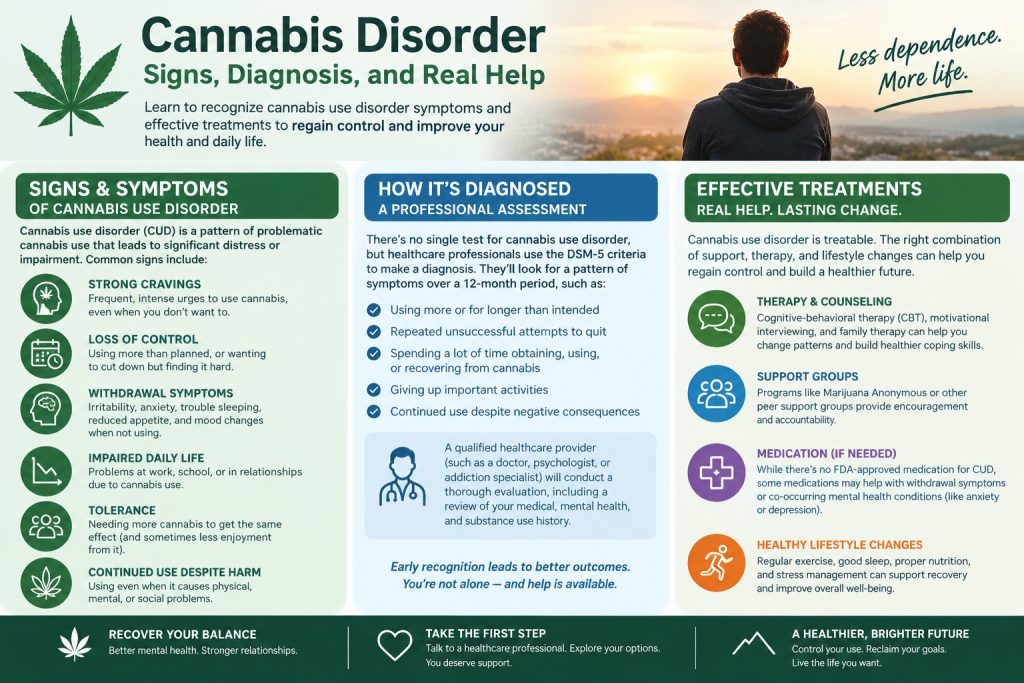
CUD usually appears as a pattern rather than one dramatic event. You might repeatedly plan to use less but consume more, devote substantial time to obtaining or recovering from cannabis, or continue despite health and relationship consequences.
Tolerance and withdrawal can occur, but the central question is simpler: Is cannabis taking more control than you want it to have?
Cravings, Loss of Control, and Problems at Work, School, or Home
Warning signs include strong cravings, unsuccessful attempts to cut down, missed obligations, hazardous use, and abandoning valued activities. Perhaps you skip morning lectures after late-night vaping or avoid dinners where you can’t use.
One rough week isn’t necessarily a disorder. Repetition matters, especially when cannabis remains the default response to boredom, stress, loneliness, or sleep trouble despite causing new problems.
Recognizing Warning Signs in Teens and Young Adults
Look for sustained changes: falling grades, unexplained spending, frequent red eyes or cannabis odours, secrecy, impaired driving, altered sleep, and withdrawal from previously valued activities. Vapes can be particularly easy to conceal.
No single sign proves CUD: adolescence is practically a factory for mood swings. Start with curiosity: “I’ve noticed you’re missing practice and seem exhausted. What’s going on?” Calm conversation works better than interrogation or scare tactics.
What Causes Cannabis Use Disorder, and What Increases Your Risk?
There isn’t one cause. CUD develops through an interaction among the drug, your biology, mental health, age of first use, social setting, and learned coping habits. Easy availability and friends who use can increase exposure, while trauma or chronic stress may make short-term relief feel especially valuable.
Risk factors raise probability: they don’t write your destiny.
High-THC Products, Concentrates, Vaping, and Edibles: Why Potency and Dose Matter
THC drives cannabis’s intoxicating effects. High-potency flower, oils, dabs, and vape cartridges can deliver large doses quickly, increasing tolerance and the likelihood of anxiety or impairment.
Edibles are slower but deceptively tricky: effects may take 30 minutes to two hours or longer, so redosing early can produce an unpleasant several-hour ride. Product labels also aren’t perfectly reliable. Start low, wait, and never drive impaired.
Early and Frequent Use, Genetics, Environment, and Mental Health Conditions
Starting during adolescence, using daily or near-daily, and having a family history of substance problems increase risk. ADHD, depression, anxiety, PTSD, bipolar disorder, and psychotic disorders may also overlap with problematic use.
Sometimes cannabis temporarily quiets symptoms while worsening motivation, panic, sleep architecture, or paranoia later. Effective care addresses both sides: treating only cannabis use while ignoring why you reach for it is like fixing a smoke alarm while leaving the stove burning.
How Is Cannabis Use Disorder Diagnosed?
A physician, psychologist, psychiatrist, or qualified addiction professional diagnoses CUD through a confidential clinical assessment. You’ll typically discuss your amount and method of use, attempts to change, withdrawal, daily functioning, medications, physical health, and mental health.
Honesty helps determine appropriate care. The purpose isn’t to catch you out, it’s to understand the pattern.
The 11 DSM-5-TR Criteria and the 12-Month Diagnostic Timeframe
The DSM-5-TR lists 11 criteria. They cover using more than intended; failed efforts to reduce; substantial time spent using; craving; role failures; social problems; abandoned activities; hazardous use; continued use despite physical or psychological harm; tolerance; and withdrawal.
CUD is diagnosed when at least two criteria occur within the same 12-month period. Clinicians consider context, including supervised medical use.
Mild, Moderate, and Severe Cannabis Use Disorder
Severity reflects the number of criteria met:
- Mild: 2–3 criteria
- Moderate: 4–5 criteria
- Severe: 6 or more criteria
These labels describe current symptom burden, not character or recovery potential. Mild CUD still merits attention, particularly if you drive after using, are pregnant, or have psychosis risk. Severity can also change over time.
Screening Questionnaires, Clinical Assessment, and Why Drug Tests Cannot Diagnose Addiction
Tools such as the CUDIT-R or ASSIST can flag risky use and guide discussion, but they don’t replace an assessment. Blood, saliva, hair, and urine tests only indicate exposure within an approximate window.
Because THC metabolites may remain detectable long after intoxication, especially with frequent use, a positive result can’t establish impairment, loss of control, or addiction. Likewise, a negative test doesn’t rule out a problematic pattern.
Cannabis Withdrawal: Symptoms, Timeline, and What to Expect
After frequent use stops, withdrawal can bring irritability, anxiety, restlessness, low mood, reduced appetite, insomnia, vivid dreams, headaches, sweating, chills, or stomach discomfort. It’s generally not medically dangerous in the way alcohol or benzodiazepine withdrawal can be, but it can feel miserable enough to trigger renewed use.
Knowing the timeline makes the experience less mysterious, and less alarming.
When Withdrawal Starts, When Symptoms Peak, and How Long They Can Last
Symptoms commonly begin within 24–48 hours, peak around days two through six, and improve over one to three weeks. Sleep disruption, mood changes, and vivid dreams may persist for several weeks after heavy, prolonged use.
Your timeline may differ according to dose, potency, frequency, metabolism, and other substances. A difficult day three doesn’t mean recovery is failing: it often means your nervous system is adjusting.
Managing Sleep, Mood, and Appetite Changes, and When Medical Support Is Needed
Keep wake times consistent, reduce late caffeine, exercise earlier in the day, eat small regular meals, and remove cannabis from easy reach. Schedule evening activities so cravings don’t inherit an empty calendar.
Seek medical guidance if symptoms are intense, you use other substances, or depression and anxiety worsen. Get urgent help for suicidal thoughts, hallucinations, severe agitation, dehydration, or an inability to care for yourself.
Related Cannabis Conditions and Potential Health Complications
Cannabis effects vary by dose, THC-to-CBD ratio, route, age, health, and individual vulnerability. Possible complications range from short-lived panic to repeated vomiting or psychosis. Mixing cannabis with alcohol or sedating medicines can intensify impairment.
Association doesn’t always prove causation, and research still has gaps. Even so, several risks are established enough to guide safer decisions.
Cannabis Intoxication, Cannabis-Induced Anxiety, and Psychosis
Intoxication may cause impaired coordination, altered time perception, increased heart rate, dry mouth, and memory difficulty. High doses can provoke panic, suspiciousness, hallucinations, or disorganized thinking.
Cannabis-associated psychosis may resolve as intoxication clears, but symptoms can persist or reveal an underlying psychotic disorder. Risk appears greater with high-THC products, frequent use, younger age, and personal or family vulnerability. Severe confusion, dangerous behaviour, or hallucinations require urgent evaluation.
Cannabinoid Hyperemesis Syndrome: Repeated Vomiting and Dehydration
Cannabinoid hyperemesis syndrome (CHS) involves cycles of nausea, abdominal pain, and persistent vomiting, usually after prolonged, frequent cannabis use. Hot showers may provide temporary relief, a distinctive clue, not a cure.
CHS can cause dehydration, electrolyte disturbances, and kidney injury. Stopping cannabis is the key long-term intervention. If you can’t keep fluids down, feel faint, urinate very little, or vomit blood, seek emergency care.
Effects on Memory, Mental Health, Driving Safety, and Pregnancy
Recent use can impair attention, reaction time, coordination, and short-term memory. Don’t drive or operate machinery while impaired: waiting a fixed number of hours isn’t a guarantee because dose and duration vary.
Cannabis may aggravate anxiety, depression, or psychosis in susceptible people. During pregnancy and breastfeeding, Health Canada and other major medical organizations advise avoiding it because THC reaches the fetus and breast milk. Discuss nausea or pain alternatives with a prenatal clinician.
Evidence-Based Treatment for Cannabis Use Disorder
Treatment is tailored to your goals, severity, safety, and co-occurring conditions. Most people begin with outpatient counselling rather than hospitalization. A good plan may combine behavioural therapy, peer support, family involvement, sleep care, and practical changes to routines.
Relapse or a lapse doesn’t erase progress. It provides data: Which trigger, person, feeling, or convenient dispensary detour needs a better plan?
Cognitive Behavioural Therapy, Motivational Enhancement Therapy, and Contingency Management
Cognitive behavioural therapy (CBT) helps you identify triggers, challenge unhelpful beliefs, and practise alternatives. Motivational enhancement therapy explores ambivalence without lecturing. Contingency management provides tangible rewards for measurable goals, such as attendance or negative tests.
Evidence reviewed by the US National Institute on Drug Abuse supports these behavioural approaches, often in combination. Participation over multiple sessions matters: this generally isn’t a one-chat-and-done situation.
Can Medications Help? Current Evidence, Limitations, and Emerging Treatments
No medication is approved in Canada specifically for CUD. Researchers have investigated N-acetylcysteine, gabapentin, cannabinoid medicines, antidepressants, and other agents, but results are mixed or insufficient for routine use.
Clinicians may treat individual symptoms or co-occurring conditions, such as depression or temporary insomnia. Don’t self-medicate withdrawal with alcohol, sedatives, or unregulated supplements, the “solution” can quickly create a second problem.
Choosing Outpatient or Residential Care and Treating Co-Occurring Mental Health Conditions
Outpatient care may fit if you have stable housing, manageable symptoms, and reliable support. Intensive outpatient, day treatment, or residential programs offer more structure when use is severe, prior attempts haven’t held, home is unsafe, or psychiatric needs are complex.
Ask whether a program uses licensed clinicians, evidence-based therapy, coordinated psychiatric care, and whether it’s publicly funded or has transparent fees. Be wary of guaranteed cures or luxury amenities masquerading as clinical quality.
Recovery, Harm Reduction, and Preventing a Return to Problematic Use
Recovery can mean abstinence or, for some adults, an agreed reduction in use and harm. The safest goal depends on your history. Abstinence is generally preferable when cannabis has caused psychosis, CHS, severe CUD, pregnancy-related risk, or repeated inability to maintain limits.
Track outcomes that matter: clearer mornings, attended classes, safer driving, improved relationships, not merely streaks on a calendar.
Setting Goals to Reduce or Stop Use, Manage Cravings, and Navigate Triggers
Choose a measurable goal and date. Remove supplies, tell a supportive person, and plan replacements for your usual use window. Cravings crest and fall: delay for 20 minutes, change location, drink water, walk, or call someone.
If reducing, avoid concentrates, set purchase limits, schedule cannabis-free days, and never mix use with driving. Write down what happened after any lapse while the details are fresh, minus the self-roasting.
How Family and Friends Can Offer Support Without Judgment
You can express concern using observations: “You’ve missed work twice and seem worried about stopping.” Listen, ask what help would feel useful, and reinforce treatment efforts.
Support doesn’t require covering debts, lying to employers, or accepting unsafe behaviour. Set clear boundaries and avoid debating while someone is intoxicated. Family therapy or groups such as SMART Recovery Family & Friends can teach practical communication skills.
When and Where to Get Help
Consider professional help when you repeatedly can’t meet your own limits, experience withdrawal, use despite consequences, or rely on cannabis to function. A primary-care clinician can screen confidentially and refer you to treatment.
In Canada, Health Canada’s Get help with substance use page lists free national and provincial services, including Drug Rehab Services (1-877-254-3348) for confidential referrals. Provincial lines include ConnexOntario (1-866-531-2600), Drugs: Help and Referrals in Quebec (1-800-265-2626), the Alberta Health Services Addiction Helpline (1-866-332-2322), and BC’s Alcohol & Drug Information Referral Service (1-800-663-1441).
Urgent Warning Signs: Suicidal Thoughts, Severe Confusion, Psychosis, or Persistent Vomiting
Call 911 or go to an emergency department for severe confusion, hallucinations, violent or unsafe behaviour, loss of consciousness, chest pain, or persistent vomiting and dehydration.
For suicidal thoughts or an immediate emotional crisis, call or text 9-8-8 anywhere in Canada. Stay with the person when safe, reduce access to weapons or dangerous medicines, and don’t assume they can simply “sleep it off.”
Finding Confidential, Affordable, and Culturally Responsive Support in Canada
Ask providers about confidentiality, provincial or private coverage, sliding-scale fees, virtual care, language access, Indigenous or culturally specific services, 2SLGBTQI+ competence, and experience with adolescents or pregnancy. Health Canada’s list also includes the Hope for Wellness Help Line (1-855-242-3310) for Indigenous peoples and Kids Help Phone (1-800-668-6868, or text 686868) for young people.
If the first clinician feels dismissive, try another. Effective care should respect your culture, goals, medical cannabis context, and lived experience while still discussing risk honestly.
Medical Review, Evidence Sources, and Last Updated Date
This educational review draws on the DSM-5-TR, Health Canada, the US National Institute on Drug Abuse, and peer-reviewed clinical reviews. It was last updated November 10, 2026. No cannabis company, treatment centre, or product manufacturer sponsored the article. It has not been represented as a substitute for an individualized medical assessment.
Cannabis disorder can be mild, severe, or somewhere in between, and recognizing it early is a strength, not an admission of failure. Start with one concrete step today: complete a screening with a clinician, record your use for a week, or tell someone you trust what has been happening. You don’t have to solve the entire problem tonight. You just need to interrupt the autopilot and choose the next safer move.