
Blog 2026
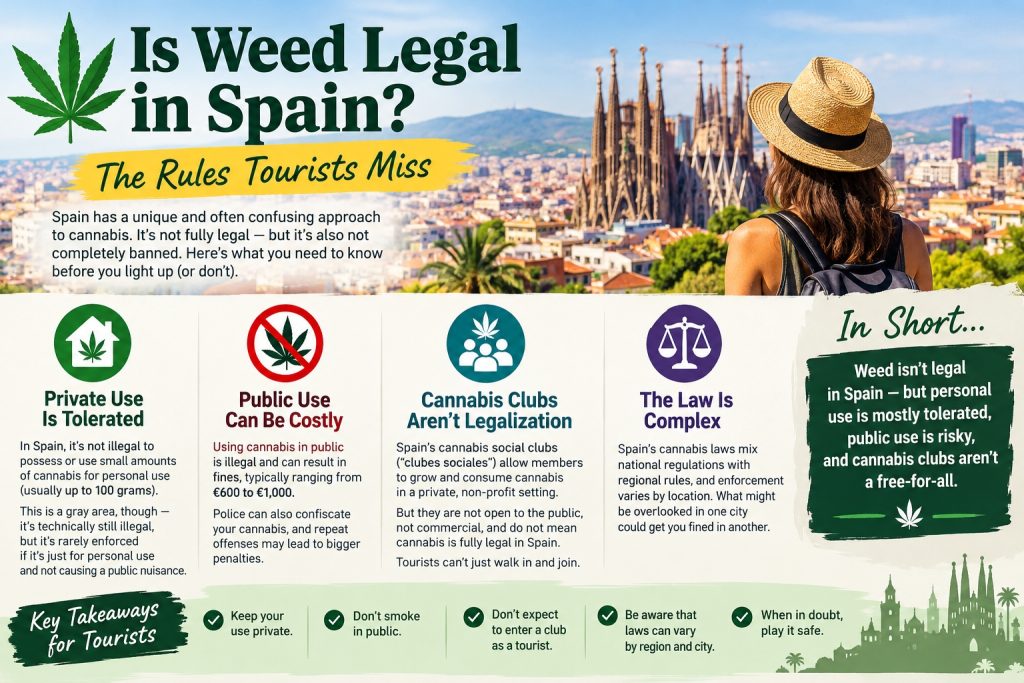
Is Weed Legal in Spain? The Rules Tourists Miss
Nov
You smell cannabis drifting through a Barcelona side street, spot a “cannabis club” sign, and naturally wonder: is weed legal in Spain? The confusing answer is not exactly. Spain hasn’t created a recreational marijuana market like Canada or certain US states. You won’t find legally licensed adult-use dispensaries, and joining a club doesn’t give you immunity from national law.
What Spain does have is a patchwork of private-use protections, administrative offenses, criminal prohibitions, court decisions, and local enforcement practices. Broadly, consuming or possessing cannabis in a genuinely private space for your own use isn’t a criminal offense. Public possession or consumption, however, can trigger confiscation and a substantial fine. Selling, trafficking, or distributing cannabis can lead to criminal prosecution.
That private-versus-public boundary explains many apparent contradictions. You may hear someone say, “Cannabis is legal in Barcelona,” while another person was fined for carrying one joint nearby. Both stories can arise from the same legal framework. Clubs add another layer: they generally operate as private associations rather than licensed retailers, and their legal position remains restricted and vulnerable to prosecution when activities resemble commercial distribution.
This guide reviews Spain’s national rules as of November 12, 2026, including private use, public possession, home cultivation, cannabis social clubs, travel, driving, CBD, and the country’s regulated medical-cannabis framework. It’s general legal information, not individualized legal advice. Enforcement and court outcomes depend on the facts, so when the stakes are serious, consult a Spanish abogado rather than relying on a stranger at a hostel who “totally knows the law.”
Key Takeaways
- Weed is not broadly legal in Spain; private adult cannabis use at home is generally decriminalized but public possession and consumption can lead to fines starting at €601.
- Cannabis social clubs operate as private associations without government-issued retail licenses, making their activities legally vulnerable despite their visibility in cities like Barcelona.
- Selling, trafficking, or distributing cannabis is a criminal offense in Spain, with penalties based on evidence of commercial intent rather than fixed gram limits.
- Travelers should never carry cannabis across international or domestic borders and must avoid driving after consumption due to strict roadside testing and severe penalties.
- Home cultivation for personal use may avoid criminal punishment only if plants are not publicly visible and cultivation shows no evidence of distribution intent.
- Medical cannabis is regulated separately under a 2025 framework requiring specialist prescriptions and hospital dispensing; foreign medical cannabis authorizations do not guarantee legal access in Spain.
Is Weed Legal in Spain? The Short Answer
The shortest accurate answer is: weed isn’t broadly legal in Spain, but some private personal conduct is not criminalized.
You generally won’t commit a crime merely by possessing or consuming cannabis for personal use inside a truly private home. That doesn’t create a legal right to buy it, carry it through public space, or share it through a large organized club. Public possession and use are administrative offenses, while sale and trafficking may be crimes.
So, if you’re asking whether Spain has legal recreational dispensaries, the answer is no. If you’re asking whether private personal consumption is prosecuted like trafficking, that answer is also generally no.
Legal vs. Decriminalized vs. Tolerated: Why the Distinction Matters
These words aren’t interchangeable:
- Legalized means legislation expressly permits and regulates conduct, usually with licensed production, sales, taxes, and consumer rules.
- Decriminalized means particular conduct isn’t treated as a crime, although administrative sanctions or confiscation may still apply.
- Tolerated describes conduct that authorities sometimes deprioritize, even while it remains legally vulnerable.
Spain’s approach is better described as limited private-use decriminalization combined with public-use penalties. Constitutional privacy principles help protect adult conduct in private, but they don’t establish a commercial supply chain.
That distinction matters the moment you leave an apartment. Cannabis tolerated behind a closed door may produce a fine when carried down the street. Likewise, a club’s existence doesn’t prove that every activity inside it is lawful.
At-a-Glance Table: Private Use, Public Possession, Buying, Growing and Clubs
| Activity | General legal position | Main risk |
|---|---|---|
| Adult personal use in a private home | Generally not a criminal offense | Lease, nuisance, child-safety, or building rules |
| Public use or possession | Administrative offense | Confiscation and fines starting at €601 |
| Recreational retail purchase | No licensed adult-use market | Street sales and supply remain unlawful |
| Giving or selling cannabis | Potential criminal offense | Prosecution under Criminal Code Article 368 |
| Home growing for private use | May avoid criminal liability in narrow circumstances | Visibility, scale, evidence of distribution |
| Cannabis social club membership | Not automatically illegal | Club operations may amount to unlawful supply |
| Crossing an international border | Unlawful and high risk | Customs seizure and possible criminal consequences |
| Driving after use | Prohibited | Testing, €1,000 fine, six points, or criminal charges |
The practical rule is simple: private does not mean fully legal, and membership does not equal protection.
Private vs. Public Cannabis Use: Where the Rules Change
In Spain, location changes the legal analysis dramatically. “Private” means more than being away from a police officer: it usually involves a space not open or exposed to the public, together with conduct that stays within the personal sphere.
A locked apartment is the clearest example. A beach, park, club entrance, shared hotel corridor, or parked car on a public road is not. Balconies and communal terraces occupy an uncomfortable middle ground because neighbors and passersby may see or smell what you’re doing.
Personal Possession and Consumption in a Private Home
Personal possession and consumption by an adult in a private residence generally fall outside criminal punishment. That principle reflects privacy rights and the distinction Spanish criminal law draws between self-use and conduct promoting consumption by others.
But “not criminal” doesn’t mean consequence-free. You could still breach:
- A rental agreement or vacation-property policy
- Condominium or homeowners’ association rules
- Noise, odor, or nuisance requirements
- Child-protection obligations
- Workplace restrictions
Suppose you consume a small amount inside a friend’s Madrid apartment. That is legally different from buying it from a dealer outside and carrying it home. The private consumption may escape sanction: the public possession and underlying sale may not. Spanish law evaluates each stage separately, annoying, yes, but crucial.
Smoking or Carrying Weed on Streets, Beaches and Public Transport
Under Article 36.16 of Spain’s Organic Law 4/2015 on Citizen Security, illicit consumption or possession of drugs in public places, roads, establishments, or collective transport is a serious administrative offense when it doesn’t constitute a crime.
That includes a joint on a Barcelona beach, cannabis in your pocket on the Madrid Metro, or a small bag in a public plaza. Police can confiscate it and initiate a sanction proceeding even when the quantity appears intended only for you.
A common tourist mistake is treating discreet possession as lawful possession. Keeping cannabis in a sock, mint tin, or very ambitious sunglasses case doesn’t turn a street into private property. And consuming inside a parked vehicle may still count as public conduct.
Hotels, Holiday Rentals and Balconies: Privacy, Visibility and Property Rules
A hotel room offers privacy, but it belongs to a regulated business that can prohibit smoking and cannabis. Ignoring its rules can bring cleaning charges, removal, or a call to police. Shared hallways, pools, rooftop terraces, and lobbies are generally communal or public-facing spaces, not extensions of your room.
Vacation rentals require similar caution. Read the Airbnb, Vrbo, lease, and building policies before consuming anything. A host’s permission doesn’t legalize conduct visible from the street or override national law.
Balconies are especially risky. If your cannabis use or plants are visible from a public place, authorities may treat the situation differently. Odor can also prompt neighbor complaints. When privacy matters legally, standing above a crowded plaza with a smoking joint is, frankly, not your strongest argument.
Cannabis Fines and Criminal Penalties in Spain
Spain separates administrative sanctions from criminal penalties. Public personal possession normally enters an administrative process. Selling or distributing cannabis can enter criminal court, with much greater consequences.
If police issue a report, don’t assume an on-the-spot conversation is the final decision. You should receive notice and have procedural rights, including an opportunity to challenge the allegations. Deadlines matter, so obtain legal help promptly if the fine or immigration implications concern you.
Public Possession and Consumption: Administrative Fines and Confiscation
Public cannabis possession or consumption is classified as a serious offense under the Citizen Security Law. The statutory fine range for serious offenses is €601 to €30,000, although a first ordinary case generally falls within the lowest statutory degree. Police normally seize the cannabis as well.
The law doesn’t require you to be smoking. A usable amount found during a lawful police interaction may be enough for proceedings. Officers’ observations, laboratory confirmation, where the substance was found, and how evidence was handled can all matter if you contest the sanction.
Don’t sign a document you can’t understand without asking what it is. Request a copy, note the location and time, and avoid arguing physically or obstructing officers. Save the courtroom drama for Netflix: calm documentation is far more useful.
Selling, Supplying and Trafficking: When Criminal Law Applies
Article 368 of Spain’s Criminal Code punishes cultivating, producing, trafficking, or otherwise promoting, facilitating, or enabling illegal drug consumption. Cannabis is generally treated as a substance that doesn’t cause “serious damage to health” within the Code’s penalty structure, but imprisonment and substantial fines remain possible.
You don’t necessarily need to make a profit. Giving cannabis to someone, organizing repeated distribution, or holding communal supplies can create risk. Courts examine the entire situation, including packaging, cash, messages, scales, customer activity, and the number of recipients.
Aggravating circumstances, such as large quantities, sales to minors, use of an organization, or supply around schools, can increase exposure. If accused of supplying cannabis, you need a Spanish criminal lawyer, not a Reddit thread.
Is There a Legal Gram Limit? Why Quantity Alone Does Not Decide the Outcome
Spain has no universal “legal gram limit” that automatically makes public possession lawful. Online claims that you may legally carry a particular number of grams often misread judicial or forensic reference quantities.
Quantity helps indicate intent, but it’s only one factor. A modest amount split into many packets alongside a customer list may suggest distribution. A larger amount stored without sales evidence might support a personal-use argument, though it can still attract investigation and public-possession penalties.
Courts may consult consumption estimates or toxicology guidance when assessing intent. Those aren’t permission slips. Your location, packaging, communications, cash, cultivation setup, and explanation all contribute to the outcome. The safer conclusion is wonderfully unexciting: don’t carry cannabis publicly, regardless of weight.
Are Cannabis Social Clubs Legal in Spain?
Cannabis social clubs exist openly in several Spanish cities, particularly Barcelona, but asking whether they’re “legal” invites an oversimplified answer. Forming a private nonprofit association can be lawful. Producing and distributing cannabis through that association may still breach criminal or administrative law.
Spanish courts have rejected the idea that club status creates a blanket exemption. Small, closed, genuinely shared-consumption arrangements may present a narrower risk under case-specific doctrine, but large, structured systems resembling retail supply are exposed to prosecution.
Private Associations vs. Licensed Dispensaries: What Clubs Actually Are
A cannabis club is usually registered as a private association. It isn’t a government-licensed recreational dispensary, and Spain doesn’t issue retail marijuana licenses comparable to those in California, Colorado, or Canada.
Legitimate-looking membership cards, reception desks, menus, and branding can create the impression of official approval. They don’t. Registration addresses the association’s legal personality and internal governance: it doesn’t authorize drug distribution.
Clubs commonly describe payments as membership fees or contributions toward collective cultivation. Courts look beyond labels. If members effectively walk in, select products, pay according to quantity, and leave, authorities may view the arrangement as trafficking or facilitation. A velvet sofa and tasteful neon leaf don’t alter the Criminal Code.
Membership, Age and Residency: Club Policies vs. Legal Requirements
Most clubs set minimum ages, often 18 or 21, and ask for identification. Some require sponsorship by an existing member, advance registration, or local residency. These are usually internal risk-management policies, not proof of a nationally authorized cannabis program.
There is no single government cannabis-club membership card. Nor is there a national rule saying every adult tourist has a right to join. Clubs can impose stricter conditions, refuse admission, or close without warning.
Be cautious when anyone solicits you on La Rambla or promises “100% legal weed.” Street promoters may be unaffiliated, and handing over your passport image creates a separate privacy risk. If a club advertises aggressively to passing tourists, that openness may also undermine the claim that it serves a predefined, closed group.
Can Tourists Join? Why Membership Does Not Guarantee Legal Protection
Some clubs admit tourists: others require Spanish residence or an invitation. Joining isn’t automatically a crime, but membership doesn’t legalize purchasing, public possession, or taking cannabis back to your accommodation.
This is the trap: you consume inside a private club without incident, put the remainder in your pocket, and step onto the sidewalk. You’ve now moved cannabis into public space, where Article 36.16 may apply. The membership card isn’t a medical prescription, retail receipt, or defense.
Tourists may also struggle to challenge sanctions after leaving Spain, while unpaid penalties can create practical complications. If you visit a club, understand that its assurances are marketing or policy statements, not binding interpretations from Spanish courts.
Shared Consumption, Distribution and Court Rulings: Where Clubs Face Legal Risk
Spain’s Supreme Court has ruled against clubs whose organized cultivation and distribution reached substantial, expandable groups. The Constitutional Court has also invalidated regional attempts to regulate club activity where those rules intruded on the state’s exclusive authority over criminal legislation.
The narrow “shared consumption” doctrine is highly fact-sensitive. Courts may consider whether participants are identified in advance, whether the group is small and closed, whether consumption occurs immediately in private, and whether quantities are limited to foreseeable personal use.
Large membership, stockpiling, recruitment, take-away cannabis, paid staff, and retail-style transactions increase legal danger. Barcelona’s club scene is culturally visible, but visibility isn’t legalization. Clubs can be searched, closed, or prosecuted, and members can still be sanctioned once they carry cannabis outside.
What Tourists Need to Know Before Using Cannabis in Spain
For visitors, the safest answer to is weed legal in Spain is operational rather than philosophical: there is no lawful tourist retail system, public possession is punishable, and international transport is a terrible gamble.
You should also consider travel insurance, employment rules, medications, and your home country’s laws. A vacation doesn’t suspend those obligations. If cannabis causes anxiety, disorientation, or illness, seek medical help and tell clinicians what you consumed: accurate treatment matters more than embarrassment.
Can You Buy Weed Legally? Why Spain Is Not a Recreational Retail Market
You can’t legally walk into a state-licensed recreational dispensary because Spain hasn’t established one. Street dealers operate unlawfully, and buying from them introduces obvious risks: arrest, theft, contamination, unknown potency, and products that aren’t laboratory regulated.
Cannabis clubs don’t convert this into a conventional legal sale. Even when a club calls payment a “donation” or “dispensing contribution,” criminal liability depends on what actually happens.
Avoid promoters approaching you in nightlife districts. Beyond the legal issue, unregulated products may contain synthetic cannabinoids, pesticides, mold, or far more THC than expected. That bargain edible shaped like a cartoon bear doesn’t come with meaningful quality assurance, only confidence, which is not the same thing.
Airports, International Borders and Domestic Travel: Cannabis Transport Risks
Never take cannabis across Spain’s international borders, including borders within the Schengen Area. Fewer routine passport checks don’t make drug transport lawful, and France currently runs temporary controls on its border with Spain. Airports, ferry terminals, customs zones, and crossings with France, Portugal, Andorra, Gibraltar, and Morocco (at Ceuta and Melilla) involve enforcement risks.
Don’t fly home with cannabis, seeds of uncertain legal status, THC vapes, or leftover edibles. Check every pocket and bag before departure. “I forgot” may explain what happened, but it doesn’t guarantee protection.
Domestic travel isn’t automatically safe either. Carrying cannabis on a train, bus, plane, ferry, or public road can trigger public-possession rules. Mailing it is worse: postal transport can create evidence of supply or trafficking. Keep in mind that the Canary and Balearic Islands remain subject to Spanish national law despite their distinct geography.
Driving After Cannabis Use: Roadside Testing and Potential Penalties
Spain uses roadside saliva testing for drugs. Driving with drugs present in your body can lead to an administrative penalty commonly stated as €1,000 and six license points, while prescribed substances used under medical direction receive different treatment under the traffic framework, provided you’re fit to drive.
Actual impairment can escalate the matter. Under Criminal Code Article 379.2, driving under the influence of drugs may bring criminal penalties, including imprisonment, a fine or community service, and loss of driving privileges.
THC may remain detectable after the obvious high fades, so “I feel fine” isn’t a reliable legal test. Don’t drive a rental car, scooter, motorcycle, or e-bike after consuming. Use the Metro, a taxi, or a designated sober driver. It’s cheaper than explaining a roadside swab to both police and Hertz.
Can You Grow Cannabis at Home in Spain?
Home cultivation isn’t covered by a simple national license allowing every adult a fixed number of plants. Private cultivation intended solely for personal consumption may avoid criminal liability, but cultivation can become an administrative or criminal matter depending on visibility, purpose, scale, and surrounding evidence.
Seeds and gardening supplies being available in shops doesn’t settle the legality of the finished cultivation. The real question is how the plants are grown and what authorities believe you intend to do with the harvest.
Private Personal Cultivation vs. Cultivation Intended for Distribution
A small, concealed grow for an adult’s own private consumption is treated differently from production intended for sale or supply. Article 368 targets cultivation that promotes or facilitates illegal consumption by others.
Evidence suggesting distribution can include unusually large output, multiple packaged portions, scales, sales messages, cash, customer visits, sophisticated infrastructure, or links to an organized group. Electricity theft and unsafe wiring create separate offenses and hazards.
Sharing a harvest isn’t necessarily protected merely because no money changes hands. If you’re producing for several people, prosecutors may argue that you’re facilitating consumption. Ten friends calling it “collective gardening” doesn’t make the legal issue disappear.
Public Visibility and Plant Counts: Why There Is No Universal Safe Number
The Citizen Security Law prohibits illicit planting or cultivation in places visible to the public when the conduct isn’t criminal. Plants on a balcony visible from the street can hence generate administrative action even if you claim personal use.
There is no nationwide rule saying two, three, or six plants are always legal. Plant size, expected yield, household consumption, visibility, equipment, prior activity, and evidence of supply matter more than a meme-friendly number.
If you cultivate in a rented home, you may also violate the lease or damage the property through humidity, wiring, or ventilation changes. Get specific legal advice before growing. At minimum, don’t assume that a privacy screen transforms an exposed terrace into a legally secure greenhouse.
Medical Cannabis, CBD and Hemp: Separate Rules Explained
Medical cannabis, CBD products, and industrial hemp sit under different legal regimes. A product associated with cannabis isn’t automatically treated like recreational marijuana, but neither is every “CBD” bottle lawful for every intended use.
Product composition, THC concentration, presentation, route of administration, and health claims all matter. Labels such as “aromatherapy,” “collector’s item,” or “not for consumption” may reflect regulatory positioning rather than safe instructions for you.
Medical Cannabis Access: Current Authorization, Prescribing and Dispensing Rules
Spain’s medical-cannabis position changed materially through Royal Decree 903/2025, which established conditions for preparing and dispensing standardized cannabis preparations for medicinal use. The framework centers on specialist prescribing, authorized preparations, AEMPS oversight, and hospital-pharmacy dispensing rather than recreational shops or broad self-certification.
Access isn’t the same as showing a foreign medical card at a club. A US state card, Canadian prescription, or UK cannabis document doesn’t automatically authorize possession or purchase in Spain. Travelers should consult their prescriber, airline, Spanish consulate, and customs authorities before carrying any controlled medicine.
Check current information from the Spanish Agency for Medicines and Health Products because eligible indications, authorized preparations, clinical protocols, and implementation details can evolve. Never substitute club cannabis for a prescribed product without speaking to a qualified clinician.
CBD Oils, Flowers and Edibles: Why Product Type and Intended Use Matter
CBD isn’t intoxicating like THC, but “CBD is legal” is too broad. Cosmetics may be permitted when they comply with EU cosmetics rules. Foods and supplements containing CBD can fall under the EU novel-food regime and require authorization before lawful marketing for ingestion.
CBD flower is particularly confusing. Spanish authorities treat hemp flowering tops as controlled narcotics regardless of THC content, and even low-THC hemp flower may resemble high-THC cannabis, leading to seizure and testing. Smoking claims, tobacco rules, product presentation, and trace THC can complicate matters.
For edibles or oils, verify the manufacturer, laboratory certificate, ingredient list, THC content, and authorized intended use. Don’t rely on a market-stall seller saying, “It’s hemp, amigo.” Also remember that full-spectrum products may contain enough THC to affect a roadside test or conflict with workplace drug policies.
Do Cannabis Laws Differ Across Spain?
Spain’s Criminal Code and Citizen Security Law apply nationally. Autonomous communities and municipalities can regulate areas within their authority, such as associations, premises, public health, urban planning, and licensing, but they can’t simply legalize recreational trafficking that national criminal law prohibits.
Local police priorities and club visibility vary, which can make the rules feel different. Yet a practice being common in one city doesn’t create a legal entitlement there.
Barcelona and Catalonia: Club Visibility Does Not Mean Recreational Legalization
Barcelona has Spain’s most internationally famous cannabis-club culture. Tourists often interpret the number of clubs as evidence of legalization, but Catalonia doesn’t have a lawful Colorado-style market.
In 2018, Spain’s Constitutional Court struck down Catalan legislation regulating cannabis consumer associations because central elements affected matters reserved to the state. Courts have also annulled Barcelona’s own planning rules for clubs on the same reasoning, and the city has since moved to close clubs, while courts and police continue acting against clubs suspected of trafficking.
If you’re in the Gothic Quarter and see club invitations everywhere, remember the distinction: the association may possess registration papers, yet its cannabis activity can still be challenged. Public possession outside the door remains sanctionable under national law.
Madrid, the Basque Country and the Islands: National Law vs. Local Enforcement
Madrid has clubs, but they’re less central to tourist culture than in Barcelona. The Basque Country has a long history of association-based activism and regional public-health initiatives, yet national criminal restrictions still apply. Earlier regional efforts to provide a framework have not created licensed recreational retail.
The Balearic Islands, including Ibiza and Mallorca, and the Canary Islands also follow national possession and trafficking law. Nightlife culture, beach parties, or relaxed local attitudes don’t create exemptions. Public cannabis use in Ibiza can be penalized just as it can in Seville.
Enforcement intensity may shift with neighborhood complaints, tourism seasons, major events, or police operations. You shouldn’t plan around rumored tolerance. Plan around the written law, especially when carrying cannabis or driving.
Official Sources and the Latest Verified Legal Updates
Cannabis guidance ages quickly because statutes interact with court decisions, medical regulations, municipal rules, and enforcement practices. For a reliable answer, prioritize official Spanish sources over club blogs, travel forums, and articles that quietly recycle decade-old information.
This guide distinguishes enacted rules from proposals. Political announcements can signal future reform, but they don’t change your legal position until the appropriate measure is adopted, published, and effective.
Check the BOE, Citizen Security Law, Criminal Code, Court Rulings and AEMPS Guidance
Your strongest starting points are:
- The Official State Gazette, or BOE, for enacted national legislation.
- Organic Law 4/2015, especially the provisions on public drug possession, consumption, and visible cultivation.
- The consolidated Spanish Criminal Code, particularly Articles 368 onward and Article 379.2.
- The Constitutional Court and Judicial Documentation Center for relevant judgments.
- AEMPS for medicines, controlled products, and medical-cannabis implementation.
- The Directorate-General for Traffic for current drug-driving rules and sanctions.
Spanish consolidated legislation is the controlling source. Translations and summaries are useful, but legal nuances can disappear between languages.
Enacted Rules vs. Proposed Reforms: What Changed and When This Guide Was Reviewed
Spain has repeatedly debated broader medical and recreational cannabis reform. A parliamentary recommendation, ministry consultation, or draft decree isn’t the same as a law already in force. Look for final publication in the BOE, an effective date, and any implementing guidance.
The major recent enacted development reflected here is the 2025 regulatory framework for standardized medicinal cannabis preparations. It did not legalize general adult-use sales, erase public-possession fines, or transform social clubs into licensed dispensaries.
Conclusion
So, is weed legal in Spain? Not in the broad recreational sense. Private adult consumption may fall outside criminal punishment, but public possession can cost at least €601, supply can become a criminal case, and club membership offers no magic shield.
Your practical checklist is short: don’t buy from street dealers, don’t carry cannabis publicly, never cross a border with it, and don’t drive after using it. Treat home cultivation and club participation as legally sensitive rather than officially approved. This guide was reviewed on November 12, 2026: before acting, verify current BOE and AEMPS material or obtain advice from a Spanish lawyer. A five-minute check now beats spending your holiday translating a police notice later.