
Blog 2026
Is Weed Legal in Florida? 2026 Rules Explained
Nov
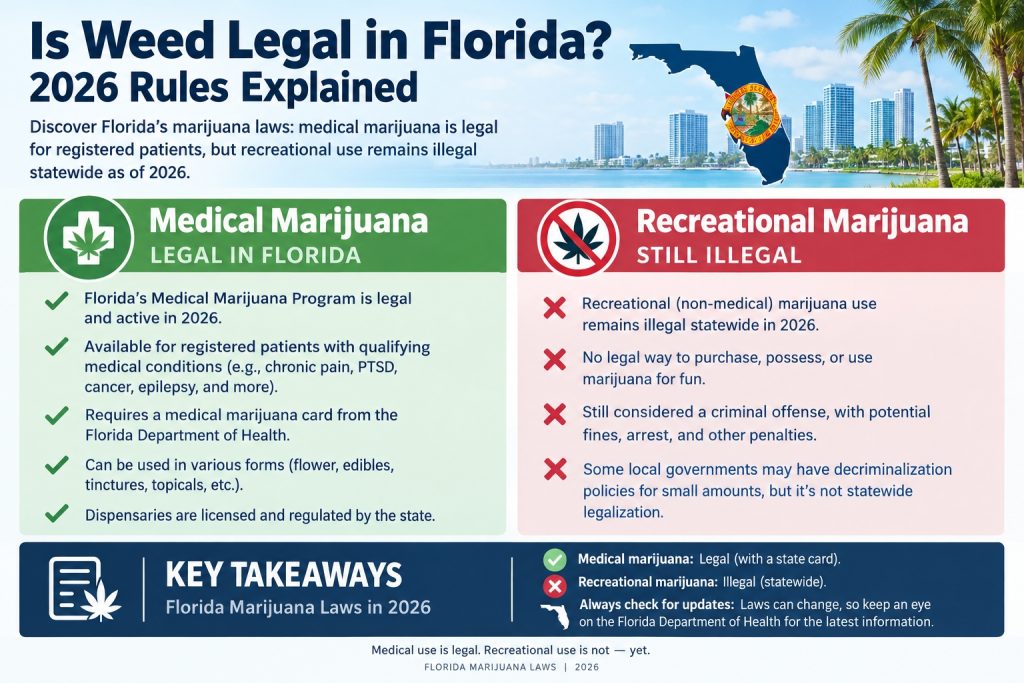
Florida’s palm trees and laid-back vacation vibe can make its marijuana laws seem more relaxed than they actually are. They aren’t. So, is weed legal in Florida? The accurate answer is: medical marijuana is legal for registered patients, but recreational marijuana remains illegal under state law.
That distinction matters whether you live in Miami, spend winters near Sarasota, or just landed in Orlando with a vape tucked into your carry-on. Being 21 doesn’t let you walk into a Florida dispensary and buy cannabis. An out-of-state medical card generally won’t work, either. And products that look nearly identical, medical cannabis, hemp-derived delta-9 gummies, THCA flower, and high-THC concentrates, may fall under very different rules.
This guide explains Florida law as last reviewed on November 11, 2026, including the failed 2024 recreational-marijuana amendment, medical card requirements, purchase limits, possession penalties, hemp products, travel, employment, and federal conflicts. It’s a practical statewide overview, not personal legal advice. Local enforcement practices can differ, and cannabis rules change faster than a beach forecast, so verify time-sensitive details with the linked government sources before acting.
The safest starting point is simple: if you don’t have active authorization through Florida’s Medical Marijuana Use Registry, don’t assume marijuana is legal merely because you smell it on the sidewalk, or because a shop sells something in very convincing green packaging.
Key Takeaways
- Medical marijuana is legal in Florida for qualified patients with a doctor’s certification and registration in the Medical Marijuana Use Registry, but recreational marijuana remains illegal statewide.
- Adults 21 and older cannot legally purchase recreational marijuana in Florida, and out-of-state medical marijuana cards are not generally accepted for purchasing within the state.
- Florida prohibits home cultivation of marijuana, requiring medical cannabis patients to obtain products only through licensed Medical Marijuana Treatment Centers (MMTCs).
- Possession limits for medical marijuana are strictly regulated, including a 2.5-ounce smokable limit over 35 days and controlled milligram limits for other product types under physician orders.
- Local civil citation programs for small marijuana possession do not change the statewide illegal status of recreational use, and public consumption of marijuana remains prohibited.
- Hemp-derived products are generally legal under strict state and federal THC limits, but their safety, legality, and labeling compliance should be carefully verified before purchase.
Is Weed Legal in Florida? The Short Answer
Medical marijuana is legal for qualified, registered Florida patients. Adult-use, or recreational, marijuana is not. You must receive certification from a qualified physician, enter the Medical Marijuana Use Registry, and obtain cannabis through a licensed Medical Marijuana Treatment Center, commonly called an MMTC.
Adults without medical authorization can’t legally possess conventional marijuana simply because they’re over 21. Florida also does not permit recreational dispensaries or general home cultivation. Hemp products occupy a separate, complicated category, but a package saying “hemp” isn’t an all-purpose shield from arrest, testing disputes, or federal restrictions.
At-a-Glance Comparison: Medical Marijuana, Recreational Weed, and Hemp
| Category | Florida status | Who may buy? | Main catch |
|---|---|---|---|
| Medical marijuana | Legal under state law | Qualified registered patients and caregivers | Must follow physician orders and registry limits |
| Recreational marijuana | Illegal | No general adult-use sales | Age 21 alone provides no exemption |
| Hemp-derived products | Generally legal if compliant | Adults 21+ for ingestible or inhalable hemp extract products | Must satisfy hemp THC, packaging, and testing laws |
| Homegrown cannabis | Illegal | No patients or recreational users | Florida provides no personal-cultivation right |
Medical authorization is a limited legal framework, not blanket immunity. Using cannabis publicly, driving impaired, sharing a patient’s product, or carrying more than authorized can still create criminal exposure.
Recreational Marijuana and Florida Legalization Updates
Florida voters have repeatedly debated adult-use legalization, but ballot campaigns and proposed bills don’t change the law by themselves. Until a measure wins every required approval and takes effect, recreational possession and sales remain prohibited.
This is where headlines cause trouble. “Legalization initiative advances” may mean organizers submitted petitions, not that you can legally light up. When checking an update, identify whether it concerns petition gathering, judicial review, ballot qualification, voter approval, implementing legislation, or an effective date. Those are very different milestones.
What Happened to Amendment 3 in 2024, and What Is the Latest 2026 Ballot Status?
Florida’s 2024 Amendment 3 would have allowed adults 21 and older to possess limited quantities and authorized existing MMTCs, and potentially other licensed businesses, to sell recreational marijuana. It received roughly 56% of the vote, according to the Florida Division of Elections, but constitutional amendments require 60% approval. It hence failed.
Legalization supporters pursued another proposed constitutional amendment for the 2026 cycle, but it did not make the November 2026 ballot. State officials said the campaign had about 833,000 valid signatures by the February 1, 2026 deadline, short of the 880,062 required, after roughly 71,000 signatures were invalidated, and in March 2026 the Florida Supreme Court declined to take up the campaign’s challenge. Any future effort would have to start again through the Division of Elections’ initiative petition database and final certified ballot, not campaign advertising. Unless and until voters approve a qualifying measure and it becomes effective, adult-use marijuana remains illegal.
Proposed Changes vs. Laws in Effect: What Has Actually Changed?
A proposal may describe possession allowances, licensed retail sales, or rules for adults over 21. None applies merely because the proposal gained signatures or survived a court challenge.
Here’s the no-nonsense test:
- Did the measure qualify for the ballot?
- Did at least 60% of Florida voters approve it?
- Has its effective date arrived?
- Have agencies adopted any required implementing rules?
If any necessary step is missing, continue following current law. As of this review, Florida’s operational system remains medical-only. There are no lawful recreational dispensaries, and unregistered adults have no statewide marijuana-possession allowance. Municipal civil-citation programs don’t change that statewide status.
Who Can Legally Use Medical Marijuana in Florida?
You may qualify if you’re a Florida resident or eligible seasonal resident, have a qualifying condition, and receive certification from a physician authorized to recommend medical marijuana. The physician must determine that expected benefits reasonably outweigh potential health risks.
Registration isn’t automatic after a diagnosis. You must complete the state process, maintain active status, and buy only within the physician orders displayed in the registry. A designated caregiver may assist an eligible patient, but caregivers face separate registration and identification requirements.
Qualifying Medical Conditions, Physician Evaluations, and Rules for Minors
Florida law lists cancer, epilepsy, glaucoma, HIV/AIDS, post-traumatic stress disorder, ALS, Crohn’s disease, Parkinson’s disease, multiple sclerosis, terminal conditions, and chronic nonmalignant pain caused by a qualifying condition. It also permits conditions of the same kind or class as listed conditions, subject to a physician’s judgment and documentation.
A certification visit isn’t a guaranteed approval appointment. Expect a medical-history review, discussion of prior treatment, contraindications, delivery routes, and dosing.
Patients under 18 generally need a qualified caregiver. Additional safeguards apply, including parental or guardian consent and a second physician’s concurrence with the certification. Smoking certification for minors is narrowly restricted: it requires a terminal diagnosis and the concurrence of a board-certified pediatrician.
How to Get a Florida Medical Marijuana Card: Residency, Costs, and Renewals
The usual path looks like this:
- Schedule an in-person evaluation with a qualified Florida medical-marijuana physician.
- Provide Florida residency or seasonal-residency evidence.
- Have the physician enter your certification and orders in the registry.
- Submit the state application, photograph, documentation, and fee.
- Wait for approval before purchasing from an MMTC.
The state identification-card application or renewal fee is $75 (plus a small convenience fee when paid online), while physician prices vary widely, often around $150 to $300 for an initial visit, with additional certification-renewal costs. Verify current charges through the Office of Medical Marijuana Use.
Cards generally renew annually, while physician certifications require renewal more frequently, typically every 210 days. Missing either deadline can interrupt purchasing eligibility even if your condition hasn’t changed.
Can Tourists, Seasonal Residents, or Out-of-State Cardholders Qualify?
Florida does not offer broad medical-marijuana reciprocity. A card from New York, Ohio, or another state generally won’t let you purchase at a Florida MMTC. Tourists visiting for a week ordinarily don’t qualify.
Seasonal residents may qualify if they temporarily live in Florida for at least 31 consecutive days each calendar year, maintain a temporary Florida residence, return to another jurisdiction at least once annually, and are registered to vote or pay income tax elsewhere. Documentation can include a lease, utility records, mail from government agencies, or other materials accepted by OMMU.
Imagine you spend January through March in Naples: you may qualify after documenting seasonal residency and completing Florida’s medical process. Arriving with an out-of-state card alone, however, isn’t enough.
Florida Marijuana Purchasing and Possession Limits
A medical card doesn’t create an unlimited cannabis allowance. Your purchases are controlled by state law, physician orders, delivery-route limits, and rolling registry calculations. The amount available today can be lower than your nominal maximum because previous purchases remain inside the relevant calculation window.
Before visiting a dispensary, check your registry profile. Staff can’t override an exhausted allotment because you drove 40 minutes or because your favorite flower finally came back in stock, painful, yes, but still true.
Where Patients Can Buy Legally and Which Cannabis Products Are Allowed
Registered patients must buy from state-licensed MMTCs such as Trulieve, MÜV, Curaleaf, Surterra Wellness, or other approved operators. Products may include flower, vape cartridges, tinctures, capsules, edibles, topical preparations, concentrates, and low-THC cannabis, provided the patient has an active order for that route.
You can’t lawfully substitute a neighborhood seller, social-media delivery service, or unlicensed “dispensary.” Keep products in their original labeled containers when transporting them. Florida requires MMTC products to meet state standards for testing, labeling, and packaging: dispensaries must record each sale in the registry.
Delivery is available from many licensed operators. That’s useful for patients with limited mobility, but the recipient and address must still comply with identification and program requirements.
Understanding 35-Day and 70-Day Purchase Limits, Possession Caps, and Exceptions
Smokable marijuana is generally tracked over a 35-day rolling period, with a statutory purchase limit of 2.5 ounces unless an approved exception applies. A patient generally may not possess more than 4 ounces of smokable marijuana at once.
Other routes, such as inhalation, oral, edible, sublingual, topical, and suppository products, are commonly ordered in sequential 70-day supply periods. Milligram limits depend on the route and physician order. Florida uses rolling calculations, so buying an ounce today doesn’t necessarily restore that ounce on the first day of the next calendar month: availability returns as the prior transaction ages out.
A physician may request an exception from certain limits when medically justified. Approval isn’t automatic, and you shouldn’t exceed the registry amount while a request is pending.
Can Medical Patients or Other Adults Grow Marijuana at Home?
No. Florida law does not authorize registered patients, caregivers, or other adults to cultivate marijuana at home. Your medical card lets you obtain approved products from licensed MMTCs: it doesn’t let you keep plants on a balcony, in a closet, or behind the tomatoes.
Cultivation can trigger more serious allegations than simple possession because police may consider plant numbers, total harvested weight, equipment, and evidence suggesting distribution. A landlord or homeowners’ association may also act under lease or community rules.
This remains true even if home cultivation is legal in the state where you previously lived. Florida’s program is vertically regulated: licensed businesses cultivate, process, and dispense cannabis. Patients purchase the finished product.
Penalties for Illegal Marijuana Possession in Florida
Unauthorized marijuana possession can lead to arrest, prosecution, fines, probation, driver’s-license consequences in some circumstances, and a record that affects work or housing. The exact charge depends on weight, substance type, packaging, evidence of sale, location, and prior history.
Don’t treat the following as a sentencing prediction. Prosecutors may reduce or enhance charges, diversion may be available, and chemically similar products can be classified differently. If you’re arrested or cited, speak with a Florida criminal-defense lawyer rather than trying to explain the case through text messages or social media.
Possession of 20 Grams or Less vs. Larger Amounts: Charges and Potential Penalties
Possessing 20 grams or less of marijuana without authorization is generally a first-degree misdemeanor under Florida law, punishable by up to one year in jail and a fine of up to $1,000. Possession above 20 grams is generally a third-degree felony, potentially carrying up to five years in prison and a fine of up to $5,000.
Those are statutory maximums, not guaranteed outcomes. Diversion, withholding adjudication, probation, or dismissal may be possible depending on the facts and jurisdiction.
Weight disputes matter. Police may weigh the material collected, and larger quantities can move a case into trafficking territory. A lawful medical patient can also face trouble if products aren’t theirs, exceed authorized limits, or were obtained outside the MMTC system.
Why THC Concentrates, Unlawful Sales, and Trafficking Can Carry Different Penalties
Florida may treat THC oil, wax, resin, and other concentrated cannabis differently from ordinary marijuana flower. Florida’s 20-gram misdemeanor rule excludes cannabis resin and products made from it, so unauthorized possession of a concentrate can support felony charges even when the cartridge or container looks small. That half-used vape in the glove box isn’t necessarily treated like a few grams of plant material.
Evidence of sales, individual packaging, scales, customer messages, cash, or observed exchanges, can produce distribution charges. Selling near certain protected locations or involving minors may create additional consequences.
Trafficking laws use substance-specific weight thresholds and mandatory penalties. Because legal classification can turn on laboratory results and statutory definitions, don’t rely on a retailer’s label or a friend’s “it’s basically CBD” assurance. Packaging is evidence: it isn’t a laboratory conclusion.
Local Civil Citations and Decriminalization Policies vs. State Criminal Law
Some Florida counties and cities have authorized civil citations or alternative enforcement for possession of small amounts. Depending on the jurisdiction and officer discretion, a person might receive a civil fine rather than face immediate misdemeanor prosecution.
That is not legalization. State marijuana prohibitions remain enforceable, and a local policy generally doesn’t bind state troopers, neighboring agencies, school police, or federal authorities. It may also exclude repeat violations, public consumption, impaired driving, sales, or cases involving other alleged crimes.
In practical terms, possessing a small amount in a city with a citation program still carries risk. Cross one municipal boundary, or encounter a different agency, and the response may change. Never build your legal strategy around the hope that an officer chooses the least severe option.
Where Can You Smoke, Vape, or Consume Marijuana in Florida?
Florida medical authorization doesn’t mean you can consume cannabis wherever tobacco use is tolerated. Public use is generally prohibited, and property owners can impose stricter rules. Your safest setting is a private residence where the owner permits consumption and no conflicting lease, smoke-free, child-safety, or federal-housing rule applies.
Smokable marijuana creates the most obvious issues, but discreet products aren’t automatically lawful in public. A gummy is less noticeable than a joint: it isn’t magically exempt from location restrictions.
Private Homes, Rentals, Hotels, Public Places, and Smoke-Free Areas
A privately owned home is usually the clearest place for a qualified patient to medicate, provided the owner agrees. Rentals are trickier. Landlords, condominium associations, and vacation-rental hosts may prohibit smoking, vaping, or all marijuana possession under lease or house rules.
Hotels can enforce no-smoking policies and may refuse cannabis use anywhere on the premises. Ask before consuming: don’t assume a balcony is private legal territory.
Florida generally prohibits medical-marijuana use in public places, on public transportation, at schools, in correctional facilities, and in workplaces unless an employer permits it. Tobacco smoke-free laws can add another layer. If you need medication during an outing, discuss lawful non-smoked routes and timing with your physician rather than improvising in a parking lot.
Marijuana in Cars: Transportation, Consumption, and DUI Rules
A registered patient may transport legally purchased medical marijuana, ideally in its original dispensary packaging and secured away from immediate access. Carry your identification and ensure the quantity matches your authorization.
Don’t use marijuana while driving. Florida can prosecute driving under the influence when cannabis impairs your normal faculties. Unlike alcohol’s familiar 0.08 threshold, THC levels don’t provide a simple universal impairment line. Officers may rely on driving behavior, observations, field exercises, statements, and toxicology evidence.
Passengers shouldn’t consume in the vehicle, either. Odor, smoke, loose flower, unlabeled containers, or conflicting stories can turn a traffic stop into a longer roadside investigation. Best practice? Keep the product sealed in the trunk or another inaccessible area and wait until you reach a lawful private location.
Traveling With Cannabis: Airports, State Lines, Cruises, and Federal Property
Do not take marijuana across state lines, even when traveling between two states with legal cannabis. Interstate transport falls under federal jurisdiction. The same warning applies to international borders.
Airports are complicated because Transportation Security Administration screening operates under federal rules. TSA’s medical-marijuana guidance recognizes only limited federally lawful products. If suspected marijuana is discovered, TSA may refer the matter to local law enforcement: what happens next depends on location and facts.
Cruise lines commonly ban cannabis, including medical marijuana, and ports involve federal, international, and maritime rules. Federal properties such as national parks, military bases, courthouses, and many federally subsidized facilities remain particularly risky. Leave cannabis behind before crossing those boundaries. A Florida card doesn’t travel like a passport.
Are CBD, Delta-8, Delta-9 Hemp Products, and THCA Legal in Florida?
Compliant hemp and hemp-derived products are generally legal in Florida, but the answer depends on the product’s chemistry, source, labeling, testing, age restrictions, and evolving state and federal definitions. Under federal law, hemp generally means cannabis containing no more than 0.3% delta-9 THC on a dry-weight basis, and Florida’s hemp law measures total delta-9 THC. A federal law passed in November 2025 narrows the federal definition, excluding final products with more than 0.4 mg of total THC per container and cannabinoids synthesized from hemp-derived CBD; its main limits are now scheduled to take effect on December 11, 2026, after a one-month delay.
That formula created a marketplace for CBD, delta-8 THC, hemp-derived delta-9 edibles, and THCA flower. Yet “sold at a smoke shop” does not necessarily mean lawful, accurately labeled, or safe. Florida has adopted packaging and consumer-protection requirements, including a 21+ age limit for ingestible and inhalable hemp extract products, and lawmakers continue to debate intoxicating hemp products.
Hemp vs. Medical Marijuana: Product Restrictions, Testing, and Legal Risks
Medical marijuana moves through Florida’s licensed MMTC system and is available only to registered patients. Hemp products move through a separate regulatory channel overseen largely by the Florida Department of Agriculture and Consumer Services.
| Issue | Medical cannabis | Hemp product |
|---|---|---|
| Purchase authorization | Active patient status | No medical card for compliant products |
| THC framework | Medical orders and state limits | Hemp-definition and product rules |
| Seller | Licensed MMTC | Properly permitted retailer/manufacturer |
| Drug-test risk | High | Still possible, including with CBD |
Delta-8 and THCA occupy legally sensitive ground. THCA converts into intoxicating delta-9 THC when heated, and testing methods or “total THC” interpretations can affect classification. Products may also contain more THC than advertised. Use retailers that provide batch-specific certificates of analysis, but remember: a QR code isn’t immunity from seizure, workplace discipline, or a failed drug test.
How Florida Marijuana Laws Interact With Employment and Federal Law
Florida’s medical program protects qualifying use under state law, but it doesn’t erase workplace policies or federal restrictions. Cannabis remains a complicated choice for employees in safety-sensitive, federally regulated, or drug-free workplaces.
Before applying, ask for the written drug-testing policy. If you already work there, review accommodation procedures before disclosing medical information. A card proves participation in Florida’s program: it doesn’t prove you weren’t impaired at work, and it doesn’t automatically require an employer to overlook a positive test.
Medical Cards, Workplace Drug Testing, and CDL Drivers
Florida generally does not provide broad employment protection requiring every private employer to accommodate medical-marijuana use. Employers may prohibit possession and impairment at work, maintain drug-free workplace programs, and act on test results when allowed by applicable law and policy.
You should never arrive impaired or bring cannabis onto workplace property without explicit authorization. If your position involves machinery, health care, law enforcement, schools, or government contracts, the consequences can be especially serious.
Commercial driver’s license holders are governed by federal Department of Transportation testing rules. The DOT expressly warns that state medical-marijuana authorization is not a valid explanation for a positive marijuana test. CBD and hemp products can also produce positive results, so “the store said THC-free” is a weak career plan.
Firearm Restrictions and Federal Scheduling: What State Authorization Does Not Resolve
Federal firearms law has historically prohibited firearm possession by an unlawful user of a federally controlled substance. In June 2026, the U.S. Supreme Court ruled in United States v. Hemani that prosecuting someone based only on regular marijuana use violated the Second Amendment, but the ban still reaches people who are addicted or presently intoxicated. Because federal law, not Florida’s medical program, governs this issue, cardholders can face serious conflicts when possessing or purchasing firearms. Federal forms must be answered truthfully. Get individualized legal advice rather than relying on internet folklore.
Federal cannabis policy has also been moving through scheduling and administrative debates. In April 2026, the Drug Enforcement Administration moved FDA-approved marijuana products and marijuana covered by a state medical marijuana license to Schedule III, while all other marijuana, including recreational, stays in Schedule I pending a broader rescheduling hearing. A proposal, agency recommendation, or rescheduling announcement doesn’t automatically legalize recreational possession, authorize interstate transport, or resolve every firearms and employment issue. Final rules, effective dates, court challenges, and agency interpretations matter.
In short, state authorization and federal legality are separate lanes. Your Florida medical card helps within Florida’s medical framework, but it doesn’t neutralize federal law on bases, at borders, in federally regulated jobs, or during firearm transactions.
Frequently Asked Questions About Florida Weed Laws
The questions below address the situations that generate the most confusion, and, frankly, the most confident wrong answers at parties. When facts involve an arrest, employment test, custody dispute, firearm, or immigration status, consult an attorney familiar with that specific field.
Can You Buy Marijuana Without a Medical Card if You Are Over 21?
No. Florida has no general recreational-marijuana retail system. If you’re 21 or older but aren’t an approved patient or caregiver, you can’t lawfully enter an MMTC and buy marijuana for personal use.
You may encounter stores advertising CBD, delta-8, THCA, or hemp-derived delta-9 products. Those products are sold under hemp rules, not as recreational marijuana, and their legality depends on compliance with current product requirements. Don’t confuse a smoke shop with a licensed medical dispensary.
If you believe you have a qualifying condition, the legal route is to consult an authorized physician and complete the OMMU process. A same-day recommendation doesn’t necessarily mean same-day purchasing: registry approval and valid orders still matter.
Can You Share or Give Away Legally Purchased Medical Marijuana?
No. Medical marijuana is authorized for the registered patient whose name is tied to the order and product. You can’t sell it, split it with a friend, hand a gummy to your spouse, or leave flower for a visiting cardholder from another state.
A caregiver may purchase, transport, and administer cannabis on behalf of an associated patient within program rules. That doesn’t make the caregiver an independent consumer, nor does it permit redistribution.
Sharing can expose both people to possession or distribution allegations and can jeopardize program participation. Think of the dispensary label like a prescription label: the product isn’t a communal party favor. If another person needs medical cannabis, that person must independently qualify and obtain it through the legal system.
Does a Medical Marijuana Card Protect You From Arrest or a Vehicle Search?
Not completely. A valid card and compliant possession can provide an important defense, but they don’t prevent officers from investigating suspected impairment, excessive quantities, unlawful products, public use, or distribution. They also don’t authorize a search automatically.
Whether police may search a vehicle depends on the total circumstances, including consent, probable cause, warrants, arrest-related rules, and other exceptions. Cannabis odor has become a more complicated factor because lawful medical marijuana and hemp exist, but you shouldn’t assume odor can never contribute to an investigation.
During a stop, stay calm, provide legally required documents, and avoid volunteering a roadside essay. Don’t physically resist a search. You can clearly state that you don’t consent, then let a lawyer challenge legality later if necessary.
Official Sources and Last-Verified Legal Updates
Cannabis law changes through statutes, agency rules, litigation, ballot decisions, and federal action. For the most dependable update, start with primary government materials rather than a dispensary blog or a screenshot making the rounds on TikTok.
This guide was last reviewed on November 11, 2026. Because election certification, hemp restrictions, agency fees, and federal policy can change, recheck official materials before purchasing, traveling, or making a decision that affects your job or legal status.
Florida Statutes, OMMU Guidance, Election Records, and Federal Agency Updates
Useful primary sources include:
- Florida Statutes, particularly sections addressing medical marijuana, controlled substances, impaired driving, and smoke-free locations.
- Florida Office of Medical Marijuana Use, patient applications, qualified physicians, MMTC information, registry guidance, and program updates.
- Florida Division of Elections, certified election results and constitutional-amendment records.
- Florida initiative petition search, official status information for proposed ballot amendments.
- Florida Department of Agriculture and Consumer Services, state hemp and consumer-product guidance.
- Drug Enforcement Administration, federal cannabis information and scheduling updates.
So, is weed legal in Florida? Only within defined channels: qualifying patients may use medical marijuana under state rules, while recreational marijuana remains illegal unless a future voter-approved measure takes effect. Hemp may be lawful when compliant, but intoxicating products bring testing and classification risks.
Your practical next step is straightforward. If you need cannabis medically, use a qualified physician, keep your registration current, buy only from licensed MMTCs, and monitor your limits. If you aren’t a patient, don’t mistake age, local citation policies, or hemp-style packaging for statewide legalization. When travel, driving, firearms, work, or criminal allegations enter the picture, pause and get advice tailored to your circumstances.