
Blog 2026
Cannabis Tea: A Safer Beginner’s Guide to Every Cup
Nov
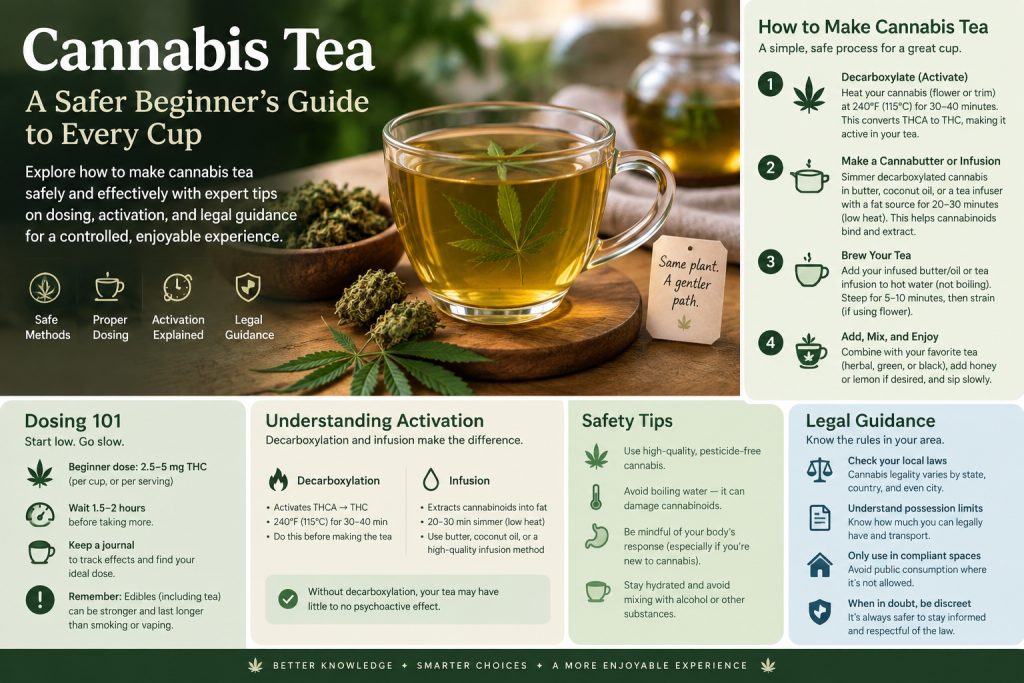
Cannabis tea sounds wonderfully simple: add cannabis to hot water, wait a few minutes, and settle in with your favourite mug. Unfortunately, cannabinoids don’t behave like Earl Grey. THC and CBD dissolve poorly in water, raw flower may need heat activation, and homemade potency can be surprisingly difficult to calculate. Your soothing cup can hence do very little, or considerably more than you planned.
This guide explains what cannabis tea is, how it works, and how to prepare a single serving with a clearly labelled, beverage-compatible cannabis product. It also covers the less predictable flower method, dosing, onset, side effects, storage, and legal considerations. The focus is harm reduction rather than maximizing potency.
You’ll find an important distinction throughout: research into cannabinoids is not necessarily evidence for cannabis tea itself. Some cannabinoid medicines have established clinical uses, but claims about an ordinary homemade brew curing pain, anxiety, insomnia, or other conditions often run well ahead of the science.
If you’re of legal age in your province or territory and you decide to try it, think of your first cup as a cautious experiment, not a challenge. Check the label, measure one serving, avoid mixing it with alcohol, and give the effects plenty of time to develop. Anyone who is pregnant, breastfeeding, taking interacting medication, managing a significant medical condition, or prone to severe cannabis reactions should speak with a qualified healthcare professional first. And yes, the charming mug with “World’s Best Parent” printed on it still needs to stay far away from children and pets.
Key Takeaways
- Cannabis tea is a beverage infused with cannabinoids like THC or CBD, offering a smoke-free consumption alternative but requiring careful dosing due to delayed and prolonged effects.
- Effective cannabis tea preparation depends on proper activation (decarboxylation) and fat-based extraction since cannabinoids dissolve poorly in plain water.
- Using labelled, beverage-compatible cannabis products ensures more accurate dosing compared to homemade flower teas, which have unpredictable potency.
- Start with a low dose (1–2.5 mg THC), wait at least two hours to gauge effects, and avoid redosing prematurely to prevent accidental overconsumption.
- Be aware of side effects such as drowsiness, anxiety, and impaired coordination, and avoid cannabis tea if pregnant, breastfeeding, or taking interacting medications without medical advice.
- Store cannabis tea securely away from children and pets, and only purchase from licensed sources to ensure safety, quality, and legal compliance.
What Is Cannabis Tea?
Cannabis tea is a hot or cold beverage containing cannabis-derived compounds, usually THC, CBD, or both. It may be prepared with a regulated liquid infusion, an infused tea bag, water-soluble powder, tincture intended for beverages, or cannabis plant material.
Unlike smoking or vaping, drinking cannabis doesn’t expose your lungs to smoke or aerosol. That doesn’t make it risk-free, though. Swallowed THC generally arrives more slowly and lasts longer, which makes accidental overconsumption easier if you refill your cup too soon.
The name can also be misleading. Some products are true tea made with Camellia sinensis; others are caffeine-free herbal infusions flavoured with mint, hibiscus, or ginger.
THC Tea vs. CBD Tea vs. Hemp Tea: Key Differences
| Type | Typical contents | Intoxicating? | Main caution |
|---|---|---|---|
| THC tea | Delta-9 THC, sometimes with CBD | Yes | Delayed, prolonged impairment |
| CBD tea | Mostly CBD, possibly trace THC | Usually not | Interactions and mislabelled products |
| Hemp tea | Hemp leaves, flowers, or extract | Depends on composition | “Hemp” doesn’t guarantee THC-free |
THC can alter perception, coordination, judgment, and heart rate. CBD doesn’t usually cause a high, but it can cause drowsiness, diarrhea, or medication interactions. “Hemp tea” is a legal or marketing category, not a reliable description of effect. Read the cannabinoid panel rather than relying on the front of the package.
Cannabis Leaves, Stems and Flowers: How Ingredients Affect Potency
Cannabis flower contains far more cannabinoid-rich resin than fan leaves or bare stems. So, tea made mainly from stems or leaves is often weak and erratic. Fresh, unheated material also contains substantial cannabinoid acids such as THCA and CBDA rather than only active THC and CBD.
Strain names aren’t dependable dosing tools. Two jars labelled “Blue Dream,” for example, can have different laboratory results, storage histories, and cannabinoid profiles. Even labelled flower doesn’t reveal how efficiently your kitchen process will extract those compounds.
For beginners, a tested product listing milligrams per serving is substantially easier to control than a pinch of flower judged by eye.
How Cannabis Tea Works: Activation and Extraction
Making effective cannabis tea involves two separate jobs: activation and extraction. Activation converts cannabinoid acids into their more familiar neutral forms. Extraction moves cannabinoids out of plant material and into something your body can consume.
Heat alone doesn’t guarantee both jobs happen efficiently. Briefly pouring boiling water over raw cannabis may provide heat, but water is a poor solvent for oily cannabinoids. That’s why a conventional five-minute tea steep is unreliable.
What Decarboxylation Does, and When It Is Needed
Decarboxylation removes a carboxyl group from compounds such as THCA, creating THC through heat and time. Raw cannabis isn’t necessarily inert, but unheated THCA generally doesn’t produce the classic THC high.
Commercial beverage drops, powders, oils, and tinctures typically contain already activated cannabinoids. Check the directions; heating them again is usually unnecessary. Raw flower generally requires controlled decarboxylation before extraction if active THC is the goal.
Kitchen decarboxylation is imprecise. Oven temperature swings, moisture, grind size, and heating time all affect conversion, while excessive heat can degrade cannabinoids. Avoid copying an aggressive “maximum strength” internet recipe, especially if you can’t verify the final dose.
Why Cannabinoids Resist Water: Fat-Based Infusions vs. Water-Dispersible Products
THC and CBD are lipophilic: they associate more readily with fats than with plain water. Traditional recipes hence use whole milk, coconut milk, butter, or oil as an extraction carrier. Simply floating oil on tea, though, can distribute the dose unevenly; the final gulp may become the strongest.
Commercial “water-soluble” cannabis isn’t literally changing THC into a naturally water-loving molecule. Manufacturers commonly use emulsions or encapsulation technology to disperse tiny droplets throughout a beverage. These products mix more consistently and may take effect faster than traditional edibles.
Only use a product whose label explicitly permits beverage use. Concentrates designed for dabbing or inhalation don’t belong in your teapot.
How to Make Cannabis Tea at Home
The most predictable home method starts with an accurately labelled cannabis infusion, not loose flower. Before preparing anything, confirm that you’re of legal age in your province or territory and allowed to possess and consume cannabis where you are. Follow the manufacturer’s serving instructions even if they differ from this general framework.
A useful house rule: prepare one cup at a time. A family-sized pitcher makes dose tracking harder and creates a tempting look-alike beverage in the refrigerator.
Ingredients, Equipment, Prep Time and Single-Serving Yield
For one serving, gather:
- One tea bag or 1 teaspoon loose tea
- 250–350 mL (8–12 oz) hot water
- One measured dose of a licensed, beverage-compatible infusion
- A mug, kettle, spoon, and proper measuring device
- Optional milk, honey, lemon, ginger, or mint
Prep time: about 5–10 minutes Yield: one clearly identified serving
Use the calibrated dropper, sachet, or measuring cap supplied with the product. Kitchen teaspoons are poor tools for tiny quantities, and “one dropper” may not equal one full millilitre. If the package is ambiguous, ask the licensed retailer or manufacturer before using it.
Step-by-Step Recipe Using a Labelled, Beverage-Compatible Cannabis Infusion
- Read the full label. Confirm THC and CBD per serving, expiry or packaging date, and beverage instructions.
- Choose your dose before brewing. For THC, a beginner may consider 1–2.5 mg; don’t exceed public-health guidance.
- Brew the base tea according to its package directions.
- Add the measured infusion at the stage specified by its manufacturer. Some emulsions are added after brewing.
- Stir thoroughly. Stir again before each sip if separation appears.
- Label your mug if other people are nearby, then put the cannabis container away immediately.
- Sip slowly and record the dose and time.
Don’t add another dose because nothing happened during the first episode of your show. Edible THC moves on its own schedule.
Using Cannabis Flower Instead: Preparation, Extraction and Potency Uncertainty
Flower tea usually requires decarboxylating the flower, then gently heating it with a fat-containing liquid before straining it. But a responsible recipe can’t promise an exact dose from flower alone. Laboratory potency represents the starting material, not what reaches your mug.
For perspective, 0.1 gram of flower labelled 20% THC contains a theoretical 20 mg THC before accounting for incomplete conversion, extraction loss, and leftover material. Even modest efficiency could produce more than a beginner intends.
If you still choose flower, weigh it with a suitable scale, use tested material, avoid boiling it violently, mix the batch thoroughly, and begin with only a small portion. Never estimate by “a small bud.” For repeatable dosing, licensed measured products win this round, comfortably.
Flavour Variations: Mint, Ginger, Rose and Lavender
Cannabis can taste grassy, bitter, or resinous. Flavouring helps, but don’t let a delicious cup disguise how much THC you’ve consumed.
- Mint: Add fresh spearmint and lemon for a clean finish.
- Ginger: Simmer sliced ginger in the water before brewing; it brings warmth without caffeine.
- Rose: Use culinary-grade dried petals sparingly with black or herbal tea.
- Lavender: A tiny culinary-grade pinch is enough. Too much tastes like a linen drawer; I learned that lesson so you don’t have to.
Avoid essential oils unless a product is specifically food-grade and directed for internal use. If your infusion contains fat, chai spices or cocoa usually complement it better than delicate green tea.
Cannabis Tea Dosing: Understanding Milligrams per Cup
Dose refers to milligrams of each cannabinoid in the entire serving, not the drink’s volume. A 475 mL (16 oz) mug containing 5 mg THC has the same total THC as a 125 mL (4 oz) drink containing 5 mg, unless you consume only part of it.
For beginners, lower-dose tea provides more room to assess sensitivity. In Canada, a legal edible or cannabis beverage can contain up to 10 mg THC per container, but that amount may feel intense to someone without tolerance. A package serving is not automatically your ideal serving.
Reading THC and CBD Labels, and Why Homemade Strength Is Hard to Predict
Look for both milligrams per unit and milligrams per package. A bottle marked “100 mg THC” may contain ten 10 mg servings rather than one serving. Also check whether a label lists THC, THCA, total THC, CBD, and serving volume separately.
Try this simple calculation:
Total milligrams consumed = milligrams per millilitre × millilitres used
If a 30 mL bottle contains 60 mg THC, each millilitre contains 2 mg THC, assuming the contents are homogeneous and the label is accurate.
Homemade flower tea is harder to calculate because decarboxylation, extraction, straining, and separation introduce losses. Treat online potency calculators as estimates, not lab reports.
Start Low, Go Slow: Avoiding Premature Redosing
If you’re new to THC, consider starting with 1–2.5 mg and waiting at least two hours; some public-health authorities recommend waiting longer before taking more because full effects may be delayed. Follow Health Canada guidance and product instructions.
Set a phone note with the time, dose, food consumed, and how you feel. That tiny log is more useful than relying on memory after an unexpectedly strong cup.
Don’t redose merely because a friend felt something sooner. Body size alone doesn’t predict response, and tolerance varies widely. Choose a calm setting, clear your schedule, and arrange safe transportation before drinking, not after.
Cannabis Tea Effects: Onset, Peak and Duration
Cannabis tea generally behaves more like an edible than inhaled cannabis, although rapid-onset emulsions may blur that distinction. Swallowed THC is processed through the digestive system and liver, where some is converted to 11-hydroxy-THC, an active metabolite associated with potent, longer-lasting effects.
Effects may include relaxation, altered time perception, sleepiness, increased appetite, impaired coordination, dry mouth, or anxiety. Your response can differ from one occasion to the next.
Will Cannabis Tea Get You High? THC, CBD and Individual Responses
Tea containing enough active THC can absolutely get you high. Tea made from plain water and raw stems may not, but unpredictability isn’t proof of safety. A properly formulated commercial THC drink can be strongly intoxicating even when it tastes like ordinary iced tea.
CBD-dominant tea usually doesn’t cause the classic high, although trace THC may matter to sensitive users or drug testing. CBD can still affect alertness and medications.
Genetics, tolerance, dose, age, metabolism, and prior cannabis experience influence the outcome. If you have previously experienced panic, paranoia, psychosis, or severe dizziness with cannabis, don’t assume tea will be gentler.
How Long Effects Can Take, and Why Formulation, Food and Tolerance Matter
Traditional swallowed products may begin working in roughly 30 minutes to two hours, sometimes longer. Effects can peak several hours after consumption and persist for six hours or more; residual impairment may last longer after a high dose.
Water-dispersible formulations may act sooner because they’re engineered for faster absorption. Food also changes the picture. A large meal can delay onset, while dietary fat may increase cannabinoid absorption. Frequent users may feel less from the same dose because of tolerance, but escalating quickly raises risk.
Your safest assumption is that the cup hasn’t “failed” just because the first hour feels quiet. Keep the evening free and don’t drive.
Potential Benefits of Cannabis Tea: What the Evidence Supports
People choose cannabis tea because it avoids inhalation, allows discreet consumption, and can fit into a familiar evening ritual. A measured beverage may also be easier to swallow than a capsule. Those are practical advantages, not proof that the tea treats disease.
Cannabinoid evidence varies significantly by compound, dose, formulation, and condition. The strongest findings for standardized cannabinoid medicines shouldn’t be transferred automatically to homemade beverages.
Pain, Anxiety and Sleep: Cannabinoid Research vs. Tea-Specific Evidence
Reviews from the National Academies found evidence supporting cannabinoids for certain chronic pain outcomes, but effect sizes and products vary. Prescription cannabinoid medicines also have specific indications, including particular seizure disorders, not general wellness use.
Evidence for anxiety and sleep is mixed. CBD has shown promise in selected settings, while THC can reduce anxiety for some people and worsen it for others, especially at higher doses. Sleepiness isn’t identical to healthier sleep architecture, either.
Crucially, there’s little high-quality clinical research on cannabis tea as a distinct preparation. If pain, anxiety, or insomnia is persistent, seek medical evaluation rather than using tea to mask an undiagnosed problem.
Side Effects, Interactions and Who Should Avoid Cannabis Tea
Cannabis tea’s gentle appearance can lower your guard. Yet THC beverages can cause the same adverse effects as other edibles, and delayed onset can make them harder to manage. Use cannabis only where it is allowed, with trusted adults nearby if you’re inexperienced, and without responsibility for driving, childcare, cooking over an open flame, or operating machinery.
Common Adverse Effects, What to Do If You Feel Unwell and When to Seek Help
Common problems include dry mouth, red eyes, dizziness, nausea, sleepiness, rapid heart rate, poor coordination, confusion, anxiety, and paranoia.
If you feel uncomfortably high:
- Stop consuming cannabis and alcohol.
- Move somewhere quiet and safe.
- Sip water, breathe slowly, and ask a trusted sober person to stay with you.
- Don’t drive or attempt to “walk it off” alone.
Call 911 for chest pain, trouble breathing, seizure, loss of consciousness, severe agitation, persistent vomiting, dangerous behaviour, or possible poisoning. In Canada, you can also call your local poison centre at 1-844-POISON-X (1-844-764-7669) (in Quebec, 1-800-463-5060) for confidential guidance.
Medication Interactions, Alcohol and Driving Risks
Cannabinoids can interact with medicines metabolized by liver enzymes and may amplify sedation. Particular caution is warranted with blood thinners, seizure medicines, sedatives, sleep aids, some antidepressants, and drugs with narrow therapeutic ranges. CBD is not interaction-free simply because it isn’t intoxicating.
Alcohol plus THC can intensify impairment, nausea, dizziness, and poor judgment. Skip the “cannabis hot toddy.”
Driving after THC is unsafe and a criminal offence in Canada if you’re impaired or have 2 ng or more of THC per mL of blood within two hours of driving. Coffee, cold showers, and confidence don’t restore reaction time. Since beverage effects can outlast the obvious high, wait until you’re completely sober and comply with the law; when uncertain, arrange another ride.
Pregnancy, Breastfeeding and Health Conditions Requiring Medical Advice
Health Canada advises that the safest choice is not to use cannabis during pregnancy and breastfeeding because THC can reach the fetus and pass into breast milk. “Natural” doesn’t create an exemption.
Get medical advice before using cannabinoids if you have heart or liver disease, low blood pressure, a seizure disorder, a substance-use disorder, or a personal or family history of psychosis or bipolar disorder. THC may increase heart rate and can provoke severe psychiatric symptoms in susceptible people.
Older adults may face greater fall and interaction risks. Children and pets should never receive cannabis tea unless a licensed clinician has prescribed an approved product for the patient; ordinary household tea isn’t a medical substitute.
Buying Cannabis Tea vs. Making Your Own
A regulated cannabis beverage usually costs more than a homemade brew, but you’re paying partly for consistency, testing, packaging, and a measurable dose. Homemade flower tea offers flavour control and may use material you already possess, yet its potency can swing from cup to cup.
| Option | Main advantage | Main drawback | Best fit |
|---|---|---|---|
| Licensed ready-to-drink tea | Convenient, tested serving | Higher cost; limited flavours | Beginners seeking predictability |
| Beverage drops or powder | Flexible dose and flavour | Requires careful measuring | People who want customization |
| Homemade flower tea | Full ingredient control | Uncertain extraction and strength | Experienced, cautious users |
No affiliation or paid relationship influences these recommendations. Brand availability and formulation vary by province and territory.
Choosing Licensed Sellers: Potency Labels, Ingredients and Lab Testing
Buy from a licensed dispensary or authorized retailer rather than an anonymous social-media seller. Packaging should identify THC and CBD per serving and package, ingredients, allergens, batch or lot number, manufacturer, testing details, and a packaging date (an expiry date is optional on Canadian labels).
Check sugar, caffeine, emulsifiers, and major allergens, not just cannabinoids. US brands you may have seen online, such as Cann, Pabst Labs, or Keef, aren’t necessarily sold in Canada, and formulas change. A familiar logo doesn’t replace reading the current label.
Avoid products making disease-cure claims or mimicking children’s candy and drink brands. If a QR code links to testing, confirm that the certificate matches the exact batch.
How to Store Cannabis Tea Safely Away from Children and Pets
Store cannabis products locked, elevated, and out of sight in their original child-resistant packaging. Refrigerated tea should sit in a locked container, not beside ordinary lemonade, where a sleepy roommate could make a memorable mistake.
Label homemade servings with “CANNABIS, DO NOT DRINK,” cannabinoid dose, preparation date, and owner’s name. Don’t use a juice bottle, branded soda container, or a child’s cup. Refrigerate per ingredient and manufacturer guidance, and discard old drinks rather than assuming cannabinoids preserve them.
Pets can become seriously ill from THC. If a child or animal may have consumed cannabis, don’t wait for dramatic symptoms. For a child, call your local poison centre at 1-844-POISON-X (1-844-764-7669) (in Quebec, 1-800-463-5060); for a pet, call your veterinarian or an animal poison-control service. Be honest about the product and estimated dose; accurate information helps treatment.
Is Cannabis Tea Legal? Check Provincial THC, Hemp and Purchase Rules
Cannabis laws differ by country, province, territory, and city, and they change. In Canada, adults can buy and possess cannabis under the federal Cannabis Act, but provinces and territories set the minimum age (19 in most, 18 in Alberta, and 21 in Quebec) and decide who can sell it and where you can use it. Adults can carry up to 30 grams of dried cannabis, or the equivalent, in public. Rules may also restrict home preparation, public consumption, delivery, and where products can be purchased.
Hemp doesn’t create a loophole in Canada. CBD and the leaves and flowers of hemp are regulated as cannabis under the Cannabis Act, and Health Canada treats intoxicating cannabinoids such as delta-8 THC as cannabis too. Taking any cannabis product, including CBD, into or out of Canada is illegal, even if you’re travelling somewhere it’s legal.
Check current government sources for your province or territory before buying or brewing. Also review housing, workplace, school, immigration, and professional-licence policies. Legal possession doesn’t necessarily protect you from drug-testing consequences, or permit you to drink cannabis tea in public.
Frequently Asked Questions About Cannabis Tea
Cannabis drinks invite deceptively simple questions. The answers usually depend on formulation, dose, and local law rather than the word “tea” printed on the package.
Can You Make Cannabis Tea Without Butter, Milk or Oil?
Yes. A commercial water-dispersible powder, emulsion, or beverage-compatible tincture may mix into tea without added dairy or oil. Follow its directions because products vary.
Plain hot water poured over cannabis flower is unlikely to extract cannabinoids efficiently. You might obtain flavour and some plant compounds, but strength will be inconsistent. Alcohol-based tinctures may disperse imperfectly and can retain alcohol; never use extracts intended for inhalation.
If you avoid dairy, full-fat coconut or oat products can work in traditional preparations, though their fat content varies. Remember that adding fat doesn’t solve inaccurate dosing; it only changes extraction and absorption.
Why Didn’t My Cannabis Tea Have a Noticeable Effect?
Possible explanations include a low dose, poor water extraction, insufficient decarboxylation, degraded material, high tolerance, slow digestion, or a CBD-dominant product that wasn’t intended to intoxicate. You may also have expected immediate effects based on smoking.
Don’t respond by rapidly adding more. Note the dose, wait according to the product and Health Canada guidance, and avoid combining servings from different products. On another day, verify the label and measuring tool before making a small, deliberate adjustment.
If a regulated product repeatedly differs from its stated performance, contact the retailer or manufacturer with the lot number. Don’t keep escalating an unknown homemade batch; that’s how a quiet cup becomes an eight-hour plot twist.
Does Cannabis Tea Contain Caffeine?
Cannabinoids don’t contain caffeine. Your drink will have caffeine only if its tea base or added ingredients contain it. Black tea, green tea, white tea, yerba mate, and guayusa are common sources; peppermint, chamomile, rooibos, rose, and most fruit infusions are naturally caffeine-free.
Check the package because blends can be sneaky. Caffeine may worsen THC-related racing heart, shakiness, or anxiety in sensitive people, while a high-THC drink may still impair you even while making you feel alert.
Eventually, the safest cannabis tea is the one you can measure, identify, store securely, and use legally. Start with a licensed low-dose formulation, wait patiently, and write down your response. If the label is unclear or your health situation is complicated, pause and ask a pharmacist or clinician. Your mug should deliver a calm ritual, not a chemistry pop quiz.