
Cannabis
How to Make Cannabis Oil: 3 Safe, Reliable Methods
Nov
Making cannabis oil at home isn’t especially complicated. The tricky part is keeping the temperature steady, controlling the unmistakable aroma, and calculating potency accurately enough that one teaspoon doesn’t send you into low-Earth orbit.
This guide shows you how to make cannabis oil using a double boiler, slow cooker, or sous vide setup. You’ll learn how to choose cannabis and carrier oil, decarboxylate THC- or CBD-rich flower, filter the finished infusion, estimate its strength, and store it safely.
The process covered here is a fat-based infusion, not a solvent extraction. You won’t need butane, ethanol, or specialized laboratory equipment, just cannabis, cooking oil, gentle heat, and patience.
Before starting, make sure you’re of legal age in your province or territory (19 in most of Canada, 18 in Alberta and 21 in Quebec). Canada’s Cannabis Act lets adults make cannabis food and drinks at home, as long as dangerous organic solvents aren’t used. Use legally obtained, laboratory-tested cannabis whenever possible, and keep your workspace ventilated. Homemade oil can be surprisingly potent, so label it clearly and store it somewhere children, pets, and unsuspecting housemates can’t reach. Nobody wants to discover that the “fancy pesto” was actually 20 milligrams per spoonful.
If this is your first batch, start small. Five grams of flower and one cup of oil will teach you the process without turning a minor temperature mistake into an expensive botanical tragedy.
Key Takeaways
- Making cannabis oil requires careful temperature control, with decarboxylation at 110–116°C (230–240°F) to activate THC or CBD and infusion between 71–82°C (160–180°F) to prevent degradation.
- Start with 5–7 grams of cannabis flower per cup of carrier oil for moderate potency and choose oils like MCT, coconut, or olive depending on intended use and shelf life.
- Use gentle infusion methods such as a double boiler, slow cooker, or sous vide to maintain consistent temperatures and control aroma during the oil-making process.
- Filter the infused oil carefully using cheesecloth or nut milk bags to remove plant material and ensure a clearer, longer-lasting product.
- Estimate potency by calculating THC or CBD content based on cannabis concentration and recovered oil volume, then dose cautiously starting with low amounts.
- Store cannabis oil in airtight, amber glass containers refrigerated or frozen, label clearly, and keep out of reach of children and pets to ensure safety and maintain quality.
Key Takeaways (Time, Temperature, Smell Control, and Dosing Basics)
Successful cannabis oil depends more on controlled heat than brute-force cooking. High temperatures don’t make the infusion stronger: they can degrade cannabinoids, scorch plant material, and create a harsh, toasted flavour.
Keep these essentials nearby:
- Decarboxylation: Approximately 116°C (240°F) for 35–45 minutes for THC-rich flower: CBD-rich flower commonly needs 60–90 minutes.
- Infusion temperature: Keep the oil around 71–82°C (160–180°F). Avoid sustained temperatures above 93°C (200°F).
- Infusion time: Allow roughly 2–4 hours, depending on the method.
- Smell control: Use an oven bag, covered baking dish, sealed jar, or sous vide bath, plus kitchen ventilation.
- Cannabis-to-oil ratio: Begin with 5–7 grams of flower per cup of oil for manageable potency.
- Dosing: Calculate estimated milligrams, test a tiny serving, and wait before taking more.
Temperature matters more than squeezing every last minute from the process. Once properly decarboxylated cannabis has infused for several hours, extending the cook overnight generally adds bitterness, not magic.
What You Need to Make Cannabis Oil (Ingredients, Equipment, and Best Cannabis-to-Oil Ratios)
Gather everything before heating the cannabis. You’ll need dried cannabis, a carrier oil, a baking sheet or covered dish, parchment paper, a thermometer, a saucepan or chosen infusion appliance, and a fine strainer. Heat-resistant glass jars, gloves, and a silicone spatula are also useful.
For beginners, a practical ratio is:
| Desired strength | Cannabis | Carrier oil |
|---|---|---|
| Mild | 3.5 g | 1 cup |
| Moderate | 5–7 g | 1 cup |
| Strong | 10–14 g | 1 cup |
These ratios don’t guarantee a particular dose because cannabinoid percentages vary enormously. Seven grams of 10% THC flower and seven grams of 25% flower are very different batches.
Avoid grinding cannabis into powder. Break it into rice- to pea-sized pieces so oil can circulate while the filter still catches the plant material. Powder slips through cheesecloth and leaves you with swampy oil, technically usable, visually questionable.
Choosing flower vs. trim vs. kief (cost, potency, and flavour tradeoffs)
Flower is the easiest material to dose because packaged products usually display THC, CBD, or total cannabinoid percentages. It produces consistent oil with a recognizable strain flavour, although premium buds can make each batch expensive.
Trim costs less and works well for larger infusions. Its potency is often uncertain, and extra leaf matter can create a grassy, bitter taste. Use clean sugar leaves rather than fan leaves, stems, or damp material.
Kief is concentrated trichome powder. It offers higher potency with less chlorophyll and usually filters more cleanly. The catch? A small amount can produce very strong oil. Use a precision scale, not an optimistic pinch.
For a first attempt, choose laboratory-labelled flower containing moderate THC or a balanced THC-to-CBD ratio. Save the mystery trim bag for later, when you’re comfortable testing doses. Whatever you choose should be dry, free of visible mould, and legally sourced.
Carrier oil comparison: MCT, coconut, olive, avocado, sunflower (best use + shelf life)
Cannabinoids dissolve readily in fat, but each carrier behaves differently:
| Oil | Best use | Typical storage life after opening* |
|---|---|---|
| MCT | Droppers, capsules, drinks | About 1–2 years |
| Coconut | Baking, balms, capsules | About 1–2 years |
| Olive | Savoury food, dressings | About 6–12 months |
| Avocado | Cooking, sauces | About 6–12 months |
| Sunflower | Neutral recipes | About 6–12 months |
*Check the manufacturer’s date: heat, light, contamination, and the original oil’s freshness affect shelf life.
MCT oil stays liquid and has a neutral flavour, making it convenient for measured servings. Regular coconut oil becomes solid below roughly 24°C (76°F), which can help with capsules and topicals but frustrate droppers. Olive oil is flavourful and widely available: avocado oil tolerates culinary heat well. Sunflower oil tastes mild but can oxidize faster.
Choose a fresh, food-grade oil you already enjoy. Infusion cannot rescue a rancid bottle from the back of the pantry.
Step 1: Decarboxylate Cannabis (Exact Temps/Times for THC vs. CBD)
Raw cannabis primarily contains acidic cannabinoids such as THCA and CBDA. Decarboxylation uses heat to convert them into THC and CBD, making the resulting oil more predictably active when swallowed.
Preheat your oven and verify its temperature with an oven thermometer: household ovens can drift by 8–14°C (15–25°F). Break up the cannabis, spread it in a single layer, and use these starting ranges:
- THC-rich flower: 110–116°C (230–240°F) for 35–45 minutes.
- CBD-rich flower: 110–116°C (230–240°F) for 60–90 minutes.
- Balanced flower: About 116°C (240°F) for 45–60 minutes is a practical compromise.
Exact conversion depends on moisture, cannabinoid profile, particle size, and oven accuracy. Shake or gently stir the material halfway through for even heating.
If your package reports total THC rather than THCA, remember that laboratory labelling may already account for conversion. Save the label, you’ll need it for the potency estimate.
Oven decarb method + how to avoid over-drying/terpene loss
Line a rimmed tray with parchment, or place the cannabis in a heat-safe covered baking dish. A loose foil cover reduces airflow and odour without creating pressure. An oven-safe roasting bag can contain more aroma: never let plastic touch heating elements.
- Preheat the oven fully.
- Break cannabis into coarse pieces.
- Spread it evenly and cover loosely.
- Bake using the appropriate range above.
- Stir once, then cool before opening or transferring.
Properly decarboxylated cannabis usually becomes dry, lightly toasted, and green-brown, not black. Some aroma loss is unavoidable because terpenes are volatile. You can limit it by avoiding unnecessarily high heat, leaving buds coarse, and keeping the dish covered.
Don’t raise the oven to 150°C (300°F) just to finish faster. Think of decarboxylation like toasting nuts: there’s a narrow stretch between fragrant and “why is the smoke alarm participating?” Low, controlled heat wins.
Decarb troubleshooting: under-decarbed vs. burnt cannabis (signs and fixes)
Under-decarboxylated cannabis may remain bright green, moist, or flexible and produce weaker-than-expected oil. If you catch it before infusion, return it to a verified 110–116°C (230–240°F) oven in 10-minute increments. Appearance alone isn’t a laboratory test, though, so don’t keep baking solely because it isn’t brown enough.
Burnt cannabis looks very dark, smells acrid, and crumbles into charred dust. Unfortunately, you can’t restore degraded cannabinoids or terpenes. You may still infuse mildly over-toasted material, but expect an unpleasant flavour and uncertain potency. Discard anything genuinely blackened or contaminated with smoke residue.
Common causes include:
- An inaccurate oven thermostat
- Cannabis sitting against bare hot metal
- Material ground too finely
- Using convection without reducing heat
- Forgetting the timer, an old classic
When in doubt, lower the temperature and extend the time slightly. Record the settings that work in your oven.
How to Make Cannabis Oil (3 Infusion Methods)
Once the cannabis has cooled, combine it with your carrier oil. The goal is to keep the mixture warm enough for cannabinoids to move into the fat without frying the plant material.
All three methods below work. Your best choice depends on the equipment you own and whether odour, speed, or precision matters most.
For any method, make sure the oil fully covers the cannabis. Add a little more carrier oil if dry pieces remain above the surface. Stir occasionally when practical, monitor temperature with a probe thermometer, and never leave an open flame unattended.
A typical infusion takes two to four hours at 71–82°C (160–180°F). Longer isn’t automatically stronger. Very extended cooking extracts more chlorophyll and waxes, which can make the finished cannabis-infused oil darker and more bitter.
Never add water unless a specific method requires it, and keep steam or condensation out of the final container. Moisture shortens shelf life and raises the risk of microbial growth.
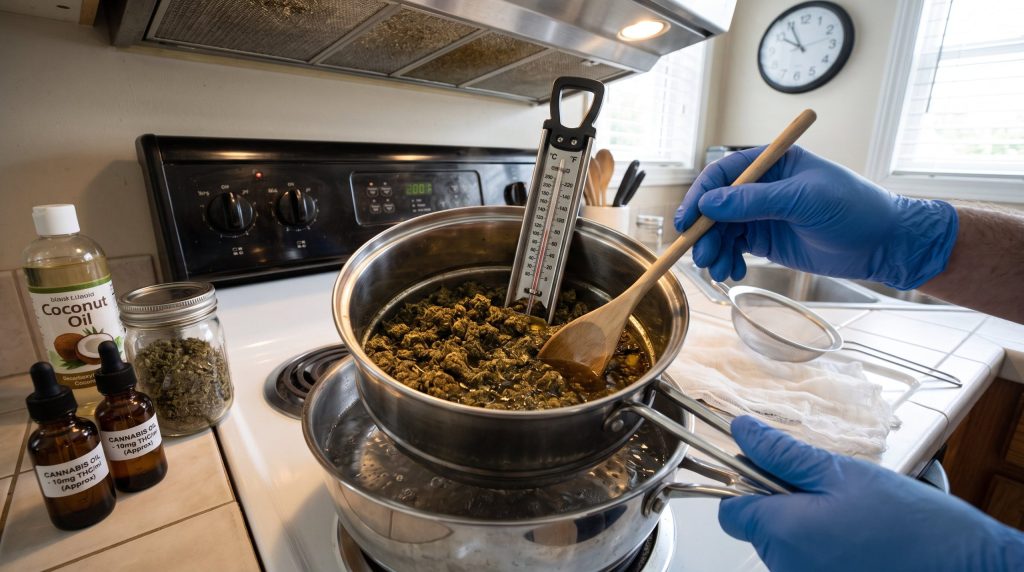
Method 1: Stovetop double-boiler infusion (fastest, best temperature control)
A double boiler gives you responsive temperature control without placing the oil directly over a burner.
- Add several inches of water to a saucepan and bring it to a gentle simmer.
- Place a heat-safe bowl or upper pan over the water. Its bottom shouldn’t touch the water.
- Combine decarboxylated cannabis and oil in the upper vessel.
- Hold the oil between 71 and 82°C (160 and 180°F) for 2–3 hours.
- Stir every 20–30 minutes and replenish evaporated water below.
Use low heat. If the carrier oil bubbles, sputters, or smells fried, it’s too hot. A clip-on thermometer makes this method far less stressful.
This is the quickest practical option, but it requires your presence. Condensation is the main nuisance: lift the lid away from the bowl so droplets don’t fall into the infusion. And keep pot handles turned inward, nobody needs a hot-oil plot twist.
Method 2: Slow cooker/crockpot infusion (set-and-forget, lowest risk of overheating)
A slow cooker is useful for larger batches, but the dial marked “Low” doesn’t promise a specific temperature. Test yours with water and a thermometer first: some Crock-Pot models run above 93°C (200°F) even on low.
Place the cannabis and oil in a heat-safe Mason jar, close the lid finger-tight, and set the jar on a folded kitchen towel inside the cooker. Add warm water around the jar without covering the lid. Maintain a water-bath temperature that keeps the oil near 71–82°C (160–180°F).
Infuse for 3–4 hours, gently swirling the jar every hour. Use tongs or heat-resistant gloves, and don’t move hot glass directly onto a cold countertop.
The jar limits odour and prevents water from mixing with the oil. It also reduces scorching along the cooker’s hot ceramic walls. Don’t seal the lid aggressively or use damaged glass: heating a tightly sealed, compromised jar is not the kind of kitchen science you want.
Method 3: Sous vide infusion (most consistent potency + best smell control)
Sous vide equipment provides the steadiest heat and usually the best odour control. Put the decarboxylated cannabis and carrier oil into a heat-safe jar or properly rated sous vide bag. If using a jar, close it finger-tight rather than wrenching it shut.
- Preheat the water bath to 79–85°C (175–185°F).
- Submerge the sealed container while keeping a jar lid above water when possible.
- Infuse for 3–4 hours.
- Swirl the contents once or twice.
- Remove carefully and let the container cool slightly before opening.
Place a rack or trivet beneath jars so they aren’t sitting against the circulator or base. For bags, double-seal the opening and clip it above the waterline.
This method costs more upfront, a basic Anova or Inkbird circulator often runs around US$70–$130, but it minimizes temperature swings. If cannabis aroma tends to travel through your building like neighbourhood gossip, sous vide is the discreet winner.
Strain, Filter, and Clarify Your Oil (Better Flavour, Longer Shelf Life)
Strain the oil while it’s warm and fluid, but not hot enough to burn you. Set a fine-mesh strainer over a clean glass measuring jug, line it with your chosen filter, and pour slowly. Let gravity do most of the work.
Pressing the plant material aggressively recovers more oil but also forces through chlorophyll, sediment, and bitter compounds. A gentle squeeze is a reasonable compromise. Wear food-safe gloves, the bundle can remain surprisingly hot.
Let the strained oil rest for 20–30 minutes. Fine particles will settle toward the bottom. You can carefully pour the clearer upper layer into a sanitized amber bottle, leaving the sediment behind.
Measure the final volume rather than assuming you recovered the amount you started with. Plant material and filters can hold several tablespoons. That smaller volume makes the finished oil stronger per teaspoon, so use the actual recovered volume in your potency calculation.
Fine filtering options (cheesecloth vs. nut milk bag vs. coffee filter) and yield tips
Cheesecloth drains quickly but may allow fine particles through. Fold it into two to four layers rather than using one loose sheet.
A nut milk bag is reusable, sturdy, and easy to squeeze gently. It’s often the best balance between clarity and yield for home batches.
A paper coffee filter produces clearer oil but drains painfully slowly, especially with coconut or olive oil. Filter while warm, replace clogged paper as needed, and expect some oil loss.
For better yield:
- Warm thick oil gently before filtering.
- Pre-wet a reusable filter with plain carrier oil.
- Scrape the bowl with a silicone spatula.
- Allow 10–20 minutes for passive draining.
- Avoid twisting the filter until it nearly tears.
If flavour matters more than maximizing every drop, don’t crush the spent cannabis. That last teaspoon often brings a disproportionate amount of bitterness. Compost or discard the solids securely where pets and wildlife cannot consume them.
Potency Calculator: How Strong Is Homemade Cannabis Oil?
You can estimate homemade potency, but you can’t confirm it without laboratory testing. Cannabinoid labels, decarboxylation, extraction efficiency, and uneven mixing all introduce uncertainty.
Use this basic framework:
Grams of cannabis × 1,000 × cannabinoid percentage × conversion factor × extraction efficiency = estimated total milligrams
Then calculate:
Total milligrams ÷ final oil volume = milligrams per millilitre
One teaspoon contains about 5 mL: one tablespoon contains about 15 mL. Dropper markings are more reliable than counting drops because drop size changes with the bottle and oil viscosity.
Treat the result as an upper-range estimate, not a promise. If you don’t know the cannabis percentage, safe calculation isn’t possible. Assume the batch’s strength is uncertain and test only a very small amount. Mixing the filtered oil thoroughly before bottling also helps prevent one container from being stronger than another.
Simple mg math using %THC/%CBD, grams used, oil volume, and estimated extraction loss
Suppose you use 7 grams of flower labelled 18% THCA and recover 200 mL of oil.
- Convert grams to milligrams: 7 × 1,000 = 7,000 mg.
- Find THCA content: 7,000 × 0.18 = 1,260 mg THCA.
- Account for conversion: 1,260 × 0.877 = 1,105 mg potential THC.
- Estimate 80% recovery: 1,105 × 0.80 = 884 mg THC in the batch.
- Divide by volume: 884 ÷ 200 = 4.42 mg/mL.
That equals approximately 22 mg per teaspoon. A beginner portion near 2 mg would be roughly 0.45 mL, not a casual spoonful.
If the label gives total THC, don’t apply the 0.877 factor again: total THC usually incorporates that conversion. Repeat the calculation separately for CBD. An extraction-efficiency estimate of 70–85% is practical, but home conditions vary, so always round cautiously and verify through conservative dosing.
How to Dose Homemade Cannabis Oil Safely (Beginner to Experienced)
Homemade cannabis oil should be measured, not poured with the breezy confidence you’d use for salad dressing. Individual responses vary with tolerance, body composition, recent meals, medications, and cannabinoid balance.
A cautious THC guide is:
- New or sensitive user: 1–2.5 mg
- Occasional user: 2.5–5 mg
- Experienced user: 5–10 mg
- Higher amounts: Only when you already understand your response
These aren’t medical prescriptions. CBD can also cause adverse effects and medication interactions, even though lacking THC’s typical intoxication.
Test a new batch at home on a low-responsibility day. Don’t combine it with alcohol or sedatives, drive, cook over an open flame, or supervise children while impaired. Write down the dose and time instead of trusting your memory later.
If someone becomes uncomfortably intoxicated, move them to a calm environment, offer reassurance and water, and for severe symptoms call 911 or your local poison centre at 1-844-POISON-X (1-844-764-7669) (in Quebec, 1-800-463-5060).
Start-low-go-slow guidelines, onset times (edible vs. sublingual), and re-dose timing
When swallowed with food, THC oil commonly takes 30 minutes to 2 hours to become noticeable, with effects sometimes intensifying beyond that point and lasting six hours or longer. A large meal can delay onset.
Oil held under the tongue may begin acting in roughly 15–45 minutes, although some is inevitably swallowed. Hold a measured amount there for 30–60 seconds before swallowing if sublingual use is intended.
For a new batch, take 1–2.5 mg THC and wait at least three hours before considering more. Beginners are better off ending the experiment and adjusting on another day rather than stacking doses. The classic mistake is saying, “I don’t feel anything,” taking more at minute 45, and then receiving both doses at once.
Increase future servings in small steps, about 1–2.5 mg at a time. Keep the same food conditions when comparing doses, and never estimate directly from an unmarked dropper.
How to Use Cannabis Oil (Cooking, Baking, Capsules, and Topicals)
Cannabis oil works best in foods that already contain fat. Stir measured portions into pesto, soup, yogurt, oatmeal, smoothies, or a finished sauce. For evenly dosed brownies or cookies, blend the infused oil thoroughly with the recipe’s other fats before adding dry ingredients.
Capsules provide convenient portioning when filled with a blunt-tip syringe and stored upright. Verify the capsule size: a size 00 capsule typically holds around 0.9 mL, but actual capacity depends on oil density and your filling technique. Coconut oil may solidify and reduce leaks.
For topical use, blend infused oil into an unscented balm and label it FOR EXTERNAL USE. Avoid broken skin, eyes, and sensitive areas. Topical preparations shouldn’t be assumed to treat pain or medical conditions, and transdermal products are different from ordinary homemade balms.
Whatever the use, calculate the entire recipe’s THC or CBD content, then divide by the number of equal servings.
Cooking temperature limits + when to add oil to protect potency
The oven’s setting isn’t necessarily the food’s internal temperature. Brownies baked at 175°C (350°F) contain moisture and usually remain far cooler inside, so infused oil can be used successfully in baking. Still, prolonged direct exposure to high heat can degrade cannabinoids and flavour.
For the gentlest treatment:
- Add oil near the end of soups, sauces, and sautés.
- Avoid deep-frying with cannabis oil.
- Don’t let it smoke in a skillet.
- Use low or moderate heat for reheating.
- Mix extremely well to distribute the dose.
If a recipe needs one cup of fat but your infusion is strong, use a measured amount of cannabis oil and make up the remainder with plain oil. For example, combine two tablespoons of infused MCT with 14 tablespoons of regular oil instead of making a pan of brownies that turns each square into a dare.
Mark infused dishes before refrigerating them, especially in a shared kitchen.
Storage, Shelf Life, and Food Safety (Prevent Rancidity and Mould)
Heat, oxygen, moisture, and light shorten the life of cannabis-infused oil. Transfer cooled oil into a clean, completely dry container with minimal headspace. Amber glass protects it better than clear plastic and doesn’t readily retain odours.
Refrigeration is the safest default for homemade oil. Depending on the carrier and sanitation, aim to use it within two to three months for best quality. Freezing can extend storage, but divide the oil into small portions so you aren’t repeatedly thawing the whole batch.
Discard oil that develops:
- A paint-like, sour, or crayon-like odour
- Visible mould or fuzzy growth
- Gas, unexpected bubbling, or a swollen lid
- Water droplets, unusual slime, or severe discolouration
Cloudiness or solidification alone isn’t always spoilage, coconut and olive oils naturally change texture when cold. When uncertainty remains, throw it away. Potency isn’t worth gambling with foodborne illness.
Best containers, fridge vs. freezer, labelling, and signs your oil has gone bad
Use a sanitized amber dropper bottle for daily portions and keep the larger supply in a sealed glass jar. This reduces repeated exposure to air and food particles. Make sure every container is fully dry before filling it.
Your label should include:
- “CANNABIS-INFUSED, CONTAINS THC” or CBD
- Preparation date
- Carrier oil
- Cannabis type and amount
- Estimated mg per mL and per teaspoon
- A clear child-and-pet warning
Store the bottle in a locked or child-resistant box, separate from ordinary ingredients. The refrigerator is convenient for current use: the freezer suits longer storage and pre-measured portions. Leave expansion space in glass containers before freezing.
Never store cannabis oil in a reused condiment bottle or beside regular olive oil. A sleepy roommate shouldn’t need forensic skills to make breakfast safely. If the product smells rancid, shows growth, or may have been contaminated by a wet utensil, discard it without tasting.
Safety, Risks, and Legal Notes (THC vs. Hemp-Derived CBD)
Cannabis rules vary by province and territory, municipality, and sometimes housing arrangement. Federal law lets adults make cannabis food and drinks at home without organic solvents, but public use, sharing limits, and legal age still apply, and taking cannabis into or out of Canada is illegal. Check current local rules before making cannabis oil, and never sell a homemade product: in Canada that’s illegal whether or not it’s tested.
THC can impair coordination, judgment, and reaction time. Keep it away from children and animals, don’t drive after using it, and avoid combining it with alcohol or sedating drugs. Cannabis may be inappropriate during pregnancy or breastfeeding and can interact with prescription medicines. Ask a qualified clinician or pharmacist if you have cardiovascular, psychiatric, liver, or medication concerns.
“Hemp-derived” doesn’t automatically mean risk-free, and in Canada CBD made from hemp is still regulated under the Cannabis Act, just like THC. CBD products may contain trace THC, affect drug tests, and interact with medicines metabolized by the liver. Product quality also varies, so choose batches supported by independent certificates of analysis.
You now have the full workflow: decarboxylate gently, infuse below 93°C (200°F), filter without excessive squeezing, calculate potency from the recovered volume, and test a tiny serving before committing to a full dose. Start with one small batch, document every temperature and measurement, and adjust only one variable next time. That modest notebook entry may be the difference between repeatable cannabis oil and an edible guessing game.
Frequently Asked Questions about Making Cannabis Oil
What is the best temperature and time to decarboxylate THC-rich cannabis for oil infusion?
Decarboxylate THC-rich flower at approximately 110–116°C (230–240°F) for 35–45 minutes. This process activates cannabinoids, making the oil more potent when consumed.
How can I control the smell while making cannabis oil at home?
Use an oven bag, covered baking dish, sealed jar, or a sous vide setup, combined with good kitchen ventilation, to manage and reduce the distinctive cannabis aroma during infusion.
What carrier oils work best for cannabis oil, and how do they differ?
MCT oil is neutral-flavoured and stays liquid, great for droppers and capsules. Coconut oil solidifies below 24°C (76°F), suitable for topicals. Olive, avocado, and sunflower oils have varying flavours and shelf lives; choose based on your intended use and flavour preference.
Can I use trim or kief instead of flower to make cannabis oil?
Yes, trim is less expensive but may taste grassy and is less consistent in potency. Kief offers higher potency and cleaner filtration but requires precise dosing due to its strength.
How do I estimate the potency of homemade cannabis oil?
Calculate potency by multiplying grams of cannabis by 1,000, cannabinoid percentage, a conversion factor (0.877 for THC), and an extraction efficiency (about 80%), then divide by the final oil volume to find mg per mL.
What are safe dosing guidelines for homemade cannabis oil?
Start with low doses: 1–2.5 mg THC for new users, 2.5–5 mg for occasional users, and 5–10 mg for experienced users. Wait at least three hours before re-dosing to avoid unintended effects.