Blog 2026
California Sober: Real Rules, Benefits, and Risks
Nov
You stop drinking, but you still use cannabis, or perhaps take psychedelics occasionally. Are you sober? California sober is the informal label many people use for this selective approach to substance use.
There’s no membership card, official rulebook, or universally accepted definition. For some people, it means replacing dangerous drinking with limited cannabis use. For others, it includes psychedelics, prescribed medication, nicotine, or caffeine. That flexibility can make the approach practical, but also confusing and controversial.
This review explains what California sober means, where the term came from, and how it differs from abstinence-based recovery. You’ll also learn about possible benefits, substantial risks, and practical safeguards. This is general educational information, not a diagnosis or treatment plan. If alcohol or drug use is affecting your health, safety, or relationships, discuss your options with a qualified clinician rather than relying on a trendy label.
Key Takeaways
- California sober is a selective sobriety approach where individuals avoid alcohol but may continue limited use of cannabis, and sometimes psychedelics or prescribed medications.
- This lifestyle choice emphasizes harm reduction by replacing harmful substances with lower-risk alternatives, but it requires clear personal boundaries to avoid misuse.
- California sober differs from abstinence-based recovery as it allows continued use of some intoxicants, which can be controversial and may not be considered ‘real sobriety’ in traditional recovery settings.
- Potential benefits include fewer hangovers, improved relationships, and better daily functioning, but risks involve dependence, impaired judgment, and legal or health consequences.
- Safe practice involves defining strict use limits, tracking effects on mood and behaviour, and having a relapse plan supported by professional or peer resources.
- It is critical to consult healthcare professionals for personalized advice, especially if there is a history of severe addiction, mental health issues, or safety-sensitive responsibilities.
What Does California Sober Mean?
Simple definition (selective sobriety) and how people use the label
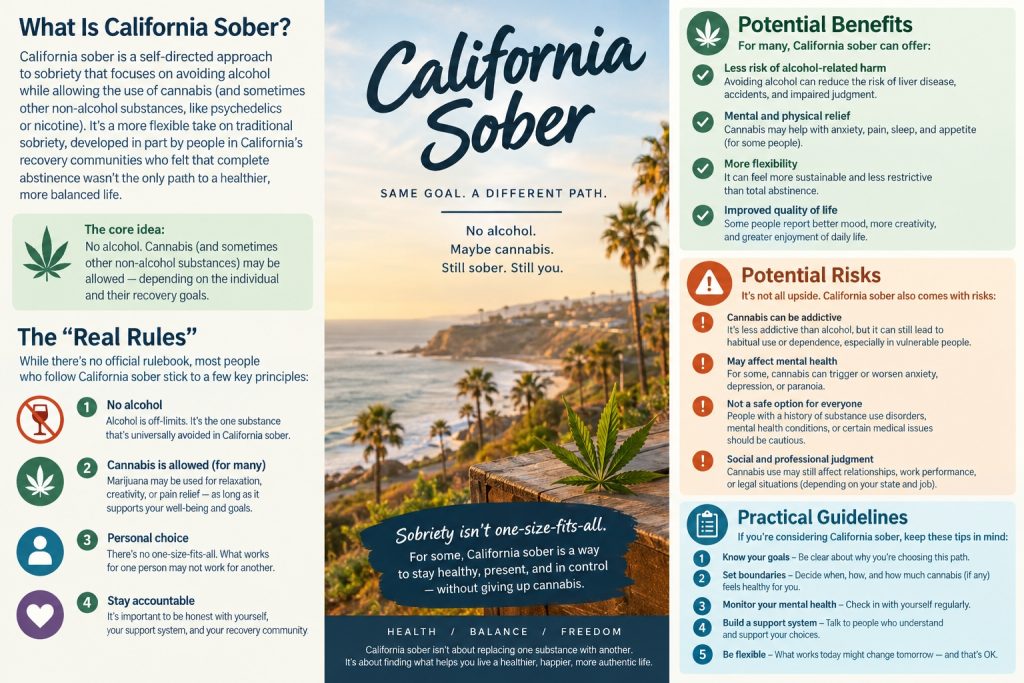
California sober generally means abstaining from certain substances while continuing to use others. It’s selective sobriety rather than complete abstinence. You might use the label to explain that you no longer drink alcohol but still consume cannabis, or that you avoid the drugs that caused serious harm while permitting lower-risk use.
Because California sober isn’t a clinical diagnosis, two people using the phrase may follow entirely different rules.
Common “rules” people mean (what’s avoided vs what’s allowed)
The most common arrangement looks like this:
- Avoided: alcohol, opioids, cocaine, methamphetamine, or another personally problematic drug
- Allowed: cannabis, caffeine, nicotine, and prescribed medication
- Sometimes allowed: psychedelics such as psilocybin, usually infrequently
Some people impose quantity and frequency limits. Others simply eliminate alcohol. If you don’t define your version clearly, however, the label can become a convenient loophole rather than a useful boundary.
California Sober Definition: What Substances Are Typically Included?
Alcohol-free but cannabis-allowed: the most common version
The best-known California sober definition is straightforward: no alcohol, but cannabis is permitted. Someone might order a nonalcoholic Athletic Brewing beer at dinner, then use a low-dose edible at home.
That doesn’t make cannabis harmless. THC can impair memory, coordination, and judgment, while frequent use can lead to cannabis use disorder. Potency matters too: today’s concentrates can be dramatically stronger than the marijuana implied by the laid-back label.
Does california sober include psychedelics? (common interpretations and caveats)
Sometimes. Certain interpretations allow occasional psilocybin, LSD, or other psychedelics, while stricter versions permit cannabis only. Psychedelics aren’t typically associated with compulsive use in the same way as alcohol or opioids, but they can still produce panic, dangerous behaviour, or prolonged psychological symptoms.
They may be especially risky if you have a personal or family history of psychosis or bipolar disorder. Clinical psychedelic research also involves screening, controlled doses, and professional supervision, not mystery mushrooms at a music festival.
Prescription meds, nicotine, caffeine: where many people draw the line
Most people don’t count coffee, nicotine, or appropriately used prescriptions as breaking California sobriety. But the details matter. Taking prescribed buprenorphine for opioid use disorder isn’t equivalent to misusing someone else’s alprazolam or Adderall.
Medication-assisted treatment is evidence-based healthcare, not a sobriety failure. Meanwhile, nicotine remains highly addictive, and enough caffeine can turn your peaceful morning into an unsolicited drum solo inside your chest.
Origin of the Term “California Sober”
Where the phrase likely came from and how it spread
The precise origin is murky. The phrase appears to have developed informally around West Coast wellness and recovery communities, where cannabis was culturally accepted, and medically legal, earlier than in much of the United States.
It spread through social media, podcasts, lifestyle journalism, and online recovery conversations. “Cali sober” offered convenient shorthand for a practice that already existed: quitting one substance without embracing total abstinence.
Pop culture and celebrity influence (including Demi Lovato references)
The term reached a much larger audience after Demi Lovato discussed being “California sober” following a near-fatal 2018 overdose. Lovato also released a 2021 song titled “California Sober,” framing moderation as a personal recovery choice.
Later that year, Lovato publicly shifted toward abstinence, writing that “sober sober” was the only way to be for them. That change captured the central issue: selective sobriety may feel sustainable at one stage, then prove unsafe or unhelpful later.
California Sober vs. Sober: Key Differences
Abstinence-based sobriety vs harm reduction vs moderation
These approaches overlap, but they aren’t interchangeable:
| Approach | Typical goal | Substance use |
|---|---|---|
| Abstinence-based sobriety | Eliminate intoxicating substances | None, apart from appropriate medication |
| Harm reduction | Reduce death, illness, and disruption | May continue under safer conditions |
| Moderation | Keep use within defined limits | Planned, limited use |
| California sober | Avoid selected substances | Cannabis or others may remain |
Harm reduction can include naloxone access, sterile supplies, or never using alone. California sober is a personal identity: harm reduction is a broader public-health framework.
Is california sober “real sobriety”? (why definitions differ)
That depends on what sober means in your setting. In everyday speech, it can simply mean “not currently intoxicated.” In Alcoholics Anonymous and many treatment communities, sobriety generally means abstinence from alcohol and other non-prescribed mind-altering drugs.
Your personal progress remains meaningful even if someone rejects your terminology. Still, calling yourself sober while concealing ongoing intoxication can create confusion, particularly with clinicians, employers, family members, or recovery peers.
Why California Sober Is Controversial (Especially in Recovery Circles)
Concerns about cross-addiction, relapse risk, and “substance substitution”
Critics worry that you may transfer compulsive behaviour from alcohol to cannabis, a pattern often called substance substitution or cross-addiction. Intoxication may also weaken judgment and reactivate familiar routines: one edible becomes several, then drinking suddenly sounds reasonable again.
Risk isn’t identical for everyone. But if you repeatedly lose control across multiple substances, swapping the container may not change the underlying cycle.
Why some people find it helpful: harm reduction, stability, and stepping-stone sobriety
For others, an all-or-nothing standard creates its own danger. If one slip is treated as total failure, a person may abandon every positive change. Selective sobriety can offer a realistic first step away from blackouts, withdrawal, fights, missed shifts, or risky sex.
You don’t need to pretend it’s perfect to recognize improvement. Going from daily vodka to no alcohol and occasional cannabis may reduce harm substantially, even if abstinence would carry fewer substance-related risks overall.
Potential Benefits and Risks of Going California Sober
Potential benefits (functioning, reduced harms, improved relationships, fewer hangovers)
If alcohol is your main problem, removing it may mean no hangovers, better mornings, fewer impulsive arguments, and more dependable work performance. You may also avoid alcohol-related poisoning, liver damage, and dangerous withdrawal cycles.
A practical example: instead of losing Sunday to nausea after Saturday bar-hopping, you attend brunch, remember the conversation, and actually keep that hiking plan. That visible return of time can be powerful.
Potential risks (increased use, dependence, mental health effects, impaired driving)
Cannabis can still cause dependence, anxiety, paranoia, cognitive impairment, and cannabinoid hyperemesis syndrome. High-THC products may aggravate psychosis risk in vulnerable people. Combining substances makes effects less predictable.
And no, cannabis doesn’t make you a magically superior driver. Health Canada warns that cannabis can slow reaction time and impair coordination. Don’t drive, cycle in traffic, or operate machinery while impaired.
Who Might Consider California Sober—and Who Should Avoid It
Situations where selective sobriety may be safer than “business as usual”
You might explore selective sobriety if alcohol or one particular drug causes clear harm, complete abstinence feels unreachable, and you’re willing to monitor the substances you continue using. It can also serve as a temporary bridge into treatment.
The key comparison is not California sober versus perfection. It’s California sober versus your likely alternative. A candid clinician can help you evaluate that difference without turning the appointment into a courtroom.
Red flags: history of severe substance use disorder, psychosis/mania risk, legal/work constraints
Avoid a do-it-yourself experiment, or seek professional guidance first, if you have:
- Severe or repeated substance use disorders
- Past psychosis, mania, or severe cannabis reactions
- Pregnancy or significant heart, liver, or psychiatric conditions
- Safety-sensitive work, drug testing, probation, or immigration constraints
- A pattern of driving impaired or mixing sedatives
Alcohol or benzodiazepine withdrawal can be life-threatening. If you use either heavily, don’t stop abruptly without medical advice.
How to Try California Sober Safely (Practical Guidelines)
Define your boundaries: what’s allowed, dosage/limits, frequency, and non-negotiables
Write your rules before cravings start negotiating like a tiny lawyer. Specify substances, product strength, dose, days, spending limits, and prohibited situations.
For example: “No alcohol or cocaine: cannabis only Friday or Saturday, maximum 5 mg THC: never before work, driving, childcare, or conflict.” Local laws still apply. Avoid unlabelled products of unknown strength, and store cannabis away from children and pets.
Track outcomes: cravings, sleep, mood, productivity, relationships
For four weeks, record use alongside sleep, mood, cravings, spending, work, and relationship friction. A notes app is enough. Ask someone you trust whether they’ve noticed changes, other people sometimes spot your “totally fine” phase before you do.
Watch trends rather than isolated evenings. Rising doses, secretive use, morning consumption, or repeatedly broken limits suggest the plan needs revision.
Create a relapse plan and support system (therapy, peer support, accountability)
Decide what happens after a warning sign: pause use, contact your therapist, attend a meeting, hand over car keys, or arrange a clinical assessment. Support options include SMART Recovery, LifeRing, Moderation Management, traditional 12-step groups, and addiction-focused therapy.
Keep naloxone available if opioids could appear in your environment. In Canada, Health Canada’s Get help with substance use page lists free services in every province and territory, including Drug Rehab Services (1-877-254-3348) for confidential treatment referrals.
California Sober in Real-Life Examples (What It Can Look Like Day-to-Day)
Example scenarios: social events, weekends, stress, and celebrations
At a wedding, you toast with sparkling water and skip the after-party joint because you’re driving. On a quiet Saturday, you take a measured edible after your responsibilities are finished. After a brutal workday, however, you call a friend rather than automatically getting high.
That last scenario matters. If every uncomfortable emotion requires a substance, your coping toolbox still has only one battered wrench in it.
How people talk about it online (tone, slang, and context)
Online, you’ll see “Cali sober,” “green sober,” or jokes about being “sober except for weed and mushrooms.” The tone may be playful, defensive, celebratory, or intentionally vague.
Don’t assume a meme describes a sound health plan. Ask what the person actually means: Which substances? How often? With what consequences? The label supplies social shorthand, not meaningful risk assessment.
Common Mistakes When People Say They’re California Sober
Vague rules, moving goalposts, and using the label to minimize problem use
The biggest mistake is having no measurable boundaries. “Only weed” can quietly become wake-and-bake use, high-potency concentrates, and nightly edibles. Another trap is changing the rules after every exception: psychedelics count, then special-occasion alcohol, then cocaine because it “wasn’t technically drinking.”
If your definition expands whenever use becomes inconvenient to examine, pause. The label may be protecting the behaviour rather than protecting you.
Ignoring tolerance/withdrawal, mixing substances, and driving impaired
Needing steadily larger doses, feeling irritable without cannabis, or repeatedly failing to cut back are potential dependence signs. Mixing cannabis with alcohol, opioids, benzodiazepines, or sedating prescriptions can amplify impairment and other harms.
Never use driving ability as a self-test. Feeling calm isn’t the same as having normal reaction time. Arrange a ride before consuming anything, not after your judgment has clocked out.
California Sober vs Related Terms
“Cali sober” vs “clean” vs “straight edge” vs “harm reduction” vs “moderation management”
Language can carry cultural baggage, so choose it thoughtfully:
- Cali sober: Shortened form of California sober: usually alcohol-free with cannabis allowed.
- Clean: Often means abstinent, though some dislike its implication that people who use drugs are “dirty.”
- Straight edge: A punk-rooted identity rejecting alcohol, tobacco, and recreational drugs: some followers also avoid other substances.
- Harm reduction: Strategies that reduce negative consequences without requiring abstinence.
- Moderation management: Structured limits intended particularly for people seeking to reduce alcohol use.
Your terminology matters less than honesty, safety, and whether the plan improves your life.
FAQ About California Sober
What does california sober mean in simple terms?
It means you avoid certain drugs, most commonly alcohol, while continuing to use cannabis or selected other substances. Your exact rules may differ because there’s no official definition.
Where did the term california sober come from?
Its creator isn’t definitively known. The phrase likely emerged from California’s cannabis-friendly wellness and recovery culture, then spread through media, social platforms, and celebrity discussion.
Does california sober include weed? What about psychedelics?
Usually, yes: cannabis is the substance most commonly allowed. Some people also permit occasional psychedelics, but others don’t. Neither option is risk-free, and psychedelics can be particularly dangerous for people vulnerable to psychosis or mania.
Is california sober a medical or clinical term?
No. It isn’t a diagnosis, treatment protocol, or standardized recovery category. A healthcare professional will need specifics about what you use, how much, how often, and with what effects, not merely the label.
Is california sober the same as being sober?
Not under most abstinence-based definitions. It may accurately describe freedom from alcohol or a particular drug, but it generally permits some intoxicating substance use. Be explicit when safety or treatment decisions depend on the answer.
Why is california sober controversial?
Supporters view it as flexible harm reduction that can make change achievable. Critics warn that continued intoxication may enable cross-addiction, relapse, or denial. Both concerns can be valid: the outcome depends on your health, history, boundaries, and behaviour.
The bottom line: California sober can reduce harm for some people, but it isn’t automatically safe, and it shouldn’t become camouflage for escalating use. Define your limits, track real-world consequences, and involve trustworthy support. If your rules keep shifting or life is shrinking around a substance, treat that as useful information, not personal failure. You can change the plan and ask for help.