
Blog 2026
What Does Weed Look Like? A Clear Visual Guide
Nov
You find a dried green clump in a bag, spot a suspicious plant behind the shed, or notice sparkly white material on a cannabis bud. Your first question is probably simple: what does weed look like? The answer is less simple because cannabis changes dramatically depending on its age, preparation, genetics, and condition.
Living cannabis typically has recognizable, palm-shaped leaves with serrated leaflets. Harvested marijuana flower looks more like a dense or airy cluster of curled leaves, tiny hairs, and crystal-like resin glands. Ground cannabis may resemble ordinary dried herbs, while concentrates can look like honey, glass, butter, or dark resin. Edibles offer even fewer clues, a THC gummy can look identical to regular candy.
This visual identification guide explains the features you can reasonably compare: shape, colour, pistils, trichomes, stems, seeds, leaf patterns, and signs of deterioration. The labelled descriptions work as a practical companion to photographs: use them to identify which structure you’re seeing rather than relying on colour alone.
One important boundary: appearance cannot prove that a substance is cannabis, reveal its THC concentration, identify a strain, or establish that it’s safe. Hemp flower and THC-rich marijuana may look virtually identical. Mold, pesticides, synthetic cannabinoids, and other contaminants also can’t be ruled out with a casual inspection. Laboratory testing is the only reliable way to establish chemical content.
So, think of this as visual orientation, not a home forensic test. If you find an unknown substance, especially around children or pets, leave it alone, secure the area, and follow the safety guidance near the end of this article.
Key Takeaways
- Weed typically appears as green, tan, or purple dried flower clusters with curled leaves, orange or brown pistils, and sparkling resin glands called trichomes.
- Visual identification includes examining bud shape, leaf patterns, pistils, trichomes, stems, and seeds, but appearance alone cannot confirm THC content, strain, or safety.
- Living cannabis plants have palm-shaped leaves with serrated leaflets and develop distinct flower clusters; immature plants are harder to identify accurately.
- Dried cannabis can resemble common herbs, so multiple features and context should be considered before assuming identity, especially to distinguish from hemp or lookalikes.
- Concentrates and edibles often lack visible cannabis cues, making labelling and testing essential for confirming cannabinoid content and safety.
- When finding unknown cannabis or plant substances, avoid handling or consuming, secure the area, and use professional testing or authorities for accurate identification.
What Does Weed Look Like? Quick Answer and Labelled Photos
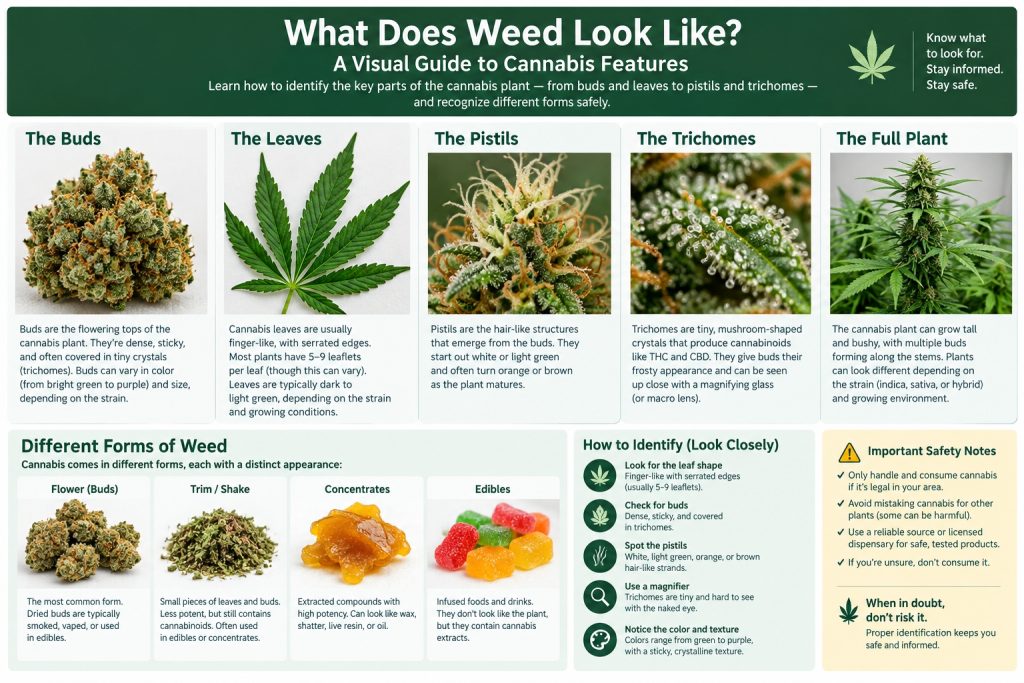
Weed most commonly appears as green, tan, or purple dried flower clusters made from the harvested flowering parts of a cannabis plant. A close view may reveal curled leaf fragments, orange or brown hairs, short stems, and a dusting of tiny resin glands that sparkle under direct light.
Use this quick visual key as you examine a clear, well-lit photo:
| Visual label | What you may see | What it means |
|---|---|---|
| Flower or bud | Dense nugget or loose botanical cluster | The dried flowering structure |
| Sugar leaf | Small, pointed leaf curling out of the flower | Leaf growing within or beside the flower |
| Pistil | Fine orange, red, cream, or brown strand | Part of a female flower’s reproductive structure |
| Trichome | Tiny clear, cloudy, or amber resin gland | Microscopic structure that contains cannabinoids and aromatic compounds |
| Stem | Firm tan or greenish twig | Supporting plant tissue |
| Seed | Hard, oval object, often tan or mottled brown | Mature cannabis seed, not a resin gland |
From across a room, dried cannabis can resemble oregano, hops, tea, or mixed dried herbs. Up close, the combined flower structure, pistils, serrated leaf pieces, and glandular coating are more informative. No single feature confirms identity. If all you have is a blurry photo, confidence should stay LOW.
What Dried Marijuana Buds Look Like Up Close
Dried marijuana buds, often called flower or nuggets, are the form many people picture when they hear “weed.” They aren’t smooth, uniform pellets. A bud is a layered botanical structure containing tightly grouped flowers, resin glands, small leaves, and sometimes a short stem.
Dispensary flower may be neatly trimmed into compact pieces. Home-grown or poorly trimmed material can look leafier and less regular. Handling and storage also matter: intact buds become flattened in tight packaging, while old or roughly handled flower can crumble into flakes.
Shape and Structure: Compact Nuggets or Loose Flower Clusters
Cannabis buds range from pea-sized pieces to clusters several centimetres long. Some are round and compact: others are elongated, pointed, or airy. Genetics influence the original structure, while growing conditions, trimming, compression, and humidity alter the final appearance.
Look for a layered, irregular surface rather than one continuous leaf. Small pointed leaf tips may overlap swollen flower parts, with fine hairs emerging between them. A central stem sometimes becomes visible where the bud has broken.
Density isn’t a dependable measure of strength. A tight nugget may simply reflect genetics or machine trimming, and loose flower isn’t automatically weak. Likewise, a perfectly rounded “golf ball” shape often says more about aggressive commercial trimming than chemical content.
Colours: Green, Purple, Brown, and Natural Variation
Dried weed is often olive, forest, lime, or grey-green, but natural variation is broad. Purple genetics and cool growing conditions can encourage anthocyanin pigments, producing violet, plum, or nearly black patches. Cream pistils and amber trichomes may give the surface a warmer cast.
Brown isn’t automatically bad. Mature pistils are commonly rust or brown, and cured flower can include tan areas. But widespread dull brown or grey colouration, especially with a stale texture, musty odour, or fuzzy growth, can indicate age, moisture damage, or deterioration.
Unnaturally vivid blue, neon colour, glitter, or an oily painted appearance deserves caution. Photographs can also distort colour through flash, filters, and white-balance settings. Compare multiple areas under neutral daylight before drawing conclusions.
Pistils: The Orange, Red, or Brown Hairlike Strands
The fine hairs woven through many buds are usually pistils, or more precisely the visible stigma portions associated with female flowers. Depending on maturity and genetics, they may appear white, pale yellow, orange, red, copper, or brown.
Pistils usually look like individual curling threads emerging from the flower. They’re thicker and more structured than mold filaments and generally don’t form a fuzzy blanket across the surface. Older dried flower may have darker, flattened pistils that are difficult to see without magnification.
A bud’s hair colour cannot identify its strain or potency. Internet folklore sometimes treats orange hairs like a THC meter: they aren’t. Pistil appearance reflects plant development and handling, while laboratory analysis is needed to measure cannabinoid content.
Trichomes: The Tiny, Sparkling Resin Glands
Trichomes are small resin-producing structures covering cannabis flowers and nearby leaves. To your unaided eye, dense trichomes can resemble frost, sugar crystals, or fine glitter. Under a jeweller’s loupe or macro camera, many glandular trichomes have a slender stalk topped by a rounded head, rather like microscopic mushrooms.
Their heads may look clear, cloudy, or amber depending on development, lighting, and storage. They reflect light as separate points instead of forming cottony strands. That distinction helps when comparing trichomes with possible mold, though it’s not a safety test.
A visibly frosty coating doesn’t automatically mean exceptional flower. Trichome density varies naturally, and visible glands can be damaged, old, or low in particular cannabinoids. Worse, contaminants or added powders may imitate frostiness. Don’t taste or inhale unknown material to investigate it.
Small Leaves, Stems, and Seeds: Other Visible Features
Tiny leaves tucked around a cannabis flower are commonly called sugar leaves because their trichome coating can make them look dusted with sugar. Their narrow tips and serrated edges may stick out after drying. Careful commercial trimming removes much of this leafy material, but some remains.
Stems are firmer, smoother, and usually tan, pale green, or brown. A small supporting stem is normal: an abundance of woody stems simply means less of the material is flower.
Cannabis seeds are hard, oval, and generally beige, brown, or mottled when mature. Immature seeds may be pale green or off-white. Seeds can appear when a female plant is pollinated. Their presence doesn’t establish whether the surrounding material contains THC, and a seed’s appearance can’t reliably predict the chemistry of any future plant.
What a Living Cannabis Plant Looks Like
A living cannabis plant looks quite different from a dried dispensary bud. It’s an upright annual herb with branching stems, distinct leaf nodes, and palmately arranged leaves. Mature outdoor plants can become taller than a person, while pruned indoor plants may remain short and bushy.
Plant shape alone isn’t conclusive. Light exposure, cultivar, crowding, pruning, and health can produce lanky, compact, sparse, or heavily branched growth. Identification becomes more reliable only after several mature leaves and flowers develop.
Cannabis Leaves: Serrated Edges and Fingerlike Leaflets
The classic cannabis leaf spreads outward like an open hand. Each mature leaf commonly has several narrow leaflets radiating from one point, often five, seven, or nine, although the number varies. The leaflets have pointed tips and conspicuous saw-toothed margins.
Leaf proportions differ. Some plants develop long, narrow leaflets: others have broad ones. Those differences aren’t a dependable shortcut for predicting an “indica” or “sativa” effect, even though they’re familiar retail labels. Hybridization and environmental effects make that visual rule overly simplistic.
Also compare how leaves attach to the stem, their vein pattern, and whether several mature leaves repeat the same palmate arrangement. One serrated leaf isn’t enough. Japanese maple, chaste tree, kenaf, and several garden plants can create a cannabis-like first impression, especially in a hasty phone photo.
Seedlings and Young Plants: Why Early Identification Is Harder
A newly emerged cannabis seedling begins with two smooth, rounded seed leaves called cotyledons. Its first true leaves may have just one serrated blade. Later sets gradually develop the familiar three-, five-, or multi-leaflet shape.
That awkward early phase is where confident internet identification often falls apart. Many seedlings share two cotyledons and a small pair of toothed leaves. Scale, image quality, and missing context make them easy to confuse.
If the plant is in a place where it can safely remain, observing later leaf sets may provide more information. Don’t handle or cultivate an unknown plant where doing so could violate local law. And wear gloves if contact is necessary for safety, unknown plants may cause irritation even when they aren’t cannabis.
Mature Plants: Branching Stems, Flower Clusters, and Pollen Sacs
Mature cannabis develops a central stem with repeated nodes where leaves and side branches emerge. Female flowers usually form clustered, resinous growth with visible pistils. Over time, these clusters can thicken into the buds recognized after harvest.
Male plants generally produce small, hanging pollen sacs arranged in groups. They may resemble tiny green balls or miniature oval pods and typically lack the prominent resinous flower clusters associated with female plants. Some plants can display both reproductive structures due to genetics or environmental stress.
Sex cannot always be judged from a distant image, especially before flowering. Nor can you determine whether a plant is legally defined hemp or marijuana by its leaves. In Canada, that distinction depends on THC concentration in the flowering heads and leaves under the Industrial Hemp Regulations, not a visible botanical feature.
Fresh vs. Dried and Cured Weed: Side-by-Side Visual Differences
Freshly harvested cannabis contains substantial moisture. It looks plumper, brighter, and more leaflike than cured flower, and its stems remain flexible. Drying removes water: curing then allows moisture to equalize under controlled storage. The flower shrinks, colours deepen, pistils curl inward, and the texture becomes firmer.
| Feature | Freshly harvested cannabis | Dried and cured flower |
|---|---|---|
| Colour | Often vivid green, with fresh white or cream pistils | Usually muted green, olive, purple, tan, or brown |
| Shape | Puffy, leafy, and moist-looking | Smaller, tighter, and more defined |
| Texture | Soft and flexible | Slightly springy to dry: may crumble with age |
| Stem | Green and bendable | Firmer, paler, and more likely to snap |
| Surface | Resinous but botanically fresh | Trichomes may appear more visibly frosted |
Fresh flower shouldn’t be confused with wet, improperly stored dried cannabis. Dried material that becomes damp in a sealed container can support microbial growth. Conversely, flower that turns to powder with minimal pressure may be excessively dry or old.
You can’t confirm correct curing by looking alone. Humidity history, internal moisture, microbial levels, and storage conditions aren’t fully visible. If unknown flower feels wet, smells musty, or shows suspicious patches, don’t use it.
What Weed Looks Like in Other Forms
Cannabis doesn’t always arrive as a recognizable green bud. Processing can turn it into flakes, powder, resin, brittle sheets, soft wax, liquid, capsules, drinks, or candy. Once that happens, visual identification becomes progressively less reliable.
Packaging can provide context, but it isn’t proof. Illicit products may imitate licensed brands, while transferred or homemade products may have no label at all. Treat any unidentified form as unknown rather than playing ingredient detective.
Ground Weed and Shake: Small Flakes and Loose Plant Material
Ground cannabis is usually a loose mixture of green, olive, tan, and brown plant particles. You may see tiny leaf fragments, crushed flower, pistil pieces, and trichome dust. Its texture can range from fluffy flakes to a coarse herbal grind.
“Shake” refers to small pieces that collect after flower is handled or stored. It may include fragments of bud and sugar leaf, but quality varies widely. Very fine material can resemble culinary herbs such as oregano, marjoram, or loose tea.
Once cannabis is ground, many identifying structures disappear. Colour isn’t enough, and smell only adds a clue. Don’t burn or taste a mystery herb to test it, that turns a visual question into an exposure.
Kief and Hash: Resin Powder and Pressed Blocks
Kief consists largely of separated trichomes. It commonly appears as a fine, dusty powder ranging from pale cream or blond to greenish tan. Greener material generally contains more plant fragments, but appearance alone doesn’t establish purity.
Hash is made by collecting and compressing resinous material. Depending on method and age, it may look like a crumbly blond cake, soft brown putty, dark green-brown block, or nearly black ball. Its surface can be matte, oily, or slightly glossy.
Unfortunately, powders and pressed blocks are visually nonspecific. Spices, pollen, herbal powders, waxes, and other drugs can look similar in a photograph. If there’s no trustworthy label or known source, don’t assume a tan powder is kief or a brown block is hash.
Concentrates and Vape Oils: Wax, Shatter, and Amber Liquids
Cannabis concentrates are named partly for their texture. “Shatter” often looks like thin, translucent amber glass. Wax or budder may resemble yellow-beige candle wax, whipped butter, or honeycomb. Crumble is drier and breaks apart, while sauce can contain liquid around visible crystals.
Vape oils commonly appear clear, gold, amber, or brown inside a cartridge. Darkening can occur with age, oxidation, heat, or formulation differences, but colour cannot tell you whether an oil is authentic, potent, or uncontaminated.
Many non-cannabis materials share these appearances. Counterfeit cartridges can also closely copy legitimate products. Health Canada advises avoiding cannabis vaping products from illegal or unregulated sources, where ingredients and manufacturing controls may be unknown.
Edibles: Why Appearance Alone Cannot Identify Cannabis Content
A cannabis brownie looks like a brownie. A THC gummy can be visually indistinguishable from a regular gummy, and infused chocolate, cookies, drinks, mints, and capsules may reveal nothing unusual. Even odour can be absent because refined extracts have little plant flavour.
That’s why packaging and storage matter so much. Regulated products in Canada must display total THC and CBD amounts, a yellow health warning box and, above a trace THC level, Health Canada’s standardized cannabis symbol. Packaging can still be forged or misunderstood.
Keep suspected edibles in a locked location, separate from ordinary food and inaccessible to children and pets. If someone may have eaten one and develops concerning symptoms, contact your poison centre at 1-844-POISON-X (1-844-764-7669; in Quebec, 1-800-463-5060). Call 911 for trouble breathing, collapse, seizure, or inability to wake.
Weed Lookalikes: What Can Be Confused With Cannabis?
Misidentification usually happens because someone anchors on one dramatic feature: a serrated leaf, herbal smell, purple colour, or “frosty” coating. Reliable comparison requires several independent traits and good context.
A living plant should be evaluated differently from dried material. For plants, inspect mature leaf arrangement, leaflet number, margins, branching, and flowers. For dried substances, compare flower structure, pistils, trichomes, stems, and packaging, without touching, tasting, or inhaling them.
Hemp and CBD Flower: Why They Can Look Like THC-Rich Marijuana
Hemp flower and THC-rich marijuana come from cannabis plants and can look, feel, and smell essentially the same. Both may have green or purple buds, orange pistils, sugar leaves, and abundant trichomes. Experienced users, growers, and police officers cannot consistently determine THC concentration by sight.
In Canada, industrial hemp is cannabis with 0.3% THC or less (by weight) in its flowering heads and leaves, grown under the Industrial Hemp Regulations. Products made from hemp flowers and leaves, including CBD, are regulated under the Cannabis Act like other cannabis. That chemical threshold isn’t painted on the plant.
A label that says “CBD” also isn’t laboratory verification. If legal classification or content matters, use documentation and qualified testing rather than visual confidence. This is the clearest example of why “looks like weed” and “is legally marijuana” are not equivalent statements.
Similar-Looking Plants and Dried Herbs: Compare Multiple Features
Japanese maple leaves may resemble cannabis from a distance, but they grow on a woody tree and have a different leaf structure. Chaste tree has palmately arranged leaflets, yet its growth habit and flowers differ. Kenaf, cassava, cleome, hops, and some young garden plants can also create fleeting similarities.
Dried oregano, mugwort, hops, sage, and mixed herbal smoking products may resemble ground cannabis. Hops are a particularly interesting cousin: both hops and cannabis belong to the Cannabaceae family and can share certain aromatic compounds, though hop cones don’t look like trimmed marijuana buds under close inspection.
Try a three-feature rule: compare overall structure, leaf or flower anatomy, and context. If only one matches, keep the identification tentative. Plant-identification apps can suggest possibilities, but their output isn’t proof, especially with blurry, wilted, or partial specimens.
What Moldy or Deteriorated Weed May Look Like
Cannabis can deteriorate through excess moisture, heat, light, oxygen, pests, or microbial growth. Warning signs may include grey-white fuzz, web-like material, unusual powdery patches, dark internal discolouration, slimy areas, or an unexpectedly musty smell.
Old flower may simply become dull, brown, brittle, and less aromatic without visible mold. Those changes still don’t reveal everything about safety. Contaminants such as pesticides, heavy metals, or microbes can be present without an obvious visual signal.
Possible Mold vs. Trichomes: Fuzzy Patches vs. Distinct Resin Glands
Under magnification, intact glandular trichomes tend to appear as repeated, discrete stalks with rounded heads. They sparkle as individual points and follow the flower’s surface. Suspected mold may look irregular, cottony, dusty, cobweb-like, or thread-forming, sometimes bridging gaps between plant structures.
But the distinction isn’t always tidy. Broken trichomes can look like powder, and some molds aren’t visibly fuzzy. Camera flash can make normal resin appear startlingly white: dense plant hairs can also confuse the picture.
Don’t scrape, sniff closely, or break apart suspicious material near your face. Disturbing mold may release spores. Seal it away from food, children, and pets, wash your hands after accidental contact, and follow local disposal rules.
Why Photos Cannot Confirm Mold, Contamination, or Safety
A photo records surface appearance under one lighting condition. It cannot assess microbial species, internal growth, pesticide residue, heavy metals, residual solvents, or synthetic additives. Even a sharp macro image doesn’t replace microscopy and accredited laboratory analysis.
People with asthma, allergies, weakened immune systems, or lung disease may face greater risks from contaminated inhaled material. When suspicious growth is present, the safe choice is not to consume it. Cutting away one patch doesn’t prove the remainder is unaffected.
If a licensed product appears contaminated, keep the package, batch number, receipt, and clear photographs. Contact the retailer or manufacturer and check Health Canada’s cannabis recalls. For symptoms after exposure, seek medical guidance rather than waiting for an online photo verdict, and you can report the side effect to Health Canada.
Visual Identification Checklist: Features to Compare and Limits to Remember
When you’re asking what does weed look like, slow down and compare the whole specimen. A single green colour or jagged leaf can send you confidently in the wrong direction.
For dried flower, check:
- An irregular, layered flower cluster rather than one flat leaf
- Small curled leaves with pointed, possibly serrated tips
- Orange, cream, red, or brown pistil-like strands
- Separate sparkling resin glands under magnification
- A small supporting stem and, occasionally, hard oval seeds
- Natural green, olive, purple, tan, or brown variation
For a living plant, check:
- Several mature leaves with fingerlike leaflets
- Consistent serrated margins and pointed leaflet tips
- Leaves and branches emerging at repeated stem nodes
- Flower clusters with pistils or groups of hanging pollen sacs
- The plant’s full growth habit, not just one cropped leaf
Then remember the limits. You cannot visually determine THC percentage, CBD content, dosage, cultivar identity, legality, purity, or safety. Smell may support an identification, but it can’t confirm one. Packaging adds context but may be counterfeit.
Your safest practical rule is simple: unknown means unknown. Don’t smoke, vape, eat, burn, or closely sniff a mystery substance. Photograph it without handling it if documentation is needed, keep other people away, and use an appropriate authority or testing service when identification genuinely matters.
Frequently Asked Questions About What Weed Looks Like
Visual identification becomes easier when you know which questions appearance can answer, and which ones it can’t. These are the issues that most often cause confusion.
Is Weed Always Green, or Can It Be Purple or Brown?
Weed isn’t always bright green. Living leaves may range from pale lime to deep green, while flowers can include violet, plum, blue-grey, red, cream, and nearly black accents. Anthocyanin pigments, genetics, temperature, nutrition, maturity, drying, and lighting all influence visible colour.
Brown pistils and tan leaf edges can be normal in cured flower. A generally brown, grey, or washed-out appearance may also reflect age, oxidation, excessive dryness, or poor storage. Colour must be considered alongside texture, structure, odour, and signs of growth.
Purple doesn’t automatically mean stronger, and unusually bright colours don’t guarantee quality. If colour appears painted, glittery, or localized as suspicious powder or fuzz, don’t use the material.
Can Smell Help Identify Weed?
Cannabis often has a strong herbal, resinous odour that people describe as skunky, piney, citrusy, earthy, floral, fruity, or fuel-like. These aromas come largely from volatile compounds, including terpenes. They can make cannabis more recognizable, but not conclusively identifiable.
Hemp and marijuana can smell alike. Hops, sage, essential oils, and other plants may share aromatic notes, while sealed, old, washed, or processed cannabis might smell faint. Added flavourings can further disguise or imitate an odour.
Avoid putting unknown material directly under your nose. Mold spores, irritating powders, and volatile chemicals aren’t worth a dramatic detective moment. Smell is supporting context, not a test.
Can You Tell THC Content, Strain, or Quality by Appearance?
No. Frosty buds may contain abundant trichomes, but visible resin doesn’t reveal the concentration of THC, CBD, or other cannabinoids. Dark colour, dense structure, orange hairs, and strong aroma likewise cannot provide a percentage.
Strain names are even harder to verify visually. Two samples sold under the same name can differ in genetics and chemistry, while unrelated cultivars may look almost identical. Only a documented supply chain and chemical or genetic testing can provide meaningful verification.
Appearance can reveal physical characteristics, trim, dryness, intact structure, seeds, or obvious deterioration, but “quality” also includes freshness, contaminant testing, composition, storage, and suitability for the individual. Pretty flower isn’t a certificate of analysis.
What Should You Do if You Find an Unidentified Plant or Substance?
Don’t consume, burn, or closely smell it. Keep children and animals away, avoid unnecessary handling, and wash exposed skin. If it may be an edible, store it separately from food in a closed, clearly marked container until you can arrange safe disposal.
For an unknown outdoor plant, a university herbarium or qualified botanist may help with botanical identification where lawful. Don’t transport suspected cannabis across jurisdictions. If the substance appears hazardous, involves needles or powders, or is found in a public area, contact the property owner or appropriate local non-emergency authority rather than collecting it yourself.
If exposure has already occurred, call your poison centre (1-844-POISON-X) or a medical professional and describe what you observed, don’t guess. Eventually, understanding what does weed look like helps you recognize visual possibilities, but the smartest conclusion is often the cautious one: a photograph can narrow the options: it cannot certify identity, potency, or safety.