Blog 2026
Is Weed Legal in Japan? 2026 Laws & Traveler Risks
Nov
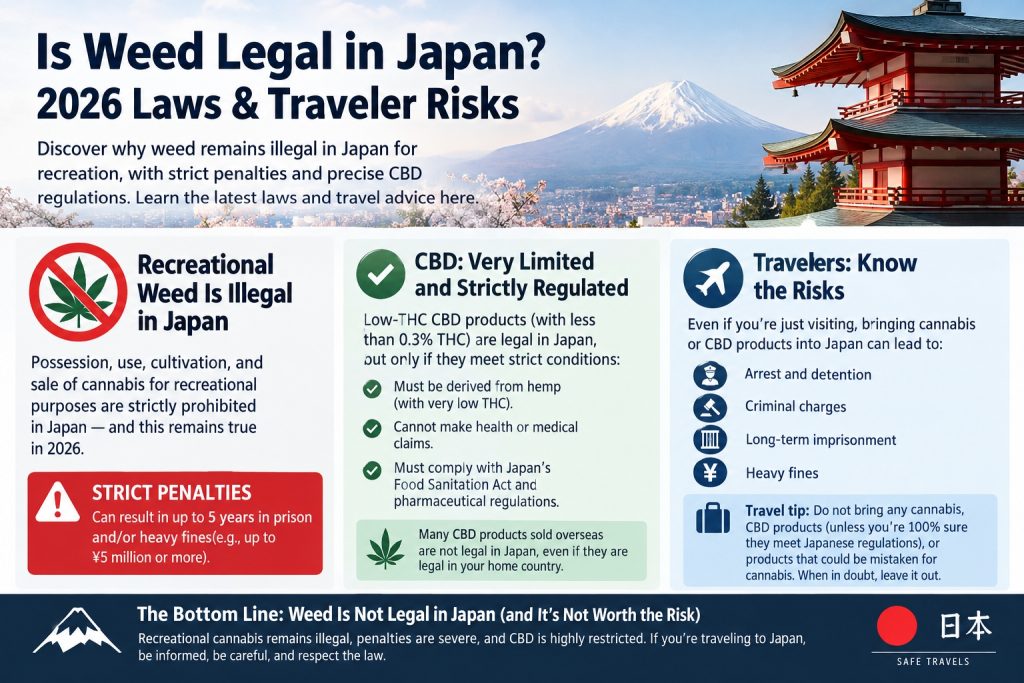
Japan’s beautiful contradiction is that hemp has centuries-old ties to Shinto rituals and traditional clothing, yet modern marijuana laws are among the strictest in the world. So, is weed legal in Japan? No, not for recreation, casual possession, or private use. A major reform effective December 12, 2024 made cannabis consumption itself a criminal offense, closing a notable gap in the former law.
This review explains the national rules in force as of November 12, 2026, including penalties, medical products, CBD limits, customs precautions, and what to do after an arrest. It’s written for travelers and foreign residents, but it isn’t individualized legal advice. Enforcement and charging decisions depend on the evidence and your circumstances.
The safest rule is refreshingly uncomplicated: don’t bring cannabis into Japan, don’t buy it there, and don’t assume a product permitted at home is permitted at Narita Airport. Japan’s customs officers won’t be persuaded by dispensary packaging, a medical card, or an enthusiastic explanation about California law.
Key Takeaways
- Weed is not legal in Japan for recreational use, and possession, use, cultivation, import, or supply without authorization can result in severe criminal penalties.
- Since December 12, 2024, cannabis consumption itself is a criminal offense punishable by up to seven years in prison.
- Medical cannabis access in Japan is strictly limited to approved pharmaceutical products under tight regulation, and foreign medical cannabis cards or prescriptions are not recognized.
- CBD products may be legal if they comply with Japan’s stringent THC residue limits, but ‘THC-free’ labels abroad do not guarantee acceptance in Japan.
- Japan’s cannabis laws apply equally to residents, tourists, and travelers, so carrying any cannabis or related products, even from countries where it is legal, risks arrest and prosecution.
- If arrested for cannabis in Japan, request a lawyer and consular assistance promptly, as legal processes can be lengthy and affect immigration status and employment.
Is Weed Legal in Japan? The Short Answer
No. Recreational cannabis remains illegal throughout Japan. You generally may not possess, receive, use, cultivate, import, export, or supply marijuana without specific legal authorization.
Recreational Marijuana Is Illegal: Key Rules at a Glance
| Activity | General legal position |
|---|---|
| Recreational possession or use | Illegal |
| Growing cannabis at home | Illegal |
| Bringing marijuana across the border | Illegal |
| Foreign medical cannabis | Not automatically authorized |
| Compliant CBD products | Potentially legal under strict THC limits |
| Approved cannabis-derived medicine | Possible through Japan’s regulated system |
Edibles, concentrates, vape cartridges, flower, and THC beverages aren’t loopholes. The product’s form, or the fact that nobody is smoking it, doesn’t create a personal-use exception.
The Same Cannabis Laws Apply to Tourists and Residents
Japan doesn’t give visitors a holiday-sized exemption. National cannabis laws apply whether you’re a tourist in Kyoto, an exchange student in Osaka, or a long-term resident in Tokyo.
Legality abroad doesn’t travel with you either. A sealed product purchased legally in Canada, Thailand, or a U.S. state can become prohibited when you enter Japan. “But it was legal back home” is context, not a defense.
Japan’s Cannabis Law Changes: What Changed and When?
Japan revised its cannabis framework to permit tightly controlled medical development, regulate hemp by THC concentration, and strengthen restrictions on nonmedical consumption. Those goals can sound contradictory, but they’re part of the same policy: industrial and pharmaceutical access under licenses, paired with tougher recreational enforcement.
December 2024 Reform: Cannabis Use Became a Criminal Offense
The amended legislation took effect on December 12, 2024. Most importantly for ordinary users, unauthorized cannabis consumption became punishable by up to seven years’ imprisonment.
Previously, possession was illegal but cannabis “use” wasn’t separately prohibited under the Cannabis Control Act, a gap partly associated with concerns about farmers absorbing compounds while handling hemp. Modern testing and revised rules removed that gap. Online claims that “Japan doesn’t punish smoking, only possession” are now dangerously outdated.
2025 Hemp Licensing Changes: Why Reform Does Not Mean Recreational Legalization
Further cultivation and licensing provisions took effect in March 2025, creating categories for industrial hemp and pharmaceutical raw materials. Low-THC hemp cultivation can be licensed, while cultivation intended for medical ingredients faces stricter national oversight.
That’s agricultural reform, not legalization. You can’t plant hemp seeds in your garden, grow “just one” cannabis plant, or treat licensed farmers as dispensaries. THC thresholds, approved varieties, security requirements, and government licensing still control cultivation.
Cannabis Penalties in Japan: Offenses and Maximum Sentences
Japan treats cannabis cases as criminal matters, not minor vacation mishaps. Exact charges and sentences depend on conduct, intent, quantity, prior history, and whether profit was involved. The figures below are statutory maximums: they aren’t predictions of the sentence in an individual case.
Unauthorized Possession and Use: Up to Seven Years in Prison
Unauthorized cannabis possession and consumption can each expose you to up to seven years in prison. Giving or receiving cannabis can also carry severe punishment.
Police may examine messages, payment records, packaging, urine results, and statements when distinguishing possession, use, or supply. Don’t assume disposing of the product erases potential evidence, and don’t improvise an explanation before receiving legal advice.
Cultivation, Importing, Exporting and Supply: How Penalties Differ
Unauthorized cultivation, import, and export can carry imprisonment of up to ten years. Profit-motivated conduct may also trigger substantial fines. Transfer, receipt, and commercial distribution have separate penalty structures, while organized or large-scale activity can raise the stakes further.
Mailing a THC gummy from overseas isn’t “less serious” merely because it arrived in a padded envelope. International shipment can create an import investigation involving Japan Customs and police.
Small Amounts and First Offenses: No Personal-Use Exemption
There’s no statutory safe amount for personal marijuana. A single edible, partly used vape cartridge, or small bag can support an investigation.
Quantity and a clean record may affect prosecutorial or sentencing decisions, but they don’t make possession lawful. Avoid folklore about police ignoring “one joint.” Japan’s 0.3% THC figure is a cultivation standard for hemp plants grown by licensed industrial farmers, not permission to possess recreational marijuana.
Is Medical Cannabis Legal in Japan?
The careful answer is that limited cannabis-derived medicine can be legal, but Japan doesn’t operate a broad medical-marijuana program resembling those in many U.S. states. You can’t visit a neighborhood clinic, show chronic-pain records, and expect a bag of flower.
Approved Cannabis-Derived Medicines vs. General Medical Marijuana Access
The reforms created a route for pharmaceutical products containing cannabis-derived ingredients when those medicines receive Japanese approval and are handled under the country’s narcotics controls. This can support products evaluated for quality, safety, and effectiveness, including potential treatments modeled on cannabinoid medicines used overseas.
That route doesn’t legalize home-grown medicine, dispensary products, or self-treatment with THC oil. Approval applies to a specific pharmaceutical product and regulated supply chain, not cannabis in general.
Are Foreign Medical Marijuana Cards or Prescriptions Recognized?
A foreign medical card doesn’t authorize possession or importation in Japan. Neither does a prescription automatically override Japanese narcotics and customs law.
Before traveling, identify every active ingredient and ask Japan’s Regional Bureau of Health and Welfare whether advance permission is required or importation is prohibited. Get written confirmation when possible. If your medicine can’t lawfully enter Japan, speak with your clinician early about a permitted alternative rather than experimenting at airport security.
Is CBD Legal in Japan? THC Limits and Product Restrictions
CBD isn’t categorically banned, but legality depends heavily on composition and compliance. Since December 2024, Japan has used residual THC limits tailored to product type. A CBD bottle legally sold in New York or London may exceed Japan’s far lower threshold.
Product-Specific THC Residue Limits: Oils, Beverages and Other Products
Japan’s maximum delta-9 THC residue limits are generally:
| Product category | Maximum THC concentration |
|---|---|
| Oils (liquid at room temperature) and powders | 10 mg/kg (10 ppm) |
| Aqueous solutions, including beverages | 0.10 mg/kg (0.10 ppm) |
| Other products | 1 mg/kg (1 ppm) |
Classification matters. Ingredients, final dosage form, and laboratory results all deserve review. Regulations can change, so check Ministry of Health, Labour and Welfare guidance before purchasing or packing anything.
Why a “THC-Free” Label or Overseas Lab Report May Not Establish Compliance
“THC-free” is marketing language, not a Japanese customs ruling. A manufacturer may use a detection limit higher than Japan’s threshold, test only one batch, or report “non-detect” without stating the analytical method.
A certificate of analysis helps only when it matches the exact batch and demonstrates compliance with Japan’s applicable limit. Even then, customs authorities make the final decision. When in doubt, leaving the CBD at home is cheaper than turning baggage claim into a legal drama.
CBD Gummies, Vapes and Alternative Cannabinoids: Check Each Product’s Legal Status
Gummies and vape liquids still face THC limits, labeling rules, and import controls. Vapes add practical risk because residue, cartridges, or blended ingredients may be difficult to verify.
Don’t assume compounds advertised as HHC, THCP, HHCH, or “legal highs” are acceptable. Japan has repeatedly controlled emerging cannabinoids under pharmaceutical and designated-substance laws. Product chemistry changes faster than travel blogs. Check the precise ingredient against current MHLW notices, not a Reddit post from 2022.
Traveling to Japan: Cannabis, CBD and Customs Rules
International travel is where otherwise cautious people get caught: an old gummy in a backpack pocket, a vape forgotten in a toiletry bag, or CBD sleep drops packed on autopilot. Inspect every compartment before departure, including the tiny one where receipts and ancient chewing gum go to retire.
Bringing Cannabis in Luggage or Mailing It to Japan
Don’t carry recreational cannabis in checked or hand luggage. Don’t mail it to yourself, accept a friend’s shipment, or order from an overseas dispensary to a Japanese address.
Customs screening may involve interviews, baggage searches, scanners, dogs, and package inspections. Declaring a prohibited item doesn’t necessarily make its import lawful. If you discover cannabis before boarding, follow local disposal rules: don’t carry it to Japan hoping to surrender it there.
Checking Medicine Import Requirements Before Departure
Make a medication inventory several weeks ahead. Record generic names, concentrations, quantity, and dosage form, then consult Japan’s Ministry of Health, Labour and Welfare guidance for travelers.
Some controlled medicines require advance authorization, often called a Yunyu Kakunin-sho for applicable pharmaceuticals. Cannabis-derived or narcotic ingredients may face separate restrictions. Keep prescriptions and approvals with you, but remember: documentation supports a lawful import: it doesn’t legalize a prohibited one.
Cannabis Used Before Arrival: What Travelers Should Verify About Overseas Use and Testing
Using cannabis before departure can create complicated questions if testing later detects metabolites. Jurisdiction, nationality, where the conduct occurred, and evidence all matter: online answers often flatten those distinctions.
Don’t travel while impaired, carry residue, or bring used paraphernalia. If you’re concerned about prior lawful overseas use, particularly as a Japanese national, seek advice from a Japanese criminal lawyer before travel. Testing windows vary by dose, frequency, body chemistry, and test method: there’s no reliable universal countdown.
What Happens If You Are Arrested for Cannabis in Japan?
An arrest may lead to questioning, evidence collection, and extended detention while prosecutors investigate. Japan’s pre-indictment process can involve an initial detention period followed by court-approved extensions, potentially reaching 23 days from arrest in a single case. Additional allegations can complicate that timeline.
Requesting a Lawyer, Interpreter and Consular Assistance
Stay calm and clearly request a lawyer. If you don’t understand Japanese, request a qualified interpreter and avoid signing documents you can’t accurately read. Ask that your embassy or consulate be notified.
Consular officers may provide lists of local attorneys, contact family, and monitor welfare, but they can’t cancel charges, demand release, or act as your defense counsel. Also remember that casual comments can become evidence. Politeness is wise: uninformed guessing isn’t.
Potential Immigration, Employment and Reentry Consequences
For noncitizens, a cannabis case may affect visa status, deportation, future landing permission, or reentry, even beyond the criminal sentence. Outcomes depend on conviction, punishment, residence category, and immigration decisions.
Employment and education may suffer too. Japanese organizations often treat drug allegations as serious reputational events, and public figures have lost contracts after arrests. Get both criminal and immigration advice: solving one half of the problem may not solve the other.
Cannabis Culture in Japan: Traditional Hemp vs. Modern Drug Laws
Cannabis isn’t historically foreign to Japan. Hemp fibers have appeared in rope, textiles, shrine decorations, and shimenawa sacred cords. The asa-no-ha geometric hemp-leaf pattern remains common on fabrics and children’s clothing, symbolizing vigorous growth.
Why Traditional Hemp Uses and Licensed Cultivation Do Not Make Marijuana Legal
Traditional hemp culture concerns fiber, seed, ritual materials, and licensed agriculture, not a hidden social license to get high. Postwar regulation sharply restricted cultivation, and today’s growers remain subject to licenses and THC-related controls.
Think of it this way: Japan’s long relationship with rice doesn’t make unlicensed sake production automatically lawful. Cultural heritage and modern drug permission are different questions. Hemp souvenirs, patterns, and shrine ropes hence tell you something fascinating about history, but nothing permissive about recreational possession.
Will Japan Legalize Weed? Confirmed Policy Changes vs. Speculation
As of the last review date, Japan has announced no general recreational legalization. Recent policy moved in the opposite direction for consumers: it criminalized unauthorized use while opening narrow routes for approved medicines and regulated low-THC hemp.
You may see reform described as “Japan legalizes medical cannabis.” That shorthand misses the boundary between approved pharmaceuticals and dispensary-style access. It also says little about recreational policy.
Future debate is possible, laws aren’t carved into Mount Fuji, but forecasts should be treated as speculation unless backed by enacted legislation or an official government proposal. For practical decisions, rely on current law, not regional trends in Thailand, parts of Europe, Canada, or the United States.
Frequently Asked Questions About Weed in Japan
Here are the two questions travelers ask most often after learning the national rule, and usually after booking the hotel.
Are Cannabis Laws Different in Tokyo, Osaka or Other Japanese Cities?
No local city has legalized recreational marijuana. The core statutes apply nationally in Tokyo, Osaka, Kyoto, Sapporo, Fukuoka, Okinawa, and rural prefectures alike.
Enforcement circumstances and available police resources can vary, but that doesn’t create a lawful cannabis zone. There’s no Japanese equivalent of walking across a U.S. state line from prohibition into a regulated adult-use market.
Is Smoking Weed in a Private Home or Hotel Room Legal?
No. Private property doesn’t exempt you from national law. Using or possessing cannabis in a home, vacation rental, hotel room, club, or parked car remains illegal.
A hotel’s smoking policy is a separate issue: permission to smoke tobacco doesn’t include marijuana, and a “no smoking” fee is the least serious possible consequence. Odor complaints, staff reports, or discovered products can bring police involvement.
Official Sources and Last-Reviewed Date: MHLW, Japan Customs and Japanese Law Translations
Last reviewed: November 12, 2026. Because criminal, pharmaceutical, and designated-substance rules can change, confirm requirements immediately before travel.
Useful primary and government sources include:
- Ministry of Health, Labour and Welfare for cannabis reforms, medicines, CBD standards, and controlled substances.
- Japan Customs for import rules, prohibited articles, and traveler procedures.
- Japanese Law Translation Database System for unofficial English translations of Japanese statutes. The Japanese text controls if translations differ, and some English versions predate the 2024 amendments.
- Ministry of Foreign Affairs of Japan for embassy and consular information.
So, is weed legal in Japan? Recreational cannabis is not legal, medical access is product-specific, and CBD is only potentially lawful when it satisfies Japan’s exact rules. Your best next step is simple: check every medicine and cannabinoid product before departure. If its status isn’t clearly confirmed by an official authority, don’t pack it. Japan offers enough memorable experiences without adding a customs interview to your itinerary.