
Blog 2026
Best Weed for Anxiety: What Actually Helps?
Nov
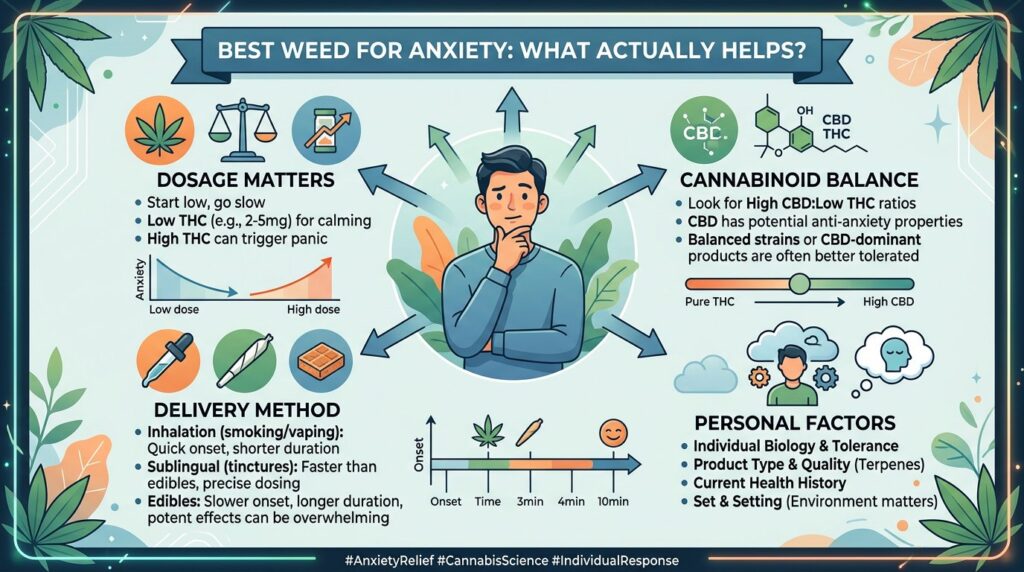
Searching for the best weed for anxiety sounds straightforward, until one product leaves you pleasantly unwound and another makes your heartbeat feel like a drum solo. Cannabis can be calming, stimulating, sedating, or downright uncomfortable. The outcome depends less on a colourful strain name and more on THC dose, CBD content, delivery method, your health history, and the situation in which you use it.
Here’s the most important point upfront: cannabis isn’t a first-line treatment for an anxiety disorder. Cognitive behavioural therapy (CBT), acceptance and commitment therapy (ACT), lifestyle changes, and appropriately prescribed medications have stronger and more consistent evidence. Cannabis may nevertheless provide short-term relief for some adults, particularly when a product is CBD-forward and THC exposure remains low. Other people experience racing thoughts, panic, paranoia, dizziness, or dependence instead.
This evidence-based review examines CBD, THC, balanced formulations, product labels, dosing, drug interactions, and safety. It doesn’t rank dispensary strains because names such as Blue Dream or Granddaddy Purple don’t reliably predict chemical composition. Two jars carrying the same name may have substantially different cannabinoid and terpene profiles. A verified certificate of analysis is far more informative than the artwork on the package.
You’ll also find practical guidance for avoiding the classic beginner mistake: eating another gummy because “nothing is happening,” then meeting the entire universe 40 minutes later. Humour aside, excessive THC can cause genuine distress. Starting with CBD, choosing very small doses, and waiting for the full onset can reduce, but never eliminate, that risk.
This article is educational rather than personalized medical advice. Cannabis laws, product quality, and medical-access rules vary by location. Speak with a qualified clinician if your anxiety is persistent, you take prescription medication, or you have bipolar disorder, substance-use concerns, heart disease, or a personal or family history of psychosis. If anxiety is disrupting your work, relationships, sleep, or safety, the priority is a proper assessment, not finding a stronger product.
Key Takeaways
- The best weed for anxiety emphasizes verified CBD-dominant products with minimal THC and controlled dosing rather than popular strain names.
- Cannabis is not a first-line treatment for anxiety disorders; evidence-based therapies and prescribed medications remain primary approaches.
- Low-dose CBD may reduce anxiety for some adults, while higher THC doses often increase anxiety, paranoia, and heart rate.
- Start cannabis use for anxiety cautiously: begin with small, measured CBD doses, avoid high-potency THC products, and monitor effects carefully.
- Avoid combining cannabis with alcohol or sedatives, and consult a healthcare professional to understand potential drug interactions and personal risks.
- Persistent anxiety requires professional assessment and treatment; cannabis should never replace therapy or medications proven effective for anxiety disorders.
Quick Answer: Does cannabis help anxiety?
Sometimes, but “cannabis” isn’t one uniform treatment. CBD may reduce anxiety in certain situations, while THC has a less predictable effect: a small amount may feel relaxing, but a larger dose frequently intensifies anxious thoughts, rapid heartbeat, and paranoia. Evidence for occasional, laboratory-observed CBD use is more encouraging than evidence for routinely treating a diagnosed anxiety disorder at home.
If you choose to experiment legally and your clinician considers it reasonably safe, a sensible starting point is a CBD-dominant, independently tested product with little or no THC. Avoid high-potency flower, concentrates, and large edibles. Product-specific guidance matters because 2.5 mg of THC and 25 mg are completely different experiences even though fitting inside gummies of identical size.
| Option | Potential advantage | Main limitation |
|---|---|---|
| CBD isolate | No intentional THC: predictable | Limited clinical evidence: labelling can be inaccurate |
| Broad-spectrum CBD | Multiple plant compounds, generally THC-free | Trace THC remains possible |
| Full-spectrum CBD | May contain a small cannabinoid mixture | Can intoxicate sensitive users or trigger a drug test |
| Balanced CBD:THC | CBD may soften some THC effects | Still intoxicating: anxiety remains possible |
| THC-dominant product | Rapid subjective relief for some users | Highest panic, impairment, and dependence risk |
So, what is the best weed for anxiety? There’s no universally best strain. The lower-risk answer is usually verified CBD-forward chemistry, minimal THC, conservative dosing, and medical guidance, not whatever has the most enthusiastic budtender description.
Understanding anxiety: symptoms, types, and when it becomes a disorder
Anxiety is part of the body’s alarm system. It helps you prepare for an interview, avoid danger, or remember that tomorrow’s deadline is, unfortunately, still real. It becomes a possible disorder when fear or worry is disproportionate, difficult to control, persistent, and disruptive.
Before using cannabis to mute the alarm, it helps to determine why it keeps ringing. Thyroid disease, medication effects, sleep deprivation, stimulant use, trauma, and heart-rhythm problems can resemble anxiety. A clinician can assess those possibilities and identify the form of anxiety you’re experiencing.
Common symptoms (mental, physical, sleep-related)
Mental symptoms include relentless worry, irritability, dread, poor concentration, intrusive thoughts, and feeling detached or unreal. Physical symptoms may include sweating, trembling, nausea, chest tightness, rapid breathing, muscle tension, dizziness, and a pounding heart. Sleep-related signs include difficulty falling asleep, waking repeatedly, nightmares, or feeling exhausted even though spending enough time in bed.
Symptoms often reinforce one another. You notice your heartbeat, interpret it as danger, breathe faster, and become even more frightened. THC can amplify that loop because it can raise heart rate and alter perception. Keeping a simple log of triggers, sleep, caffeine, menstrual-cycle changes, medication, and cannabis use can reveal patterns that memory misses.
Types of anxiety disorders (GAD, panic, social anxiety, PTSD-related anxiety, phobias)
Generalized anxiety disorder (GAD) involves difficult-to-control worry across several areas of life. Panic disorder features recurrent panic attacks plus fear or behavioural changes related to another attack. Social anxiety disorder centres on scrutiny, embarrassment, or rejection. Specific phobias cause intense fear around a particular object or situation.
PTSD is categorized separately from anxiety disorders, but hypervigilance, avoidance, nightmares, and anxiety are common features. Cannabis may temporarily suppress some symptoms while strengthening avoidance, the very pattern trauma-focused treatment often needs to address. Different conditions hence need different plans. A gummy that makes sleep easier doesn’t necessarily treat the mechanism maintaining social anxiety, panic, or trauma symptoms.
When to seek urgent help (panic, suicidality, psychosis, severe impairment)
Seek urgent medical help for suicidal thoughts, plans to harm yourself or someone else, hallucinations, severe confusion, dangerous behaviour, or an inability to care for basic needs. New chest pain, fainting, one-sided weakness, or severe breathing difficulty also requires medical evaluation rather than an assumption that it is “just anxiety.”
During an intense panic episode, move somewhere quiet and safe, avoid taking more cannabis, and ask a trusted person to stay with you. If symptoms followed cannabis and include extreme agitation, repeated vomiting, loss of consciousness, or psychosis, call 911 or your local poison centre at 1-844-POISON-X (1-844-764-7669) (in Quebec, 1-800-463-5060). In Canada, you can call or text 9-8-8 any time for suicide crisis support. Don’t drive yourself.
Why cannabis can both reduce and worsen anxiety
Cannabis can feel contradictory because its effects depend on the compound, dose, user, and context. THC may quiet internal chatter at one dose yet turn it into a megaphone at another. CBD doesn’t produce the same classic high, but it can still cause side effects and interact with medication.
Your response can also change over time. Tolerance, poor sleep, a stressful environment, or a more potent batch may turn a previously comfortable routine into an unpleasant one.
Endocannabinoid system basics (CB1/CB2) and stress response
The endocannabinoid system helps regulate stress responses, learning, appetite, pain, sleep, and emotional processing. Its best-known receptors are CB1, abundant in the brain and nervous system, and CB2, found largely in immune tissues and elsewhere. THC partially activates CB1 receptors, producing intoxication and changes in memory, perception, and threat processing.
CBD works less directly. It influences several signalling systems and may modify endocannabinoid activity, but its anxiety-related mechanisms in humans remain under investigation. Describing CBD as simply “balancing your endocannabinoid system” oversells what science currently knows. The system is more like a complex mixing board than a single calm-down button.
Biphasic effects: low vs high dose outcomes
A biphasic effect means that low and high doses can produce opposite outcomes. With THC, a very low dose may reduce perceived stress for some people: higher exposure is more likely to increase anxiety, suspiciousness, cognitive disruption, and heart rate.
That dose curve isn’t identical for everyone. One person may notice impairment at 1–2.5 mg of oral THC, while a tolerant user barely perceives it. This is why advice such as “take half a gummy” is inadequate: half of a 5 mg gummy is very different from half of a 50 mg product. Always calculate the milligrams per serving, not the fraction or number of pieces.
Set, setting, and individual sensitivity (tolerance, genetics, prior anxiety)
“Set” means your internal state: “setting” means your surroundings. Using THC while rested at home with someone you trust can feel different from using the same amount before a crowded event. Existing worry, unfamiliar surroundings, conflict, caffeine, and social pressure can all colour the experience.
Sensitivity also varies with tolerance, genetics, metabolism, age, body composition, previous panic reactions, and other substances. A family history of psychosis or bipolar disorder raises particular concern. And tolerance isn’t pure protection: it may reduce noticeable intoxication while encouraging larger doses and dependence. Your friend’s ideal product is data about your friend, not a dosing plan for you.
What the research says about cannabis for anxiety (current evidence)
Research is promising in places but thinner than marketing suggests. Studies vary by diagnosis, cannabinoid, dose, formulation, and duration. Many are small, short-term, or based on a single laboratory challenge rather than months of real-world treatment.
Observational surveys often report relief, but they can’t establish whether cannabis caused improvement. People choose their own products, expectations influence ratings, and those who had bad experiences may stop using cannabis and disappear from later samples.
CBD for anxiety: what studies show and where evidence is strongest/weakest
Small human studies suggest CBD may reduce anxiety during simulated public speaking and certain laboratory stress tasks, especially among people with social anxiety. Reviews also identify possible benefits across anxiety-related conditions, but emphasize inconsistent dosing and limited high-quality clinical trials.1 2
The weak spot is everyday, long-term treatment. Experimental studies have sometimes used hundreds of milligrams of CBD, far beyond the 10–50 mg commonly found in retail wellness products. That doesn’t mean small doses never help: it means you can’t assume a 20 mg oil reproduces a study using 300 mg. Higher CBD doses also bring greater interaction, sedation, diarrhea, and liver-enzyme concerns.
THC for anxiety: short-term relief vs increased anxiety/paranoia risk
Many users report that THC temporarily reduces tension or helps them disengage from worry. Yet controlled research and clinical experience show a clear downside: THC can produce anxiety, panic, paranoia, impaired memory, and altered judgment, particularly at higher doses.
Relief can also become a behavioural trap. If you use THC every time anxiety appears, you may never learn that the feeling can rise and fall without escape. Over time, tolerance may require more THC, withdrawal between sessions may feel like worsening anxiety, and the original problem becomes difficult to separate from the use cycle. Short-term relief isn’t automatically long-term recovery.
THC:CBD ratios and why balance matters
A ratio describes relative cannabinoid amounts. A product labelled 20:1 CBD:THC is CBD-dominant: 1:1 contains equal quantities. But ratios can mislead without the actual dose. A 1:1 product containing 1 mg of each cannabinoid is very different from one containing 20 mg of each.
CBD may moderate some THC effects under certain conditions, but it doesn’t reliably cancel intoxication or prevent panic. Timing, dose, and route matter, and research findings are mixed. For anxiety-prone beginners, ratios such as 20:1 or higher are generally more conservative than 1:1. The safest THC dose for some people, but, is zero.
Delivery method in studies (oral, sublingual, inhaled) and onset/duration
Route changes both the experience and the evidence. Inhaled cannabis takes effect within minutes and is easier to titrate one puff at a time, but it can irritate the lungs and produces rapid THC peaks. Oral products take longer, last much longer, and can feel stronger because the liver converts THC into 11-hydroxy-THC.
“Sublingual” tinctures may begin acting in roughly 15–45 minutes if held under the tongue, although swallowed portions behave more like edibles. Oral effects commonly emerge in 30–120 minutes and may last six hours or longer. Study results from a purified oral CBD capsule can’t automatically be transferred to a dispensary vape or infused brownie.
Best cannabis products for anxiety: CBD, THC, and balanced options
The best cannabis products for anxiety are defined by measurable chemistry and quality control, not an indica/sativa label. Look for exact cannabinoid quantities, a recent batch-specific certificate of analysis (COA), and a manufacturer that provides realistic rather than miracle-level claims.
For beginners, CBD-dominant oils or capsules offer more controlled dosing than high-THC flower. Avoid concentrates such as wax, shatter, and high-potency cartridges: they make accidental overconsumption easier.
CBD isolate vs broad-spectrum vs full-spectrum (pros/cons for anxiety)
CBD isolate contains primarily cannabidiol and is the simplest option when you want to avoid THC, though contamination or inaccurate labelling is still possible. Broad-spectrum CBD contains other plant compounds while typically removing THC. Full-spectrum CBD includes multiple cannabinoids and legally permitted trace THC where applicable.
Full-spectrum enthusiasts often cite an “entourage effect,” but evidence that retail combinations reliably outperform isolated CBD for anxiety is incomplete. Trace THC may matter if you’re highly sensitive, subject to drug testing, or taking repeated doses. Well-known US brands such as Charlotte’s Web, Lazarus Naturals, and CBDistillery aren’t part of the Canadian market, because CBD falls under the Cannabis Act like any other cannabis product. Whatever the brand, reputation isn’t a substitute for checking the current product’s COA.
When a balanced product may be preferable to THC-dominant
An adult who already tolerates THC but finds high-potency products edgy may prefer a balanced or CBD-dominant formulation. For example, a product containing 5 mg CBD and 1 mg THC offers much gentler THC exposure than a typical 10 mg THC edible. Even that 1 mg can be noticeable to a sensitive beginner.
Balanced products may also allow smaller, more reproducible doses than flower. Still, “balanced” doesn’t mean non-intoxicating, and CBD won’t act as an emergency off switch. If THC has previously caused panic, derealization, paranoia, or prolonged palpitations, switching ratios without medical advice may be a poor experiment.
Terpenes and anxiety: what’s plausible vs hype (linalool, limonene, myrcene)
Terpenes create aromas and may have biological effects. Linalool is associated with lavender, limonene with citrus, and myrcene with earthy or herbal scents. Preclinical research offers plausible calming mechanisms, but human evidence showing that retail terpene profiles reliably treat anxiety is limited.
A pleasant aroma can shape expectations and experience, that’s real, even if it isn’t a clinical treatment. Just don’t choose a 28% THC flower because the label mentions linalool. Cannabinoid dose has more immediate safety relevance. Terpenes can also irritate airways, and more isn’t necessarily better. Treat them as a secondary preference after potency, testing, and delivery method.
How to use cannabis for anxiety: dosing and practical guidance
If you’re of legal age in your province or territory and a clinician agrees it’s suitable, use a written plan. Record the product, dose, time, food intake, symptoms before and after, side effects, and sleep. Change only one variable at a time: otherwise, you won’t know what helped.
Choose a low-stakes evening at home for a first trial, not an airport, first date, presentation, or family reunion where Uncle Gary wants to debate politics.
Start low, go slow: beginner dosing framework (CBD-first approach)
A cautious approach starts with a CBD-dominant, tested oral product. Some adults begin around 5–10 mg of CBD once daily, maintain that dose for several days, and increase gradually if tolerated. This is a conservative retail framework, not a clinically proven anxiety-treatment dose.
If the product contains THC, beginners may start at 1 mg or less: 1–2.5 mg is commonly considered a low oral range. Wait at least two hours, and preferably longer, before considering more edible THC. Don’t keep escalating CBD indefinitely without clinical input, especially if you take medication or develop fatigue, diarrhea, appetite changes, or abnormal liver tests.
Microdosing THC: who might consider it and who shouldn’t
“Microdosing” has no universal medical definition. In practice, it often means taking enough THC to notice subtle effects without obvious intoxication, sometimes 1–2.5 mg orally. Adults with prior THC experience may find this more manageable than standard 5–10 mg servings.
Avoid THC microdosing if you’re pregnant or breastfeeding, underage, prone to panic, subject to workplace testing, driving, or at elevated risk for psychosis. It’s also a poor choice before operating tools or making safety-critical decisions. If you keep increasing the dose, feel unable to function without it, or use it to avoid every uncomfortable emotion, the “micro” label isn’t making the pattern safer.
Timing for daytime anxiety vs nighttime anxiety and sleep
For daytime use, prioritize non-intoxicating products and test them when you have no driving or work obligations. CBD can still cause sleepiness. THC may impair reaction time even when you feel fairly normal, so don’t rely on subjective confidence.
At night, consider the full duration. A late edible may cause morning grogginess, especially if redosed near bedtime. Cannabis can shorten sleep onset for some people, but frequent THC use may alter sleep architecture and lead to rebound insomnia or vivid dreams during withdrawal. If sleep is the main issue, evaluate caffeine, sleep apnea, restless legs, medication timing, and insomnia habits rather than treating every bad night with more THC.
Avoiding common pitfalls (edible overconsumption, mixing with alcohol)
The classic edible mistake is redosing after 30 minutes. Food, metabolism, and formulation can delay onset, so impatient stacking may produce several uncomfortable hours. Keep products in original child-resistant packaging and away from children and pets: a gummy doesn’t stop looking like candy because adults know better.
Don’t combine cannabis with alcohol, benzodiazepines, opioids, or sedating sleep aids unless a clinician has specifically reviewed the combination. Impairment, dizziness, vomiting, and poor judgment can compound. Also avoid eyeballing oils or cutting uneven gummies. Use a marked dropper, verify milligrams per millilitre, and write down the dose before taking it.
Risks, side effects, and long-term concerns
Cannabis is often framed as either harmless or terrifying. Neither extreme helps you make a good decision. Risk varies with age, potency, frequency, route, genetics, and mental-health history. Occasional low-dose CBD is not equivalent to daily use of high-THC concentrates.
Review benefits and harms after a defined trial, perhaps two to four weeks, rather than letting occasional use quietly become an automatic nightly habit.
Short-term side effects (increased anxiety, panic, racing heart, dry mouth, dizziness)
THC can cause anxiety, panic, rapid heartbeat, dizziness, dry mouth, red eyes, nausea, impaired coordination, slowed reaction time, and short-term memory problems. CBD may cause fatigue, diarrhea, appetite changes, and medication interactions. Blood-pressure changes can make you lightheaded when standing.
If mild anxiety occurs, stop consuming cannabis, sit somewhere calm, sip water, and remind yourself that the effects are time-limited. Slow exhalations can reduce hyperventilation. Don’t drive, add alcohol, or take an unprescribed sedative. Seek medical help for chest pain, fainting, severe confusion, psychosis, breathing problems, or symptoms that feel medically dangerous.
Dependency and cannabis use disorder: warning signs
Cannabis use disorder can involve craving, unsuccessful attempts to cut down, tolerance, withdrawal, hazardous use, and continuing even though harm. Withdrawal may bring irritability, anxiety, poor sleep, reduced appetite, and restlessness, symptoms easily mistaken for proof that you “need” cannabis.
Warning signs include using earlier in the day, abandoning activities, concealing use, spending beyond your budget, or needing THC to feel normal. A useful test is whether you can take a planned break without repeatedly renegotiating it. If not, talk with a clinician or addiction specialist. That conversation isn’t a moral verdict: it’s preventive maintenance.
Cognition, motivation, and mood impacts with frequent use
Frequent THC exposure can affect attention, memory, learning, and executive function, particularly during intoxication and among younger users. Some people report reduced motivation, while others use cannabis without noticing that pattern. Mood may improve briefly but worsen when intoxication fades or withdrawal begins.
Track concrete outcomes rather than relying on vibes: missed deadlines, forgotten conversations, exercise frequency, sleep quality, and anxiety ratings. If functioning declines while the dose rises, the product isn’t serving its intended purpose. Consider a supervised reduction, especially after heavy daily use, because abrupt stopping may temporarily disrupt sleep and mood.
High-THC products and psychosis risk (who is most vulnerable)
High-potency and frequent cannabis use are associated with a greater risk of psychotic outcomes, although individual causality is complex.3 Vulnerability is higher among people with a personal or family history of psychosis, those who began young, and frequent users of high-THC products.
Warning signs include hearing or seeing things others don’t, fixed suspicious beliefs, severe disorganization, or losing touch with reality. Stop use and seek urgent assessment. CBD content shouldn’t be assumed to neutralize a large THC dose. For someone at elevated psychosis risk, avoiding THC is generally more prudent than searching for a supposedly calming strain.
Who should avoid cannabis for anxiety (or use only with medical guidance)
Cannabis deserves additional caution when brain development, pregnancy, psychiatric vulnerability, medication, or public safety is involved. Legal access doesn’t establish personal safety. A licensed dispensary can sell a lawful product without knowing your medical history.
If any category below applies, get individualized guidance instead of relying on a friend, influencer, or product quiz.
Teens/young adults, pregnancy/breastfeeding, personal/family history of psychosis
Adolescents and young adults are more vulnerable to cognitive, dependence, and psychiatric harms, especially with frequent high-THC use. Developing brains aren’t defective: they’re simply still developing. Anxiety in this age group deserves evidence-based assessment and family support where appropriate.
Cannabis is not recommended during pregnancy or breastfeeding because fetal and infant exposure may occur and safety hasn’t been established. People with personal or close family histories of schizophrenia or other psychotic disorders should generally avoid THC. Ask about family history explicitly, “mental health problems” can hide a relevant diagnosis no one discusses at dinner.
Bipolar disorder, severe panic disorder, substance use disorders
THC may destabilize mood or contribute to manic and psychotic symptoms in people with bipolar disorder. Severe panic disorder also warrants caution because intoxication, increased heart rate, and altered perception can resemble, and trigger, the sensations feared during panic.
A current or previous substance use disorder doesn’t automatically produce the same risk for every person, but it calls for a deliberate plan. Discuss frequency limits, non-intoxicating alternatives, accountability, and early warning signs. If you’ve previously lost control over cannabis, trying a stronger product for anxiety is unlikely to be the clever workaround it first appears to be.
Driving, safety-sensitive jobs, and workplace drug testing
Never drive or operate machinery while impaired. THC can affect reaction time, attention, tracking, and decision-making, and impairment doesn’t map neatly onto how “high” you feel. Local laws may impose specific restrictions, but legal waiting periods aren’t personalized guarantees of fitness to drive.
Firefighters, pilots, commercial drivers, healthcare workers, military personnel, and others in safety-sensitive roles may face strict policies. Full-spectrum CBD can also produce a positive THC test because products may contain trace THC or be mislabelled. “It was legal CBD” may not protect your job. Check policy before use, not after an unexpected test.
Drug interactions and medication considerations
Cannabinoids can interact through sedation, cardiovascular effects, and liver metabolism. The practical risk depends on the cannabinoid, dose, timing, and medication. Don’t stop a prescribed anxiety drug suddenly to replace it with cannabis: discontinuation symptoms can be severe and may look like worsening illness.
Bring the actual label or COA to your clinician or pharmacist. “CBD oil” doesn’t reveal whether you take 5 mg or 500 mg, or whether THC is present.
SSRIs/SNRIs, benzodiazepines, beta-blockers, sleep meds: what to ask your clinician
Ask whether cannabis could increase drowsiness, dizziness, bleeding risk, heart-rate changes, or medication levels. SSRIs and SNRIs have varied metabolic pathways: a clinician can assess the specific drug rather than treating them as one category. Beta-blockers may compound dizziness or blood-pressure effects.
Combining cannabis with benzodiazepines, sedating antihistamines, zolpidem, opioids, or alcohol can magnify impairment. Ask: What symptoms should I monitor? Should doses be separated? Is driving prohibited? Do I need follow-up testing? Never taper benzodiazepines abruptly without supervision: withdrawal can cause severe anxiety, seizures, and other medical complications.
CBD and liver enzymes (CYP interactions) and why doses matter
CBD can inhibit cytochrome P450 enzymes involved in metabolizing many medications, including CYP2C19 and CYP3A4. Clinically meaningful interactions are especially documented with prescription cannabidiol at much higher doses than typical wellness products, but retail doses aren’t automatically interaction-free.4
Potentially affected drugs include certain antiseizure medicines, anticoagulants, antidepressants, and immunosuppressants. Dose matters: interaction risk generally becomes more relevant as CBD exposure rises. People with liver disease or those taking medicines requiring blood-level monitoring need particular caution. A pharmacist can often provide the clearest product-by-product review.
Cannabis vs standard anxiety treatments: what to try first
For a diagnosed anxiety disorder, start with treatments supported by stronger evidence and clearer dosing standards. Cannabis may reduce symptoms, but it doesn’t consistently teach coping skills, challenge catastrophic beliefs, or address trauma. Think of relief and recovery as related, but not identical, goals.
Your best plan may combine professional care, self-help, and carefully monitored symptom management rather than placing every expectation on one product.
Therapy (CBT/ACT), lifestyle, and evidence-based self-help
CBT helps you identify unhelpful predictions, reduce avoidance, and gradually approach feared situations. ACT emphasizes psychological flexibility and acting according to values even when uncomfortable thoughts show up. Exposure-based therapy is particularly important for phobias, panic, social anxiety, and OCD-related fears when appropriately delivered.
Sleep regularity, aerobic exercise, reduced caffeine, and mindfulness can support treatment, though none should be presented as a cure-all. Try a concrete seven-day experiment: keep wake time consistent, move for 20–30 minutes, and record caffeine and anxiety. Small measurable changes beat a heroic wellness routine abandoned by Wednesday.
Prescription options and where cannabis may fit (adjunct vs replacement)
SSRIs and SNRIs are common first-line medication options for several anxiety disorders. Buspirone may be considered for GAD, while beta-blockers are sometimes used for specific performance-related physical symptoms. Benzodiazepines can provide rapid relief but carry tolerance, dependence, and withdrawal risks, so they require careful prescribing.
Cannabis may fit, if at all, as a monitored adjunct when standard options are insufficient, poorly tolerated, or inaccessible, not as an automatic replacement. Define goals such as fewer panic attacks or improved sleep, establish a dose ceiling, and schedule reassessment. If symptoms don’t meaningfully improve, stop rather than escalating indefinitely.
Legal and medical access: medical cannabis eligibility and how prescriptions work
In Canada, cannabis is legal for adults under the federal Cannabis Act once they meet their province’s or territory’s minimum age (19 in most of Canada, 18 in Alberta, and 21 in Quebec). Medical access is a separate national system, and it doesn’t use a list of qualifying conditions: a health care practitioner decides whether cannabis is appropriate for your condition, anxiety included.
Canadian practitioners don’t issue a conventional prescription for dried cannabis or oils. If they decide cannabis is suitable, they provide a medical document, which you use to register with a federally licensed seller or to register to grow your own. Prescription cannabinoid medications are a separate category. Check Health Canada’s medical access page rather than relying on a dispensary blog that may be outdated.
What clinicians evaluate (diagnosis, prior treatments, goals, risks)
A responsible clinician reviews your diagnosis, symptom severity, previous therapy and medication, substance-use history, cardiovascular health, pregnancy status, medications, and personal or family psychiatric history. They should also ask what success would look like to you.
Be wary of services that guarantee approval before evaluating you or promise cannabis will “cure” anxiety. A useful consultation includes contraindications, dosing boundaries, follow-up, and a plan for adverse effects. Bring records where possible and be honest about current use. You’re not trying to pass a test: you’re trying to avoid a preventable problem.
Choosing a reputable product: lab testing, COAs, contaminants, accurate labelling
Choose products with a recent, batch-specific COA from an independent accredited laboratory. Match the batch number on the report to the package. Confirm CBD and THC amounts per serving, not merely per container, and check tests for pesticides, heavy metals, residual solvents, microbes, and mycotoxins.
Avoid products making disease-cure claims, using vague “proprietary hemp blend” quantities, or lacking contact and lot information. Prefer sellers that share batch COAs. A QR code alone proves little: open it and read the report. If a 30 mL bottle contains 600 mg CBD, each 1 mL dropper should provide about 20 mg, assuming the dropper actually holds 1 mL.
Frequently asked questions about cannabis for anxiety
These quick answers address the questions that usually appear after someone encounters shelves full of flower, tinctures, gummies, ratios, and strain names. When in doubt, favour the product with clearer testing and less THC, not the louder marketing.
Can cannabis cause anxiety or panic attacks?
Yes. THC can trigger racing thoughts, rapid heartbeat, derealization, paranoia, and panic, particularly at high doses or in inexperienced and anxiety-sensitive users. Edibles are common culprits because delayed onset encourages redosing.
Risk rises with high-potency products, unfamiliar settings, sleep deprivation, caffeine, and previous panic reactions. A product that felt relaxing once can still cause anxiety on another day. If this repeatedly happens, don’t keep testing your limits in hopes of finding the magical strain. THC may simply be a poor fit for your nervous system.
Is CBD better than THC for anxiety?
CBD is generally less likely to cause intoxication, panic, or paranoia, making it the more conservative cannabinoid for anxiety-prone users. Limited clinical research suggests anxiety-reducing potential in some situations. But evidence is not strong enough to declare over-the-counter CBD a proven treatment for every anxiety disorder.
THC may provide short-term relief but carries greater risks of impairment, rebound symptoms, dependence, and anxiety. CBD can also cause fatigue, gastrointestinal effects, and medication interactions. “Better” hence means a more favourable risk profile for many people, not guaranteed effectiveness.
What’s the best strain for anxiety (and why “strain” isn’t a guarantee)?
No strain is reliably best. Names such as ACDC, Harlequin, and Cannatonic are associated with CBD-forward or balanced profiles, while Northern Lights is often marketed as relaxing. Yet cultivation, phenotype, harvest, storage, and labelling can produce major chemical differences under the same name.
Choose by tested cannabinoid content instead. For lower anxiety risk, look for high CBD, very low THC, transparent milligrams, and modest terpene levels. Ask for the batch COA. The “indica equals calm, sativa equals energy” shortcut is commercially convenient but scientifically unreliable.
How long does it take to work (vape vs tincture vs edible)?
Inhaled products may act within minutes, peak relatively quickly, and fade over a few hours, although impairment can persist. Tinctures held under the tongue may begin within approximately 15–45 minutes: any swallowed portion can take longer. Edibles typically begin within 30–120 minutes and may last six hours or more.
Individual timing varies with food, metabolism, tolerance, and formulation. Wait for the full expected onset before redosing. Vaping offers rapid feedback but introduces respiratory and product-quality concerns, so it isn’t automatically the healthiest route.
What should I do if I get too high and feel anxious?
Stop consuming cannabis and move to a quiet, familiar place. Sit or lie down, take slow breaths with longer exhalations, sip water, and ask a calm trusted person to stay with you. Remind yourself when and how much you took: most uncomplicated effects diminish with time.
Don’t drive, mix in alcohol, or take someone else’s benzodiazepine. CBD and black pepper are popular internet remedies, but neither is a dependable antidote. Call your local poison centre (1-844-POISON-X; in Quebec, 1-800-463-5060) or seek urgent care for severe chest pain, fainting, breathing difficulty, seizures, dangerous behaviour, persistent vomiting, or psychosis. Call 911 for a medical emergency.
References and further reading
- Health Canada: Cannabis and your health
- National Center for Complementary and Integrative Health: Cannabis and cannabinoids
- World Health Organization: Cannabidiol critical review report
- Health Canada: Review of cannabidiol (Science Advisory Committee report)
- National Academies report on the health effects of cannabis
- Health Canada: Get help with substance use
- 9-8-8: Suicide Crisis Helpline
The bottom line is less exciting than a “Top 10 Strains” list, but considerably more useful: the best weed for anxiety isn’t a strain name. If cannabis is appropriate for you, the lower-risk path is a verified CBD-dominant product, little or no THC, a measured dose, and a plan to monitor actual results. High-THC flower, concentrates, mystery gummies, and repeated redosing create more opportunities for anxiety, not fewer.
Give any experiment boundaries. Decide what symptom you’re targeting, what improvement would count, how often you’ll use the product, and what side effects mean you’ll stop. Reassess within a few weeks. If you’re using more while functioning less, change course.
Most importantly, don’t let cannabis postpone effective care. Persistent anxiety is treatable, and you don’t need to white-knuckle it or solve it alone. Therapy, evidence-based self-help, medication when appropriate, and supportive routines have a stronger foundation than product hunting. Cannabis may have a supporting role for selected adults, but it should never be the entire cast.