
Blog 2026
Ounce of Weed in Bag: Size, Weight & Storage Guide
Nov
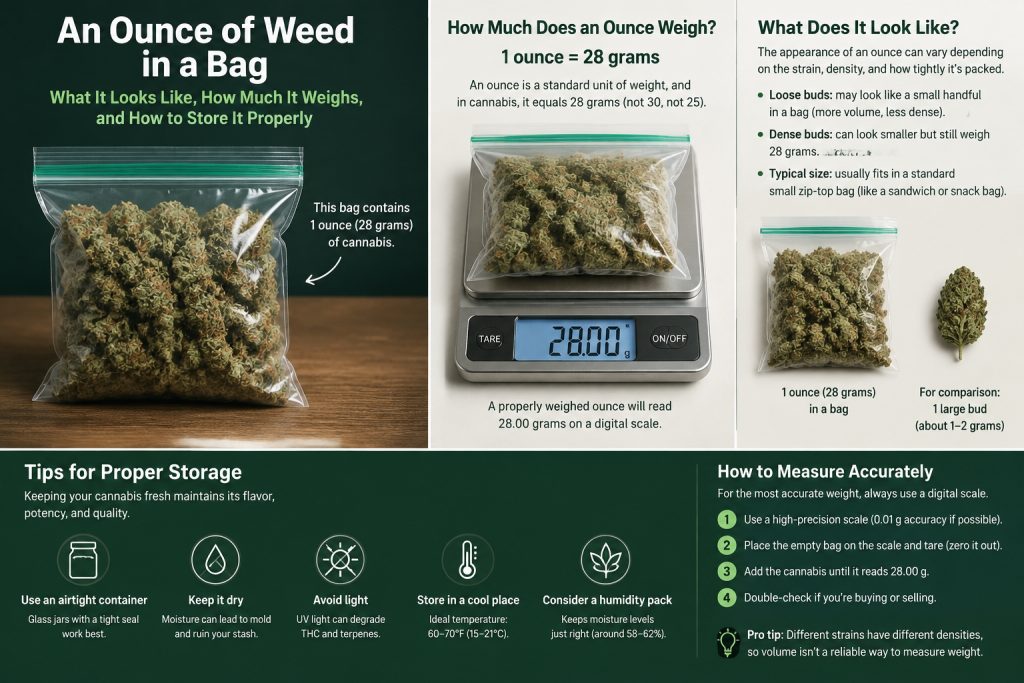
An ounce of weed in bag packaging can look surprisingly different from one purchase to another. One ounce may resemble a compact green brick: another can puff up a pouch like somebody packed it with leafy popcorn. Both could weigh exactly the same.
That visual uncertainty is why photos, bag dimensions, and the old “hold it in your palm” test aren’t reliable ways to confirm cannabis weight. Bud density, trimming, moisture, compression, and packaging all change the apparent volume. If accuracy matters, you need a scale, not especially confident eyeballs.
This guide explains what an ounce of cannabis commonly looks like, how much it weighs, which bags and containers fit it, and how to verify net weight correctly. You’ll also learn how to compare prices, protect flower from heat and moisture, recognize possible mold, and handle storage around children and pets.
The scope is cannabis flower sold or possessed where adult use or medical use is lawful. Laws and labelling rules vary considerably, so check current provincial, territorial and municipal requirements before purchasing, carrying, or storing cannabis. Nothing here is legal or medical advice.
Transparency note: This is an independent educational guide. No cannabis brand, dispensary, or packaging company paid for placement, and specific products are mentioned only as practical examples.
Key Takeaways
- An ounce of weed in bag typically weighs 28 grams but its volume varies widely depending on bud density, moisture, and packaging.
- Visual estimates of an ounce’s weight are unreliable; always confirm cannabis quantity using a calibrated digital scale for accuracy.
- Choosing the right bag for an ounce depends on bud structure, with stand-up pouches offering more space for airy flower and glass jars ideal for long-term home storage.
- Proper storage in airtight containers away from light, heat, and moisture preserves cannabis quality and prevents mold or deterioration.
- Provincial and territorial laws set possession and transport rules, and federal rules set packaging requirements; always verify current regulations before purchasing, transporting, or storing an ounce of weed.
- Calculate price per gram using the labelled weight to make informed purchasing decisions and avoid overpaying for cannabis products.
What Does an Ounce of Weed in Bag Look Like?
An ounce generally looks like a substantial personal supply rather than one oversized bud. Depending on density, 28 grams of flower might occupy roughly one-third of a compact 1-litre (quart-size) pouch or fill much of a larger flexible bag. Loose, airy flower can take up nearly twice the space of tightly structured buds.
Colour doesn’t establish weight or quality. Neither does the number of buds: an ounce might contain six chunky colas, dozens of smaller “popcorn” buds, or a mixture of flower and shake. Compression during transport can also make the contents appear smaller.
Labelled Photo Guide: One Ounce in Clear and Mylar Bags
When judging a labelled photograph, look for a known scale reference. A ruler, standard playing card, or clearly stated bag dimensions is more useful than a hand because hands, and camera lenses, vary.
A typical visual guide would show:
- One ounce in a clear zipper bag: The contents are visible, but glare and flattened buds can distort volume.
- One ounce in a stand-up Mylar pouch: A bottom gusset lets the package expand, making the same flower look less tightly packed.
- One ounce spread on a tray: This reveals individual buds better but still can’t confirm weight.
- One ounce in a jar: Dense flower may sit below the shoulder, while airy buds may reach the lid.
Treat any photograph as an illustration, not proof. Perspective can turn a modest pouch into Godzilla’s lunch bag.
Why Dense Buds, Airy Flower, and Shake Fill Bags Differently
Cannabis cultivars develop different structures. Dense buds, often associated with compact indica-leaning morphology, though those labels don’t reliably predict effects, pack considerable mass into limited space. Airy flower has more open branching and occupies more volume at the same weight.
Other variables include:
- Trim: Sugar leaves increase bulk without adding dense flower structure.
- Moisture: Properly cured buds retain some flexibility: overly dry flower weighs less and crumbles more easily.
- Compression: Vacuum sealing or a tightly packed pouch reduces apparent volume.
- Shake: Small fragments settle into gaps between larger buds, producing a compact-looking ounce.
Imagine filling two jars with 28 grams: one with marbles, another with dry cereal. Equal mass doesn’t promise equal volume. That simple distinction explains most confusing online photos.
Side-by-Side Size Comparison: Eighth, Quarter, Half-Ounce, and Ounce
Each common retail quantity doubles from the previous major fraction:
| Common amount | Retail weight | Relative amount |
|---|---|---|
| Eighth | 3.5 g | 1/8 ounce |
| Quarter | 7 g | 1/4 ounce |
| Half-ounce | 14 g | 1/2 ounce |
| Ounce | 28 g | Full ounce |
An ounce hence equals eight eighth-ounce packages, four quarters, or two half-ounces. Spread side by side, the progression is obvious. Inside different bags, but, packaging can fool you: a quarter in a tiny pouch may look “fuller” than an ounce in an oversized bag.
For a useful comparison, place each amount in identical containers and photograph them from the same distance. Even then, use the display only to understand relative volume. The scale remains the referee.
How Much Does an Ounce of Weed Weigh?
In Canadian cannabis retail, an ounce of flower is normally sold as 28 grams, and the federal Cannabis Regulations require the label to state net weight in grams. In conventional measurement, one avoirdupois ounce equals approximately 28.35 grams. Retail menus and package labels commonly use the rounded 28-gram convention.
The flower alone should correspond to the declared net weight under applicable packaging tolerances. The pouch, humidity pack, label, and container are separate from that amount. Put the unopened package directly on a scale and you’re measuring gross weight, not 28 grams of cannabis.
28 Grams vs. 28.35 Grams: Retail Convention and Exact Conversion
Mathematically, one international avoirdupois ounce is 28.3495 grams. Cannabis commerce generally rounds that figure to 28 grams, partly because retail fractions divide neatly:
- 28 grams ÷ 2 = 14 grams
- 28 grams ÷ 4 = 7 grams
- 28 grams ÷ 8 = 3.5 grams
That difference of about 0.35 gram isn’t necessarily a shortage when a package is explicitly labelled “28 g.” You purchased the labelled metric quantity, even if the menu casually calls it an ounce.
Check the actual net-weight statement rather than assuming the shop uses 28.35 grams. In Canada, the declared net weight must fall within federal tolerance limits (5% for dried cannabis packages over 2 grams).
Cannabis Weight Conversion Chart: Grams, Eighths, Quarters, and Ounces
Here’s the practical retail conversion chart you’re most likely to encounter:
| Quantity | Typical grams | Ounces by fraction |
|---|---|---|
| Gram | 1 g | About 0.035 oz |
| Eighth | 3.5 g | 1/8 oz |
| Quarter | 7 g | 1/4 oz |
| Half-ounce | 14 g | 1/2 oz |
| Ounce | 28 g | Approximately 1 oz |
Two cautions matter. First, a “dub,” “slice,” and similar slang terms aren’t standardized weights. Second, concentrates, infused products, and pre-rolls may be regulated differently from flower. Don’t automatically apply flower limits to another product category.
If you’re comparing packages, work in grams. It prevents rounding confusion and makes price-per-gram calculations pleasantly boring, which is exactly what accurate shopping math should be.
Why an Ounce Is Called a Zip, and Why Bag Size Does Not Prove Weight
“Zip” is longstanding slang for an ounce of cannabis. One common explanation connects the term to the Ziploc-style bags historically used to hold approximately an ounce, although slang origins are difficult to document conclusively. You may also hear “O” or simply “ounce.”
The nickname doesn’t mean any full zipper bag contains 28 grams. Sandwich, quart-size, and stand-up pouches vary in width, thickness, gusset depth, and usable capacity. Bud structure adds another variable.
A bag can also contain trapped air, while opaque Mylar hides the fill line entirely. If somebody points to a photo and declares, “Definitely a zip,” they’re estimating, not measuring. A readable package label offers better evidence: a properly used calibrated scale offers the strongest practical confirmation.
How to Check the Net Weight Without Counting the Bag
To check cannabis weight, separate the flower from its packaging and use a digital scale that reads to at least 0.1 gram. A 0.01-gram resolution can show smaller differences, but accuracy and calibration matter more than an impressive number of decimal places.
Only weigh cannabis you may lawfully possess, and avoid handling someone else’s sealed product. Opening regulated packaging may affect return options, transport compliance, or the dispensary’s ability to investigate a complaint.
Use a Calibrated Digital Scale and Tare an Empty Container
Place the scale on a hard, level surface away from fans, vibrations, and wobbly counters. Turn it on, confirm that it displays grams, and calibrate it according to the manufacturer’s instructions using the specified calibration weight.
Then follow this process:
- Put a clean, empty bowl or tray on the scale.
- Press tare or zero until the display reads 0.0 g.
- Transfer all flower, including loose crumbs, from the package.
- Wait for the reading to stabilize.
- Repeat once to catch setup errors.
Don’t use a phone “scale” app: most phones cannot measure mass accurately without specialized hardware. Models from AWS, OXO, or Jennings may be suitable when their stated range and precision fit the job, but verify calibration before relying on any consumer scale.
Gross Weight vs. Net Weight: Accounting for Packaging
Gross weight includes the cannabis and everything weighed with it. Net weight is the flower alone. Tare weight is the packaging or empty container.
The relationship is straightforward:
Gross weight − tare weight = net weight
Suppose a sealed pouch weighs 33.8 grams and an identical empty pouch weighs 5.7 grams. The estimated net contents would be 28.1 grams. But using a different “similar-looking” pouch can introduce error because zippers, labels, seals, and material thickness differ.
The cleaner method is to tare a bowl and remove the product. If you need to preserve an unopened package, rely on its regulated label and receipt rather than trying to reverse-engineer net weight from an unknown wrapper.
What to Check If the Measured Weight Differs From the Label
A small discrepancy can result from scale calibration, crumbs left in a corner, normal packaging tolerances, or moisture loss after opening. Cannabis gradually dries, so a package weighed weeks later may not match its original packing-day measurement.
If the difference seems meaningful:
- Recalibrate and repeat the measurement.
- Confirm that the scale is set to grams, not grains or ounces.
- Check the pouch folds for trapped flower.
- Photograph the label, lot number, receipt, and stable scale reading.
- Contact the licensed retailer promptly and calmly.
Keep the original packaging. A reputable dispensary can explain its policy or report a production issue, although provincial rules or store policies may prohibit ordinary returns of cannabis. Don’t add other flower to the package before making a complaint: that destroys the evidence chain and makes resolution harder.
What Size Bag Fits an Ounce of Weed?
There is no universal ounce-bag dimension. For many types of flower, a stand-up pouch with roughly 1 litre (1 quart) of usable capacity is a practical starting point, but very airy buds may require more room. Packaging suppliers often market bags as 1-ounce pouches: that rating is an estimate based on typical flower density, not a guarantee.
Choose a container that closes without squeezing trichome-rich buds against the zipper or seal. Some headspace is useful. A huge half-empty package, on the other hand, traps more air and allows flower to tumble around.
Bag Dimensions, Gussets, and Headspace: Why Capacity Varies
Flat dimensions don’t reveal total capacity. A 15-by-23-cm (6-by-9-inch) flat bag and a 15-by-23-cm stand-up pouch behave differently because the latter’s bottom gusset unfolds into a three-dimensional base. Side gussets can add still more room.
Packaging vendors may list outside dimensions, while thick heat-seal areas and zipper tracks reduce usable interior space. Before ordering 500 custom pouches, an expensive way to learn geometry, request samples and test them with representative flower.
Allow enough headspace to:
- Close the zipper without catching plant material.
- Heat-seal above the zipper when required.
- Avoid compressing delicate buds.
- Fit any compliant label without hiding mandatory information.
Commercial packagers should validate capacity with their own cultivars and filling equipment rather than relying solely on a supplier’s ounce rating.
Mylar Bags vs. Plastic Zip Bags vs. Glass Jars
Each format solves a different problem:
| Container | Strengths | Drawbacks | Best use |
|---|---|---|---|
| Mylar-style pouch | Lightweight; blocks light; low shipping bulk | Can crush flower; seal quality varies | Retail and short-term storage |
| Plastic zipper bag | Inexpensive; contents visible | Limited odour and light protection; easily punctured | Brief lawful transport where permitted |
| Glass jar | Rigid; reusable; doesn’t compress buds | Heavy; breakable; admits light unless tinted | Home storage in a dark cabinet |
“Mylar” is commonly used as a category label, though actual pouches may be multilayer films with different barrier properties. An opaque pouch protects against light better than a clear sandwich bag. A clean Ball mason jar offers physical protection, but its large volume can leave excess air around a small amount of flower.
For long-term quality, container fit and seal performance matter more than fashionable branding.
Resealable, Heat-Sealed, and Child-Resistant Packaging: Key Differences
A resealable zipper provides repeat access but may not be airtight. A heat seal creates a tamper-evident closure above the zipper and must be cut or torn to open. Child-resistant packaging is specifically designed and tested to be difficult for young children to open, not merely annoying for adults before coffee.
These features can overlap. A pouch may be child-resistant, resealable after opening, and initially heat-sealed. Or it may offer only one of those properties.
Check the manufacturer’s certification and the federal Cannabis Regulations if you’re packaging commercially: they require child-resistant, tamper-evident immediate containers that hold no more than the equivalent of 30 grams of dried cannabis. For household storage, don’t rely on a child-resistant pouch alone. Put the closed package inside a locked container that children and pets cannot access. Child-resistant does not mean childproof.
How Much Does an Ounce of Weed Cost?
An ounce can cost less than C$100 in a mature, competitive market or several hundred dollars in a high-tax or limited-licence market. Cultivation method, freshness, cannabinoid profile, brand reputation, harvest size, and local supply all affect the shelf price.
Discounted flower may be perfectly serviceable small buds, or old inventory approaching the end of its desirable storage life. Premium pricing may reflect careful cultivation and hand trimming, but a shiny package and dramatic cultivar name don’t guarantee a better experience.
Compare Dated Local Prices by Market, Flower Grade, and Taxes
Because cannabis prices change quickly, compare dated, final checkout prices from licensed local retailers. A menu viewed in November 2026 may not reflect what was available six months earlier, and advertised prices may exclude GST/HST, provincial sales tax, or delivery fees.
Build a simple comparison with:
- Retailer and location
- Date checked
- Brand and cultivar
- Harvest or packaging date
- Net weight
- Pre-tax price
- Out-the-door total
- Flower category, such as smalls, sungrown, indoor, or premium hand-trimmed
Compare like with like. A budget ounce of outdoor smalls isn’t a fair direct rival to a fresh indoor release from a premium brand or a regional craft grower. More importantly, don’t cross the border to chase a lower price: taking cannabis into or out of Canada is illegal, even where it’s legal on the other side.
Calculate Price per Gram and Compare Smaller Packages
Divide the final price by the net grams:
Price per gram = out-the-door price ÷ grams
A C$168 ounce costs C$6 per gram. Four C$48 quarter-ounce packages total C$192, or about C$6.86 per gram. The ounce saves C$24, but only if you can legally possess it and use it before quality declines.
Price per gram isn’t the whole story. Check dates, terpene information where available, return policies, and whether the ounce consists of full-size buds or smalls. If you’re trying an unfamiliar cultivar, buying an eighth first may be smarter than committing to 28 grams of something you dislike. Bulk value disappears rapidly when the jar becomes an expensive paperweight.
How to Store an Ounce of Cannabis Flower
For home storage, place flower in a clean, appropriately sized airtight glass jar or high-barrier resealable pouch, then keep it in a cool, dark, locked location. Avoid bathrooms, cars, sunny windowsills, and the cabinet above the stove.
Label the container with its cultivar, purchase date, and package or batch details. If multiple adults share the home, clear labels prevent mix-ups. Keep the original regulated package and warnings when practical.
Limit Air, Light, Heat, and Excess Moisture Without Crushing Buds
Oxygen, ultraviolet light, and heat accelerate chemical and sensory deterioration. Repeatedly opening a container also releases aroma compounds and introduces fresh air. Consider dividing a large amount into two suitable containers: one for routine access and one kept closed.
Humidity-control packs from brands such as Boveda or Integra Boost can help moderate conditions, but they aren’t magical repair kits. Use a size intended for the amount being stored, don’t soak the pack, and don’t let it replace common sense.
Avoid:
- Refrigerators, where condensation and food odours may become issues
- Freezers, where brittle trichomes can break during handling
- Tobacco humidors made from aromatic cedar
- Fruit peels, bread, or lettuce used as homemade “rehydration” tools
Those kitchen tricks can introduce microbes and unwanted odours. Nobody wants cannabis with a mysterious tortilla backstory.
Recognize Mold and Deterioration: When Not to Use the Contents
Do not use flower that shows possible mold. Warning signs include fuzzy white or grey growth, web-like material inside a broken bud, dark soft patches, unexpected dampness, or a musty basement odour. Mold can hide within dense buds, so inspect the interior under bright light.
Trichomes are not the same as mold. Healthy resin glands usually look sparkly, crystalline, and organized around the flower: mold tends to appear fuzzy, irregular, or threadlike. Photographs can help you compare, but uncertainty deserves caution.
Overly dry cannabis may crumble into dust and smell muted. That indicates deterioration, though dryness alone isn’t the same as visible mold. If contamination is suspected, don’t smell deeply, smoke it, vape it, or try to salvage it by cutting away one patch. Seal it, keep it away from others, and follow local disposal guidance. People with asthma, allergies, or weakened immune systems should be especially cautious.
Legal Limits and Safe Storage
Cannabis laws can differ by province or territory, municipality, age, product category, and whether you’re authorized to use cannabis for medical purposes. In Canada, the adult public possession limit is 30 grams of dried cannabis or the equivalent, so a 28-gram ounce sits just under it, and other cannabis products you carry count toward the same limit.
Federal law also remains relevant, particularly at the border. Taking cannabis into or out of Canada is illegal, even to or from a place where it’s legal, and travelling between provinces or territories means following the rules of each one you enter.
Check Local Possession, Purchase, and Transport Rules
Before buying an ounce, verify rules through your provincial or territorial government’s official cannabis website, not a years-old forum post. Check:
- Minimum age and identification requirements
- Purchase limits per transaction
- Public and private possession limits
- Rules for people authorized to use cannabis for medical purposes
- Vehicle storage and open-container requirements
- Restrictions on consumption locations
- Home cultivation and household limits
Keep cannabis in its original sealed packaging during lawful transport when possible, place it out of reach in the vehicle, and never drive impaired. Rules may be stricter on college and university campuses, in workplaces, and in rental or condo buildings with their own smoking rules.
If you travel, research the destination and every boundary you’ll cross. Airports and international borders are not legal grey-area teleporters.
Keep Cannabis Locked Away From Children and Pets
Store cannabis in a locked box or cabinet, out of sight and reach. Use child-resistant packaging as a second layer, not the entire safety plan. Avoid transferring flower into food jars, candy bags, or anything that could be mistaken for an ordinary snack.
Pets can be exposed by eating flower, residue, edibles, or discarded material. Dogs may develop lethargy, poor coordination, dilated pupils, dribbling urine, vomiting, or unusual sensitivity. If exposure is suspected, contact a veterinarian or animal poison-control service promptly and describe the product honestly: accurate information helps treatment.
For a child exposure or medical emergency, call 911 or your poison centre at 1-844-POISON-X (1-844-764-7669; in Quebec, 1-800-463-5060). Don’t wait for severe symptoms, and don’t induce vomiting unless a qualified professional instructs you to do so.
Frequently Asked Questions
These quick answers address the practical questions that often arise after you see a bag, label, or online listing. The recurring lesson is simple: volume provides context, but weight, packaging specifications, and local law provide answers.
Can You Tell Whether a Bag Contains an Ounce From a Photo?
No, not reliably. You can make a rough visual estimate if the image includes known bag dimensions and a scale reference, but density, moisture, trim, compression, camera angle, and hidden shake can all change how much flower appears to be present.
A photo of a regulated package showing an intact label and “Net Wt. 28 g” provides more useful evidence than appearance alone, though it still doesn’t independently verify the contents. For direct confirmation, weigh the flower on a calibrated digital scale after taring an empty container.
Be especially skeptical of marketplace images with no ruler, label, or consistent perspective. A close-up lens can make an eighth look enormous, while tightly compressed flower can make a genuine ounce seem suspiciously small.
Will an Ounce Fit in a Sandwich Bag?
It may, but fit depends heavily on bud density and the bag’s dimensions. Dense, compact flower can fit in many standard sandwich bags: airy buds may crowd the zipper or require a larger quart-size bag. Forcing the closure can crush buds, strip trichomes, and leave plant material caught in the track.
Ordinary sandwich bags also provide limited protection from light, oxygen, punctures, and odours. They’re better viewed as temporary containment than ideal storage. Where lawful, a properly sized high-barrier pouch or glass jar protects an ounce more effectively.
And remember: fitting inside a sandwich bag doesn’t prove the contents weigh 28 grams. That’s a volume test wearing a fake mustache and pretending to be a scale.
Does a Smell-Resistant Bag Guarantee an Airtight Seal?
No. “Smell-resistant” and “odour-proof” are marketing descriptions unless they’re supported by specific test data. Odour can escape through zipper channels, seams, punctures, or material that has inadequate barrier performance. A bag may reduce smell noticeably without being truly airtight.
Test a reusable bag for damaged seams, contamination around the zipper, and whether the closure fully engages. Heat sealing can improve the initial barrier on compatible packaging, but once cut open, performance depends on the resealable closure.
For home storage, choose a container with a dependable seal, keep it cool and dark, and place it inside locked storage. Never treat odour control as concealment from law enforcement, landlords, children, or pets.
The bottom line: An ounce of weed in bag packaging has no single visual size. It generally means 28 grams at retail, but only a clear net-weight label or calibrated scale can establish that quantity with confidence. Choose packaging based on actual flower density, protect it from air, light, heat, and moisture, and check current provincial or territorial rules before purchasing or transporting it.
Your most useful next step is simple: confirm the label, calculate the final price per gram, and prepare an appropriately sized locked container before bringing the package home. That small routine protects your money, your flower, and, most importantly, the people and animals around you.