
Blog 2026
Indica vs Sativa vs Hybrid: What’s the Real Difference?
Oct
Walk into a cannabis store in Canada and you’ll probably hear a familiar shortcut: indica relaxes you, sativa energizes you, and hybrids land somewhere in between. It’s tidy, memorable, and much less reliable than it sounds.
The real difference between indica and sativa isn’t a dependable split between “couch” and “creativity.” Those names originally described cannabis ancestry and plant characteristics. Today, decades of crossbreeding mean a product’s cannabinoid content, terpene profile, dose, freshness and your own biology usually predict the experience better than the category printed on the package.
That doesn’t make the labels useless. They can communicate a grower’s intent or work as a rough shopping shorthand, which is why you’ll still see indica strains, sativa strains and hybrid strains sorted separately on almost every Canadian menu. But buying “indica” for sleep without checking the THC level is a bit like ordering coffee based only on cup colour: you’re missing the part most likely to keep you awake.
This guide explains what the categories mean, where they fall short, and how indica vs sativa vs hybrid products may differ in practice. You’ll learn how to read a Canadian cannabis label, compare consumption methods, choose around goals such as sleep or daytime focus, and reduce the chance of an unpleasant experience.
This is an evidence-based consumer guide for adults in Canada, not individualized medical advice. Research remains limited by inconsistent product definitions. No cannabis company sponsored this article, and no brand mentioned has paid for placement.
Key Takeaways
- The indica vs sativa distinction mainly reflects plant ancestry and expected effects, but it is unreliable for predicting your actual experience because of extensive hybridization and varying chemical profiles.
- Focus on the product’s THC-to-CBD ratio, dominant terpenes, dose and delivery method rather than the indica or sativa label.
- Indica-labelled products tend to be marketed for relaxation or sleep, while sativa-labelled ones are linked to energy and focus, yet individual responses vary widely with dose and personal biology.
- Checking the label (and a certificate of analysis where one is available) for cannabinoid and terpene content gives you better information than strain names or the look of the bud.
- Start low and go slow, especially as a beginner, and be most careful with edibles, which take longer to kick in and last longer.
- Avoid cannabis if you’re pregnant, under your province’s legal age, at risk for certain mental health conditions, or about to do something safety-sensitive, and never drive while impaired.
Quick Answer: Indica vs Sativa (What Most People Mean)
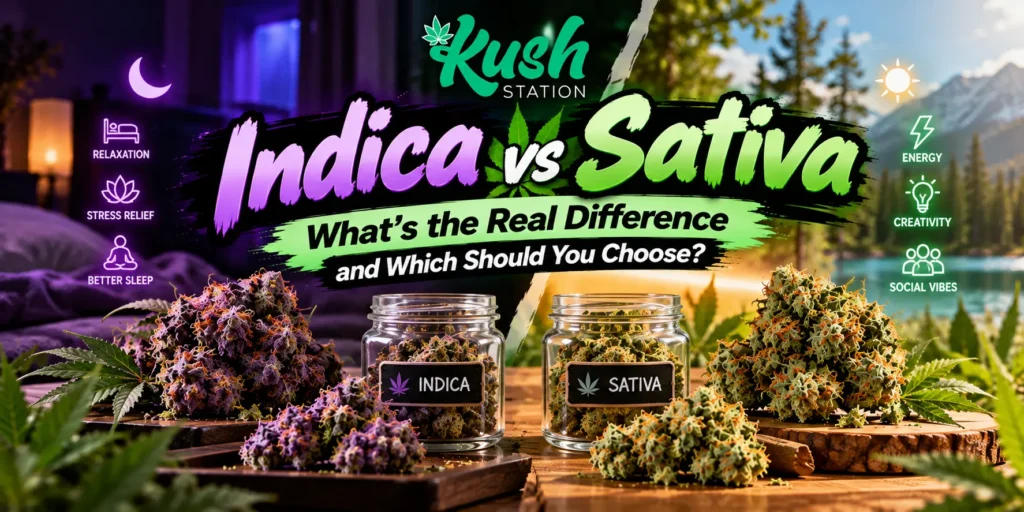
In everyday store language, indica usually means a product expected to feel calming, physically heavy or sleepy. Sativa generally means uplifting, cerebral, social or energizing. A hybrid supposedly combines the two, sometimes with “indica-dominant” or “sativa-dominant” added for direction.
That’s what most shoppers mean when they ask, “What’s the difference between indica and sativa?” Botanically and chemically, though, the answer gets messier.
The terms have historical roots in plant classification. Broad-leaf, compact plants associated with parts of Central and South Asia became linked with indica, while taller, narrow-leaf plants were commonly associated with sativa. Cannabis taxonomy remains debated, and modern commercial cultivars, usually called strains (see what a strain name can and can’t tell you), have been crossed so extensively that names and visual ancestry don’t reliably forecast effects.
Research has also found that commercial labels frequently fail to match a clear genetic or chemical divide. A 2021 analysis in Nature Plants, for example, reported that indica and sativa labelling did not consistently reflect overall genetic differences, although some terpene patterns were associated with label expectations.1
So here’s the useful version:
Treat indica, sativa and hybrid as shopping clues, not pharmacological guarantees.
If you want a particular experience, look at the THC-to-CBD ratio, dominant terpenes, dose and delivery method. Then record how you respond. Your nervous system doesn’t read shelf signs.
Indica vs Sativa: Key Differences at a Glance
The classic indica vs sativa difference is best understood as a set of tendencies rather than rules. This table separates the familiar retail story from what you can responsibly infer.
| Feature | Indica stereotype | Sativa stereotype | Important reality |
|---|---|---|---|
| Expected feeling | Relaxed, heavy, sleepy | Upbeat, alert, creative | Chemistry and dose matter more than the label |
| Common timing | Evening or bedtime | Morning or daytime | High-THC products can impair you at any hour |
| Plant form | Short, bushy, broad leaves | Tall, airy, narrow leaves | Appearance doesn’t reliably predict human effects |
| Flowering tendency | Often shorter | Often longer | Cultivar and growing environment alter timing |
| Typical shopper goal | Sleep, pain, decompression | Mood, socializing, focus | Evidence for condition-specific “strains” is limited |
| Hybrid expectation | A blend of both | A blend of both | Nearly all modern commercial cultivars have mixed ancestry |
Indica vs sativa effects: relaxation vs uplift (and why it varies)
An indica-labelled flower might make you sink happily into the sofa. Another could produce racing thoughts because it contains 28% THC and you inhaled more than intended. Likewise, a sativa may feel bright at a small dose but foggy or anxious after several deep pulls.
Variation comes from several places:
- Dose: THC often becomes more impairing and anxiety-provoking as intake rises.
- Chemical profile: CBD and aromatic compounds may modify the overall experience, though human evidence for specific terpene effects is still developing.
- Tolerance and metabolism: A regular consumer and a first-timer can react very differently to the same batch.
- Set and setting: Your mood, expectations, company, food intake and surroundings all matter.
- Batch differences: Products sharing a cultivar name can contain different cannabinoid and terpene concentrations.
Expectation itself may shape perception. If someone tells you a gummy is a “knockout indica,” you’re primed to notice drooping eyelids. That doesn’t mean the effect is imaginary: cannabis experiences are both chemical and contextual.
Common use cases: sleep, stress, pain vs daytime focus, mood, creativity
Indica products are commonly marketed for bedtime, physical discomfort and end-of-day stress. Sativas are often sold for chores, concerts, creative work or social plans. Hybrids are pitched as a flexible middle ground.
These categories shouldn’t be confused with approved medical uses. Evidence supports certain cannabinoid-based medicines in specific settings, such as some forms of chronic pain, chemotherapy-related nausea and multiple-sclerosis spasticity, but that doesn’t prove that any product labelled “indica” treats pain or insomnia. Health Canada’s information for health care professionals on cannabis and cannabinoids summarizes both the potential applications and the substantial evidence gaps.
Think in terms of tasks and acceptable impairment. A product that helps you unwind may still interfere with driving, work, memory or next-morning alertness. “Daytime” on a package is marketing, not permission to operate a forklift. Yes, apparently the forklift needs saying.
Plant traits: leaf shape, height, flowering time (and the limits of looks)
Traditional broad-leaf drug-type plants tend to be shorter and bushier, with relatively compact flowers. Narrow-leaf types can grow taller, stretch farther between nodes and take longer to flower. Those distinctions still help breeders and growers discuss morphology.
But you usually buy dried flower, a vape or an extract, not a living plant with a family tree attached. Growing conditions can alter height, yield, aroma and cannabinoid production. Hybridization further blurs the visual categories.
A broad leaf also can’t tell you whether the finished flower contains 12% or 30% THC, meaningful CBD, residual pesticides, or a terpene profile you enjoy. Use plant appearance for horticultural identification, not dose forecasting. For consumers, a verified lab result beats leaf geometry every time.
Why the Labels Can Be Misleading: Chemotypes, Not Just Indica or Sativa
A chemotype groups cannabis by its chemical composition. This framework is more useful than ancestry labels alone because it focuses on the compounds you’ll actually consume.
A simple cannabinoid-based system distinguishes THC-dominant products, balanced THC/CBD products and CBD-dominant products. More detailed profiles add minor cannabinoids and terpenes. Two jars labelled sativa may sit in entirely different chemical neighbourhoods, while two products sold as opposite types may be surprisingly similar.
Product names aren’t dependable anchors either. Blue Dream from one producer may differ from Blue Dream grown elsewhere, and storage changes volatile compounds over time. That’s why the lot number matters.
Cannabinoids: THC, CBD and minor cannabinoids (CBG, CBC, THCV, CBN)
THC is the main intoxicating cannabinoid. It can produce euphoria, altered time perception, appetite changes (the munchies), pain relief and sleepiness, but it can also cause anxiety, impaired coordination or paranoia. More THC doesn’t automatically mean a better experience. For beginners, ultra-potent flower and concentrates can turn a pleasant evening into a very long conversation with the ceiling fan.
CBD isn’t intoxicating in the usual sense. Depending on dose and formulation, it may moderate some THC effects, although it doesn’t guarantee protection from anxiety or impairment. Balanced products, such as a 1:1 THC-to-CBD edible, often feel more manageable to some consumers than THC-only options, but individual reactions differ.
Minor cannabinoids are promising, yet marketing frequently runs ahead of clinical evidence:
- CBG: Studied for possible neurological, inflammatory and gastrointestinal uses; human evidence remains preliminary.
- CBC: Investigated for inflammatory and pain-related pathways, mostly in preclinical research.
- THCV: Sometimes promoted as energizing or appetite-suppressing. Effects may depend heavily on dose, and strong consumer claims aren’t established.
- CBN: Widely marketed for sleep. CBN may be mildly intoxicating, but evidence that CBN alone is a reliable sedative remains weak.
Check quantities, not just front-of-pack callouts. A package can trumpet “CBN” while containing only a tiny amount alongside a much larger THC dose, and the THC may be doing most of the noticeable work.
Terpenes and the entourage effect: what actually drives the experience
Terpenes create much of cannabis’s aroma: citrus peel, damp pine, pepper, lavender, fuel. Common examples include myrcene, limonene, beta-caryophyllene, linalool, pinene and terpinolene.
You’ll often hear tidy equations: myrcene equals sedation, limonene equals happiness, pinene equals focus. These associations are plausible and useful for personal experimentation, but they aren’t universal prescriptions. Much terpene research uses isolated compounds, animal models or concentrations that don’t map neatly onto ordinary cannabis use.
The entourage effect proposes that cannabinoids, terpenes and other plant compounds interact to shape effects. It’s an attractive theory with some supporting pharmacological rationale, but the term is also stretched into a marketing catch-all. High-quality human trials comparing complete, well-characterized profiles are still limited.
Use terpenes as pattern-finding tools. If several products you enjoy contain beta-caryophyllene and modest THC, that’s actionable personal data. If a budtender promises that one terpene will “erase anxiety,” keep your wallet in its natural habitat.
A practical sensory clue helps, too: stale flower with little aroma may have lost volatile terpenes through age, heat, oxygen or poor storage. Still, a strong smell proves freshness more readily than it predicts your exact high.
Indica vs Sativa vs Hybrid: What to Expect
When comparing indica vs sativa vs hybrid, expect overlapping experiences rather than three sealed boxes. Any category may produce relaxation, euphoria, altered sensory perception, increased appetite, dry mouth, short-term memory problems or anxiety.
Hybrids dominate the Canadian market because modern breeding combines characteristics from multiple lineages (more in hybrid strains explained). “Indica-dominant” usually communicates an expected relaxing profile; it doesn’t mean the plant is mathematically 70% sleepy.
The indica vs sativa high: body vs head effects
A “body high” may feel like warmth, loosened muscles, heaviness, tingling or reduced awareness of discomfort. A “head high” can include euphoria, rapid associations, laughter, sensory intensity or altered time perception. People often associate the first with indica and the second with sativa, but THC can create both.
Couch-lock isn’t a clinical category. It describes pronounced heaviness and low motivation, commonly reported after larger doses or strongly sedating products. That might be welcome during a movie at home and deeply inconvenient five minutes before dinner with your in-laws.
Sleepiness can appear as the acute effects fade, even when the first phase felt stimulating. Conversely, THC can make some people mentally busy rather than sleepy.
For clarity, lower doses generally preserve function better than higher ones. Yet even when you feel focused, reaction time and judgment may be impaired. Subjective confidence isn’t a sobriety test.
A simple journal can expose useful patterns. Record the product, lot, method, dose, time, meal timing, desired effect, actual effect and next-day impact. After four or five sessions, you may discover that “balanced 1:1 products below 5 mg THC” predicts your comfort better than “sativa.” That’s the kind of boring discovery that saves money and prevents drama.
Does indica get you more stoned?
Not necessarily. Indica-labelled products are associated with a heavier, sleepier feel, but how “stoned” you get depends mainly on how much THC you take in, how fast it arrives and your tolerance. A high-THC sativa can feel far more intense than a mild indica. If intensity is the worry, compare THC per gram or per serving, not the category.
Onset and duration by method: flower, vape, edibles, tinctures
Delivery method can outweigh the indica or sativa label because it determines how quickly cannabinoids arrive and how long effects last. (For a deeper comparison, see edibles vs smoking.)
| Method | Typical onset | Typical duration | Beginner concern |
|---|---|---|---|
| Smoked flower or pre-rolls | Minutes | Roughly 2–4 hours | Easy to take another puff before assessing the first |
| Vaporized flower or oil cartridge | Minutes | Roughly 2–4 hours | High-potency oils can deliver more THC than expected |
| Edible | 30 minutes–2+ hours | Often 6–8 hours, sometimes longer | Delayed onset encourages accidental redosing |
| Sublingual tincture | About 15–45 minutes | Often 4–6 hours | Effects vary if part of the dose is swallowed |
These ranges aren’t promises. Food, metabolism, tolerance, product formulation and dose can shift them.
Inhaled cannabis reaches the bloodstream quickly, which makes gradual self-titration easier: take one small inhalation, wait and reassess. Smoke still exposes your lungs to combustion products, while vaping carries its own device, contaminant and respiratory risks. Avoid modified cartridges or ones from unknown sources: Health Canada has warned about severe lung illness linked to vaping, with many North American cases tied to THC cartridges containing vitamin E acetate. [VERIFY: link the current Health Canada vaping-illness page]
Edibles are different. The liver converts THC into 11-hydroxy-THC, which can feel powerful and long-lasting. A classic beginner mistake goes like this: take 10 mg, feel nothing after 40 minutes, eat another 10 mg, then realize both doses were merely waiting backstage. Give oral products at least two hours, and preferably longer if you’re inexperienced, before considering more.
Indica vs sativa edibles, gummies and vapes
You’ll see indica, sativa and hybrid labels on gummies, chocolates, drinks and vape cartridges too. In edibles the label matters even less than in flower: the oil is often a distillate where much of the original terpene profile has been lost, and some products add terpenes back afterwards. With an edible, the milligrams of THC and CBD per piece, and how long you wait, will shape the experience far more than “indica” or “sativa” on the box. Vapes sit in between: a live resin cartridge keeps more of the plant’s terpenes than a plain distillate one (see live resin vs distillate).
Best Choice by Goal (Practical Recommendations)
Choose around your goal, the level of function you need, and your risk factors, not a coloured shelf card. The recommendations below are conservative starting points, not treatment plans. If you’re managing a medical condition, review cannabis use with a qualified clinician who knows your history and medications.
Should a beginner choose indica or sativa?
Neither is automatically better. Health Canada’s “start low, go slow” advice and Canada’s Lower-Risk Cannabis Use Guidelines [VERIFY URL] both point beginners toward products with lower THC and some CBD, whatever the label says. Start with a low-THC option, a small amount and a quiet evening at home. Our THC dosage guide for beginners and best weed for beginners walk through first purchases in more detail.
Indica vs sativa for sleep
An indica label may point you toward heavier evening products (see best indica strains for sleep), but examine the formula. A low-dose THC product, a balanced THC/CBD option, or a product with a measured amount of CBN may be worth discussing with a clinician. Don’t assume CBN guarantees sleep.
THC can shorten the time it takes some people to fall asleep, but regular high-dose use may lead to tolerance, dependence, rebound sleep difficulty or changes in sleep architecture. It can also leave you groggy, especially after a late edible.
For a cautious experiment, choose a night with no early driving, use the lowest available dose and take it early enough to judge next-morning effects. Keep your sleep routine stable so you can tell what changed. If insomnia lasts for months, cognitive behavioural therapy for insomnia (CBT-I) has stronger evidence than chasing a progressively “stronger indica.”
Indica vs sativa for anxiety (and when to avoid high THC)
Cannabis can feel calming at one dose and agitating at another. High-THC products are more likely to cause racing thoughts, panic or paranoia, particularly if you’re inexperienced or already anxious. Health Canada’s page on cannabis and mental health makes the same point: the THC level, not the indica or sativa label, is what to watch.
Consider CBD-dominant or balanced products with very low THC, and test them in a familiar place with someone you trust. Skip the experiment when you’re emotionally overwhelmed: cannabis tends to turn up the volume on the room you’re already in.
Be especially cautious with high-potency concentrates if you have a personal or family history of psychosis, bipolar disorder or severe panic reactions. If cannabis repeatedly worsens your anxiety, the correct “strain” may be none. That’s not failure; it’s useful feedback.
If acute anxiety occurs, move somewhere quiet, slow your breathing, sip water and remind yourself that the effects are temporary. Don’t drive. Call 911 for chest pain, severe confusion, loss of consciousness, dangerous behaviour or symptoms that don’t settle.
For pain and inflammation
Some people report relief from neuropathic or chronic pain, but average benefits in research are often modest and side effects are common. The evidence doesn’t establish an indica label as a marker for pain relief.
Your clinician may suggest starting with non-intoxicating options or a balanced THC/CBD formulation, depending on the condition. In Canada, people with a health care practitioner’s authorization can also access cannabis through the medical program under the Cannabis Regulations. [VERIFY wording] Topicals can be appealing for localized discomfort, though standard cannabis creams generally don’t produce a systemic high; transdermal patches are designed differently and may deliver cannabinoids into circulation.
Track function, not only a 1–10 pain score. Did you sleep longer, walk farther or wake less at night? Or did you simply feel too intoxicated to care for two hours? Those are not the same outcome.
Never stop prescribed medication abruptly. Cannabis can interact with sedatives, alcohol, anticoagulants, antiseizure drugs and other medicines through added impairment or metabolic pathways. A pharmacist can help identify risks.
Indica vs sativa for focus, energy and daytime use
A sativa or terpinolene-forward product may be marketed for energy (see best sativa strains for energy and focus and best strains for focus and creativity), but cannabis isn’t a dependable productivity tool. THC can impair working memory, divided attention and reaction time even when the experience feels stimulating.
If you choose daytime use, favour a low dose and avoid tasks where a mistake matters. CBD-dominant products may be less impairing, although full-spectrum formulas can contain THC. If workplace testing is a concern, remember that “CBD” or “full-spectrum” doesn’t mean THC-free; see how long weed stays in your system.
Try a controlled mini-scenario: on a free afternoon, use one small inhalation or no more than 1–2.5 mg THC, then do a low-stakes activity such as sketching or folding laundry. Don’t debut a new “focus sativa” before a presentation, exam or a connection at Pearson. Your future self has enough problems.
If the product makes you scattered, switch to a lower THC level or stop. The most energizing cannabis dose is often much smaller than people expect.
Popular indica and sativa strains in Canada
If you want familiar names to start comparing, classic indica-leaning cultivars include Northern Lights and Granddaddy Purple, while Sour Diesel and Jack Herer are long-standing sativa-leaning favourites. For a broader list, see the most popular cannabis strains in Canada. Just remember the point of this guide: the same name from two growers can test very differently, so check the numbers on the package.
How to Choose the Right Product (A Step-by-Step Checklist)
You don’t need to become a cannabis chemist. You just need a repeatable buying process that beats guessing from strain art and names such as “Intergalactic Pancake Wreck.”
- Define one goal. Sleep, mild relaxation or social ease is easier to evaluate than “feel better.”
- Choose the method. Inhalation offers faster feedback; edibles last longer but are harder to correct.
- Set a THC ceiling. Beginners should avoid making high-potency flower or concentrates their starting point.
- Compare cannabinoid ratios. CBD-dominant and balanced options may feel gentler than THC-dominant products.
- Check the label and lot. Read the THC and CBD numbers for the exact package you’re buying.
- Buy a small quantity. Don’t commit to 28 grams before discovering the product makes you reorganize one sock drawer for three hours.
- Test under controlled conditions. Stay home, clear your schedule and don’t combine it with alcohol.
- Record the result. Repeat only if the experience and next-day effects were acceptable.
Prices in Canada vary by province, taxes, format and potency. As a rough guide, most legal flower costs about $5 to $16 per gram, $15 to $50 for an eighth (3.5 g) and $70 to $300 for an ounce (28 g), with big differences between value, core and premium tiers; our Canadian weed price guide breaks this down by format and province. A higher price doesn’t guarantee a better fit: pay for transparent testing, freshness and consistent formulation rather than THC bravado.
How to read a Canadian cannabis label (and a COA)
Legal cannabis packaging in Canada follows Health Canada’s labelling rules: plain packaging, the standardized red THC symbol, a health warning, and the THC and CBD content (including “total THC” and “total CBD”). [VERIFY against the Cannabis Regulations labelling page] Our full guide on how to read a cannabis label goes line by line.
Some producers also publish a certificate of analysis (COA) from a testing lab. If one is available, it should match the product’s lot number. Check these items:
- Total THC and total CBD: Flower lists these as a percentage or mg/g; edibles and oils should state milligrams per unit or per mL and per package.
- Serving size: A 100 mg chocolate bar divided into ten pieces still contains 10 mg per piece, which is often too much for a beginner.
- Minor cannabinoids: Note actual amounts rather than decorative front-of-pack claims.
- Dominant terpenes and total terpene content: Use these to spot personal patterns, not guaranteed effects.
- Contaminant testing: Pesticides, heavy metals, microbes, mycotoxins and residual solvents.
- Packaging date and lot number: Old flower may be dry and terpene-depleted. The COA lot must match the package.
Percentages aren’t always directly comparable across laboratories, and natural products vary. A new harvest of the “same” cultivar can feel different. If consistency matters, measured-dose products may be easier to repeat than flower.
Also distinguish THCA from THC. Raw flower contains substantial THCA, which converts to intoxicating THC when heated. Canadian labels report “total THC,” which accounts for this conversion. Don’t read a low THC number while ignoring a large THCA value.
Start low, go slow: dosing for beginners
For inhaled cannabis, take one small puff, then wait at least 10–15 minutes before deciding whether you need more. Choose lower-potency flower when possible and avoid holding smoke in your lungs: it adds irritation without meaningfully improving absorption.
For edibles, 1–2.5 mg THC is a cautious beginner dose. Canada’s legal market caps an edible package at 10 mg THC [VERIFY], but a regulatory maximum isn’t necessarily your serving. Wait at least two hours, and four hours is safer before redosing when you’re new or using an unfamiliar product. Our edibles dosing guide covers onset and duration in detail.
With tinctures, use the dropper markings and calculate milligrams, not vague “drops.” If a 30 mL bottle contains 300 mg THC, each millilitre contains 10 mg. A quarter millilitre delivers about 2.5 mg, assuming the product is evenly mixed.
Write down the dose before consuming it. Once effects arrive, mental arithmetic becomes an ambitious hobby. Increase on a different day in small steps, not repeatedly within the same session.
Keep products in their original child-resistant packaging and lock them away from children and pets. Gummies are especially easy to mistake for ordinary candy. If a child eats cannabis, call your provincial poison centre right away (1-844-POISON-X / 1-844-764-7669 connects you to your local centre [VERIFY]); call 911 for severe drowsiness, breathing problems or unresponsiveness.
Side Effects, Safety, and Who Should Be Cautious
Common short-term side effects include dry mouth, red eyes, dizziness, increased heart rate, impaired coordination, slowed reaction time, anxiety, short-term memory problems and nausea. Large doses, especially edibles, can cause panic, paranoia, vomiting, confusion or hallucination-like experiences.
Frequent use can lead to tolerance and cannabis use disorder. Warning signs include needing more for the same effect, unsuccessful attempts to cut down, using despite relationship or work problems, and withdrawal symptoms such as irritability, sleep disruption or reduced appetite. Recurrent severe vomiting relieved by hot showers may indicate cannabinoid hyperemesis syndrome and deserves medical evaluation.
You should avoid cannabis or seek individualized medical guidance if you:
- Are pregnant, trying to become pregnant or breastfeeding
- Are under the legal age in your province or territory (19 in most of Canada, 18 in Alberta, 21 in Quebec) [VERIFY], or are a young person whose brain is still developing
- Have a personal or strong family history of psychosis or bipolar disorder
- Have significant cardiovascular disease or unexplained fainting
- Take medicines that cause sedation or may interact with cannabinoids
- Have a history of substance use disorder
- Need to drive, supervise children alone, operate machinery or do safety-sensitive work
Never drive while impaired. Cannabis can affect lane control, attention, decision-making and reaction time, and combining it with alcohol compounds the risk. In Canada, drug-impaired driving is a Criminal Code offence, and police can test drivers for THC. [VERIFY] Legal cannabis doesn’t make you fit to drive, and there’s no universal waiting period that guarantees sobriety for every dose or method.
Smoking exposes the lungs to irritants and combustion products. Vaporizers eliminate combustion but aren’t harmless, particularly when cartridges come from unknown sources. Edibles avoid inhalation but bring delayed-onset and accidental-ingestion risks. Every method trades one problem for another; there’s no cheat code.
If you take too much, stay in a calm environment, avoid alcohol and more cannabis, hydrate normally and ask a sober person to stay nearby. Call 911 for difficulty breathing, seizure, collapse, severe chest pain, dangerous agitation or inability to wake. Your provincial poison centre can also advise you.
Final Thoughts
The most useful conclusion in the indica vs sativa debate is reassuringly practical: you don’t need to find a mythical perfect strain. Start with verified chemistry, a modest dose and a low-risk setting. Judge the exact lot by what it does for your goal, and what it costs you in impairment or next-day fog.
Indica, sativa and hybrid labels can start the conversation, but they shouldn’t finish it. Check the label, keep notes, change one variable at a time, and walk away from products that don’t suit you. Your own carefully observed response is more valuable than a catchy strain name. When you’re ready to compare, browse our indica, sativa and hybrid collections with the THC and CBD numbers in mind.
Frequently Asked Questions about Indica vs Sativa
What is the main difference between indica and sativa cannabis?
Indica and sativa originally described plant ancestry and traits. Indica is often associated with relaxing, sedating effects, while sativa is linked to uplifting, energizing feelings. However, the actual effects depend more on cannabinoid content, terpene profile, dose and individual biology than on the label.
Do sativa and indica really feel different?
Some people do notice a difference between products labelled indica and sativa, but research shows the labels don’t consistently match the plant’s genetics or chemistry. Two products with the same label can feel very different, and two with opposite labels can feel alike. THC level, CBD, terpenes and dose explain more of the difference.
What is the difference between indica, sativa and hybrid?
Indica is marketed as relaxing, sativa as uplifting, and hybrid as a mix of both. In practice, almost every strain sold in Canada today has mixed ancestry, so “hybrid” describes most of the market. Use the label as a starting point, then compare THC, CBD and terpenes.
Should a beginner smoke indica or sativa?
Neither is automatically better for beginners. Choose a product with lower THC (ideally with some CBD), take one small puff, and wait 10–15 minutes before deciding on more. Health Canada’s “start low, go slow” advice applies whichever label you pick.
Should I get indica or sativa if I have anxiety?
Focus on the THC-to-CBD ratio rather than the label. High-THC products of any type are more likely to trigger anxiety or paranoia, so CBD-dominant or balanced products with very low THC are the more cautious choice. If cannabis repeatedly makes your anxiety worse, it may not be right for you.
Does indica get you more stoned?
Not necessarily. Indica is associated with a heavier, sleepier high, but how intense it feels depends mostly on THC content, dose, method and tolerance. A strong sativa can feel more intense than a mild indica.
Are indica or sativa edibles different?
Usually less than you’d expect. Edibles are often made with distillate that has lost much of the original terpene profile, so the THC and CBD milligrams and the long onset time matter more than the indica or sativa label. Start with 1–2.5 mg THC and wait at least two hours.
How do cannabinoids and terpenes influence the effects of indica and sativa?
THC is the main intoxicating cannabinoid, causing effects from euphoria to sedation, while CBD can moderate THC’s impact. Terpenes contribute aroma and may influence mood, but their effects vary. Together, cannabinoids and terpenes may interact in the “entourage effect” that shapes the overall experience.
Can indica help with sleep, and how should it be used safely?
Indica-labelled products are often marketed for relaxation and sleep, but effectiveness depends on THC, CBD and other compounds. Use low doses, take them early enough to judge next-morning effects, and avoid relying on stronger products over time. A stable sleep routine and medical advice are important for persistent insomnia.
Are indica or sativa better for daytime focus and energy?
Sativa or terpinolene-heavy products are marketed for energy and focus, but cannabis isn’t a reliable productivity tool. Low doses and CBD-dominant options may help limit impairment. Experiment cautiously, on a free day, before relying on any product during work or study.
What is the legal age to buy cannabis in Canada?
It depends on your province or territory: 19 in most of Canada, 18 in Alberta and 21 in Quebec. [VERIFY] Always follow the rules where you live.